
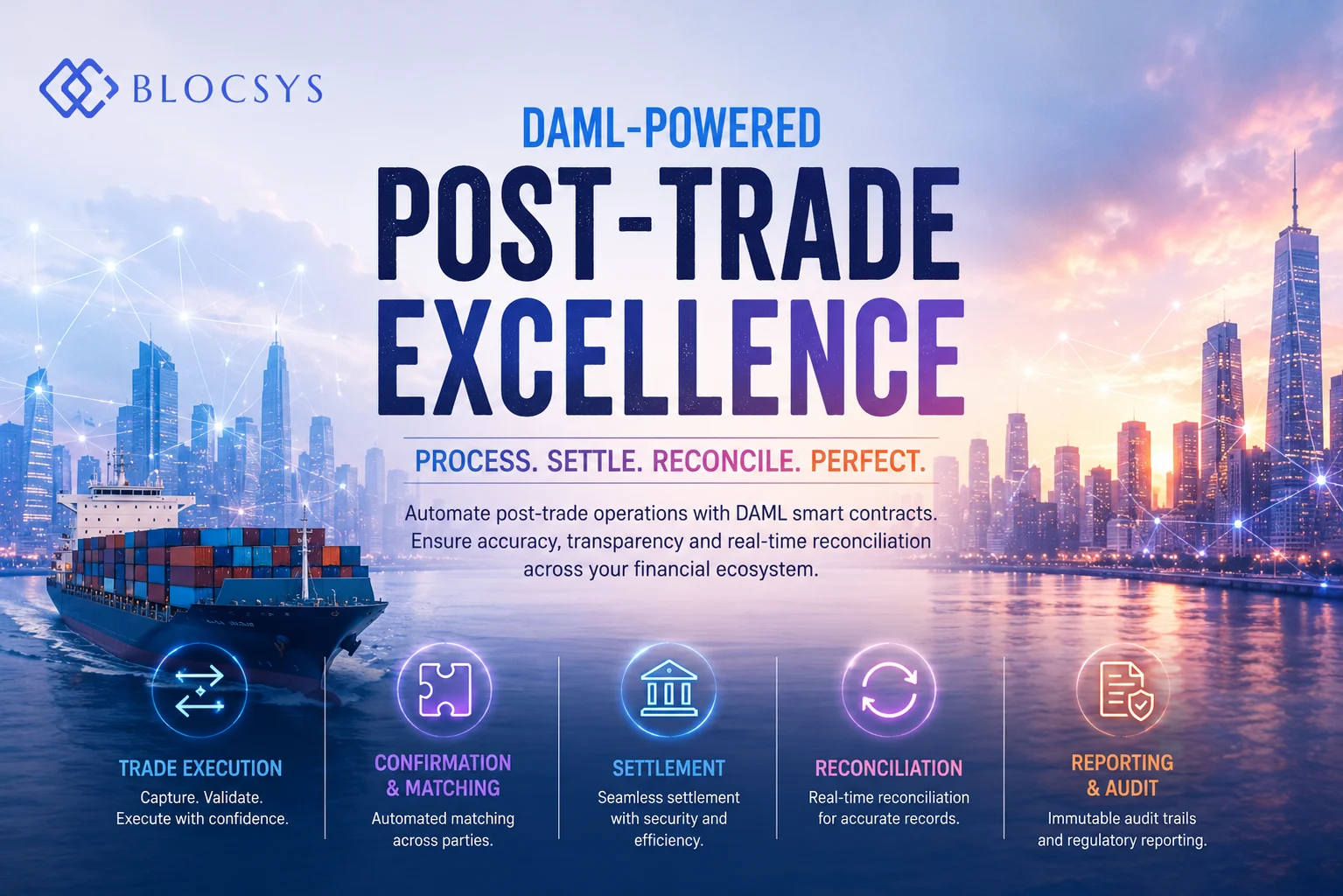
DAML for Post-Trade Processing: Modernizing Settlement and Reconciliation for Financial Institutions
Post-trade operations rarely make headlines, but they quietly consume a huge share of every financial institution’s operational budget. Trade confirmations, settlement instructions, and reconciliation runs still depend on batch files, manual matching, and phone calls between counterparties. DAML post-trade processing offers a different approach: model the entire trade lifecycle as shared, permissioned business logic that every authorized party executes against the same facts. This isn’t about replacing exchanges or core systems. It’s about giving banks, custodians, brokers, and clearing corporations a common language for coordinating what happens after a trade executes.
In this post, we’ll walk through why settlement and reconciliation stay fragmented, how DAML models multi-party workflows, and where Canton Network fits into the picture. We’ll also flag what’s confirmed capability versus what remains an emerging or illustrative use case, because that distinction matters when you’re evaluating infrastructure for regulated operations.
What DAML Post-Trade Processing Actually Means
DAML post-trade processing refers to using the DAML smart contract language to encode the rights, obligations, and permissions of every party involved in a trade after execution. Think confirmation, allocation, settlement instruction matching, and reconciliation. DAML is a smart contract language built by Digital Asset, purpose-built for multi-party business workflows rather than general-purpose blockchain scripting.
Here’s a direct definition: DAML for post-trade processing means writing the settlement and reconciliation logic once, as a shared contract template, so that every party with a legitimate interest in a trade sees a consistent, authorized view of its state — without requiring a single central operator to reconcile everyone’s separate records. That’s the core idea, and everything else in this article builds on it.
Unlike trading platforms, which handle price discovery and order matching, DAML post-trade processing picks up after the trade is done. It’s also distinct from tokenization and digital asset issuance, which create new instruments on-chain. Post-trade processing, as we’re covering it here, is about lifecycle coordination for trades that have already executed, regardless of whether the underlying asset is tokenized.
Why Settlement and Reconciliation Remain So Complex
Ask any operations lead at a custodian or broker-dealer, and they’ll tell you the same thing: post-trade breaks eat up disproportionate time relative to their financial value. Why? Because each participant in a trade — the executing broker, the clearing corporation, the custodian, the counterparty — maintains its own ledger of what supposedly happened.
When those separate records diverge, someone has to figure out why. According to the Depository Trust & Clearing Corporation (DTCC), the U.S. equity market moved to a T+1 settlement cycle in May 2024, a shift that compressed the window institutions have to catch and fix mismatches before settlement fails occur. Shorter cycles mean less time for manual reconciliation, which is exactly the process DAML post-trade processing is designed to support with shared, real-time state instead of after-the-fact file comparison.
Fragmentation shows up in a few consistent places. Trade confirmation between broker and client often still relies on separate messaging systems. Settlement instructions get keyed independently by custodians and sub-custodians. Corporate action processing multiplies the number of parties who need consistent, timely information. Each handoff is a potential point of disagreement, and disagreements become breaks that operations teams chase manually.
The problem with post-trade isn’t that institutions lack data — it’s that everyone has their own version of it. Reconciliation exists because no two parties trust the other’s copy of the truth. That’s the exact problem multi-party ledgers were designed to solve.
The Trade Lifecycle After Execution
Once a trade executes, it moves through a fairly predictable sequence, even though the systems handling each step are usually disconnected. Confirmation happens first, where both sides agree on trade economics. Allocation follows, especially for asset managers splitting a block trade across funds. Then comes clearing, settlement instruction, actual settlement (delivery versus payment), and finally reconciliation against custodian and clearing records.
Each of these steps involves different counterparties with different permissions. A custodian shouldn’t see a broker’s full client list. A clearing corporation needs visibility into net obligations, not necessarily individual client allocations. This is precisely where DAML’s permissioning model earns its keep, and we’ll get into that shortly.
How DAML Post-Trade Processing Models These Workflows
DAML represents each stage of the trade lifecycle as a contract with explicit signatories, observers, and controllers. A settlement instruction, for example, becomes a DAML contract where the custodian and counterparty are signatories, the exchange or clearing corporation might be an observer, and specific choices define what actions each party can take next — confirm, amend, or cancel.
This matters because the workflow logic lives in one place. Instead of each institution independently coding its interpretation of “what happens when a settlement instruction is confirmed,” everyone executes against the same DAML template. That doesn’t eliminate operational judgment, but it does remove a common source of disagreement: differing interpretations of business rules across systems.
![DAML post-trade processing — [Flow diagram showing the DAML post-trade lifecycle: Trade Confirmation → Allocation → Settlement Instruction Matching → Clearing Coordination → Settlement (DvP) → Reconciliation → Exception Resolution]](https://s3.blocsys.com/blocsys/blog-images/1787270534841-3ffcad6f23c656ee.webp)
DAML for Settlement Coordination
Settlement coordination is where DAML post-trade settlement logic shows its value most clearly. A settlement instruction typically requires agreement from at least two parties before it’s actionable — the delivering party and the receiving party, often with a custodian or sub-custodian involved on each side.
In a DAML-modeled workflow, the settlement instruction contract only advances to “matched” status once both parties have exercised the relevant choice with consistent terms. There’s no separate matching engine reconciling two independently submitted files after the fact. The match happens because the contract’s logic requires it, and every authorized participant can see the same instruction status simultaneously, in line with what they’re permitted to view.
That said, DAML doesn’t replace the settlement rails themselves — the actual movement of cash and securities still runs through existing custodian, central securities depository, or payment infrastructure. DAML coordinates the instructions and confirmations around that movement.
DAML for Securities Settlement Specifically
Securities settlement introduces extra layers: corporate actions, entitlement calculations, and multi-tier custody chains. DAML for securities settlement workflows can model these tiers explicitly, since each custodian in a chain can be represented as a distinct party with its own visibility into only the contracts relevant to it.
A sub-custodian, for instance, doesn’t need to see the end investor’s identity — just the net settlement obligation it’s responsible for executing. That’s a privacy requirement as much as an operational one, and it’s a recurring theme in how DAML distributed ledger settlement models are designed for capital markets use cases.
DAML for Trade Reconciliation
Reconciliation, as practiced today, mostly means comparing two or more independently maintained records after the fact and investigating differences. DAML reconciliation works differently, because it changes the starting assumption. If multiple parties are executing against the same shared contract, there’s less need to reconcile after the fact — the parties were already looking at consistent state throughout the lifecycle.
That doesn’t mean reconciliation disappears. Institutions still need to reconcile DAML-based systems against legacy books and records, at least during any transition period, and against external systems that sit outside the DAML workflow entirely. DAML trade reconciliation, in practice, often means fewer breaks originating from process disagreement, while breaks originating from external data sources — pricing feeds, corporate action data, legacy ledger entries — still need traditional reconciliation approaches.
Here’s a simple way to think about where each reconciliation model applies.
| Reconciliation Type | Typical Cause of Breaks | DAML’s Role |
|---|---|---|
| Internal cross-desk reconciliation | Disconnected internal systems | Shared contract state reduces internal divergence |
| Counterparty reconciliation | Independent record-keeping by each party | Multi-party contracts create one authorized version of events |
| Legacy system reconciliation | Data not yet migrated to DAML | Requires integration layer, not eliminated by DAML alone |
| External market data reconciliation | Third-party pricing or reference data | Outside DAML’s scope; still needs conventional checks |
Exception Management and Dispute Resolution
Breaks still happen, even in well-modeled workflows. What changes is how exceptions surface. Since every authorized party sees the same contract state, a mismatch — say, a delivering party proposing different settlement terms than the receiving party expects — becomes visible immediately as a rejected or pending choice, rather than something discovered days later during a batch reconciliation run.
This gives operations teams an earlier signal, which matters more than it sounds. Catching a break before settlement date, rather than after, changes the entire remediation conversation. DAML doesn’t resolve disputes automatically; a genuine disagreement over trade terms still needs human judgment. What it does is surface the disagreement point precisely, instead of leaving teams to guess which system is right.
Multi-Party Authorization and Privacy
Financial institutions are understandably cautious about shared ledgers, and privacy is usually the first objection raised. DAML addresses this through sub-transaction privacy: each party only sees the parts of a contract relevant to them, based on their role as signatory, observer, or controller.
A clearing corporation might see net settlement obligations across all its members without seeing individual client-level trade details. A broker’s client sees their own trade confirmations without visibility into the broker’s other clients. This selective disclosure is enforced at the ledger model level, not bolted on through access control lists after the fact — which is a meaningfully different architecture than a shared database with row-level permissions.
Multi-party authorization also governs who can take which actions. A settlement instruction might require joint action from both counterparties before it advances. An allocation might require the asset manager’s authorization before a custodian can act on it. DAML smart contracts for post-trade use cases encode these authorization rules directly into the workflow, so an unauthorized party literally cannot exercise a choice it doesn’t have rights to — the ledger rejects it, rather than relying on application-layer checks that a bug or misconfiguration could bypass.
The Role of Canton Network
Canton Network is a privacy-enabled interoperability network built on DAML’s smart contract model, designed to let independently operated ledgers synchronize specific transactions without merging into one shared database. For post-trade processing, this matters because no single institution wants to run its settlement infrastructure on someone else’s server.
Canton allows a custodian, a clearing corporation, and a broker to each operate their own node while still participating in shared, atomically synchronized workflows for the trades that involve all three. Several capital markets participants have explored Canton for use cases spanning collateral management, repo, and settlement coordination, and Canton Network’s mainnet has been live since 2023 with growing participation from financial infrastructure providers. It’s worth being precise here: production deployment scope varies by institution and use case, and readers evaluating Canton for a specific workflow should confirm current status directly with Canton Network or Digital Asset rather than assuming universal production maturity across every post-trade function.
![DAML post-trade processing — [Architecture diagram showing Canton Network synchronization: Custodian Node ↔ Synchronizer ↔ Clearing Corporation Node ↔ Synchronizer ↔ Broker Node, with sub-transaction privacy boundaries shown around each node]](https://s3.blocsys.com/blocsys/blog-images/1787270535516-0ea61a23b1333d3f.webp)
DAML Distributed Ledger Settlement and Interoperability
DAML distributed ledger settlement doesn’t require every institution to run the same software stack. Because Canton is designed for interoperability, a bank’s existing settlement engine can interact with a DAML-modeled workflow through defined integration points, rather than requiring a full platform replacement. That’s a meaningful distinction for institutions with decades of investment in existing settlement infrastructure.
Integration With Existing Financial Infrastructure
No CTO wants to hear that modernizing settlement means ripping out core systems. Fortunately, that’s not how DAML post-trade infrastructure typically gets deployed. DAML applications commonly integrate through APIs with existing order management systems, custodian platforms, and messaging standards like SWIFT and FIX, acting as a coordination layer rather than a full replacement.
In practice, institutions often start with a specific workflow — settlement instruction matching between two or three counterparty types, for example — and integrate that DAML-based process alongside existing systems, rather than migrating an entire post-trade stack at once. This phased approach lets operations teams validate the model against real trade volume before expanding scope.
Security and Compliance Considerations
Security in a DAML post-trade processing environment rests on a few pillars: cryptographic authorization for every action, ledger-enforced privacy boundaries, and a complete, auditable transaction history that every authorized party can independently verify. Because the ledger enforces who can do what, institutions get a built-in audit trail without needing a separate logging system bolted onto their application layer.
That said, DAML and Canton don’t automatically make a post-trade system compliant with any specific regulation. Compliance depends on the institution, the jurisdiction, the asset class, and the specific regulatory framework in play — whether that’s SEC and FINRA requirements in the U.S., EU regulations like CSDR and MiFID II, or UK, Swiss, Singaporean, or UAE frameworks depending on where the institution operates. Institutions still need to map their specific regulatory obligations onto whatever DAML-based workflow they build, and legal and compliance teams should be involved from the design stage, not bolted on afterward.
Enterprise Use Cases
To make this concrete, consider a few illustrative scenarios. These are hypothetical examples meant to show how the pieces fit together, not descriptions of specific deployed systems.
A custodian and a broker could use a DAML-modeled settlement instruction workflow where both parties exercise a “confirm” choice, and the instruction only becomes actionable once both confirmations match. A clearing corporation could maintain a DAML contract representing net settlement obligations across its members, giving each member visibility into only its own position. An asset manager allocating a block trade across multiple funds could use DAML to ensure each fund’s custodian only sees the allocation relevant to that fund, preserving confidentiality between funds while keeping the broker’s overall trade record consistent.
For institutions exploring a similar model, Blocsys’ work on a permissioned blockchain infrastructure for capital market post-trade operations reflects this same pattern — using shared, permissioned logic to coordinate reconciliation across multiple authorized parties.
Benefits and Limitations of DAML Post-Trade Processing
The benefits are fairly consistent across use cases: shared business logic reduces process-driven disagreement, privacy controls let institutions collaborate without exposing sensitive data, and the audit trail is native to the system rather than reconstructed after the fact. However, DAML post-trade processing isn’t a universal fix. It requires genuine multi-party adoption to deliver its coordination benefits — a workflow modeled in DAML but used by only one party in a bilateral relationship doesn’t capture the same value. It also requires integration effort with legacy systems, and institutions should expect a real implementation project, not a drop-in replacement.
Implementation Considerations
Institutions evaluating DAML for post-trade processing typically need to think through a few things early. Which workflow to start with matters — settlement instruction matching is a common starting point because its scope is bounded and its value is measurable. Counterparty readiness matters too, since DAML’s coordination benefits depend on other parties participating in the shared workflow, not just your own institution modeling it internally.
Data migration and legacy integration also deserve real planning time, since most institutions run a hybrid environment during any transition. And because this touches regulated settlement processes, compliance and legal review needs to happen alongside technical design, not after it. Working with a development partner experienced across DAML modeling, Canton deployment, and capital markets operations tends to shorten this learning curve considerably.
The Future of DAML in Post-Trade Processing
Post-trade modernization is a gradual process, and DAML post-trade processing sits within a broader industry conversation about reducing settlement risk and operational friction. Emerging areas worth watching include closer integration between DAML-based settlement coordination and tokenized collateral management, expanded Canton interoperability across more financial infrastructure providers, and continued exploration of shorter settlement cycles that make real-time coordination more valuable. These remain developing areas rather than settled outcomes, and institutions should track official updates from Digital Asset and Canton Network directly.
Why Financial Institutions Need an Experienced DAML Development Partner
Building a DAML post-trade workflow well requires more than knowing the syntax. It requires understanding trade lifecycle mechanics, custody chains, regulatory context, and how to integrate cleanly with the legacy systems institutions already depend on. Getting the contract model wrong early — misjudging who should be a signatory versus an observer, for instance — creates rework later that’s expensive to unwind.
This is where an experienced partner earns its keep. Blocsys works across DAML, Canton Network, and broader enterprise blockchain development, helping financial institutions design post-trade workflows that fit their actual operational and regulatory context rather than a generic template. If you’re evaluating DAML for settlement or reconciliation, it’s worth talking to a team that’s done this modeling work before. You can hire DAML developers at Blocsys to scope a workflow specific to your institution’s post-trade requirements, from initial contract modeling through Canton integration.
Frequently Asked Questions
Here are direct answers to the questions we hear most often about DAML post-trade processing.
What is DAML post-trade processing?
DAML post-trade processing is the use of the DAML smart contract language to model trade confirmation, settlement instructions, and reconciliation as shared, permissioned workflows. Instead of each institution keeping a separate record and reconciling later, authorized parties execute against the same contract logic, with privacy controls determining what each party can see and do at every stage of the lifecycle.
How can DAML improve post-trade settlement?
DAML post-trade settlement works by requiring matched authorization from relevant counterparties before a settlement instruction advances, rather than relying on separately submitted files reconciled after the fact. This gives every authorized party a consistent, real-time view of instruction status. It doesn’t replace the underlying cash and securities movement infrastructure, but it coordinates the instructions and confirmations around it more directly.
How does DAML support trade reconciliation?
DAML reconciliation reduces process-driven breaks by giving multiple parties a shared, authorized version of trade state instead of independently maintained records. Reconciliation against legacy systems and external data sources, like pricing feeds, still requires conventional approaches, since DAML’s benefit applies specifically to workflows where multiple parties execute against the same contract logic.
Does Canton Network play a role in DAML-based settlement?
Yes. Canton Network lets institutions run their own independent ledger nodes while synchronizing specific transactions with counterparties, without merging into one shared database. For DAML post-trade settlement, this means a custodian, broker, and clearing corporation can each keep their own infrastructure while participating in synchronized, privacy-preserving settlement workflows together.
Can DAML integrate with existing settlement systems?
Yes, DAML applications are typically built to integrate through APIs with existing order management systems, custodian platforms, and standard messaging protocols like SWIFT and FIX. Most institutions deploy DAML post-trade infrastructure as a coordination layer alongside existing systems, starting with a specific workflow rather than replacing their entire post-trade stack at once.
What are the benefits of using DAML for reconciliation?
DAML trade reconciliation benefits come from shared business logic that reduces disagreement between counterparties’ independently maintained records, native audit trails enforced by the ledger, and privacy controls that let institutions collaborate without exposing sensitive client data. These benefits depend on genuine multi-party adoption of the shared workflow, not just internal modeling by one institution.
How does DAML handle multi-party post-trade processes?
DAML models each party’s rights and obligations explicitly through signatories, observers, and controllers on every contract. A settlement instruction, allocation, or reconciliation record only advances when the authorized parties exercise the correct choices, and the ledger enforces these permissions directly, rather than relying on application-level access checks alone.
What role does privacy play in DAML post-trade infrastructure?
Privacy in DAML is enforced through sub-transaction visibility, meaning each party sees only the portions of a contract relevant to their role. A clearing corporation might see net obligations without individual client details, while a broker’s client sees only their own confirmations. This selective disclosure is a core architectural feature, not an added-on permission layer.
Does DAML automatically make a post-trade system compliant?
No. DAML and Canton provide enforced authorization, privacy, and audit capabilities, but compliance depends on the institution, asset class, jurisdiction, and applicable regulations, such as SEC and FINRA rules in the U.S. or CSDR and MiFID II in the EU. Institutions need to map their specific regulatory obligations onto their DAML-based workflow with legal and compliance input from the design stage.
How much does it cost to develop a DAML-based post-trade solution?
Cost depends on workflow scope, the number of counterparties involved, integration complexity with legacy systems, and whether the deployment runs on Canton Network. Rather than relying on generic estimates, institutions can get a scoped figure using the Blocsys Software Development Cost Estimator, which accounts for the specific requirements of your post-trade use case.
Bringing It Together
DAML post-trade processing addresses a real, persistent problem: institutions maintaining separate records of the same trade and spending significant operational effort reconciling the differences. By modeling settlement instructions, confirmations, and reconciliation as shared contract logic with enforced privacy and authorization, DAML gives multiple counterparties a consistent, permissioned view of trade state throughout the post-trade lifecycle.
This isn’t a wholesale replacement for existing capital market infrastructure, and it isn’t a compliance shortcut. It’s a coordination layer that integrates with what institutions already run, starting with bounded workflows and expanding as counterparties adopt it. If your institution is evaluating DAML post-trade processing for settlement instruction management, reconciliation, or broader post-trade infrastructure, Blocsys’ team can help scope a workflow suited to your systems and regulatory context. Reach out to hire DAML developers at Blocsys and start with a concrete, bounded pilot rather than a full platform overhaul.
Ready to move beyond theory and build an intelligent platform that delivers real-world value? Blocsys Technologies specialises in engineering enterprise-grade AI and blockchain solutions for the fintech, Web3, and digital asset sectors. Connect with our experts today to discuss your vision and chart a clear path from concept to a secure, scalable reality.
