
A compliance lead at a mid-sized exchange starts Tuesday with a supervisory letter asking three uncomfortable questions: how are client bitcoin balances segregated, who can authorise withdrawals, and which sanctions lists were checked against recent outbound transfers? The engineering counterpart opens tickets across the wallet service, identity and access management system, transaction monitor, and reporting pipeline. Nobody can solve the request with a policy document alone.
That situation is increasingly familiar to financial institutions, fintechs, banks, asset managers, exchanges, Web3 companies, and blockchain developers building institutional digital asset products. This guide explains how to turn custody obligations into working architecture, from wallet infrastructure and private-key management to KYC/AML, Travel Rule data, audit trails, testing, and jurisdiction-aware deployment. For broader Blockchain Development Services, the same principle applies: regulatory readiness has to be designed into the platform rather than attached after launch.
Table of Contents
- Why Custody Compliance Is Now the Core Engineering Problem
- What Digital Asset Custody Compliance Requires
- Custody Models and How to Choose the Right One
- Wallet Infrastructure and Private-Key Architecture
- Access Control, Authorization, and Transaction Monitoring
- KYC, AML, Travel Rule, and Audit-Grade Records
- Regulatory Map Across US, EU, UK, UAE, Singapore, Switzerland, and India
- Build Path, Costs, and How Blocsys Helps You Ship
Why Custody Compliance Is Now the Core Engineering Problem
Digital asset custody sits where cryptography, identity, governance, operations, and reporting meet. A regulator may ask who controlled a key, but the answer depends on several systems working together: the wallet ledger, signing service, access-control layer, approval workflow, blockchain node, and evidence store.
A compliance team can define the policy, but the platform must enforce it. If a withdrawal is screened only after broadcast, the control is advisory. If an administrator can change a transaction policy without a second approver, segregation of duties exists on paper but not in production.
The questions supervisors actually surface
A custody review typically reaches beyond private-key storage:
- Asset segregation: Can the operator prove which balances belong to clients and which belong to the firm?
- Signing authority: Can the platform show who initiated, approved, and executed each transfer?
- Counterparty screening: Did the system screen addresses, counterparties, and relevant identity data before broadcast?
- Operational resilience: Can the business recover wallets without creating an uncontrolled key path?
- Evidence quality: Are policy decisions, exceptions, approvals, and blockchain outcomes tamper-evident?
These aren’t separate workstreams. A withdrawal policy is only credible when the signing service receives the policy decision, the transaction monitor records the checks, and the audit system preserves the evidence.
Practical rule: If a control can’t block, quarantine, or require approval before an irreversible blockchain action, treat it as monitoring rather than prevention.
The build path therefore starts with legal-entity and jurisdictional scoping, then moves through custody-model selection, wallet architecture, identity and compliance integrations, security testing, audit preparation, and controlled launch. A platform designed for a US institutional desk may need different policy parameters from one serving clients in the EU, UK, UAE, Singapore, Switzerland, or India. The underlying cryptographic primitives can be shared, but the control configuration cannot be assumed to be universal.
What Digital Asset Custody Compliance Requires
A custody platform can protect private keys and still fail an examination. Digital asset custody covers the credentials, wallets, and control mechanisms used to move assets for a person or organisation. Digital asset custody compliance adds the legal, operational, and evidentiary controls needed to show that assets are protected, attributable, segregated, monitored, and recoverable.
HSMs and multi-party computation address only part of the problem. The operating entity must determine whether its activities require licensing or reporting, how clients are identified, how transfers are reviewed, and how records are produced for supervisors. Those decisions also vary by jurisdiction. A configuration suitable for a US institutional desk may need different permissions, policy thresholds, data handling, and reporting workflows for clients in the EU, UK, UAE, Singapore, Switzerland, or India.
Five layers of a compliant custody system
Legal entity and licensing posture. Identify the entity providing custody, its customer types, supported assets, and operating jurisdictions. That scope informs applicable permissions, outsourcing arrangements, segregation requirements, and supervisory duties.
Key custody and wallet operations. Document key generation, wallet creation, signing, backup, recovery, rotation, cold-storage access, and incident response. Separate operational liquidity from reserves, and keep client accounting distinct from firm accounting.
Identity and onboarding. Link KYC, beneficial-owner checks, sanctions screening, risk classification, and account permissions to wallet addresses and transaction records. The link must survive account changes and later investigations.
Transaction and market-integrity controls. Place screening, velocity limits, address allowlists, smart-contract checks, Travel Rule data, maker-checker approvals, and suspicious-activity escalation in the transaction workflow.
Reporting and recordkeeping. Preserve balances, approvals, policy versions, signing events, exceptions, alerts, and final blockchain outcomes so an authorised reviewer can reconstruct activity.
These layers produce the evidence auditors expect, including segregated balance reports, signed approval records, counterparty data, immutable event histories, and control-testing records. They also apply to tokenised products. Tokenization Platform Development may involve real-world assets, securities, real estate, commodities, and digital assets. Custody records therefore need to connect the token with the underlying asset, investor entitlement, and any required transfer restrictions.
The engineering target is an evidence-generating system. Each material action should leave a record that a compliance officer can interpret and an investigator can reproduce, while the control configuration remains adaptable to local rules rather than treating one regulator’s playbook as universal.
Custody Models and How to Choose the Right One
The custody model sets the boundary for key control, operational duties, and compliance enforcement. A custodial platform holds or controls signing authority for customers. A non-custodial platform leaves keys with users, who carry more responsibility, while the interface may still need sanctions screening, geofencing, identity checks, and transaction restrictions. Hybrid designs split control among the platform, customer, and specialist custody components.
The right choice depends on the service and jurisdiction. A bank providing institutional safekeeping faces different licensing, segregation, recovery, and reporting requirements from a DeFi interface that connects users to external wallets. A design accepted in one regulatory perimeter may require a different operating model in the US, EU, UK, Singapore, UAE, Switzerland, or India.
Custody Model Decision Matrix
| Criterion | Custodial | Non-Custodial | Hybrid (MPC / Qualified + Module) |
|---|---|---|---|
| Key control | Platform or appointed custodian controls signing | User controls keys | Control is divided between parties or modules |
| Customer experience | Familiar account-based workflow | Greater user responsibility | Configurable balance between convenience and control |
| Regulatory exposure | Highest, because the platform may provide custody for others | Concentrated around the interface and connected services | Depends on which party can approve or complete transfers |
| Liability profile | Platform owns more operational and recovery responsibility | User bears key-loss and signing risk | Responsibility divisions must be defined both contractually and technically |
| Integration effort | Requires ledger, wallet, compliance, and governance depth | Requires secure wallet connection and transaction policy | Requires coordination across signing, identity, and custody providers |
| Suitable use | Banks, exchanges, institutional custodians | Self-custody applications and permissionless protocols | Institutional wallets, staking modules, and staged market entry |
Use four questions to narrow the model:
- Who is the customer? Retail users may prefer direct control. Institutions often require delegated approvals, reporting, and recoverability.
- What assets are involved? UTXO-based assets, EVM accounts, stablecoins, tokenised securities, and smart-contract positions create different accounting and risk requirements.
- Where will the service operate? Map the licensing perimeter, client location, asset type, and transfer restrictions for each target market instead of copying one regulator’s approach.
- Who can cause an asset movement? Practical control should guide the compliance analysis, even when a contract assigns responsibility elsewhere.
Document these boundaries before selecting vendors. The operating model should state who approves transfers, who restores access, who holds customer assets, and which party produces records for regulators and clients. A custodial and non-custodial wallet architecture comparison helps teams test those control boundaries before committing to production architecture.
Wallet Infrastructure and Private-Key Architecture
A production custody stack usually separates wallets by liquidity and exposure. Hot wallets support operational activity, warm wallets handle controlled replenishment or scheduled settlement, and cold wallets protect reserves through stronger physical and procedural isolation.
The tiering only works when policy controls govern movement between tiers. A hot wallet shouldn’t be able to refill itself without limits, and a cold-storage release shouldn’t depend on one administrator’s credentials.
The signing architecture
Teams generally evaluate MPC, threshold signatures, HSM-based custody, or a hybrid. MPC and threshold approaches distribute signing authority across parties or devices. HSMs keep key material inside protected hardware and can suit institutions with established cryptographic infrastructure. A hybrid pattern can combine MPC for operational wallets with HSM-backed or offline controls for reserves.
Deterministic and hierarchical key derivation can support structured wallet creation and reconciliation, but it doesn’t replace segregation. Each client or account should have an explicit ledger relationship, and the system should prevent key reuse across unrelated chains or legal entities.
A mature wallet service also includes:
- Quorum signing: Require multiple independent approvals for sensitive transfers.
- Offline ceremonies: Record key generation, backup, recovery, and rotation events in an evidence-grade system.
- Address governance: Bind approved addresses to identity, risk, jurisdiction, and business purpose.
- Chain-aware accounting: Reconcile UTXO balances and EVM account activity using models appropriate to each network.
- Enclave isolation: Use isolated signing environments, such as AWS Nitro Enclaves where appropriate, with tightly scoped access to orchestration services.
Vendor choices may include Fireblocks, BitGo, Anchorage, Threshold, AWS KMS, or institution-operated HSMs. The correct choice depends on deployment control, supported networks, recovery procedures, integration requirements, and the organisation’s risk appetite. Private-key design should be reviewed with the same seriousness as private-key cryptography architecture, because a strong algorithm doesn’t compensate for weak operational governance.
Account recovery deserves separate attention. Consumer-device recovery can create an unexpected control path, so teams evaluating mobile or social recovery should review resources such as Apple account recovery risks for crypto before connecting account recovery to signing authority.
Common day-one audit findings include weak entropy sources, undocumented key ceremonies, shared administrator accounts, reused keys, incomplete backup testing, and a wallet inventory that doesn’t reconcile to the general ledger.
Access Control, Authorization, and Transaction Monitoring
A signing service should never receive an unqualified transaction. It should receive a transaction request enriched with the initiator’s identity, wallet context, destination risk, asset details, jurisdiction, approval state, and policy version.
Enforcement belongs before broadcast
Use RBAC to separate treasury operations, risk, compliance, engineering, and administrators. Add ABAC when decisions depend on attributes such as jurisdiction, asset type, counterparty risk, transaction purpose, or wallet classification. Just-in-time access can limit privileged actions to a defined operational need and make access revocation easier to prove.
A maker-checker flow might work like this:
- Treasury creates a withdrawal request.
- The policy engine evaluates the wallet, destination, asset, value band, and client status.
- Compliance services screen the address and counterparty.
- Risk or an authorised second operator approves, rejects, or quarantines the request.
- The signing service checks the approval quorum and policy version.
- The platform broadcasts the transaction and records the chain result.
OPA or Cedar can express policy logic, but the policy decision must be connected to signing. A dashboard that shows a warning while allowing an operator to bypass it won’t satisfy the same control objective as a hard block.
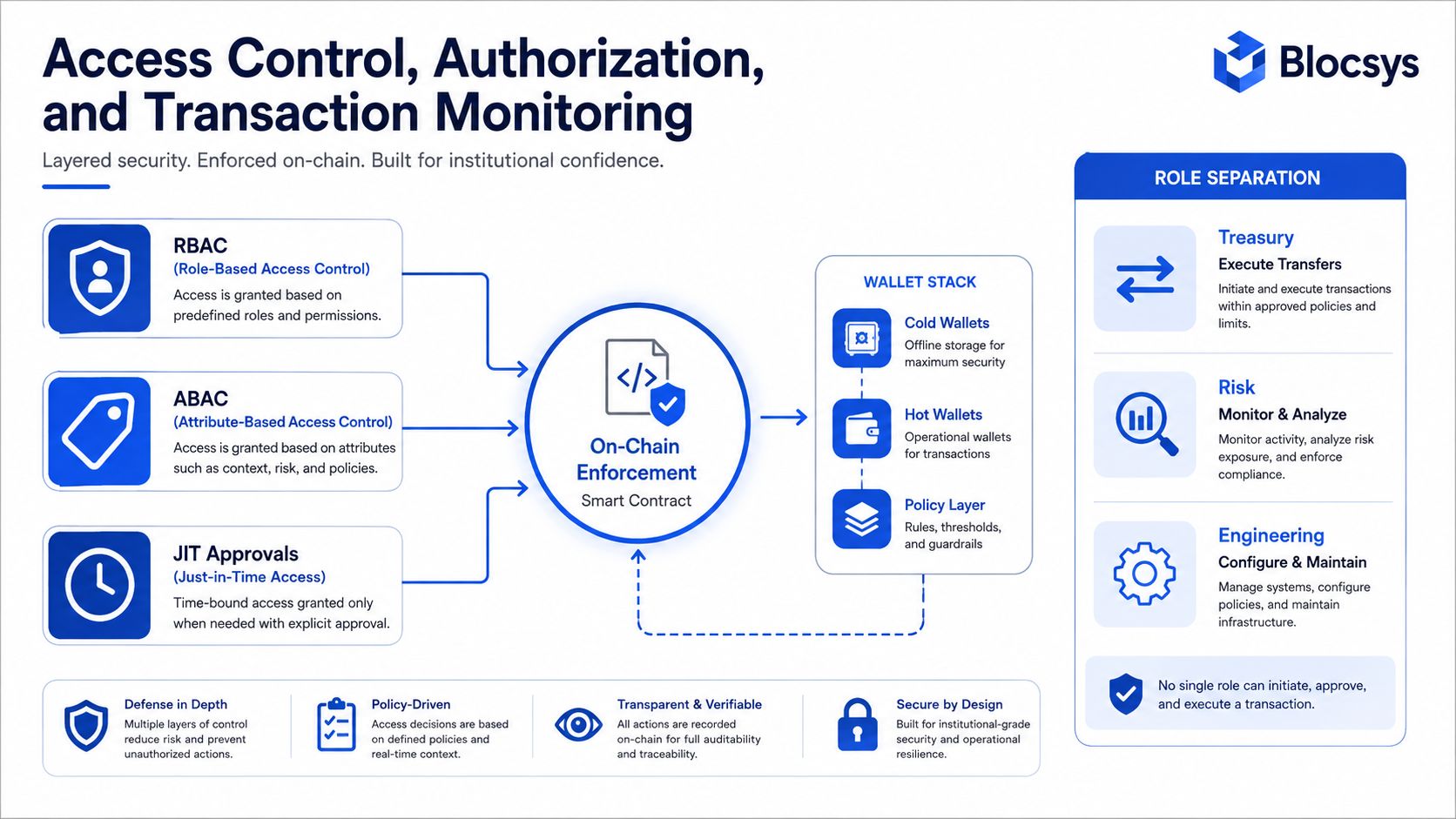
Transaction monitoring should combine off-chain and on-chain signals. Address exposure, sanctions data, contract calls, unusual mempool behaviour, gas conditions, velocity, and account history can all influence whether a request proceeds. Smart-contract transactions need simulation and decoded call review, because the destination may be an application rather than a simple address.
For a wider view of security governance, an information security 2026 guide can provide useful context alongside custody-specific controls. The audit trail should capture the decision and the reason, not only the final transaction hash. Designing compliance-ready audit trails with cryptographic evidence helps connect operational controls to SOC 2, ISO 27001, NYDFS Part 500, and DORA evidence requirements.
KYC, AML, Travel Rule, and Audit-Grade Records
KYC, AML, Travel Rule exchange, and audit logging need one shared identity and event model. The platform should connect each customer to associated wallet addresses, record control evidence for relevant counterparty addresses, and show which checks cleared before a transfer. That model must support jurisdiction-specific fields and retention rules, because a control designed for the US cannot be assumed to satisfy EU, UK, Singapore, UAE, Switzerland, or India requirements.
Onboarding may include identity verification, beneficial-owner collection, sanctions and PEP screening, risk classification, jurisdiction checks, and source-of-funds review. Ongoing monitoring evaluates activity against the customer’s expected profile, wallet exposure, transaction patterns, and changes in risk data. Reliable blockchain verification for KYC and customer onboarding in banking helps connect those checks to actual wallet activity.
One transaction, one evidence chain
A transfer record should connect four evidence groups:
- Customer identity: Verified person or legal entity, beneficial ownership, risk tier, and account status.
- Wallet identity: Address, chain, ownership or control evidence, wallet category, and counterparty relationship.
- Compliance decision: Screening results, Travel Rule payload, monitoring alerts, reviewer action, and policy version.
- Cryptographic execution: Transaction request, approval signatures, signing event, broadcast result, confirmations, and reconciliation outcome.
Travel Rule data should pass through a controlled pipeline. Originator and beneficiary fields need consistent schemas, validation, exception handling, and a quarantine route when required information is missing or inconsistent. Providers such as Notabene, Codefi Compliance, or an equivalent Travel Rule network can support data exchange. The custody platform still owns the rules governing how that data enters the workflow and affects the transaction decision.
Compliance Control Mapping Across Regulatory Frameworks
| Control | US (BSA/FinCEN) | EU (MiCA/AMLA) | UK (FCA) | FATF Travel Rule |
|---|---|---|---|---|
| Customer due diligence | Identity and risk-based AML controls | Customer and transaction controls under the applicable perimeter | Registration and financial-crime systems are central considerations | Originator and beneficiary information must accompany covered transfers |
| Transaction monitoring | Detect and escalate suspicious activity | Monitor activity and maintain records under applicable requirements | Risk-based monitoring and reporting expectations | Missing-data detection and counterparty checks support transfer decisions |
| Reporting | SAR processes and supporting records | Supervisory and financial-crime reporting pathways | Suspicious-activity and regulatory reporting processes | Data transmission, verification, and exception handling |
| Evidence | Retain records that support examination and investigation | Preserve auditable operational records | Demonstrate governance and control effectiveness | Reconstructible payloads linked to the transaction |
India’s framework adds a specific implementation requirement for platform teams. The 7 March 2023 Ministry of Finance notification brought VDA exchange, transfer, and safekeeping or administration activities into the PMLA scope when performed for or on behalf of another person in business. Affected providers become reporting entities required to register with FIU-IND. The official parliamentary material on VDA service providers confirms that reporting-entity position.
Under India’s VDA AML framework, reporting entities must conduct customer due diligence, monitor transactions, file suspicious transaction reports, and retain transaction records for at least five years, as described in FIU-India VDA compliance guidance. That period should shape storage, indexing, legal holds, access controls, and retrieval testing from the first release.
Regulatory Map Across US, EU, UK, UAE, Singapore, Switzerland, and India
A global custody platform needs a shared control plane with jurisdiction-specific parameters. The cryptographic layer may be common, but licensing status, customer eligibility, reporting fields, outsourcing rules, stablecoin treatment, and Travel Rule handling should be configurable rather than hard-coded.
| Jurisdiction | Primary Regime | Custody / Licensing Trigger | Segregation Rule | Travel Rule | Audit / Reporting |
|---|---|---|---|---|---|
| US | BSA/FinCEN, state regimes, NYDFS Part 500, SEC and FINRA scrutiny where relevant | Depends on activity, entity, state, and asset classification | Design for clear client-asset accounting and control evidence | Implement through applicable VASP and financial-crime obligations | SAR processes, cybersecurity evidence, and regulator-specific reporting |
| EU | MiCA, Transfer of Funds Regulation, DORA, AML framework | Authorisation and service classification depend on the activity and entity | Client-asset segregation and operational safeguards require explicit mapping | Applicable transfer-data requirements need configurable handling | Supervisory reporting, incident management, resilience testing, and audit evidence |
| UK | FCA crypto registration, financial-crime rules, FSMA perimeter | Registration and permissions depend on service and asset treatment | Document client-asset controls and governance | Apply relevant UK transfer-data requirements | Regulatory returns, suspicious-activity reporting, and control testing |
| UAE | VARA and relevant federal requirements | Licensing depends on emirate, activity, and customer segment | Segregation and custody governance should be explicit | Configure applicable transfer-data obligations | Local supervisory reporting and independent assurance expectations |
| Singapore | Payment Services Act and MAS PSN02 | Licensing depends on payment-token and service activity | Establish clear asset and operational controls | Apply MAS and FATF-aligned transfer procedures | Regulatory reporting, technology-risk controls, and audit evidence |
| Switzerland | FINMA fintech and DLT licensing frameworks | Classification depends on service, asset, and business model | Segregation and custody treatment depend on the applicable licence | Configure Swiss and FATF-aligned data exchange | FINMA-facing records, audit support, and governance evidence |
| India | PMLA, FIU-IND directions, tax reporting developments | VDA activities performed for others in business can create reporting-entity obligations | Separate client records and wallet controls, with reconstructible evidence | Originator and beneficiary data, missing-data monitoring, and screening | FIU-IND reporting, suspicious-transaction processes, and records retained at least five years |
India’s 7 March 2023 notification is a foundational milestone because it expressly includes safekeeping or administration of VDAs or instruments enabling control over VDAs within the PMLA activity set. The India crypto-regulation overview also explains the earlier 2022 tax definition of VDA through the Finance Act, 2022.
Further Indian enforcement signals make weak controls difficult to defend. A 2024 Lok Sabha reply cited Rs 824.14 crore in GST evasion across 17 cryptocurrency exchanges, with Rs 122.29 crore recovered in taxes, penalties, and interest, as reported in India crypto enforcement statistics. The practical response is not a country-specific patch. Build source-of-funds checks, address traceability, suspicious-transaction workflows, and auditable wallet controls into the shared platform.
India’s Travel Rule implementation also turns identity into a near-real-time data problem. India’s Travel Rule guidance describes monitoring for missing information, pre-transfer CDD, and sanctions screening, so the system should be able to block or quarantine transfers until the counterparty record is complete.
Build Path, Costs, and How Blocsys Helps You Ship
Cost should be treated as a scope question, not a generic software number. A custody MVP with limited networks, operational wallets, basic KYC, and a narrow customer segment has a different architecture from an institutional platform requiring HSM-backed controls, multi-region resilience, Travel Rule connectivity, complex ledgering, and audit preparation.
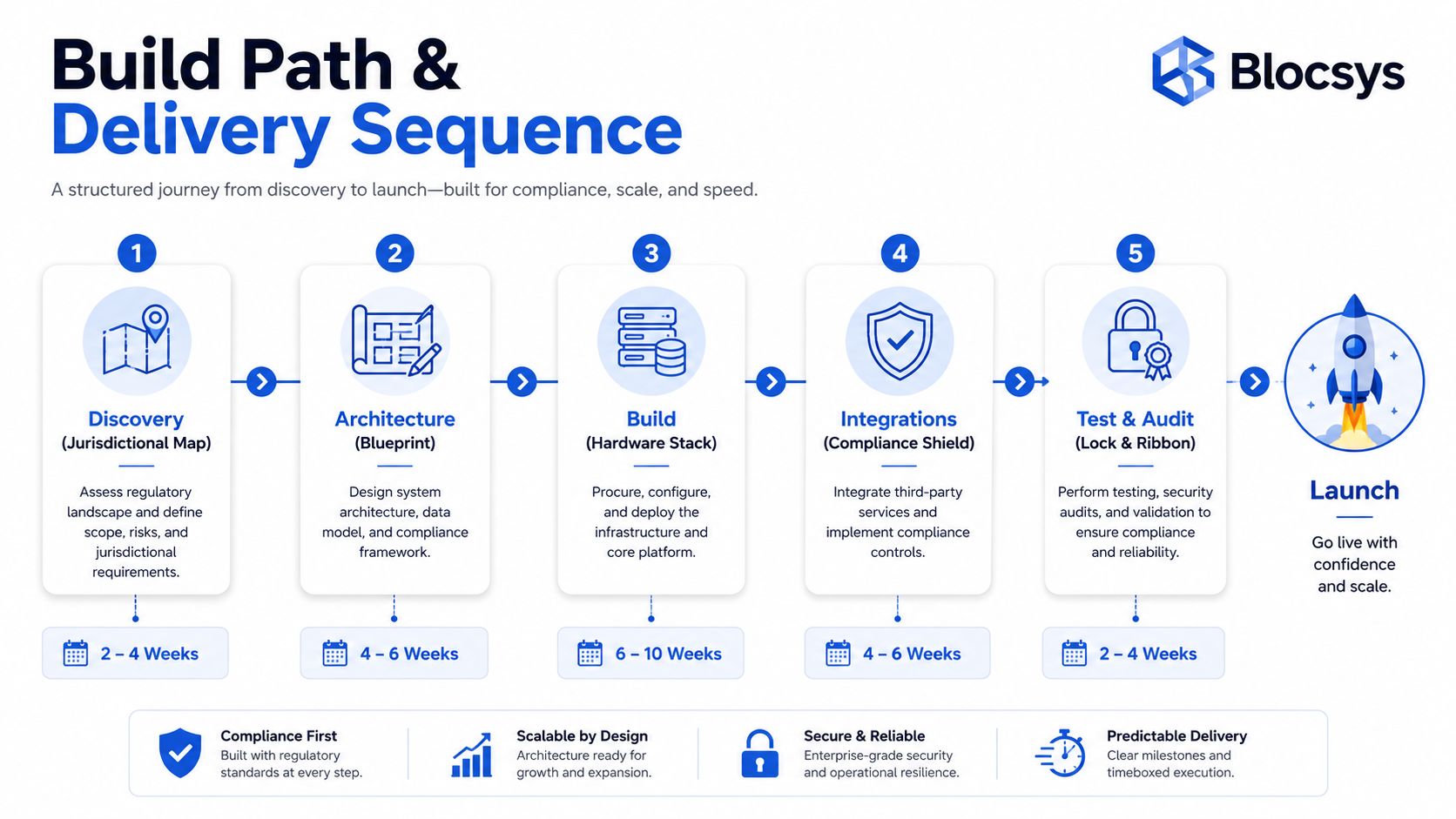
A delivery sequence that survives review
- Discovery: Map legal entities, customer types, assets, jurisdictions, outsourcing boundaries, and licensing assumptions.
- Architecture: Define custody model, wallet tiers, ledger segregation, key ceremonies, approval quorums, recovery, integrations, and evidence retention.
- Build: Implement wallet orchestration, signing services, policy enforcement, identity binding, transaction workflows, and reconciliation.
- Integrate: Connect KYC/AML, sanctions intelligence, Travel Rule services, banking rails, blockchain nodes, reporting systems, and smart-contract simulation.
- Test and audit: Run threat modelling, penetration testing, key-ceremony exercises, recovery drills, failure injection, access reviews, and evidence walkthroughs before launch.
- Operate: Monitor policy exceptions, wallet health, chain changes, vendor dependencies, incident signals, and regulatory updates continuously.
The cost drivers are concrete. More supported chains increase node, indexing, testing, and upgrade work. Institutional segregation increases ledger and reconciliation complexity. Multi-jurisdiction deployment expands policy configuration, reporting, data-residency, and legal review. HSM or MPC choices affect operations, recovery, vendor integration, and incident procedures. Audit readiness adds evidence design, control mapping, assessor support, and repeatable testing.
The common failure is under-scoping the non-wallet work. Teams build signing first, then discover that compliance cannot trace a wallet to a verified customer, finance cannot reconcile balances, or risk cannot explain an exception. Blockchain Development can include custom development for enterprises, startups, and governments across public, private, and hybrid blockchain networks, but the custody programme still needs clear ownership between technology, compliance, legal, risk, and operations.
Blocsys Technologies can own the engineering layer across wallet infrastructure, private-key management, compliance integrations, smart contracts, tokenisation workflows, and audit evidence. Organisations assessing scope can also use the Blocsys Cost Estimator Tool to frame an initial development discussion, then validate the result against jurisdiction, asset, integration, and assurance requirements. A practical architecture review should also account for building compliance-ready blockchain platforms before product teams commit to a release plan.
Blocsys Technologies develops secure digital asset platforms, blockchain infrastructure, crypto wallets, smart contracts, tokenisation systems, and compliance workflows for banks, fintechs, exchanges, enterprises, and Web3 companies. Visit Blocsys Technologies to discuss your custody architecture, regulatory scope, and next implementation step with a team that can help turn the control model into production software.
Frequently Asked Questions
What is digital asset custody compliance?
Digital asset custody compliance adds the legal, operational, and evidentiary controls on top of basic custody that prove assets are protected, attributable, segregated, monitored, and recoverable. Basic custody covers credentials, wallets, and control mechanisms used to move assets, but compliance requires showing supervisors how those controls actually work in production, not just in policy documents.
What questions do supervisors typically ask during a custody review?
Reviews generally probe five areas: asset segregation between client and firm balances, signing authority over who initiated and approved transfers, counterparty and address screening before broadcast, operational resilience for wallet recovery, and evidence quality of approvals and exceptions. These aren’t separate workstreams — a withdrawal policy is only credible when the signing service, transaction monitor, and audit system all work together to produce the evidence.
Why isn’t a compliance policy document enough to satisfy a supervisory request?
A policy defines intent, but the platform must enforce it. If a withdrawal is screened only after broadcast, the control is advisory rather than preventive, and if an administrator can change a transaction policy without a second approver, segregation of duties exists on paper but not in production. The blog’s practical rule: if a control can’t block, quarantine, or require approval before an irreversible blockchain action, it’s monitoring, not prevention.
What are the five layers of a compliant custody system?
They are: legal entity and licensing posture, key custody and wallet operations, identity and onboarding, transaction and market-integrity controls, and audit-grade evidence. Each layer links to the next — for example, identity checks must connect to wallet addresses and transaction records in a way that survives account changes and later investigations.
Does the same custody platform configuration work across all jurisdictions?
No. While underlying cryptographic primitives can be shared, a configuration built for a US institutional desk may need different permissions, policy thresholds, data handling, and reporting workflows for clients in the EU, UK, UAE, Singapore, Switzerland, or India. Jurisdictional scoping is one of the first steps in the build path, before custody-model selection and wallet architecture decisions.
Where does regulatory readiness fit in the platform build process?
The build path starts with legal-entity and jurisdictional scoping, then moves through custody-model selection, wallet architecture, identity and compliance integrations, security testing, audit preparation, and controlled launch. The blog stresses that regulatory readiness must be designed into the platform from the start rather than attached after launch.
