
France’s Tokenization Strategy: How AMF and Banque de France Are Shaping Digital Finance
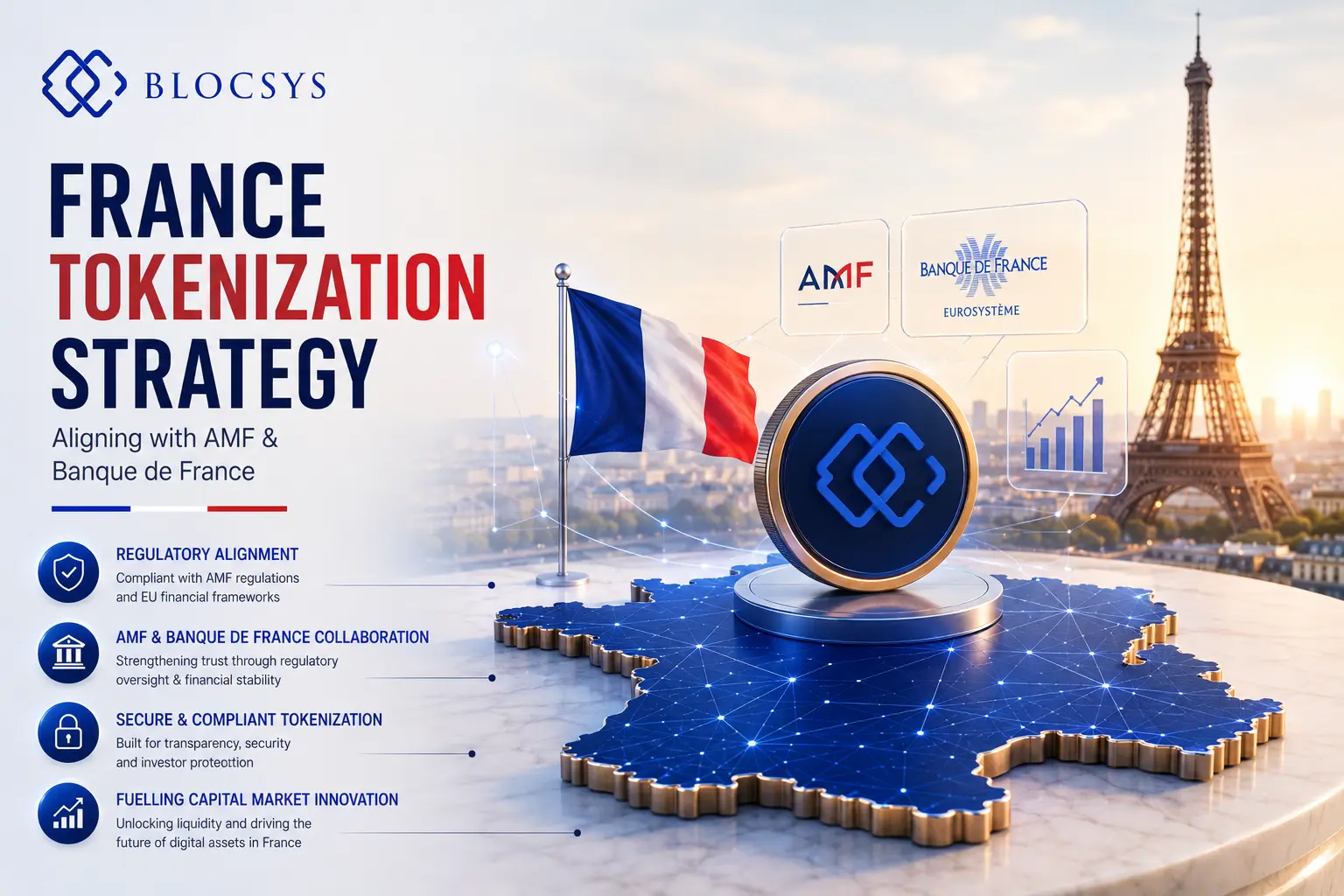
France’s tokenization strategy is quickly becoming one of the most closely watched regulatory stories in European finance. Between the Autorité des marchés financiers, Banque de France, and the Direction générale du Trésor, the country has built a coordinated institutional approach to tokenized securities, tokenized funds, and DLT-based market infrastructure. If you’re a financial institution, fintech, or asset manager trying to understand where France tokenization is headed, this article breaks down what’s confirmed, what’s still a pilot, and what’s simply on the drawing board. We’ll also look at how businesses can prepare their own tokenized financial instruments strategy through platforms like Blocsys.
What Financial Tokenization Means in the French Market
Financial tokenization is the process of representing ownership rights in a financial asset, such as a bond, fund unit, or short-term debt instrument, as a digital token on a blockchain or distributed ledger. The token itself doesn’t automatically make the underlying asset legally compliant. Instead, it changes how that asset is issued, recorded, and transferred, while the surrounding legal and regulatory framework still determines whether it qualifies as a security or financial instrument under French and EU law.
In France, this concept isn’t theoretical anymore. Tokenization in France has moved from academic discussion into structured pilots involving real institutions, real settlement assets, and real regulatory oversight. That’s a meaningful shift, and it’s why so many banks and asset managers are paying attention.
Why France Is Building a Deliberate Tokenization Strategy
France isn’t approaching digital assets the way some markets have, chasing speculative crypto trends. Instead, the France tokenization strategy is grounded in capital markets efficiency, financial market infrastructure modernization, and maintaining Paris’s competitiveness as a European financial hub. Authorities want tokenized financial instruments to work within existing regulatory guardrails, not around them.
France also sits at an interesting intersection. It has one of Europe’s most active NEU-CP (Negotiable European Commercial Paper) markets, a strong asset management industry, and an early mover advantage through its participation in EU DLT Pilot Regime activity. Consequently, French regulators have strong incentive to shape tokenized settlement assets and tokenized funds before other jurisdictions set the pace.
France isn’t racing to tokenize everything at once. It’s testing which parts of the market actually benefit from DLT, and building the regulatory scaffolding around those specific use cases first.
The Role of AMF, Banque de France, and the French Treasury
Three institutions anchor France’s tokenization strategy, and each plays a distinct role.
AMF Tokenization Oversight
The AMF (Autorité des marchés financiers) is France’s securities regulator. AMF digital asset regulation covers how tokenized securities, tokenized funds, and digital asset service providers fit within MiCA and existing French financial law. The AMF has also been active in the EU DLT Pilot Regime, granting permissions to market infrastructure operators testing DLT-based trading and settlement systems. AMF tokenization work generally centers on investor protection, market integrity, and ensuring tokenized instruments meet the same disclosure standards as traditional securities.
Banque de France Digital Assets Work
Banque de France tokenization initiatives focus heavily on settlement. The central bank has run wholesale central bank digital currency (CBDC) experiments since 2020, testing how tokenized central bank money could settle DLT-based securities transactions. Banque de France digital assets research isn’t about replacing cash or retail payments here; it’s about exploring whether tokenized settlement assets can reduce operational friction between the primary issuance of a security and its final settlement.
Direction Générale du Trésor’s Coordinating Function
The French Treasury brings a policy and international coordination lens. It works alongside AMF and Banque de France to align domestic tokenization efforts with EU-level frameworks like MiCA and the DLT Pilot Regime, and to represent French interests in broader European digital finance discussions.
France’s Strategic Tokenization Group
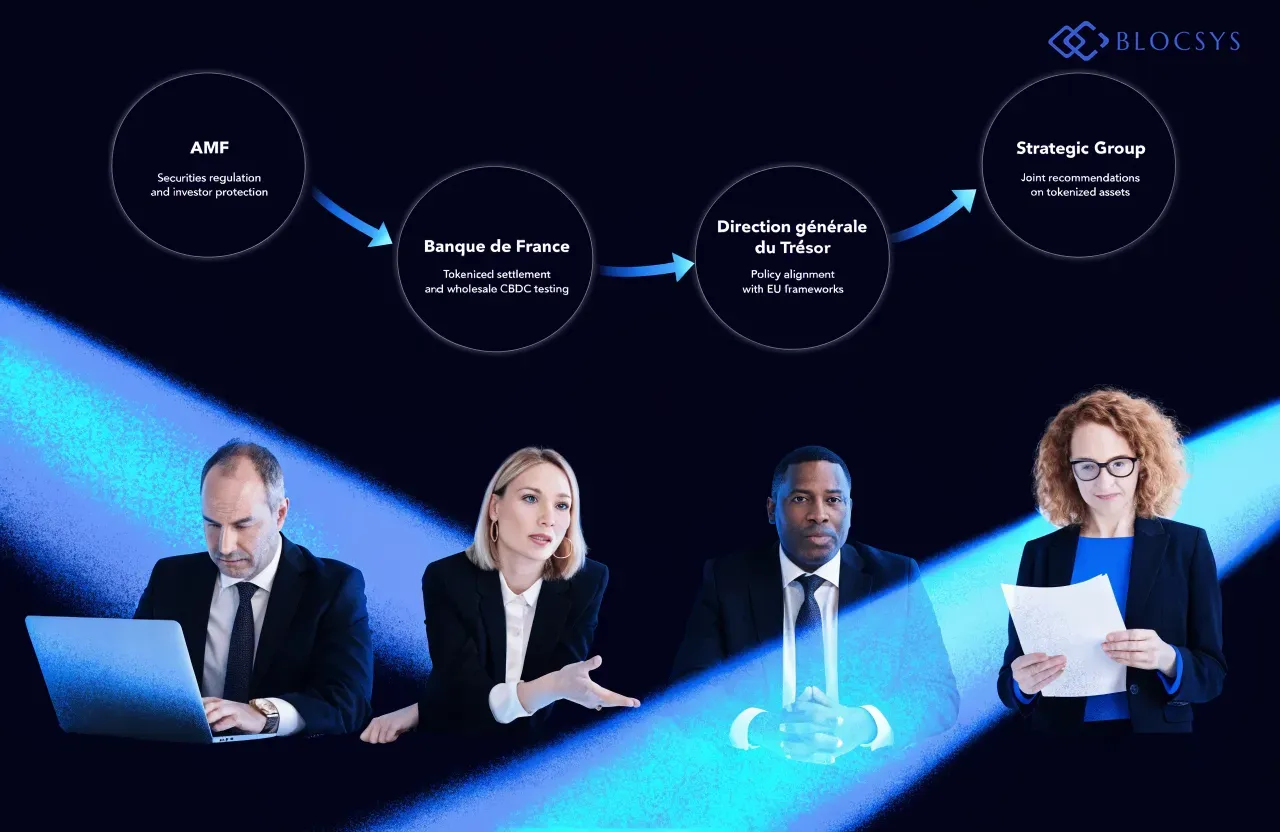
In March 2026, AMF, Banque de France, and the Direction générale du Trésor formed a joint strategic group dedicated to financial tokenization. This is a confirmed, current initiative, not a proposal. The group’s mandate is to examine how tokenization could be integrated into French capital markets in a structured, risk-aware way.
According to the group’s identified scope, four concrete areas of work stand out: tokenized settlement assets, NEU-CP tokenization, DLT-based financial market infrastructure, and tokenized funds. These aren’t final decisions or approved products. They’re the working areas the group has flagged for deeper exploration, analysis, and potential pilot activity.
How the France Tokenization Strategy Group Is Structured
The strategic group brings together regulatory, monetary, and treasury perspectives under one coordinated effort. That matters because tokenization touches multiple layers of the financial system at once: securities law, payment settlement, and monetary policy. Rather than each institution running separate initiatives, France tokenization strategy work now flows through a shared framework, which should, in principle, reduce regulatory fragmentation as pilots move forward.
| Institution | Primary Focus Area | Confirmed Activity |
|---|---|---|
| AMF | Securities regulation, investor protection, DLT Pilot Regime authorizations | Ongoing regulatory guidance and pilot permissions |
| Banque de France | Tokenized settlement assets, wholesale CBDC experimentation | Experiments running since 2020, continuing through 2026 |
| Direction générale du Trésor | Policy coordination, EU alignment | Joint strategic group member since March 2026 |
Key Areas of Focus: Tokenized Assets, Instruments, and Infrastructure
France tokenized assets work spans several categories. Understanding each one helps clarify what’s realistic today versus what remains further out.
Tokenized Settlement Assets
This is arguably the most mature area. Tokenized settlement assets refer to central bank money or commercial bank money represented on a distributed ledger, used to settle a tokenized securities transaction. Banque de France has tested this extensively through its wholesale CBDC experiments, working with other central banks and market participants across multiple settlement scenarios.
France Tokenized Securities and Financial Instruments
France tokenized securities cover bonds, structured products, and other tokenized financial instruments issued directly on a blockchain, or “natively,” rather than digitized after the fact. The EU DLT Pilot Regime, which came into force in 2023, gives market infrastructure operators a temporary regulatory sandbox to test trading and settlement of these instruments at scale, under specific volume caps.
DLT-Based Financial Market Infrastructure
This is the plumbing question: can a distributed ledger replace or complement existing trading, clearing, and settlement systems? French infrastructure providers have explored this under the DLT Pilot Regime, though full-scale replacement of legacy market infrastructure remains a longer-term proposition, not a near-term certainty.
Tokenized Funds
Tokenized funds represent fund units on a distributed ledger instead of, or alongside, traditional registrar records. France’s strategic group has flagged this as an area for continued study, particularly around subscription and redemption efficiency and how tokenized fund units interact with existing custody and transfer agent workflows.
If your organization is evaluating any of these paths, understanding the underlying technology stack matters as much as the regulatory picture. Blocsys works with institutions building on Asset Tokenization Platform infrastructure designed specifically for regulated financial instruments.
NEU-CP Tokenization and the Pythagore Initiative
What’s the Pythagore project? Pythagore is a Banque de France wholesale settlement experiment exploring DLT-based settlement for tokenized instruments, including work relevant to the NEU-CP market. NEU-CP, France’s negotiable short-term debt market, is one of Europe’s largest commercial paper markets, and it’s a natural candidate for tokenization experiments given its high transaction volume and standardized issuance process.
NEU-CP tokenization work explores whether short-term debt instruments can be issued, transferred, and settled on a distributed ledger while still meeting existing market conventions and investor expectations. This remains an area of active exploration rather than a fully deployed production system across the NEU-CP market. Still, it’s a meaningful signal: France is testing tokenization on a market that already has scale and institutional trust, rather than starting from scratch with a novel asset class.
Why NEU-CP Was Chosen for Early Tokenization Work
Short-term debt markets involve frequent issuance and settlement cycles, which makes them a useful testing ground for DLT-based processes. Additionally, NEU-CP already operates under established regulatory oversight, so tokenization pilots can build on existing compliance frameworks rather than creating entirely new ones. That said, no broad claims should be made yet about settlement speed or efficiency gains beyond what’s been documented in specific pilot reports.
Role of French Financial Institutions in Tokenization in France
Banks, asset managers, and market infrastructure operators aren’t passive observers here. Several French institutions have participated in DLT Pilot Regime activities, and asset managers have shown growing interest in tokenized fund structures as a way to explore new distribution and servicing models.
Here’s a realistic, illustrative scenario worth considering. Imagine a mid-sized French asset manager wants to test tokenized fund units for a professional investor share class. It would need to work with a custodian comfortable with DLT-based record-keeping, confirm AMF’s regulatory position on the specific instrument structure, and likely operate within DLT Pilot Regime volume thresholds during an initial pilot phase. This isn’t a hypothetical far-future scenario; it reflects the kind of due diligence process institutions are already going through today.
Interoperability and Smart Contracts in Institutional Workflows
Smart contracts, self-executing code that automates parts of a financial transaction, are often discussed alongside tokenized instruments because they can automate processes like coupon payments or redemption triggers. However, smart contracts don’t remove the need for legal agreements or regulatory compliance; they automate execution once conditions defined by those agreements are met. Interoperability between different DLT platforms and legacy systems remains a genuine technical challenge, and it’s one reason institutions often work with experienced infrastructure partners rather than building tokenization systems entirely in-house.
Regulatory Framework and Investor Protection
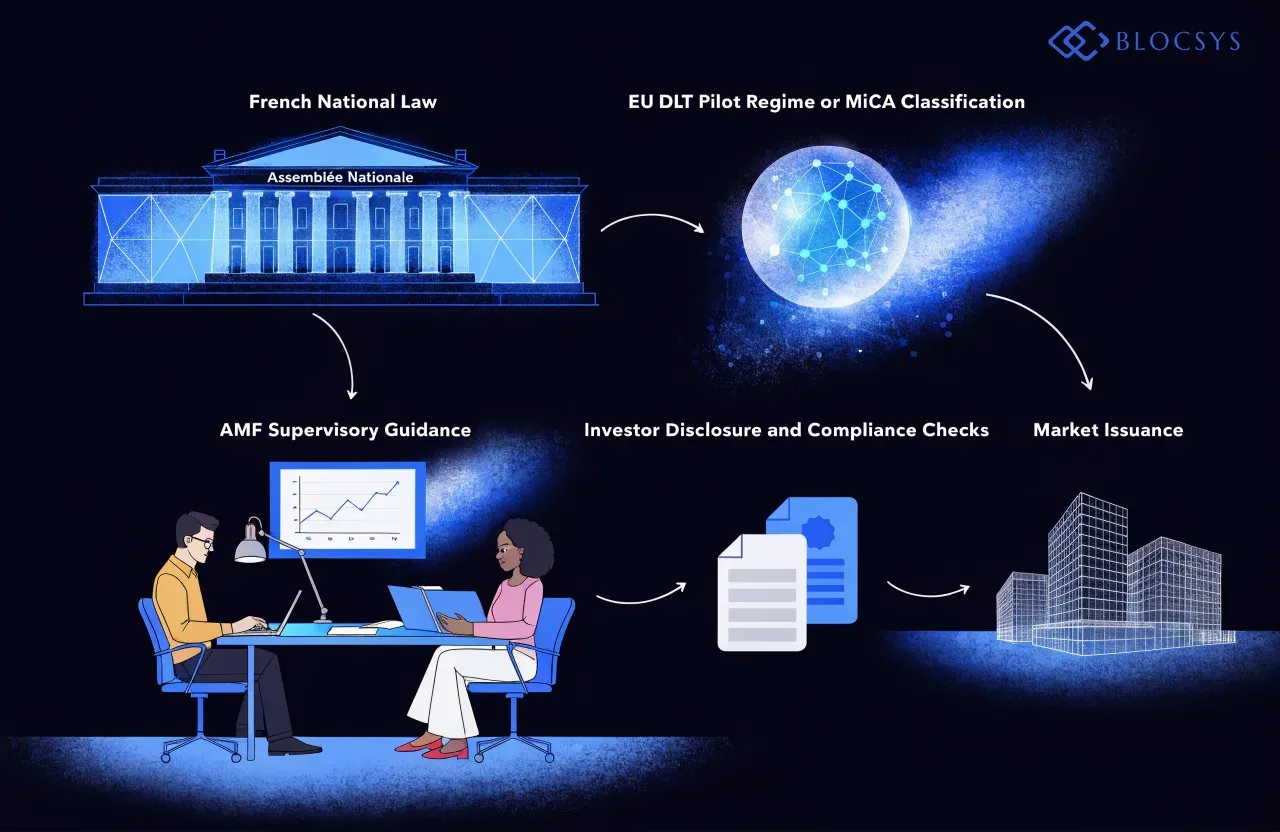
French tokenization regulations operate within a layered structure: French national law, the AMF’s supervisory guidance, and EU-level frameworks including MiCA and the DLT Pilot Regime. MiCA primarily governs crypto-assets and digital asset service providers, while tokenized securities that qualify as financial instruments generally fall under existing securities law, not MiCA.
Investor protection remains central to AMF’s approach. Tokenizing a security doesn’t change its underlying legal classification or exempt it from disclosure obligations. Consequently, any France tokenized securities offering marketed to retail or institutional investors still needs to meet the same prospectus, suitability, and conduct requirements as its traditional counterpart. This is a point AMF has been consistent about, and it’s a good reminder that tokenization is a technology layer, not a shortcut around regulation.
Benefits and Opportunities of France’s Tokenization Strategy
What could tokenization realistically offer French capital markets? Based on the pilots and research conducted so far, potential benefits include more automated post-trade processes, clearer audit trails through immutable ledger records, and new possibilities for fractional ownership structures in certain asset classes. These are documented directions from pilot findings, not guaranteed outcomes for every future implementation.
Moreover, tokenized financial instruments could eventually support more flexible fund distribution models, particularly for professional investor products. However, claims about faster settlement, lower costs, or increased liquidity should be treated as pilot-specific findings rather than universal guarantees, since outcomes depend heavily on the specific infrastructure, asset class, and regulatory scope involved.
Challenges and Limitations Still Facing France Tokenization
Legal certainty around token ownership transfer, custody of tokenized assets, and cross-border interoperability between different national DLT frameworks remain open questions. Additionally, the DLT Pilot Regime itself is time-limited and capped by transaction volume, meaning today’s pilots don’t automatically translate into permanent market infrastructure. Institutions considering tokenization need realistic expectations about timelines and regulatory evolution.
France’s Position Within European Digital Finance
France isn’t operating in isolation. Germany and Luxembourg have also seen active DLT Pilot Regime participation and growing interest in tokenized fund structures, particularly given Luxembourg’s role as Europe’s largest fund domicile. The European Central Bank and European Commission continue shaping the broader regulatory environment through MiCA implementation and ongoing DLT Pilot Regime review.
France tokenized financial assets work benefits from this broader European context because regulatory alignment reduces fragmentation for institutions operating across borders. That said, France’s approach, with its formal strategic group and central bank-led settlement experimentation, gives it a distinctly coordinated character compared to some other European markets.
Future of Financial Tokenization in France
Looking ahead, expect continued pilot activity around NEU-CP tokenization, further Banque de France settlement experiments, and ongoing AMF guidance as EU frameworks mature. Full-scale production deployment across major asset classes isn’t confirmed yet, and it likely depends on how current pilots perform and how EU-level rules evolve over the next several years. What’s clear is that France tokenization strategy work is structured, well-resourced, and unlikely to stall.
Why Businesses Need Experienced Asset Tokenization Infrastructure
Navigating this landscape, evolving regulation, settlement complexity, and interoperability requirements, isn’t something most institutions want to build from scratch. That’s where working with an experienced technology partner matters. Blocsys builds tokenization infrastructure designed around compliance, security, and institutional-grade architecture, covering everything from Real World Asset Tokenization to Corporate Bond Tokenization Platform Development and Equity Tokenization Platform Development.
Whether you’re a bank exploring tokenized settlement assets, a fund manager considering tokenized fund units, or a fintech building new digital securities infrastructure, having a technology partner who understands both blockchain architecture and regulatory constraints saves you from costly missteps later.
Frequently Asked Questions
Here are direct answers to the questions we hear most often about France’s tokenization strategy.
What is tokenization in France?
Tokenization in France refers to representing financial instruments, such as bonds, fund units, or short-term debt, as digital tokens on a distributed ledger. It’s being explored through coordinated regulatory and institutional efforts led by AMF, Banque de France, and the Direction générale du Trésor, focused on integrating tokenized assets within existing French and EU financial regulation rather than creating a separate parallel market.
What is France’s tokenization strategy?
France’s tokenization strategy is a coordinated institutional approach involving AMF, Banque de France, and the French Treasury, formalized through a joint strategic group established in March 2026. It focuses on four concrete areas: tokenized settlement assets, NEU-CP tokenization, DLT-based financial market infrastructure, and tokenized funds, all examined within existing securities regulation and EU frameworks like the DLT Pilot Regime.
What role does AMF play in financial tokenization?
The AMF regulates securities and digital asset service providers in France, ensuring tokenized instruments meet the same investor protection and disclosure standards as traditional financial instruments. AMF tokenization oversight includes granting permissions under the EU DLT Pilot Regime and providing guidance on how tokenized securities fit within MiCA and French financial law, without treating tokenization as a way to bypass existing regulatory obligations.
How is Banque de France supporting tokenization?
Banque de France tokenization work centers on settlement, primarily through wholesale central bank digital currency experiments running since 2020. These experiments test how tokenized central bank money can settle DLT-based securities transactions, including work connected to the Pythagore initiative, which explores settlement models relevant to tokenized instruments and the NEU-CP market.
What is the French government’s approach to tokenized finance?
The Direction générale du Trésor coordinates policy across institutions and ensures France’s tokenization efforts align with EU-level frameworks, including MiCA and the DLT Pilot Regime. Its role within the March 2026 strategic group focuses on connecting domestic tokenization work with broader European regulatory developments, rather than issuing standalone French-only rules disconnected from the EU context.
What financial assets can be tokenized in France?
France tokenized assets currently being explored include short-term debt through NEU-CP tokenization, tokenized fund units, and tokenized settlement assets used in securities transactions. Bonds and other tokenized financial instruments have also been tested under the EU DLT Pilot Regime. Full-scale tokenization across all asset classes isn’t confirmed, and most activity remains in pilot or exploratory stages.
How does the DLT Pilot Regime apply to tokenization in France?
The EU DLT Pilot Regime, active since 2023, gives market infrastructure operators, including those in France, a temporary regulatory sandbox to test trading and settlement of tokenized securities under specific volume caps. French entities have used this framework to explore DLT-based financial market infrastructure while operating under AMF supervision, though the regime itself is time-limited and doesn’t guarantee permanent market changes.
What is the Pythagore project?
Pythagore is a Banque de France-led wholesale settlement experiment exploring how distributed ledger technology can support settlement of tokenized instruments, including relevance to the NEU-CP market. It’s part of Banque de France’s broader digital assets research into tokenized settlement assets, and it remains an experimental initiative rather than a fully deployed production settlement system.
How are French financial institutions using tokenization?
French banks, asset managers, and infrastructure operators have participated in DLT Pilot Regime pilots and explored tokenized fund structures for professional investor products. Institutional adoption remains at the pilot and exploratory stage, with organizations working through custody, regulatory classification, and interoperability questions before considering broader deployment of tokenized financial instruments.
What is the future of tokenization in France?
The future of tokenization in France likely involves continued pilot activity around NEU-CP tokenization, further Banque de France settlement experiments, and evolving AMF guidance as EU regulation matures. Broad production-scale adoption across major asset classes isn’t confirmed yet and will depend on pilot outcomes and how frameworks like MiCA and the DLT Pilot Regime develop over the coming years.
Moving Forward with France Tokenization Strategy
France’s tokenization strategy shows what a coordinated, regulator-led approach to digital finance transformation can look like. AMF, Banque de France, and the Direction générale du Trésor aren’t rushing untested products to market. They’re building structured pathways for tokenized settlement assets, tokenized funds, and DLT-based financial market infrastructure, one pilot at a time. For institutions watching this space, the message is clear: the France tokenization strategy rewards preparation, not speculation.
If your organization is exploring tokenized financial instruments, tokenized funds, or DLT-based infrastructure, working with a partner who understands both the technology and the regulatory landscape makes a real difference. Visit Blocsys to see how our Asset Tokenization Platform supports institutions building compliant, secure tokenized financial infrastructure, backed by Smart Contract Development expertise built for regulated financial markets.
Ready to move beyond theory and build an intelligent platform that delivers real-world value? Blocsys Technologies specialises in engineering enterprise-grade AI and blockchain solutions for the fintech, Web3, and digital asset sectors. Connect with our experts today to discuss your vision and chart a clear path from concept to a secure, scalable reality.
