
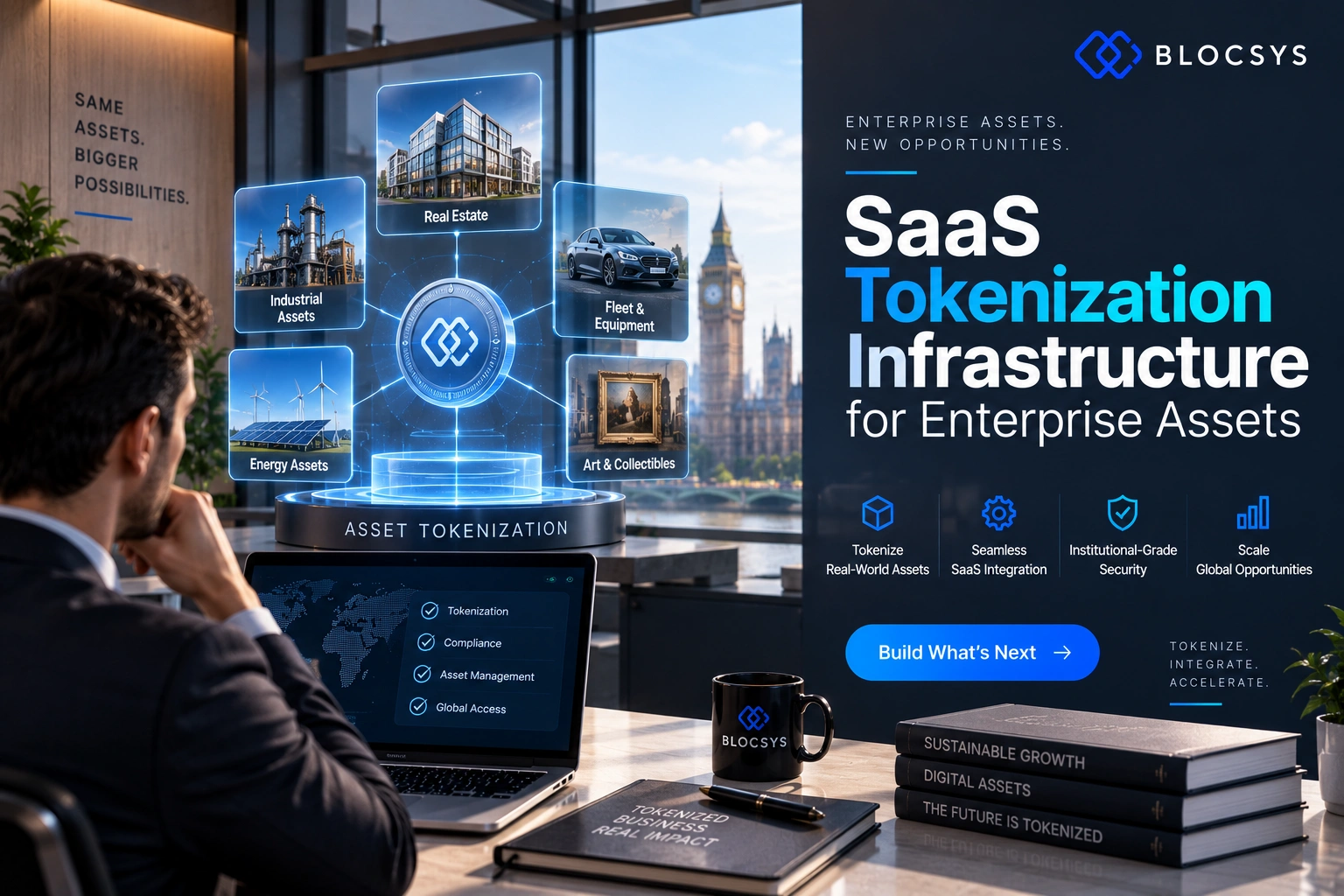
SaaS Tokenization Infrastructure: How Enterprises Can Launch and Manage Tokenized Assets at Scale
Enterprises evaluating digital asset strategy keep running into the same wall: tokenizing one fund or one bond is easy to prototype, but running dozens of asset classes across multiple jurisdictions is a different problem entirely. That’s where SaaS Tokenization Platform Development changes the equation. Instead of building blockchain infrastructure from scratch for every issuance, enterprises can deploy a managed, multi-tenant platform that handles issuance, compliance, custody connectivity, and reporting as a service. This article breaks down what SaaS tokenization infrastructure actually is, how it differs from custom-built systems and legacy tokenization platforms, and what enterprises need to evaluate before committing engineering budget to it.
What Is SaaS Tokenization Infrastructure?
SaaS Tokenization Infrastructure is a cloud-delivered platform layer that lets enterprises issue, manage, and service tokenized assets without owning the underlying blockchain stack. Think of it as the operating system for digital securities and tokenized funds — it handles smart contract deployment, investor onboarding, compliance workflows, and reporting through a shared, multi-tenant architecture rather than a bespoke build.
Unlike a single-purpose tokenization tool built for one product launch, SaaS infrastructure is designed to support many issuers, many asset types, and many jurisdictions from one operational base. That distinction matters enormously once you’re past your first tokenized offering and thinking about a second fund, a third bond series, or a partner network issuing through your platform.
Why the “SaaS” Part Actually Matters
Here’s the thing people miss: tokenization itself isn’t hard anymore. Deploying a token contract is a solved problem. What’s hard is the operational layer around it — investor eligibility checks, transfer restrictions, corporate actions, audit trails, and reporting across every token you’ve ever issued. SaaS Tokenization Infrastructure exists specifically to solve that operational layer, not the smart contract layer alone.
The real value of SaaS tokenization infrastructure isn’t the token itself — it’s the operational plumbing that keeps a hundred token holders compliant across three jurisdictions without your team touching a spreadsheet.
Why Enterprises Are Moving Toward Tokenization SaaS
Banks, asset managers, and fintech firms aren’t adopting tokenization SaaS because it’s trendy. They’re adopting it because custom blockchain builds are slow, expensive to maintain, and hard to staff. A dedicated in-house tokenization stack means owning node infrastructure, smart contract audits, KYC integrations, and compliance updates indefinitely. That’s a heavy lift for a team whose core business is asset management, not blockchain engineering.
Consider an illustrative scenario: a mid-size asset manager wants to launch three tokenized private-market funds over eighteen months. Building custom infrastructure for the first fund alone could take six to nine months. With SaaS Tokenization Infrastructure, that same manager can configure a new fund as a new tenant on existing infrastructure — issuance, KYC workflows, and investor dashboards already exist. Fund two and fund three launch in weeks, not quarters.
The Regulatory Pressure Point
Additionally, regulatory expectations around digital securities keep tightening. Financial institutions need auditable records of every transfer, every eligibility check, and every permission change. Building that from scratch, and keeping it current as rules evolve, is a full-time compliance engineering job. A well-built Asset Tokenization Platform delivered as SaaS bakes those workflows into the infrastructure itself, so compliance updates ship as platform updates rather than custom rework.
How SaaS Tokenization Infrastructure Works
At a functional level, SaaS Tokenization Infrastructure sits between your asset data and the blockchain networks you issue on. It abstracts away node management, smart contract deployment, and cross-chain complexity behind APIs and dashboards your team actually uses day to day.
A typical flow looks like this: an issuer onboards as a tenant, configures an asset (a bond, a fund share, an equity instrument), and the platform generates the smart contract logic, investor onboarding flow, and compliance rules tied to that asset. From there, investors go through KYC/AML, receive eligibility approval, and get tokens issued to their wallet or custodian. Every subsequent transfer, redemption, or corporate action runs through the same compliance and permission layer automatically.
Enterprise Tokenization Platform Development in Practice
Enterprise Tokenization Platform Development, when built on SaaS architecture, means engineering teams focus on integrations and configuration rather than rebuilding core infrastructure per product. Your team spends time connecting custody providers, mapping compliance rules to jurisdiction, and configuring dashboards — not writing node management code or rewriting smart contract logic for every new asset.
Core Components of a SaaS Tokenization Infrastructure
Every serious SaaS Tokenization Infrastructure is built from a consistent set of components. Missing any one of these usually means the platform isn’t actually enterprise-ready, no matter how polished the front end looks.
- Multi-tenant architecture with strict tenant isolation
- Token issuance and lifecycle management engine
- Smart contract templates and deployment infrastructure
- Blockchain and node connectivity layer
- API infrastructure for third-party and internal integrations
- KYC/AML and investor eligibility engine
- Wallet and custody integration layer
- Compliance automation and transfer restriction logic
- Analytics, reporting, and audit trail systems
- Role-based access control and permission management
We’ll walk through the ones that matter most for enterprise deployments next, because each carries operational weight that a generic feature list doesn’t capture.
Multi-Tenant Architecture for Tokenized Assets
Multi-tenancy is arguably the single most important architectural decision in any SaaS Tokenization Infrastructure. It determines whether your platform can support one issuer or a hundred, and whether adding a new fund, bond, or partner takes weeks or months.
In a properly designed multi-tenant model, each issuer, fund, or business unit operates as an isolated tenant with its own investor base, compliance rules, and reporting, while sharing the same underlying infrastructure. That shared core is what makes the “SaaS” economics work — you’re not standing up new servers, new smart contract audits, or new compliance pipelines for every product.
Tenant Isolation Without Sacrificing Efficiency
Tenant isolation has to go deeper than a separate database row. Enterprises need data isolation, permission isolation, and often blockchain-level separation depending on the asset class and jurisdiction. A bank running tokenized bonds for institutional clients and a fintech running retail tokenized funds shouldn’t share investor data, compliance thresholds, or reporting visibility — even if they run on the same underlying SaaS Tokenization Infrastructure.
| Isolation Layer | What It Protects | Enterprise Requirement |
|---|---|---|
| Data isolation | Investor records, KYC data, transaction history | Mandatory for regulated entities |
| Compliance isolation | Jurisdiction-specific rules and thresholds | Critical for multi-region issuers |
| Permission isolation | Admin roles, approval workflows | Required for delegated management |
| Contract-level isolation | Smart contract logic per asset | Needed for asset-specific rules |
Enterprises managing multiple issuers through one infrastructure layer — say, a fintech offering tokenization-as-a-service to several asset managers — depend entirely on this layered isolation. Without it, one tenant’s misconfiguration could expose or affect another tenant’s data.
Token Issuance and Lifecycle Management
Issuing a token is a single event. Managing it for the next five years is the actual job. Token Lifecycle Management covers everything from initial issuance through corporate actions, redemptions, buybacks, and eventual token retirement.
A robust Real World Asset Tokenization infrastructure needs to handle lifecycle events like dividend distributions, interest payments, voting rights, and partial redemptions programmatically. Manually processing these across hundreds of token holders isn’t realistic once you’re operating at any real scale.
What Token Management Infrastructure Actually Covers
Token Management Infrastructure isn’t just a ledger of who owns what. It includes:
- Issuance workflows tied to compliance approval
- Transfer restriction enforcement at the contract level
- Corporate action automation (dividends, splits, redemptions)
- Burn and mint controls for supply adjustments
- Historical audit trails for every state change
A Corporate Bond Tokenization Platform Development project, for instance, needs interest payment automation and maturity handling built into the lifecycle engine from day one — retrofitting it later is far more expensive than designing for it upfront.
Smart Contracts, Blockchain Networks, and API Infrastructure
Smart contracts are the enforcement layer of any tokenization system, but in a SaaS model they’re templated and configurable rather than custom-coded per issuance. That’s a meaningful shift from traditional custom-built approaches, where every asset might mean a new contract audit cycle.
SaaS Tokenization Platform Development and Smart Contract Templates
Good SaaS Tokenization Platform Development relies on audited, reusable smart contract templates that support configuration rather than rewriting. An issuer configures transfer restrictions, investor caps, and jurisdictional rules through the platform interface, and the underlying contract logic adjusts accordingly. This is where Blocsys and similar infrastructure providers differentiate — contract templates that have already been through security review reduce both cost and launch time significantly.
Programmable logic still matters enormously here. Enterprises building on Equity Tokenization Platform Development frameworks need contracts that enforce shareholder rights, voting mechanics, and transfer approvals automatically. Getting this wrong at the smart contract layer creates compliance exposure that’s expensive to unwind after launch.
Blockchain Connectivity and Node Infrastructure
Enterprises rarely want to run their own blockchain nodes. SaaS Tokenization Infrastructure abstracts node management, gas optimization, and multi-chain connectivity behind the platform layer. Whether you’re issuing on a public chain, a permissioned network, or a hybrid setup, the infrastructure provider handles node uptime, chain monitoring, and network failover — so your team isn’t paged when a node falls out of sync.
API Infrastructure as the Integration Backbone
APIs are what let SaaS Tokenization Infrastructure plug into your existing systems — core banking platforms, portfolio management tools, CRM systems, and custody providers. Without a solid API layer, even the best tokenization engine becomes an isolated silo your operations team has to work around instead of with.
KYC/AML, Compliance, Permissions, and Transfer Controls
Compliance is infrastructure, not paperwork. In SaaS Tokenization Infrastructure, KYC/AML checks, investor eligibility, and transfer restrictions need to be enforced at the protocol level, not bolted on afterward as a manual review step.
To be clear: this platform-level capability is a technical enforcement mechanism, not a substitute for actual legal or regulatory compliance in your jurisdiction. Enterprises still need qualified legal counsel to determine applicable securities regulations. What SaaS infrastructure provides is the technical machinery to enforce whatever rules your legal team defines, consistently and automatically.
Compliance Automation Workflow
A typical compliance automation flow includes identity verification, sanctions screening, accredited investor checks, jurisdiction-based eligibility, and ongoing transfer restriction enforcement. Once configured, the platform blocks non-compliant transfers automatically rather than relying on manual review after the fact.
Role-Based Access and Permissions
Enterprises need granular role-based access control across compliance officers, fund administrators, and platform admins. Each role should see and act only within its defined scope — a compliance officer approving eligibility shouldn’t automatically have access to smart contract deployment settings. This separation of duties isn’t optional at enterprise scale; auditors expect to see it.
Investor, Asset, and Token Management
Beyond issuance and compliance, enterprises need day-to-day operational tooling: investor dashboards, asset servicing tools, and reporting that satisfies both internal stakeholders and external auditors.
Investor Onboarding and Token Holder Management
Investor onboarding within Tokenized Asset Management Software needs to handle document collection, accreditation checks, wallet linking, and ongoing eligibility monitoring in one continuous flow. Once onboarded, token holder management covers portfolio views, distribution history, and communication tools — the same operational needs a traditional transfer agent handles, just automated through the platform.
Custody and Wallet Integration
Enterprises rarely want their platform to be the custodian. Instead, SaaS Tokenization Infrastructure integrates with qualified custodians and institutional wallet providers, letting investors choose custody arrangements that satisfy their own regulatory requirements. This flexibility matters a lot for institutional investors who have existing custody relationships they’re not willing to abandon for a single tokenized product.
Analytics and Reporting
Dashboards need to answer real operational questions: who holds what, how has the token performed, what compliance exceptions occurred, and what’s the current cap table. Analytics and reporting in a Digital Asset SaaS Platform should be exportable, audit-ready, and available in real time — not generated manually at quarter-end.
Security and Scalability for Enterprise Tokenization SaaS
Security in SaaS Tokenization Infrastructure spans several layers: smart contract security, infrastructure security, data security, and operational security. A vulnerability in any single layer can compromise investor funds or expose sensitive data, so enterprises need to evaluate all four before committing to a provider.
What Enterprise Tokenization Software Needs for Security
- Independently audited smart contracts with published audit reports
- Encrypted data at rest and in transit
- Multi-factor authentication and hardware key support for admin access
- Continuous monitoring and anomaly detection
- Disaster recovery with defined recovery time objectives
Disaster recovery deserves special attention here. Enterprises need documented failover plans for node outages, database failures, and even entire cloud region outages. A platform that can’t demonstrate a tested recovery plan isn’t ready for institutional deployment, regardless of its feature set.
Platform Scalability
Scalability isn’t just about transaction throughput. It’s about how many tenants, assets, and investors the infrastructure can support without performance degradation. Cloud-native, horizontally scalable architecture lets enterprises add new asset issuances without re-architecting the platform each time — which is precisely the advantage SaaS delivers over a fixed, custom-built system.
SaaS Tokenization Infrastructure vs Custom Tokenization Platforms
Enterprises generally choose between three paths: SaaS Tokenization Infrastructure, a fully custom-built platform, or a traditional (often single-purpose) tokenization tool. Each has a place, depending on scale, timeline, and internal engineering capacity.
| Factor | SaaS Tokenization Infrastructure | Custom-Built Infrastructure | Traditional Tokenization Platform |
|---|---|---|---|
| Time to launch | Weeks to a few months | Six to twelve months or more | Fast but limited flexibility |
| Multi-asset support | Native, built for it | Possible, but requires design effort | Often single-asset focused |
| Compliance updates | Delivered as platform updates | Requires internal engineering | Frequently manual or outdated |
| Ownership of code | Platform-owned, configurable | Fully owned by enterprise | Vendor-locked, limited access |
| Ongoing maintenance | Handled by provider | Enterprise’s responsibility | Vendor-dependent, variable |
| Best fit | Multi-fund issuers, fintechs, scaling enterprises | Highly specialized, unique regulatory needs | Single, small-scale pilot projects |
When Each Approach Makes Sense
Choose SaaS Tokenization Infrastructure when you’re planning multiple issuances, need fast time-to-market, or want ongoing compliance updates without maintaining an internal blockchain team. Choose custom-built infrastructure when your regulatory environment or asset structure is genuinely unique enough that no configurable platform fits — this is rarer than most teams assume. Choose a traditional platform only for a narrow, single-purpose pilot where long-term scale isn’t the goal.
For most banks, asset managers, and fintechs looking at Decentralized Traded Funds (DTF) Platform style products or multi-fund strategies, SaaS infrastructure wins on cost and speed without meaningfully sacrificing control.
Key Features Enterprises Should Look For
When evaluating vendors, look past the marketing page and check for these concretely:
- True multi-tenant architecture, not single-tenant deployments relabeled as SaaS
- White-label capability for branded investor-facing portals
- Published smart contract audit history
- API documentation depth and third-party integration support
- Custody and wallet provider partnerships already in place
- Transparent SLAs for uptime and support response
- Configurable compliance rules by jurisdiction
White Label Tokenization Platform Considerations
A White Label Tokenization Platform lets your brand stay front and center while the underlying infrastructure runs on the provider’s technology. This matters especially for fintechs and asset managers who want investors interacting with their brand, not a third-party vendor’s. Check how deep the white-labeling actually goes — domain, UI, investor communications, and reporting should all be customizable, not just a logo swap.
How to Build and Deploy SaaS Tokenization Infrastructure
Deployment typically follows a phased approach: infrastructure setup, asset and compliance configuration, integration with custody and identity providers, pilot issuance, then full-scale rollout. Rushing this sequence is where most enterprise tokenization projects run into trouble.
Tokenization SaaS Development Company Selection
Choosing the right Tokenization SaaS Development Company matters more than most enterprises initially budget for. You’re not just buying software — you’re selecting a long-term infrastructure partner who’ll handle security updates, compliance changes, and blockchain network upgrades for years. Ask potential partners about their track record with regulated financial products, not just crypto-native projects, since the operational demands are quite different.
Enterprises with complex integration needs often benefit from working with a Hire Real World Asset Tokenization Developers engagement model, where a dedicated engineering team handles customization, custody integrations, and ongoing platform support alongside the core SaaS infrastructure.
SaaS Tokenization Development Cost Considerations
Costs for SaaS Tokenization Platform Development vary widely based on tenant complexity, integration scope, and compliance requirements across jurisdictions. A single-asset pilot on existing SaaS infrastructure costs meaningfully less than a multi-tenant deployment supporting several fund structures and custody integrations.
Rather than estimating in the abstract, enterprises should map their specific requirements — number of tenants, integration count, jurisdictions, and custody partnerships — against a detailed cost breakdown. The Software Development Cost Estimator is a useful starting point for scoping budget ranges before committing to a full development engagement.
How Blocsys Can Help Enterprises Build Tokenization Infrastructure
Blocsys works with enterprises building SaaS Tokenization Infrastructure across corporate bonds, equity, real-world assets, and fund structures. Our approach centers on architecture that actually holds up at scale — multi-tenant isolation, audited smart contract infrastructure, and compliance workflows built into the platform rather than bolted on afterward.
Whether you’re evaluating an OTC Trading Platform Development integration for secondary liquidity, need Carbon Tokenization Platform Development for environmental asset programs, or are scoping a broader enterprise rollout, our engineering team handles the infrastructure layer so your team can focus on the product and investor relationships.
Frequently Asked Questions
Here are direct answers to the questions we hear most often about SaaS Tokenization Infrastructure.
What is SaaS Tokenization Platform Development?
SaaS Tokenization Platform Development is the process of building or deploying cloud-based, multi-tenant infrastructure that lets enterprises issue and manage tokenized assets without owning custom blockchain systems. It covers token issuance, compliance automation, investor onboarding, and lifecycle management delivered as a managed service rather than a one-off custom build.
How is SaaS Tokenization Infrastructure different from a custom-built platform?
SaaS Tokenization Infrastructure runs on shared, configurable architecture that supports multiple tenants and asset types, while custom-built platforms are engineered for one specific use case. SaaS deploys faster, gets compliance updates automatically, and costs less upfront — custom builds offer more control but require ongoing internal engineering investment.
Can SaaS Tokenization Infrastructure support multiple asset issuers on one platform?
Yes. Multi-tenant architecture is core to SaaS Tokenization Infrastructure, allowing separate issuers, funds, or business units to operate as isolated tenants on shared infrastructure. Each tenant gets its own investor base, compliance rules, and reporting, while the provider maintains the underlying platform.
Is SaaS Tokenization Infrastructure secure enough for regulated financial products?
Enterprise-grade SaaS Tokenization Infrastructure includes audited smart contracts, encrypted data handling, role-based access control, and documented disaster recovery plans. Security depends heavily on the specific provider’s practices, so enterprises should always request audit reports and uptime SLAs before committing.
What integrations does SaaS Tokenization Infrastructure typically support?
Most platforms integrate with identity verification providers, custody and wallet solutions, banking systems, and CRM tools through API infrastructure. Enterprises should confirm integration depth with their existing core systems before selecting a provider, since integration gaps often become the biggest deployment delay.
How long does it take to launch on SaaS Tokenization Infrastructure?
Enterprises can typically launch a pilot tokenized asset within weeks to a few months on existing SaaS infrastructure, compared to six months or more for custom-built systems. Timeline depends on compliance configuration complexity, custody integration requirements, and how many jurisdictions the offering needs to support.
What does Token Management Infrastructure actually include?
Token Management Infrastructure covers issuance workflows, transfer restriction enforcement, corporate action automation like dividends and redemptions, and complete audit trails for every token state change. It’s the operational engine that keeps a tokenized asset compliant and manageable long after initial issuance.
Does SaaS Tokenization Infrastructure handle KYC/AML compliance automatically?
The infrastructure automates the technical enforcement of KYC/AML rules — identity verification, sanctions screening, and eligibility checks — once your legal and compliance teams define the applicable requirements. It’s a technical enforcement layer, not a replacement for actual regulatory or legal compliance advice.
How much does SaaS Tokenization Platform Development cost?
Costs depend on tenant complexity, number of integrations, and jurisdictional compliance requirements, ranging from a focused single-asset pilot to a full multi-tenant enterprise deployment. Using a detailed cost estimator tool helps enterprises scope realistic budget ranges before starting development.
Can SaaS Tokenization Infrastructure be white-labeled for enterprise branding?
Yes, most enterprise-grade providers offer White Label Tokenization Platform options that let your brand control the investor-facing experience — domain, UI, and communications — while the provider manages the underlying infrastructure. Enterprises should confirm how deep the white-labeling extends before signing on.
Conclusion and Next Steps
SaaS Tokenization Infrastructure gives enterprises a genuinely faster, more sustainable path to launching and managing tokenized assets than custom builds or single-purpose tools. Whether you’re a bank issuing tokenized bonds, an asset manager running multiple tokenized funds, or a fintech launching a private-market product, the multi-tenant SaaS model lets you scale without rebuilding your infrastructure every time you add a new asset.
Investing in the right SaaS Tokenization Platform Development approach now, with proper compliance automation, tenant isolation, and integration support, saves enterprises significant engineering time down the road. If you’re evaluating infrastructure for a tokenized bond program, a multi-fund platform, or a broader digital asset strategy, Blocsys can walk through architecture options, integration scope, and realistic timelines for your specific use case. Reach out to discuss what enterprise-grade SaaS Tokenization Infrastructure looks like for your organization.
Ready to move beyond theory and build an intelligent platform that delivers real-world value? Blocsys Technologies specialises in engineering enterprise-grade AI and blockchain solutions for the fintech, Web3, and digital asset sectors. Connect with our experts today to discuss your vision and chart a clear path from concept to a secure, scalable reality.
