


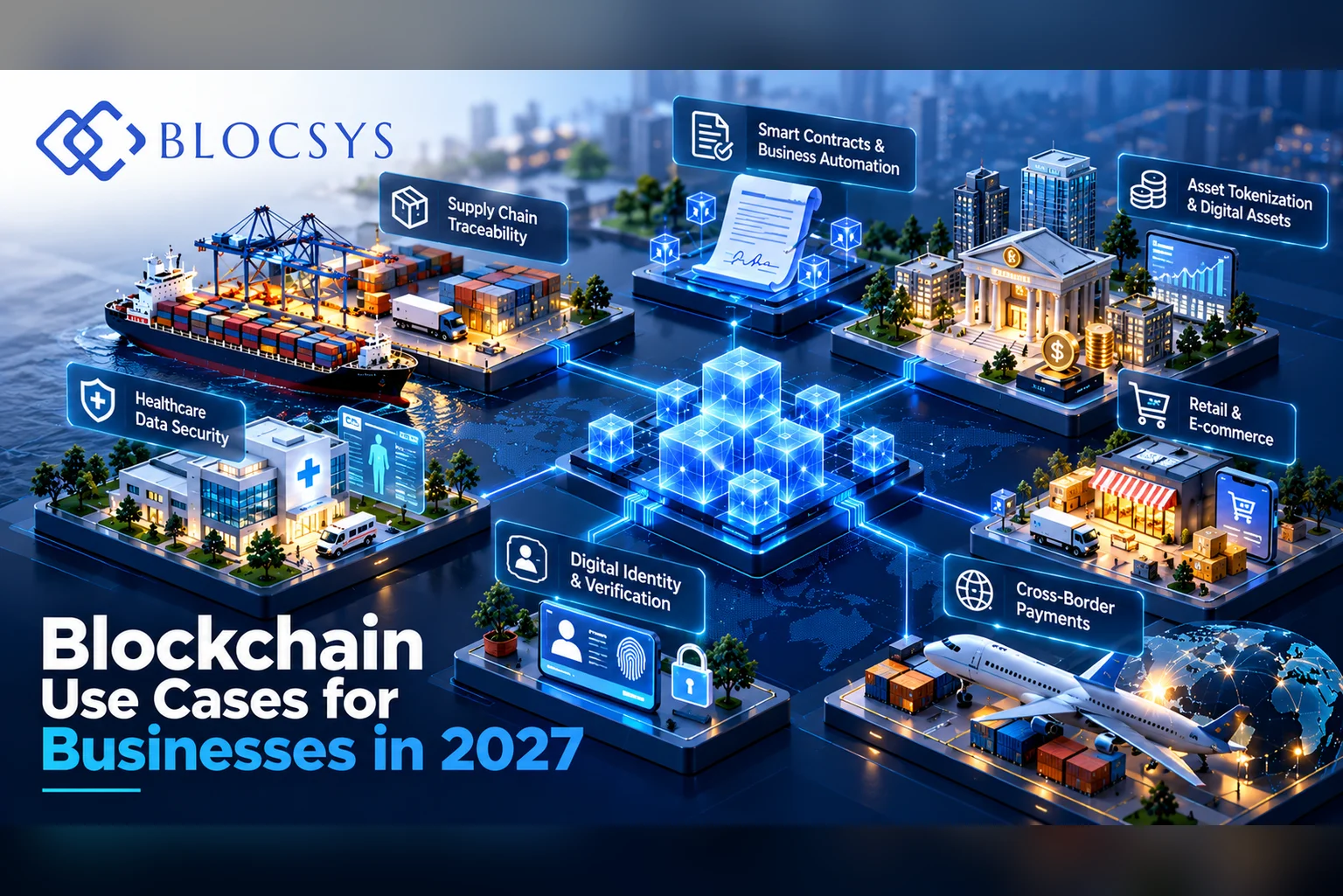
How Businesses Can Use Blockchain Technology in 2027
How can a business actually use blockchain technology? In practice, the real blockchain use cases for businesses in 2027 come down to one thing: letting multiple parties trust the same record without one company controlling it. That’s the actual problem blockchain solves, not hype or speculation. Banks, supply chain operators, fintech founders, and enterprise technology leaders are evaluating it because reconciliation errors, fraud, and data disputes between organizations cost real money every quarter. A blockchain is a shared, append-only ledger that every approved participant can verify independently. You don’t need to understand the cryptography behind it; you need to understand which business processes it actually fixes. This article walks through the practical blockchain use cases for businesses in 2027, where they genuinely help, and where a conventional database still wins. If you’re trying to figure out whether your organization needs a blockchain project at all, here’s a good place to start thinking it through.
1. Blockchain Use Cases for Businesses in 2027: Supply Chain Transparency and Traceability
Supply chains break down when partners can’t agree on what actually happened. A shipment gets delayed, a certificate goes missing, and three companies spend a week emailing spreadsheets to figure out whose record is correct. That’s the business problem. A shared ledger gives every approved participant, from raw material suppliers to retailers, the same version of events: origin, handoffs, customs clearance, and quality checks, all timestamped and visible to whoever has permission to see them.
Picture a coffee exporter, a roaster, and a retail chain. Instead of each one keeping a private record of the same batch, they write to one shared ledger. Nobody has to call anyone to confirm a certification date. That’s a meaningful shift.
However, this only works if the data entering the system is accurate. Blockchain doesn’t verify truth; it preserves whatever gets recorded, permanently and traceably. If a sensor misreads a temperature or a supplier enters the wrong batch number, that error becomes just as permanent as a correct entry. Therefore, businesses considering this route need reliable source data: scanners, IoT sensors, or verified manual checks, before the ledger adds any value. If suppliers won’t participate consistently, a blockchain layer adds overhead without closing the trust gap it’s meant to fix. Blocsys has built dedicated blockchain supply chain traceability systems for manufacturers facing exactly this challenge.
![Blockchain use cases for businesses in 2027 — [Flow diagram showing supply chain traceability on blockchain: Raw Material Scan → Supplier Ledger Entry → In-Transit Verification → Customs/Quality Checkpoint → Retailer Confirmation → Consumer-Facing Audit Trail]](https://s3.blocsys.com/blocsys/blog-images/1791936154283-63de3cc3bfa031bc.webp)
2. Automate Business Processes with Smart Contracts
Smart contracts are simply code that runs automatically when agreed conditions are met. No ambiguity, no manual sign-off chasing. Think of a trade finance agreement where payment releases the moment a shipping document gets verified, or an insurance claim that pays out automatically once a verified data feed confirms a flight delay.
These examples are conceptual illustrations of how the logic works, not case studies of specific deployments. Still, the underlying mechanism is well established: predefined rules, encoded once, executed consistently every time.
Here’s the catch. A smart contract is only as good as its code. Once deployed, it’s difficult to change quietly, and a flawed line of logic can trigger incorrect payments at scale. That’s why rigorous testing, strict access controls, and independent code audits matter more here than in typical software releases. Additionally, smart contracts need careful boundaries around who can trigger them and under what conditions. Teams exploring blockchain development for process automation should treat contract security as a first-class requirement, not an afterthought.
Most smart contract failures we see aren’t exotic hacks. They’re simple logic errors that nobody caught because the team rushed deployment to hit a launch date. Testing time isn’t optional overhead; it’s the actual product.
3. Strengthen Data Sharing and Business Record Management
Multiple organizations often need the same facts but keep separate systems. Banks reconciling trades, hospitals sharing patient referrals, or manufacturers coordinating with auditors all run into this. Each party maintains its own database, and reconciliation becomes a recurring, expensive task.
A shared ledger can replace some of that back-and-forth by giving every permissioned party write access to agreed fields and read access to a common audit trail. Consequently, reconciliation shrinks from a weekly fire drill to a rare exception.
That said, this isn’t automatically better than a well-built centralized database. A conventional system is faster, cheaper to run, and easier to patch when only one organization owns the data. Blockchain earns its place when multiple independent parties need shared visibility and nobody wants to be the single point of control. Document-heavy workflows benefit especially well here, which is why platforms like blockchain document verification systems have gained traction for contracts, certificates, and compliance records.
4. Enterprise Blockchain Solutions in 2027 for Financial Services and Digital Transactions
Financial institutions deal with settlement delays, duplicate reconciliation work, and fragmented records across custodians, clearing firms, and counterparties. Enterprise blockchain solutions in 2027 are mostly being evaluated here because shared ledgers can shorten the gap between a trade happening and all parties agreeing it settled correctly.
Post-trade operations are a good example. When multiple institutions each keep separate books for the same transaction, mismatches are common and expensive to fix. A shared, permissioned ledger lets everyone work from one synchronized record instead of chasing discrepancies after the fact. Blocsys has built permissioned infrastructure addressing exactly this kind of post-trade reconciliation challenge for capital markets.
Tokenized digital assets are part of this picture too, but only as one piece among many, not the whole strategy. Representing an asset or payment right digitally on a ledger can simplify transfer and settlement, provided the underlying legal and custody framework is sound. Regulatory treatment still varies by jurisdiction, so any financial institution moving in this direction needs legal review alongside the technical build, not after it.
![Blockchain use cases for businesses in 2027 — [Flow diagram showing post-trade settlement on a permissioned blockchain: Trade Execution → Shared Ledger Entry → Counterparty Verification → Automated Reconciliation Check → Settlement Confirmation → Regulatory Reporting]](https://s3.blocsys.com/blocsys/blog-images/1791936154456-7b491e2210b5e8c7.webp)
5. Improve Identity Verification and Access Management
Businesses waste significant time re-verifying the same identity facts over and over: KYC checks repeated across departments, credential checks repeated across partners. Blockchain-based identity approaches let a user prove a verified credential, like “this person passed KYC” or “this certificate is genuine”, without re-sharing the raw underlying document every time.
Here’s the important distinction. Sensitive personal data, like a passport number or medical record, generally shouldn’t sit directly on-chain. Instead, the ledger typically stores a cryptographic proof or hash referencing the verified credential, while the actual sensitive data stays in a controlled, access-managed system off-chain. This protects privacy while still letting other parties confirm authenticity.
Key management is the operational weak point here. If a business or individual loses the private key tied to their identity credential, recovery can be genuinely difficult. So before adopting this approach, organizations need a clear key custody and recovery policy, not just the technology itself. Document-proof use cases like this overlap closely with what Blocsys built in its tamper-proof document verification platform.
6. Enable Secure Collaboration Across Business Networks
When suppliers, banks, regulators, and partner firms all need to act on shared information, nobody wants a single vendor controlling the infrastructure. This is where permissioned blockchain networks, as opposed to fully public ones, tend to fit enterprise needs better.
A permissioned network restricts who can join, write, and read specific data, while still giving every member a verifiable, shared record. Governance matters enormously here: who can add new participants, who resolves disputes, and how upgrades get approved across organizations that don’t fully trust each other.
Interoperability is the part businesses underestimate. If your network can’t talk to partner systems, existing ERPs, or other blockchain networks your counterparties already use, you’ve built an isolated island. Consequently, network design and governance planning deserve as much attention as the smart contract logic itself. Organizations building this kind of multi-party infrastructure often need a dedicated blockchain engineering team rather than a single contractor, simply because governance, security, and integration each require different expertise.
How to Decide Whether Blockchain Use Cases Fit Your Business
Not every data problem needs a blockchain. Here’s a practical filter before committing budget to one.
Ask whether multiple independent organizations genuinely need to share and verify the same record. If only your own teams touch the data, a well-managed internal database usually wins on cost and speed. Ask whether reconciliation disputes or audit requirements currently create real operational pain. If nobody’s arguing about whose record is right, blockchain adoption for businesses in 2027 probably isn’t your priority yet.
Also weigh governance and privacy. Who approves new participants? What data must stay private, and what needs to be visible across the network? And consider performance: blockchain networks, especially public ones, are generally slower and costlier per transaction than a centralized database. If you need thousands of transactions per second at low cost, that’s a real constraint, not a minor detail.
Finally, check regulatory exposure early. Financial services, healthcare, and identity-related use cases often carry compliance obligations that shape the entire architecture. Get legal and compliance input before development starts, not during the audit.
![Blockchain use cases for businesses in 2027 — [Decision flow chart for blockchain adoption: Multiple Parties Need Shared Data? → Reconciliation or Trust Problem Exists? → Privacy and Governance Requirements Defined? → Performance Needs Assessed? → Regulatory Review Complete? → Proceed to Architecture Design]](https://s3.blocsys.com/blocsys/blog-images/1791936154657-37c9da836899080d.webp)
What Businesses Should Consider Before Implementing Blockchain in 2027
Once you’ve confirmed blockchain genuinely fits your problem, implementation decisions matter just as much as the initial choice.
Architecture and Network Type
Most enterprise projects land on permissioned blockchain infrastructure rather than fully public networks, mainly for control over participants and data visibility. Choose this early, since it shapes everything downstream.
Security and Smart Contract Review
Smart contracts handling money or legal obligations need independent audits before launch. Skipping this step to save time is a common, costly mistake.
Integration With Existing Systems
Blockchain rarely replaces your ERP, CRM, or core banking system. It usually sits alongside them. Businesses integrating blockchain with existing software need clear APIs and data pipelines connecting the ledger to systems teams already use daily.
Scalability, Regulation, and Ongoing Ownership
Plan for transaction volume growth, not just your pilot’s test load. Review regulatory obligations relevant to your industry and region. And decide, in advance, who inside your organization owns ongoing maintenance, upgrades, and incident response once the system goes live.
Because these decisions span architecture, security, and compliance, most organizations benefit from working with an experienced enterprise blockchain development company rather than building every layer from scratch internally. Enterprise blockchain development services typically combine solution design, smart contract engineering, and systems integration under one accountable team, which reduces the coordination risk of managing separate vendors for each piece.
Conclusion: Turning Blockchain Use Cases for Businesses in 2027 into Practical Solutions
The most useful blockchain use cases for businesses in 2027 share one trait: they solve a specific, measurable coordination problem between parties who don’t fully trust each other. Supply chain traceability, smart contract automation, shared financial records, identity verification, and multi-party collaboration all fit that pattern. A general ledger upgrade for a single internal team usually doesn’t.
Business blockchain applications work best when they start from the problem, not the technology. So resist adopting blockchain because it’s trending in 2027; adopt it because reconciliation costs, fraud risk, or partner trust gaps are actually hurting your business today. If you’ve identified a use case along these lines and want to talk through architecture, integration, and development approach, reach out to the Blocsys team to scope what a realistic build actually looks like for your organization.
Frequently Asked Questions
Here are direct answers to the questions we hear most often about blockchain use cases for businesses in 2027.
How can businesses use blockchain technology in 2027?
Businesses use blockchain to create shared, verifiable records across organizations that don’t fully trust each other. Common applications include supply chain traceability, smart contract automation, financial reconciliation, identity verification, and secure multi-party data sharing.
Which industries can benefit from blockchain technology?
Financial services, supply chain and manufacturing, healthcare, insurance, and identity-heavy sectors benefit most. Each deals with multiple parties needing the same verified records, which is exactly the coordination problem blockchain addresses well.
What are the most practical blockchain use cases for businesses?
Supply chain traceability, smart contract-based settlement, shared audit trails, identity credential verification, and permissioned data sharing between partner organizations are the most practical, well-understood applications today.
Is blockchain suitable for small businesses?
It can be, but only if a small business regularly shares verified records with outside partners, like suppliers or auditors. If operations stay entirely internal, a conventional database is usually simpler and cheaper.
When should a business use blockchain instead of a conventional database?
Choose blockchain when multiple independent organizations need to trust the same data without a single controlling party. If one team or company owns all the data, a standard database remains faster and more cost-effective.
How can blockchain improve supply chain transparency?
Blockchain gives every approved supply chain participant the same timestamped record of a product’s journey. This reduces disputes over shipment history, provided the data entered at each step is accurate and verified.
Can blockchain integrate with existing business software?
Yes. Blockchain typically works alongside existing ERP, CRM, or core systems through APIs rather than replacing them. Successful integration requires clear data pipelines connecting the ledger to the tools your teams already use.
How do smart contracts help businesses automate processes?
Smart contracts execute predefined actions automatically once agreed conditions are met, such as releasing payment after document verification. This removes manual approval delays, though contracts need thorough testing before handling real transactions.
What security and compliance issues should businesses consider before adopting blockchain?
Businesses should review smart contract audit requirements, key management and recovery policies, data privacy obligations, and industry-specific regulations. Legal and compliance review should happen during design, not after development finishes.
How can a business choose the right blockchain development partner?
Look for a partner offering solution architecture, smart contract security review, and systems integration experience together, not just coding support. Enterprise blockchain development services with a track record across your industry reduce implementation risk significantly.
Ready to move beyond theory and build an intelligent platform that delivers real-world value? Blocsys Technologies specialises in engineering enterprise-grade AI and blockchain solutions for the fintech, Web3, and digital asset sectors. Connect with our experts today to discuss your vision and chart a clear path from concept to a secure, scalable reality.
