


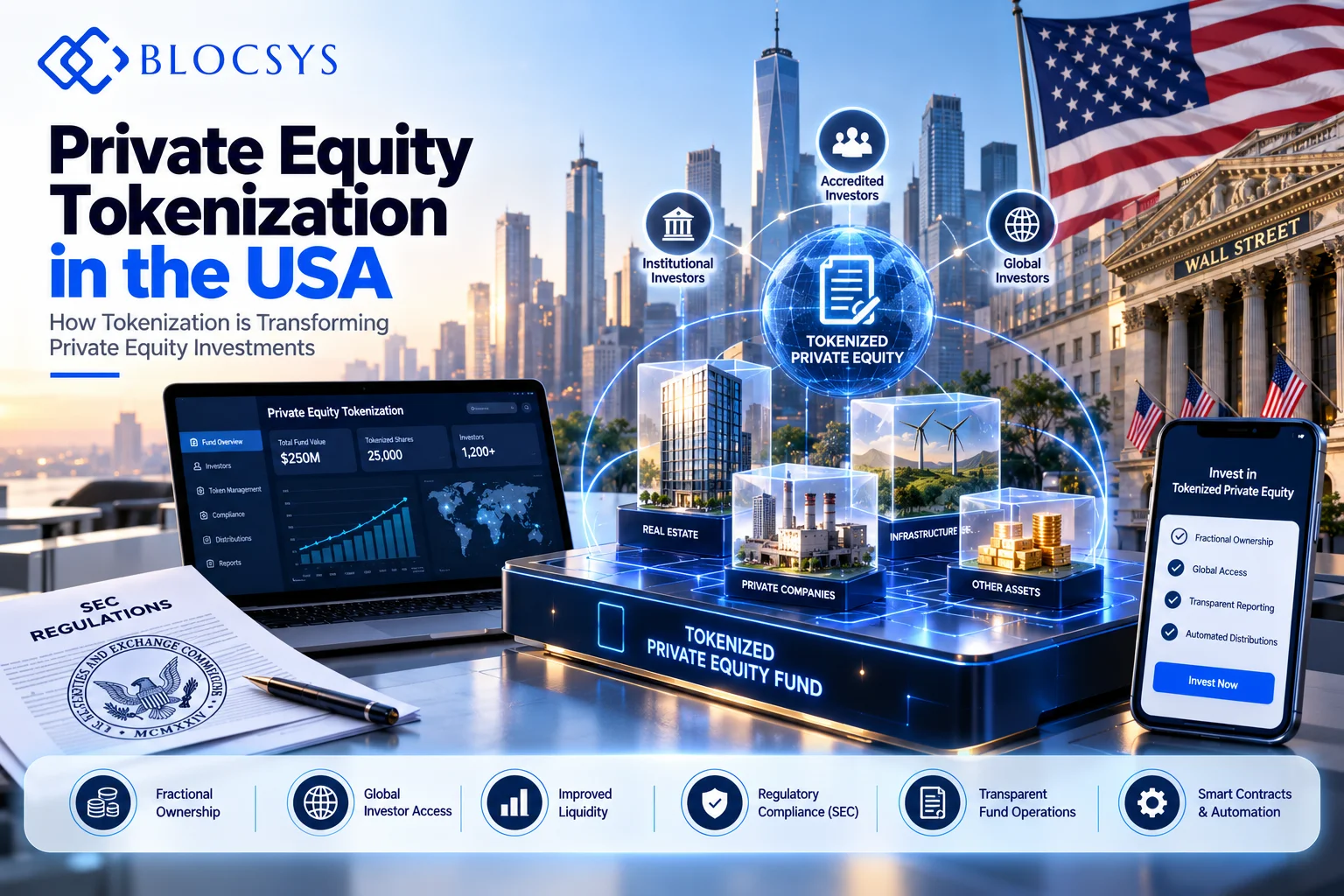
Private Equity Tokenization in the USA: How Businesses Can Issue and Manage Digital Shares
Private equity tokenization in the USA is moving from a conference-stage concept to a real operational question for founders, CFOs, and fund managers. If you’re asking whether your company’s shares could live on a blockchain, you’re not alone — and you’re asking the right question before touching any code. This article walks through how tokenized equity actually works, what US rules apply, and what a real platform needs to do day-to-day. We’ll also point out where a partner like Blocsys’s equity tokenization platform development services fit into the picture, without pretending tokenization is the right move for every private company.
Let’s start with the plain-English version. Private equity tokenization means representing ownership of a private company’s shares as digital tokens on a blockchain, instead of (or alongside) paper certificates or a spreadsheet-based cap table. That’s it. It sounds simple, but here’s the catch: turning a share into a token doesn’t change what the share legally is. The stock remains a security. Your obligations under US securities law don’t disappear just because the record now lives on a distributed ledger. Tokenization changes the format and the management layer of ownership — not the underlying legal rights baked into your governing documents.
How Private Equity Tokenization Works
Tokenized private equity starts with a legal decision, not a technical one. A company first defines the equity interest it wants to issue — common stock, preferred stock, or an interest in an SPV that holds the underlying shares. Only after that structure is settled does the token design come into play. Consequently, skipping this step and jumping straight to smart contracts is one of the most common mistakes we see.
Once the structure is set, the issuer deploys a smart contract that represents the share class on-chain. Each token is tied to a specific number of shares, and the contract enforces rules such as who can hold the token and under what conditions it can move. Investors go through onboarding and verification, then receive tokens into a wallet once they’re approved and funds settle. From there, the platform records ownership, tracks transfers, and keeps a running ledger of who holds what.
The token is never the security itself — it’s a representation of rights the security already carries. If the legal documents and the token logic disagree, the legal documents win every time.
It’s worth drawing a sharp line here between two very different things. An issuer-sponsored equity token is created directly by the company (or its transfer agent) and tied to actual shares on the company’s register. A third-party synthetic product, by contrast, might track the price of a private company’s stock without granting any direct ownership, voting rights, or claim on the underlying asset. Confusing these two models is a real risk for investors and issuers alike, and it’s exactly the kind of distinction the SEC has flagged in its public guidance on tokenized securities.
![Private equity tokenization in the USA — [Flow diagram showing private equity tokenization process: Define Legal Structure → Select Offering Exemption → Deploy Smart Contract → Investor Onboarding and Verification → Token Issuance → Ownership Recorded on Digital Shareholder Register]](https://s3.blocsys.com/blocsys/blog-images/1792022515390-5d8b863cdc01408f.webp)
How US Businesses Can Prepare to Issue Tokenized Shares
Before any token gets minted, a private company needs corporate authorization — board approval, updated bylaws if needed, and clarity on which share class is being tokenized. Governing documents should explicitly contemplate digital representation of shares, including how the digital register interacts with the company’s official books.
Next comes the securities-law question, and this is where most of the real work happens. A tokenized offering is still an offering. It has to be registered with the SEC or fit within an available exemption, based on the specific facts of the deal. Regulation D, Regulation A, and Regulation Crowdfunding are not interchangeable — each has different investor eligibility rules, disclosure obligations, and resale restrictions, and not every pathway is available to every company. The SEC’s January 2026 staff statement on tokenized securities makes clear that tokenizing a security doesn’t remove it from existing registration or exemption requirements.
Here’s a short, practical gut-check list before you move forward:
- Which legal entity actually issues the shares, and does it match the entity named on the token contract?
- What specific rights — voting, dividends, information rights — does each token represent?
- Which offering exemption applies, and what does it require for investor eligibility and disclosure?
- How will transfer restrictions under that exemption be enforced technically, not just contractually?
These aren’t rhetorical questions. They determine almost everything about platform design later. Therefore, legal counsel and your technical team should be in the same room from day one, not working in sequence.
Essential Features of a Private Equity Tokenization Platform
A working private equity tokenization platform needs several components working together, not just a token contract sitting on a blockchain. Investor onboarding comes first: identity verification, accreditation checks where required, and eligibility screening tied to the offering exemption you’ve chosen.
Issuance management follows — tools for minting tokens against approved share allocations, setting lock-up periods, and defining who’s allowed to hold which class of token. The platform also needs a digital shareholder register that stays synchronized with actual ownership, acting as the single source of truth for who owns what, when they acquired it, and under what terms.
Transfer restriction logic sits inside the smart contract itself in many designs, blocking a trade automatically if the receiving wallet hasn’t been verified or isn’t eligible under the relevant exemption. However, smart contracts can’t do everything. Dispute resolution, lost-credential recovery, and corrections to the register typically still require off-chain administrative processes with clear authority over the final record.
Reporting rounds out the list — cap table snapshots, transaction history for audits, and investor communications tools. A platform like Blocsys’s asset tokenization platform infrastructure is built around exactly this combination of on-chain enforcement and off-chain administrative control, rather than treating the blockchain as the whole system.
Managing Shareholder Rights, Transfers, and Corporate Actions
Think about a realistic scenario. A private company approves a new share issuance to ten accredited investors under Regulation D. The platform verifies each investor’s accreditation, mints tokens against their allocation, and updates the digital shareholder register automatically. Later, one investor wants to transfer shares to a family trust. The platform checks whether the trust qualifies as an eligible holder, requires administrative approval, then records the transfer and updates the register — all before the transfer is considered final.
Now picture a shareholder vote. The platform can pull eligible token holders from the register, issue voting tokens or permissions tied to the vote, and tally results transparently. That said, the platform only reflects the voting rights actually granted by the shares’ governing documents — it doesn’t create rights that weren’t there to begin with. The same goes for dividends or distributions: tokenization can automate the calculation and payment workflow, but the underlying entitlement comes from the security itself, not from the token wrapper.
Corporate actions — stock splits, buybacks, conversions — need a clear process for who initiates the change, how it’s approved, and how the register reflects it afterward. An audit trail matters here more than almost anywhere else, since regulators, auditors, and investors will all eventually want to see exactly what happened and when.
![Private equity tokenization in the USA — [Flow diagram showing shareholder transfer approval: Transfer Request Submitted → Eligibility Check Against Register → Compliance Review → Approval or Rejection → Digital Shareholder Register Updated → Confirmation Sent to Both Parties]](https://s3.blocsys.com/blocsys/blog-images/1792022515017-313772c141a75daa.webp)
Security, Compliance, and Technology Considerations for Private Equity Tokenization in the USA
Wallet and private key management deserve serious attention. If an investor loses access to their wallet, there needs to be a defined recovery process that doesn’t depend on hoping nothing ever goes wrong. Role-based access control matters just as much on the administrative side — not everyone on your team should be able to mint tokens or approve transfers.
Smart contract code should go through independent testing and auditing before it touches real investor money. Bugs in a contract that enforces transfer restrictions aren’t a minor inconvenience; they’re a compliance failure waiting to happen. Services such as Demat 2.0, tokenization and CBDC integration work illustrate how this kind of infrastructure is evolving alongside traditional securities record-keeping, rather than replacing it outright.
Here’s something founders often get wrong: sensitive investor information — social security numbers, bank details, full KYC files — generally shouldn’t sit directly on a public or even permissioned blockchain. Store that data off-chain in a properly secured database, and reference it through hashed identifiers on-chain instead. This protects investor privacy and keeps you aligned with data protection expectations. Ongoing maintenance, patching, and monitoring need a named owner too, because a platform left unmaintained after launch becomes a liability fast.
How to Choose a Private Equity Tokenization Development Partner
Not every blockchain developer understands securities workflows, and not every securities-focused firm understands smart contracts. You need both. When evaluating a development partner, ask about their track record with financial-services clients specifically, not just blockchain projects in general.
Look for configurable compliance workflows rather than rigid, one-size-fits-all logic — your offering exemption and investor base will shape the rules, and the platform needs to adapt. Ask how they handle integration with existing cap table tools, banking rails, and KYC providers, since a tokenization platform rarely operates in isolation. Documentation and post-launch support matter more than most buyers expect; you’ll need to update rules, fix issues, and onboard new investor cohorts long after the initial build. Firms experienced in real world asset tokenization and able to hire real world asset tokenization developers into your project on demand tend to handle this kind of scaling more smoothly than a one-off contractor.
Conclusion: Building a Private Equity Tokenization Platform in the USA
Private equity tokenization in the USA sits at the intersection of corporate law, securities compliance, and software architecture. Getting it right means settling your legal structure first, choosing an applicable offering exemption with qualified counsel, and only then designing the technology that enforces those rules. A digital shareholder register, proper transfer controls, and a clear separation between on-chain and off-chain data aren’t optional extras — they’re the backbone of a platform that actually holds up under scrutiny.
If your company is evaluating private equity tokenization in the USA as a real project rather than a future idea, start by mapping your legal requirements before you pick any technology. From there, Blocsys’s equity tokenization platform development team can talk through platform architecture, investor onboarding workflows, smart contract design, and how everything integrates with your existing systems. That conversation costs you nothing and saves you from building the wrong thing twice.
Frequently Asked Questions
Here are direct answers to the questions we hear most often about private equity tokenization in the USA.
What is private equity tokenization?
It’s the process of representing ownership of a private company’s shares as digital tokens on a blockchain. The token reflects rights defined by the underlying security and governing documents — it doesn’t create new rights on its own.
How can a private company tokenize its shares in the USA?
The company defines its share class, secures corporate authorization, selects an applicable securities registration or exemption pathway, then builds or licenses a platform to issue, onboard investors, and maintain the digital shareholder register accordingly.
Are tokenized private shares considered securities under US law?
Generally, yes. Tokenizing a security doesn’t remove its status as a security or eliminate registration and disclosure obligations. The SEC has stated that existing securities laws continue to apply to tokenized offerings.
Do tokenized shares provide the same shareholder rights as traditional shares?
Only if the governing documents and security terms grant those rights. Tokenization doesn’t automatically confer voting rights, dividends, or unrestricted transferability — those outcomes depend entirely on the underlying legal structure.
Which US securities requirements should businesses evaluate before issuing tokenized equity?
Companies should evaluate whether Regulation D, Regulation A, Regulation Crowdfunding, or full registration applies, based on their specific facts. Each pathway differs in investor eligibility, disclosure, and resale restrictions, so case-specific legal review is essential.
What features should a private equity tokenization platform include?
Core features include investor onboarding and verification, issuance management, a digital shareholder register, transfer restriction enforcement, role-based permissions, corporate actions support, and audit-ready reporting across the full ownership lifecycle.
How are investor eligibility and share transfer restrictions managed?
Smart contracts can enforce eligibility rules automatically, blocking transfers to unverified or ineligible wallets. However, disputes, corrections, and edge cases typically still require off-chain administrative review tied to the official shareholder register.
Can tokenized private shares be traded on a secondary market?
Not automatically. Secondary trading depends on the offering exemption used, applicable resale restrictions, and whether an eligible trading venue or intermediary exists. Many private tokenized shares remain restricted from open secondary trading.
How can businesses protect investor information and secure tokenized share records?
Sensitive investor data should generally stay off-chain in secured databases, referenced on-chain through hashed identifiers. Combine this with role-based access control, audited smart contracts, and ongoing security monitoring of the platform.
How can a business choose a private equity tokenization platform development partner?
Prioritize partners with financial-services experience, proven smart contract development, configurable compliance workflows, integration expertise with existing systems, and a track record of ongoing post-launch support rather than one-time builds.
Ready to move beyond theory and build an intelligent platform that delivers real-world value? Blocsys Technologies specialises in engineering enterprise-grade AI and blockchain solutions for the fintech, Web3, and digital asset sectors. Connect with our experts today to discuss your vision and chart a clear path from concept to a secure, scalable reality.
