
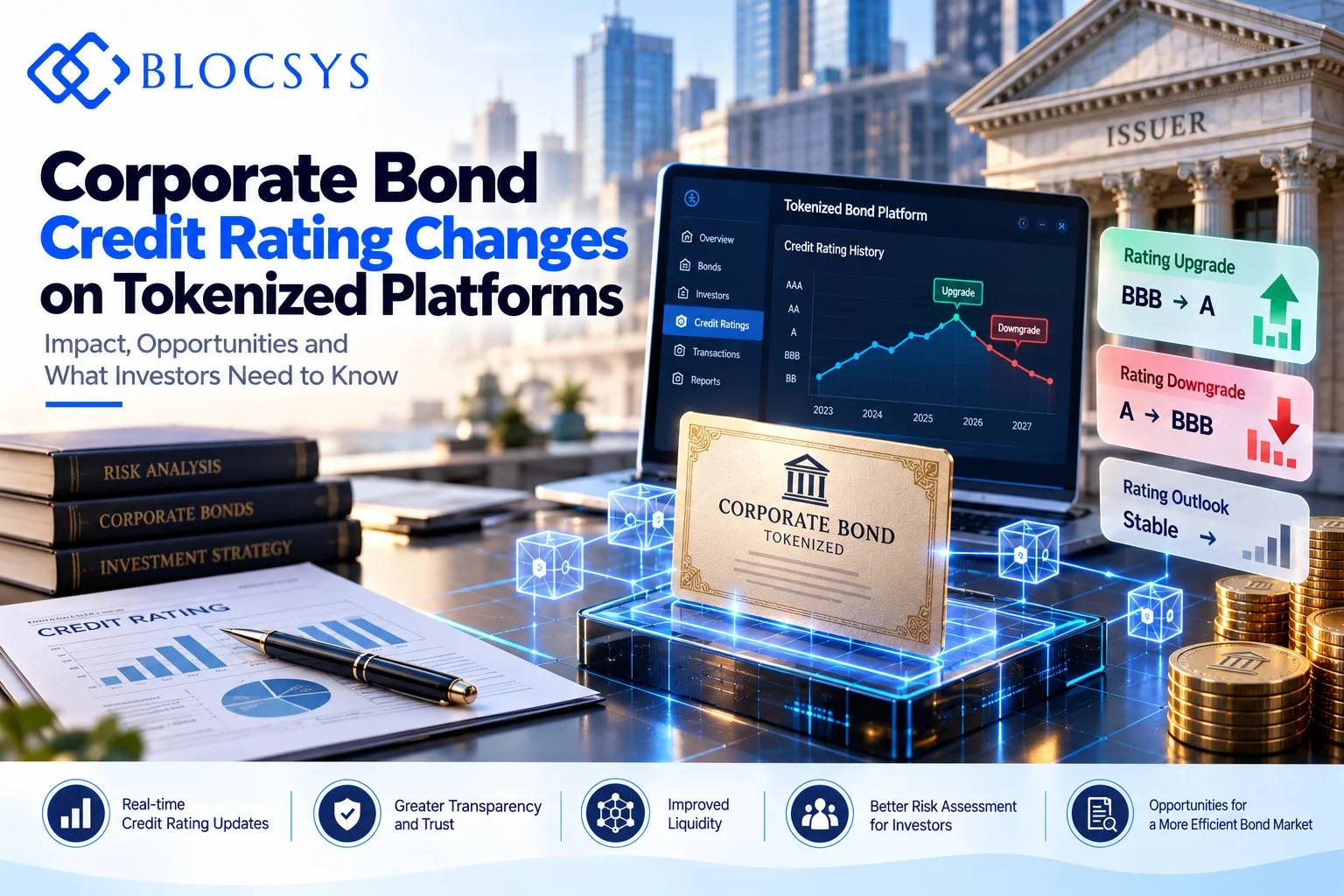
How Tokenized Corporate Bond Platforms Should Handle Credit-Rating Changes
A rating agency revises an issuer’s outlook on a Tuesday afternoon. Your tokenized bond ledger still shows the old rating on Wednesday morning. That gap, however small, is the real operational problem behind corporate bond credit rating changes on digital asset platforms. It’s not about whether blockchain can “handle” ratings — it’s about building a workflow that ingests, validates, records, and surfaces rating updates without breaking trust in your tokenized corporate bond platform. This piece is for the engineering and product leaders who have to design that workflow, not for readers who need ratings explained from scratch.
Why Corporate Bond Credit Rating Changes Are a Platform Design Problem
Most teams treat credit ratings as reference data — something fetched once and cached. That assumption breaks down fast. A rating isn’t static; it’s an event stream. Agencies publish upgrades, downgrades, outlook revisions, and watch placements on their own schedules, not yours. Consequently, your platform needs a process for continuous rating monitoring, not a one-time lookup at issuance.
Here’s the catch: tokenized records are expected to be dependable sources of truth. If a bond token’s metadata shows a rating that’s three weeks stale, investors and compliance teams notice. Therefore, corporate bond credit rating changes need the same operational rigor you’d apply to coupon payments or redemption events — detection, verification, and a clear record of what changed and when.
Treat a rating update like a corporate action, not a metadata edit. If you wouldn’t let an unverified source move a coupon date, don’t let one silently move a rating field either.
How Corporate Bond Credit Rating Changes Enter the Platform Workflow
Rating data typically reaches a platform through one of a few channels. Some institutions subscribe to feeds or APIs from agencies such as CRISIL, ICRA, CARE, or India Ratings. Others rely on data vendors who aggregate and normalize agency output. Many platforms, particularly smaller ones, still pull updates manually from agency press releases or issuer disclosures.
Each path carries different trade-offs. A direct feed gives you timeliness but adds vendor dependency and contract overhead. A manual process is cheaper to start but doesn’t scale once you’re tracking dozens of issuers. Credit rating data integration, in other words, isn’t a single technical decision — it’s a sourcing decision with operational consequences attached.
Under SEBI’s framework for credit rating agencies (SEBI Credit Rating Agencies Regulations, 1999, as amended), agencies must disclose rating actions and maintain rating rationale on their websites, which gives platforms a verifiable public reference point even without a paid feed. That said, we haven’t found evidence that SEBI mandates a specific technical integration method for downstream platforms — the obligation sits with agencies to disclose, not with platforms to ingest in any particular way.

Direct Integration Versus Intermediary Workflows
Direct agency integration sounds appealing on a slide deck. In practice, most mid-size platforms route through a data vendor or an internal operations team that reviews agency publications before anything touches the ledger. That intermediary step isn’t inefficiency — it’s a checkpoint. Automated feeds can misfire, duplicate, or arrive with formatting errors. A human or rules-based review layer catches what a raw API call won’t.
Validating Corporate Bond Credit Rating Changes Against Issuer and Bond Records
Ingestion is only half the job. Before any update touches a bond’s record, your system needs to confirm three things: that the rating belongs to the correct legal entity, that it applies to the correct instrument, and that the effective date is accurate.
This sounds obvious until you’ve dealt with issuers that have multiple ISINs, subsidiaries with similar names, or ratings issued at the issuer level that don’t automatically map to a specific bond series. A downgrade on the parent company doesn’t always apply identically to every outstanding instrument, especially where structured or secured bonds carry instrument-specific ratings.
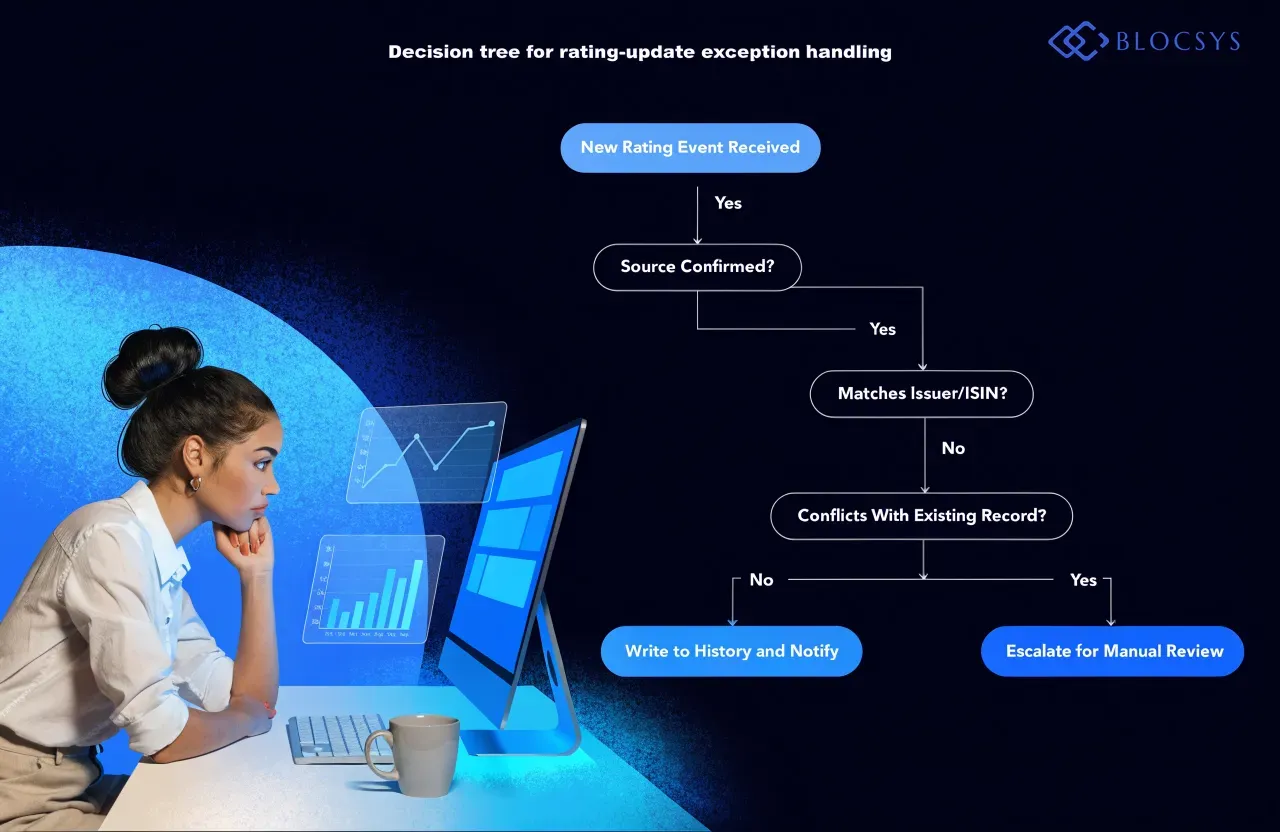
Identifier mismatches are the most common failure point here. Matching on ISIN, not issuer name, reduces ambiguity considerably. Where ISIN isn’t available in the source data — which happens more often with press-release-style disclosures than with structured feeds — your workflow needs a fallback matching step, ideally reviewed by a person before the record goes live.
Source verification matters just as much as matching. A rating mentioned in a news article isn’t the same as a rating confirmed on the agency’s own rationale page. Strong corporate bond rating monitoring practice means tracing every update back to a primary agency source before it’s treated as authoritative, and keeping that source reference attached to the record permanently.
Designing a Reliable Workflow for Corporate Bond Credit Rating Changes
A dependable workflow generally moves through four stages: detection, validation, recording, and exposure. Detection catches the raw event. Validation checks it against issuer and instrument records. Recording writes the confirmed update, with its source and effective date, into the bond’s history. Exposure makes the change visible to the right stakeholders through dashboards, reports, or notifications.
Where this gets architecturally interesting is the on-chain versus off-chain question. Writing every rating change directly on-chain as an immutable event has appeal for auditability. But ratings get corrected, agencies occasionally withdraw actions, and immutable records don’t accommodate correction gracefully. A more workable pattern many platforms use: keep a mutable, well-audited off-chain rating history with full version control, and anchor periodic, confirmed snapshots or hashes on-chain for integrity verification. That way, you get tamper-evidence without locking yourself into unchangeable bad data.
Moreover, this is where credit rating integration for tokenized bonds differs meaningfully from traditional bond administration. A traditional registrar can quietly correct a data entry error. A platform anchoring hashes on a shared ledger needs a defined correction process — a new, clearly superseding record, not a silent overwrite.
Managing Delays, Corrections and Conflicting Rating Data
Rating data isn’t always clean. You’ll encounter four recurring scenarios, and each needs its own handling path rather than a single generic exception rule.
- Delayed updates: an agency publishes an action days before your feed or operations team picks it up. Your record should show both the agency’s effective date and your platform’s recorded date, so the lag is traceable rather than hidden.
- Corrected announcements: an agency retracts or amends a rating action. The original entry stays in history, marked superseded, with the correction recorded as a new event — never a deletion.
- Conflicting sources: a vendor feed and a manual check disagree. Treat the primary agency source as the tiebreaker, and flag the conflict for review rather than auto-resolving it.
- Unavailable data: an issuer temporarily has no updated rating, perhaps during a withdrawal period. Mark the field explicitly as “not currently rated” instead of leaving stale data displayed as current.
None of these scenarios are edge cases you can defer to “later.” Realistically, they’re the majority of what an operations team deals with week to week. A platform that only designed for the clean-update happy path will struggle here.
Rating History, Audit Trails and Stakeholder Notifications
Every confirmed rating change should leave a permanent, timestamped entry: what changed, from what to what, the source, the effective date, and who or what approved it. This history matters for two separate audiences — internal compliance teams reconstructing a bond’s rating trajectory, and external parties checking whether disclosures were timely.
Notifications are where platforms tend to overcorrect. Not every rating change warrants the same alert to the same audience. An outlook revision on a small holding might only need to appear in a routine report, while a multi-notch downgrade on a large position likely needs an immediate alert to risk and compliance teams. Building tiered notification logic — rather than one blanket “rating changed” email — keeps the signal useful instead of generating alert fatigue.
This connects directly to broader corporate bond risk monitoring. Rating history isn’t just a compliance artifact; it feeds risk dashboards, concentration reports, and portfolio reviews. Platforms that treat rating records as reconciled, auditable data — similar in spirit to the reconciliation discipline used in post-trade settlement infrastructure — tend to handle regulatory review far more smoothly than those treating ratings as a cosmetic field.
We should be clear about one thing: a rating downgrade does not, by itself, automatically trigger a contractual or settlement action on a tokenized bond. Whether a downgrade affects covenants, step-up coupons, or early redemption depends entirely on the specific bond’s terms. A platform can flag a change and notify stakeholders; it shouldn’t assume a universal consequence that isn’t written into the instrument.
Technical Decisions Before Implementing Rating Integration
Before committing to a build, a few decisions deserve real scrutiny rather than default answers.
Source reliability. Will you rely on a licensed data vendor, a direct agency relationship, or manual capture? Each has a different cost and latency profile, and your choice should match how actively you actually trade or monitor the affected bonds.
Access and permissions. Who can approve a rating update before it’s written to the ledger? A single-approver model is faster; a two-person review is safer. For a regulated instrument, safer usually wins.
Monitoring and alerting on the integration itself. Feeds go down. APIs change their schema without warning. Your platform needs monitoring on the rating pipeline, not just on the ratings it carries — otherwise a silent feed failure looks identical to “no rating changes happened.”
Reconciliation cadence. Even with automated feeds, periodic manual reconciliation against agency publications catches drift that automation alone misses.
These decisions are easier to make correctly with an experienced team that’s dealt with regulated data pipelines before. If you’re scoping this internally, working with dedicated blockchain engineering teams that understand both tokenized securities infrastructure and financial data governance tends to shorten the number of costly redesigns.
Conclusion: Building Reliable Credit-Rating Workflows for Tokenized Bonds
Handling corporate bond credit rating changes well isn’t about chasing the fastest possible feed. It’s about disciplined validation, honest handling of delays and corrections, a history that can’t be quietly edited, and notifications sized to the actual risk involved. Get those four right, and the rest of your tokenized securities infrastructure benefits — because reliable rating data strengthens every downstream process built on top of it.
If you’re building or re-architecting a tokenized corporate bond platform and want rating-event handling designed in from the start rather than bolted on later, that’s a conversation worth having before your first issuance, not after your first downgrade.
Frequently Asked Questions
Here are direct answers to the questions we hear most often about corporate bond credit rating changes on tokenized platforms.
How do credit rating changes affect a tokenized bond’s on-chain record?
A rating change updates the bond’s reference data, not its token supply or ownership structure. Most platforms keep detailed rating history off-chain with periodic hashes anchored on-chain, so the record stays auditable without making corrections impossible.
Can a platform verify a rating update without a paid agency feed?
Yes. Agencies publish rating rationale and actions on their own public websites under SEBI disclosure norms. A manual or semi-automated check against that source is slower than a feed but still verifiable, provided someone logs the source reference.
Is direct integration with rating agencies necessary for every platform?
No. Direct integration suits platforms tracking many issuers at scale. Smaller platforms or those with limited issuer counts often manage reliably with vendor feeds or manual monitoring, provided the validation and history steps are still rigorous.
How should conflicting rating updates from two sources be resolved?
Don’t auto-resolve them. Flag the conflict, treat the primary rating-agency publication as the reference point, and route it to manual review. Auto-resolution logic tends to mask data-quality problems instead of fixing them.
What happens if a rating update is delayed by several days?
Record both the agency’s original effective date and the date your platform actually captured it. This keeps the lag visible in the audit trail instead of making the update look instantaneous when it wasn’t.
Do rating downgrades automatically trigger smart-contract actions?
Not automatically, and not universally. Any consequence — covenant triggers, step-up coupons, early redemption rights — depends on the specific bond’s documented terms. A platform should flag the event; it shouldn’t assume a blanket contractual response.
How should stakeholders be notified of a rating change?
Tier the notifications. Material downgrades on significant holdings justify immediate alerts to risk and compliance teams; minor outlook shifts can sit in routine reporting. One-size-fits-all alerts tend to get ignored over time.
What audit controls matter most for rating data?
Source traceability, timestamped history, and clear separation between original and corrected entries. Reviewers should be able to see exactly what changed, when, from where, and who approved it — without anything being overwritten.
How is a corrected rating announcement handled differently from a new one?
The original entry stays in history marked as superseded. The correction is logged as a distinct new event referencing the one it replaces. Nothing gets deleted — that’s what makes the trail defensible later.
What should a team evaluate before building rating-data integration?
Source reliability, approval permissions, pipeline monitoring, and reconciliation cadence. Teams that skip reconciliation often don’t notice a feed has silently stopped updating until an audit or an investor question surfaces the gap.
Ready to move beyond theory and build an intelligent platform that delivers real-world value? Blocsys Technologies specialises in engineering enterprise-grade AI and blockchain solutions for the fintech, Web3, and digital asset sectors. Connect with our experts today to discuss your vision and chart a clear path from concept to a secure, scalable reality.
