How to Build an Institutional Tokenization Platform: Architecture, Compliance and Scalability
If you’re evaluating institutional tokenization platform development, you’ve probably noticed that most guidance online treats this as three separate problems: pick a blockchain, add some KYC, and scale later. That’s backwards. Institutional tokenization platform architecture, compliance requirements for institutional tokenization platforms, and how institutions can secure digital asset platforms aren’t separate workstreams you bolt together at the end. They shape each other from day one. Decide how to integrate custody with a tokenization platform before you write a line of smart contract code, and you’ll avoid rebuilding your permissioning layer six months in. This article walks through how to design a scalable tokenization platform step by step, from scoping requirements through ongoing operations, including where a platform like corporate bond tokenization infrastructure fits into the bigger picture.
Define Institutional Requirements and Platform Scope
Before anyone touches architecture, you need clarity on what you’re actually tokenizing and for whom. Are you issuing equity, bonds, fund units, carbon credits, or real estate interests? Each asset class carries different ownership rights, settlement conventions, and investor profiles. A corporate bond platform needs coupon schedules and maturity logic; an equity platform needs cap table integrity and voting rights. These aren’t interchangeable problems.
You’ll also need to map your participants early: issuers, transfer agents, custodians, broker-dealers, qualified investors, and sometimes regulators who need read access. Ask yourself who initiates issuance, who approves transfers, and who holds veto rights over corporate actions. Furthermore, think about your business objective. Are you building a platform for a single issuance, or enterprise tokenization infrastructure meant to support dozens of asset classes over years? That single decision changes almost everything downstream, including whether you need multi-tenant architecture from the start.
Institutions exploring real-world asset tokenization often underestimate how much scope definition affects cost and timeline. A narrow, well-defined pilot is cheaper and faster than an ambitious platform with vague requirements. Start narrow, and expand once your governance model is proven.
Designing Institutional Tokenization Platform Architecture: Core Building Blocks
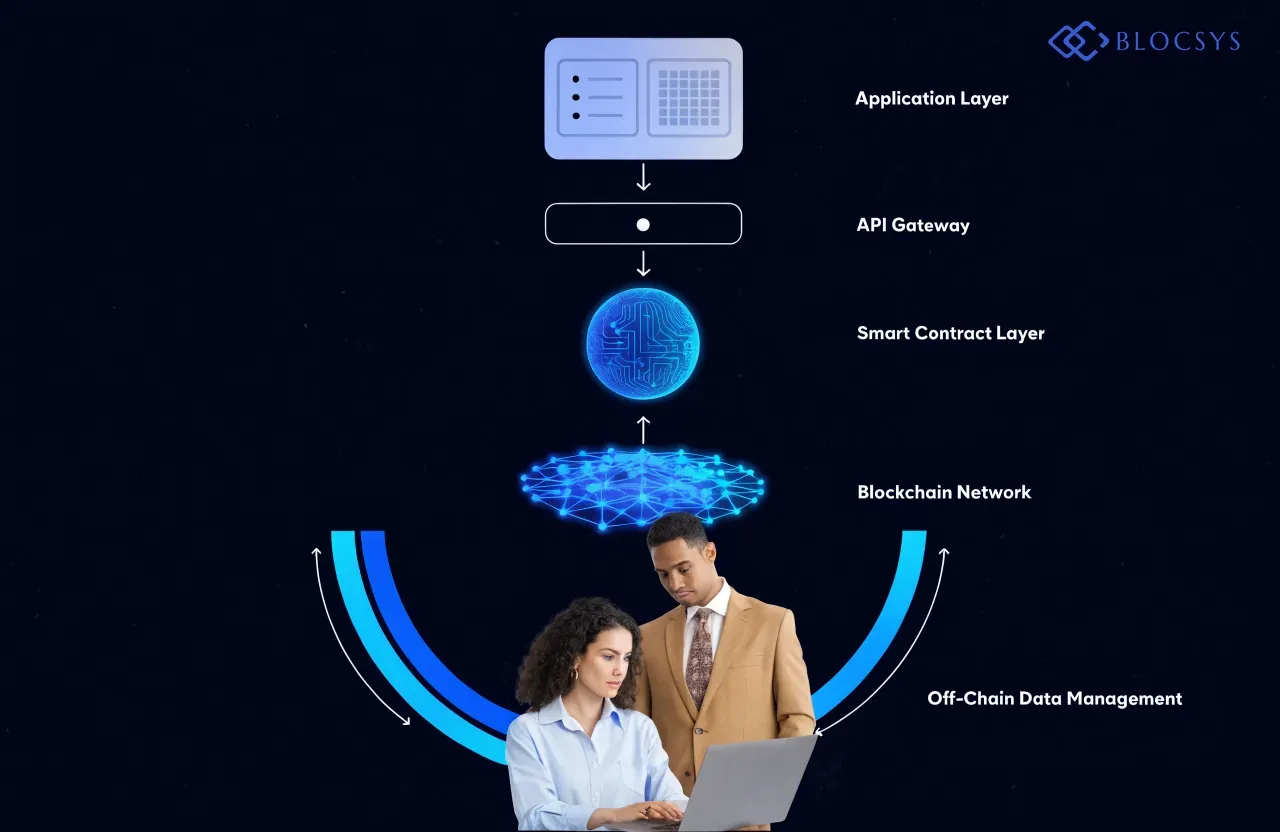
Institutional tokenization platform architecture typically breaks into five layers: the application layer, the blockchain network, smart contracts, APIs, and off-chain data management. The application layer is what issuers, investors, and administrators actually touch — dashboards, onboarding flows, reporting screens. Underneath it sits the blockchain network, which records ownership and transfer events as immutable entries.
Smart contracts encode the rules: who can hold tokens, how transfers execute, what triggers a corporate action. However, smart contracts shouldn’t try to do everything. Off-chain systems handle KYC documents, financial statements, and anything with privacy or storage constraints that don’t belong in a public or even permissioned ledger. APIs connect the two worlds, letting your core banking or portfolio management systems talk to the chain without exposing raw blockchain complexity to end users.
Network choice matters more than people assume. Public networks offer transparency and liquidity potential but limited privacy controls. Private networks give you full control but can isolate you from broader market infrastructure. Permissioned networks — where known validators operate under agreed rules — tend to suit regulated institutions best, since they balance auditability with access control. Whichever you choose, your institutional tokenization platform architecture should let you swap network components later without rewriting the application layer. That modularity is what separates platforms built to last from one-off pilots.
The biggest architecture mistake we see isn’t choosing the wrong blockchain — it’s hardcoding business rules directly into smart contracts that should live in a configurable permissions layer instead. You end up redeploying contracts for changes that should’ve taken an admin console update.
Build Compliance and Investor Management Workflows: Compliance Requirements for Institutional Tokenization Platforms
Compliance requirements for institutional tokenization platforms depend heavily on asset type, jurisdiction, and your platform’s regulatory role. A platform issuing securities in the United States may fall under SEC frameworks; one operating in the UK may need to consider FCA guidance; platforms in the UAE often work within ADGM or VARA frameworks, while Singapore issuers typically reference MAS guidelines. These obligations differ by structure and intent, so don’t assume one jurisdiction’s rules transfer directly to another.
What stays consistent across jurisdictions is the need for investor identity verification, eligibility checks, and transfer restriction enforcement. Your platform should verify accredited or qualified investor status before allowing subscriptions, and it should enforce lock-up periods, jurisdictional restrictions, and ownership caps directly at the smart contract or transfer-agent level. Audit trails matter too — regulators and auditors will want a complete, timestamped record of who held what, when it moved, and under what approval.
Here’s the important caveat: technology enforces rules, it doesn’t create compliance on its own. Your legal counsel defines what the rules should be; your platform executes them consistently. Consequently, institutions evaluating development partners should look for teams that build configurable compliance modules rather than hardcoded assumptions about one regulatory regime.
How Institutions Can Secure Digital Asset Platforms: Security, Custody and Access Controls
How institutions can secure digital asset platforms comes down to layered controls, not a single silver-bullet feature. Start with smart contract security. Every contract handling asset ownership or transfers needs independent auditing against known vulnerability classes — reentrancy, integer overflow, access control bypass — following standards like those published by OWASP and audit frameworks used across the industry. Automated testing catches some issues; manual review by experienced auditors catches the rest.
Key management is where institutional platforms differ sharply from retail crypto products. You’ll want multi-signature or threshold signature schemes for any administrative action, hardware security module (HSM) backed key storage, and strict separation between hot operational keys and cold administrative keys. Role-based access control should govern every administrative function — issuance, freezing accounts, pausing contracts — with no single individual holding unilateral power over investor assets.
Monitoring matters just as much as prevention. Set up real-time transaction monitoring, anomaly detection, and a documented incident response plan before launch, not after an incident forces one. Privacy deserves attention too: permissioned ledgers can still leak sensitive information through transaction patterns, so consider confidential transaction features where your chosen network supports them.
Short version: security isn’t a feature you add later.
How to Integrate Custody With a Tokenization Platform (Plus Payments and Enterprise Systems)
How to integrate custody with a tokenization platform is one of the most practical questions institutions ask, and understandably so — custody determines who actually controls the private keys behind investor holdings. Most institutions choose between self-custody through institutional-grade wallets, third-party qualified custodians, or a hybrid model where the platform manages token logic while a regulated custodian holds keys. Your integration approach should expose clean APIs for balance checks, transfer initiation, and reconciliation, rather than requiring custodians to interact directly with raw blockchain nodes.
Payment integration follows similar logic. Institutions need to connect token issuance and redemption to existing payment rails, whether that’s traditional wire transfers, stablecoins, or tokenized cash equivalents. Reconciliation between on-chain token movements and off-chain cash settlement needs to be automated; manual reconciliation doesn’t scale past a handful of transactions per day.
Finally, think about your enterprise systems. Your tokenization platform likely needs to connect to core banking systems, portfolio management tools, CRM platforms for investor relationships, and reporting infrastructure for regulators or auditors. Building this through well-documented APIs, rather than point-to-point custom integrations, keeps future system changes manageable. Platforms built around asset tokenization platform frameworks generally handle this integration layer as a first-class design concern rather than an afterthought.
How to Design a Scalable Tokenization Platform for Growth and Interoperability
How to design a scalable tokenization platform starts with an honest look at your expected transaction volume, not an assumption that you need blockchain-scale throughput from day one. Most institutional platforms handle issuance events, periodic corporate actions, and investor transfers — volumes that rarely approach the throughput ceilings that public blockchain debates focus on. Still, you should performance-test under realistic peak conditions, like a large redemption event or a bulk investor onboarding batch, before you go live.
Modular architecture is what actually lets you scale without a rebuild. If your smart contract layer, API gateway, and off-chain data systems are cleanly separated, you can upgrade or replace one component without touching the others. This also supports blockchain interoperability — the ability to move assets or data across different networks as your institution’s needs evolve, whether that’s connecting to a new custodian’s preferred chain or supporting a multi-chain issuance strategy.
Operational resilience deserves equal weight. Build redundancy into node infrastructure, plan for network congestion, and avoid unsupported promises about guaranteed transaction speeds — actual performance depends on network conditions, contract complexity, and infrastructure choices that vary by deployment.

Manage the Token Lifecycle and Ongoing Operations
A tokenization platform’s work doesn’t end at issuance. Token lifecycle management covers everything from initial minting through transfers, corporate actions like dividends or coupon payments, redemptions, and eventual retirement of tokens at maturity. Each of these events needs clean recordkeeping that satisfies both your internal reconciliation and any regulatory reporting obligations.
Consider a mid-sized asset manager issuing tokenized fund units. Beyond the initial issuance, they’ll process periodic NAV updates, handle investor redemptions on a rolling basis, and need governance processes for any smart contract upgrades — say, adding a new jurisdiction’s eligibility rules. Without a defined lifecycle management process, these ongoing operations become ad hoc, which is exactly where errors and compliance gaps creep in.
Governance also matters for upgrades. Decide upfront who approves contract changes, how upgrades get tested before production deployment, and how you communicate changes to custodians and investors. Platforms supporting equity tokenization often need more frequent lifecycle updates than debt instruments, given corporate actions like stock splits or voting events.
How to Choose an Institutional Tokenization Development Partner
Selecting an enterprise tokenization platform development services provider is as consequential as any architecture decision you’ll make. Look for demonstrated architecture expertise — ask how they’ve handled permissioned network selection, modular design, and custody integration on past projects, not just whether they’ve “built tokenization before.”
Security practices deserve direct questions too. Do they commission independent smart contract audits? What’s their key management approach? How do they handle incident response planning? Ask for documentation standards as well — a platform without clear technical documentation becomes a maintenance liability the moment your original development team moves on.
Compliance workflow support matters just as much. A tokenization platform development company should understand that they’re building configurable compliance tooling, not making legal determinations themselves. Finally, consider long-term maintenance commitments. Institutional platforms run for years, not months, so ask how the partner handles ongoing upgrades, security patching, and support as regulations and business needs evolve.
Conclusion: Building a Secure and Scalable Institutional Platform
Institutional tokenization platform architecture, compliance, security, and scalability aren’t sequential checkboxes — they’re interconnected decisions that each shape the others. Get your architecture modular from the start, build compliance workflows that adapt across jurisdictions, secure every layer from smart contracts to key management, and integrate custody thoughtfully, and you’ll have infrastructure that can genuinely scale with your institution’s ambitions. Whether you’re planning a single issuance or full enterprise tokenization infrastructure, these decisions compound over time.
If you’re scoping institutional tokenization platform development, including use cases like corporate bond tokenization platform development, it’s worth working through these architecture and compliance decisions with a team that’s handled the integration and security questions before. Blocsys works with institutions on exactly this kind of infrastructure planning and build-out.
Frequently Asked Questions
Here are direct answers to the questions we hear most often about institutional tokenization platform development.
What is an institutional tokenization platform?
It’s infrastructure that lets institutions issue, manage, and transfer digital representations of assets like bonds, equity, or funds on a blockchain network. It combines smart contracts, compliance controls, custody integration, and reporting tools built for regulated, large-scale use rather than retail trading.
How do you build an institutional tokenization platform?
You start by defining asset types, participants, and business goals, then design modular architecture covering the application layer, blockchain network, smart contracts, and APIs. Compliance workflows, security controls, and custody integration get built in parallel, not added afterward.
What components are required in tokenization platform architecture?
Core components include an application layer, a blockchain network (public, private, or permissioned), smart contracts for issuance and transfer logic, APIs connecting on-chain and off-chain systems, and off-chain data management for KYC, documents, and reporting.
How do institutions manage compliance on a tokenization platform?
Through identity verification, investor eligibility checks, enforced transfer restrictions, and detailed audit trails. Requirements vary by asset type and jurisdiction, so platforms need configurable compliance modules rather than one fixed rule set, with legal counsel defining the actual rules.
How should an institutional tokenization platform be secured?
Through layered controls: independently audited smart contracts, multi-signature or HSM-backed key management, role-based access controls, continuous transaction monitoring, and a documented incident response plan established before launch, not after a problem occurs.
How can custody services be integrated with a tokenization platform?
Through clean APIs connecting the platform to self-custody wallets, third-party qualified custodians, or hybrid models. The integration should support balance checks, transfer initiation, and automated reconciliation between on-chain activity and custodial records.
How can a tokenization platform scale as transaction volumes grow?
By using modular architecture that separates smart contracts, APIs, and data layers, so each can be upgraded independently. Institutions should performance-test under realistic peak loads and build redundancy into infrastructure rather than assuming unlimited throughput.
What role do smart contracts play in institutional tokenization?
Smart contracts encode issuance rules, transfer restrictions, and ownership logic directly on-chain. They automate enforcement of eligibility and lock-up rules, but sensitive data and complex business logic typically stay off-chain for privacy and flexibility.
How can a tokenization platform integrate with existing financial systems?
Through well-documented APIs connecting to core banking, portfolio management, CRM, and reporting systems. This avoids fragile point-to-point integrations and keeps reconciliation between on-chain and off-chain records automated and consistent.
How should institutions evaluate a tokenization platform development partner?
Check their architecture and security track record, smart contract audit practices, documentation standards, and experience supporting configurable compliance workflows across jurisdictions. Also confirm their commitment to long-term maintenance, since institutional platforms operate for years.
Ready to move beyond theory and build an intelligent platform that delivers real-world value? Blocsys Technologies specialises in engineering enterprise-grade AI and blockchain solutions for the fintech, Web3, and digital asset sectors. Connect with our experts today to discuss your vision and chart a clear path from concept to a secure, scalable reality.