
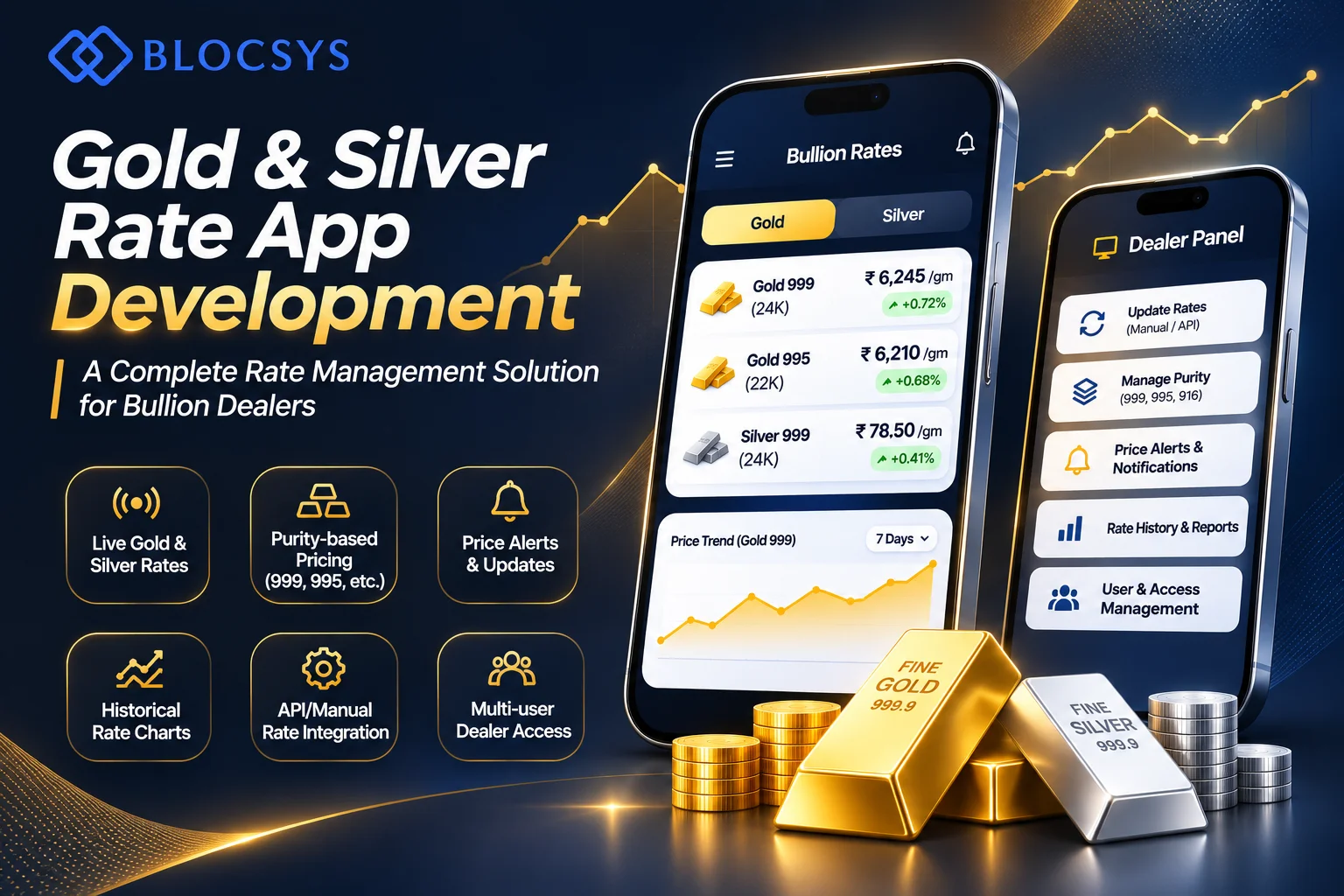
Gold and Silver Rate App Development for Bullion Dealers: Essential Features
Walk into any bullion trading office in India and you’ll still hear phones ringing non-stop. Dealers shout out rates, customers call back to confirm, and WhatsApp groups buzz with the day’s gold and silver prices. It’s worked for decades, but it’s slow, and it’s hard to scale once your customer base grows beyond a city or two. That’s exactly why more bullion businesses are exploring Gold and Silver Rate App Development for Bullion Dealers as a way to publish prices directly, consistently and under their own brand.
This article focuses specifically on what goes into building a gold and silver rate application. We won’t cover broader bullion trading platforms or city-wise rate management here. Instead, we’re looking closely at the features, pricing logic and technical pieces that matter when you’re planning your own branded rate app.
Introduction: Why Bullion Dealers Need Their Own Gold and Silver Rate Application
Traditional rate-sharing methods have real limits. Phone calls tie up staff. WhatsApp broadcasts get lost in crowded group chats. Websites often require a manual refresh and don’t always reach customers on the move. Consequently, many dealers end up repeating the same rate information several times a day across different channels.
A dedicated application changes that equation. Customers open the app, see the current rate, and move on. There’s no back-and-forth needed just to check today’s price. Moreover, a branded app keeps your business name in front of customers every time they check gold or silver prices, which plain WhatsApp forwards simply can’t do.
In bullion trading, the business that controls how fast and how clearly it communicates price changes usually keeps customers more engaged than one relying purely on verbal rate calls.
What Is Gold and Silver Rate App Development for Bullion Dealers?
Gold and Silver Rate App Development for Bullion Dealers refers to building a mobile or web application that displays current gold and silver prices, organised by purity, weight and dealer-specific margins. The app pulls pricing data, processes it according to business rules, and presents a final rate to customers.
It’s important to be clear about what this type of app is and isn’t. A rate-display application shows prices. It doesn’t execute trades, hold customer funds or manage digital gold holdings. A bullion trading application, by contrast, handles order placement and settlement. A digital gold investment platform lets customers buy and store gold value digitally. These are different products with different regulatory and technical considerations.
If your goal is simply to get accurate, branded pricing in front of customers, a rate-focused build through digital gold and silver app development is a more focused and achievable starting point than a full trading platform.
Why Should Bullion Dealers Develop a Custom Gold and Silver Rate App?
The honest answer: convenience and control. Custom app development doesn’t guarantee more sales or new customers. What it does offer is a faster, more reliable way to reach the customers you already have.
Here’s what a custom rate application typically improves for an existing bullion business:
- Direct communication without depending on third-party rate-sharing apps
- Faster rate updates reaching customers at the same time
- Consistent branding across every customer touchpoint
- Reduced manual effort spent repeating rates over calls
- A record of rate history that both dealer and customer can refer back to
Think of it as an extension of relationships you’ve already built, not a replacement for them. Your existing customers still trust your rates because they trust you; the app just makes accessing those rates easier.
Essential Features of a Gold and Silver Rate Application
So, what should go into a bullion rate app? Below are the features that matter most, based on actual dealer workflows rather than generic app checklists.
Live Gold and Silver Rate Display
This is the core of any Gold Rate App Development project. Customers need to see today’s gold rate and silver rate clearly, without digging through menus.
Purity-Based Pricing
Indian bullion dealers commonly trade in 995 and 999 purity categories. Your app should let you configure and display rates separately for each.
Buy and Sell Rate Display
Many dealers quote different buy and sell prices. The app needs clear buy and sell rate management so customers aren’t confused about which figure applies to them.
Manual and Automated Rate Updates
Some dealers prefer manual gold rate updates to retain full control. Others want automated rate synchronisation from a market data source. A well-built app supports both.
Gold and Silver Price History
Customers often ask how today’s rate compares to last week. A simple price history view answers that without another phone call.
Price Alerts and Notification System
A gold rate notification system can alert customers when prices move, so they don’t need to keep checking manually.
Customer Registration
Registered users can receive personalised rate notifications and, if needed, dealer-specific gold rates rather than a single public rate.
Admin Dashboard
Every rate app needs a bullion admin dashboard where authorised staff manage pricing, purity categories and user access.
Not every business needs every feature on day one. A smaller dealer might start with live rates and manual updates, then add alerts and dealer-specific pricing later as the customer base grows.
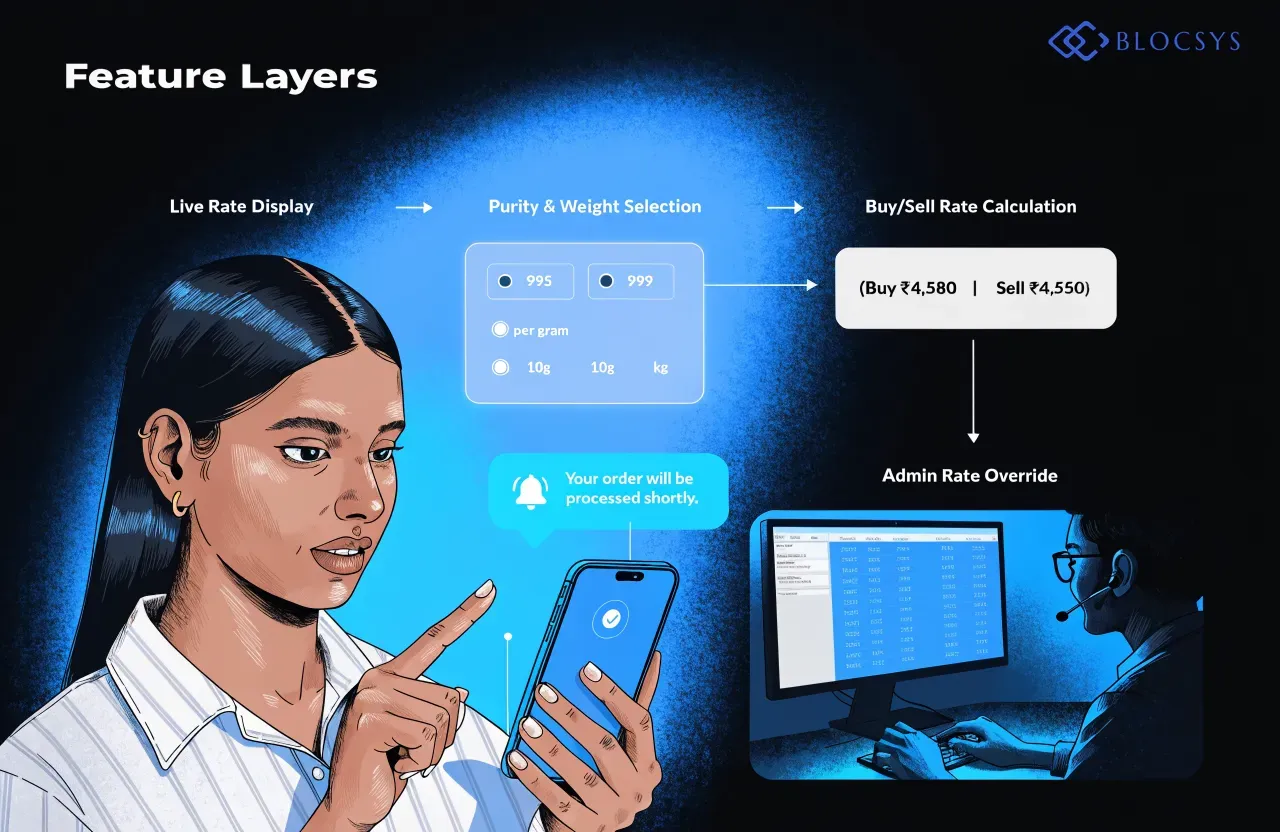
Live Gold and Silver Price Integration: How Does It Work?
Live pricing in a bullion app usually comes from a market data API that provides benchmark gold and silver prices. These benchmark figures, often referenced against international markets and bodies like the digital gold and silver app development framework, aren’t the same as the rate a customer ultimately sees.
Here’s the practical flow: the app fetches a benchmark price through gold price API integration or silver price API integration. The backend then applies currency conversion if needed, adds any local premium, factors in applicable charges, and layers on the dealer-defined margin. Only after this calculation does the final customer-facing rate get published.
This is a meaningful distinction. The benchmark market price is a reference point. The dealer-defined rate reflects your business’s actual pricing decisions. Confusing the two is a common mistake in rate app planning.
APIs can fail or lag occasionally. A properly built app includes manual rate override functionality, so if an API call fails or data looks stale, your team can publish the correct rate without waiting on a third-party service. Automated rate synchronisation works well most of the time, but manual control remains essential as a fallback.
Gold Purity and Weight-Based Rate Management
Gold purity-based pricing is one area where generic apps fall short. Indian bullion businesses typically deal in 995 and 999 gold rates, and these need separate pricing lines, not a single blended figure.
Weight units matter too. A dealer might publish rates per gram, per 10 grams, and per kilogram, depending on customer type. Wholesale buyers often look for per-kilogram pricing, while retail-facing customers expect per-gram or per-10-gram rates. Silver rates typically follow a similar per-kilogram and per-gram structure.
For example, a dealer could configure the app to show 999 gold per gram, 995 gold per gram, and silver per kilogram, each updated independently. The admin can also set rules so that purity categories update together when the benchmark changes, saving repetitive manual entry.
Dealer-specific gold rates add another layer. A wholesale customer might see a different margin than a walk-in retail buyer, even though the benchmark used is identical. Your app’s pricing engine needs this flexibility built in from the start, rather than bolted on later.
Admin Dashboard for Gold and Silver Rate Management
The admin dashboard is where your team actually runs the application day to day. This is the control centre behind Bullion Rate Management Software, and it deserves as much planning attention as the customer-facing screens.
A solid dashboard should let administrators manage purity categories, set buy and sell margins, override automated rates when needed, and review historical rate records for audit purposes. It should also handle user permissions, so junior staff can view rates while only senior staff can publish changes.
Activity logs matter here too. If a rate gets published incorrectly, you need to know who changed it and when. This kind of accountability is standard in Custom Bullion App Development projects built for serious trading operations, not an optional extra.
Customer Communication and Gold Rate Notifications
Publishing a rate is only half the job; customers need to actually know it’s changed. Push notifications are the most direct route, alerting app users the moment a significant price movement happens.
Price-change alerts can be configured by threshold, so customers aren’t flooded with notifications for minor fluctuations. WhatsApp sharing remains relevant too, since many customers still prefer it for quick rate checks, even after your app goes live. Supporting both channels together tends to work better than replacing one with the other.
That said, no notification system guarantees instant delivery every single time. Network conditions and device settings affect delivery speed. Setting that expectation with customers upfront avoids confusion if a push notification arrives a few minutes late.
Technology and Integrations Required for a Gold and Silver Rate App
A reliable Gold and Silver Price Tracking App rests on a few core technical layers working together. The mobile application, typically built for Android and iOS, handles the customer-facing display. The backend processes pricing logic, applies margins and manages data flow between the API and the app.
The database stores rate history, user accounts and dealer-specific pricing rules. Market data APIs feed in benchmark prices. Cloud infrastructure keeps the app available and responsive, while notification services handle alerts. Authentication and access control protect both customer accounts and the admin dashboard from unauthorised changes.
Blockchain isn’t a requirement for a standard rate-display app. It becomes relevant only if a dealer specifically needs transparent, tamper-proof rate audit trails or plans to extend into tokenised gold products later. For most bullion dealers publishing rates, a well-built backend and database setup is sufficient.
Which Platforms Can a Gold and Silver Rate App Be Developed For?
Android remains the dominant choice for Indian bullion customers, given its wide device reach. iOS matters too, particularly for dealers serving business clients or urban retail customers who prefer Apple devices. A web application extends access to desktop users and customers who prefer checking rates through a browser.
The admin web dashboard is typically separate from the customer app, accessible to staff through a secure browser login. Choosing the right mix of platforms depends on your customer base. A dealer serving mainly local retail shoppers might prioritise Android first and add iOS later, while a wholesale-focused business might lean more heavily on web access for bulk-buying clients.
Gold and Silver Rate App Development Process
Building a rate app follows a fairly standard development lifecycle, though the specifics around pricing logic need careful attention.
- Business requirement analysis, covering purity categories, weight units and margin rules
- Feature planning, deciding which functionality is essential versus optional
- UI/UX design for both the customer app and admin dashboard
- Technology selection for mobile, backend and database layers
- Market data API integration for live pricing
- Admin dashboard development with user permissions
- Testing, including API failure scenarios and rate calculation accuracy
- Deployment and ongoing maintenance
Skipping the requirement analysis stage is a common mistake. Dealers who clearly define their purity categories, margin rules and notification preferences upfront generally move through development faster than those who leave those decisions for later.
How Much Does Gold and Silver Rate App Development Cost in India?
Development cost depends on several factors rather than a single fixed number. Android-only builds cost less than Android plus iOS plus web. The complexity of your admin dashboard, the number of rate categories you need, and whether you require automated API-based pricing versus simple manual updates all affect the final scope.
Additional ongoing costs sit separately from the core development price. These include third-party market data API subscriptions, cloud hosting, and regular maintenance. It’s worth treating these as recurring operational expenses rather than one-time development costs when budgeting.
Because requirements vary so widely between a small local dealer and a multi-location wholesale business, it’s best to request a scoped estimate based on your specific feature list rather than relying on a generic published figure.
Gold and Silver Rate App Development Services Offered by Blocsys
Blocsys works with bullion dealers, wholesalers and precious metal businesses to build custom mobile and web applications suited to their specific rate publishing needs. This includes Android and iOS application development, web application builds, and backend systems designed to handle pricing logic reliably.
On the admin side, Blocsys builds dashboards that give your team real control over purity categories, buy and sell margins, and user permissions. Third-party API integration work connects your app to market data sources for live pricing, while custom rate management functionality handles the specifics of your business, whether that’s dealer-specific pricing tiers or multi-category weight units.
Application maintenance is part of the equation too. Rate apps need ongoing attention as market data sources change or as your business adds new purity categories and customer segments. You can review the full scope of this work on the digital gold and silver app development service page.
How to Choose the Right Gold and Silver Rate App Development Company
Before picking a development partner, get clear on your own requirements first. How many purity categories do you need? Do you want automated pricing, manual updates, or both? Will dealer-specific rates apply to any customer segments?
Once you’ve answered those questions, evaluate potential partners on their understanding of bullion business workflows, not just generic app development skills. Ask about their experience with API integrations, admin dashboard builds, and pricing logic specifically. Security practices matter too, since rate data and customer accounts both need protection. Finally, consider scalability and the availability of ongoing technical support after launch.
Why Choose Blocsys for Gold and Silver Rate App Development?
Blocsys operates as a technology development partner for bullion dealers and precious metal businesses looking to build their own branded applications. The team works across custom mobile applications, web platforms, backend systems and admin dashboards tailored to each client’s pricing and communication requirements.
Rather than offering a fixed, one-size-fits-all product, Blocsys builds around your specific purity categories, margin structure and customer communication preferences. API integration work connects your app to the market data sources you choose, and backend development ensures pricing calculations run reliably even when upstream data is delayed.
If you’re still comparing options, it’s worth starting the conversation early so your feature list and development timeline can be planned together from the outset.
Conclusion: Develop a Custom Gold and Silver Rate Application for Your Bullion Business
A dedicated rate application gives bullion dealers a faster, more consistent way to publish gold and silver prices. It won’t replace the trust you’ve built with customers over years of calls and WhatsApp updates, but it does make price access simpler for everyone involved.
Throughout this piece, we’ve covered the pieces that matter: live rate display, purity-based pricing, admin controls, API integration and customer notifications. Gold and Silver Rate App Development for Bullion Dealers works best when features are chosen to match your actual business model, not a generic template. Therefore, start with your must-have features and expand from there as your needs grow.
Planning to launch your own branded gold and silver rate application? Connect with Blocsys to discuss your bullion business requirements and explore a customised mobile or web application solution through digital gold and silver app development.
Frequently Asked Questions
Here are direct answers to the questions we hear most often about gold and silver rate app development for bullion dealers.
What is a gold and silver rate application for bullion dealers?
It’s a mobile or web app that displays current gold and silver prices, organised by purity and weight, so customers can check rates without calling or messaging the dealer directly.
What features should a gold rate app include?
Live rate display, purity-based pricing, buy and sell rates, manual and automated rate updates, price history, notifications and an admin dashboard cover the essentials.
How can bullion dealers display live gold and silver prices in an application?
Through a market data API that provides benchmark prices, which the app’s backend then adjusts with premiums and dealer-defined margins before publishing the final rate.
Can a gold rate app display different purity categories such as 995 and 999?
Yes. The app can be configured to show separate rates for each purity category, updated independently or together depending on dealer preference.
Can bullion dealers manually update gold and silver rates?
Yes, manual rate updates are a standard feature, often used alongside automated pricing as a fallback when API data is delayed or unavailable.
Can a bullion rate application display both buy and sell prices?
Yes. Buy and sell rate management lets dealers publish two distinct prices clearly, so customers know exactly which rate applies to their transaction.
Can a gold and silver rate app send price alerts to customers?
Yes, through push notifications triggered by price thresholds, though delivery timing can vary slightly depending on network and device conditions.
How much does gold and silver rate app development cost in India?
Cost depends on platform choice, dashboard complexity, API integrations and feature scope. It’s best to request an estimate based on your specific requirements.
How long does it take to develop a custom bullion rate application?
Timelines vary with feature complexity and platform count, generally following standard phases of planning, design, development, testing and deployment.
Can Blocsys develop a branded gold and silver rate application for bullion dealers?
Yes. Blocsys builds custom mobile and web applications, backend systems, and admin dashboards tailored to a bullion dealer’s specific rate and communication needs.
Ready to move beyond theory and build an intelligent platform that delivers real-world value? Blocsys Technologies specialises in engineering enterprise-grade AI and blockchain solutions for the fintech, Web3, and digital asset sectors. Connect with our experts today to discuss your vision and chart a clear path from concept to a secure, scalable reality.
