
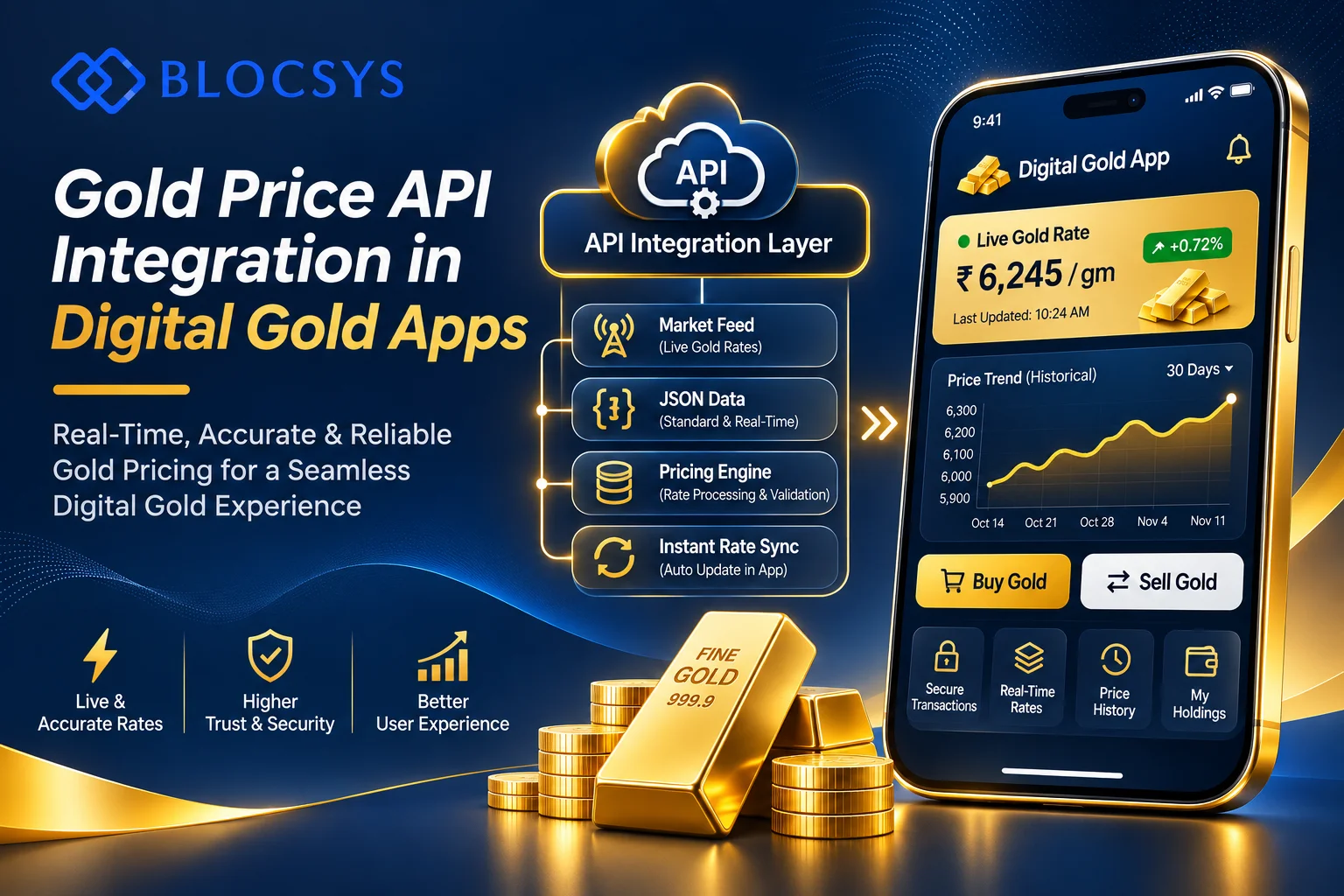
Gold Price API Integration in Digital Gold Apps: Architecture, Data Flow and Real-Time Pricing
If you run a jewellery business or you’re building a fintech app for gold investment, you already know one thing: customers check the gold rate before they check anything else. Gold price API integration decides whether your digital gold app shows that rate correctly, every single time. Get it wrong, and you’ve got mismatched invoices, confused customers, and a support team firefighting all day. This article walks you through how gold price API integration in digital gold apps actually works, from the external data feed to the number a customer sees on screen. We’ll also show where digital gold and silver app development teams fit into this picture.
Why Gold Price API Integration Matters in Digital Gold Apps
Every digital gold purchase, sale, or SIP instalment depends on one number: today’s gold rate. If that rate is stale or wrong, your customer either overpays or your business absorbs a loss. That’s the real job of gold price API integration — keeping this number accurate, current, and consistent across every screen in your app.
Think about a customer buying 2 grams of 22K gold at 10:15 AM. If your app still shows the 9:00 AM rate, you’ve either shortchanged them or shortchanged yourself. Multiply that across thousands of daily transactions, and the gap becomes a real business risk.
Pricing also affects how customers see their existing holdings. A digital gold wallet showing yesterday’s valuation feels broken, even if the underlying gold is perfectly safe. Consequently, accurate pricing isn’t a cosmetic feature — it’s core to trust in a gold savings app.
What Is a Gold Price API and How Does It Work?
A gold price API is a data service that supplies current gold (and often silver) market prices to another application through a structured request-response system. Your app sends a request to the provider’s server; the provider sends back pricing data, usually as JSON, containing the latest rate, currency, unit, and a timestamp.
Here’s the part people often miss: the price your API returns is a raw market rate, not your final selling price. It typically reflects the international spot price of gold, quoted per troy ounce in US dollars. Your backend still has to convert, adjust, and mark it up before a customer ever sees it.
So what’s the difference between a market feed and a customer-facing price? The market feed tells you what gold costs on global exchanges right now. Your customer-facing price adds currency conversion, purity adjustment, domestic market factors, your margin, and applicable taxes. These are two very different numbers, and conflating them is a common integration mistake.
How Gold Price API Integration Works in a Digital Gold Application
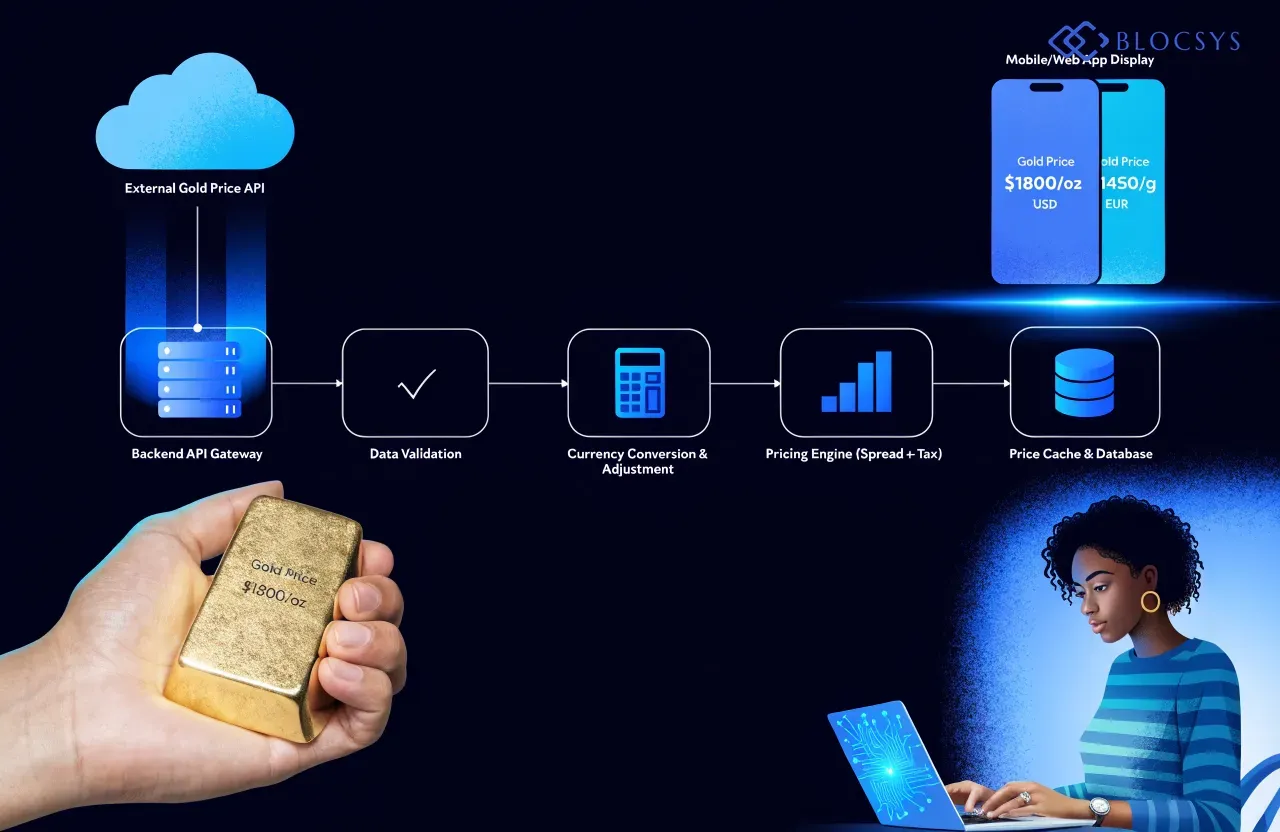
Successful gold price API integration depends on four connected stages: fetching, validating, calculating, and delivering. Your backend requests data from the provider, checks that the response is valid, runs it through your pricing engine, and only then pushes the final price to the app.
Let’s walk through a practical example. Suppose the international gold price moves from $2,400 to $2,415 per ounce overnight. Your backend receives this updated figure during its next scheduled poll. It converts the rate to INR per gram, applies your purity factor for 22K gold, adds your spread, and stores the result as the new live price.
The mobile app then calls your own backend API — not the external provider directly — to fetch this calculated price. This separation matters. It means your pricing logic, margins, and business rules stay private, while the app simply displays what your backend tells it to.
Understanding the Architecture Behind Gold Price API Integration
A reliable architecture has distinct, separate layers. Each one plays a specific role, and none of them should be skipped just to save development time.
External Pricing Provider
This is where your live gold price feed originates — an international or domestic data vendor offering gold market data API access over HTTPS.
Integration Layer
A middleware or service module that handles API authentication, request scheduling, and response parsing. It’s the bridge between the provider and your own systems.
Application Backend and Pricing Engine
Good gold price API integration treats the backend as the single source of truth. The pricing engine here converts currency, applies purity ratios, adds spreads, and calculates final rates for 24K, 22K, and silver.
Database, Cache, and Admin Dashboard
The database stores historical and transaction-level prices. A cache layer serves frequently requested prices quickly, without hammering the provider on every app refresh. An admin dashboard lets your team monitor rates and override values if needed.
The biggest integration mistake we see isn’t a bad API choice — it’s letting the frontend calculate prices instead of a controlled backend. The moment pricing logic lives in the app, you lose auditability and consistency across platforms.
How Are Gold Prices Calculated in a Digital Gold App?
Final prices come from a sequence of conversions applied to the raw market feed, not from the feed alone. Here’s a simplified, illustrative example using hypothetical figures.
- International spot price: $2,415 per troy ounce
- Convert troy ounce to grams: 1 troy ounce ≈ 31.1035 grams
- USD to INR conversion: assume ₹84 per USD
- 24K price per gram ≈ ($2,415 ÷ 31.1035) × 84 ≈ ₹6,524
- 22K price per gram (91.6% purity) ≈ ₹6,524 × 0.916 ≈ ₹5,976
Your business then adds a spread for operational cost and margin, plus applicable GST, before showing the final per-gram or per-10-gram rate. Actual methods vary between businesses, so treat this as illustrative rather than a fixed formula.
Silver pricing follows the same logic, just with a different base rate and no karat-based purity split in most retail use cases. Domestic demand, import duty, and local market sentiment can also push Indian prices slightly away from a pure currency-converted international rate — which is exactly why many Indian gold platforms reference MCX and domestic bullion association rates alongside international feeds.
Types of Gold Price APIs and Data Sources Businesses Can Consider
Not every pricing source fits every business. Broadly, businesses evaluate four categories: international precious metal price feeds, domestic bullion market sources, commodity exchange data providers, and currency exchange APIs for INR conversion.
International feeds track global spot prices and update frequently, often every few seconds for premium tiers. Domestic sources, meanwhile, reflect local market conventions more directly, which matters for Indian jewellers working in per-gram and per-10-gram terms.
Before committing to any provider, verify their update frequency, commercial licensing terms, and data coverage directly from their official documentation. Subscription tiers, rate limits, and permitted use cases differ widely, so don’t assume one provider’s terms apply to another.
Essential Features Supported by Gold Price API Integration
Live price displays, purchase calculators, and holdings valuation all rely on the same underlying pricing pipeline. When that pipeline is solid, these features become simple to build correctly.
- Live 24K and 22K gold price, plus silver price per gram
- Instant purchase and sale calculators using the current rate
- Real-time holdings valuation for each customer’s digital gold balance
- Price alerts when rates cross a customer-defined threshold
- Transaction records that lock in the exact price used at purchase time
- Admin dashboard visibility into current and historical rates
Each of these depends on accurate, timely data. A strong digital gold and silver app development approach builds these features around the pricing engine, not around assumptions about how often prices will change.
How Often Should Gold Prices Update in a Digital Gold App?
Most digital gold apps update prices through scheduled polling — requesting fresh data from the provider every few seconds or minutes. Some premium providers also offer webhooks or streaming feeds, pushing updates automatically instead of waiting for a request.
Update frequency ultimately depends on your provider’s plan, your transaction volume, and your business risk tolerance. A high-volume trading feature needs tighter polling than a simple savings app, for instance.
Whatever frequency you choose, always record a timestamp with every price. Additionally, store the exact price used for each transaction permanently. This protects both your business and your customer if a dispute ever arises later.
What Happens When a Gold Price API Fails or Returns Incorrect Data?
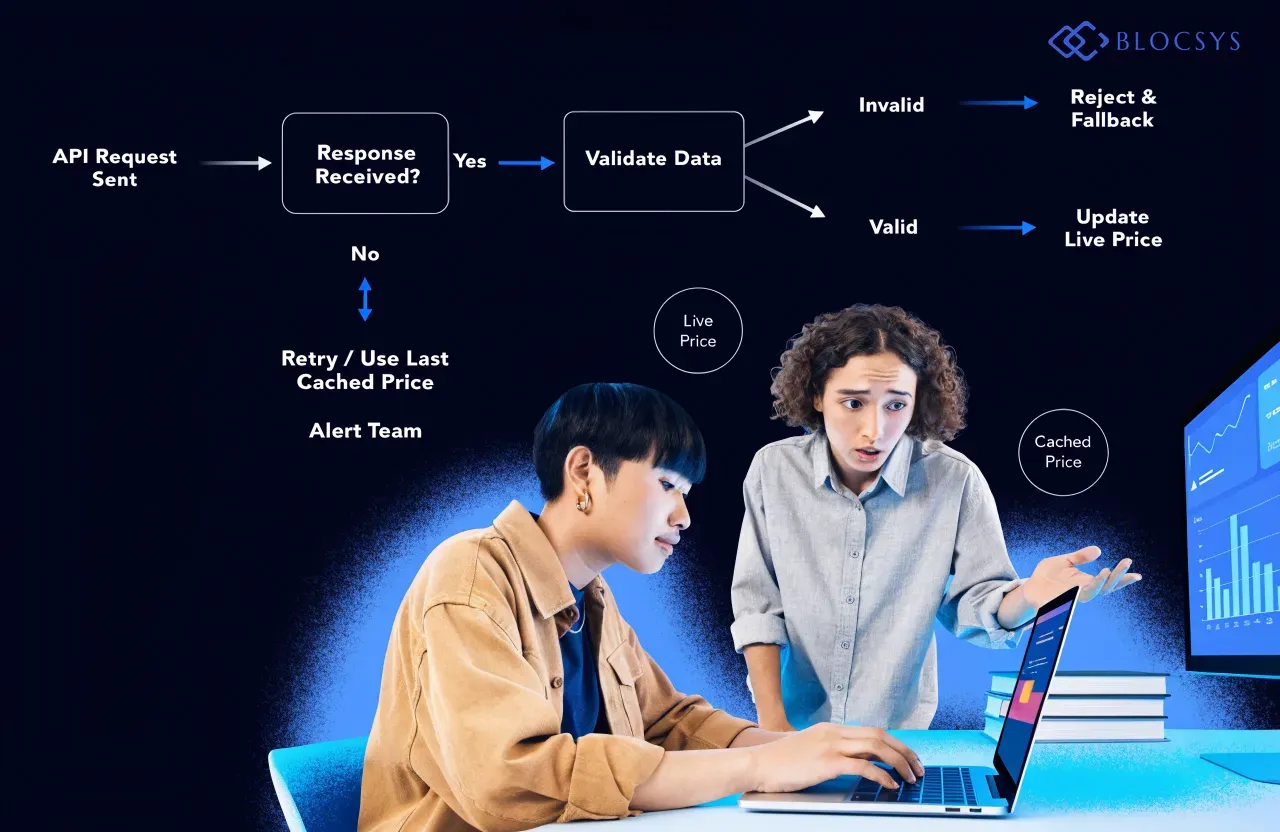
APIs go down. Providers hit rate limits. Networks hiccup. Your integration needs a plan for all three, because silently showing an old price as if it’s live is worse than showing no price at all.
Robust gold price API integration includes validation checks — rejecting responses with missing fields, impossible values, or sudden unexplained swings. If a request fails, your system should fall back to the last verified price, clearly flagged as delayed, rather than pretending it’s current.
Monitoring and alerting matter here too. Your team should know within minutes if the feed stops updating, not when a customer complains about a wrong rate. Logging every failure also helps you spot patterns, like a provider’s recurring downtime window.
Gold Price API Integration Services Offered by Blocsys
Blocsys works with jewellers, bullion dealers, and fintech founders who need their digital gold or silver platform connected to a reliable pricing pipeline. The scope typically covers backend development, custom API integration, mobile and web application development, admin dashboard development, and blockchain integration where a business wants tokenised gold holdings.
In practice, this means building the integration layer that connects your chosen pricing provider to your backend, designing the pricing engine logic around your specific spreads and purity rules, and delivering a customer-facing app that reflects it accurately. Every implementation gets shaped around how a specific business actually prices gold and silver, rather than a one-size-fits-all template.
Security and Data Reliability Considerations for Gold Price APIs
API keys should never sit inside your mobile app’s source code or public frontend files. Anyone can decompile an app or inspect browser network traffic, and an exposed key becomes an open invitation to abuse your provider quota.
Instead, keep all API credentials on your backend server, behind proper authentication. Use encrypted connections for every request, validate every response before trusting it, and manage rate limits proactively so you don’t get throttled mid-trading-hours.
Timestamp management and error logging round out a reliable setup. Together, these practices protect both your pricing accuracy and your customers’ transaction data.
How Much Does Gold Price API Integration Cost?
Gold price API integration cost splits into two separate buckets: what the data provider charges, and what your development team charges to build the integration itself. Treating these as one number leads to confused budgeting.
Provider subscription costs usually scale with request volume, update frequency, and data coverage — higher-frequency, commercial-use plans cost more than free or delayed-data tiers. Development costs depend on backend complexity, currency conversion requirements, caching and monitoring setup, and whether you need both gold and silver pricing support.
Because pricing varies by provider and by project scope, treat any number you see online as an illustrative estimate rather than a fixed quote. The right way to budget is to define your requirements first, then get a scoped estimate from your development partner.
Why Choose Blocsys for Digital Gold and Silver App Development?
Blocsys builds custom applications for businesses entering the digital gold and silver space, covering Android, iOS, and web platforms alongside the backend systems that power them. This includes API integration work, admin dashboards, and blockchain integration for businesses exploring tokenised gold products.
Rather than offering a fixed template, development gets aligned with how your business actually prices gold — your spreads, your purity conventions, your update frequency needs. If you’re planning a digital gold and silver app development project, that alignment between pricing logic and app architecture is what makes the difference between a smooth launch and a messy one.
Conclusion: Build a Digital Gold App with Reliable Gold Price API Integration
Reliable gold price API integration isn’t a one-time task you finish and forget. It’s an ongoing discipline — choosing a trustworthy data source, validating every response, calculating prices transparently, and keeping a permanent record of what price applied to each transaction.
Get these fundamentals right, and your customers trust what they see on screen. Get them wrong, and even a great app idea struggles under pricing disputes.
Planning to build a digital gold application with reliable gold and silver price integration? Connect with Blocsys to discuss your business requirements and explore a customised digital gold and silver app development approach.
Frequently Asked Questions
Here are direct answers to the questions we hear most often about gold price API integration.
What is a gold price API?
It’s a data service that sends current gold and silver market prices to your application through a request-response connection, usually formatted as JSON with price, unit, and timestamp.
How does a gold price API work in a digital gold app?
Your backend requests data from the provider at set intervals, validates the response, runs it through your pricing engine, and delivers the calculated price to your app’s frontend.
How do digital gold apps get live gold prices?
They subscribe to an external pricing provider — international, domestic, or commodity exchange-linked — and poll or stream data from that provider’s API continuously.
How is the final gold price calculated in a digital gold application?
The raw market rate gets converted to INR, adjusted for purity (24K or 22K), and then marked up with your business spread and applicable taxes before display.
Can a digital gold app display both 22K and 24K gold prices?
Yes. Your pricing engine applies different purity multipliers to the same base rate, so both values can be shown from a single data feed.
How often should gold prices be updated in a digital gold app?
That depends on your provider’s plan and your business needs — commonly every few seconds to a few minutes, with every price timestamped and logged.
What happens if a gold price API stops working?
A well-built system falls back to the last verified price, flags it as delayed, and alerts your team, rather than showing stale data as if it were live.
Can the same API integration support gold and silver prices?
Yes, most providers offer both metals through the same feed or a related endpoint, and your backend can run both through similar calculation logic.
How much does gold price API integration cost?
Costs split into provider subscription fees and development costs for building the integration, backend logic, and app interface — both vary by scope and provider.
Can Blocsys develop a digital gold app with custom pricing API integration?
Yes. Blocsys builds custom digital gold and silver applications, including backend systems and API integrations shaped around a business’s specific pricing model.
Ready to move beyond theory and build an intelligent platform that delivers real-world value? Blocsys Technologies specialises in engineering enterprise-grade AI and blockchain solutions for the fintech, Web3, and digital asset sectors. Connect with our experts today to discuss your vision and chart a clear path from concept to a secure, scalable reality.
