
How to Launch Your Own Bullion Trading App in India: 8 Essential Steps
More bullion dealers, gold wholesalers and jewellery businesses are asking the same question this year: how do we move our rate updates, order requests and dealer communication onto a proper digital platform? If you’ve been wondering how to develop a bullion trading app for your own business, you’re not alone. However, the process involves far more than hiring someone to build a mobile screen with gold rates on it. You need a defined business model, a clear feature list, a reliable pricing data source and a technology partner who understands precious metal workflows. This article walks you through exactly that, in eight practical steps.
What Is a Bullion Trading App and How Does It Work?
A bullion trading app is a digital platform that lets a bullion business share gold and silver rates with customers or dealers, and optionally lets them submit buy or sell requests through the app. Unlike a simple rate-display widget, a trading application usually includes customer accounts, order history and some form of administrative control over pricing and transactions.
How it actually works depends heavily on what you’re building. A basic rate app shows live or periodically updated prices and nothing else. A trading application adds order submission, dealer-level access and transaction records. A dealer management system goes further, handling multiple branch logins, credit limits and internal approvals. A digital gold investment platform is a different category entirely — it typically involves custody arrangements, redemption rules and financial obligations that a simple rate or order app doesn’t carry.
“The biggest mistake we see is businesses assuming ‘bullion app’ means one fixed product. It doesn’t. Your operating model decides nearly every technical decision that follows,” says a Blocsys product consultant who works with precious metal businesses on application planning.
Therefore, before you write a single requirement, you need to know which of these your business actually needs.
How to Launch Your Own Bullion Trading App in India: 8 Essential Steps
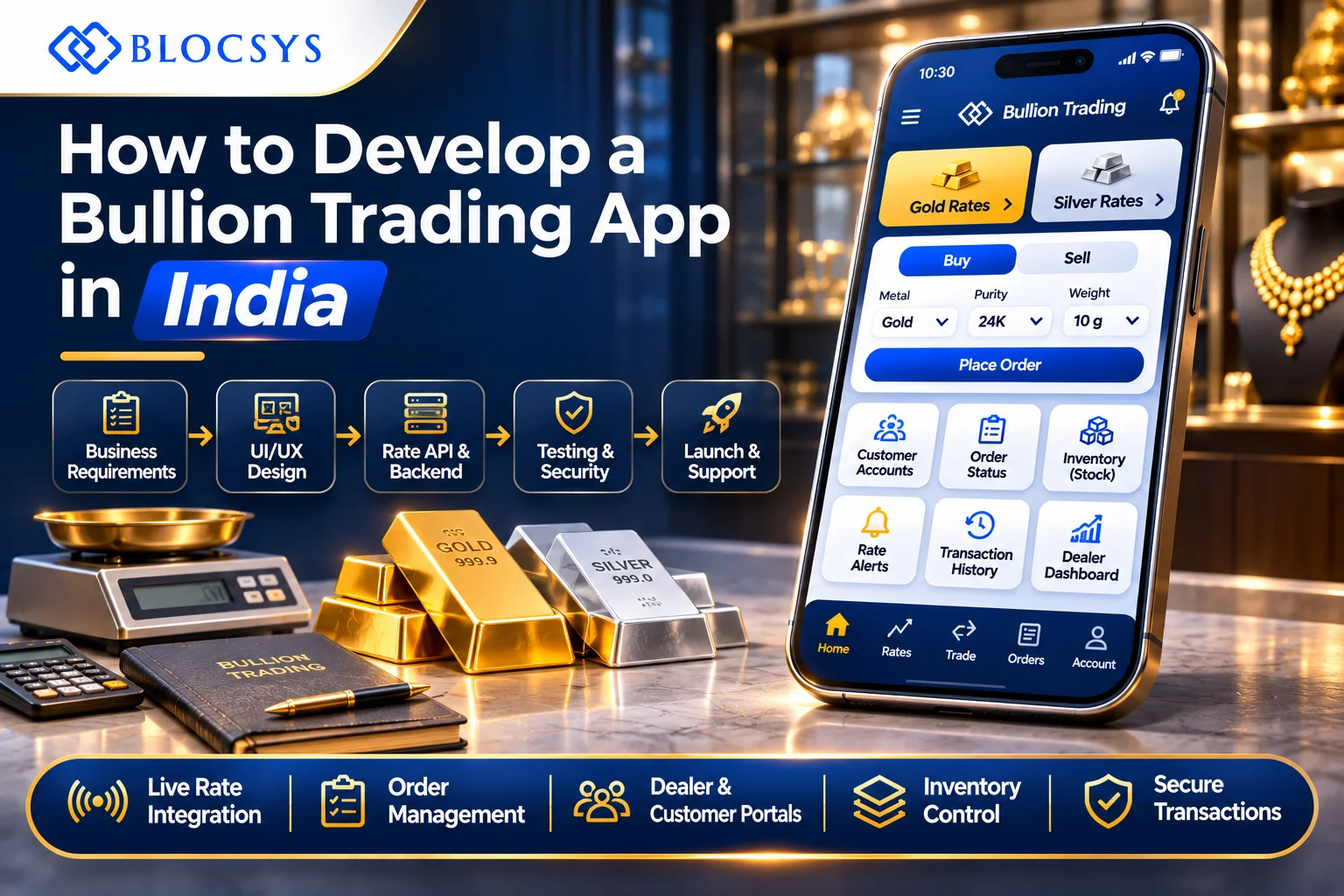
Here’s the roadmap we’ll walk through. Each step builds on the one before it, though in a live project some stages do overlap. Together, they answer the practical question entrepreneurs keep asking us: how to develop a bullion trading app without wasting budget on the wrong features.
Step 1 – Define Your Bullion Business Model and Target Audience
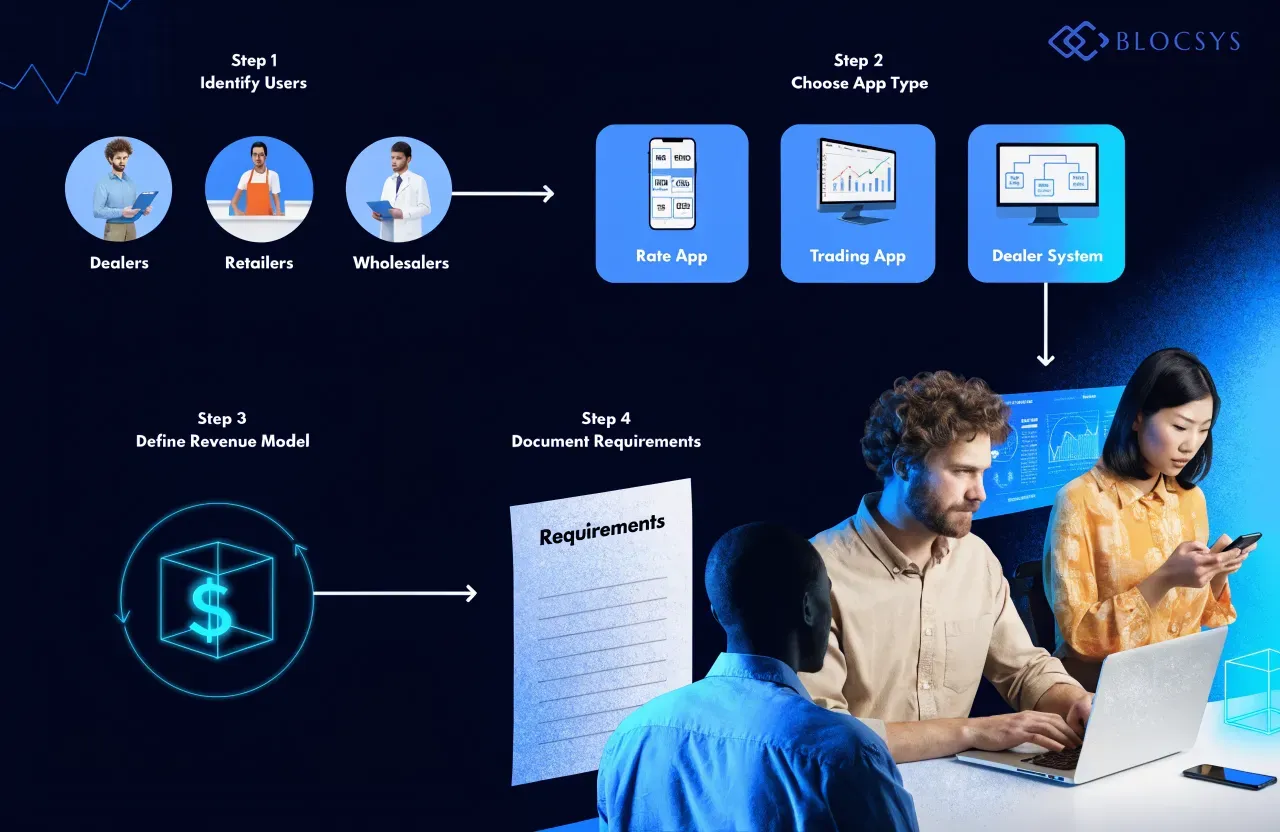
Start by deciding who the app actually serves. Is it for retail customers checking rates, wholesale dealers placing bulk orders, or your own branch network managing stock across cities? Each audience needs a different set of screens and permissions.
Consider a Mumbai-based bullion wholesaler supplying twenty jewellery retailers across Gujarat and Maharashtra. Their priority isn’t a flashy consumer app — it’s a dealer portal where registered buyers see negotiated rates and submit purchase requests. Compare that to a retail-facing gold trader in Delhi who wants walk-in customers to track daily rates on their phone. The feature sets barely overlap.
You’ll also need to separate a bullion rate application from a B2B trading platform, an order booking app, a dealer management system or a digital gold platform. Each carries different commercial and operational responsibilities. Clarify your revenue model too — subscription, dealer commission or simple digitisation of existing sales — since this shapes how the admin side gets built.
Step 2 – Identify the Essential Features and Application Requirements
Once your model is clear, list what the app must actually do on day one. Don’t start with a wish list — start with the workflow your business runs today and digitise that first.
Most bullion applications need customer registration, dealer accounts, live or periodically updated rate display with purity categories, buy and sell rate visibility, order request submission, transaction history, push notifications and an admin dashboard for rate control. A jewellery retailer might also want branch-level access, while a wholesaler needs credit limit tracking per dealer.
Separate what’s essential for launch from what can wait. A loyalty programme, multi-language support or advanced analytics can come in version two. Trying to build everything at once is exactly how bullion application development projects stall halfway through.
Step 3 – Plan Gold and Silver Pricing and Market Data Integration
How will your app get its gold and silver prices, and how often will they update? This is arguably the most technical decision in the whole project, and it deserves early attention.
Most businesses pull a base reference rate from a third-party pricing API, often tied to domestic market references or international benchmarks published by sources such as the World Gold Council or reflected through exchanges like MCX. From there, your business applies its own margin, purity-based adjustments for 22K and 24K gold, and a displayed rate timestamp so customers know how fresh the number is.
Here’s the part people often miss: the market reference rate and your final customer-facing rate are not the same thing. Your app needs clear, configurable pricing rules — not a raw data feed shown as-is. Additionally, not every market data provider offers the same update frequency, licensing terms or API reliability, so test this thoroughly before committing.
This is where bullion rate app development expertise genuinely matters — getting the API integration, update intervals and margin logic right from day one saves considerable rework later.
Step 4 – Plan the Application Design and User Experience
Your interface should reflect who’s actually using it, not a generic template. A customer screen needs rate visibility, simple order submission and account history. A dealer dashboard needs bulk order tools, credit visibility and faster navigation. An administrator interface needs rate override controls, user management and reporting.
Think about platform coverage too. Do you need Android and iOS apps, or does a responsive web application cover your dealer network better? A wholesale business with desk-based dealers might prioritise a web portal, while a retail-facing brand leans mobile-first. Don’t assume you need every platform on day one — build what your actual users will touch.
Step 5 – Choose the Right Technology and Development Partner
This step decides nearly everything that follows: mobile frameworks, backend architecture, database design, API integrations, cloud infrastructure and how the system scales as your dealer network grows.
You’ll also face a genuine choice between custom development and white-label software. White-label gets you live faster but limits customisation, ownership and your ability to change workflows later. Custom bullion trading application development costs more upfront but gives you full control over features, branding and future integrations — a meaningful difference if you plan to scale across multiple cities.
When evaluating a partner, look at their actual experience with precious metal or financial applications, not just general app development. Ask about project scope definition, post-launch support and how they handle maintenance once the app is live.
This is where a company like Blocsys fits the picture. Blocsys works on custom mobile and web application development, backend systems, administrative dashboards and API integrations tailored to bullion businesses — connecting your specific pricing logic, dealer hierarchy and order workflow into one coherent platform rather than forcing you into a fixed template.
Step 6 – Develop the Application and Integrate Required Systems
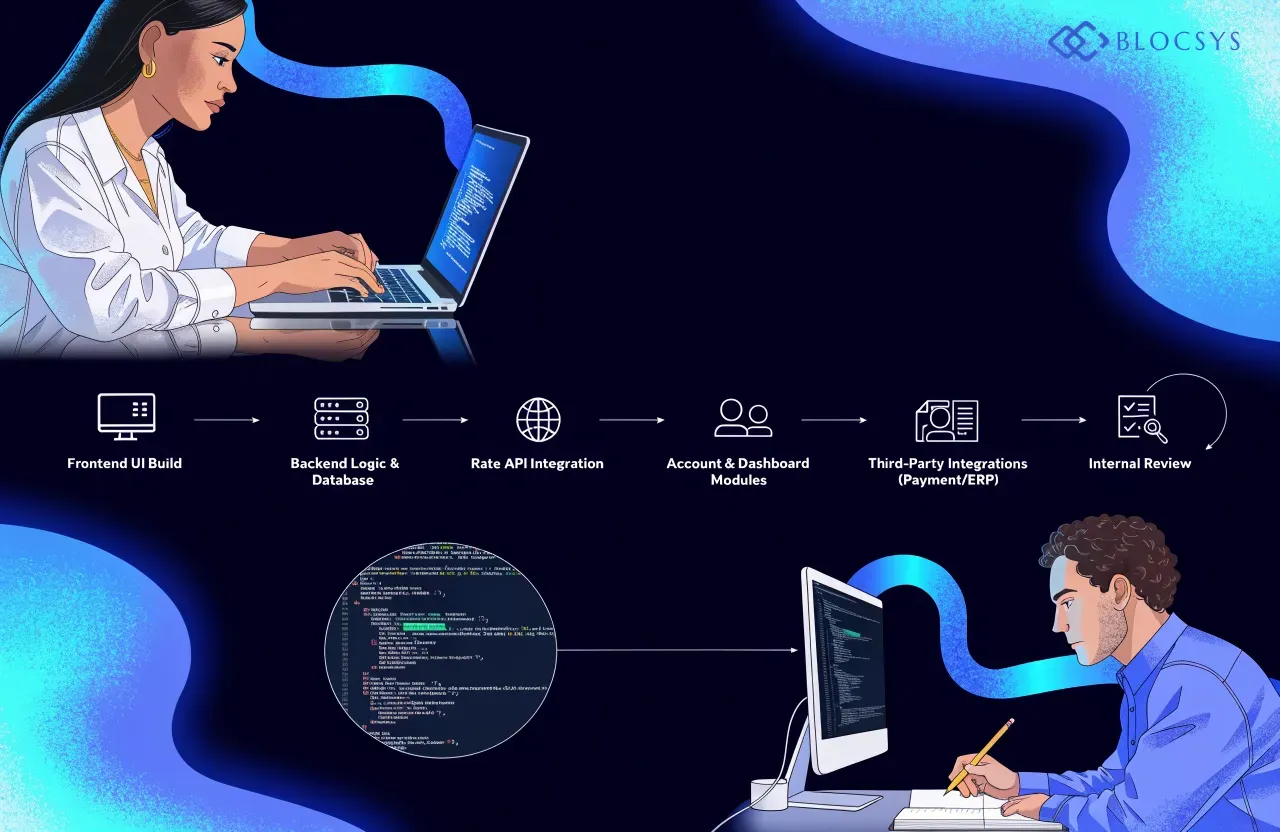
Development brings together frontend screens, backend business logic, your database structure, the pricing API connection, customer and dealer account systems and the admin dashboard. Each piece gets built and reviewed against the scope you defined in steps one and two.
If your business model requires it, this stage also covers payment gateway integration, accounting software connections or inventory and ERP links. Not every bullion app needs these — a rate-display or order-request app may not touch payments at all.
One distinction matters enormously here: an order request isn’t the same as a confirmed order, a completed payment settlement or a physically delivered bullion consignment. Treating these as one event in your app’s logic creates confusion for both customers and dealers. Build your workflow so each stage is tracked and recorded separately.
Step 7 – Test Application Functionality, Security and Business Workflows
Before anyone outside your team touches the app, you need rigorous testing. This covers functional testing, interface testing, API testing, rate update validation, registration flows, dealer permission checks, notification delivery and performance under load.
Test realistic scenarios too — what happens during a sudden rate spike, an API failure, an incorrect customer input or a dropped internet connection midway through an order? These edge cases reveal more about your app’s reliability than a smooth demo ever will.
Security testing deserves particular attention given the financial nature of bullion trading. Review authentication, data encryption and access controls for each user role. User acceptance testing with actual dealers or staff, followed by fixing critical issues, should happen before any public release. No amount of testing eliminates every risk, but thorough testing meaningfully reduces it.
Step 8 – Launch the App and Plan Ongoing Maintenance
Launch involves deployment to production servers, switching from test to live API credentials, app store submission for mobile apps, and domain setup for your web portal. Train your administrators and dealers before go-live, and prepare clear onboarding communication for customers.
Once live, monitor application performance, rate feed accuracy, user activity and any technical errors closely during the first weeks. Launching isn’t the finish line — it’s the start of ongoing product management, including security updates, feature refinements and infrastructure scaling as your user base grows.
Essential Features to Prioritise Before Launching a Bullion Trading App
At minimum, your launch version should include live or periodically refreshed gold and silver rates, purity-based pricing, customer and dealer accounts, order booking, transaction records, an admin dashboard and basic security controls. Notifications for rate changes are also commonly expected.
Advanced features like multi-branch analytics, loyalty tools or AI-based price alerts can follow in later releases. Keep your first version lean and functional — it’s easier to add features than to unwind a bloated launch.
Business and Regulatory Considerations for Bullion Apps in India
Before launch, understand exactly which commercial activities your app supports. A platform that simply displays rates or records order requests carries different obligations than one that handles customer funds, offers investment-style products or makes claims about digital ownership of precious metals.
Depending on your model, you may need to evaluate payment processing rules, taxation treatment, consumer protection obligations and data protection requirements under India’s current data protection framework. These obligations vary significantly based on your actual business activities, so treat this as a case-by-case legal review rather than a universal checklist. We’d recommend consulting a qualified legal or compliance professional familiar with precious metal trade and fintech regulation in India before finalising your business model.
How Much Does It Cost to Develop a Bullion Trading App in India?
Cost depends on several variables: how many platforms you need, the depth of customer and dealer functionality, pricing API complexity, admin dashboard requirements, third-party integrations, backend architecture, security measures and testing scope.
You should also budget for recurring costs beyond initial development — hosting, market data subscriptions, API licensing fees and ongoing technical support. There’s no universal price tag that applies to every bullion business, since a simple rate app and a full multi-branch trading platform sit at very different ends of the spectrum. Get a project-specific assessment rather than relying on generic estimates floating around online.
Bullion Trading App Development Services Offered by Blocsys
Blocsys works with bullion dealers, gold wholesalers, silver traders and jewellery businesses on custom mobile and web application development, backend systems, administrative dashboards, database architecture and relevant API integrations. Their work includes translating a client’s actual pricing rules, dealer hierarchy and order workflow into a functioning, branded application.
For businesses specifically exploring digital gold or silver investment functionality rather than a straightforward trading or dealer app, Blocsys’s digital gold and silver app development service addresses that distinct use case separately.
Why Choose Blocsys for Bullion Trading App Development?
Blocsys brings together custom mobile and web development, backend engineering, API integration and scalable dashboard design under one roof — which matters when your bullion app needs all of these working in sync rather than stitched together from separate vendors.
What stands out is the emphasis on understanding your business model first. Before any code gets written, the priority is mapping your pricing rules, customer and dealer workflows and launch goals accurately. That groundwork is what separates a generic template from a platform that actually fits how your bullion business operates day to day.
Conclusion – Turn Your Bullion Business Idea into a Trading Application
Launching a bullion trading application in India comes down to eight connected stages: defining your business model, planning features, integrating gold and silver pricing, designing for your actual users, choosing the right technology partner, building the platform, testing it thoroughly and preparing for a controlled launch. Skip any of these, and you’ll likely rebuild it later anyway.
If you’ve been researching how to develop a bullion trading app for your own dealership, wholesale business or jewellery brand, the groundwork matters more than the code itself. Planning to launch your own bullion trading application in India? Connect with Blocsys’s bullion rate app development team to discuss your requirements for rate management, customer workflows, dealer accounts and a customised mobile or web platform.
Frequently Asked Questions
Here are direct answers to the questions we hear most often about launching a bullion trading app in India.
How can I launch my own bullion trading app in India?
Start by defining your business model and target users, then move through feature planning, rate integration, design, development partner selection, building, testing and launch. Each of these eight stages feeds into the next.
What are the essential steps involved in bullion app development?
The eight core steps are business model definition, feature planning, pricing and market data integration, UI/UX planning, technology and partner selection, development, testing, and launch with ongoing maintenance.
What features should a bullion trading application include?
At minimum: rate display with purity-based pricing, customer and dealer accounts, order booking, transaction records, notifications and an admin dashboard. Advanced features can follow after launch.
How much does it cost to develop a bullion trading app in India?
Cost varies based on platform count, feature depth, API complexity, integrations and security requirements. There’s no fixed industry-wide figure — get a project-specific assessment.
Can a bullion trading app display live gold and silver rates?
Yes, through a connected pricing API that feeds market reference rates, which your business then adjusts with its own margins and purity-based rules before displaying them to users.
Sources referenced for market and pricing context: World Gold Council publications, London Bullion Market Association resources and Multi Commodity Exchange of India (MCX) market data.
Ready to move beyond theory and build an intelligent platform that delivers real-world value? Blocsys Technologies specialises in engineering enterprise-grade AI and blockchain solutions for the fintech, Web3, and digital asset sectors. Connect with our experts today to discuss your vision and chart a clear path from concept to a secure, scalable reality.
