
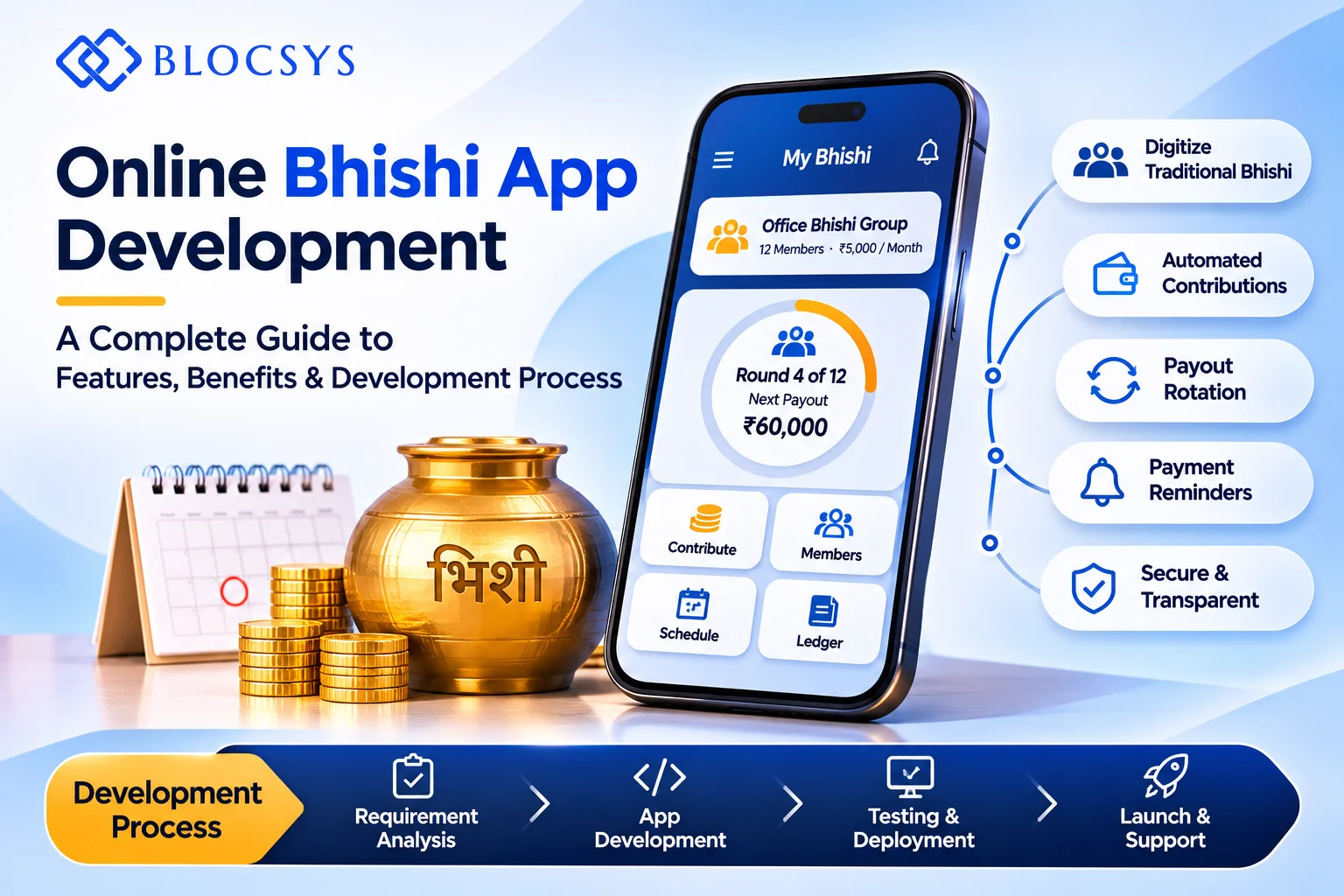
Online Bhishi App Development: Features, Benefits, and Development Process
Bhishi groups have run on trust and memory for generations. A group of neighbours, colleagues or relatives agrees on a monthly contribution, an organiser collects the money, and everyone keeps their own mental ledger of who paid and who didn’t. That’s exactly why Bhishi Management Software is gaining attention today. As groups grow and contribution cycles stack up, a notebook or WhatsApp group simply can’t keep pace with the coordination needed. Online Bhishi app development gives organisers and members a shared, connected view of the same information, which is the real starting point of this guide.
Traditionally, a Bhishi organiser manages everything manually. They note down who joined, when payments are due, and who still owes money this month. Members, in turn, depend on reminders sent over calls or group chats. This works fine for five or six people. However, once a group crosses fifteen or twenty members, or runs multiple Bhishi cycles together, manual tracking starts cracking under its own weight. Missed reminders, disputed payment claims, and lost records become common complaints.
That’s where a digital platform changes the picture. If you’re exploring how custom fintech-style tools get built for Indian group savings use cases, it helps to see how specialised financial applications are structured end-to-end — Blocsys’s work on Bullion Rate App Development is a good example of how a focused financial app brings real-time data, member-facing dashboards and admin controls together on one platform. Bhishi app development follows a similar philosophy, just applied to group contributions instead of commodity pricing.
What Is an Online Bhishi App and How Does It Work?
An online Bhishi app is a mobile or web platform that organises group savings activities digitally. It replaces scattered registers and chat threads with one central system for group creation, member management and contribution tracking.
Here’s how it typically works. A member joins a group through an invite sent by the organiser. Once added, they can view the contribution schedule, check how much they owe, see their payment history and get reminders before due dates. Members don’t need to call the organiser to confirm whether their last payment was recorded — it’s right there on their dashboard.
Organisers, meanwhile, get a different view. They create the group, set the contribution amount and frequency, add or remove members, and monitor who has paid and who hasn’t. Every action gets logged, so the group’s history isn’t dependent on anyone’s memory.
It’s important to separate two things here. A simple group savings application just tracks contributions and balances for a shared goal. A platform that also manages rotating payouts, auctions or prize-based distributions is doing something structurally different, and that distinction matters later when we talk about legal considerations.
Why Are Bhishi Organisers Moving Towards Digital Applications?
Organisers are shifting to digital tools mainly because manual coordination doesn’t scale well. Once a group runs for several months, reconciling who paid what becomes genuinely time-consuming.
Consider a Mumbai-based organiser running three Bhishi groups with twenty members each. Every month, she has to confirm forty-plus payments, chase the ones who forgot, and still keep a clean record for each group separately. A centralised Bhishi Management System turns this into a dashboard view instead of a manual reconciliation task.
Digitisation also brings transparency. Members can see their own payment history instead of taking the organiser’s word for it. This reduces disputes and builds trust within the group. That said, software doesn’t automatically guarantee that every member will pay on time, nor does it eliminate every operational hiccup. What it does is give organisers better visibility and members better clarity, which together make group coordination noticeably smoother.
In group savings products, the biggest complaint we hear isn’t about the money — it’s about not knowing where things stand. A member dashboard that shows real contribution status solves more disputes than any reminder message ever could.
Essential Features of an Online Bhishi App
A well-built Bhishi Software solution needs to cover both member-facing and administrator-facing functionality. Here are the core pieces:
- Member registration and profile management — onboarding, KYC-light details, and group association.
- Group creation and configuration — group name, member list, contribution amount, schedule and start date.
- Payment tracking and confirmation — recording each contribution and its status.
- Member contribution history — a running log each member can check anytime.
- Group progress dashboard — total collected, pending amounts, and participation status.
- Payment reminders and notifications — automated alerts before due dates.
- Admin dashboard — a control centre for managing members and monitoring groups.
- Transaction records — a transparent, exportable log of group activity.
- Payout tracking — relevant only where the group model includes structured payouts.
- Reports and statements — monthly or cycle-wise summaries for members and organisers.
- Member communication — announcements, schedule changes and group updates.
Not every group needs all of these on day one. Payout tracking, for instance, is optional functionality that depends entirely on whether the Bhishi follows a rotating or auction-based structure. Essential features are registration, contribution tracking and the admin dashboard — everything else can be layered in based on actual demand.
Bhishi Group Creation and Member Management
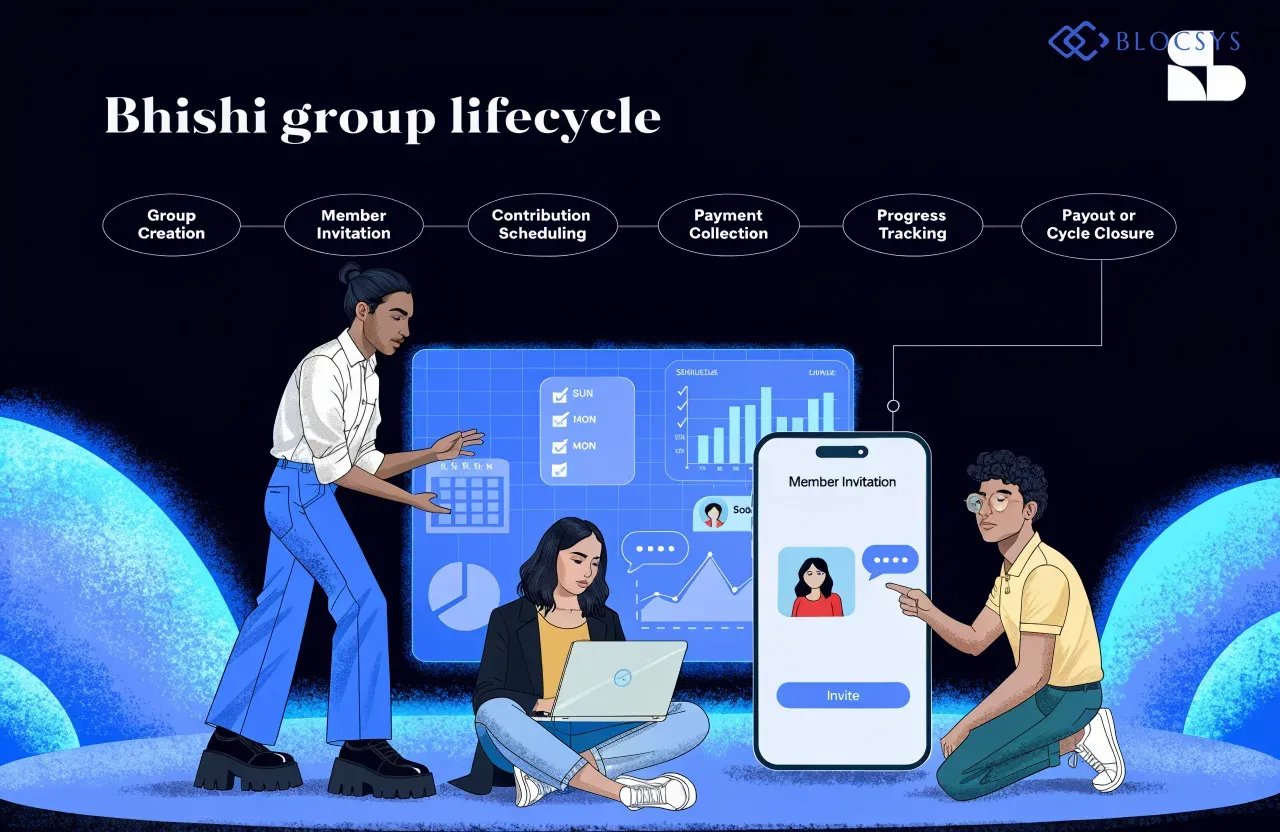
Group creation is usually the organiser’s first action inside the app. They name the group, set the monthly contribution amount, decide the start date, and invite members through a link, phone number or email.
Take a practical example: a Pune-based organiser starts a twelve-month Bhishi with ten members contributing ₹2,000 each per month. Inside the app, she creates the group, adds all ten members, and sets the first due date. Each member receives an invite, accepts it, and their profile gets linked to that specific group automatically.
From here, the organiser can track participation status for each member — active, pending, or exited — directly from one screen. If someone leaves midway, their record stays intact for reference, while the active group list updates on its own. This kind of Bhishi Group Management Software setup removes the need for a separate spreadsheet per group.
Monthly Contribution Scheduling and Payment Tracking
What happens when a contribution date arrives? The app sends a reminder, the member initiates payment through a supported method, and the system logs that transaction against the group record.
Most Indian groups now prefer UPI for monthly contributions, so UPI payment integration is a practical must-have for any modern Online Bhishi Management Software. Once a payment is initiated, there’s a distinction worth understanding: initiation, confirmation and reconciliation aren’t the same step. A member can start a UPI transfer, but the app should wait for actual payment confirmation from the Software Development Cost Estimator-grade backend logic before marking it as received, and reconciliation against bank or gateway records happens separately.
Receipts get generated once confirmation is successful, and pending contributions remain flagged until resolved. One more thing worth checking early: payment gateway eligibility and permitted transaction categories need verification against NPCI’s UPI guidelines and the gateway’s own documentation, since not every provider treats recurring group contributions the same way.
Group Savings Progress and Member Dashboards
Members want one simple answer: where do I stand in this group right now? A member savings dashboard answers exactly that — showing contributions made, upcoming dues, and overall participation in a single screen.
For example, a member tracking a six-month ₹1,500 monthly Bhishi can see at a glance that they’ve paid four instalments, two remain, and the group’s total pool stands at a certain amount. This is contribution tracking, not an investment projection — there’s no return percentage or growth chart involved, because a Bhishi savings group isn’t a financial product promising returns. Keeping that distinction clear in the UI prevents members from misreading a savings tracker as something it isn’t.
Payout Management and Different Bhishi Models
Not every Bhishi runs the same way. Some groups simply pool a shared savings goal with no rotation involved. Others follow rotating payouts, where one member receives the collected amount each cycle. A few use auction-based structures, where members bid for early access to the pooled fund.
Where rotation or auctions are part of the model, the Bhishi Management Software needs to record payout schedules, approvals and payment status for each cycle, along with a clear transaction trail.
Here’s the part organisers can’t skip: a simple group savings feature is not automatically the same as a regulated chit fund. Once pooled contributions, rotating payouts, auctions or prize-based distributions enter the picture, the structure may fall within the scope of the Chit Funds Act, 1982, and state-level Registrar of Chits requirements. This depends entirely on how the specific arrangement is designed, not on what the group calls itself. Treating one Bhishi structure as universal is a mistake — each organiser’s model needs its own assessment.
Notifications and Communication Features in Bhishi Apps
Automated reminders are what actually reduce late payments in practice. A well-designed system nudges members a few days before the due date, confirms once payment is received, and alerts the group when schedules or terms change.
Push notifications, SMS and email all serve different purposes — push works for quick in-app alerts, SMS reaches members without data access, and email suits formal statements. Letting members set their own notification preferences matters too; nobody wants five reminders for the same payment. Over-notifying is just as damaging to trust as under-notifying.
Benefits of Online Bhishi Apps for Organisers and Members
For organisers, the gains are mostly operational. Centralised records replace scattered notebooks, member management becomes a few taps instead of phone calls, and reporting across multiple groups gets handled from one dashboard. Manual coordination effort drops noticeably.
For members, the benefit is visibility. They get instant access to their own payment history, upcoming dues, and group standing without depending on the organiser’s availability. Communication becomes easier since updates reach everyone at once.
None of this guarantees that every member pays on schedule or that savings goals get met automatically. What a Digital Bhishi Management Software platform does is remove friction from coordination — the rest still depends on the group’s own discipline and trust.
How to Develop an Online Bhishi App: Step-by-Step Process
Building a Bhishi platform isn’t fundamentally different from building any purpose-built fintech-adjacent app, provided the process is followed in order:
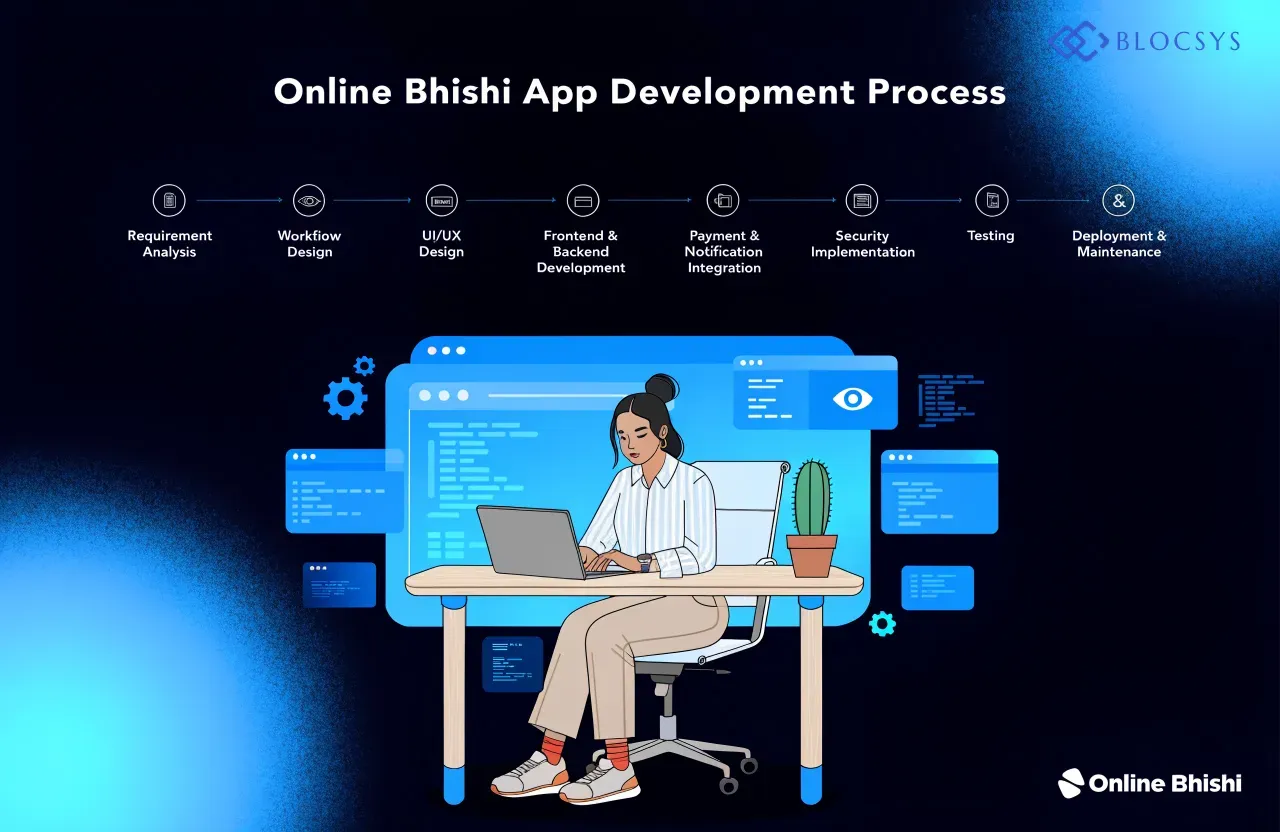
- Understand the actual Bhishi business model — simple savings, rotation, or auction-based.
- Define separate workflows for members and administrators.
- Shortlist essential features first, optional ones later.
- Plan mobile and web architecture together, since most groups use both.
- Design the interface around clarity — dashboards, not clutter.
- Develop frontend and backend functionality in parallel sprints.
- Integrate payment and notification services relevant to the region.
- Implement authentication, role-based permissions and data security.
- Test contribution, payment and group management workflows thoroughly.
- Deploy, then maintain the app as groups and requirements evolve.
The exact feature set and workflow depend heavily on the group’s real contribution and payout model, so this process should never be treated as a fixed template.
Technology and Security Considerations for Bhishi App Development
Behind every Bhishi app sits a layer most members never see — mobile apps and web dashboards talking to backend services, databases, payment APIs and notification services. Each piece needs to work reliably together.
Authentication and role-based permissions decide who can see what — a member shouldn’t be able to edit group settings, and an admin’s actions should always be traceable. Secure communication with payment gateways, encrypted member data, and regular backups aren’t optional extras; they’re baseline requirements for any Group Savings Management Software handling financial records.
Blockchain isn’t a requirement here. It only makes sense for specific use cases like immutable audit trails across multiple independent organisers — not as a default for every Bhishi build. A well-logged relational database with proper access controls does the job for most groups.
Legal and Operational Considerations for Online Bhishi Applications
Before writing a single line of code, organisers and businesses should identify the legal nature of their Bhishi arrangement. An informal shared-savings group among friends is very different from a structured scheme involving pooled subscriptions and rotating prize distributions.
Where the model involves auctions, rotating payouts or pooled subscriptions, checking applicability under the Chit Funds Act, 1982, alongside relevant state Registrar of Chits rules, is necessary — and that assessment should come from qualified legal counsel, not from the software vendor. Transparent contribution terms, documented member consent, accurate records and responsible handling of payment and personal data all matter regardless of legal classification. No application, however well built, makes an arrangement compliant on its own — compliance comes from how the business structures and registers its operations.
Online Bhishi App Development Services Offered by Blocsys
Blocsys works as a technology development partner for businesses building custom financial and group-management applications. Relevant capabilities include custom mobile app development for Android and iOS, web application development, backend and database architecture, and dashboards built separately for members and administrators.
Beyond that, the team handles payment gateway and third-party API integration, notification and communication setup, custom business workflow development, and application security, testing and maintenance. If you’ve looked at how Blocsys approaches other structured financial tools — like the Digital gold and silver app development work, or the Decentralized Traded Funds (DTF) Platform — you’ll notice the same pattern: workflows built around the actual business model rather than a generic template. Blocsys doesn’t offer a ready-made Bhishi product; every build gets shaped around the organiser’s specific group structure and requirements.
How Much Does Online Bhishi App Development Cost?
Cost depends on several moving parts: the number of user roles, how complex member management needs to be, group configuration options, payment integrations, notification channels, and whether you need both mobile and web versions.
Admin dashboard depth, security requirements and testing coverage add to this too. It’s worth separating software development cost from ongoing expenses like payment gateway charges, hosting fees, third-party API costs and post-launch maintenance — these recur regardless of the initial build cost. For a realistic estimate matched to your group’s actual feature list, running your requirements through a Software Development Cost Estimator gives a clearer starting figure than a generic quote.
Why Choose Blocsys for Online Bhishi App Development?
Blocsys positions itself as a development partner, not a financial institution or Bhishi organiser. The focus stays on custom application development — backend systems, user dashboards, API integrations, database architecture, notifications and business workflow automation — built around what your group actually needs.
If your group’s model is closer to a structured, pooled contribution system with real-time value tracking — similar in spirit to how Bullion Rate App Development handles live data and member dashboards for a different financial use case — that same architectural approach adapts well to Bhishi contribution tracking and reporting. The team also brings experience from adjacent sectors, including Hospital Management System builds, which share the same need for role-based dashboards and reliable record-keeping that a Bhishi platform demands.
Conclusion – Build a Digital Bhishi Platform for Better Group Management
Online Bhishi applications organise what used to live across notebooks, memory and scattered chat messages — group creation, member registration, contribution tracking, reminders and administrative reporting, all in one place. Good Bhishi Management Software doesn’t replace trust between members; it just gives that trust better records to stand on.
Before development starts, define your actual Bhishi model, pick features that match it, and get legal clarity where rotation or pooled payouts are involved. Planning to take your Bhishi operations online with a customised mobile application? Connect with Blocsys to discuss your requirements for member management, contribution tracking, payment integration and group administration.
Frequently Asked Questions About Online Bhishi App Development
Here are direct answers to the questions we hear most often about online Bhishi app development.
What is an online Bhishi app?
It’s a mobile or web platform that digitises group savings coordination — group creation, member registration, contribution tracking and administrative reporting, all in one connected system instead of manual registers.
How does a digital Bhishi application work?
Organisers create groups and set contribution schedules; members join, make payments through supported methods, and track their status on a personal dashboard that updates in real time.
What features should an online Bhishi app include?
Core features include member registration, group creation, contribution scheduling, payment tracking, reminders, an admin dashboard and transaction records. Payout tracking is optional and depends on the group’s structure.
Can members track their monthly Bhishi contributions through an app?
Yes. A member dashboard typically shows paid instalments, pending dues and overall group participation, so members don’t have to rely on the organiser for updates.
Can a Bhishi app support multiple groups and members?
Yes, a properly built system supports multiple groups running in parallel, each with its own members, schedules and records managed independently.
Can online Bhishi apps integrate with UPI payment systems?
UPI integration is common for Indian Bhishi apps, since most members already use it for monthly transfers. Eligibility and permitted transaction categories should be confirmed with the chosen payment gateway’s documentation.
Can organisers manage payout schedules through a Bhishi application?
Yes, where the group follows a rotating or auction-based model. The app can record payout schedules, approvals and status, but only if that functionality is built into the platform.
What is the difference between a Bhishi app and chit fund software?
A Bhishi app can range from simple contribution tracking to pooled or rotating structures. Chit fund software specifically serves registered schemes governed by the Chit Funds Act, 1982. The two overlap only when the Bhishi’s actual structure meets that legal definition.
How much does online Bhishi app development cost?
Cost varies based on features, user roles, payment integrations and platform scope (mobile, web, or both). A tailored estimate needs an actual requirements review rather than a flat figure.
Can Blocsys develop a customised Bhishi application?
Yes. Blocsys builds custom mobile and web applications, including member dashboards, admin controls, payment integrations and backend systems shaped around your group’s specific requirements.
Ready to move beyond theory and build an intelligent platform that delivers real-world value? Blocsys Technologies specialises in engineering enterprise-grade AI and blockchain solutions for the fintech, Web3, and digital asset sectors. Connect with our experts today to discuss your vision and chart a clear path from concept to a secure, scalable reality.
