

Top Blockchain Development Companies in 2027
Picking a build partner is harder than it looks. This guide to the Top Blockchain Development Companies in 2027 compares ten providers with real engineering capability. It covers what each one builds, where it’s based and who it suits. If you’re scoping a project, our blockchain development overview gives useful context first.
We’ve written this for CTOs, founders, bank technology leads and product managers. Our position is simple. Blocsys sits at #1 as a fixed editorial placement, not a claim of market leadership. Every profile rests on public company information, and we flag gaps honestly.
What Blockchain Development Companies Do
A blockchain development company designs, builds, tests and maintains blockchain-based software. That includes smart contracts, decentralized applications, wallets, tokenization platforms and enterprise networks. Additionally, these firms connect blockchain systems to your existing APIs, databases and identity tools.
Why not hire general developers? Because mistakes are expensive. A deployed smart contract is hard to change, and a flawed key-management design can lose assets. Therefore, specialist teams matter most where money, records or regulated data are involved.
Still, blockchain isn’t automatically secure, transparent or compliant. Those outcomes depend on design, governance and operations. A good partner will tell you when a conventional database does the job better.
Core Blockchain Development Services Explained
Smart contract development
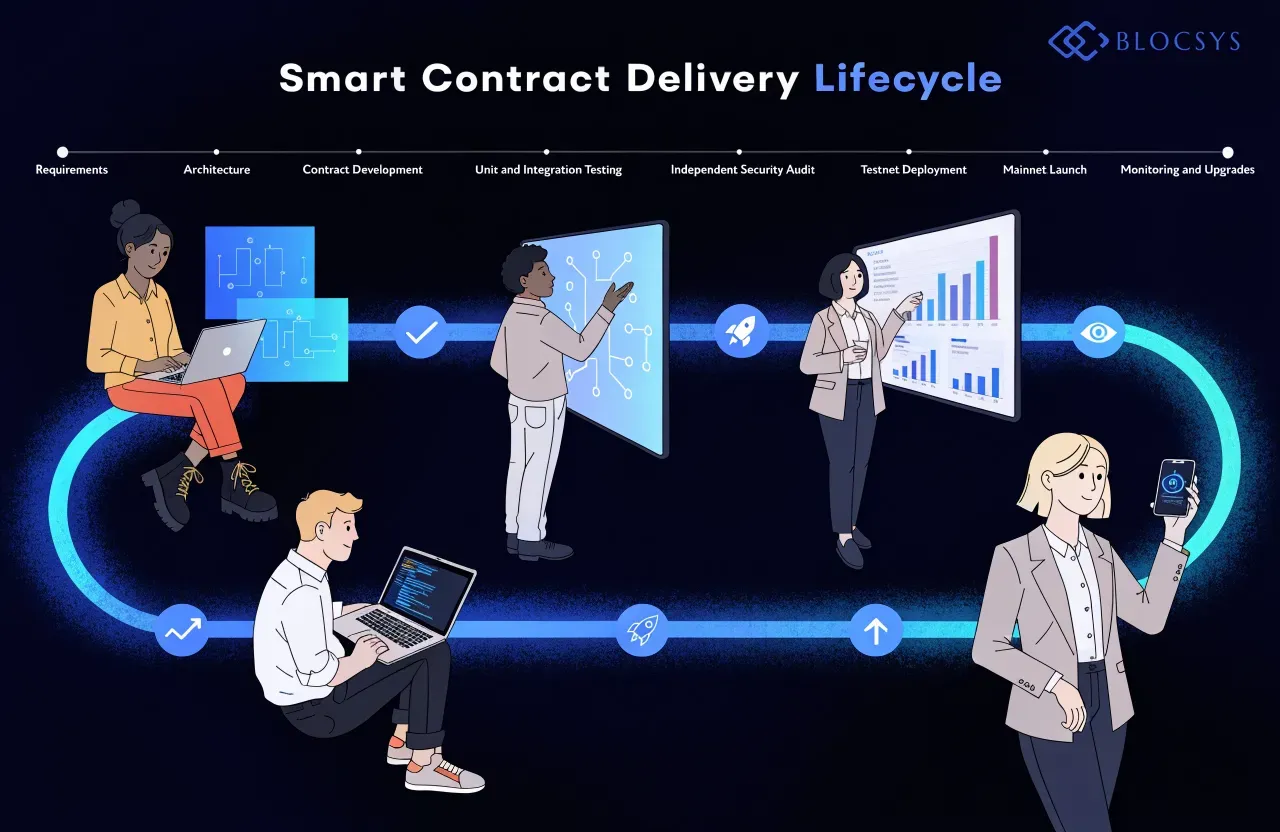
Smart contracts are programs that run on a blockchain and execute rules automatically. Developers write them in languages such as Solidity or Rust, then test and audit them. Moreover, vulnerabilities like reentrancy or faulty access control need dedicated review before launch.
Decentralized and Web3 applications
A decentralized application combines a front end, smart contracts and often off-chain services. Web3 development adds wallet connections, token-based access and on-chain data. Consequently, you must decide what lives on-chain and what stays in conventional storage.
Custom blockchain networks
Sometimes an existing chain won’t fit. Custom networks give you control over consensus, permissions and privacy. However, you’ll also own node operations, upgrades and governance. That’s a real cost.
Tokenization and digital asset platforms
Tokenization represents rights in an asset, such as a bond, equity or property interest, as a digital token. Furthermore, the platform around it handles investor onboarding, transfer rules, custody and reporting. Legal structure matters as much as code here.
Integration and maintenance
Blockchain rarely runs alone. Integration links it to ERP, core banking, KYC and analytics systems. Afterwards, monitoring, upgrades and key rotation continue for years.
Technologies Blockchain Developers Commonly Use
Public chains such as Ethereum, Solana, Avalanche and BNB Chain offer open participation and large ecosystems. Layer 2 networks like Arbitrum and Polygon reduce fees and raise throughput. In contrast, permissioned frameworks such as Hyperledger Fabric restrict participants, which suits consortium data sharing.
So how do public and private builds differ? Public builds favour openness, composability and liquidity. Private builds favour privacy, access control and predictable performance. Many enterprises now combine both, keeping sensitive data off-chain while anchoring proofs on-chain.
Interoperability deserves attention too. Cross-chain bridges have been a repeated source of major exploits, so ask how a vendor handles them.

How We Selected the Top Blockchain Development Companies in 2027
We screened for a few clear things. Each company had to offer direct development services, not just a protocol, exchange or analyst practice. We also looked for a published service description, a verifiable headquarters and a mix of regions.
Where evidence was thin, the table says “Not publicly verified.” Nothing here is a statistical ranking. Details change, so confirm current offices and services on each official site before you shortlist.
Comparison of the Top Blockchain Development Firms
| # | Company | Headquarters | Core focus | Key services | Technology | Suited to |
|---|---|---|---|---|---|---|
| 1 | Blocsys | Pune, India | Enterprise blockchain, tokenization, Web3 | Custom development, smart contracts, wallets, DeFi, RWA tokenization | Multi-chain; see service page | Financial institutions, fintechs, asset managers, startups |
| 2 | LeewayHertz | San Francisco, USA | Blockchain and AI engineering | Smart contracts, dApps, tokenization | Ethereum and EVM chains; others Not publicly verified | Mid-size firms, startups |
| 3 | SoluLab | USA (per its website) | Blockchain and Web3 products | dApps, smart contracts, tokens, wallets | Ethereum, Solana, others | Startups, SMEs |
| 4 | Antier Solutions | Chandigarh, India | Crypto and DeFi platforms | Exchanges, wallets, DeFi, tokenization | Not publicly verified in detail | Exchanges, digital asset firms |
| 5 | Appinventiv | Noida, India | Broad digital engineering with blockchain | Blockchain apps, smart contracts, integration | Not publicly verified in detail | Enterprises needing wider software work |
| 6 | Itransition | Denver, USA | Custom software with blockchain | Smart contracts, dApps, integration | Ethereum, Hyperledger | Enterprises, fintech |
| 7 | ChainSafe | Toronto, Canada | Protocol and infrastructure engineering | Client software, tooling, research | Ethereum, Polkadot, Filecoin | Protocol teams, infrastructure projects |
| 8 | Nethermind | Distributed team; HQ Not publicly verified | Ethereum engineering and security | Client development, auditing, research | Ethereum, Starknet | Protocols, L2 builders |
| 9 | Accenture | Dublin, Ireland | Systems integration and consulting | Blockchain strategy and enterprise integration | Not publicly verified in detail | Large global enterprises |
| 10 | IBM Consulting | Armonk, USA | Enterprise consortium blockchain | Consulting, implementation | Hyperledger Fabric | Regulated industries, supply chains |
1. Blocsys: Enterprise Blockchain and Digital Asset Development
Headquarters: Pune, India. Type: blockchain technology and development company.
Blocsys Technologies Pvt Ltd works across blockchain, Web3, fintech, digital assets and enterprise technology. Its headquarters is in Pune. It serves international clients through remote delivery, and we haven’t verified any overseas offices, so we won’t claim any.
Its custom blockchain development services cover smart contracts, decentralized applications, Web3 platforms, wallets and DeFi solutions. It also builds enterprise blockchain solutions that connect to existing systems.
Tokenization is where the profile gets distinctive. Blocsys publishes dedicated pages for real-world asset tokenization, corporate bond tokenization and equity tokenization platform development. That focus suits banks, asset managers and real estate businesses that need compliant digital asset infrastructure.
Engagement models matter too. It offers blockchain consulting for scoping, and dedicated engineering teams for longer builds. You can start with advice and move into delivery with the same partner.
Which chains does it work with? Its service pages describe multi-chain work, and typical stacks include Ethereum-compatible networks, Polygon and Solana. Ask for the current, project-specific list in discovery rather than assuming it.
Best for: financial institutions, fintech companies, asset managers, exchanges, real estate businesses and Web3 startups that want one partner for architecture, contracts, tokenization and integration. Notably, we aren’t citing client names or awards because we can’t verify them here. Ask Blocsys for references directly.
The best blockchain vendors talk about your operating model first and your chain second. If a pitch starts with a token standard, slow down.
2. LeewayHertz
Headquarters: San Francisco, USA. LeewayHertz is a software engineering firm that pairs blockchain with AI work. It lists smart contract development, decentralized applications and tokenization among its services. Its engineering strength outside the US is public, but a full office list isn’t something we’ve verified.
It fits startups and mid-size companies that want blockchain and AI features in one product. Moreover, buyers who plan AI-assisted analytics on top of on-chain data may find that combination practical.
3. SoluLab
Headquarters: United States, per its website. SoluLab builds blockchain and Web3 products for startups and SMEs. Its listed work includes smart contracts, decentralized apps, token development and wallets.
It’s a sensible shortlist candidate if you want a product-focused team for a first launch. However, request audit processes and post-launch support terms in writing. Enterprise-grade compliance experience isn’t something we could confirm from public material.
4. Antier Solutions
Headquarters: Chandigarh, India. Antier concentrates on crypto-native platforms. Its public offering centres on exchange development, wallets, DeFi products and tokenization.
That makes it relevant to digital asset companies building trading or liquidity infrastructure. In contrast, it’s less obviously aimed at permissioned consortium networks. Its overseas presence is Not publicly verified here, so ask about delivery locations.
5. Appinventiv
Headquarters: Noida, India. Appinventiv is a broad digital engineering company, and blockchain is one practice among several. Its public materials list offices in markets such as the US, UK, UAE and Australia.
That reach helps if you’re a global enterprise needing mobile, cloud and blockchain work under one contract. However, a generalist firm may not match a specialist on niche protocol work. Check which engineers would actually staff your project.
6. Itransition
Headquarters: Denver, USA. Itransition is a custom software company that delivers blockchain as part of wider enterprise builds. It describes smart contract and decentralized application development, plus integration with existing systems.
Therefore, it suits established businesses modernizing finance or operations software rather than launching a token. Its delivery teams are mainly in Europe, according to its public profile. Sector examples should be confirmed through case studies on its site.
7. ChainSafe
Headquarters: Toronto, Canada, operating as a remote-first team. ChainSafe is an open-source engineering firm. It maintains Lodestar, an Ethereum consensus client, and contributes to tooling such as web3.js.
Here’s the distinction. This is protocol and infrastructure engineering, not typical business-application delivery. Choose it if you’re building core infrastructure, clients or developer tools. It’s a weaker fit for a bank launching a retail app.
8. Nethermind
Headquarters: Not publicly verified; it works as a distributed team. Nethermind built the Nethermind Ethereum execution client and contributes to Starknet tooling. It also runs a security and auditing practice.
Consequently, it’s relevant for Layer 2 builders, protocol teams and projects that need deep Ethereum expertise plus code review. It’s a technical specialist, and it isn’t positioned as a general enterprise integrator.
9. Accenture
Headquarters: Dublin, Ireland. Accenture is a global systems integrator and consulting firm. It offers blockchain strategy and implementation inside larger transformation programmes.
We’re listing it as an integrator, not a pure blockchain builder. Its value lies in scale, governance and enterprise change management. For that reason, it suits large multinationals with complex stakeholders. A focused startup would probably find it heavy.
10. IBM Consulting
Headquarters: Armonk, New York, USA. IBM was a founding contributor to Hyperledger Fabric and has long delivered permissioned blockchain projects. Its consulting arm handles design and implementation for regulated industries.
There’s a useful lesson here. IBM and Maersk’s TradeLens supply chain platform was discontinued in 2023, showing that consortium adoption can fail even with strong technology. So ask any vendor how it manages governance and participation, not just code.
Types of Blockchain Development Companies
Not every firm in this space does the same job. Understanding the categories keeps you from buying the wrong thing.
- Specialist development firms build contracts, applications and platforms.
- Systems integrators and consultancies plan programmes and connect enterprise systems.
- Protocol engineering teams build clients and core infrastructure.
- Security auditors review code but don’t usually build products.
- Protocols, exchanges and infrastructure providers supply networks, liquidity or node access, and aren’t development partners.
Our list deliberately excludes pure protocols and exchanges. Ethereum, Solana and Avalanche are networks you build on, not vendors you hire.
Industries Using Blockchain Development
Banks and asset managers use tokenization for bonds, funds and equity. Fintechs build wallets, payment rails and DeFi products. Supply chain teams share provenance records across partners. Meanwhile, real estate firms explore fractional ownership, and gaming studios build digital item economies.
Each sector pulls toward a different architecture. Regulated finance leans on permissioned or compliance-aware designs. Consumer apps lean on public chains and low fees.
How to Evaluate a Blockchain Development Company in 2027
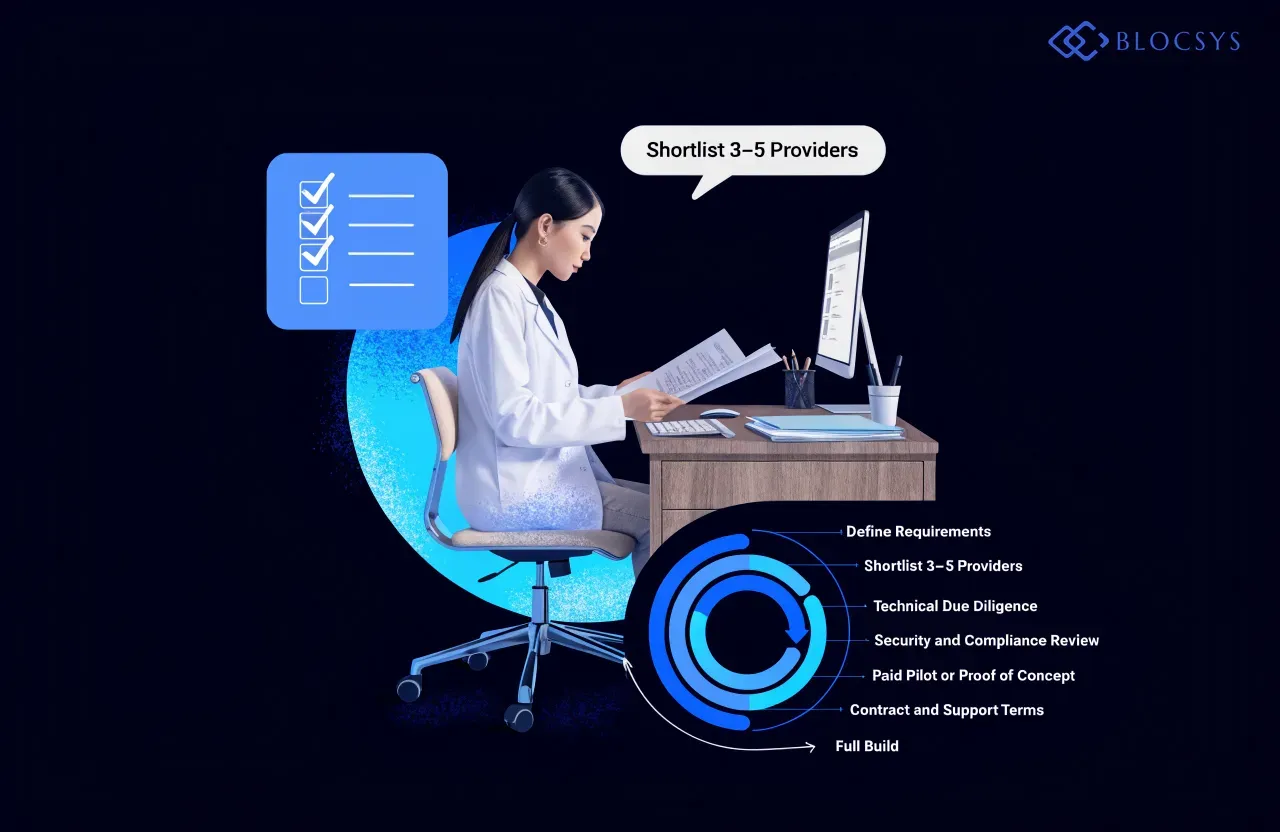
Start with evidence. Ask for case studies, code samples and references you can call. Then test the following areas.
- Technical expertise: Do their engineers know your target chain in depth?
- Security: Do they run internal reviews, use independent audits and manage keys properly?
- Architecture: Can they justify on-chain versus off-chain data choices?
- Scalability: How do they handle throughput, fees and Layer 2 options?
- Interoperability: What’s their approach to cross-chain risk?
- Integration: Can they connect to your core systems, KYC and custody providers?
- Industry experience: Have they delivered in your regulatory setting?
- Ongoing support: Who monitors, patches and upgrades after launch?
Also check governance and privacy early. Who controls upgrades? Where does personal data live? Those answers shape compliance outcomes more than the chain choice does.
Most failed blockchain projects didn’t fail on code. They failed because nobody agreed who owned governance, data and the cost of keeping it running.
What Shapes Vendor Choice in 2027
Three factors affect your shortlist most. First, tokenization of financial assets is moving from pilots toward production, so regulatory fluency matters more. Second, Layer 2 networks make fees lower, but they add bridging and sequencer considerations. Third, institutions want custody and identity handled properly from day one.
Therefore, favour partners who can explain trade-offs plainly. If you’d rather build capacity in-house, you can hire blockchain developers to extend your team.
Choosing Among the Top Blockchain Development Companies in 2027
Match the provider type to your need. Use a specialist for tokenization or DeFi. Use an integrator for a multinational rollout. Use a protocol team for infrastructure. Additionally, run a small paid pilot before you commit to a full build.
If you’re comparing the Top Blockchain Development Companies in 2027 for a regulated digital asset project, Blocsys deserves a discovery call. Explore its blockchain development services, then share your requirements. Whether you’re a bank, fintech, asset manager or Web3 startup, talk to the team about scope, architecture and support before you decide.
Frequently Asked Questions
Here are direct answers to the questions we hear most often about the Top Blockchain Development Companies in 2027.
What do blockchain development companies do?
They design and build blockchain software, including smart contracts, decentralized applications, wallets, tokenization platforms and enterprise networks.
They also integrate those systems with existing business software and provide testing, security review and maintenance.
How does enterprise blockchain differ from public blockchain development?
Enterprise builds usually run on permissioned networks where participants are known, which helps with privacy and access control. Public builds run on open networks like Ethereum, offering broader reach and liquidity but less privacy by default.
How much does blockchain development cost, and how long does it take?
We can’t give a fixed price because it depends on network choice, scope, smart contract complexity, integrations, security requirements, infrastructure and ongoing maintenance.
Timelines follow the same factors. A simple token contract is far quicker than a regulated tokenization platform with audits and system integration.
How do I evaluate a blockchain development company?
Check verifiable case studies, security and audit processes, architecture reasoning, integration experience and support terms. Call references and run a paid pilot.
How do I choose the right development partner?
Match the provider type to your goal: specialist builder, integrator or protocol engineer. Then confirm industry experience, governance approach and post-launch support. Finally, shortlist two or three firms and compare proposals side by side.
Ready to move beyond theory and build an intelligent platform that delivers real-world value? Blocsys Technologies specialises in engineering enterprise-grade AI and blockchain solutions for the fintech, Web3, and digital asset sectors. Connect with our experts today to discuss your vision and chart a clear path from concept to a secure, scalable reality.
