
Startup Equity Tokenization: A New Approach to Private Company Ownership
Every startup begins with a simple ownership story. Two founders split the shares, and that’s about it. Then angel money arrives, a venture round follows, and an employee option pool appears. Startup Equity Tokenization is a proposed way to represent and administer that growing web of ownership through blockchain-based digital records. It’s still an emerging idea in India, so we’ll separate what exists today from what’s only possible. If you’re exploring the technology side, equity tokenization platform development is a sensible starting point.
Introduction: Understanding Startup Ownership and Equity Tokenization
Equity is how a young company pays for ambition. Founders can’t match big-company salaries, so they offer a share of the future instead. Investors buy in for the same reason, and employees accept options on the same promise.
However, each new group adds a new set of rights. Founders hold ordinary shares. Investors often hold preference shares with special terms. Employees hold options that aren’t shares yet. Consequently, keeping everything accurate gets harder with every round.
Tokenization offers one possible response. It represents eligible ownership interests as digital tokens on a blockchain. Importantly, it doesn’t replace company law, and it doesn’t create liquidity by itself. Think of it as a technology layer for administration, not a legal shortcut.
How Does Startup Ownership Work in Traditional Private Companies?
In a typical Indian private limited company, ownership sits in shares recorded in the register of members. Founders subscribe to shares at incorporation, often at face value such as ₹10 each. Their percentage reflects both contribution and agreement.
Take a hypothetical Bengaluru logistics startup. Two co-founders hold 50% each. An angel investor then puts in ₹1 crore for 10%. After that round, the founders hold 45% each. That drop is equity dilution, and it’s normal.
Next comes a venture round. A fund invests ₹10 crore for 20%, and an ESOP pool of 10% is created. Founders slip further. Meanwhile, the cap table, a table showing who owns what, becomes the key reference for everyone.
Accurate records matter here. The Companies Act, 2013 requires companies to maintain a register of members, and investors rely on it. Without clean records, a later funding round or exit can stall.
What Challenges Do Startups Face in Managing Private Company Ownership?
The short answer: records drift apart. Founders keep a spreadsheet. Lawyers hold signed agreements. The company secretary maintains statutory registers. Each source may be right, yet they rarely match perfectly.
Furthermore, every event adds work. A fresh allotment, a share transfer or an option exercise changes the numbers. Someone must update the cap table, the register and the filings, and they must do it consistently.
Three groups feel this differently. Founders need clean records to raise capital and plan dilution. Investors need to verify what they own and what rights attach. Employees want to know the status of their options without chasing HR for emails.
Multiple funding stages multiply the problem. Series A terms differ from seed terms. Therefore, anti-dilution clauses, transfer restrictions and information rights all need tracking. It’s easy to miss something.

What Is Startup Equity Tokenization and How Does It Work?
Startup Equity Tokenization is the process of representing eligible equity interests in a private startup as digital tokens on a blockchain, so ownership records, permissions and transfers can be administered through a structured digital system. The token is a representation. It isn’t the share itself.
That distinction matters. The legal share exists under the Companies Act, 2013 and the company’s articles. A token can point to that share and record who holds it. Therefore, the legal and digital records must stay aligned.
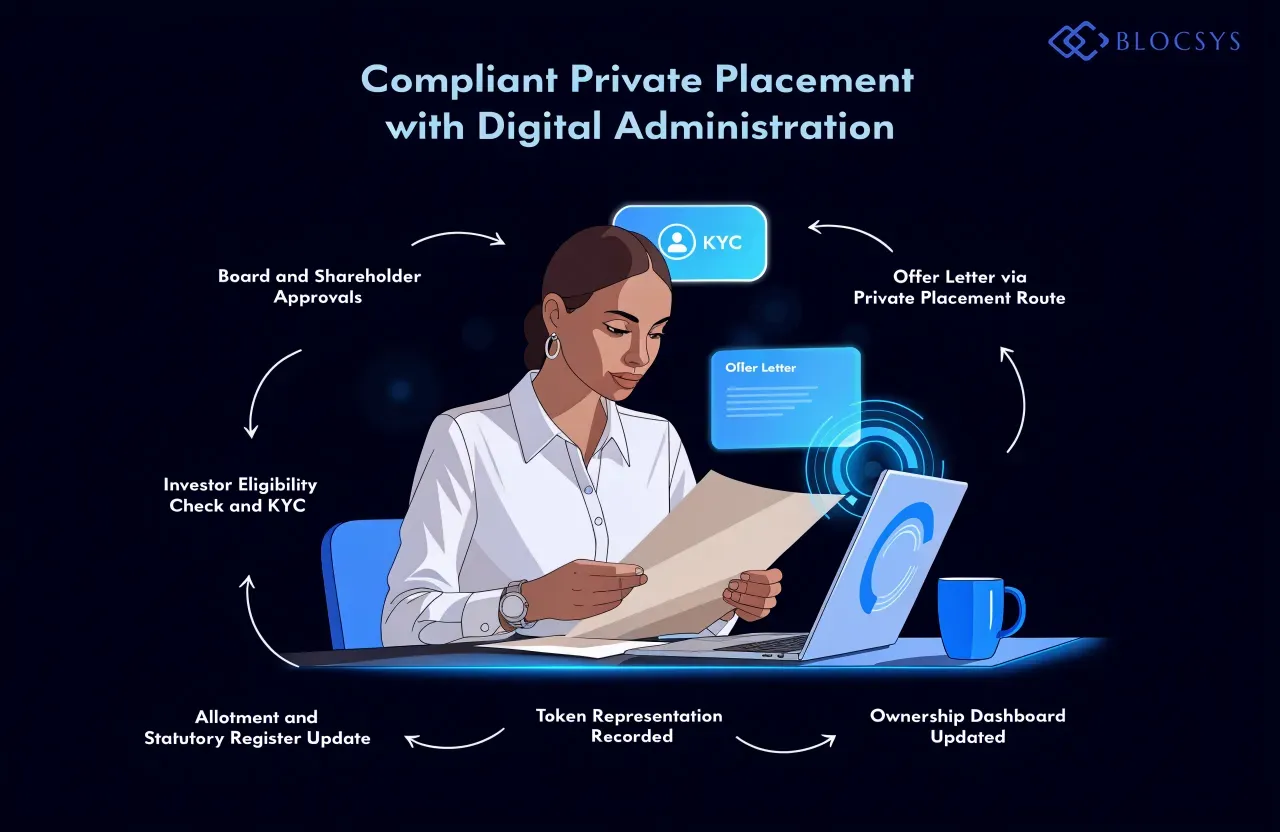
Here’s a simple flow. The startup defines which interests are eligible. A platform verifies investors through KYC. A smart contract, which is code that enforces preset rules, issues tokens and applies transfer conditions. Finally, the ledger logs every change.
Picture our logistics startup again. The angel investor completes KYC on a platform. The company records the allotment legally. A token then mirrors that holding, and any permitted transfer updates both records. Consequently, everyone sees one consistent history.
How Startup Equity Tokenization Could Change Private Company Ownership
This is where the idea gets interesting. Today, ownership information is scattered. With tokenization, a single platform could hold ownership records, investor details and transaction histories together. It wouldn’t replace statutory records. Instead, it could keep them synchronised.
Digital Ownership Records and Transaction History
A blockchain ledger is append-only. Each change gets timestamped and traceable. For a startup, that could mean a clear trail from the first allotment to the latest transfer. Auditors and investors would spend less time reconciling files.
Visibility also improves. Role-based access lets founders see the full table, while an employee sees only their own interest. That solves a real frustration: people can check their position without emailing three departments.
Smart Contracts and Transfer Conditions
Most startup shares carry restrictions. Lock-ins, rights of first refusal and board consent are common. Smart contracts can encode some of these, such as blocking a transfer until approvals are logged. However, they can only enforce rules that someone has defined legally first.
Code doesn’t create rights. It enforces the rights your legal documents already define. Get the shareholders’ agreement right first, and then build the platform around it.
Three Ideas You Shouldn’t Mix Up
We often see three separate activities blurred together. Primary issuance means the company creates new shares to raise capital. Representing existing ownership means mirroring shares that already exist. Secondary transfers mean one shareholder sells existing holdings to another.
Each affects people differently. Primary issuance dilutes existing holders and changes the capital structure. Representation changes nothing about ownership percentages. Secondary transfers shift holdings between investors without bringing money into the company.
Fractional Representation
Tokens can be divided into small units. That sounds like fractional share ownership. Yet splitting a token doesn’t automatically create legally recognised fractional shares. Indian company law deals in whole shares, and any fractional model needs a clear legal structure behind it.
Likewise, a smaller ticket size doesn’t widen the eligible investor pool on its own. Private placement rules still decide who can be offered securities. So treat fractional representation as a possibility, not a given.
How Can Startups Use Tokenization to Manage Founder and Investor Equity?
Founders can use a digital platform to keep their holdings, vesting terms and dilution scenarios in one place. Investors can see their allocations and rights without waiting for a manual statement. That’s the practical benefit.
Suppose a Pune fintech closes a ₹5 crore round. The allotment is approved legally. The platform then records new holdings, updates percentages and flags any transfer restrictions. Each step reflects a legal action that already happened.
Consistency is the real discipline. Token records, signed agreements, the register of members and filings must agree. If they don’t, the token record carries no weight.
Equally important, tokenization doesn’t set ownership percentages, voting rights or shareholder rights. Those come from the underlying legal and corporate structure. The platform only reflects them.
Can Equity Tokenization Support Startup Fundraising and Investor Participation?
Possibly, as an administrative layer. Startups raise money from angels, venture funds and other eligible investors at different stages. Each round involves onboarding, documentation and issuance records. A digital platform could organise that workflow.
Tokens could represent eligible equity interests during a private round. Investor onboarding and KYC could run inside the same system. Consequently, the company would have cleaner issuance records from day one.
Still, tokenization doesn’t grant new fundraising rights. A startup can’t use it to run an open public offering. Section 42 of the Companies Act, 2013 and the Companies (Prospectus and Allotment of Securities) Rules govern private placements, including who can be offered securities and how.
Therefore, ask the legal question first: who may invest, under which route, and with what disclosures? Technology comes second.
How Tokenization Could Improve Startup Shareholder and Cap Table Management
A cap table is only useful when it’s current. A digital cap table, linked to token records, could update as events occur. Allotments, permitted transfers and option exercises would flow into one view, and reporting would become simpler.
Role-based access adds control. A founder sees everything, an investor sees their holdings, and an auditor gets read access. Additionally, transaction traceability makes it easier to answer “who owned what, and when?”
Startup shareholder management also covers rights, not just numbers. Information rights, consent requirements and exit terms could be tagged against each holder. That reduces missed obligations.
However, a blockchain-based cap table doesn’t replace legally required registers. The company must still maintain statutory records. Good platforms integrate with those processes instead of competing with them.
Traditional Startup Equity vs Tokenized Equity: Understanding the Differences
Both approaches can coexist. Here’s a fair comparison across the points founders ask about most.
- Representation: Traditional equity lives in registers and certificates, or in demat form. Tokenized equity adds a digital representation of the same legal interest.
- Recordkeeping: Traditional records sit in separate files. A tokenized system can centralise a shared, traceable history.
- Onboarding: Traditional onboarding is manual. Digital workflows can standardise KYC and document capture.
- Transfers: Traditional transfers follow paper-heavy approvals. Smart contracts can enforce parts of the process, but legal approvals still apply.
- Transparency: Tokenized systems can offer clearer visibility, though only to permitted users.
- Legal certainty: Traditional equity rests on established law. Tokenized models in India remain largely untested.
Conventional infrastructure remains necessary for legal title, statutory filings and governance. Tokenized equity isn’t automatically more liquid, safer or more valuable. It’s a different administrative method.
Can Equity Tokenization Support Employee Equity and ESOP Management?
It could support the administration side. Employee stock options (ESOP) let staff buy shares later at a set price. Startups use them to attract talent and align people with long-term growth. Under Section 62(1)(b) of the Companies Act, 2013, ESOPs need a special resolution and follow prescribed rules.
Three things get confused. An option is a right to buy shares in future. An issued share is actual ownership. A token is a digital representation of one of those. Tokenizing an ESOP doesn’t convert an option into a share or grant immediate ownership.
Still, a platform could track grants, vesting schedules and exercise windows. Imagine a Hyderabad SaaS startup with 40 employees holding options. Each person could see their vesting status in one dashboard. That’s useful clarity.
Company approvals, exercise conditions and tax treatment all still apply. Employees gain transparency, not extra rights.
Regulatory and Compliance Considerations for Startup Equity Tokenization in India
Let’s be direct. We’re not offering legal advice, and the position keeps evolving. Please verify everything against current official sources before acting. Moreover, India hasn’t established a fully regulated public market for tokenized startup equity, so you shouldn’t assume models from other countries apply here.
Several existing provisions matter. Section 42 of the Companies Act, 2013 and the related rules govern private placements. Section 62 covers further issue of shares, including ESOPs. Section 56 deals with transfers, and Section 88 requires registers of members. A private company must also restrict share transfers under Section 2(68).
Dematerialisation is another point. MCA amended rules in 2023 to require most private companies, except small companies, to issue securities in dematerialised form and facilitate demat of existing holdings. The Depositories Act, 1996 governs depositories such as NSDL and CDSL. Confirm current applicability for your company.
SEBI regulations may apply where listing or public issuance is involved. A public issue is different from a private placement. A secondary transfer is different again. Therefore, a blockchain token can’t independently replace statutory registers, depositories or legally required ownership records.
Investor eligibility, identity verification, transfer restrictions and disclosures all need attention. Consequently, tokenized startup equity can’t simply be issued or traded on any blockchain platform. Take qualified legal advice early.
Technology Infrastructure Required for a Startup Equity Tokenization Platform
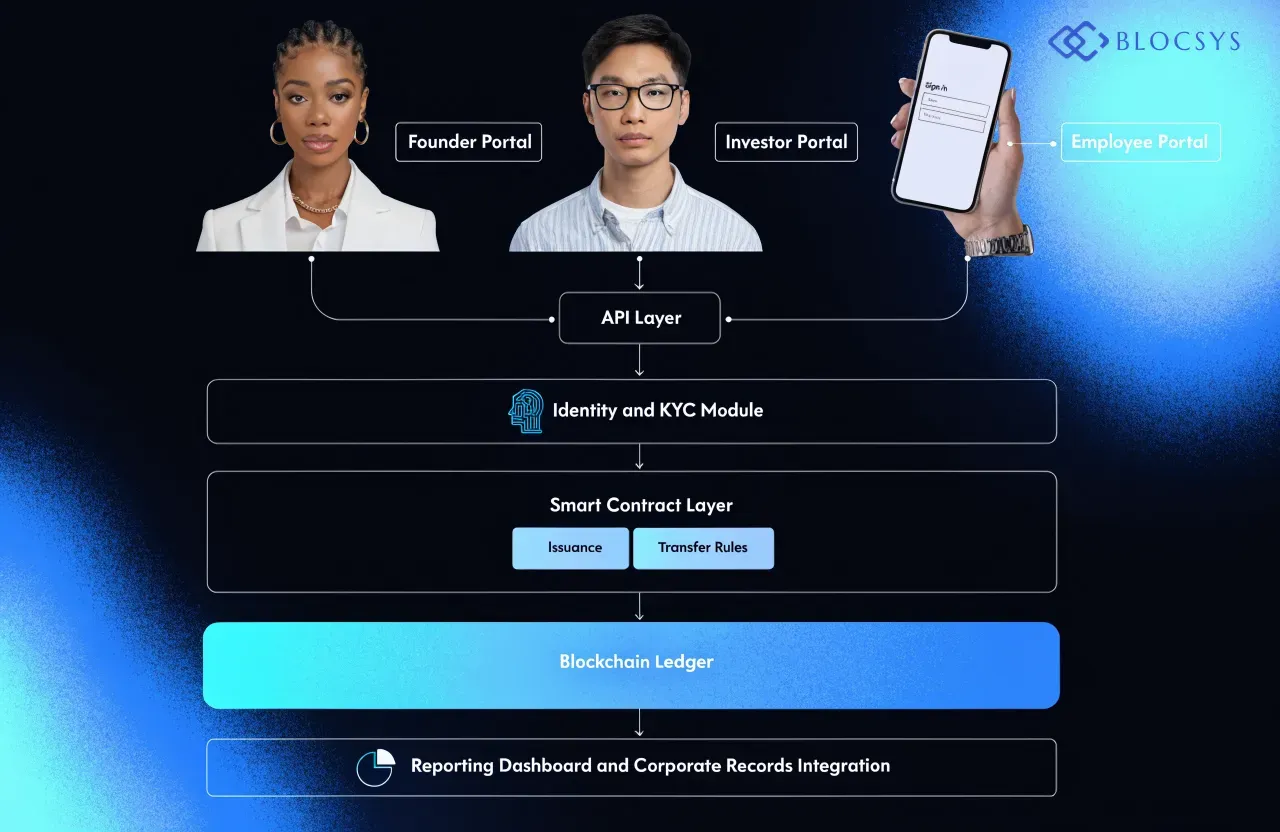
A serious platform has several layers. At the base sits the blockchain architecture, which might be permissioned or public depending on privacy needs. Smart contracts handle token issuance, transfer rules and cap table logic. Above them sit applications for founders, investors and administrators.
Supporting components matter just as much. Investor onboarding and identity verification screen participants. Role-based permissions control access. Transaction monitoring flags unusual activity. Reporting tools produce statements for auditors, and custody integrations secure digital assets.
Security, privacy and auditability aren’t optional extras. Cap tables hold sensitive commercial data. Scalability also matters as funding rounds add holders. Additionally, integrations with banks, KYC providers and corporate records keep the system practical.
Needs vary. A basic equity issuance platform differs from a full shareholder management system. A broader digital securities ecosystem differs again. Importantly, picking a blockchain network doesn’t establish regulatory compliance.
Challenges and Risks of Startup Equity Tokenization
Regulatory clarity comes first. Without it, structuring is difficult. Investor eligibility, transfer restrictions and ownership verification need careful legal design. Cybersecurity and custody add technical risk.
Adoption is a people problem too. Founders, existing shareholders and investors must accept a new system. Technology integration with legacy records takes effort. Some stakeholders simply won’t want the change.
Business fundamentals don’t disappear. Valuations, dilution, funding risk and shareholders’ agreements matter just as much. Tokenization can’t remove investment risk or prevent losses.
A token is a better ledger entry, not a better business. If the startup’s economics are weak, no technology fixes that.
So evaluate legal, financial, operational and technology needs before building anything. A pilot with clear scope beats a grand launch.
The Future of Startup Ownership and Digital Equity Markets in India
India has already built strong digital infrastructure in demat accounts and depositories. For background on where that thinking is heading, see this look at Demat 2.0, tokenization and CBDC integration. It shows how regulated securities infrastructure might evolve.
Future roles are shared. Founders and venture funds shape demand. Financial institutions and technology providers build tools. Depositories and regulators set the boundaries. Nobody can predict approvals or adoption, and we won’t pretend to.
What we can say is simple. Better onboarding, structured administration and transparent records have clear value. Current technology can already support internal administration. Wider uses remain potential future applications.
Startup Equity Tokenization Platform Development Services Offered by Blocsys
Blocsys is a technology development company working on blockchain development, digital asset platforms, tokenization solutions and custom software. It builds technology. It doesn’t provide legal, regulatory, investment banking, brokerage, depository or stock exchange services.
For startups exploring digital equity infrastructure, relevant work includes custom blockchain platforms, smart contract development and token issuance infrastructure. It also covers investor-facing applications, backend systems, administrative dashboards, API development and third-party integrations.
Architecture follows your needs. Your ownership structure, intended users, business model, security expectations and regulatory context all shape the design. Teams comparing broader options can also review the asset tokenization platform approach.
Why Choose Blocsys for Startup Equity Tokenization Platform Development?
Startups need a partner who builds for business realities. Blocsys focuses on scalable, secure infrastructure that fits your workflows instead of forcing a template. That means a customised approach to ownership structures, investor journeys and platform requirements.
Its strengths sit across blockchain development, digital asset platforms, smart contracts, backend systems and web applications. Equally, it keeps compliance requirements in view during design, while your legal advisers define the rules.
Exploring equity tokenization for your startup? Connect with Blocsys to discuss your digital equity platform requirements, blockchain architecture, smart contract infrastructure and technology development approach. Earlier-stage teams may also find the Founder Checklist 2026 useful.
Conclusion: Is Startup Equity Tokenization a New Approach to Private Company Ownership?
Traditional ownership gets messy as startups grow. Founder equity, investor allocations, employee options and shareholder records pull in different directions. Startup Equity Tokenization could help by offering digital ownership representation, structured administration, smoother onboarding and clearer transaction history.
Success depends on solid legal structuring, regulatory compliance, protected shareholder rights and dependable technology. Tokenization won’t guarantee liquidity or bypass securities law. Even so, digital equity infrastructure may become a meaningful part of how private capital markets evolve.
If you’re ready to explore it, start a conversation with Blocsys about your equity tokenization platform requirements.
Frequently Asked Questions
Here are direct answers to the questions we hear most often about Startup Equity Tokenization.
What is startup equity tokenization?
It’s the digital representation of eligible startup equity interests as blockchain tokens. The token records ownership and conditions, while the legal share remains governed by company law.
How does equity tokenization work for startups?
A company defines eligible interests, verifies investors, and issues tokens through smart contracts. The ledger then records holdings and permitted transfers alongside legal records.
Can startups tokenize their shares in India?
There’s no clear, dedicated framework for it yet. Any structure must comply with the Companies Act, 2013, securities rules and depository provisions. Take legal advice first.
How can blockchain help manage startup ownership?
It can offer a shared, timestamped record of holdings and transfers. That reduces reconciliation work, although statutory registers are still required.
Can startup founders tokenize their equity holdings?
Possibly as a representation, but founders remain bound by articles, shareholders’ agreements and transfer restrictions. A token doesn’t override those.
Can tokenization help startups raise private capital?
It can support administration of a private round. It doesn’t create new fundraising rights, and Section 42 private placement rules still apply.
What is the difference between traditional startup equity and tokenized equity?
Traditional equity is the legal share recorded in registers or demat. Tokenized equity is a digital representation of it, adding workflow and record-keeping features.
Can employee stock options be represented through tokenization?
Tracking grants digitally is feasible. However, an option isn’t an issued share, and tokenizing it doesn’t grant ownership or voting rights.
Is startup equity tokenization legal in India?
Legality depends on structure. No general approval exists for tokenized startup equity trading, so existing company and securities laws govern. Seek qualified legal advice.
How can a startup develop an equity tokenization platform?
Define the legal structure first. Then plan architecture, smart contracts, onboarding and integrations with a technology partner such as Blocsys.
Ready to move beyond theory and build an intelligent platform that delivers real-world value? Blocsys Technologies specialises in engineering enterprise-grade AI and blockchain solutions for the fintech, Web3, and digital asset sectors. Connect with our experts today to discuss your vision and chart a clear path from concept to a secure, scalable reality.
