
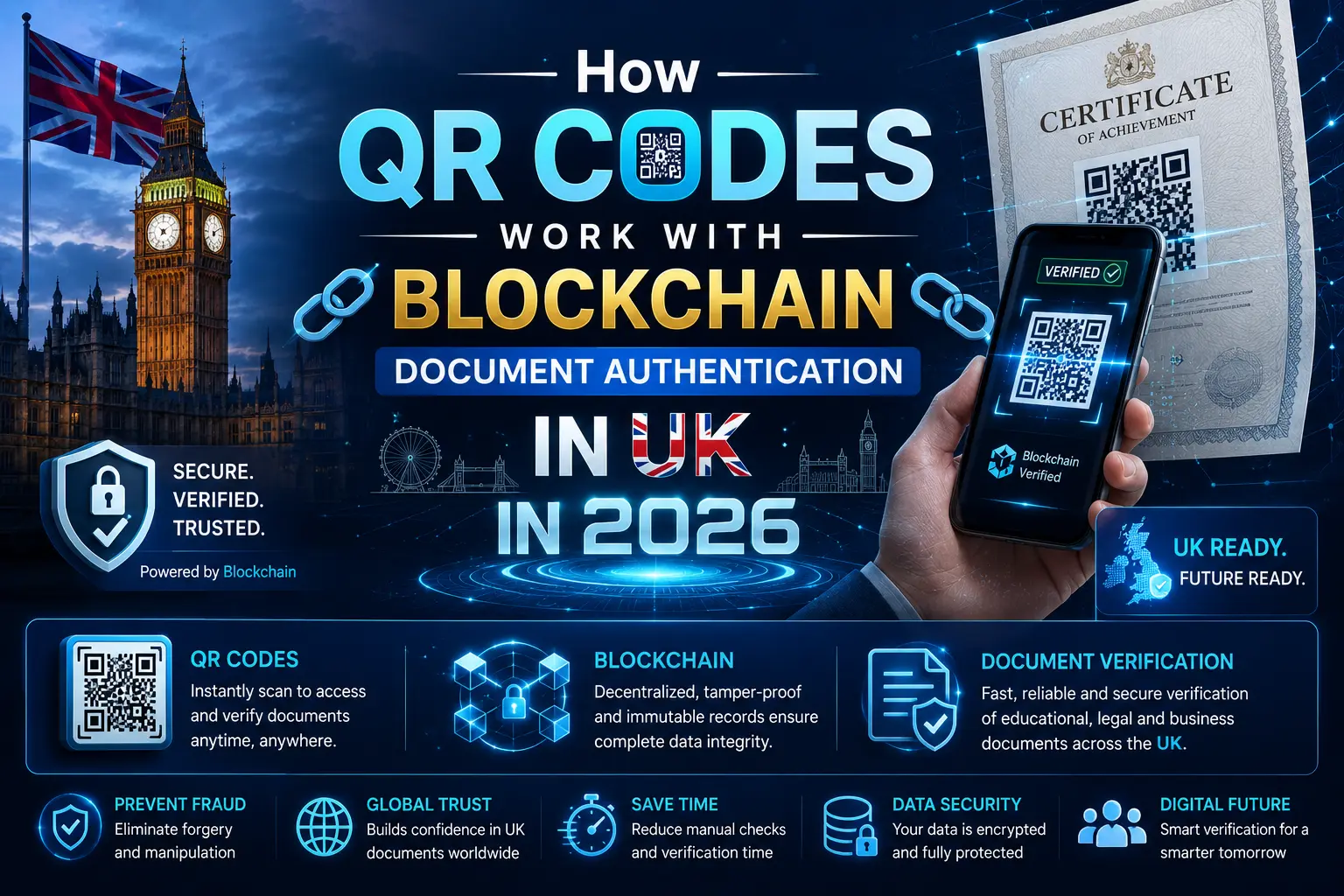
A hiring manager receives a polished PDF degree certificate. The crest looks right. The QR code scans. The candidate sounds credible. Two weeks later, someone spots a formatting inconsistency and the institution can’t confirm the record through its normal channel. At that point, the problem isn’t just a fake document. It’s a failed control process, a weak audit trail, and an avoidable operational risk.
That scenario plays out in different forms across hiring, onboarding, compliance, logistics, healthcare, and regulated reporting. In the UK, organisations are moving away from paper-heavy checks toward digital, auditable verification models. The shift is not happening in a vacuum. The UK government launched GOV.UK Verify in 2016 as a central digital identity verification framework, and by 2020 it had supported millions of verification attempts across public services before being retired in 2023, a useful reminder that trusted issuer models and verifiable records have been part of the UK’s digital environment for years, not a sudden invention (JOIV on blockchain certificate verification and UK digital identity context).
For enterprise teams evaluating QR code blockchain authentication, the important question isn’t whether a QR code can be added to a document. That part is easy. The real question is whether the scan triggers a trustworthy verification flow that resists tampering, supports revocation, protects personal data, and works in real operations.
This guide is for CTOs, product leaders, compliance teams, digital identity providers, universities, banks, and enterprise verification platforms that need to understand how QR codes work with blockchain document authentication in UK environments, and what separates a credible deployment from a fragile demo.
Table of Contents
- The Growing Threat of Document Fraud in a Digital World
- Why Traditional Verification Systems Are Failing Enterprises
- How Blockchain and QR Codes Create Tamper-Proof Documents
- Automating Trust with Smart Contracts in Document Verification
- Blockchain QR Authentication Use Cases Across UK Industries
- A Framework for Adopting Blockchain Verification
- Building Your Secure Verification Platform with Blocsys
- Frequently Asked Questions About Blockchain Document Authentication
- How do QR codes work with blockchain document authentication?
- What is blockchain QR code verification?
- Does the blockchain store the whole document?
- How does blockchain improve QR code security?
- Can a fraudster copy a real QR code onto a fake document?
- Are QR code blockchain authentication systems suitable for UK compliance use cases?
- What industries benefit most from blockchain document verification systems?
- What should CTOs look for in a blockchain authentication platform?
- Can Blocsys help build a QR code blockchain authentication system?
The Growing Threat of Document Fraud in a Digital World
Document fraud rarely arrives looking suspicious. It usually arrives formatted well, branded correctly, and timed to fit a busy workflow. A candidate presents a degree, a supplier uploads a compliance certificate, or a borrower submits KYC paperwork that appears complete. The immediate pressure is to keep the process moving.
That’s exactly why fraud persists. In many organisations, the point of use is still the weakest point of control. Staff often trust what they can open, print, or scan, even when the underlying record hasn’t been validated against a trusted source. In the UK, that matters because fraud remains a major public-sector and enterprise concern, and authentication workflows are high-value targets in any system that depends on claims made by documents.

Why the business impact escalates quickly
A forged or altered document creates more than one problem:
- Operational risk. Teams make downstream decisions based on bad data.
- Compliance exposure. The business may fail its own control requirements.
- Reputational damage. Once a fake passes internal checks, trust in the process drops.
- Costly remediation. Manual re-validation pulls legal, compliance, HR, and IT into the same incident.
Practical reality: most fraud losses in document workflows come from process failure, not from a lack of file formats or visual security marks.
UK organisations also face a specific transition challenge. They’re moving from paper-first validation to digital verification, but many controls still behave as if a document itself is the source of truth. It isn’t. The source of truth has to be the issuer record and the validation process around it.
Where blockchain document authentication fits
Blockchain document authentication changes the model. Instead of trusting the document on sight, the verifier checks whether the document matches an immutable issuer-backed record. The QR code becomes the access point, not the trust mechanism by itself.
That distinction matters. A QR code on its own is just a container. A QR code tied to a verifiable ledger entry, issuer identity, and current status check becomes part of a fraud-resistant verification system.
Why Traditional Verification Systems Are Failing Enterprises
Traditional document verification still depends on methods that were designed for lower-speed, lower-volume workflows. PDFs, visual seals, email confirmations, and central database lookups can still play a role, but they don’t hold up well when documents move across organisations, jurisdictions, and digital channels.
A PDF can be edited. A watermark can be copied. A screenshot of a certificate can circulate long after the original should have been revoked. A central server can provide a valid answer, but only if the verifier reaches the correct system, has access, and checks the current status rather than trusting a stored file.
The core weakness is misplaced trust
Most legacy verification systems fail because they trust the artefact too much. They treat the document as evidence of authenticity instead of treating it as a claim that must be checked.
That creates predictable gaps:
- Visual inspection is inconsistent. Staff notice different things, and fatigue lowers attention.
- Email-based confirmation is slow. It also fails outside business hours and across time zones.
- Static links are weak. A copied URL doesn’t prove the linked document is still valid.
- Centralised databases create friction. Verifiers may not have the right credentials or integration path.
A lot of enterprises also underestimate replay risk. If a forged document carries a copied QR code or a real screenshot from a valid document, a shallow scan can create false confidence.
Why central control alone isn’t enough
Centralised systems can be secure, but they often become bottlenecks in enterprise operations. Every verification depends on one repository, one permission model, and one support path. If the verifier can’t reach that system quickly, teams fall back to manual acceptance.
That is one reason many organisations are comparing traditional repositories with distributed verification models. A useful reference is this overview of centralized vs blockchain-based document verification, particularly for teams deciding whether they need tamper evidence, issuer traceability, and auditability beyond a standard document portal.
What doesn’t work well in practice
A few common controls look stronger than they are:
| Legacy control | Why teams use it | Why it fails under pressure |
|---|---|---|
| Password-protected PDF | Easy to issue | Protects access, not authenticity |
| Visible seal or stamp | Familiar to users | Easy to imitate visually |
| Signed email attachment | Fast to send | Hard to verify later at scale |
| Static QR to webpage | Good user experience | Doesn’t prove the document hasn’t been altered |
| Manual registry lookup | Reliable when done well | Too slow for high-volume workflows |
If the verifier can accept a document without checking live status, revocation, and issuer identity, the system still has a fraud gap.
The trade-off is simple. Traditional systems are often easier to launch. They are harder to trust at scale. Enterprises need a model that preserves usability while making tampering visible and verification traceable.
How Blockchain and QR Codes Create Tamper-Proof Documents
The cleanest architecture is also the one that most enterprise teams misunderstand at first. You don’t put the full document on-chain. You put proof on-chain, keep the document payload off-chain, and use the QR code as a controlled way to start verification.
That design is stronger for privacy, lighter for operations, and better aligned with regulated environments in the UK and Europe.
What actually gets stored
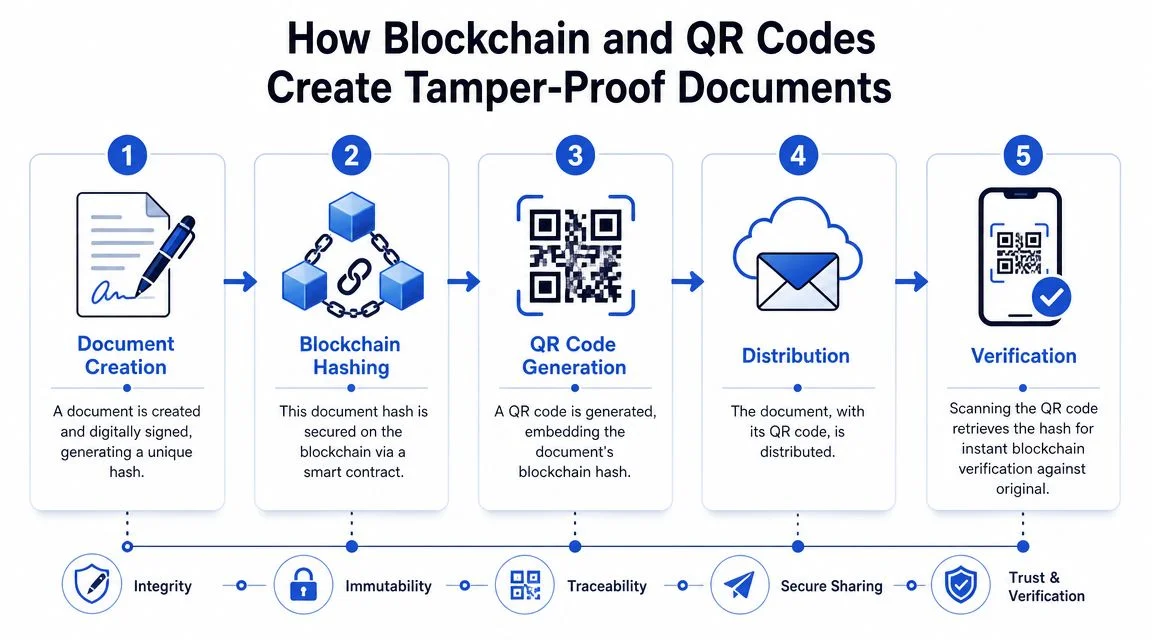
A secure blockchain QR code verification flow usually works like this:
- A document is created by an authorised issuer.
- The system generates a cryptographic hash of that document. This acts like a digital fingerprint.
- The hash, issuer reference, and status-related metadata are written to a blockchain or distributed ledger.
- The document receives a QR code that points to the verification record or identifier.
- When someone scans the QR code, the system recomputes or checks the hash and compares it with the on-chain proof.
If the values match, the document is authentic and unaltered. If they don’t match, the system flags the mismatch.
This is why the QR code should never be treated as the security layer by itself. It is just the trigger for the validation process.
The verification flow in practice
A good mental model is a digital public notary. The notary doesn’t hold every copy of the contract in public. The notary records proof that a specific version existed, who issued it, and whether that proof is still valid. Blockchain plays that notary role in a machine-readable way.
For enterprise implementation, the strongest pattern is to keep personal data and credential content off-chain. QRCodeKIT describes this model clearly: once a hash is recorded on a blockchain, a QR scan can verify whether current data still matches the original, and a mismatch reveals alteration (QRCodeKIT on QR codes and blockchain verification).
That approach is especially useful in UK document systems because it supports data minimisation. The QR payload can carry an identifier or hash pointer instead of sensitive personal information.
Architect’s rule: store proofs on-chain, store documents off-chain, and validate current status at scan time.
A practical document team may prototype the visual layer with a QR code generator tool, but production systems need controlled encoding rules, signed issuer workflows, and secure resolver services behind the scan.
Why this model fits the UK market
The UK has already seen a broad move toward digital identity and records infrastructure. In certificate and credential verification, that matters because institutions need a trusted issuer, a verifiable record, and a quick integrity check without exposing unnecessary data. That broader pattern is reflected in blockchain-based certificate systems where a scanner compares a QR-embedded hash with an immutable ledger entry, making tampering visible (JOIV on QR-backed document authentication architecture).
There is also a practical implementation pattern worth noting. The UK National Center for High-Performance Computing’s blockchain-based certificate platform describes three properties, “tamper proof, convenience, and privacy”, uses Ethereum as the underlying blockchain layer, and uses proof-of-authority rather than proof-of-work for efficiency. It also states that the QR code is used for authentication or certificate display while the authentication code is stored on-chain to prevent fake certificates (NCHC blockchain certificate platform).
For a CTO, the takeaway is direct. Tamper-proof QR code authentication is not about embedding trust inside a square graphic. It is about binding the scan event to an immutable issuer-backed verification path.
Automating Trust with Smart Contracts in Document Verification
Once the verification record exists on-chain, the next step is making the lifecycle enforceable. That is where smart contracts matter. In document systems, they act as rule engines that run consistently every time a document is issued, checked, updated, suspended, or revoked.
Without that layer, many organisations still rely on manual status changes and fragmented administration. The ledger may be tamper-resistant, but the workflow around it is still fragile.
Rules that should run automatically
A well-designed smart contract can enforce document logic such as:
- Issuance control. Only approved issuers can register a valid document proof.
- Expiry handling. Credentials can move from valid to expired automatically based on policy.
- Revocation status. A verifier can see that a once-valid document should no longer be accepted.
- Access conditions. Some records can be verifiable only by approved counterparties or apps.
- Event logging. Every lifecycle action can create an audit trail.
This matters in banking, compliance, and credentialing because the question is rarely just “was this document ever issued?”. The more important question is “is it valid right now, under the current policy state?”
Where automation helps most
The strongest use cases are the ones with repeated checks and clear business rules. A professional certificate may expire. A supplier compliance document may require reapproval. A training credential may be suspended pending review. If staff must update all that manually in separate systems, inconsistency creeps in quickly.
Dock’s verification model is a useful benchmark here. It uses decentralized identifiers as the on-chain registry while credentials and personally identifiable information remain off-chain. Verifiers scan a QR code to resolve the issuer DID and confirm authenticity in real time, which supports privacy while reducing reliance on the QR alone (Dock on blockchain verification with DIDs and QR flows).
Smart contracts are most valuable when they remove discretionary steps from high-trust workflows.
Teams exploring this layer in more depth should think beyond issuance and include revocation, policy updates, approval paths, and verifier permissions. At this point, a document verification platform begins to function as infrastructure rather than a simple document viewer. For organisations mapping that workflow logic, this guide on how smart contracts automate secure document authentication is a useful technical reference.
Blockchain QR Authentication Use Cases Across UK Industries
The real test of any verification system is whether it survives messy operational environments. Documents move between mobile phones, portals, inboxes, field teams, auditors, hiring managers, suppliers, and third-party verifiers. If the system only works in a controlled demo, it won’t reduce fraud in production.
Education and professional credentials
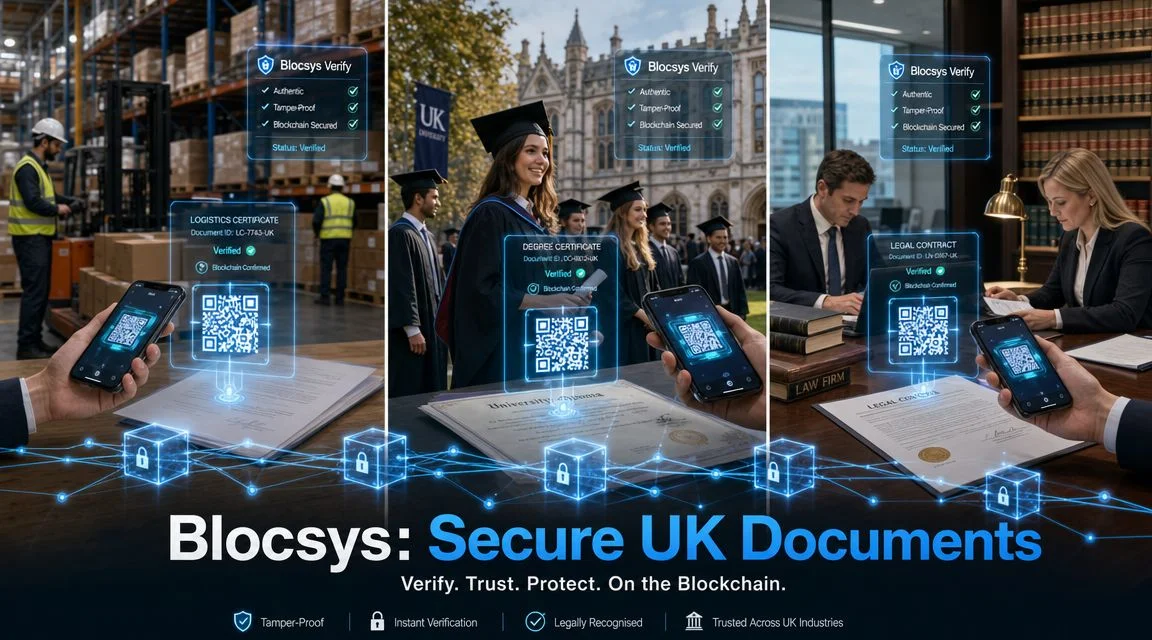
This is one of the clearest UK use cases. Universities and certifying bodies issue documents that are regularly shared with employers, recruiters, regulators, and overseas institutions. Fraud is persistent, and manual confirmation is slow.
A blockchain-backed credential changes the process:
- The institution issues the certificate.
- The certificate hash or authentication code is recorded on-chain.
- The graduate shares the document with a QR code.
- The verifier scans and confirms the issuer-backed proof.
This model fits the wider shift toward digital, auditable checks in academic and professional verification. It is particularly useful when institutions need to show authenticity without exposing full record contents during every check.
Healthcare, finance, logistics, and property records
In healthcare, teams need confidence that records, prescriptions, test outputs, or authorisation documents haven’t been altered during transfer. The operational value is integrity and traceability, not public transparency.
In finance and banking, document authenticity often sits inside KYC, onboarding, transaction approvals, internal reporting, and compliance evidence. A secure document authentication using blockchain model helps when multiple teams or counterparties must rely on the same verified status.
In logistics, shipping papers, certificates of origin, inspection records, and chain-of-custody documents are often passed through several systems. A QR-backed blockchain proof gives frontline staff a faster way to validate whether a record still matches its issuer state.
For regulated record systems in healthcare, legal, and government-adjacent workflows, this overview of blockchain document verification for healthcare legal and government records is relevant because these sectors need both integrity controls and auditable verification histories.
A short demonstration helps show how these workflows look in practice:
What changes at the point of use
The biggest gain is not just document security. It is decision confidence at the exact moment someone must accept or reject a record.
Consider a few practical examples:
- University admissions or hiring. The recruiter checks issuer authenticity before progressing the candidate.
- Supplier onboarding. Procurement confirms that a compliance document is still valid and not replaced with an altered version.
- Clinical administration. Staff verify that a record presented from another system still matches the authorised source.
- Property and legal workflows. Counterparties confirm that a supporting record has not been tampered with since issuance.
The best systems make these checks easy enough that staff perform them. That is often the difference between a secure platform and a secure-looking one.
A Framework for Adopting Blockchain Verification
Most enterprise failures in this area don’t come from choosing the wrong hash function or ledger pattern. They come from weak rollout design. Teams focus on the issuance demo and ignore verification behaviour in the field, revocation controls, staff adoption, and integration with existing systems.
That’s why the decision framework has to cover operations, not just architecture.
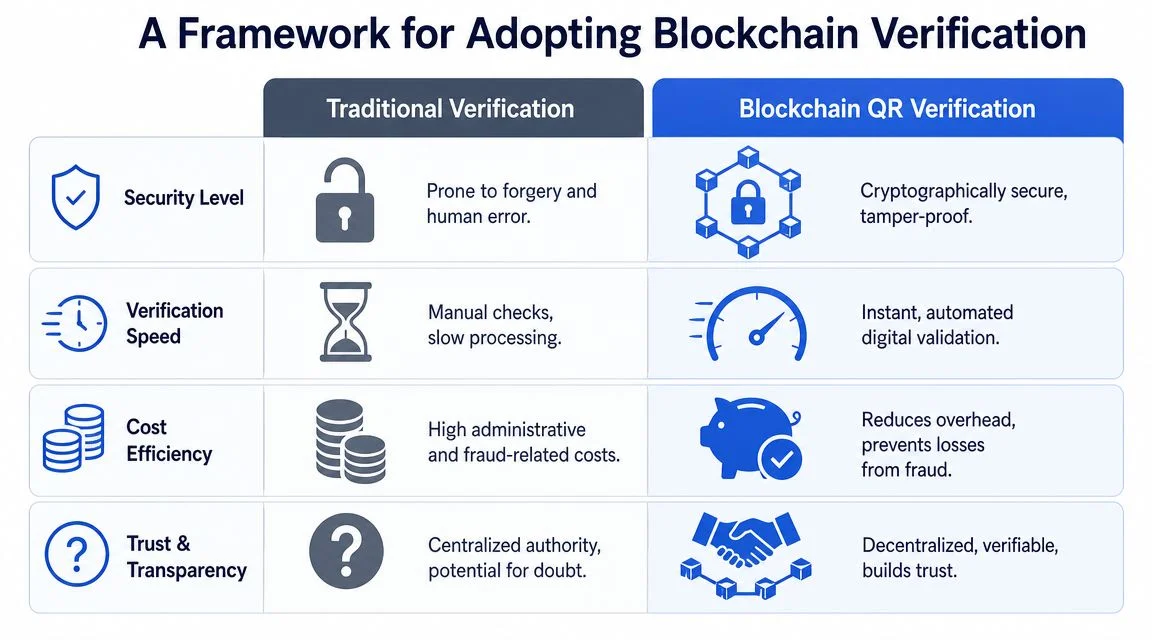
Traditional vs Blockchain QR code verification
| Feature | Traditional Systems (e.g., PDF, Central Server) | Blockchain + QR Code Systems |
|---|---|---|
| Security | Depends heavily on visual checks and central database integrity | Uses cryptographic proof plus issuer-backed verification |
| Tamper detection | Often weak unless manually revalidated | Strong when document hash is checked against on-chain proof |
| Verification speed | Can be slow and staff-dependent | Fast when scan flows are integrated well |
| Revocation handling | Frequently inconsistent across channels | Can be built into live verification checks |
| Audit trail | Split across emails, portals, and admin logs | Easier to trace when lifecycle events are recorded consistently |
| Privacy model | Often duplicates full files across systems | Can keep payload off-chain and expose only proof |
| Cross-party trust | Harder when each party relies on separate records | Stronger when all parties verify against a shared trust layer |
What to check before rollout
The most overlooked issue is copied authenticity. A forged certificate can carry a real QR code taken from an authentic document. If the verifier only checks that the QR opens a valid page, the fraud may still pass.
That is why lifecycle controls matter. The main bottleneck is often adoption and operational integration, not the cryptography itself. UK-focused guidance highlighted in this area stresses that technical controls fail when users don’t verify properly, and that preventing misuse of a copied real QR code usually requires issuer signatures, revocation checks, timestamping, and wallet-based verification rather than a static scan alone (ProofEasy on QR code certificate forgery prevention and rollout realities).
A practical shortlist for vendor or platform evaluation:
- Issuer trust model. Can only authorised issuers write valid records?
- Revocation support. Can the verifier see current status, not just issuance history?
- Privacy design. Is personal data kept off-chain where appropriate?
- Resolver security. What happens between the scan and the verification result?
- Auditability. Can compliance teams reconstruct who issued, changed, or revoked a record?
- User behaviour. Will frontline staff actually use the scan-and-verify flow?
- Integration path. Can this plug into HR, LMS, KYC, onboarding, or records systems?
The strongest verification architecture still fails if staff trust the visible QR code instead of the live verification result.
Build vs buy
Start-ups often prefer to build because their workflows are narrow and speed matters. Large enterprises tend to benefit from buying or partnering because integration, governance, and support needs are broader.
A simple rule helps here:
- Build when document types are specialised, trust rules are unique, and your internal engineering team already owns adjacent identity or compliance infrastructure.
- Buy or partner when you need faster implementation, policy support, and lower operational risk across multiple business units.
For some teams, that also means using a specialist implementation partner rather than a generic QR tool or a pure document management vendor. Verification is not just a UI problem. It is a trust infrastructure problem.
Building Your Secure Verification Platform with Blocsys
By this point, the pattern should be clear. A credible platform needs more than QR rendering, more than a blockchain transaction, and more than a polished verification screen. It needs issuer controls, proof design, status handling, privacy boundaries, and integration into real operating workflows.
That’s where implementation discipline matters. Some organisations need a lightweight credential verification layer. Others need a full enterprise system tied into onboarding, compliance, audit, and digital identity infrastructure.
One option in this space is Blocsys Technologies, which works on blockchain and AI infrastructure for secure digital platforms. For teams evaluating a production deployment rather than a proof of concept, a relevant starting point is its tamper-proof document verification platform. The practical value is not that it adds a QR code to a document, but that it can support the wider architecture around tamper evidence, verification flows, and enterprise integration.
What a production-ready platform should include
A secure rollout usually needs these building blocks:
- Document proof service that generates and anchors hashes correctly
- Issuer identity controls so only trusted entities can create valid records
- Verification API and scan interface for web, mobile, and partner checks
- Revocation and expiry logic so status remains current
- Audit reporting for compliance and dispute resolution
- Integration support across HR, ERP, LMS, KYC, and records systems
For regulated sectors, it also helps to map policy requirements before coding starts. A university, bank, logistics provider, and healthcare operator may all use QR-backed verification, but the surrounding controls differ sharply.
The main implementation mistake is treating all document categories the same. They aren’t. Degree certificates, shipping documents, legal records, and KYC artefacts each have different validation patterns, retention needs, and verifier populations.
Frequently Asked Questions About Blockchain Document Authentication
How do QR codes work with blockchain document authentication?
A QR code usually acts as the entry point to verification, not the proof itself. When scanned, it directs the verifier to a record identifier, hash pointer, or issuer reference. The system then checks that data against a blockchain-backed proof to confirm the document is authentic and unaltered.
What is blockchain QR code verification?
It is a verification model where a QR scan triggers validation against a blockchain or distributed ledger record. The ledger stores proof of issuance or integrity, while the document itself usually remains off-chain. This helps detect tampering and gives verifiers a traceable authenticity check.
Does the blockchain store the whole document?
In enterprise-grade systems, usually no. The stronger pattern is to store a cryptographic proof, issuer reference, or authentication code on-chain and keep the document payload off-chain. That improves privacy, reduces unnecessary exposure of personal data, and keeps the blockchain layer focused on integrity and auditability.
How does blockchain improve QR code security?
A standard QR code can be copied or redirected. Blockchain improves the model by making the verification result depend on an immutable issuer-backed record. If the underlying document has been altered, replaced, or mismatched, the proof comparison reveals it.
Can a fraudster copy a real QR code onto a fake document?
Yes, and that’s one of the most important operational risks. A copied QR code can still appear on a forged document. That’s why static scans are not enough. A secure system needs live issuer validation, revocation checks, timestamp awareness, and strong lifecycle controls so the verifier checks current authenticity rather than trusting the visible code.
Are QR code blockchain authentication systems suitable for UK compliance use cases?
They can be, provided the design supports privacy, auditability, and controlled verification. In the UK, this is especially relevant for education, professional credentials, onboarding, compliance documents, and regulated records where organisations need a verifiable issuer trail without exposing full underlying data during every check.
What industries benefit most from blockchain document verification systems?
The clearest use cases are sectors with high fraud exposure or repeated third-party checks. That includes universities, banks, fintech platforms, healthcare providers, logistics companies, professional certification bodies, and organisations handling legal or compliance records.
What should CTOs look for in a blockchain authentication platform?
Look at issuer controls, revocation handling, privacy design, audit trails, integration support, and user behaviour at the point of verification. If the platform makes scanning easy but doesn’t enforce live status checks, it won’t close the fraud gap that matters most.
Can Blocsys help build a QR code blockchain authentication system?
Yes. If your organisation needs a custom verification workflow, issuer model, or enterprise integration path, Blocsys can be part of that implementation discussion. The useful starting point is to define the document lifecycle, the verifier journey, and the trust model before choosing the ledger and QR architecture.
If you’re evaluating secure document verification for credentials, compliance records, onboarding workflows, or regulated enterprise documents, Blocsys Technologies can help you map the architecture, trade-offs, and implementation path for a blockchain-backed QR authentication system. Connect with the team to discuss issuer controls, revocation workflows, privacy-first proof design, and enterprise integration requirements for your environment.
