
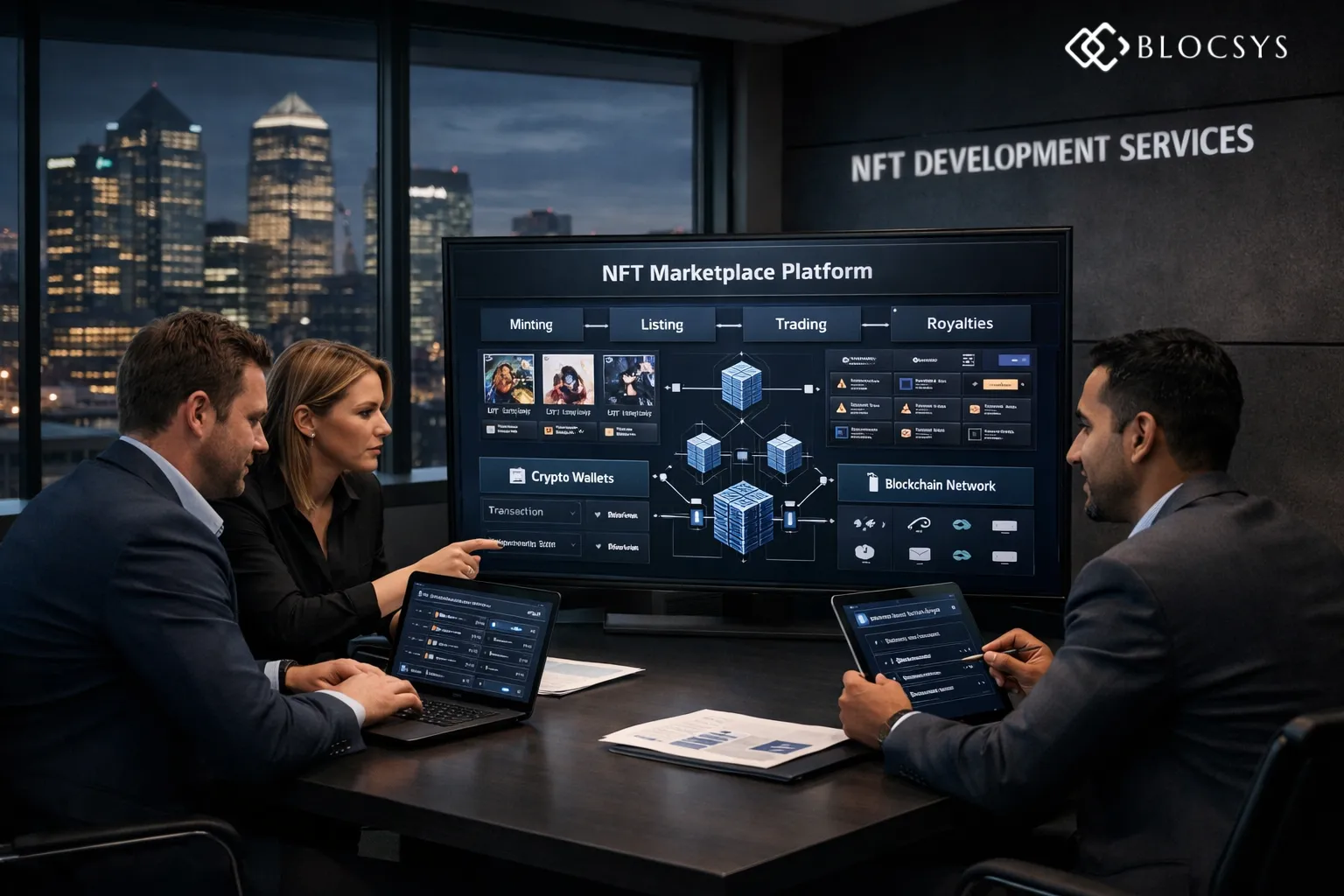
The NFT landscape has evolved far beyond digital art, now powering real-world asset (RWA) tokenization, decentralized finance (DeFi), and secure intellectual property management. For decision-makers in Web3, blockchain, and AI sectors, this shift creates significant commercial opportunities. However, capitalizing on them depends on selecting a technically proficient and reliable partner. The wrong choice can result in security flaws, scalability bottlenecks, and missed market windows.
This guide is designed for founders, product managers, and enterprise leaders who need to vet and select a top-tier NFT development partner. It moves beyond marketing jargon to provide a structured comparison of leading companies based on their core services, technical expertise, and proven track record. We are here to help you evaluate and choose a firm capable of executing your vision, whether it’s building a secure NFT marketplace, a tokenization platform for real-world assets, or an integrated DeFi solution.
Inside, you’ll find detailed profiles of top NFT development companies, an analysis of their specialties, and insights into their approach to smart contract security and technology stacks (like Solidity, Rust, and Substrate). This article provides the actionable information you need to confidently select a development partner and bring your NFT initiative to market successfully.
1. Blocsys Technologies
Blocsys Technologies has established itself as a formidable force among NFT development companies, specialising in building production-ready blockchain and AI-powered platforms. It stands out by delivering end-to-end, security-first engineering for fintechs, exchanges, and digital-asset businesses. The company moves beyond basic NFT creation, focusing on the infrastructure that powers high-value digital asset ecosystems, making it a strong choice for businesses with serious commercial ambitions.
Their service catalogue is extensive, covering everything from foundational smart contract development and wallet integration to sophisticated trading engines and complete tokenisation infrastructure. A key differentiator is the fusion of AI with blockchain, which adds a layer of intelligence to their solutions. This integration facilitates automated fraud detection, predictive analytics for market behaviour, and intelligent compliance workflows, directly addressing critical operational risks in the Web3 space.
What are the core strengths of Blocsys?
Blocsys demonstrates a clear focus on practical, market-ready solutions rather than just conceptual development. Their expertise is particularly relevant for projects requiring robust, scalable, and secure systems.
- Institutional-Grade Infrastructure: Their offerings include institutional-grade crypto exchanges (both spot and derivatives), DeFi trading systems, and real-world-asset (RWA) tokenisation platforms. This capability signals their ability to handle complex financial logic and high-volume transactions securely.
- AI-Driven Security and Compliance: By embedding AI into their platforms, Blocsys provides tools that automatically detect fraudulent activities and streamline compliance processes. This is a significant advantage for businesses operating in highly regulated or risk-prone environments.
- Multi-Chain and Flexible Technology Stack: The team possesses multi-chain expertise across Ethereum, Polygon, BSC, and enterprise frameworks. This versatility allows them to recommend and build on the optimal blockchain for a project’s specific needs regarding cost, speed, and security.
How does Blocsys engage with clients?
Recognising that different projects have different needs, Blocsys offers a range of engagement models designed for flexibility and speed. This approach allows clients to choose the best fit for their budget, timeline, and internal resource capacity.
- White-Label Solutions: For clients needing rapid market entry, Blocsys offers white-label RWA platforms that can be launched in as little as five days.
- Custom Development: For unique requirements, their team undertakes full-cycle custom builds. Timelines are transparently communicated, ranging from 6-8 weeks for basic platforms to 3-6 months for complex exchanges.
- Team Extension: They provide staff augmentation and dedicated developer options, allowing companies to hire specialists in Solana, Rust, Solidity, AI, and full-stack development to supplement their own teams.
What is their track record and pricing?
With over 30 projects delivered in its 5+ years of operation, the 20+ member team has earned an impeccable reputation. Blocsys maintains a perfect 5.0 rating across Clutch, TopDevelopers, Google, and GoodFirms from 27 client reviews, with consistent praise for on-time delivery and responsive project management.
Pricing is not publicly listed. Instead, Blocsys operates on a custom quote basis. Prospective clients must contact their sales team for a tailored estimate based on the project’s scope and chosen engagement model. While this requires an initial consultation, it ensures the pricing accurately reflects the specific work involved. To gain a deeper understanding of their capabilities, you can find more information about their work as an NFT development company on their website.
Website: https://blocsys.com
2. Antier Solutions
Antier Solutions has established itself as a significant enterprise blockchain and Web3 engineering firm, delivering a wide range of services from its headquarters in India. The company focuses on end-to-end development, making it a strong partner for established businesses and well-funded startups aiming to build secure and scalable NFT platforms. Their work spans NFT marketplaces, gaming, tokenisation, and decentralised finance (DeFi), positioning them as one of the go-to nft development companies for projects requiring complex, integrated ecosystems.
The firm excels at building custom NFT marketplaces from the ground up, offering both custodial and non-custodial models to fit diverse business requirements. Their experience extends beyond simple art collections into more functional applications, such as NFT gaming and the metaverse. For organisations looking at a long-term roadmap, Antier’s ability to integrate on-chain identity, DeFi protocols, and payment gateways into an NFT platform is a distinct advantage. This approach supports a cohesive user experience where digital assets, finance, and identity work together seamlessly. A key area of their expertise also includes exploring NFT utility beyond art by developing tokenized experiences and real-world assets, which aligns with the growing demand for functional tokenisation.
What are Antier’s core offerings?
Antier Solutions is best suited for clients with substantial, multi-phase projects rather than simple minting websites. Their technical depth and enterprise focus mean they are equipped to handle intricate challenges related to security, scalability, and post-launch maintenance.
- Full-Stack NFT Marketplace Builds: Development of complete platforms including wallets, auction mechanisms, royalty configurations, and lazy minting features.
- Multi-Chain Support: Expertise in deploying NFT projects across various blockchains like Ethereum, Polygon, Solana, and BNB Chain, allowing clients to target specific user bases.
- Integrated Ecosystems: They combine NFT technology with DeFi components, creating platforms where users can stake, lend, or trade their digital assets.
- Global Delivery Footprint: With a strong base in India and a multi-continent presence, Antier offers flexible timezone coverage and support for global clients.
What is their pricing and engagement model?
Antier Solutions operates on a bespoke pricing model. There is no public rate card; instead, project costs are determined after a detailed discovery and estimation phase. This is typical for enterprise-level development where requirements are unique and complex. While this model may not suit startups with limited initial budgets, it ensures that the final quote accurately reflects the project’s scope and technical demands.
Pros:
- Broad portfolio across both NFT and DeFi stacks, ideal for complex, integrated projects.
- Extensive experience with enterprise-grade security and scalability.
- Global delivery model provides good timezone coverage for international clients.
Cons:
- Pricing is not transparent and requires a consultation process.
- Focus on larger, enterprise builds might make them less accessible for early-stage startups.
Website: https://www.antiersolutions.com
3. LeewayHertz
As a long-standing custom software development firm with a significant presence in both the US and India, LeewayHertz has carved out a niche in the Web3 space. The company delivers a broad spectrum of blockchain services, making it a reliable choice for enterprises seeking to build robust NFT platforms. Their expertise is particularly pronounced in creating NFT marketplaces, including specialised ones for gaming, and deploying solutions across multiple chains. This multi-chain capability positions them as one of the key nft development companies for businesses aiming to reach diverse user ecosystems on platforms like Ethereum, Solana, Tezos, and Cardano.
LeewayHertz stands out for its demonstrated history in delivering complex projects, often integrating adjacent technologies like AI and IoT into its blockchain products. A notable offering is their in-house metaverse framework, Metavesal, designed for building virtual event spaces, NFT galleries, and digital commerce experiences. This focus on functional and immersive applications shows their commitment to moving beyond simple collectables into creating utility-driven digital assets. Their approach to building secure and auditable contracts is also a core strength, aligning with the critical need for a solid foundation in any project. For those new to the technicalities, understanding the importance of a professional smart contract development service is the first step toward a secure NFT launch.
What services does LeewayHertz offer?
LeewayHertz is best suited for enterprise-scale projects that require a high degree of customisation and technical depth. Their background in traditional software development combined with blockchain expertise allows them to manage large, multifaceted builds effectively.
- Multi-Chain NFT Marketplaces: Specialised in creating platforms for art, gaming, and other digital assets across numerous blockchain protocols.
- Metaverse Development: Utilises their proprietary Metavesal framework to build interactive metaverse environments for brands and creators.
- Gaming NFT Solutions: Strong focus on developing in-game asset marketplaces, supporting the play-to-earn (P2E) model and player-owned economies.
- Enterprise Blockchain Integration: Experience in connecting blockchain solutions with existing enterprise systems, including AI and IoT.
How does LeewayHertz price its services?
LeewayHertz follows a bespoke pricing structure based on project scope, complexity, and technology stack. They do not offer a public rate card, and potential clients must engage in a consultation and discovery process to receive a detailed quote. This model is standard for enterprise-level engagements where project requirements are unique. Industry directories suggest they typically handle larger projects, which may make them a better fit for well-funded organisations rather than early-stage startups with tight budgets.
Pros:
- Strong focus on NFT gaming commerce and multi-chain development.
- Proven track record with public case studies and an enterprise delivery model.
- Offers an in-house metaverse framework for building immersive experiences.
Cons:
- Some client reviews mention mixed experiences with project management and communication.
- Engagement sizes are geared towards enterprise-level projects, which can be a barrier for smaller clients.
Website: https://www.leewayhertz.com
4. SDLC Corp
SDLC CORP is a blockchain development company delivering secure and scalable NFT, Web3, and digital asset solutions for startups, creators, brands, and enterprises.
The company develops NFT marketplaces, tokenisation platforms, smart contracts, decentralised applications, launchpads, and multi-chain digital ecosystems. Its team supports the complete development lifecycle, covering strategy, blockchain architecture, UI/UX design, smart contract engineering, platform development, testing, deployment, and ongoing maintenance.
SDLC CORP is best suited for businesses seeking custom NFT products that require strong security, scalability, blockchain integration, and support for long-term platform growth.
What are SDLC CORP’s key strengths?
- End-to-End Blockchain Development: SDLC CORP manages the complete project lifecycle, from initial discovery and blockchain selection to development, security testing, deployment, and post-launch maintenance.
- NFT and Digital Asset Expertise: The company develops NFT marketplaces, digital collectibles, tokenised assets, gaming NFTs, and enterprise-grade digital asset platforms.
- Secure Smart Contract Engineering: Its developers create smart contracts that manage NFT minting, ownership transfers, royalties, auctions, staking, and other platform-specific functions.
- Multi-Chain Development: SDLC CORP builds NFT solutions across blockchain networks such as Ethereum, Polygon, Solana, BNB Chain, Polkadot, and Avalanche.
What are SDLC CORP’s main services?
- NFT Marketplace Development: SDLC CORP builds custom NFT marketplaces that allow users to mint, list, buy, sell, auction, and trade digital assets. Platforms can include storefronts, search and filtering, bidding systems, royalty management, wallet connectivity, and administrative dashboards.
- NFT Smart Contract Development: The company develops secure smart contracts for NFT creation, ownership verification, transfers, auctions, royalties, staking, and marketplace transactions. Contracts can be customised according to the project’s business model and chosen blockchain network.
- Blockchain NFT Development: SDLC CORP creates blockchain-based NFT solutions that provide transparent ownership, asset authenticity, traceability, and tamper-resistant transaction records. These solutions can support art, gaming, entertainment, real estate, and enterprise use cases.
- NFT Minting and Launchpad Development: The company develops platforms that allow creators, brands, and businesses to launch, mint, distribute, and manage NFT collections. These platforms can include whitelist management, scheduled drops, pricing controls, metadata management, and wallet integrations.
- NFT dApp Development: SDLC CORP builds decentralised applications that enable users to interact directly with NFT ecosystems through blockchain wallets and smart contracts. These dApps can support trading, staking, governance, gaming, memberships, and digital asset management.
- NFT Gaming and Metaverse Solutions: The company develops NFT-powered gaming ecosystems where players can own, trade, and monetise in-game assets. Its solutions can include NFT characters, weapons, collectibles, virtual land, play-to-earn mechanics, and marketplace integrations.
- Real-World Asset Tokenisation: SDLC CORP develops blockchain platforms that represent physical or financial assets as digital tokens. These solutions can support fractional ownership, transparent asset records, automated transfers, and controlled investor access.
What is SDLC CORP’s pricing model?
SDLC CORP provides customised pricing based on the project scope, selected blockchain network, smart contract complexity, marketplace features, security requirements, and integrations.
Pros
- Full-cycle blockchain and NFT development services
- Strong expertise in NFT marketplaces, smart contracts, and tokenisation
- Support for multiple blockchain networks
- Custom solutions for startups and enterprises
- Focus on security, scalability, and platform performance
- Ongoing maintenance and technical support
Cons
- Exact pricing requires a detailed discovery and consultation process
- Complex multi-chain platforms may require longer development and security-testing timelines
Website: https://sdlccorp.com/
5. Maticz Technologies
Maticz Technologies is an India-based blockchain development firm that has carved out a niche in delivering targeted NFT solutions, particularly for startups and small-to-medium businesses (SMBs). Their focus on speed-to-market and accessible development models makes them a popular choice for organisations looking to launch NFT marketplaces, dedicated minting websites, and promotional NFT collections without the overhead of a large-scale enterprise build. As one of the more agile nft development companies, Maticz offers a good balance of customisation and pre-built templates for sectors like art, music, sports, and gaming.
The company’s main strength lies in building functional NFT marketplaces complete with essential features like storefronts, bidding and auction systems, royalty automation, and multi-wallet integrations. By offering both templated and fully custom builds, they provide a flexible entry point for clients with varying budgets and timelines. Their dedicated offerings for NFT websites and minting platforms are designed for projects that need a fast and reliable way to get their digital assets in front of an audience. This approach is particularly effective for marketing campaigns, creator-led drops, and initial product offerings where a full marketplace is not immediately required.
Who is Maticz best suited for?
Maticz Technologies is best suited for startups and established businesses aiming for a quick and cost-effective entry into the NFT space. Their model supports rapid deployment of marketplace platforms and minting sites, making them a strong partner for projects that prioritise momentum.
- NFT Marketplace Development: Full builds including storefronts, search and filter functions, auction mechanics, royalty standards, and wallet support.
- Dedicated Minting Sites: Focused development of standalone websites for NFT drops, providing a streamlined user experience for collectors to mint directly.
- Multi-Industry Experience: Proven track record in delivering NFT platforms for diverse sectors, from digital art and collectibles to NFT-based gaming assets.
- Startup and SMB Focus: Their processes and pricing are structured to accommodate the needs and budgets of early-stage companies and smaller organisations.
How much does Maticz charge?
Maticz operates with a more transparent and competitive pricing structure compared to enterprise-only firms. While final costs are project-dependent, their engagement models are generally more accessible for startups. They provide quotes after an initial consultation, but their positioning suggests a focus on delivering value for clients with moderate budgets. This makes them a practical choice for launching a minimum viable product (MVP) or a first-generation NFT platform before scaling.
Pros:
- Competitive pricing bands well-suited for early-stage NFT products and startups.
- Positive delivery feedback for marketplace builds and reliable post-launch support.
- Strong focus on core NFT features needed for a successful market launch.
Cons:
- Smaller public review sample size compared to larger, global agencies.
- Complex enterprise projects may require careful evaluation of team seniority and resource coverage.
Website: https://maticz.com
6. Rejolut
Rejolut is an emerging technology studio from India that specialises in both blockchain and Generative AI solutions. The firm positions itself as a product acceleration partner for startups and enterprises, offering services that range from NFT marketplace design and development to custom smart contract engineering. Their approach is centred on transparency and collaboration, making them a suitable choice for teams that prefer a hands-on, iterative development process. As one of the more agile nft development companies, Rejolut appeals to clients looking for a cost-effective yet technically sound partner to build proofs-of-concept (PoCs) and minimum viable products (MVPs).
The company’s strength lies in its ability to deliver clean code and provide clients with high project visibility through dedicated dashboards and regular communication. This transparency is particularly valuable for founders and product managers who need to track progress closely and make adjustments during the development cycle. Rejolut offers expertise across multiple blockchain networks, including Ethereum and its Layer-2s, enabling them to guide clients in choosing the right chain for their project’s specific needs regarding cost, speed, and security. Their focus is on building functional and secure NFT platforms from the ground up, with a clear emphasis on smart contract integrity and scalable architecture.
What are Rejolut’s core services?
Rejolut is best suited for startups and established businesses that need a flexible and collaborative technical partner for building initial product versions or specific blockchain components. Their model is geared towards iterative builds where requirements may evolve.
- NFT Marketplace Development: Full-cycle creation of NFT marketplaces, including front-end design, back-end logic, and smart contract deployment.
- Custom Smart Contract Engineering: Specialised development of secure and gas-optimised smart contracts for unique NFT functionalities or business logic.
- Multi-Network Deployment: Capability to build and deploy NFT projects on various blockchains, ensuring the platform is aligned with the target user base and performance goals.
- Transparent Project Management: A delivery approach that emphasises clear communication and provides clients with dashboards for real-time project visibility.
What is their pricing and engagement model?
Rejolut’s engagement model is flexible, often accommodating both fixed-price projects and dedicated team (staff augmentation) models. Pricing is determined based on a detailed scope of work and the required resources. This makes them a cost-effective option, especially for startups and for developing PoCs or MVPs where budgets may be more constrained. The process begins with a consultation to understand project goals, followed by a specific proposal.
Pros:
- Transparent delivery process with high client involvement and visibility.
- Cost-effective partner for proofs-of-concept and iterative development cycles.
- Strong focus on clean code and solid smart contract engineering.
Cons:
- As a smaller team, they have a lighter public review footprint compared to larger, established firms.
- Very large, enterprise-scale programmes may require careful scope management to align with their team size and operational footprint.
Website: https://rejolut.com
7. Queppelin
Queppelin positions itself at the intersection of immersive technology and Web3, operating as an India-based AR/VR and blockchain studio. The company specialises in building experiential commerce platforms, metaverse environments, and NFT marketplaces for brands and enterprises. Their approach focuses on creating engaging digital experiences, making them a strong choice for clients who want to go beyond simple collectibles and integrate NFTs into virtual events, games, or interactive marketing campaigns. As one of the more specialised nft development companies, Queppelin is particularly adept at projects where the digital asset is tied to a rich, immersive user experience.
The firm’s core strength lies in its ability to combine NFT functionality with its established expertise in augmented and virtual reality. This allows them to deliver projects like virtual art galleries where users can explore and purchase NFTs, or live-streamed events where digital tickets are issued as tokens. For brands, this opens up new avenues for customer engagement and monetisation. Queppelin handles the end-to-end development process, from initial design and smart contract creation to wallet integrations and post-launch support, ensuring a cohesive final product. Their work with global brands demonstrates a capacity to deliver polished, enterprise-ready solutions.
What makes Queppelin unique?
Queppelin is best suited for brands and enterprises looking to build unique, immersive NFT experiences rather than standard marketplace clones. Their expertise in AR/VR makes them a go-to partner for projects that require a strong visual and interactive component.
- Experiential NFT Platforms: Development of NFT marketplaces integrated with AR/VR features, virtual galleries, and interactive 3D models.
- Metaverse Development: Building custom metaverse spaces for virtual events, social gatherings, and branded experiences with NFT-based ticketing and in-world economies.
- Enterprise NFT Solutions: Creating custom storefronts, managing user permissions, configuring royalty structures, and tokenising intellectual property for corporate clients.
- Full-Cycle Development: The company provides a complete service package, including UI/UX design, front-end and back-end development, smart contract auditing, and ongoing maintenance.
What is Queppelin’s pricing model?
Queppelin follows a custom pricing model where costs are determined after a project discovery phase. They do not offer public rate cards, as their work is tailored to the specific and often complex requirements of each client. This engagement model requires an initial consultation to define the project scope, technical specifications, and desired outcomes. While this approach means pricing is not immediately transparent, it ensures the final estimate accurately reflects the work involved, which is fitting for bespoke, feature-rich builds.
Pros:
- Strong specialisation in AR/VR, offering unique, immersive NFT experiences.
- Demonstrated track record with case studies from globally recognised brands.
- Recognised as a key player in the metaverse and immersive tech space.
Cons:
- Pricing requires a detailed discovery process and is not publicly available.
- As a specialist in custom projects, the scope and cost need to be carefully validated upfront.
Website: https://www.queppelin.com
Top 7 NFT Development Companies Comparison
| Provider | Implementation Complexity 🔄 | Resource Requirements ⚡ | Expected Outcomes ⭐📊 | Ideal Use Cases 💡 | Key Advantages ⭐ |
|---|---|---|---|---|---|
| Blocsys Technologies | 🔄 Medium‑High — fast white‑label to complex exchange timelines (5 days → 3–6 months) | ⚡ Moderate — 20+ core team, flexible staff augmentation/dedicated teams | ⭐⭐⭐📊 Institutional‑grade, secure platforms with AI-driven automation and compliance | 💡 RWA tokenization, institutional crypto exchanges, DeFi trading systems | AI + blockchain integration, multi‑chain support, rapid white‑label launches |
| Antier Solutions | 🔄 High — enterprise‑scale, end‑to‑end builds | ⚡ High — multi‑continent delivery footprint for large projects | ⭐⭐⭐📊 Scalable, secure NFT/DeFi systems for enterprise use | 💡 NFT marketplaces, NFT gaming, complex DeFi ecosystems | Broad enterprise portfolio, global delivery coverage |
| LeewayHertz | 🔄 Medium‑High — multi‑chain and gaming integrations | ⚡ Medium‑High — India & US presence with enterprise delivery capabilities | ⭐⭐⭐📊 Multi‑chain gaming marketplaces and metaverse integrations | 💡 Gaming NFT commerce, virtual commerce, enterprise blockchain apps | Strong gaming focus, in‑house metaverse framework, public case studies |
SDLC Corp | 🔄Medium to high, depending on smart contracts, blockchain networks, marketplace features | ⚡ Blockchain developers, smart contract engineers, UI/UX designers, backend developers, QA specialists | ⭐⭐⭐📊 Secure and scalable NFT marketplaces, tokenization platforms | 💡NFT marketplaces, gaming assets, digital collectibles, real-world asset tokenization | End-to-end blockchain development, multi-chain expertise, secure smart contracts |
| Maticz Technologies | 🔄 Low‑Medium — template + custom marketplace builds for faster GTM | ⚡ Low — competitive pricing suitable for SMBs and startups | ⭐⭐📊 Affordable, rapid NFT marketplace and minting site delivery | 💡 SMBs and early‑stage NFT projects (art, music, sports, gaming) | Cost‑competitive templates, positive marketplace delivery track record |
| Rejolut | 🔄 Low‑Medium — PoC and iterative product acceleration | ⚡ Low‑Moderate — smaller team, hands‑on collaboration model | ⭐⭐📊 Cost‑effective PoCs and clean, transparent codebases with dashboards | 💡 Startups and teams seeking collaborative, iterative builds | Emphasis on transparency, clean code, and project visibility |
| Queppelin | 🔄 Medium‑High — AR/VR + Web3 adds complexity to standard NFT builds | ⚡ Medium‑High — specialized AR/VR and enterprise capabilities | ⭐⭐⭐📊 Strong experiential NFT commerce and metaverse event outcomes | 💡 Brands and enterprises seeking virtual galleries, live events, NFT utilities | Proven global brand work, bundled AR/VR + NFT utilities and audits |
How to Choose the Right NFT Development Company
Navigating the world of NFT development requires a clear understanding of your project’s unique demands. The central lesson is that success isn’t just about finding a developer; it’s about securing a partner whose technical proficiency, security protocols, and strategic vision align precisely with your objectives. Your choice of a development partner is the single most important decision you will make. A misstep can lead to security vulnerabilities, scalability issues, or a final product that fails to capture user interest. The right team acts as a strategic advisor, helping you navigate blockchain selection, compliance, and long-term ecosystem viability.
What are the key evaluation criteria for an NFT developer?
As you evaluate potential NFT development companies, it’s crucial to move beyond surface-level comparisons. Use a robust decision framework tailored to your specific needs, whether you are a startup founder or an enterprise product manager. Prioritize these critical factors:
- Security and Auditing: A company’s commitment to security should be non-negotiable. Ask for details on their smart contract auditing process and security testing methodologies. A top partner integrates security from the initial architecture phase, not as an afterthought.
- Technical Stack Proficiency: Your project’s requirements dictate the technology. Does it require cross-chain compatibility or AI integration? Ensure the company has proven experience with the specific blockchains (e.g., Ethereum, Solana), languages (e.g., Solidity, Rust), and frameworks essential to your build.
- Scalability for Future Growth: A successful NFT platform will face increasing transaction volumes. Your chosen partner must demonstrate how they build scalable architectures using Layer-2 solutions, efficient data indexing, and infrastructure that can handle growth without compromising performance.
- Real-World Asset (RWA) Tokenization: If your roadmap involves tokenizing physical assets like real estate or financial instruments, you need a partner with specialized legal, compliance, and technical expertise in this domain. This is a core differentiator for enterprise-grade firms.
Why Partner with Blocsys for Your NFT Project?
While the market offers many capable NFT development companies, Blocsys Technologies differentiates itself by focusing on production-ready, secure, and scalable digital asset ecosystems. Our expertise is rooted in building platforms that are not only technologically sound but also commercially viable and future-proofed for the evolving Web3 landscape.
We understand that modern NFT platforms demand more than a minting button; they require intelligent compliance, sophisticated trading infrastructure, and AI integration to create genuine value. Whether you are building a decentralized trading platform, tokenizing real-world assets, or launching a complex Web3 gaming economy, our team provides the end-to-end expertise you need. We offer flexible engagement models, from full-project development to staff augmentation, ensuring you receive the precise support required to bring your vision to life. Our foundation in building secure systems for clients in crypto, AI, and carbon markets makes us the ideal partner for ambitious projects that demand reliability, innovation, and long-term performance.
Ready to build an NFT platform that stands out for its security, scalability, and innovation? Connect with Blocsys Technologies to discuss your project with our expert architects and strategists. Let us show you how our deep experience and focus on enterprise-grade solutions can help you achieve your goals and outpace the competition.
Panini Blockchain: Building a Complete Digital Collectibles Ecosystem
Panini Blockchain is a strong real-world example of how NFT development can evolve into a complete digital collectibles ecosystem rather than stopping at NFT minting. Its platform combines officially licensed sports NFTs with pack drops, rarity-based digital trading cards, marketplace listings, offers, transaction histories, challenges, and exclusive 1/1 collectibles. Panini has also introduced an Ethereum bridge that allows eligible digital cards to move between its blockchain and Ethereum, giving collectors access to self-custody and external marketplace trading while retaining functionality within the Panini ecosystem. For businesses evaluating NFT development companies, this demonstrates the value of working with a development partner that can handle the broader ecosystem—including NFT marketplaces, smart-contract functionality, trading infrastructure, blockchain interoperability, wallet integration, and user-focused collectible experiences.
Frequently Asked Questions
What has the NFT development landscape expanded to include beyond digital art?
NFT development now extends into real-world asset (RWA) tokenization, decentralized finance (DeFi), and secure intellectual property management. This shift creates significant commercial opportunities for decision-makers in Web3, blockchain, and AI sectors. Choosing a technically proficient partner is essential to capitalizing on these opportunities.
What risks come from choosing the wrong NFT development partner?
Selecting the wrong partner can lead to security flaws, scalability bottlenecks, and missed market windows. This is why founders, product managers, and enterprise leaders need a structured way to vet firms based on core services, technical expertise, and track record. The goal is finding a firm capable of executing the specific vision, whether a marketplace, tokenization platform, or DeFi solution.
What core strengths does Blocsys Technologies offer as an NFT development company?
Blocsys specializes in security-first, production-ready blockchain and AI-powered platforms for fintechs, exchanges, and digital-asset businesses. Its strengths include institutional-grade infrastructure (spot and derivatives exchanges, DeFi trading systems, RWA tokenisation platforms), AI-driven fraud detection and compliance tools, and multi-chain expertise across Ethereum, Polygon, BSC, and enterprise frameworks.
What engagement models does Blocsys offer clients?
Blocsys provides white-label RWA platforms that can launch in as little as five days for rapid market entry. It also offers full-cycle custom development, with timelines ranging from 6-8 weeks for basic platforms to 3-6 months for complex exchanges, plus team extension options for hiring specialists in Solana, Rust, Solidity, AI, and full-stack development.
What is Blocsys’s track record and how is its pricing structured?
Blocsys has delivered over 30 projects in 5+ years with a 20+ member team, maintaining a perfect 5.0 rating across Clutch, TopDevelopers, Google, and GoodFirms from 27 client reviews. Pricing is not publicly listed and is instead provided via custom quotes based on project scope and chosen engagement model.
What areas does Antier Solutions focus on within NFT development?
Antier Solutions is an enterprise blockchain and Web3 engineering firm headquartered in India, offering end-to-end development for established businesses and well-funded startups. Their work spans NFT marketplaces, gaming, tokenisation, and DeFi, with particular strength in building custom NFT marketplaces offering both custodial and non-custodial options.
