
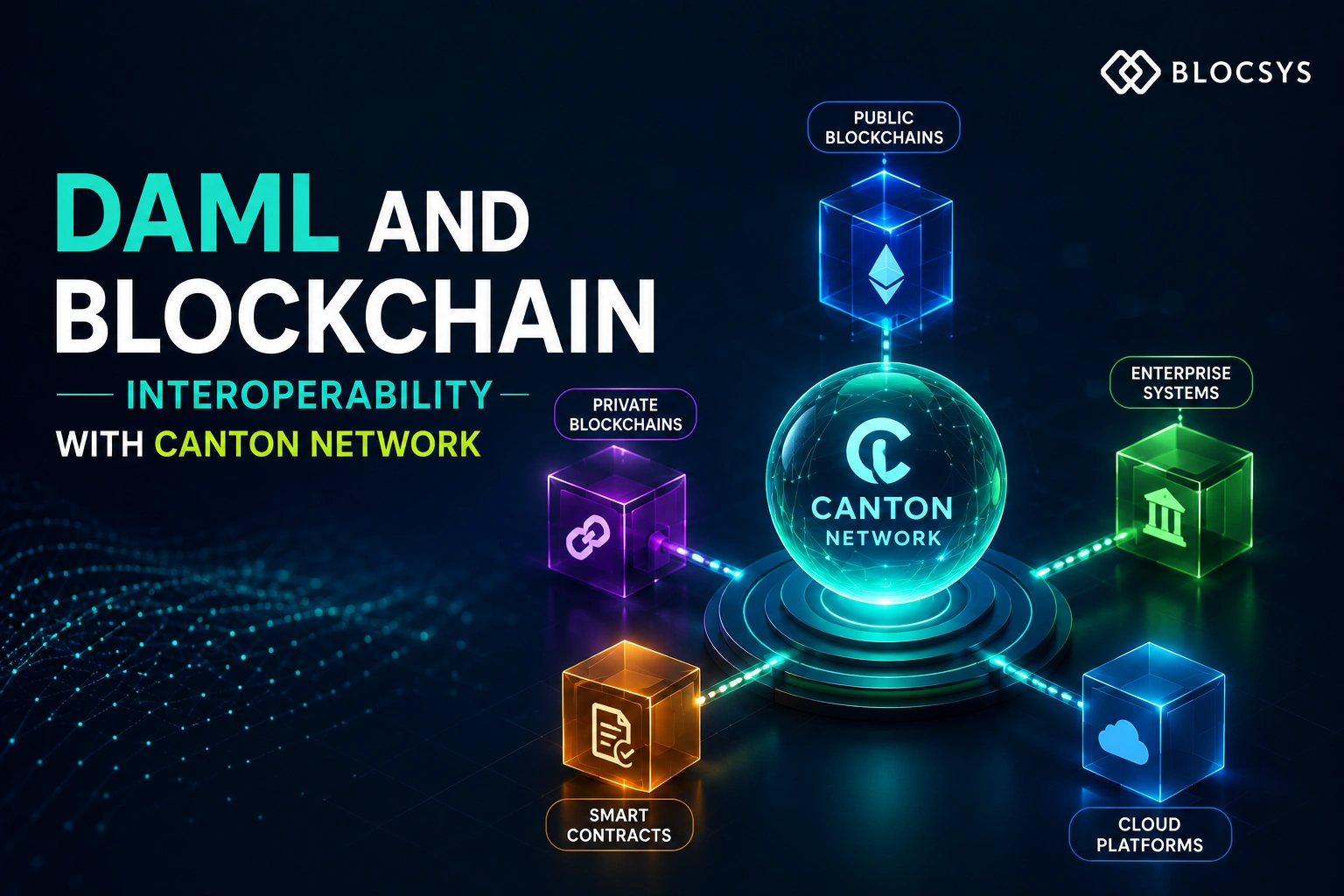
DAML and Blockchain Interoperability: Connecting Canton Network with Public Blockchains
Enterprise finance is finally asking the right question: how do private, regulated ledgers talk to public networks without breaking compliance or leaking sensitive data? That’s exactly where DAML blockchain development comes in. DAML, paired with Canton Network, gives banks and fintech firms a way to run privacy-preserving smart contracts that still sync with the broader digital asset ecosystem. If you’re an enterprise architect or CTO evaluating this space, Blocsys has spent years building the kind of secure, compliant infrastructure this shift demands.
This post breaks down how DAML and Canton Network actually connect to public blockchains, why that matters for institutional adoption, and what it takes to build it right. We’ll cover architecture, security, tokenization, and real use cases you can point to internally when making the case for interoperability.
What is DAML?
DAML is a smart contract language built specifically for regulated, multi-party workflows. Unlike general-purpose blockchain languages, it was designed from day one for financial-grade privacy and rights management. Every party in a DAML contract only sees the data relevant to them.
That’s a big deal for banks. Traditional smart contracts on public chains expose transaction data broadly. DAML flips that model. It enforces need-to-know visibility at the protocol level, which is why so many capital markets firms have adopted it for post-trade processing, collateral management, and tokenized securities.
Because DAML separates business logic from the underlying ledger, developers can write contracts once and deploy them across different infrastructures. This portability is a core reason enterprises considering DAML development partners want teams who understand both the language and the compliance context it operates in.
Understanding Blockchain Interoperability
Blockchain interoperability means different networks can exchange data, assets, and instructions without a central intermediary. Think of it as the financial equivalent of SWIFT, except messages carry verified, settled value instead of just payment instructions.
For years, interoperability meant bridges — often risky, frequently exploited, and rarely built with regulatory oversight in mind. Enterprise blockchain interoperability needs a different approach: one that preserves privacy, meets audit requirements, and doesn’t compromise on security just to achieve connectivity.
This is where DAML and blockchain interoperability start to diverge from typical Web3 bridge solutions. Instead of exposing entire ledgers, DAML-based systems synchronize only the specific contract states that need to move across networks.
Enterprise interoperability isn’t about connecting everything to everything. It’s about connecting the right parties to the right data, with proof that nothing else was exposed along the way.
Why Enterprise Blockchains Need Interoperability
Banks don’t operate in isolation. A tokenized bond issued on a permissioned network still needs to settle against custody systems, public stablecoins, or client wallets that live elsewhere. Without interoperability, tokenization projects become isolated islands.
Consider a European bank issuing tokenized commercial paper. Investors might hold assets across multiple platforms — some permissioned, some public. Without a reliable interoperability layer, that bank can’t offer the liquidity or settlement speed institutional clients expect.
Additionally, regulators increasingly expect auditability across the full transaction lifecycle, not just within one closed system. That’s a governance problem as much as a technical one.
What is Canton Network?
Canton Network is a privacy-enabled, interoperable blockchain network built on DAML. It’s not a single chain — it’s a network of independently operated Canton Network nodes that can synchronize state across institutions while keeping data confidential by default.
Major financial players, including global custodians, exchanges, and asset managers, run Canton Network nodes today. That’s not a hypothetical pilot; it’s live infrastructure processing tokenized funds, repo transactions, and margin workflows.
What makes Canton Network development distinct is its synchronization protocol. Rather than broadcasting every transaction to every participant, Canton Network only shares data between parties directly involved in a given contract, while still guaranteeing global consistency.
Enterprises exploring enterprise blockchain development often start here, because Canton Network already solves the privacy-versus-composability tradeoff that plagues most permissioned ledgers.
![DAML blockchain development — [Flow diagram showing Canton Network's synchronization model: Institution A Node → Privacy-Filtered Sync Protocol → Institution B Node → Global Ledger Consistency Check → Settlement Confirmation]](https://s3.blocsys.com/blocsys/blog-images/1784937715450-daf233e31aa3cb97.webp)
Connecting Canton Network with Public Blockchains
Here’s the part enterprises care about most: how does a permissioned network like Canton actually reach public chains such as Ethereum or Bitcoin-anchored infrastructure? The answer involves a combination of interoperability protocols, oracle-style bridges, and DAML’s contract portability.
Canton Network public blockchain connections typically work through gateway nodes that translate verified, privacy-preserved state changes into public-chain-compatible transactions. This isn’t a raw bridge exposing everything — it’s a controlled, permissioned handoff.
How DAML Blockchain Development Powers Cross-Network Smart Contracts
DAML blockchain development makes cross-network contracts possible because DAML contracts aren’t tied to one specific ledger implementation. The DAML Ledger Model defines behavior abstractly, so the same contract logic can run against Canton Network today and extend toward other synchronization domains tomorrow.
In practice, this means a tokenized asset issued under DAML can maintain consistent business rules — ownership transfer conditions, compliance checks, settlement triggers — regardless of which underlying network ultimately settles it. That consistency is exactly what capital markets teams need when moving between permissioned and public rails.
Interoperability Architecture Behind DAML Blockchain Development
A typical DAML blockchain development architecture for cross-chain use includes four layers: the application layer (where contract logic lives), the Canton synchronization layer, a bridge or gateway layer, and the public blockchain settlement layer.
Each layer has a distinct job. The application layer defines what’s allowed. The synchronization layer enforces privacy and consistency. The gateway layer handles translation and proof verification. The settlement layer finalizes the transaction on the destination chain.
This separation matters. It means you can upgrade or swap the gateway layer without touching your core business logic — a huge advantage for banks that need long-term system stability alongside evolving blockchain integrations.
Comparing Interoperability Approaches
| Approach | Privacy Model | Regulatory Fit | Typical Use Case |
|---|---|---|---|
| Traditional cross-chain bridges | Public, fully visible | Limited compliance controls | Retail DeFi transfers |
| Public blockchain smart contracts | Transparent by design | Weak for regulated data | Open Web3 applications |
| DAML and Canton Network interoperability | Need-to-know privacy | Built for regulated finance | Tokenized securities, banking settlement |
Security and Privacy Considerations
Security in DAML and blockchain interoperability isn’t just about cryptography — it’s about controlling exactly who sees what, when, and why. Canton Network’s sub-transaction privacy model means counterparties never see data outside their contractual relationship.
However, connecting to public chains introduces new risk surfaces. Gateway nodes, oracle feeds, and bridge contracts all need independent security audits. Consequently, enterprises should treat every cross-chain connection point as a potential attack vector requiring its own hardening strategy.
Governance also matters here. Who can authorize a new interoperability connection? What approval workflow exists before a Canton Network node exposes state to a public settlement layer? These aren’t afterthoughts — they belong in the architecture from day one.
Tokenized Assets Across Multiple Blockchains
Tokenization is arguably the strongest use case for Canton Network interoperability. A tokenized fund unit, bond, or real estate share issued through DAML can carry its compliance rules with it as it moves between networks.
For example, a real-world asset platform might issue tokens on Canton for institutional settlement while allowing secondary trading through a public-chain-connected marketplace. The underlying DAML contract still enforces transfer restrictions, KYC checks, and jurisdictional rules no matter where the token ends up.
Teams building this kind of infrastructure often work with an asset tokenization platform partner who understands both DAML’s compliance logic and the mechanics of real world asset tokenization across chains.
![DAML blockchain development — [Flow diagram showing tokenized asset lifecycle across networks: Asset Issuance on Canton Network → Compliance Rule Embedding → Gateway Bridge Verification → Public Blockchain Listing → Secondary Market Trading → Settlement Reconciliation]](https://s3.blocsys.com/blocsys/blog-images/1784937716035-9d7bd2d04c89e0d1.webp)
Enterprise and Financial Institution Use Cases
Banks aren’t experimenting with this technology anymore — they’re deploying it. Here’s where DAML blockchain development is showing up in production environments today.
- Global custodians using Canton Network for tokenized fund settlement with public-chain investor access.
- Capital markets firms automating post-trade reconciliation across permissioned and public infrastructure, similar to the workflows behind permissioned blockchain infrastructure for post-trade operations.
- Repo markets running intraday margining through synchronized, privacy-preserved contracts.
- Cross-border payment providers linking Canton Network settlement with public stablecoin liquidity.
- Insurance and reinsurance platforms automating multi-party claims workflows without exposing full contract data.
Each of these examples shares a common thread: institutions want the trust and finality of blockchain settlement without sacrificing the confidentiality regulated finance requires.
Benefits of DAML-Based Interoperability
Why are so many enterprises betting on this approach instead of building custom bridges from scratch? A few reasons stand out.
- Consistent business logic across networks, reducing duplicate development work.
- Privacy-by-default architecture that satisfies data protection regulations.
- Faster settlement cycles compared to legacy reconciliation processes.
- Reduced counterparty risk through synchronized, verifiable state changes.
- Easier auditability, since DAML contracts are inherently traceable and rights-aware.
Moreover, DAML blockchain development reduces the operational burden of maintaining separate compliance layers for every new network connection. That’s a real cost saving, not just a technical nicety.
Challenges and Best Practices in DAML Blockchain Development
No interoperability project is without friction. Gateway complexity, node governance, and cross-chain latency all need careful planning before go-live.
Here’s what tends to trip teams up: underestimating the operational overhead of running Canton Network nodes alongside public-chain gateways. Additionally, many teams skip proper key management design early on, which creates painful rework later.
Best practice starts with scoping your interoperability needs precisely. Don’t connect to every chain “just in case.” Instead, map out which counterparties actually need cross-network access, then build gateway infrastructure around those specific flows. This keeps your DAML blockchain development effort focused and auditable rather than sprawling.
The projects that succeed are the ones that treat interoperability as a governance decision first and a technical implementation second. Get the approval framework right, and the engineering becomes far more straightforward.
Future of Enterprise Blockchain Interoperability
Where is this heading? Expect deeper standardization around cross-network messaging protocols, more Canton Network nodes coming online globally, and tighter integration between tokenization platforms and public settlement rails.
Regulators in the UK, EU, Switzerland, Singapore, and UAE are also moving faster than many expect on digital asset frameworks. That regulatory clarity will likely accelerate institutional adoption of DAML and Canton Network interoperability even further, since compliance teams finally have clearer rules to build against.
Why Choose Blocsys for DAML and Enterprise Blockchain Development
Building secure, compliant DAML blockchain development infrastructure isn’t a weekend project — it takes teams who’ve actually shipped this kind of system before. Blocsys works with banks, fintech platforms, and digital asset providers to design and deploy Canton Network integrations that connect cleanly with public blockchains.
We handle everything from smart contract architecture to gateway security, governance frameworks, and tokenization infrastructure. Our dedicated blockchain engineering teams bring hands-on experience with both DAML’s privacy model and the broader blockchain interoperability landscape.
Whether you’re a bank exploring tokenized settlement or a Web3 company needing a compliant bridge into regulated finance, our blockchain development company background means we understand both sides of that equation. We also support teams needing to hire blockchain developers for ongoing platform maintenance and scaling.
Frequently Asked Questions
Here are direct answers to the questions we hear most often about DAML blockchain development and Canton Network interoperability.
What is DAML and why is it important for enterprise blockchain development?
DAML is a smart contract language built for privacy-first, multi-party business workflows. It’s important because it enforces need-to-know data visibility, meaning each party only sees information relevant to them. This makes it ideal for regulated industries like banking, insurance, and capital markets, where traditional public blockchain transparency creates compliance problems. DAML also separates contract logic from the underlying ledger, so it works consistently across different infrastructures.
What is blockchain interoperability?
Blockchain interoperability is the ability for different blockchain networks to exchange data, assets, and instructions without needing a central intermediary. It allows a permissioned network like Canton to communicate with public chains such as Ethereum. For enterprises, interoperability means tokenized assets and smart contracts can move across systems while preserving compliance, security, and consistent business logic throughout the transaction lifecycle.
How does Canton Network enable secure interoperability between enterprises?
Canton Network uses a synchronization protocol that shares transaction data only with directly involved parties, rather than broadcasting it network-wide. Each institution runs its own node, keeping sensitive data private while still guaranteeing global ledger consistency. This sub-transaction privacy model lets banks, custodians, and asset managers transact together without exposing proprietary details to unrelated participants on the same network.
Can Canton Network connect with public blockchains like Ethereum?
Yes. Canton Network can connect to public blockchains through gateway nodes and interoperability protocols that translate verified, privacy-preserved contract states into public-chain-compatible transactions. This isn’t a raw data bridge — it’s a controlled handoff that maintains compliance rules and privacy guarantees even as assets move toward public settlement infrastructure.
What role does DAML play in cross-chain smart contracts?
DAML defines contract behavior abstractly through its Ledger Model, so the same smart contract logic can run consistently across Canton Network and, through interoperability layers, extend toward public chains. This means ownership rules, compliance checks, and settlement conditions stay consistent no matter which network ultimately processes the transaction, reducing duplicated development and compliance risk.
What are the benefits of connecting Canton Network with public blockchains?
Connecting Canton Network with public blockchains gives institutions access to broader liquidity, faster settlement, and wider investor reach while keeping sensitive contract data private. It also reduces counterparty risk through synchronized, verifiable state changes and simplifies auditability, since DAML contracts inherently track rights and obligations across the entire transaction lifecycle.
Which industries benefit the most from DAML-based blockchain interoperability?
Capital markets, banking, insurance, asset management, and tokenized real estate all benefit significantly. Any industry handling regulated, multi-party transactions — where privacy and auditability both matter — gains from DAML’s need-to-know data model combined with Canton Network’s interoperability capabilities. Global custodians and cross-border payment providers are among the most active adopters today.
What security and compliance advantages does Canton Network provide over traditional blockchain interoperability solutions?
Unlike typical cross-chain bridges that expose full transaction data, Canton Network only shares information between directly involved counterparties. This built-in privacy reduces attack surface and satisfies data protection regulations more naturally. Combined with DAML’s rights-aware contract structure, Canton Network offers stronger auditability and governance controls than most public bridge-based interoperability solutions.
What challenges should enterprises consider when integrating DAML with public blockchains?
Key challenges include gateway node complexity, key management design, cross-chain latency, and governance around who can authorize new network connections. Enterprises should scope interoperability needs precisely rather than connecting broadly, and treat every gateway or bridge point as a distinct security consideration requiring its own audit and hardening plan.
How can Blocsys build secure enterprise-grade DAML and blockchain interoperability solutions?
Blocsys designs and deploys Canton Network integrations that connect securely with public blockchains, covering smart contract architecture, gateway security, governance frameworks, and tokenization infrastructure. Our teams bring hands-on DAML blockchain development experience across banking, capital markets, and digital asset platforms, helping institutions launch compliant, scalable, and truly interoperable blockchain ecosystems.
Conclusion
DAML blockchain development isn’t just another enterprise buzzword — it’s becoming the practical foundation for how regulated finance connects with public digital asset markets. Canton Network interoperability solves a problem banks have wrestled with for years: how to get blockchain’s benefits without giving up privacy or compliance control.
If your organization is exploring tokenization, cross-chain settlement, or DAML and Canton Network integration, now’s the time to build it right. Blocsys works alongside banks, fintechs, and digital asset platforms to design secure, scalable, and truly interoperable blockchain ecosystems that connect Canton Network with public blockchains. Reach out to our team and let’s build your next institutional-grade blockchain solution together.
Ready to move beyond theory and build an intelligent platform that delivers real-world value? Blocsys Technologies specialises in engineering enterprise-grade AI and blockchain solutions for the fintech, Web3, and digital asset sectors. Connect with our experts today to discuss your vision and chart a clear path from concept to a secure, scalable reality.
