

The global prediction markets sector is experiencing explosive growth. Entrepreneurs, DeFi protocols, and financial institutions are all racing to deploy platforms where users can trade on real-world outcomes. At the heart of every reliable platform sits prediction market smart contract development — the technical foundation that guarantees trustless settlement, transparent fund management, and automated reward distribution. Choosing the wrong development partner can cost you months and millions. Therefore, this guide profiles the top prediction markets development companies operating in 2026 and explains exactly what separates the elite from the average.
Understanding the Modern Prediction Markets Landscape
Prediction markets allow participants to buy and sell shares tied to the outcome of future events. These markets aggregate collective intelligence in ways that consistently outperform traditional expert forecasting. Furthermore, they generate real-time probability signals that financial institutions, governments, and research organizations find enormously valuable.
Blockchain technology has fundamentally transformed this category. Decentralized prediction markets platforms remove centralized intermediaries entirely. Consequently, traders benefit from faster settlements, reduced counterparty risk, and far greater transparency than any traditional prediction exchange can offer.
Moreover, the emergence of Web3 ecosystems has attracted a new wave of developers into the space. Blockchain prediction markets development is now a mainstream infrastructure discipline within the broader DeFi ecosystem. Additionally, institutional appetite for regulated prediction market products is growing rapidly, opening entirely new market segments.
Why Prediction Market Smart Contract Development Defines Platform Success
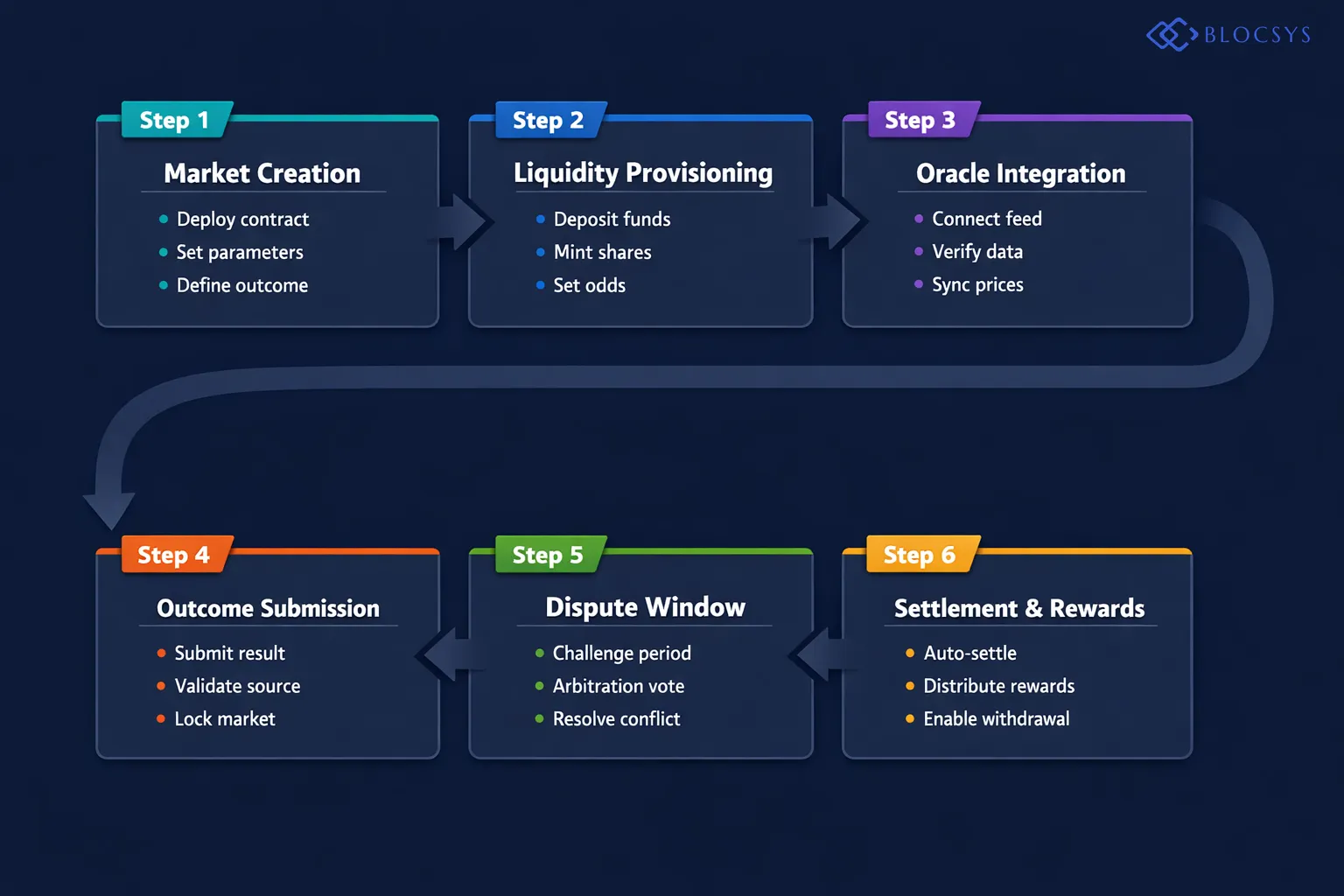
Smart contracts are the operational core of every on-chain prediction market. They handle fund locking, outcome resolution, fee collection, and reward distribution automatically and without human intervention. Therefore, poorly engineered smart contracts can expose platforms to devastating financial losses, reputation damage, and regulatory scrutiny.
Leading teams approach prediction market smart contract development with extreme rigor. They conduct multiple independent security audits, deploy on testnets under simulated attack conditions, and stress-test edge cases like disputed outcomes and oracle failures. Additionally, they design contracts that remain gas-efficient at scale and upgradeable when protocol improvements are necessary.
Top-tier developers also integrate reliable oracle networks such as Chainlink, UMA, and Pyth Network to feed real-world event data into contracts. Furthermore, they implement governance mechanisms that allow communities to challenge and override incorrect outcome reports before settlements finalize. This combination of security depth and thoughtful product design distinguishes the best blockchain prediction markets development firms from competitors.
“The difference between a prediction market that scales and one that collapses under pressure is almost always found in the smart contract architecture. Teams that cut corners during development pay ten times the cost to fix issues after launch.” — Blockchain Infrastructure Architect, DeFi Advisory Group
Top Prediction Markets Development Companies in 2026
The market now features dozens of teams offering prediction markets software development. However, only a handful combine genuine blockchain expertise with a strong track record of delivered products. Below, we profile the most respected companies currently active in this space.
Blocsys
Blocsys is widely recognized as one of the most comprehensive prediction markets platform development companies available today. Their team delivers end-to-end solutions that cover smart contract engineering, UI/UX design, liquidity infrastructure, and post-launch support. Moreover, they serve clients ranging from early-stage startups to large enterprise organizations across multiple blockchain ecosystems.
Their core offering includes a fully production-ready Decentralized Prediction Market Platform that teams can deploy and customize rapidly. Additionally, Blocsys provides Hybrid Trading & Prediction Market Platform Development for clients who want to combine centralized order book efficiency with trustless on-chain settlement logic.
Furthermore, Blocsys integrates AI prediction markets solutions into their development stack, enabling smarter automated market-making and real-time anomaly detection. Their flagship Prediction Markets Platform Development service is broadly regarded as one of the most feature-complete offerings in the market. Consequently, they attract clients from gaming, sports analytics, political forecasting, financial derivatives, and DAO governance sectors.
Augur Development Community
Augur pioneered decentralized prediction markets on Ethereum and continues to shape protocol design across the industry. Their open-source codebase serves as an invaluable reference for many blockchain prediction markets development teams worldwide. However, Augur focuses primarily on protocol infrastructure rather than turnkey commercial solutions ready for rapid deployment.
Teams searching for ready prediction markets solutions will likely find Augur’s approach too low-level for direct use. Nevertheless, its technical contributions provide foundational primitives that many sophisticated development teams build upon when creating custom market protocols.
Gnosis and the Conditional Token Framework
Gnosis introduced the Conditional Token Framework, a powerful and flexible primitive for building complex, nested prediction markets. Additionally, their Gnosis Safe infrastructure provides the secure custody solutions that institutional prediction market operators require. Their development tools, therefore, serve as critical building blocks for many Web3 prediction markets development company engagements worldwide.
However, Gnosis tooling is developer-facing and demands significant blockchain expertise to implement correctly. Teams without in-house Solidity engineers frequently partner with experienced firms like Blocsys to leverage Gnosis primitives within a fully managed development engagement.
Suffescom Solutions
Suffescom Solutions is a leading AI mobile app development company specializing in next-generation betting, fintech, and blockchain-powered platforms. As a trusted Prediction Markets Development Company, the company delivers scalable and secure solutions that empower businesses to launch real-time prediction market platforms for sports, finance, politics, entertainment, and event forecasting.
Polymarket Ecosystem Builders
Polymarket brought prediction markets to mainstream retail audiences through a clean, intuitive interface backed by deep USDC liquidity pools. Their architecture demonstrated conclusively that decentralized prediction markets platforms can achieve meaningful user traction far beyond the crypto-native community. Moreover, their success has directly inspired dozens of enterprise adaptations and protocol forks globally.
Polymarket’s technical stack, however, remains proprietary. Consequently, teams that want to replicate their model must either rebuild from the ground up or engage experienced developers for prediction markets development who understand similar architectural patterns and liquidity dynamics.
Zeitgeist
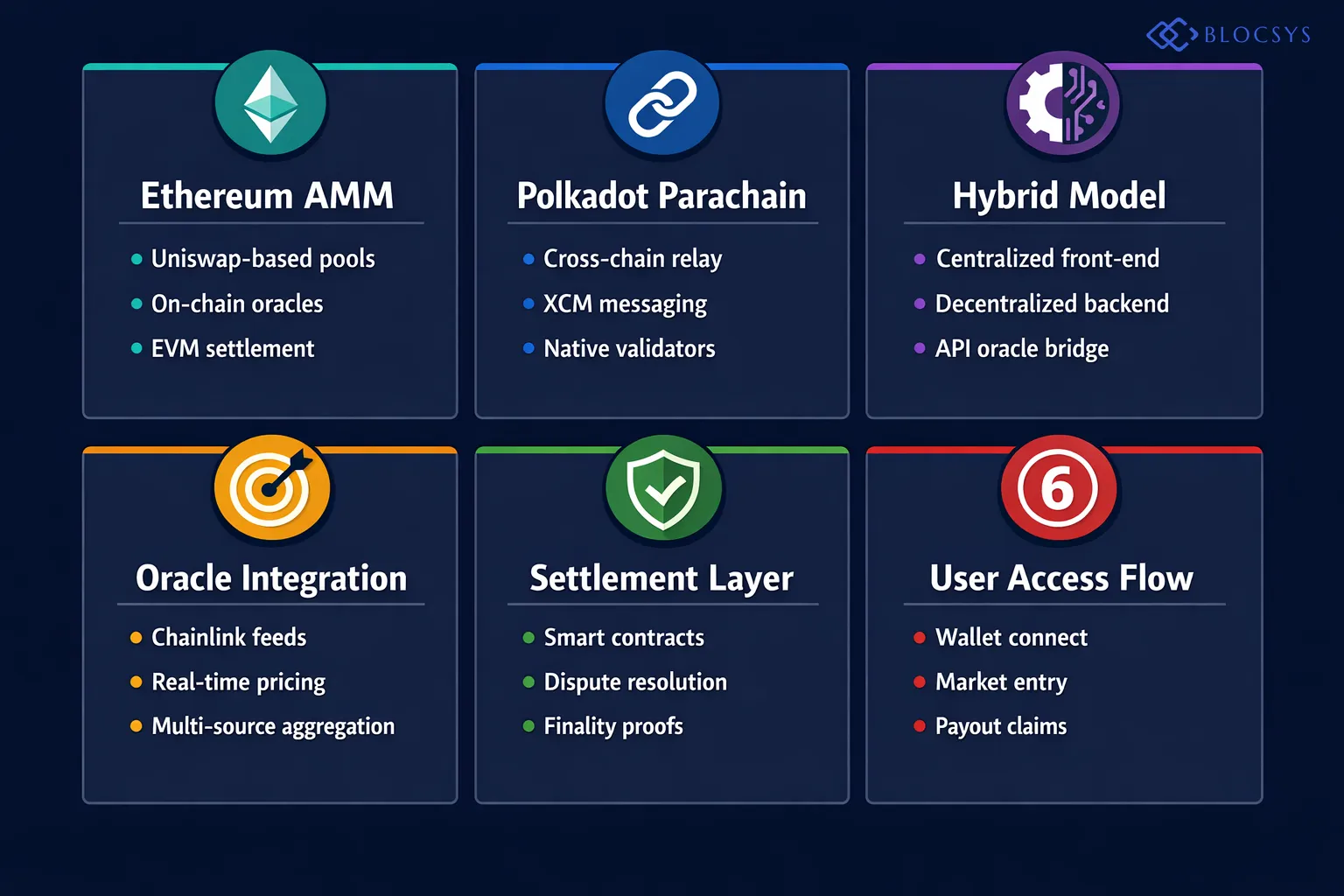
Zeitgeist operates within the Polkadot ecosystem and specializes in futarchy-based governance prediction markets. Their platform enables decentralized organizations to make treasury allocation decisions based on predicted outcome probabilities. Furthermore, their parachain architecture supports high transaction throughput at minimal cost — a critical competitive advantage for high-frequency prediction markets software development use cases.
What to Evaluate When Selecting a Web3 Prediction Markets Development Company
Choosing the right development partner requires systematic evaluation across multiple dimensions. Not every firm that claims blockchain expertise can consistently deliver production-ready prediction markets software development. Therefore, buyers must ask precise, technical questions before signing any engagement agreement.
Smart Contract Audit Track Record
A credible Web3 prediction markets development company will proactively share audit reports from recognized security firms such as Trail of Bits, OpenZeppelin, or Certik. Additionally, they should clearly explain how they identified and resolved each vulnerability discovered during those audits. This level of transparency provides justified confidence in their technical discipline and delivery standards.
Oracle Integration Expertise
Real-world prediction markets depend entirely on reliable external data feeds to settle outcomes correctly. Moreover, oracle manipulation remains one of the most exploited attack vectors in the entire DeFi ecosystem. Therefore, your development partner must demonstrate deep hands-on experience integrating Chainlink, UMA, Pyth, or equivalent oracle networks directly into their smart contract architecture.
User Experience Design for Mainstream Adoption
The platforms that achieve scale attract both crypto-native power users and mainstream participants simultaneously. Consequently, leading developers for prediction markets development invest heavily in intuitive onboarding flows, social login support, and fiat on-ramp integrations. A technically flawless smart contract delivers no value if users find the interface confusing or intimidating.
Multi-Chain Deployment Capability
Prediction markets now operate across Ethereum, Polygon, Base, Arbitrum, Optimism, and several other chains. Therefore, your development partner must support multi-chain deployment strategies from the very beginning of the project. Blocsys, for example, connects their prediction markets infrastructure directly with their broader DeFi Trading Platform Development capabilities, enabling seamless cross-chain liquidity routing for clients who need it.
“The prediction markets category remains in its early innings. The development companies building robust, composable infrastructure today will define the protocols that power global outcome forecasting for the next decade. Speed to market matters — but correctness matters even more.” — Chief Technology Officer, Web3 Venture Studio
AI Prediction Markets Solutions: The Next Competitive Frontier
Artificial intelligence is rapidly reshaping every layer of how prediction markets operate. Leading development teams now embed AI models into market creation workflows, dispute resolution systems, and liquidity management engines. Furthermore, autonomous AI agents can open and close positions based on real-time news data streams without any manual intervention.
AI prediction markets solutions make it commercially viable to operate markets across far more granular categories — from hyperlocal weather forecasts to individual company earnings surprises. Additionally, machine learning models help platform operators detect suspicious trading patterns and potential oracle manipulation attempts before they escalate into exploitable vulnerabilities.
Blocsys documents their AI integration methodology comprehensively in their Premium Guide: AI Agent Development for Blockchain Strategy 2026. Furthermore, they apply these AI agent frameworks directly within their prediction markets builds, giving clients measurable advantages in market liquidity depth and operational automation efficiency.
Ready Prediction Markets Solutions vs. Fully Custom Development
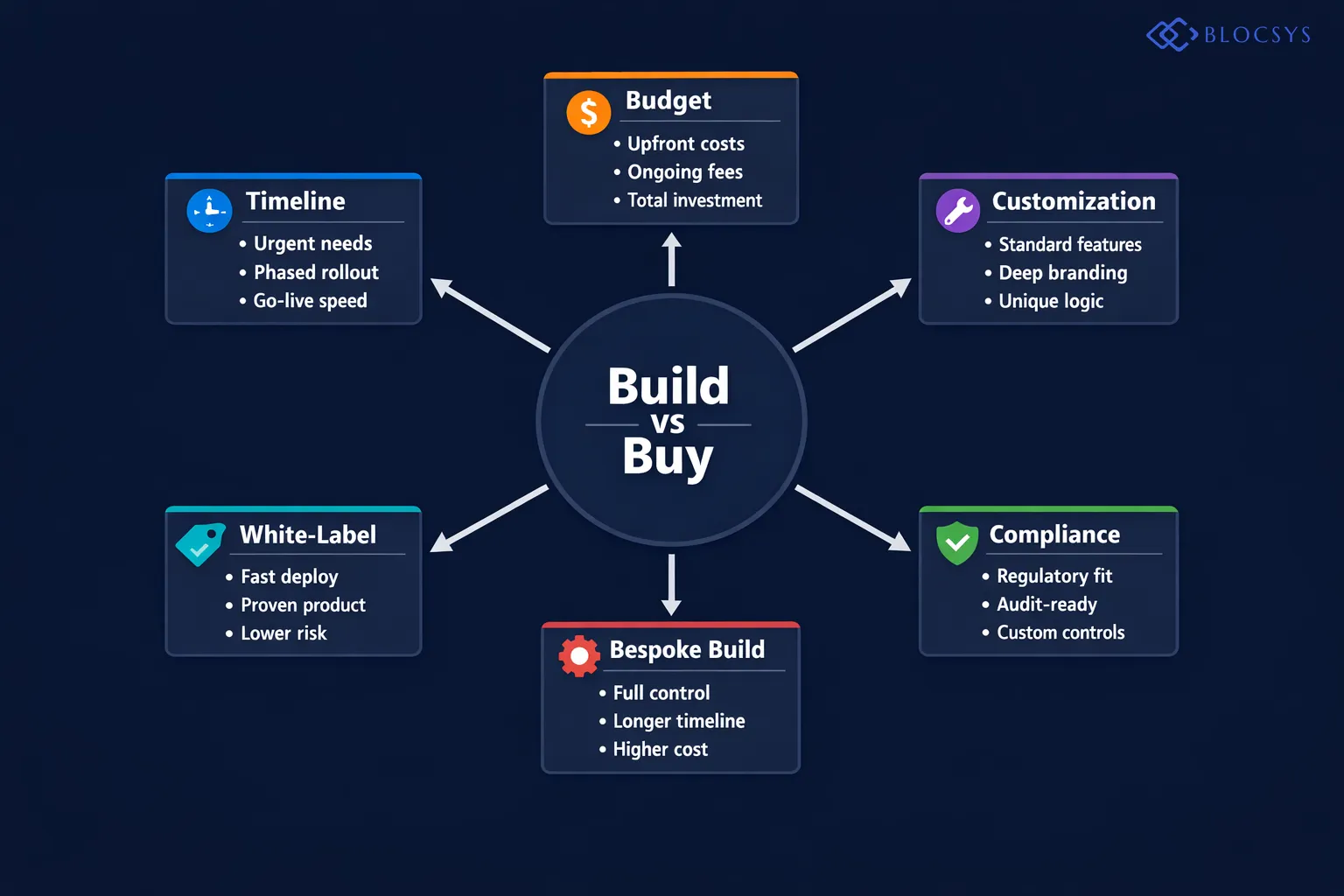
Not every organization requires a fully bespoke development engagement. For many teams, ready prediction markets solutions offer a dramatically faster and more cost-efficient path to their first deployment. These white-label products include pre-built and pre-audited smart contracts, admin dashboards, market creation wizards, and analytics tooling that clients can configure and brand independently.
However, ready prediction markets products carry inherent limitations. They may not support niche market types, specialized oracle configurations, proprietary governance models, or complex compliance requirements. Therefore, organizations with differentiated product visions frequently choose custom blockchain prediction markets development despite the significantly higher upfront investment it demands.
Blocsys bridges this gap more effectively than most competitors. They offer both ready prediction markets products for rapid market validation and fully custom builds for enterprise clients with complex requirements. Consequently, clients at any stage of growth can find an appropriate engagement model that fits their timeline, technical needs, and budget constraints without sacrificing quality.
Teams interested in adjacent trading infrastructure should also explore Blocsys’s Crypto Trading Development Company solutions and their foundational Blockchain Development services, both of which integrate naturally with prediction market platform architectures.
Essential Technical Components Every Prediction Markets Platform Requires
Successful prediction markets software development demands more than writing clean smart contracts. Top-performing platforms combine multiple technical layers into a cohesive, scalable product. Below are the core components every serious platform must include at launch.
- Automated Market Maker Logic: Enables continuous on-chain liquidity without requiring a traditional order book matching engine.
- Oracle Integration Layer: Connects smart contracts to real-world outcome data reliably and in a tamper-resistant manner.
- Dispute Resolution Module: Allows designated reporters or community members to challenge incorrect outcomes within a defined window.
- Liquidity Mining Incentives: Rewards early market participants who provide depth and stability to newly launched markets.
- Operator Admin Dashboard: Empowers non-technical platform managers to create markets, adjust fees, and monitor activity independently.
- Multi-Asset Collateral Support: Accepts USDC, ETH, native governance tokens, and other assets to maximize participant flexibility.
- Gas Optimization Architecture: Reduces on-chain transaction costs through batching strategies, proxy patterns, and Layer 2 deployment options.
- Compliance and KYC Module: Implements user verification flows at the application layer while preserving on-chain neutrality for global markets.
Additionally, analytics and reporting dashboards have become baseline expectations for enterprise clients. Operators need real-time visibility into market volume, liquidity depth, user activity, and protocol revenue. Therefore, experienced prediction markets development teams now include robust analytics infrastructure in their standard delivery packages rather than treating it as an optional add-on.
Understanding Development Costs and Engagement Models
Pricing across the prediction markets development industry varies significantly based on platform complexity, target blockchain networks, and required feature sets. Therefore, buyers should always request fully itemized proposals with clear milestone breakdowns rather than accepting opaque flat-fee quotes that obscure cost drivers.
Ready prediction markets products typically range from $20,000 to $80,000 for a fully branded, audited deployment. Custom blockchain prediction markets development engagements, however, can exceed $350,000 for platforms requiring multi-chain deployment, sophisticated oracle configurations, and institutional-grade governance systems. Additionally, ongoing security monitoring, protocol upgrades, and customer support generate meaningful recurring costs that buyers must plan for carefully.
Teams operating with tighter initial budgets should strongly consider launching with a ready prediction markets product and migrating to a fully custom architecture once they validate product-market fit and close follow-on funding. Blocsys structures their engagements specifically to support this phased evolution model. Consequently, clients avoid paying for capabilities they cannot yet utilize and maintain the flexibility to scale infrastructure as their user base and revenue grow.
The Future Trajectory of Decentralized Prediction Markets Platforms
The decentralized prediction markets platform category will continue expanding aggressively through 2026 and well beyond. Regulatory clarity emerging in the United States, European Union, and major Asian markets is opening doors for institutional capital to enter prediction market positions at meaningful scale. Furthermore, Layer 2 scaling solutions are reducing the cost of individual on-chain market interactions by orders of magnitude compared to early Ethereum deployments.
Additionally, prediction markets are converging with DeFi derivatives, structured financial products, and DAO governance mechanisms in novel ways that were technically impossible just two years ago. Consequently, development companies that build flexible, composable, and interoperable infrastructure today will power the next generation of on-chain financial and forecasting products used globally.
Blocsys positions itself at the center of this multi-sector convergence. Their expanded service portfolio — including OTC Trading Platform Development and Crypto Trading Platform Development — gives prediction market clients direct access to complementary trading infrastructure under a single development relationship. Moreover, this integrated approach reduces cross-system integration friction, lowers total development cost, and meaningfully accelerates time to market for complex multi-product platforms.
Frequently Asked Questions
Here are direct answers to the questions we hear most often about prediction markets development companies and the process of building these platforms from the ground up.
What exactly is prediction market smart contract development?
Prediction market smart contract development refers to the complete process of writing, testing, auditing, and deploying the on-chain code that governs how prediction markets operate. These contracts define how markets are created, how participant funds are held securely, how outcomes are reported, and how winnings are distributed automatically upon settlement.
Well-engineered smart contracts handle complex edge cases gracefully — including disputed outcome reports, liquidity withdrawals under stress conditions, and oracle failures. Therefore, this work requires experienced Solidity, Rust, or Vyper engineers with specific knowledge of DeFi protocol attack surfaces and formal verification techniques.
How long does it typically take to build a decentralized prediction markets platform?
A ready prediction markets product can deploy within four to eight weeks from contract signing to mainnet launch. Custom blockchain prediction markets development engagements typically require three to six months, depending on feature complexity, audit schedules, and oracle integration requirements. Additionally, platforms requiring institutional compliance infrastructure or novel governance mechanisms add several weeks to most project timelines.
Teams that start with a white-label solution can reach real users faster and iterate based on authentic behavioral data. This approach consistently leads to stronger product-market fit than attempting to build a comprehensive feature set before any public launch occurs.
Which blockchains are best suited for prediction markets software development?
Ethereum remains the most trusted foundation for high-value prediction markets because of its security guarantees and deep liquidity ecosystem. However, gas costs make Layer 2 networks like Arbitrum, Base, and Optimism increasingly attractive for platforms targeting high-frequency or lower-value market categories. Furthermore, Polygon and Solana serve use cases where transaction speed and minimal fees take priority over maximum decentralization.
The optimal chain choice depends on your target user demographics, preferred collateral assets, acceptable trust assumptions, and regulatory environment. A qualified Web3 prediction markets development company will guide you through these trade-offs rigorously before committing to a specific architecture and deployment chain.
Are AI prediction markets solutions necessary for competitive platforms?
AI prediction markets solutions are not strictly mandatory, but they provide meaningful and growing competitive advantages. AI enables automated market creation from real-time news sources, more intelligent market-making that reduces slippage for traders, and proactive detection of anomalous trading activity that may signal oracle manipulation attempts.
For platforms targeting institutional clients or high-volume retail traders specifically, AI integration is rapidly shifting from a premium differentiator to a baseline product expectation. Consequently, factoring AI capabilities into your initial development roadmap — rather than retrofitting them later — is strongly advisable for any team serious about long-term market leadership.
What distinguishes ready prediction markets solutions from fully custom builds?
Ready prediction markets solutions are pre-built, white-labeled platforms that you configure with your brand identity, native token, and chosen market categories. They deploy quickly, typically within weeks, and carry significantly lower upfront costs than custom development. Custom builds, however, offer complete architectural freedom to design unique market mechanics, proprietary oracle configurations, specialized governance systems, and compliance frameworks tailored to specific regulatory requirements.
Most successful projects begin with a ready product to validate their core hypothesis and acquire initial users, then migrate to a custom architecture after securing follow-on funding. A skilled development partner designs the initial ready solution with forward compatibility in mind, minimizing the technical debt and rework cost involved in making that transition at the appropriate stage of growth.
Ready to move beyond theory and build an intelligent platform that delivers real-world value? Blocsys Technologies specialises in engineering enterprise-grade AI and blockchain solutions for the fintech, Web3, and digital asset sectors. Connect with our experts today to discuss your vision and chart a clear path from concept to a secure, scalable reality.
