

The worlds of artificial intelligence and distributed ledgers are converging faster than most experts predicted. AI and blockchain integration now powers smarter contracts, fraud-resistant data pipelines, and self-optimizing decentralized networks across every major industry. As organizations explore the Top Blockchain Trends in 2026: The Future of Web3, DeFi, and Enterprise Adoption, it becomes clear that neither technology reaches its full potential without the other. Whether you are a startup founder, an enterprise CTO, or a developer ready to build, Blocsys is the resource you need to understand and act on these powerful shifts.
Why AI and Blockchain Integration Is Dominating the 2026 Landscape
Blockchain technology trends in 2026 point unmistakably toward automation and intelligence. Traditional blockchains excel at trustless record-keeping, but they lack contextual decision-making. AI fills this gap by analyzing on-chain data in real time, flagging anomalies, and triggering smart contract actions without human intervention. Consequently, enterprises gain systems that are both transparent and highly adaptive.
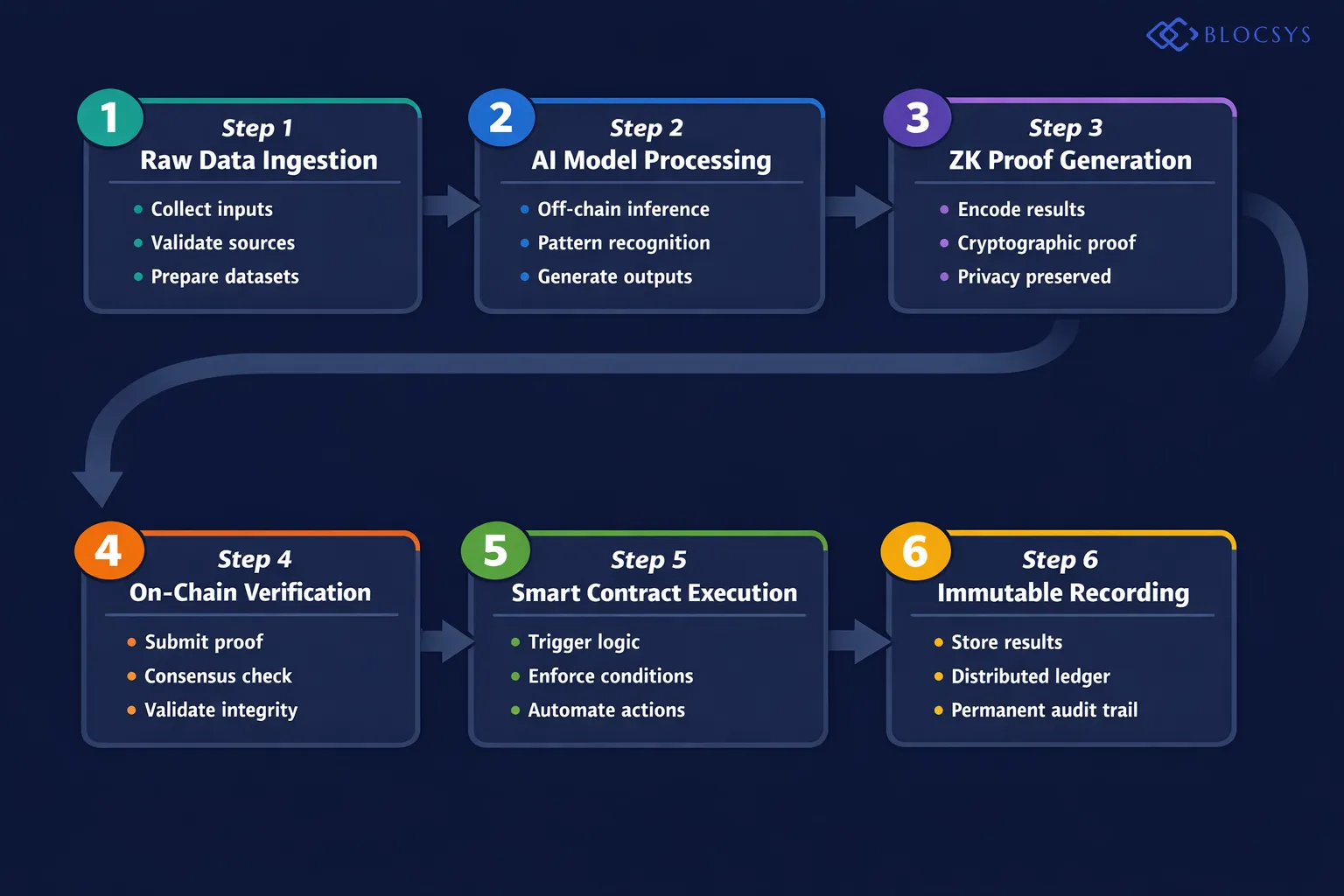
Furthermore, the rise of Modular Blockchain Architecture in 2026: Why It’s the Future of Scalable Networks provides the infrastructure AI workloads need. Modular chains separate execution, settlement, and data availability layers. Therefore, AI models can process data off-chain and commit verified outputs on-chain, reducing gas costs and dramatically increasing throughput.
Core Blockchain Technology Trends Enabling AI-Powered Systems
ZK Proofs and Privacy-Preserving AI
Zero-knowledge proofs allow AI models to prove a computation is correct without revealing sensitive inputs. This breakthrough is critical for finance, healthcare, and government blockchains. Moreover, zk proofs blockchain applications let businesses comply with data-privacy regulations while publishing verifiable AI decisions on a public ledger. The result is fully auditable intelligence with zero data exposure.
Layer 2 Scaling Solutions
Layer 2 scaling solutions make AI inference on blockchain economically viable for the first time. Historically, running complex computations on-chain was prohibitively expensive. However, rollup-based networks compress thousands of transactions into a single cryptographic proof. Additionally, optimistic and zk-rollups now support AI co-processors that verify model outputs before committing state changes to the base layer.
Blockchain Interoperability Trends
AI systems thrive on large, diverse datasets. Therefore, blockchain interoperability trends enabling chains to communicate freely are essential for AI training pipelines. Cross-chain bridges and messaging protocols allow AI agents to aggregate data from Ethereum, Solana, and emerging Layer 2 ecosystems simultaneously. Consequently, decision quality improves as training data becomes more comprehensive and representative.
“The organizations winning in 2026 are not choosing between AI and blockchain — they are building systems where each technology amplifies the other. AI brings cognition; blockchain brings accountability. Together, they create infrastructure that neither humans nor institutions can manipulate undetected.” — Senior Blockchain Architect, Enterprise DeFi Platform
Emerging Blockchain Technologies 2026: Industry Applications
Across every sector, emerging blockchain technologies 2026 are reshaping how data gets validated and shared. The integration of AI accelerates this transformation further, delivering measurable gains in speed, security, and operational efficiency that businesses can quantify immediately.
AI-Driven Supply Chain on Blockchain
Supply chain visibility has long been a blockchain promise. In 2026, AI finally delivers on that promise at scale. AI models monitor sensor data from IoT devices and predict disruptions before they occur. Furthermore, smart contracts automatically reroute shipments when anomalies appear. Explore how a Blockchain Supply Chain Traceability System for Manufacturing delivers end-to-end visibility powered by AI-triggered automation.
Finance and Capital Markets
Blockchain for the finance industry advances significantly when AI handles post-trade reconciliation. AI agents match trades in milliseconds, flag discrepancies, and settle positions through smart contracts with no manual intervention. Moreover, institutional adoption of blockchain grows rapidly as compliance teams gain AI-generated audit trails they can trust. See how Permissioned Blockchain Infrastructure for Capital Market Post-Trade Operations addresses these institutional-grade needs directly.
Decentralized Identity and Document Verification
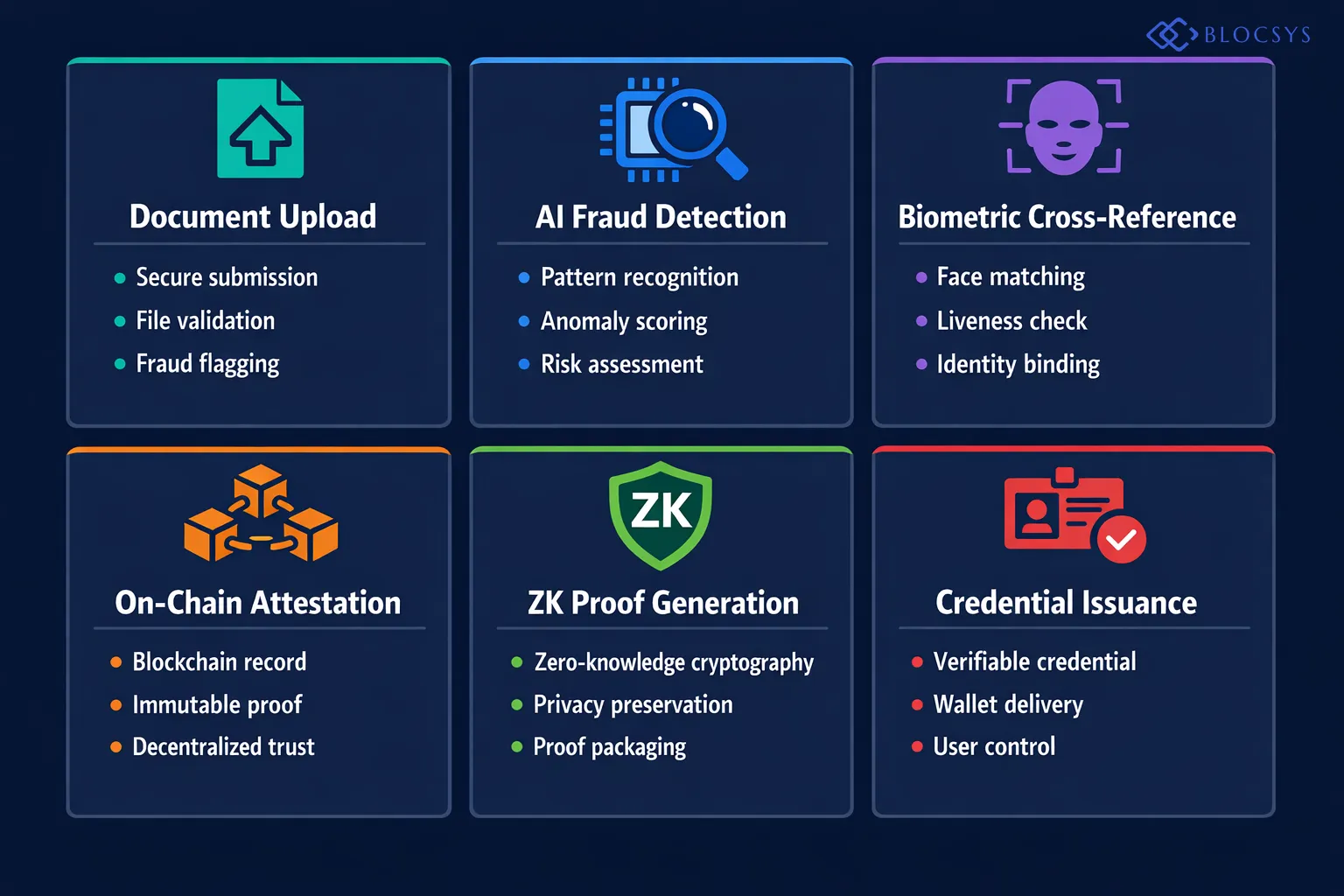
Decentralized identity blockchain solutions gain a powerful upgrade when AI validates credentials at issuance. AI models detect forged documents, cross-reference on-chain attestations, and flag suspicious identity patterns in real time. Additionally, a Blockchain Document Verification System for Secure Digital Proof combines these capabilities into a production-ready solution that enterprises can deploy rapidly.
Real World Assets Tokenization Powered by AI
Real world assets tokenization is one of the most significant blockchain trends 2026 observers are tracking. AI accelerates this trend by automating asset valuation, pricing tokens dynamically, and monitoring secondary market activity for manipulation. Consequently, illiquid assets — from real estate to infrastructure bonds — become accessible to a much broader investor base than ever before.
Furthermore, AI-powered risk scoring models assess each tokenized asset continuously. When risk thresholds breach defined parameters, smart contracts trigger automatic rebalancing or investor notifications. This closes the gap between traditional asset management and decentralized finance, delivering the best attributes of both worlds in a single integrated system.
For a deeper overview of how tokenization fits into the broader ecosystem, the Top Blockchain Trends in 2026: The Future of Web3, DeFi, and Enterprise Adoption pillar provides essential context every decision-maker should read before committing capital or engineering resources.
Enterprise Blockchain Solutions 2026: DAO Governance and AI
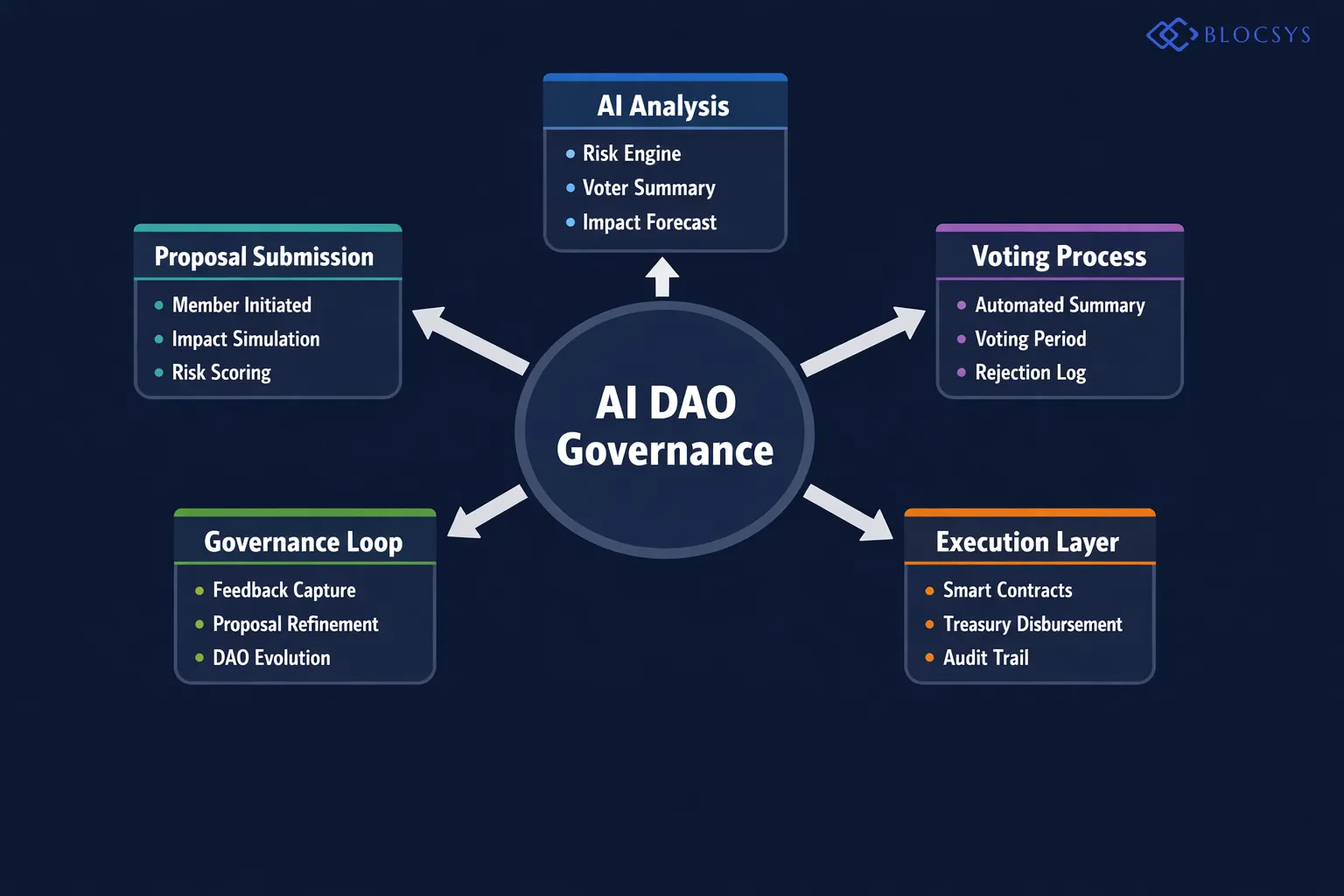
DAO governance trends 2026 reveal a critical structural weakness: human voter apathy and slow decision cycles. AI agents solve this by analyzing proposal impacts, simulating economic outcomes, and summarizing complex governance documents for token holders. Therefore, participation rates rise and decision quality improves simultaneously — without sacrificing decentralization.
Moreover, enterprise blockchain solutions 2026 increasingly embed AI governance layers that flag malicious proposals before voting begins. This protects treasuries worth billions of dollars from coordinated governance attacks. Enterprises exploring Enterprise Blockchain Solutions 2026: Leading Use Cases and Adoption Strategies will find that AI-enhanced governance is rapidly becoming a baseline expectation, not an optional feature.
“AI governance layers are not a luxury — they are table stakes for any DAO managing institutional funds in 2026. Without them, you are running a billion-dollar treasury on a suggestion box.” — Head of DeFi Research, Institutional Web3 Fund
What This Means for Developers and Business Leaders
Developers who master AI and blockchain integration position themselves at the center of the most in-demand skill set in technology today. Building AI co-processors, integrating zk proofs, and designing cross-chain data pipelines are not theoretical exercises. Companies pay premium rates for these capabilities and are actively hiring teams who can deliver them at production scale.
Furthermore, businesses that delay blockchain implementation trends risk losing competitive ground to AI-native competitors who build trustless, automated systems from day one. The Latest Innovations in Blockchain Technology 2026: Breakthroughs You Can’t Afford to Miss article outlines exactly which technologies deserve your investment attention right now.
Additionally, the Premium Guide: AI Agent Development for Blockchain Strategy 2026 provides a tactical roadmap for teams ready to build production-grade AI agents operating on decentralized networks. Moreover, understanding Crypto Trends 2026: What Investors and Developers Need to Know Right Now helps frame where speculative momentum and real enterprise adoption are diverging — a critical distinction for anyone allocating capital.
Therefore, the smartest move any business leader can make right now is to partner with experienced builders who understand both sides of this convergence. Blocsys helps organizations design, build, and scale AI-integrated blockchain systems that deliver measurable ROI — not just technical novelty. Explore our work and start a conversation about your specific use case today.
Frequently Asked Questions
Here are direct answers to the questions we hear most often about AI and blockchain integration in 2026.
What exactly is AI and blockchain integration?
AI and blockchain integration refers to embedding machine learning models and autonomous AI agents directly into blockchain infrastructure. This enables smart contracts to make data-driven decisions, blockchains to detect fraud autonomously, and decentralized networks to optimize their own operations without human intervention.
In practice, integration takes forms like AI-powered oracles, on-chain AI co-processors, and off-chain inference with zk proof verification. Each approach balances cost, speed, and trust requirements differently depending on the use case.
What are the top blockchain technology trends driving this shift in 2026?
The leading blockchain technology trends in 2026 include modular blockchain architecture, real world assets tokenization, zk proofs adoption, layer 2 scaling solutions, and decentralized identity systems. AI and blockchain integration sits at the intersection of all of them, amplifying the impact of each individual trend significantly.
How does AI improve blockchain security specifically?
AI improves blockchain security by detecting anomalous transaction patterns in real time, flagging potential smart contract exploits before execution, and monitoring governance proposals for coordinated manipulation. Additionally, AI models trained on historical attack data predict vulnerability vectors that traditional static audits consistently miss.
Which industries benefit most from AI and blockchain integration in 2026?
Finance, supply chain, healthcare, and government sectors benefit most immediately. Finance gains automated reconciliation and fraud detection. Supply chains gain predictive disruption management and real-time traceability. Healthcare gains privacy-preserving data sharing. Government gains tamper-proof record systems with AI-driven compliance monitoring built in.
How can my business start with AI and blockchain integration?
Start by identifying a high-value process where data integrity and automation both matter — supply chain tracking, financial reconciliation, and identity verification are proven entry points. Then engage experienced blockchain development partners who understand both AI infrastructure and smart contract architecture.
Reviewing Blockchain Consulting Services in 2026: How to Choose the Right Partner for Your Business provides a practical, vendor-neutral framework for evaluating potential partners before signing any engagement.
Ready to move beyond theory and build an intelligent platform that delivers real-world value? Blocsys Technologies specialises in engineering enterprise-grade AI and blockchain solutions for the fintech, Web3, and digital asset sectors. Connect with our experts today to discuss your vision and chart a clear path from concept to a secure, scalable reality.
