

Hire Dedicated Developers in 2026: Cost, Benefits & Scale Your Team Faster has become a board-level decision, not just a hiring task. The reason is simple. In specialised product categories such as Web3, AI, fintech, exchanges, tokenisation, and compliance infrastructure, engineering speed now shapes funding efficiency, launch timing, and operational risk.
The strongest cost signal in the market is hard to ignore. In 2026, hiring dedicated blockchain developers from India costs $7,000-$13,000 per month, versus $20,000-$35,000 in the US, which creates 40-70% savings and can mean more than $300,000 in annual savings for a medium-sized team of 4-6 developers according to SecondTalent’s 2026 dedicated team cost breakdown.
For founders, CTOs, and product leaders, the question is no longer whether remote engineering can work. It is which operating model gives you the fastest access to dependable specialist talent without inflating delivery risk. For high-stakes platforms, dedicated developers often win because they combine continuity, control, and speed in a way freelancers and conventional hiring rarely do.
The Strategic Case for a Dedicated Team Model in 2026
A dedicated development team is a group of developers who work as a long-term extension of your product organisation, aligned to your roadmap, processes, and delivery goals rather than isolated one-off tasks. This model suits products that need continuity, specialised expertise, and the ability to scale engineering capacity without building every role locally.
The strategic appeal is not only flexibility. It is financial structure.
A 2020 Deloitte Global Outsourcing Survey found that 70% of businesses hiring dedicated developers cited cost-cutting as the primary driver, achieving up to 59% budget reductions. The same analysis notes that dedicated teams remove 149%+ total ownership costs beyond base salary, including 20-30% for benefits, 15% for recruitment, and 10% for management, as summarised by FlairsTech’s review of the Deloitte outsourcing data.
Why this model is different from freelancers
Freelancers can work well for narrow tasks, design fixes, or short-term prototypes. They are less suited to systems that require product memory, coordinated releases, shared security practices, and accountability across multiple sprints.
A DeFi trading engine, AI-powered compliance workflow, or tokenisation platform usually needs more than code delivery. It needs:
- Architecture continuity that survives roadmap changes
- Team coordination across backend, smart contracts, DevOps, QA, and frontend
- Operational ownership for releases, fixes, and maintenance
- Security discipline suitable for regulated or high-value systems
Freelancers often optimise for task completion. Dedicated teams optimise for product evolution.
Why this model is different from in-house hiring
In-house teams offer strong control, but 2026 hiring conditions make local-only scaling expensive and slow. Specialist roles in blockchain, Rust, smart contracts, exchange infrastructure, and AI integration are hard to hire in sequence, especially when founders need execution now rather than after a long recruitment cycle.
Key takeaway: A dedicated team is most valuable when the cost of delayed hiring is higher than the cost of external delivery.
That trade-off matters in sectors where shipping late affects fundraising, listings, enterprise contracts, or compliance timelines.
It also matters because AI has changed workflows without eliminating the need for engineers. If you are assessing how much automation can replace hiring, why AI agents can’t replace developers is a useful read. It explains why architecture judgement, debugging, trade-off analysis, and system accountability still sit with experienced developers.
When the dedicated model makes the most strategic sense
A dedicated team is usually the strongest option when:
- You have a live roadmap with multiple releases, not a single fixed-scope brief
- Your stack is specialised such as Solidity, Rust, Solana, AI/ML pipelines, or exchange infrastructure
- You need stable delivery capacity without hiring every role internally
- You want cost control without fragmenting ownership across several contractors
For founders, the hidden advantage is organisational. A dedicated team lets leadership reserve local hiring for core product, compliance, or executive technical roles while external specialists handle build velocity.
A Playbook for Hiring Your Dedicated Development Team
The difference between a productive dedicated team and a costly mismatch usually appears before the first sprint. The hiring process needs to test technical fit, operating fit, and risk fit in that order.
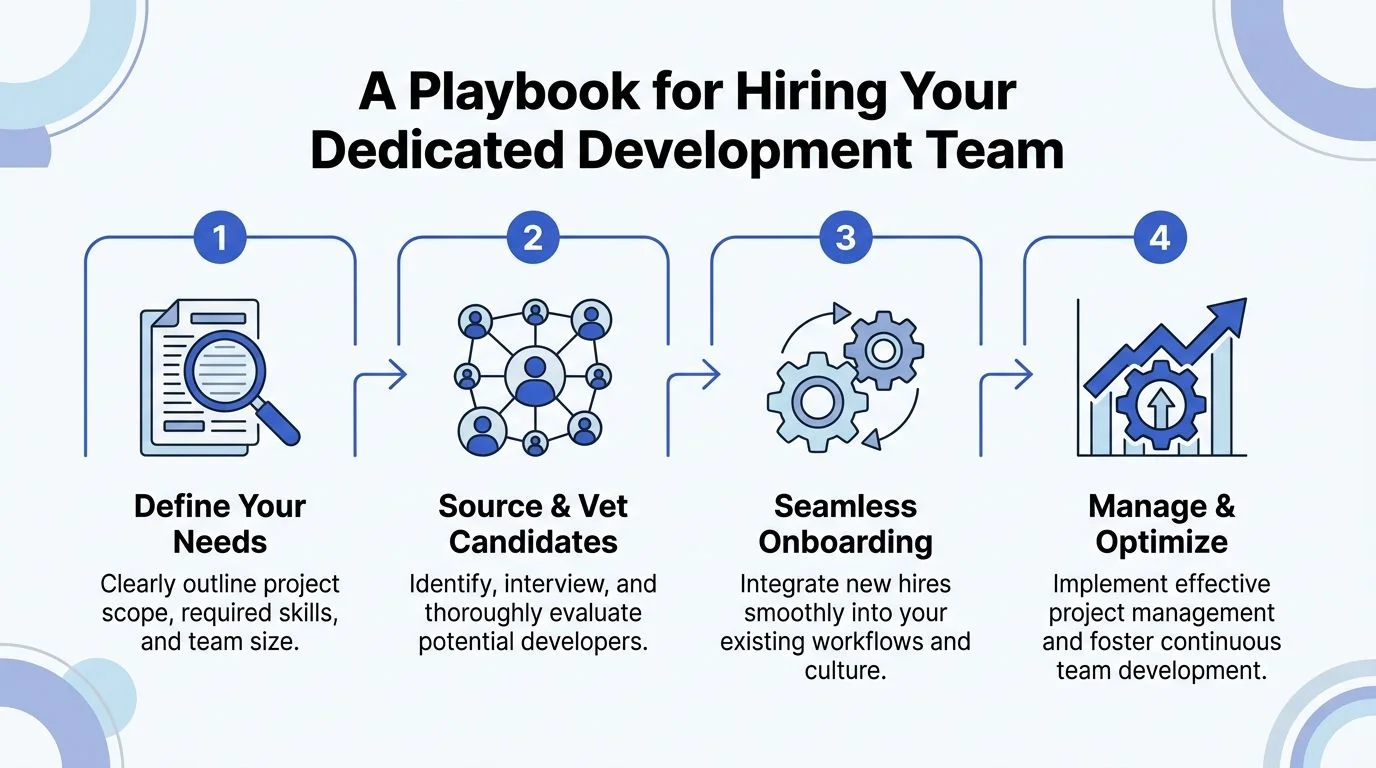
A structured methodology matters. According to iDelsoft’s guide to building a dedicated development team, a proven hiring approach can achieve 85-90% project success rates. The same source highlights scope creep as a risk in 25% of DeFi projects, notes that vendor vetting can deliver 30-40% faster onboarding than in-house, and warns that poor cultural alignment can cause 35% productivity loss.
Define the engineering problem before you define headcount
Many companies start by asking for two backend developers or one blockchain engineer. That is too early.
Start with the product workload:
What must be built first
Identify your release-critical modules. For example, wallet flows, matching logic, custody integrations, smart contracts, admin tooling, KYC workflow, or observability.Which skills are essential
If you are building tokenisation rails, you may need Solidity. If you are building on Solana, Rust becomes central. If your product includes dashboard and API work, full-stack capability may matter more than narrow protocol expertise.Where internal teams will retain ownership
Some teams keep architecture and product decisions in-house while delegating implementation. Others want an external team to own delivery end to end.
This is also where role-specific hiring pages can help you pressure-test staffing choices. Depending on your stack, you might evaluate options to hire blockchain developers, hire Solana developers, hire Rust developers, hire Solidity developers, or hire full stack developers.
Vet partners like an operator, not a buyer
A polished sales deck tells you very little. Product leaders should test for delivery behaviour.
Review these areas closely:
- Domain depth: Have they worked on fintech, blockchain, exchange, or AI-heavy products with meaningful complexity?
- Team composition: Do they provide only developers, or also QA, DevOps, technical leads, and product coordination?
- Communication design: Will engineers join stand-ups directly, or sit behind an account layer?
- Code ownership: Who controls repositories, documentation, deployment access, and handover?
- Continuity: What happens if one developer exits the project?
A practical companion resource for screening process design is Recruiting Software Developers: A Practical Hiring Guide, especially if you want to tighten your interview loops and evaluation criteria.
Tip: Ask vendors to explain a difficult delivery trade-off from a prior project. Strong teams answer with architecture and execution detail, not marketing language.
Run live technical screening against your actual risks
For complex products, interviews should mirror the actual environment.
Use a layered screen:
- Architecture review: Ask how they would design a secure release path for your platform.
- Code reasoning: Discuss smart contract edge cases, indexing strategy, API concurrency, or data integrity issues.
- Delivery judgement: Test how they handle delays, ambiguous requirements, and sprint trade-offs.
- Security thinking: Ask about access control, audit preparation, secrets management, and failure handling.
The strongest candidates explain what they would refuse to rush.
Choose the right engagement model
Not every project needs the same contract shape.
Full-time dedicated team
Best when your roadmap is active, evolving, and likely to continue beyond an initial release. This model works well for exchanges, token platforms, AI compliance systems, and SaaS products with ongoing iteration.
Part-time specialists
Useful when your internal team already covers most functions and only needs concentrated expertise in one area, such as smart contracts, DevOps, or protocol integration.
Project-based engagement
A fit for fixed deliverables with tight scope boundaries. It is weaker when requirements will move frequently.
If your immediate need is to extend an internal team rather than assemble a self-contained unit, IT staff augmentation services can be the cleaner route.
Security and compliance checks cannot be an afterthought
In Web3, AI, and fintech, hiring mistakes create more than delivery delays. They can create exposure.
Evaluate these controls before signing:
- Access design: Repository access, cloud permissions, wallet handling, and credential separation
- Documentation discipline: Clear technical specs, decision logs, and handover standards
- Release governance: Review paths, testing expectations, rollback planning
- Compliance awareness: Ability to work within audit, reporting, and data handling constraints
Founders often focus on rates first. Security maturity is usually the more expensive variable to fix later.
Decoding the Costs of Dedicated Developers in 2026
In specialist engineering, the quoted monthly rate is rarely the number that decides whether a team is affordable. The key variable is cost per unit of reliable delivery.
Founders often compare an employee salary with a vendor invoice and stop there. That misses taxes, recruitment lag, bench risk, management overhead, security review, and the cost of shipping slower because the team lacks one hard-to-find skill. In Web3, AI, and fintech, those hidden costs are not accounting details. They shape runway, audit readiness, and how quickly a product can clear regulated release gates.
The benchmark that matters
As noted earlier, offshore pricing for blockchain talent can be materially lower than US hiring costs. The important point is not the percentage alone. It is what that pricing gap allows a company to buy.
A lower per-seat cost can fund a stronger team design: one senior engineer instead of two mid-level generalists, dedicated QA from month one, or part-time DevOps and security support before the first external audit. For high-stakes products, that often produces a better outcome than assembling the cheapest possible build team.
What drives dedicated team pricing
Dedicated team budgets usually move on four variables:
Skill scarcity
Solidity, Rust, Solana, zero-knowledge systems, model optimisation, MLOps, and fintech integration work price above general web development because supply is narrower and failure costs are higher.Seniority and decision quality
Senior engineers cost more per month, but they often reduce total spend by cutting rework, shortening architecture debates, and making cleaner production decisions under compliance constraints.Delivery structure included in the contract
Some vendors provide engineer hours only. Others include technical planning, QA process, sprint management, documentation standards, and release coordination. Those offers are not directly comparable.Engagement horizon
A six to twelve month engagement usually creates better economics than fragmented short-term work because onboarding effort is amortised over a longer period and team continuity improves output.
The highest monthly rate is not always the expensive option. A cheaper team with weak review discipline can create contract vulnerabilities, unstable AI pipelines, or payment workflow defects that cost far more to correct later.
Europe versus offshore, how founders should model it
The source material available for this article gives verified US and India benchmarks, but not a directly comparable Europe-wide pricing dataset. Rather than insert weak estimates, use a planning model.
Start with three questions. How much specialist work sits on the critical path? How expensive is delay for your next release or funding milestone? Which roles must stay close to product, compliance, and customer teams?
For many UK and European startups, the answer is a split model. Keep product leadership, architecture ownership, and compliance accountability close to the business. Place specialist implementation capacity offshore where the talent pool is deeper and hiring can scale faster. Founders comparing suppliers can use lists of offshore software development partners and outsourcing providers as a starting point, then filter for domain depth in smart contracts, AI systems, payments, and regulated delivery.
| Region | Average Monthly Cost (EUR) | Average Monthly Cost (GBP) | Key Considerations |
|---|---|---|---|
| Europe | Qualitative only | Qualitative only | Local hiring can improve proximity and in-person coordination, but specialist engineering costs are often higher and hiring cycles can be slower. |
| Offshore (India) | Approx. €6.4k-€11.9k | Approx. £5.5k-£10.2k | Based on the verified $7,000-$13,000/month range referenced earlier for dedicated blockchain developers from India. The main advantage is lower monthly cost combined with access to specialist talent. |
The finance view that changes the decision
The strongest reason to use a dedicated team is capital allocation.
If each engineering seat costs less, a founder gains options. The company can extend runway, add QA before defects accumulate, fund external security review, or preserve local budget for a head of engineering, compliance lead, or payments specialist. That matters more in Web3 and fintech than in standard SaaS because one release failure can trigger legal, security, and reputational costs at the same time.
A disciplined cost model should include four lines: monthly delivery spend, time-to-hire, rework risk, and control costs such as testing, audit preparation, and release management. Teams that look cheaper on paper often become expensive in the third and fourth lines.
Key takeaway: The best dedicated team budget is not the lowest monthly quote. It is the one that buys enough specialist capacity, process control, and delivery reliability to hit the roadmap without exposing the business to avoidable technical or compliance risk.
Why UK & European Startups Increasingly Prefer Offshore Teams
UK and European companies do not choose offshore teams only to lower costs. They do it because local specialist hiring is slow, fragmented, and difficult to scale across blockchain, AI, and fintech product lines.

Why UK startups prefer offshore teams
A UK founder building a trading platform or tokenisation product usually faces three simultaneous pressures. They need niche talent, they need it quickly, and they cannot allow payroll structure to outrun product progress.
Offshore teams solve all three if managed well.
A key operational advantage is access to a broader skills market. A local hiring strategy may work for product managers, compliance leads, and a core technical architect. It becomes much harder when the roadmap suddenly requires smart contract expertise, Rust engineering, QA automation, and cloud support in parallel.
That is why many scaling companies adopt a hybrid pattern:
- Core leadership in-house
- Specialist build capacity offshore
- Shared product process across both groups
For UK and European operators evaluating suppliers, a useful shortlist can start with firms experienced in distributed delivery models such as those discussed in this review of outsourcing IT companies.
Offshore is often a speed decision disguised as a cost decision
European markets reward product timing. If a team spends too long filling specialist roles locally, the commercial cost can exceed the salary premium.
Offshore teams are often preferred because they let companies:
- Stand up delivery faster
- Test new product lines without permanent local expansion
- Access blockchain and AI specialists that are hard to source regionally
- Keep internal teams focused on strategy, partnerships, and regulation
The practical concern is usually collaboration. In reality, the model works best when companies establish overlap hours, shared sprint rituals, and written documentation standards from day one.
A short visual overview of offshore team thinking can help frame this shift:
What European teams should watch for
Offshore is not a shortcut around management. It is a different management system.
The strongest partnerships usually share these traits:
- Clear ownership lines between product, architecture, and implementation
- Direct engineer access rather than filtered communication
- Documentation-first workflows for asynchronous progress
- A common definition of done across QA, release, and support
For UK and Europe-based startups, offshore works best when treated as an operating model, not a temporary staffing patch.
Onboarding, Management, and Measuring Success
A dedicated team proves its value after contract signature, not before. The first two weeks determine whether engineers become productive contributors or remain external resources waiting for direction.

What strong onboarding looks like
Effective onboarding is operationally simple but often inconsistently executed.
A good first fortnight usually includes:
Access setup
Repositories, ticketing tools, documentation, staging environments, and communication channels must be live early.Product context
Developers need more than a backlog. They need business logic, user flows, edge cases, and architectural constraints.Decision clarity
Establish who approves architecture, prioritises tickets, signs off releases, and manages blockers.Working agreements
Define stand-ups, sprint planning, code review expectations, and incident response paths.
If any one of these is missing, velocity slows quickly.
How to manage a dedicated team without micromanaging
Dedicated developers perform best when they are integrated into the same operating cadence as internal engineers.
Useful tools and rhythms include:
- Slack or Microsoft Teams for direct communication
- Jira for sprint planning and issue tracking
- Confluence or Notion for product and technical documentation
- GitHub, GitLab, or Bitbucket for code review and release workflows
- Daily stand-ups to surface blockers early
- Weekly roadmap review to connect sprint work to business outcomes
The mistake many companies make is measuring availability instead of progress. Distributed teams need transparent output signals, not constant surveillance.
Tip: If developers are waiting on product answers for days, the problem is usually operating design, not engineering performance.
What to measure
Hours worked is a weak management metric for specialist software development. Better signals come from flow, quality, and predictability.
Track:
Sprint completion quality
Are committed items shippable when marked done?Cycle stability
Does work move consistently through review and testing, or pile up near release?Defect patterns
Are the same bug categories repeating across releases?Communication reliability
Are blockers raised early, with enough context to solve them?Documentation quality
Can internal teams understand and continue the work without tribal knowledge?
These indicators tell you whether the partnership is building a sustainable engineering system.
Red flags that deserve action
Some delivery issues look small at first and become expensive later.
Watch for:
Repeated ambiguity around ownership
If nobody knows who decides what, progress will degrade.Thin written communication
Remote teams fail when key decisions live only in calls.Long code review queues
This often signals a mismatch in standards, capacity, or architecture understanding.Frequent reassignment of vendor staff
Continuity matters. Rotation weakens product memory.Optimism without evidence
Confident updates that lack demoable progress usually hide delivery risk.
When a partnership drifts, the first remedy is usually tighter process definition. Replace vague expectations with explicit rituals, owners, and acceptance criteria.
Build Your Next Platform with Blocsys’s Dedicated Engineers
Companies building exchanges, tokenisation products, DeFi infrastructure, AI-powered compliance systems, or carbon-linked digital platforms need more than generic software capacity. They need developers who understand how technical choices affect security posture, operational resilience, and release confidence.
That requirement changes how you should assess partners.
Look for teams that can work across the full delivery chain:
- Protocol and smart contract work for blockchain products
- Backend and data infrastructure for trading, reporting, and compliance workflows
- Frontend implementation for user-facing financial products
- DevOps and release discipline for stable production environments
- Documentation and handover for long-term maintainability
One option in this category is Blocsys’s dedicated development team services, which focuses on production-ready blockchain and AI-powered platforms for fintechs, exchanges, and digital asset businesses. That type of model is most relevant when a company needs vetted engineering talent aligned to a specific roadmap rather than disconnected task execution.
Where a specialist partner adds the most value
Dedicated engineering support is often most useful when:
- The roadmap is technically demanding
- Security and compliance cannot be improvised
- The business needs to scale build capacity without bloating internal headcount
- Product leaders want direct collaboration with engineers, not opaque outsourcing layers
For founders, the practical test is simple. Can the team help you ship a platform that still holds up under scrutiny six months later?
Key takeaway: The right dedicated team does not only accelerate output. It reduces the number of strategic mistakes made under delivery pressure.
If your next platform involves digital assets, fintech workflows, AI-assisted operations, or complex backend systems, a specialist partner should be evaluated on architecture judgement, communication discipline, and production readiness as much as speed.
Frequently Asked Questions
What is the difference between dedicated developers and freelancers
Dedicated developers work as an ongoing extension of your team and stay aligned to your roadmap, tooling, and release process. Freelancers usually work best for isolated tasks or short engagements. For products with multiple dependencies, dedicated developers offer stronger continuity and accountability.
When should a startup hire dedicated developers instead of building fully in-house
Startups should consider dedicated developers when they need specialist skills quickly, want to protect runway, or cannot afford long hiring cycles for every role. This is especially relevant when the product roadmap includes blockchain, AI, fintech integrations, or platform infrastructure that requires uncommon technical depth.
Are dedicated developers suitable for regulated fintech and crypto products
Yes, if the hiring process includes strong checks around security practices, documentation standards, access control, and release governance. The risk is not the remote model itself. The risk is selecting a team without the process maturity required for regulated or high-value systems.
Which engagement model is best for long-term product development
A full-time dedicated team is usually the most effective model for products with an active roadmap and frequent iteration. Part-time specialists fit narrower needs, and project-based contracts work better when scope is stable and unlikely to change much after kickoff.
How do I evaluate a dedicated development company properly
Assess domain experience, technical depth, communication style, team continuity, delivery process, and security discipline. Ask practical questions about architecture trade-offs, release handling, and handover standards. Avoid making the decision on portfolio design or pricing alone.
Can dedicated teams work well for UK and European companies
Yes. The model works particularly well when companies create overlap hours, shared sprint routines, direct communication with engineers, and strong written documentation. Offshore success depends less on geography and more on operating design.
What roles should be hired first for a Web3 or fintech build
That depends on the product, but many teams begin with the roles closest to delivery bottlenecks. For example, backend and smart contract engineers for core platform logic, then frontend, QA, and DevOps as release complexity grows. Founders should staff around system risk, not generic org charts.
How long does it take for a dedicated team to become productive
A team becomes productive faster when the company has clear requirements, proper access setup, defined owners, and well-documented product context. The technical handover matters, but operational clarity often matters more.
If you are planning to scale a Web3, AI, fintech, or digital asset product, Blocsys Technologies can help you assess the right dedicated team structure, specialist roles, and delivery model for your roadmap. Connect with the team to discuss your platform, hiring goals, and the most practical next step to hire dedicated developers with confidence.
