

The blockchain landscape is evolving faster than ever before. Modular blockchain architecture stands at the center of this transformation, reshaping how developers build scalable, efficient, and interoperable networks. Understanding modular design is no longer optional — it is essential for anyone serious about the future of blockchain 2026. The team at Blocsys has been tracking these shifts closely, and the evidence is clear: modular systems are winning. For the full strategic context, start with Top Blockchain Trends in 2026: The Future of Web3, DeFi, and Enterprise Adoption, which maps out exactly where the industry is heading.
What Is Modular Blockchain Architecture?
Traditional blockchains handle everything in a single layer — execution, consensus, data availability, and settlement. This monolithic approach creates serious bottlenecks. Modular blockchain architecture breaks these functions into separate, specialized layers. Each layer focuses on doing one thing exceptionally well.
Therefore, modular systems can scale individual components independently. Additionally, teams can mix and match layers from different protocols without rebuilding from scratch. This design philosophy is driving the latest innovations in blockchain technology and enabling a new generation of high-performance networks that were previously impossible to build.
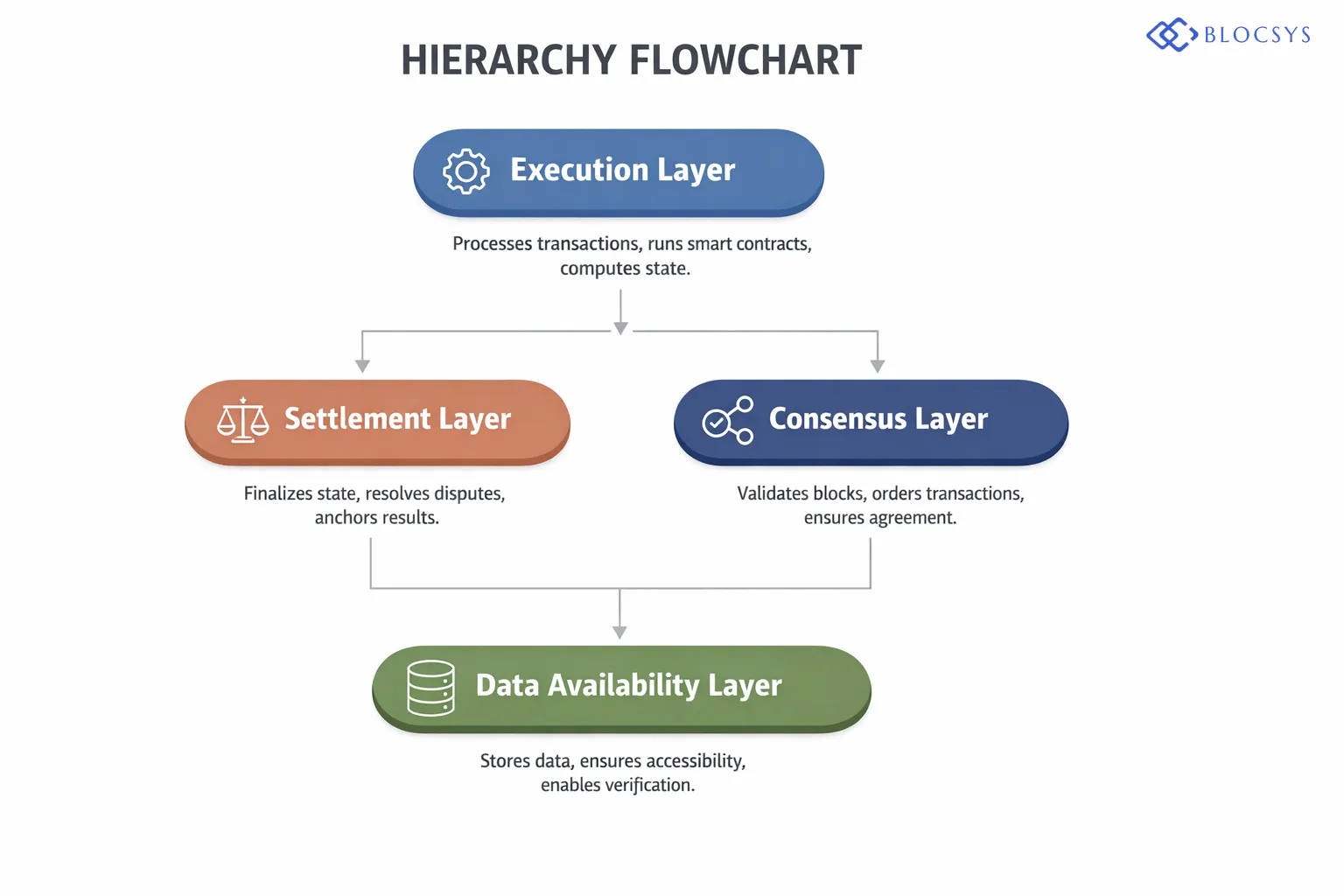
The Core Components: Execution, Settlement, Consensus, and Data Availability
Understanding modular design requires knowing its four foundational layers:
- Execution layer: Processes transactions and runs smart contracts at high throughput.
- Settlement layer: Verifies proofs and resolves disputes between layers with finality.
- Consensus layer: Ensures all nodes agree on the current state of the network.
- Data availability layer: Guarantees that transaction data remains accessible and verifiable by anyone.
Consequently, projects can upgrade any single layer without disrupting the entire system. This modularity creates enormous flexibility. Moreover, it allows blockchain networks to achieve performance levels that monolithic chains simply cannot match at scale.
Why Modular Blockchain Architecture Is Leading Blockchain Development Trends 2026
Among all blockchain development trends 2026, modular architecture has emerged as the most impactful structural shift. The reason is straightforward: scalability without sacrifice. Furthermore, the demand for enterprise blockchain solutions 2026 has never been stronger, and modular systems deliver the enterprise-grade performance that businesses require.
“Modular architecture is not just a technical upgrade — it is a complete rethinking of how blockchains should be built. The chains that will dominate in 2026 and beyond are those that treat scalability, security, and decentralization as separate engineering problems, not a single impossible trade-off.” — Senior Blockchain Architect, Web3 Infrastructure
Scalability Without Compromise
The blockchain trilemma — balancing scalability, security, and decentralization — has challenged developers for years. However, modular design offers a practical and proven path forward. By separating concerns, networks scale execution independently while maintaining strong consensus and security guarantees on dedicated layers.
Layer 2 scaling solutions built on modular foundations are processing millions of transactions daily. Additionally, zk proofs blockchain implementations are making verification faster and cheaper than at any previous point. These advances position modular architecture as the backbone of the future of blockchain 2026.
Developer Flexibility and Innovation
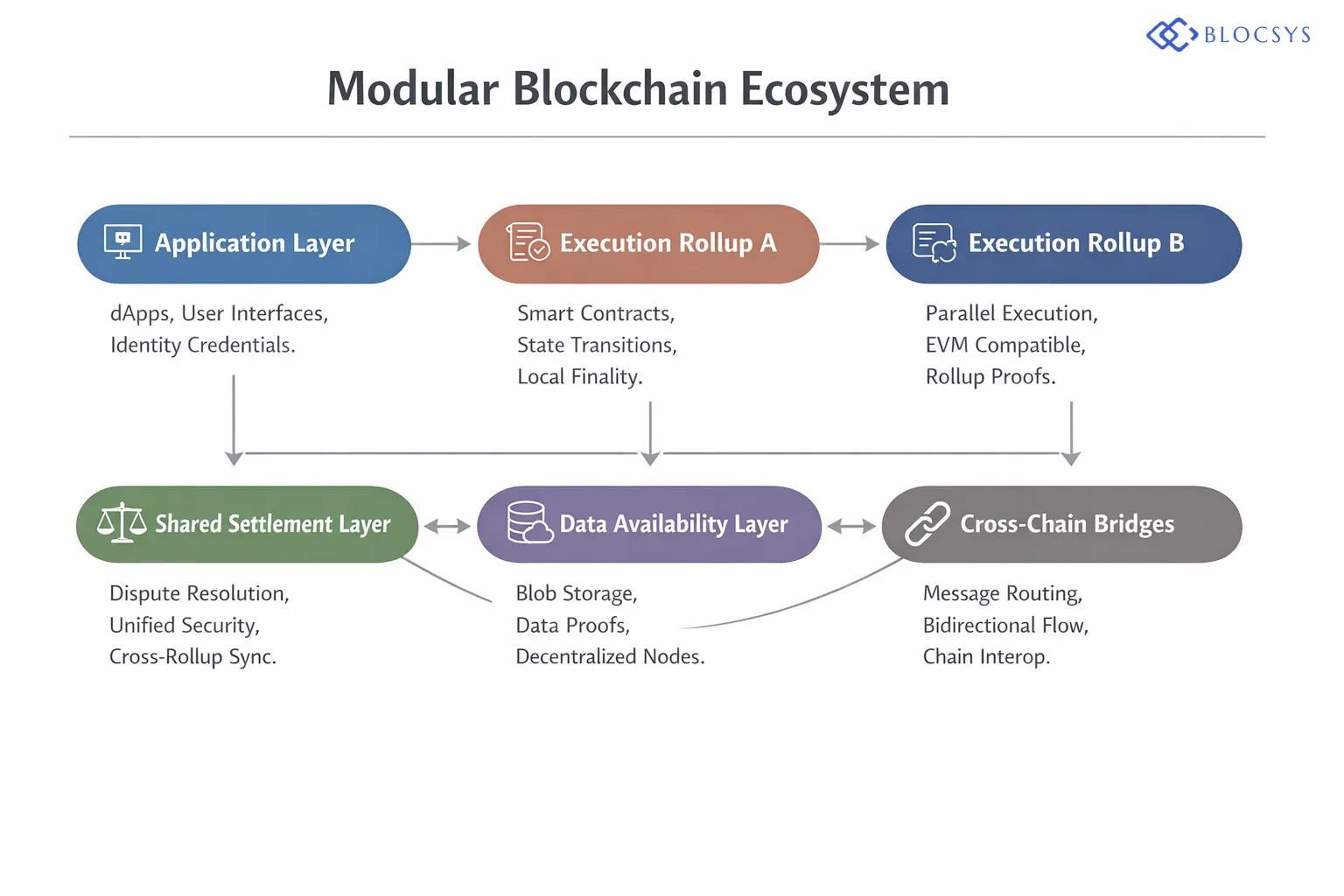
Modular systems empower developers in unprecedented ways. Teams can deploy application-specific rollups using execution environments they select freely. They can plug into established settlement and data availability layers without building expensive infrastructure from the ground up.
Therefore, the barrier to launching sophisticated blockchain applications is dropping rapidly. This flexibility fuels blockchain implementation trends across gaming, DeFi, enterprise platforms, and regulated finance. Additionally, explore how Web3 Trends 2026: How the Decentralized Web Is Reshaping Digital Ownership are being shaped directly by these modular breakthroughs.
Emerging Blockchain Technologies 2026 Powered by Modular Design
Several emerging blockchain technologies 2026 are leveraging modular architecture to unlock capabilities that were previously out of reach. These innovations are converging to create a more interconnected, efficient, and developer-friendly blockchain ecosystem that benefits users at every level.
Layer 2 Scaling Solutions and ZK Proofs
Layer 2 scaling solutions have matured dramatically over the past eighteen months. Rollups — both optimistic and zero-knowledge — now handle the vast majority of user-facing transactions on major networks. ZK proof generation has become faster and more affordable, making zk proofs blockchain a viable standard for enterprise-grade applications.
Furthermore, modular data availability layers provide rollups with cheap, reliable data posting at scale. Consequently, the cost of launching a high-performance Layer 2 has dropped by orders of magnitude compared to just two years ago. This is accelerating web3 development trends across every sector of the economy. Discover more at Latest Innovations in Blockchain Technology 2026: Breakthroughs You Can’t Afford to Miss.
Decentralized Identity and Blockchain Interoperability
Decentralized identity blockchain systems are gaining serious real-world traction. Modular architectures make it significantly easier to integrate identity layers across different networks. Users carry portable credentials and reputation across chains without friction or duplication.
Moreover, blockchain interoperability trends are advancing through shared settlement layers and standardized cross-chain messaging protocols. Networks no longer operate in isolation. Instead, they communicate and transact freely, creating the interconnected ecosystems that Web3 has always promised to deliver.
Enterprise and Real-World Integration: How Businesses Benefit
Enterprise blockchain solutions 2026 are increasingly built on modular foundations. Businesses need performance, compliance flexibility, and long-term upgradeability — and modular architecture delivers all three simultaneously. Enterprise Blockchain Solutions 2026: Leading Use Cases and Adoption Strategies covers this structural shift in comprehensive detail.
Real-World Asset Tokenization
Real world assets tokenization is one of the most transformative blockchain business use cases 2026. Modular chains provide the performance needed to handle large volumes of tokenized assets — real estate, commodities, treasury bonds, and private equity — with fast finality and minimal transaction costs.
Additionally, dedicated settlement layers ensure that asset transfers are secure and cryptographically irreversible. Therefore, institutional adoption blockchain is accelerating as financial institutions find modular platforms they can trust for mission-critical infrastructure. Institutional Adoption of Blockchain in 2026: Trends, Challenges, and Opportunities provides a comprehensive analysis of this wave.
Blockchain for Supply Chain and Finance
Modular architecture is transforming blockchain for supply chain 2026 applications. Custom execution environments allow businesses to deploy chain logic tailored precisely to their operational workflows. Moreover, shared data availability layers ensure that all supply chain participants access the same verifiable, tamper-proof record.
The blockchain for finance industry is benefiting equally. Banks and asset managers deploy modular systems that separate compliance logic from transaction processing cleanly. Consequently, they achieve regulatory flexibility without compromising throughput or security. Discover further Blockchain Use Cases 2026: Real-World Applications Transforming Every Industry.
AI and Blockchain Fusion: The Modular Advantage
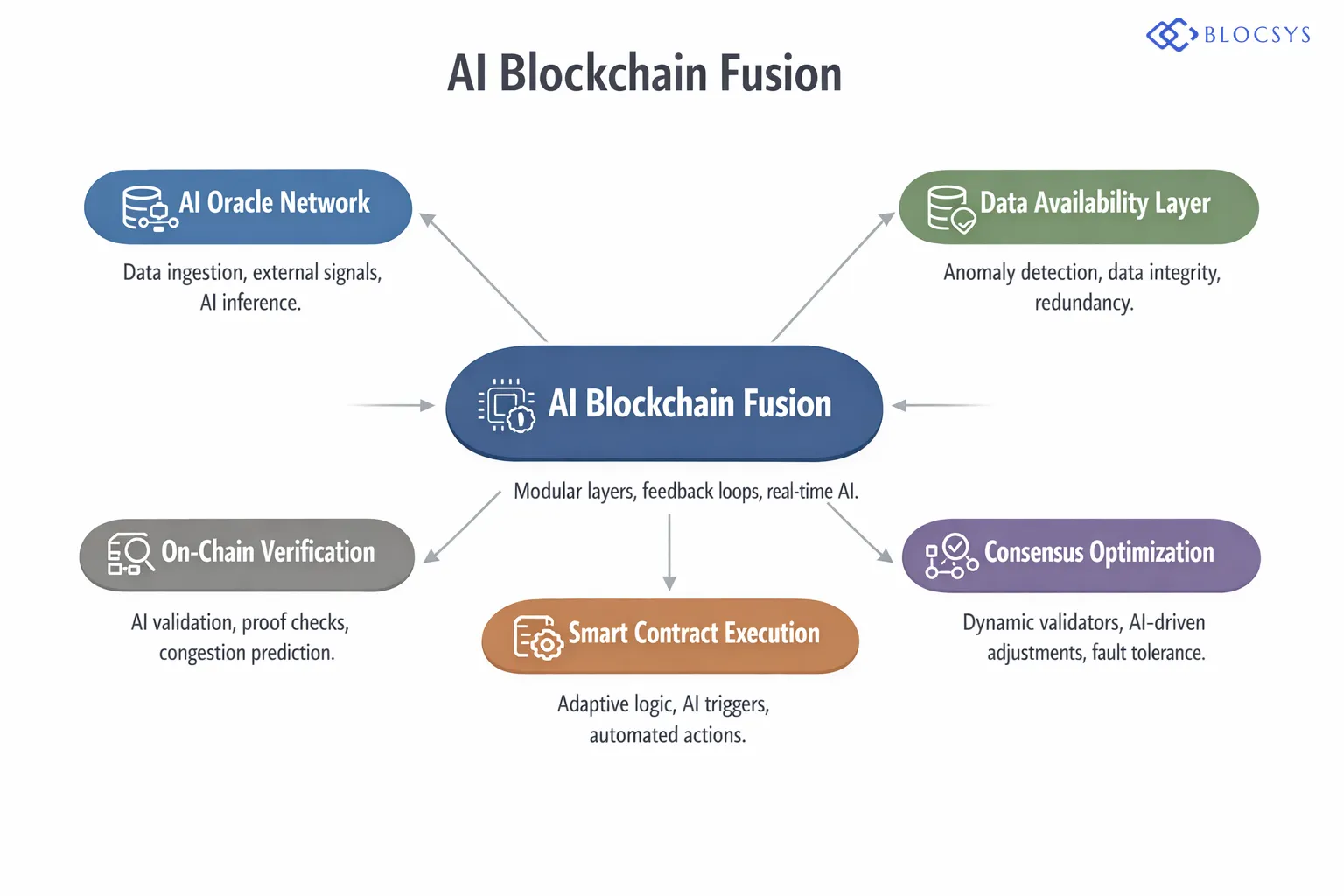
AI and blockchain integration is emerging as one of the most compelling crypto trends 2026. Modular architecture creates natural entry points for AI-driven components at every layer of the stack. This fusion produces smarter, more adaptive, and more resilient networks that respond dynamically to real-world conditions.
“The combination of modular blockchain stacks and AI-driven oracles is fundamentally changing how on-chain systems interact with real-world data. We are moving from static smart contracts to dynamic, self-optimizing protocols — and modular design is precisely what makes this technically feasible at production scale.” — Lead Protocol Engineer, DeFi Infrastructure
Smarter Consensus and Data Layers
AI models are actively optimizing consensus mechanisms in real time across modular networks. They detect anomalies, adjust validator incentives dynamically, and predict network congestion before it disrupts user experience. Furthermore, AI-powered data availability layers prioritize critical transactions intelligently during peak demand periods.
This exciting convergence is explored thoroughly in AI and Blockchain Integration in 2026: Smarter, More Secure Decentralized Systems. Additionally, DAO governance trends 2026 are benefiting as AI tools help decentralized communities make faster, data-driven decisions on protocol upgrades and treasury allocation.
Blockchain Trends 2026: What Is Driving Adoption Forward
Several powerful forces are accelerating blockchain trends 2026 adoption of modular systems globally. Institutional investors demand infrastructure that scales without sacrificing security guarantees. Developers choose modular stacks because they dramatically reduce time-to-market for complex applications.
Furthermore, regulatory clarity in major markets gives enterprises the confidence to build on public modular chains with long-term commitment. Blockchain consulting services providers guide clients through the complex process of selecting, integrating, and maintaining modular components across their organizations. If your team needs expert strategic guidance, Blockchain Consulting Services in 2026: How to Choose the Right Partner for Your Business is an essential resource worth exploring.
Moreover, the crypto trends 2026 narrative is shifting decisively from speculation to infrastructure utility. Modular architecture provides the foundation that makes genuine utility possible at global scale. As a result, capital and talent are flowing into modular ecosystem projects at historically unprecedented rates, signaling a structural change rather than a passing trend.
The performance data speaks clearly. Networks built on modular principles outperform their monolithic counterparts on every key metric — throughput, transaction cost, developer activity, and ecosystem growth velocity. Therefore, understanding and embracing modular blockchain architecture is non-negotiable for anyone serious about the future of crypto and blockchain.
Conclusion
Modular blockchain architecture represents the most significant structural shift in blockchain technology since the introduction of smart contracts. It solves the scalability trilemma pragmatically, empowers developers with unprecedented flexibility, and enables enterprise-grade applications at genuinely global scale. Furthermore, as AI integration deepens and real-world asset tokenization accelerates, modular systems will serve as the critical infrastructure layer for the entire Web3 economy.
The blockchain technology trends of 2026 all point unmistakably in one direction: modular design is the future. Moreover, the businesses and developers who invest in understanding and building on modular stacks today will hold decisive competitive advantages tomorrow. To stay ahead of these developments and collaborate with a team that understands the full spectrum of blockchain innovation, visit Blocsys and start the conversation.
Additionally, revisit Top Blockchain Trends in 2026: The Future of Web3, DeFi, and Enterprise Adoption for the complete strategic overview that situates modular architecture within the broader evolution of Web3. Finally, explore Crypto Trends 2026: What Investors and Developers Need to Know Right Now to understand how these infrastructure shifts are actively reshaping investment decisions and development priorities across the industry.
Frequently Asked Questions
Here are direct answers to the questions we hear most often about modular blockchain architecture.
What is modular blockchain architecture, and how does it differ from monolithic blockchains?
Modular blockchain architecture separates a blockchain’s core functions — execution, settlement, consensus, and data availability — into distinct, independently upgradeable layers. Monolithic blockchains bundle all these functions together in a single layer, which creates unavoidable performance bottlenecks as usage scales.
Therefore, modular systems scale each component independently, making them significantly more efficient, adaptable, and cost-effective. Teams upgrade individual layers without touching or risking the stability of the entire network.
Which blockchain networks use modular architecture in 2026?
Several leading networks have adopted modular designs as their core architectural philosophy. Ethereum’s rollup-centric roadmap is the most prominent example, with dozens of Layer 2 networks handling execution. Celestia provides a dedicated data availability layer, while networks like Dymension and Eclipse build application-specific rollups on modular stacks.
Additionally, many enterprise blockchain solutions 2026 are deployed as custom modular systems that combine components from the broader ecosystem rather than relying on a single monolithic chain for everything.
How does modular architecture improve blockchain scalability?
Modular architecture improves scalability by allowing each layer to be independently optimized for its specific function. Execution layers process transactions at high throughput without waiting for slower consensus finalization. Data availability layers handle storage separately, removing a major bottleneck from the execution environment.
Consequently, modular networks support millions of transactions per second across interconnected rollups — far exceeding what any single monolithic chain can realistically achieve today.
Is modular blockchain architecture suitable for enterprise use cases?
Absolutely. Enterprise blockchain solutions 2026 increasingly favor modular designs because they offer compliance flexibility, customizable execution environments, and the ability to connect private business logic to shared public settlement and data availability layers. This gives enterprises both granular control and broad interoperability simultaneously.
Moreover, specialized blockchain consulting services providers now help businesses design and deploy modular stacks tailored to specific industry regulatory requirements and operational workflows.
What role do ZK proofs play in modular blockchain architecture?
ZK proofs are foundational to the efficiency of modular blockchain architecture. They allow execution layers to prove the validity of thousands of transactions to the settlement layer in a single compact cryptographic proof. This eliminates the need for every node to re-execute every transaction, dramatically reducing verification costs and latency.
Furthermore, zk proofs enable privacy-preserving transactions across modular systems — a critical capability for enterprise blockchain adoption in regulated industries including finance, healthcare, and government services.
Ready to move beyond theory and build an intelligent platform that delivers real-world value? Blocsys Technologies specialises in engineering enterprise-grade AI and blockchain solutions for the fintech, Web3, and digital asset sectors. Connect with our experts today to discuss your vision and chart a clear path from concept to a secure, scalable reality.
