
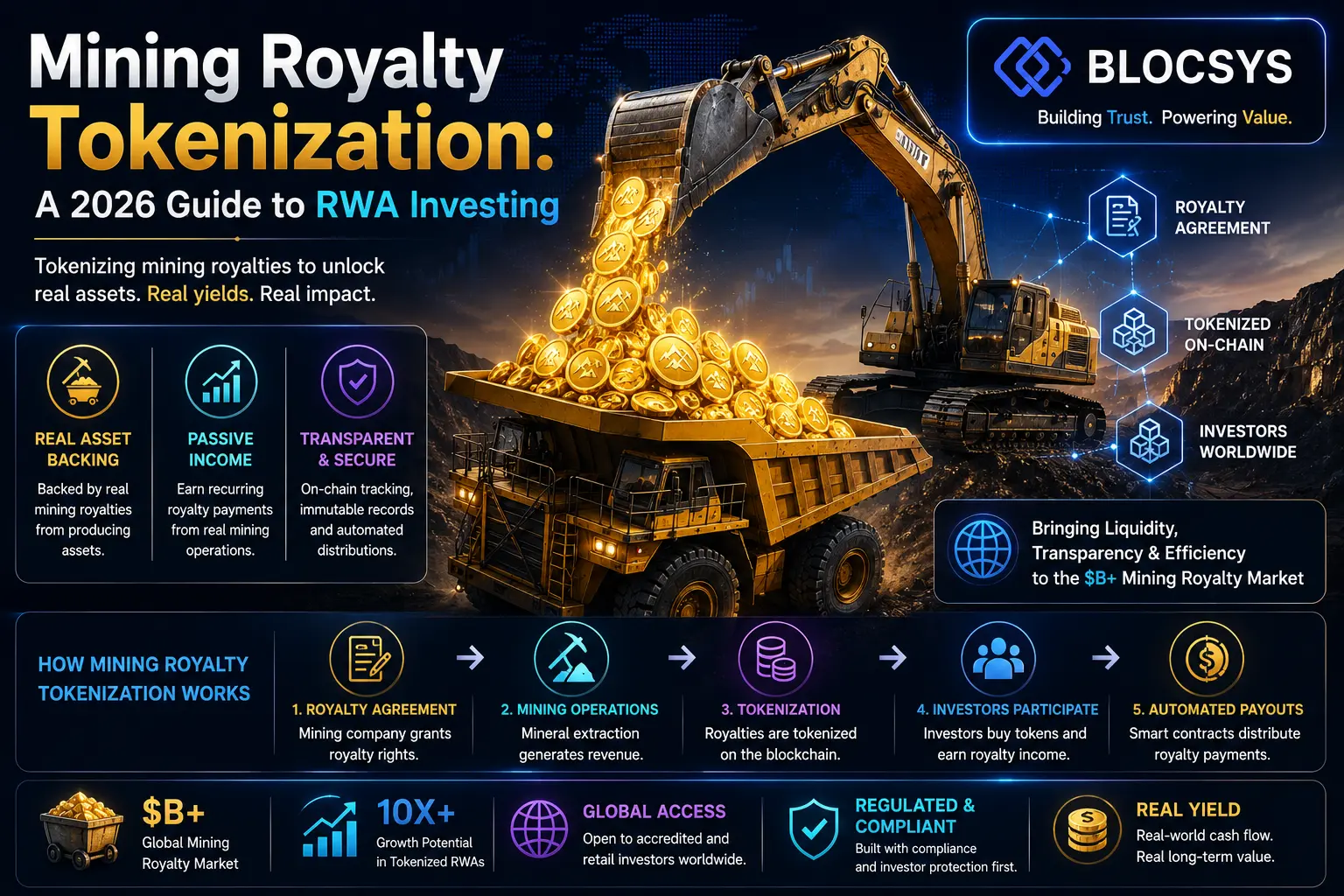
Mining royalty tokenization is the process of converting the rights to future revenue from a mine—like gold, copper, or lithium royalties—into tradable digital tokens on a blockchain. This innovation transforms what has traditionally been an illiquid, long-term private contract into a transparent, divisible, and liquid digital asset, opening up a historically exclusive market to a global pool of institutional and enterprise investors.
This guide is for mining companies, institutional investors, fintech innovators, and commodity trading firms across the USA, UK, Europe, UAE, and Singapore. It breaks down how mining royalty tokenization works, its benefits, and how it’s reshaping investment in the natural resources sector. You’ll gain a clear understanding of how to leverage this technology for capital formation and portfolio diversification.
Table of Contents
How Blockchain Transforms Mining Royalties into Tokenized RWAs
Traditional Royalty vs. Blockchain Tokenization: A Comparison
What Is Mining Royalty Tokenization?
At its core, mining royalty tokenization is the digital representation of a legal agreement. Imagine a contract that entitles its holder to a percentage of a mine’s revenue over the next 20 years. Instead of existing as a static document in a secure vault, this right is converted into thousands of digital tokens on a secure blockchain network. Each token acts as a digital share, entitling its owner to a proportional slice of the royalty payments.
This process unlocks several powerful advantages for all parties involved:
Fractionalization: It breaks down a large, multi-million-dollar royalty agreement into smaller, more accessible investment units, democratizing access.
Liquidity: It establishes a secondary market where investors can trade these tokenized mining assets 24/7, a stark contrast to the locked-in nature of traditional royalty finance.
Transparency: All ownership records and transactions are permanently recorded on the blockchain, creating an immutable and auditable trail that can be verified by anyone at any time.
This model is a specific application of real world asset tokenization, adapted for the unique economics of mineral extraction. As highlighted in discussions around tokenised royalties, ownership is recorded on-chain, and revenue distribution is automated through smart contracts, eliminating manual overhead and human error. This shift is already gaining momentum in major financial centers like the USA, UAE, and Singapore, offering a modern fundraising solution for mining companies and a novel, uncorrelated asset class for investors.
Problems with Traditional Mining Royalty Investment Systems
Why is an industry as fundamental as mining finance so ripe for a technological overhaul? The answer is friction. For decades, both mining operators and institutional investors have navigated a system built on outdated practices that are slow, opaque, and incredibly inefficient, hindering growth at every stage.
Consider a mid-sized Canadian mining company with proven lithium reserves. They need capital to expand operations but face immense challenges when trying to collateralize their future royalty streams. Traditional lenders often impose cumbersome, time-consuming due diligence processes, making it nearly impossible to secure financing without relinquishing significant equity. This is a recurring struggle that stifles innovation and keeps valuable assets underutilized.
High Barriers, Opaque Processes, and Crippling Illiquidity
From an investor’s perspective, the traditional process for investing in mining royalties is a minefield. A Swiss family office or a Dubai-based investment fund looking to diversify into commodity-backed assets faces significant deterrents.
Prohibitive Investment Sizes: Most deals require multi-million-dollar commitments, shutting out all but the largest institutional players.
Opaque and Manual Paperwork: The sheer volume of non-standardized legal documents creates an administrative nightmare, driving up costs, complexity, and risks.
Crippling Illiquidity: Once an investment is made, capital is effectively locked in. There is no straightforward secondary market to exit the position, tying up funds for years or even decades.
These obstacles create a fundamentally broken market. Royalty assets, which represent potentially stable, long-term cash flows, become unattractive due to the immense friction involved in transacting them. The stark contrast between blockchain vs. traditional systems highlights the urgent need for a modern solution. A mining royalty blockchain platform directly addresses these pain points by creating a more accessible, liquid, and transparent financial ecosystem.
How Blockchain Transforms Mining Royalties into Tokenized RWAs
How does a complex, illiquid mining royalty agreement become a tradable Real-World Asset (RWA)? The process uses blockchain to bridge traditional legal contracts with modern digital finance, making these valuable assets accessible to a global pool of qualified investors. It all begins with a robust legal and financial foundation.
First, the physical royalty agreement—the legal right to a portion of a mine’s future revenue—is placed into a Special Purpose Vehicle (SPV). The SPV acts as a legal container that isolates the asset, providing a clear and legally enforceable claim for the on-chain tokens. This step is critical for investor protection in regulated markets like the USA, UK, and Singapore.
How Smart Contract Automation Enables Digital Ownership
With the legal framework established, a set number of digital tokens are minted on a blockchain. Each token represents a fractional ownership share in the SPV and, by extension, the royalty income stream. To ensure regulatory adherence, these tokens often use standards like ERC-3643, which embed compliance rules directly into the code. This allows for automated enforcement of KYC/AML checks and transfer restrictions, ensuring only verified, eligible investors can hold or trade the asset. We explore this technical process in our guide on how to tokenize real-world assets.
The core of the automation lies in smart contracts—self-executing agreements with terms written directly into code. They automate the entire revenue distribution process. When the mining company pays its royalty, the funds (often converted to a stablecoin like USDC) are sent to the smart contract. The contract then instantly distributes the payments to all token holders according to their share, with zero manual intervention.
This automated process drastically cuts administrative costs and eliminates the delays and human errors that plague traditional royalty management. It delivers a transparent, auditable, and instantaneous settlement system.
This entire lifecycle is managed by an enterprise-grade RWA tokenization platform. From initial asset structuring and token issuance to ongoing compliance monitoring and automated dividend payouts, such platforms provide the operational backbone that makes these new liquid assets possible.
Traditional Royalty vs. Blockchain Tokenization: A Comparison
When you compare traditional mining royalties to their tokenized counterparts, the difference is not just a minor technical upgrade—it’s a fundamental shift in how investment in this space operates.
A typical $50 million royalty agreement in the old model is a single, massive contract locked between the mining operator and a handful of large institutions. Tokenizing that same deal allows it to be fractionalized into thousands of digital assets. Suddenly, a global pool of verified investors can access an opportunity that was previously unthinkable, powered by a mining tokenization platform.
FeatureTraditional Royalty SystemTokenized Royalty System (RWA)LiquidityHighly illiquid; assets are locked in for years with no easy exit.High liquidity; tokens are tradable on compliant secondary markets 24/7.Investor AccessRestricted to large institutions due to high minimum investment sizes.Democratized; fractional ownership allows for much lower entry points for qualified investors.Transaction CostsHigh, involving lawyers, brokers, and extensive administrative overhead.Low; smart contracts automate transactions, drastically reducing intermediary fees.TransparencyOpaque; payment flows and ownership records are private and difficult to audit.Fully transparent; all transactions and ownership are recorded on an immutable blockchain.Settlement SpeedSlow; payment distribution can take weeks or months due to manual processing.Instant; smart contracts distribute revenue to holders automatically and immediately.Geographic ReachLimited by jurisdiction and complex cross-border legal frameworks.Global; accessible to a worldwide pool of verified investors, subject to local regulations.
It’s clear that a blockchain mining royalty platform does more than just digitize a contract. It rebuilds the financial infrastructure from the ground up, creating a system designed to unlock value long trapped by inefficient processes and high barriers to entry.
Benefits for Mining Companies and Institutional Investors
So, what does mining royalty tokenization actually achieve for the key players? It solves longstanding problems in mining finance, creating tangible value and new opportunities for both mine operators and investors.
A New Source of Capital for Mining Companies
For a mining company, tokenization opens up a global pool of capital without the usual drawbacks.
Imagine an Australian iron ore operator needing funds for a major expansion. Traditionally, their options were diluting ownership by issuing more equity or taking on expensive debt with restrictive covenants. With tokenization, a third option emerges: they can tokenize a percentage of their future royalty stream, selling those tokens to raise capital today. This provides immediate, non-dilutive funding to fuel growth while they maintain full ownership and operational control. It’s a powerful tool for optimizing a company’s capital structure.
Unlocking Access and Transparency for Investors
For investors, tokenized mining assets represent a powerful new way to access the commodities market. It’s no longer an arena reserved exclusively for the largest institutions. Now, an investment firm in Switzerland or a family office in Singapore can gain direct exposure to an asset class that was historically out of reach.
The advantages are crystal clear:
Real Diversification: Royalty returns are tied to production volumes and commodity prices, offering a hedge against traditional stock market volatility.
Accessible Entry Points: Fractionalization transforms multi-million-dollar royalty agreements into smaller, more affordable tokenized mining assets.
Unprecedented Transparency: Every transaction and payout is recorded on the blockchain, creating a perfect, real-time audit trail for enhanced due diligence.
This model dismantles the walls of an exclusive asset class, giving more investors the chance to add genuine commodity exposure to their portfolios, backed by a level of transparency and efficiency previously unattainable.
Of course, evaluating these new assets requires rigorous due diligence. Investors must apply sound financial analysis, similar to principles discussed in UBAMM.AI fundamental analysis, to understand the underlying economics of the tokenized royalty. This analytical rigor is a cornerstone of the broader institutional tokenization revolution in banking.
How Blocsys Builds Enterprise-Grade Tokenization Platforms
Transforming the concept of mining royalty tokenization into a secure, scalable, and compliant reality requires deep engineering expertise. This is where a specialist partner like Blocsys makes a critical difference. We don’t offer off-the-shelf products; we engineer strategic digital asset platforms tailored to the specific demands of the commodities and mining sectors.
Our focus is on building enterprise-grade RWA tokenization platforms from the ground up. We integrate our expertise in enterprise blockchain, smart contract automation, and AI-driven compliance to construct infrastructure that is not only powerful but also fully compliant with regulations in key jurisdictions like the EU, USA, and UAE.
For a comprehensive overview of the necessary steps, explore our RWA tokenization checklist for asset tokenization projects. Robust payment processing is a non-negotiable component, and for a solid technical resource on this topic, we recommend Webtwizz’s payment integration guide. Our mission is to deliver a purpose-built system that aligns directly with your business objectives, ensuring security, scalability, and long-term market success.
If you are a mining company, institutional investor, or fintech firm looking to build a mining tokenization platform, Blocsys has the expertise to help you succeed.
Contact Blocsys today to discuss your enterprise tokenization project with our experts.
Provenance Blockchain for Institutional RWA Tokenization
As more financial institutions adopt real-world asset (RWA) tokenization, Provenance Blockchain is gaining attention as a blockchain built specifically for regulated financial markets. Unlike general-purpose blockchain networks, it focuses on helping organizations securely issue, manage, and transfer tokenized assets while supporting compliance and transparency. Whether the asset is private credit, real estate, investment funds, or corporate bonds, Provenance Blockchain demonstrates how purpose-built infrastructure can simplify enterprise tokenization and improve operational efficiency.
Why GIFT City Is Emerging as a Hub for Real Estate Tokenization
GIFT City is rapidly positioning itself as one of India’s leading financial innovation hubs for digital assets and real world asset (RWA) tokenization. With the regulatory framework established by the International Financial Services Centres Authority (IFSCA), the ecosystem is attracting financial institutions, asset managers, fintech companies, and global investors exploring blockchain-powered investment infrastructure. As demand for compliant digital securities and fractional real estate ownership continues to grow, developers building real estate tokenization platforms should consider how regulated financial hubs like GIFT City can accelerate institutional adoption. Understanding the broader role of blockchain in securities tokenization also provides valuable context for enterprises evaluating long-term tokenization strategies.
Mining Royalty Tokenization Opportunities in GIFT City
GIFT City provides a relevant context for exploring mining royalty tokenization as part of the broader real-world asset tokenization landscape. By representing mining royalty interests digitally, blockchain-based platforms can support structured ownership, asset management, investor participation, and transaction workflows. For businesses exploring mining royalty tokenization, these platform components can help shape a practical RWA investment solution for the GIFT City ecosystem.
Frequently Asked Questions (FAQs)
As executives and investors explore this innovative space, several critical questions consistently arise. Here are clear, straightforward answers to address the practical realities of implementing this technology.
What is mining royalty tokenization?
Mining royalty tokenization is the process of converting a legal right to a mine’s future revenue into tradable digital tokens on a blockchain. This transforms an illiquid, private contract into a liquid, fractional, and transparent digital asset that can be bought and sold on secondary markets, making it more accessible to a wider range of investors.
How does blockchain tokenize mining royalties?
The process begins by placing the legal royalty agreement into a Special Purpose Vehicle (SPV). Digital tokens representing fractional ownership in that SPV are then issued on a blockchain. A smart contract automates the rules for revenue distribution, ensuring that when the mining company pays its royalty, the funds are instantly and transparently distributed to all token holders.
What are tokenized mining assets?
Tokenized mining assets are digital representations of ownership in a mining royalty stream. Each token acts as a share, entitling the holder to a portion of the revenue generated by a mine. These tokens are considered Real-World Assets (RWAs) because their value is directly backed by a tangible, cash-flow-producing asset in the physical world.
How does RWA tokenization work in mining?
In mining, RWA tokenization applies blockchain technology to create digital, tradable versions of physical assets or revenue streams. For royalties, it involves legally linking a royalty agreement to digital tokens. This enhances liquidity, automates payments via smart contracts, and provides a transparent ownership record, solving many of the inefficiencies of traditional mining finance.
Why are mining companies adopting blockchain tokenization?
Mining companies are adopting tokenization primarily as a new way to raise capital. It allows them to access a global pool of investors and secure funding without diluting equity or taking on traditional debt. The process is often faster and more efficient than conventional financing routes, providing immediate liquidity to fund expansion, exploration, or operational needs.
What are the benefits of mining royalty tokenization for investors?
For investors, the key benefits are increased liquidity, greater accessibility, and enhanced transparency. Tokenization allows them to trade their holdings on secondary markets, lowers investment minimums through fractionalization, and provides a clear, immutable record of all transactions and payments on the blockchain, significantly reducing counterparty risk.
How can Blocsys build mining tokenization platforms?
Blocsys offers end-to-end engineering services to build secure, scalable, and compliant mining tokenization platforms. We handle everything from designing the core tokenization engine and developing the smart contracts for automated distributions to implementing institutional-grade security and building user-facing dashboards. Our focus is on delivering an enterprise-ready solution that integrates seamlessly into your financial workflows.
Ready to unlock the future of mining finance? Whether you’re a mining operator seeking innovative capital solutions or an institutional investor looking for the next frontier in RWA, tokenization offers a powerful path forward.
Blocsys specializes in engineering the enterprise tokenization infrastructure needed to succeed in this evolving market. We build robust, secure, and compliant platforms for commodity tokenization blockchain applications.
