
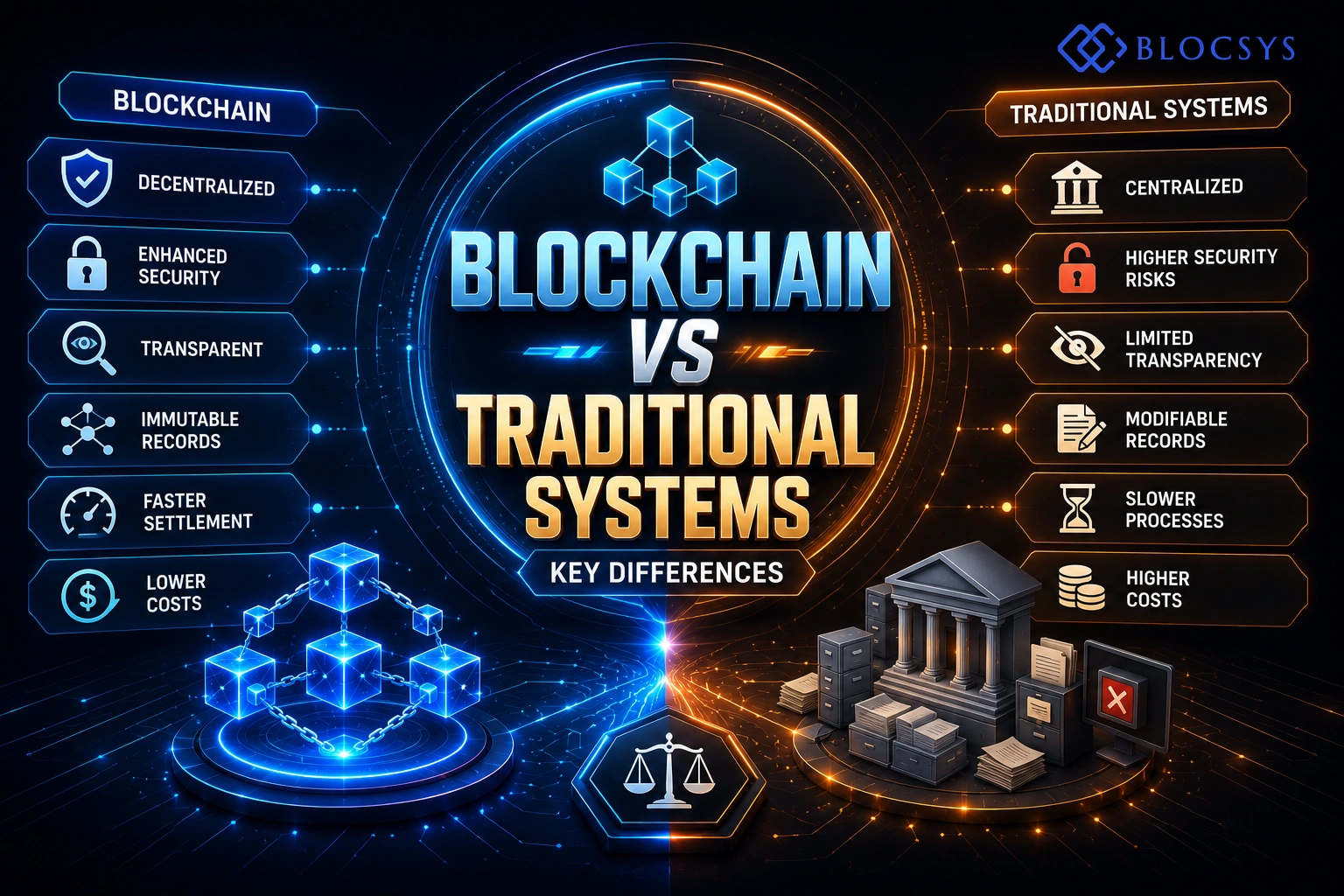
Your board is likely asking a version of the same question many leadership teams are asking now. Should we keep investing in traditional systems that already scale, or shift toward blockchain infrastructure because customers, regulators, and competitors are moving in that direction?
The wrong way to answer that question is with ideology. The useful way is to map architecture to business goals. For a bank, exchange, carbon platform, tokenisation venture, or DeFi product, the choice isn’t about centralised versus decentralised in the abstract. It’s about throughput, auditability, cost predictability, regulatory fit, and whether your system needs shared trust across multiple parties.
This analyst view is written for founders, CTOs, product leaders, and board members evaluating blockchain vs traditional systems in practical terms. The outcome is a decision framework you can use to choose the right operating model for 2026 and beyond, especially if you’re comparing enterprise blockchain solutions, reviewing blockchain implementation cost, or deciding whether to build internal capability or hire blockchain developers.
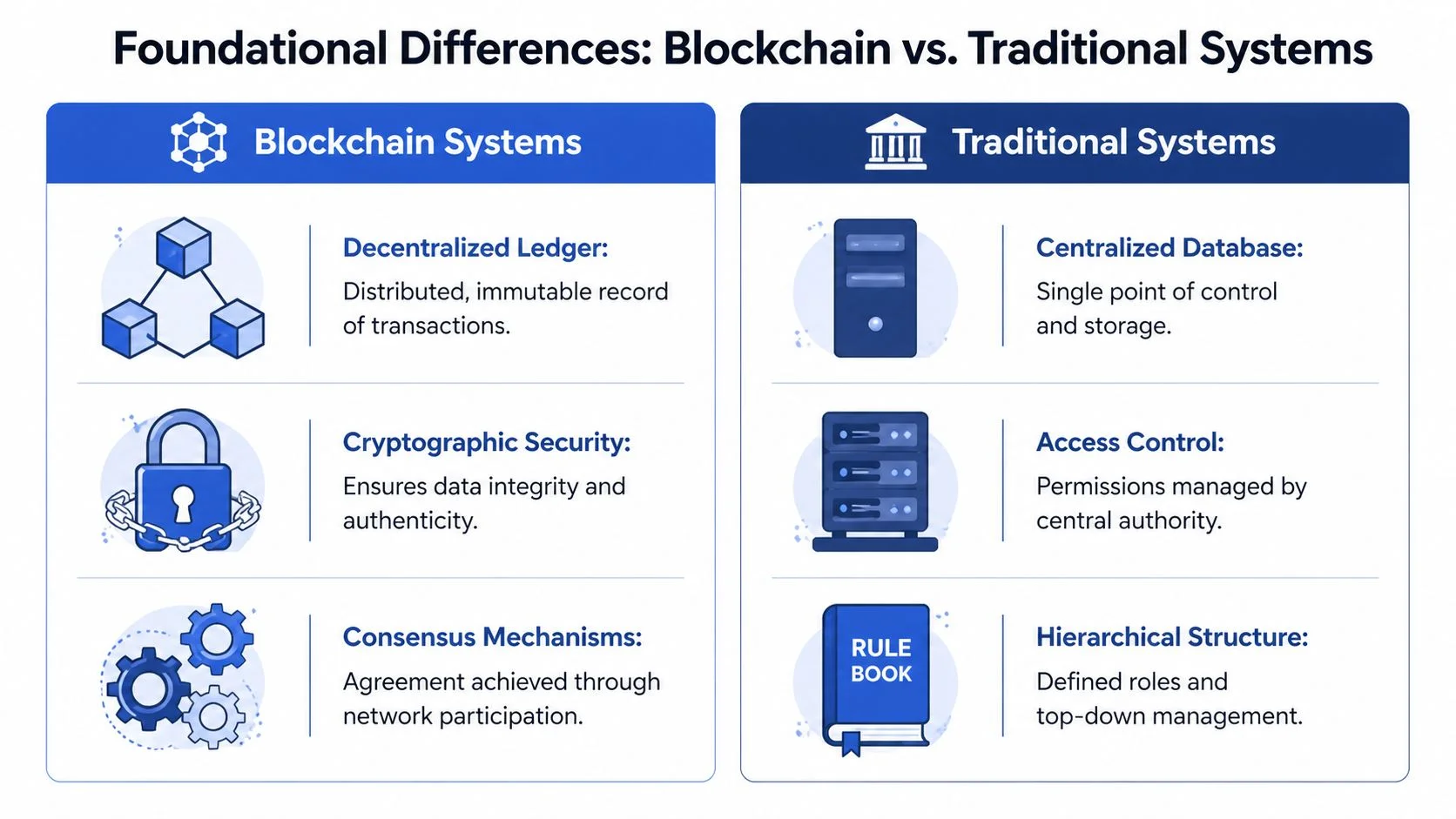
Foundational Differences Blockchain vs Traditional Systems
Most comparisons start and stop at one phrase. Blockchain is decentralised, traditional systems are centralised. That’s directionally true, but it’s too shallow to guide an investment decision.
The distinction is where trust lives.
In a traditional system, trust sits inside an organisation. A bank, exchange, insurer, or platform owns the database, controls permissions, edits records when needed, and decides which system state is authoritative. That model works well when one entity has legal and operational control over the process.
In a blockchain system, trust is pushed into the architecture itself. Transactions are signed cryptographically, validated by network rules, and written to an append-only ledger. Participants don’t need to rely on a single administrator to agree on what happened. They rely on the network’s rules and evidence trail.
How the data model changes business control
A relational database is designed for efficient storage, retrieval, and modification. That makes it ideal for operational systems where records change constantly. Payment status updates, customer profile changes, reconciliation fixes, and fraud reversals all fit that model.
Blockchain uses a different logic. It doesn’t treat history as something to be overwritten. It treats history as something to be preserved. New events are appended, and the chain of records shows how the state evolved.
For directors, that difference matters in three board-level areas:
- Auditability: A traditional database can preserve logs, but the operator still governs the record. A blockchain ledger creates a stronger shared evidence trail across parties.
- Operational flexibility: Traditional systems are easier to correct. Blockchain systems are harder to alter after finality.
- Business model design: If multiple organisations need to trust the same ledger without ceding control to one party, blockchain becomes strategically relevant.
Practical rule: If one company already owns the workflow end to end, a database is usually the default. If several parties must share the same truth and don’t want a single operator to control it, blockchain deserves serious consideration.
Mutability versus immutability
Boards often hear “immutability” presented as an automatic advantage. It isn’t. It’s a trade.
Immutability is valuable when you need a tamper-resistant record of ownership, settlement, provenance, or compliance action. It’s less valuable when your priority is correcting operational errors quickly.
That’s why many serious implementations don’t put everything on-chain. They keep high-change, high-volume application logic in conventional infrastructure and reserve blockchain for the records that most need independent verification.
This is also where many tokenisation discussions become confused. Teams often mix up native blockchain assets with application-level assets. If your leadership team is assessing token-based models, this breakdown of key differences between crypto coins and tokens helps clarify what belongs to a network layer versus what belongs to a product or financial instrument layer.
Consensus versus administration
Traditional systems use administrative authority. Someone defines access rights, approval workflows, backup policies, and rollback procedures. That’s efficient and often necessary in regulated environments.
Blockchain uses consensus. The network has to agree that a transaction is valid before it becomes part of the shared ledger. That creates stronger distributed trust, but it also introduces overhead.
A useful way to explain this to a non-technical board member is simple. A traditional database is like your company’s official accounting file stored in a controlled finance system. A blockchain is like a ledger copied across many parties where changes only count if the network accepts them under predefined rules.
That architectural shift is also part of the broader move from platform-controlled systems to decentralised digital ecosystems, which is explored well in this comparison of Web 2.0 vs Web 3.0 models.
Why these differences matter commercially
The strategic implication isn’t that blockchain replaces traditional systems. It’s that each architecture solves a different trust problem.
A concise board view looks like this:
| Business question | Traditional systems | Blockchain systems |
|---|---|---|
| Who controls the data? | One operator or institution | Shared network rules |
| Can records be changed? | Yes, with permissions | History is append-only |
| Best use case | Internal operations, high-speed workflows | Shared ownership, transparent settlement, provenance |
| Main strength | Speed and administrative control | Trust minimisation and auditability |
| Main limitation | Reliance on operator integrity and uptime | Slower coordination and greater design complexity |
The deeper insight is this. Blockchain isn’t a better database. It’s a different governance model for data. Once leadership understands that, later debates about performance, cost, and compliance become much easier to evaluate.
The Performance and Scalability Dilemma
Performance is where blockchain enthusiasm usually collides with operational reality.
For systems that must process high transaction volumes in real time, traditional architecture still sets the benchmark. In India, UPI processed over 13 billion transactions annually and peaked at 49,000 transactions per second, while Ethereum handled 15 to 30 TPS. The same source notes that some carbon credit tokenisation pilots reported a 40% failure rate due to network fragmentation, which underlines the scalability gap for high-frequency applications according to this analysis of blockchain versus traditional databases.

Why traditional systems remain faster
Traditional systems are faster because coordination is simpler. One operator controls the database, transaction ordering, and settlement logic. The system doesn’t need to wait for a distributed network to agree on validity.
That design is hard to beat in use cases such as:
- High-frequency trading venues where order books update continuously
- Consumer payment rails where latency affects user trust
- Fraud screening workflows that need immediate response
- Core banking platforms with massive concurrent demand
A centralised platform can optimise for throughput, low latency, and predictable operational control. It can also tune infrastructure around a known workload pattern rather than a decentralised network’s shared constraints.
Why blockchain accepts lower speed
Blockchain’s slower speed isn’t a bug in the usual sense. It’s the cost of distributed trust.
A transaction typically needs to be signed, propagated through the network, checked against consensus rules, and finalised into a ledger that participants can independently verify. That makes blockchain valuable for ownership transfer, token issuance, immutable recordkeeping, and settlement between parties that don’t want to rely on a single institution.
The board-level question is not “which one is faster?” You already know that answer in most high-volume contexts. The question is “where does speed matter more than shared trust, and where does shared trust justify slower finality?”
Speed wins customer acquisition. Finality wins disputes.
Layer 2 and architectural mitigation
The good news for blockchain infrastructure teams is that scalability is no longer a single-layer conversation. Layer 2 networks and hybrid designs can improve practical performance, especially when not every application event needs to hit the main chain immediately.
For technical leaders reviewing this path, this overview of Layer 2 scalability strategies is a useful reference point. It helps frame the difference between theoretical network throughput and the performance an actual product experiences under live demand, wallet interaction, and smart contract constraints.
A more useful way to compare performance
Boards should compare systems using four questions, not one benchmark.
Throughput
How many transactions or state changes must the system handle at peak demand?
If the answer is “very high and continuous,” traditional systems usually own the operational layer.
Latency
How quickly must the user receive confirmation that matters to their workflow?
Consumer payments, trading, and customer support operations often depend on near-immediate system response.
Finality
When is the transaction economically or legally complete?
Blockchain may be worth the added latency when finality and audit integrity carry more weight than raw speed.
Failure mode
What happens under stress?
In fragmented blockchain environments, interoperability and routing issues can break the user experience. In centralised systems, outages can create a single point of failure.
The strategic conclusion on performance
The market often frames blockchain as if it will catch up to traditional systems on speed and then replace them. That’s too simplistic.
Performance differences are tied to governance design. Traditional systems are built for operational efficiency under central control. Blockchain systems are built for verifiable coordination across parties. Some overlap will grow, but the categories won’t collapse into one another.
That’s why the strongest architectures in finance, tokenisation, carbon markets, and digital asset trading increasingly separate the workload. Keep the high-frequency activity off-chain when speed is paramount. Use blockchain where independent verification, programmable settlement, or transparent ownership creates business value.
Analyzing the Total Cost of Ownership and ROI
Most cost discussions in blockchain vs traditional systems fail for one reason. They compare build cost, not operating model cost.
Boards need a broader lens. Total cost of ownership includes infrastructure, specialist talent, transaction fees, security review, compliance design, integration with existing systems, and the cost of failure. On that basis, blockchain can create meaningful upside, but only for the right workload.
A cited comparison from TechTarget notes that blockchain can reduce fraud by up to 40% in some Indian enterprise pilots, while gas fees on Polygon can range from $0.06 to $0.24 per transaction, 25% of projects fail initial security audits, and traditional systems can process transactions for as low as $0.01. The same source notes that centralised systems are still vulnerable to outages affecting large user groups in this review of blockchain and database differences.
Where blockchain costs rise quickly
Public blockchain implementation introduces cost categories that many enterprise buyers underestimate.
One is transaction economics. Per-transaction fees may look manageable in a pilot and become material at scale, especially if the product requires frequent on-chain actions. Another is assurance cost. Smart contracts often require specialist audits, and if an audit fails, timelines and budgets move with it.
Then there’s talent. Teams that need protocol engineering, smart contract security, wallet integration, node operations, and token logic usually can’t staff the project with a standard application team alone. If you’re planning to hire blockchain developers, the budget question isn’t only salary. It’s whether those hires reduce delivery risk enough to justify the premium and whether the architecture needs on-chain complexity.
Where traditional systems create hidden cost
Traditional systems look cheaper because their direct costs are more familiar. Cloud infrastructure, managed databases, API integrations, and internal engineering processes are well understood.
The hidden expense appears elsewhere:
- Reconciliation overhead when multiple systems disagree
- Audit and reporting effort when trust depends on internal logs
- Outage exposure when one platform failure disrupts operations
- Intermediary dependence when partners each maintain their own record of truth
Those costs don’t always appear in a technical budget, but they show up in operations, finance, compliance, and customer churn.
TCO Comparison Blockchain vs Traditional Systems
| Cost Category | Traditional System (Example) | Blockchain System (Example) | Key Considerations |
|---|---|---|---|
| Infrastructure | Cloud database, application servers, standard monitoring | Node access, smart contracts, indexing, wallet infrastructure | Traditional infrastructure is usually simpler to forecast |
| Transaction cost | Low per-transaction processing cost | Network fees can vary by chain and demand | Public chain economics can change with usage patterns |
| Security assurance | AppSec reviews, access controls, database governance | Smart contract audits, key management, on-chain monitoring | Blockchain assurance often requires niche expertise |
| Integration | ERP, CRM, banking rails, legacy APIs | Wallets, custodians, token standards, off-chain sync | Hybrid models raise integration complexity |
| Compliance operations | Internal controls and reporting | On-chain screening, policy logic, token controls | Blockchain can improve traceability but not remove compliance work |
| Failure cost | Outages and centralised downtime risk | Contract bugs, network fragmentation, governance issues | Failure mode differs, but neither path is free |
How to evaluate ROI honestly
ROI should be framed around business outcomes, not novelty.
Blockchain may justify its cost when it materially improves one or more of these:
- Fraud control and audit confidence in multi-party environments
- New revenue models such as tokenised products or programmable asset services
- Settlement transparency across counterparties
- Market access where customers expect on-chain participation
Traditional systems usually win when your value comes from efficient transaction processing, predictable service levels, and lower implementation risk.
A strong business case doesn’t ask whether blockchain is cheaper. It asks whether blockchain unlocks value a conventional stack can’t deliver without heavy manual trust machinery.
Cost discipline still matters in both models
For traditional infrastructure, cloud sprawl can erase the cost advantage of staying off-chain. Teams evaluating scale economics should apply the same rigour to their Web2 environment that they apply to token design and smart contract architecture. This checklist of AWS cost optimisation recommendations is a good reminder that conventional infrastructure also needs active financial governance.
The strongest conclusion here is not ideological. Traditional systems are usually cheaper to run for high-volume internal operations. Blockchain earns its keep when trust, programmability, and independent verification create strategic value that outweighs the extra complexity.
Navigating Security, Trust, and Global Compliance
Security architecture is never just a technical matter. It determines who your customers trust, how your counterparties verify actions, and whether regulators believe your controls are enforceable.
Traditional systems and blockchain answer that challenge differently.
Traditional systems create trust by proxy. Users trust the institution operating the platform. Security comes from access control, privileged administration, internal governance, perimeter defence, and recovery procedures.
Blockchain creates trust by evidence. Users rely more heavily on cryptographic signatures, transaction visibility, consensus rules, and ledger immutability. The design reduces dependence on any single operator, but it also creates new obligations around smart contract logic, key management, and governance design.
Security models create different board risks
A board overseeing a traditional platform should ask whether administrators have too much power, whether monitoring is reliable enough, and whether a central outage or internal control failure could undermine the system.
A board overseeing a blockchain-based platform should ask different questions:
- Who controls upgrade rights?
- How are keys secured and recovered?
- What happens if a smart contract behaves as written but not as intended?
- How is suspicious activity screened across wallets and counterparties?
This distinction matters because many organisations adopt blockchain thinking they are reducing trust risk, when in fact they are relocating it. Trust moves from database administrators toward protocol design, contract quality, and governance processes.
Compliance is where architecture becomes strategic
The compliance challenge grows when a product spans jurisdictions. A traditional centralised system maps relatively cleanly to known operating entities and internal data controls. A blockchain-based service can complicate data residency, user screening, transaction monitoring, asset classification, and reporting obligations.
The broad strategic problem is fragmentation. One cited market analysis notes that only 12% of banks in India have piloted blockchain projects, compared with 45% globally, and 65% of fintech founders cite regulatory silos as the top barrier. The same source links that hesitation to cross-border compliance complexity affecting services operating across the EU, USA, and UAE in this discussion of regulatory and operational barriers to blockchain adoption.
For boards targeting Europe, the UK, the USA, Singapore, Dubai, or Germany, the takeaway is straightforward. Architecture choices can expand or restrict market access.
What leaders should map by region
A practical compliance review should cover these categories before final architecture is approved.
Data privacy and residency
Public blockchain systems can conflict with privacy expectations if personal data design isn’t carefully separated from on-chain records. Traditional systems usually offer more straightforward control over deletion, localisation, and access management.
KYC and AML operating model
Traditional systems can embed KYC and AML controls directly into account creation and transaction routing. Blockchain systems can also support screening and policy enforcement, but wallet-based interactions create a different operational pattern and often require specialised analytics and workflow tooling.
Token and asset treatment
A tokenised product may be treated very differently from a database entry representing the same economic exposure. Legal classification affects issuance, custody, transfer restrictions, investor access, and disclosure obligations.
Governance and reversibility
Traditional systems can reverse, freeze, and remediate more easily. In blockchain environments, those controls must be explicitly engineered if the business or regulator expects them.
Board takeaway: Compliance isn’t a wrapper added after launch. In blockchain systems, compliance logic often has to be part of the architecture itself.
Public, private, and permissioned design choices
Many compliance tensions can be reduced by choosing the right blockchain model. Public chains maximise openness and composability. Private or permissioned models can provide stronger control over participation, visibility, and policy enforcement.
Leaders evaluating that spectrum should compare the trade-offs carefully, especially where enterprise confidentiality and regulatory clarity matter. This guide on public versus private blockchain is useful for framing that decision in operational terms.
The central insight is that security and compliance are inseparable from system design. Traditional systems excel when legal accountability and central control are the priority. Blockchain becomes compelling when verifiable execution, shared trust, and programmable policy create an advantage that outweighs governance complexity.
The Decision Matrix Choosing the Right Path
Leadership teams rarely fail because they chose the wrong technology in theory. They fail because they chose a design that didn’t match their operating constraints.
That’s why the practical answer to blockchain vs traditional systems isn’t universal. It depends on who you are, how regulated your market is, and where your advantage comes from.
A board-level matrix for enterprises
Large organisations should start with constraint mapping, not innovation language.
If your business depends on existing ERP, payment, risk, identity, and reporting systems, then a full blockchain rebuild is rarely the sensible first move. Enterprises usually benefit from selective deployment where blockchain handles proof, provenance, tokenisation, or settlement, while traditional systems remain the operational core.
Use this matrix:
- If your top priority is operational scale and service reliability, favour traditional systems for the transaction engine.
- If multiple counterparties must rely on the same audit trail, consider blockchain for the record layer.
- If regulation requires reversibility, oversight, and explicit permissions, prefer centralised or permissioned designs.
- If you’re tokenising an asset or creating programmable financial products, blockchain may be necessary, but keep customer operations and internal controls off-chain where possible.
- If your organisation has heavy legacy exposure, start with a hybrid proof of value instead of a wholesale platform replacement.
Enterprise buyers should also ask a blunt question. Does distributed trust create commercial advantage, or does it create technical theatre? In many boardrooms, that question removes half the proposed use cases immediately.
A decision matrix for startups and scale-ups
Startups face a different reality. They don’t have entrenched systems to protect, but they do have funding constraints, talent constraints, and time-to-market pressure.
A startup should lean toward blockchain when the product itself depends on open ownership, token transfer, composability, or on-chain settlement. If the blockchain element is just a marketing layer over a normal application, the extra complexity usually slows delivery without adding defensible value.
Use this matrix:
| Scenario | Better default | Why |
|---|---|---|
| Building internal SaaS workflow tools | Traditional systems | Faster build, lower complexity |
| Launching tokenised assets or DeFi products | Blockchain or hybrid | Product logic depends on on-chain execution |
| Running high-frequency order matching | Traditional core with optional blockchain settlement | Execution speed matters more than shared validation |
| Building carbon or provenance records across parties | Hybrid | Shared trust matters, but operational systems still need efficiency |
| Testing a new market with uncertain demand | Traditional MVP first, add chain later if needed | Preserves speed and capital |
Startups should only pay the blockchain complexity tax when on-chain features are central to distribution, trust, or revenue.
The architecture question most boards miss
The most useful decision isn’t “blockchain or traditional?” It’s “which system should own which function?”
That changes the conversation from replacement to allocation.
For example:
- A trading platform can keep its order book, pricing engine, and user management in a traditional stack.
- The same platform can settle tokenised assets on-chain.
- Compliance events can be logged in both environments, with each layer serving a different control purpose.
That approach reduces ideological bias and forces every system component to justify its place.
A short explainer can help stakeholders visualise the trade-offs before a technical workshop:
A step-by-step development process for decision-stage teams
For organisations moving from strategy to execution, this sequence works well:
Define the asset and trust model
What exactly are you recording, transferring, or proving? Ownership, payment, identity, provenance, or compliance status all lead to different architecture choices.
Split the workload
Separate high-frequency operational actions from trust-critical final records. Such separation can simplify many overbuilt systems.
Choose the architecture pattern
Select among centralised, permissioned blockchain, public blockchain, or hybrid based on users, counterparties, compliance needs, and market expectations.
Select the stack
Traditional layers may include cloud databases, event streaming, API gateways, and identity systems. Blockchain layers may include smart contracts, wallet integration, indexing, custody tooling, and policy controls.
Build controls before scale
KYC, AML, permissions, audit trails, failover plans, and legal workflows should be designed before broad rollout.
The clearest recommendation for boards is this. Enterprises should default to hybrid unless decentralisation is itself the product. Startups should default to simplicity unless on-chain functionality is the reason customers will choose them.
Blocsys Engineering Hybrid Solutions for a Complex World
The strongest conclusion from this comparison is that the market doesn’t need more ideology. It needs better systems design.
That’s where a hybrid approach becomes commercially useful. Many high-value digital products need the speed and control of traditional infrastructure plus the auditability and programmable trust of blockchain. Treating those as mutually exclusive usually leads to either underpowered Web3 products or overcomplicated enterprise systems.
Blocsys Technologies works in that middle ground. The firm builds production-ready platforms for fintechs, exchanges, tokenisation ventures, and digital asset businesses that need both performance and trust. In practice, that can mean a traditional database and matching engine for high-throughput trading activity, with a blockchain layer used for immutable settlement, token issuance, or asset provenance.
Where the hybrid model fits best
This model is particularly relevant for teams building:
- Tokenisation platforms where ownership history must be tamper-resistant
- Trading infrastructure where order execution has to remain fast and controlled
- Compliance-heavy products where audit logs and policy enforcement need stronger integrity
- Carbon, DeFi, and digital asset platforms where multiple parties need a shared source of truth
The advantage is architectural separation. Keep fast-changing application logic in the environment best suited to scale and operational control. Put trust-critical records where independent verification matters most.
A practical architecture and tech stack view
A typical delivery model for this kind of platform often includes:
- Application layer using conventional backend services, identity systems, and operational databases
- Blockchain layer for token contracts, settlement logic, or provenance records
- Integration layer connecting wallets, custodians, KYC systems, payment rails, and reporting workflows
- Compliance layer for transaction monitoring, approvals, case handling, and governance controls
The key challenge isn’t choosing one stack. It’s orchestrating them without creating operational blind spots.
Why execution capability matters
A hybrid system can fail in two ways. One, the traditional side becomes a bottleneck or a compliance risk. Two, the blockchain side becomes expensive, hard to maintain, or difficult to govern. The delivery partner has to understand both worlds.
That’s also why infrastructure decisions such as how to deploy blockchain nodes matter more than they appear on a slide. Node strategy affects reliability, latency, observability, and resilience, especially for platforms that can’t afford interruptions.
For organisations evaluating enterprise blockchain solutions, Blocsys is most relevant when the question is no longer “should we use blockchain?” and has become “how do we design the right blend of systems so the product scales, complies, and still delivers trust where it counts?”
Frequently Asked Questions
| Question | Answer |
|---|---|
| What’s the simplest definition of blockchain vs traditional systems? | Traditional systems rely on a central operator to manage data and permissions. Blockchain relies on network rules, cryptographic validation, and an append-only ledger to create shared trust across participants. |
| Which is better for enterprise software? | It depends on the job. For internal workflows, reporting systems, and high-speed application logic, traditional architecture is usually more efficient. For tokenisation, shared settlement, and cross-party auditability, blockchain can be the better fit. |
| Is blockchain always more secure? | Not automatically. Blockchain reduces some tampering risks through immutability and cryptographic verification, but it introduces new risks around smart contracts, key management, and governance design. Security depends on implementation quality. |
| How should companies think about blockchain implementation cost? | Look beyond build cost. Include transaction fees, specialist development, audits, integration work, compliance tooling, and operating support. Compare that against the value created by trust, programmability, and new product models. |
| When should a startup avoid blockchain? | A startup should avoid it when the product doesn’t need tokens, on-chain ownership, or decentralised settlement. If blockchain isn’t central to user value, it usually slows delivery and raises cost without improving the business. |
| Do enterprises need to replace legacy systems to adopt blockchain? | Usually not. Most mature organisations get better results from hybrid architecture, where blockchain supports a specific trust-critical function while existing systems continue to handle operations, identity, and reporting. |
| What should boards ask before approving a blockchain project? | Ask what trust problem the project solves, which records must be independently verifiable, how compliance will work across jurisdictions, where operational speed matters most, and whether a hybrid design would achieve the same goal with lower risk. |
If you’re evaluating tokenisation, trading infrastructure, AI-powered compliance, or a hybrid architecture for digital assets, Blocsys Technologies can help you turn strategy into a production-ready roadmap. The team works with startups and enterprises that need scalable blockchain infrastructure, secure product design, and execution support grounded in real operating constraints. If you want a practical view of what to build, what to keep off-chain, and how to move forward with confidence, connect with Blocsys for expert guidance.
