
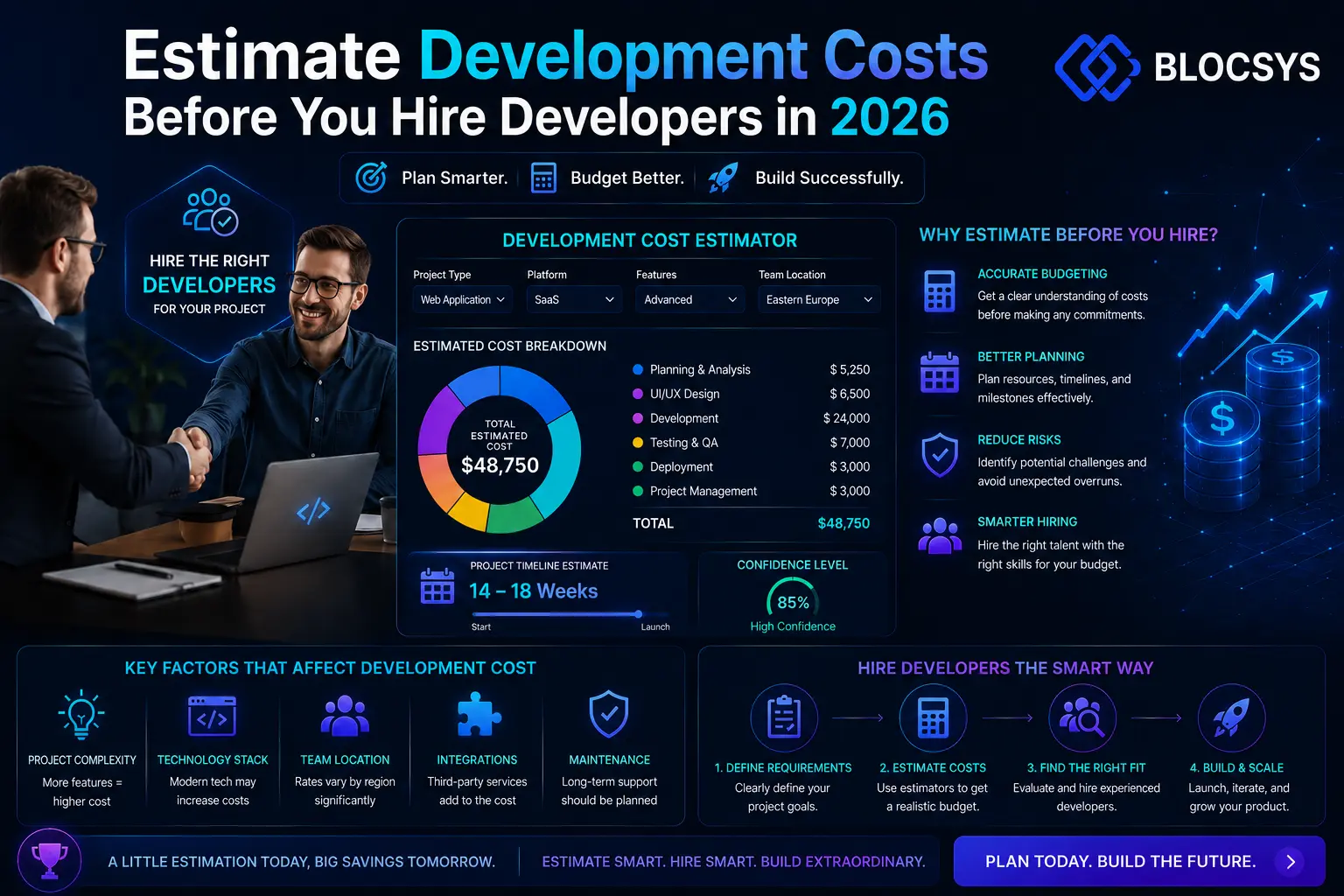
A lot of founders start in the same place. The product idea is clear enough to explain in a pitch deck, but the budget is still a blur. You know you need developers, yet hiring before you know the likely cost is how teams end up over-scoped, underfunded, or stuck with a build plan that doesn’t fit the business.
That problem gets sharper when the product isn’t a simple brochure app. AI platforms, blockchain products, SaaS tools with integrations, and regulated fintech systems all carry different cost structures. Some need stronger security design. Some need specialist engineers. Some look affordable at prototype stage and then become expensive once cloud, audit, and support requirements show up.
The good news is that you don’t need perfect certainty before you hire. You need a defensible estimate. That means translating product ambition into a budget range, a staffing model, and a first-year cost view. Industry budgeting guides put small projects such as MVPs at $5,000–$50,000, medium projects such as SaaS or mobile/web apps at $50,000–$200,000, and large projects such as ERP, AI, BI, banking, or healthcare platforms at $200,000+. The same research notes that large-scale complex systems can start at $100,000 and exceed $1 million, with the average cost of a custom app in 2025 estimated at about $171,450 (software cost estimation benchmarks). If you’re also comparing channels, this guide on budgeting for a mobile app is useful context because platform choice changes scope very quickly.
This article is for founders, CTOs, product managers, and enterprise teams who need to estimate development costs before they hire developers. If you’re planning a SaaS platform, AI product, or blockchain build, you’ll leave with a practical framework you can use before signing with an agency, building an in-house team, or opening hiring requisitions. For projects in emerging tech, a focused blockchain, AI, and SaaS cost estimator guide can also help pressure-test assumptions early.
Table of Contents
- Introduction Why Cost Estimation Is Your First Critical Step
- The Anatomy of a Software Budget Key Cost Drivers Explained
- Budgeting for Innovation AI vs Blockchain vs SaaS Costs
- A Practical Framework to Estimate Development Costs Before You Hire
- Beyond the Build Uncovering Hidden Costs in Your First Year
- How Blocsys Ensures Predictable Budgets and Flawless Execution
- Frequently Asked Questions on Software Development Costing
Introduction Why Cost Estimation Is Your First Critical Step
Founders often treat hiring as the first move. It usually shouldn’t be. The first move is deciding what you can afford to build, how much risk the business can absorb, and which team model fits that reality.
A weak estimate causes two predictable problems. Either you hire too early and burn budget discovering what the product is, or you hire too late and compress delivery into unrealistic timelines. Both mistakes are expensive, especially when investors or internal stakeholders expect production-ready delivery rather than a rough prototype.
The estimate protects the product strategy
A sound estimate does more than predict spend. It forces decisions on scope, release order, architecture, and staffing. If the numbers don’t work at MVP stage, the answer isn’t to hope developers will somehow make it cheap. The answer is to cut scope, change sequencing, or choose a different build path.
Practical rule: If you can’t explain which features belong in release one, you’re not ready to hire. You’re still in product definition.
For startup teams, this matters because every unnecessary feature extends runway risk. For enterprise teams, the same issue appears as procurement friction, approval delays, and unclear ownership across product, security, and engineering.
The budget should match the type of software
A basic SaaS dashboard and a compliance-heavy trading platform are not variations of the same budget problem. They require different assumptions from day one. Security, auditability, role permissions, transaction logic, and integrations can reshape the estimate long before a line of code is written.
That is why useful budgeting starts with project type, not hourly rates alone. Rates matter, but they don’t rescue weak scoping. A clear estimate provides an advantage when comparing agencies, contractors, and internal hiring plans because you’re evaluating them against defined work rather than vague promises.
The Anatomy of a Software Budget Key Cost Drivers Explained
Software cost isn’t one number. It’s the sum of decisions. Each decision adds effort, coordination, risk, or post-launch obligation.
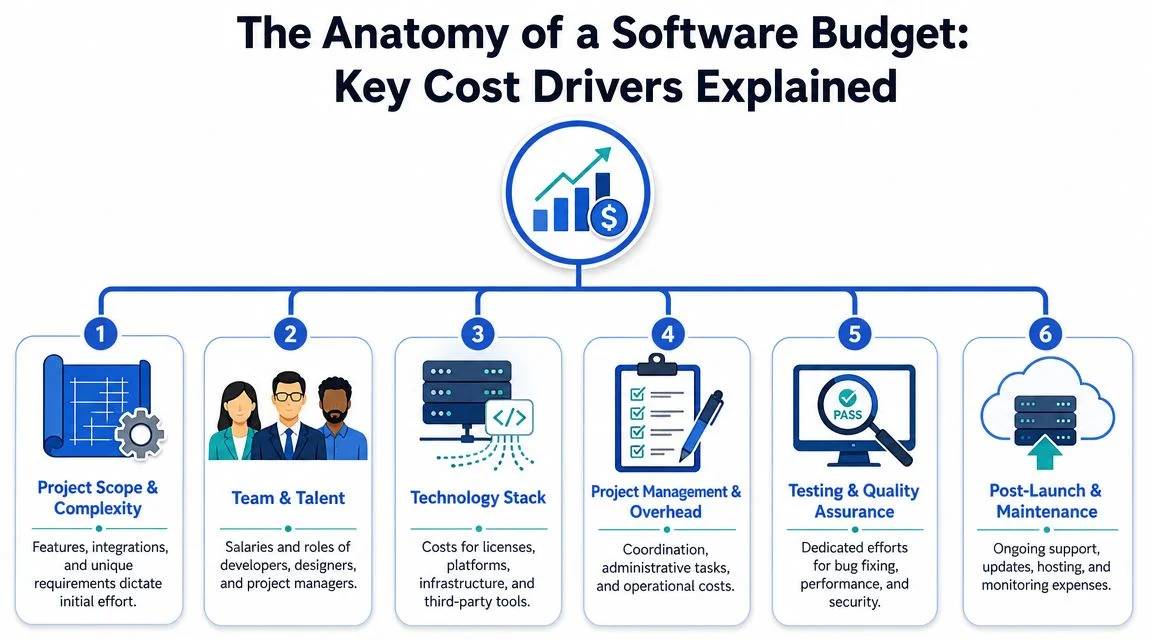
Project scope and complexity
Scope drives almost everything else. More screens, more user roles, more workflows, more integrations, and more edge cases mean more design, engineering, testing, and coordination time.
The biggest budgeting mistake here is treating features as equal. Login is not the same as role-based access across tenants. Payment integration is not the same as reconciliation logic, exception handling, and reporting. A founder who writes a short feature list without operational detail usually gets a quote that looks neat and fails later.
If you need help turning a concept into buildable requirements, this guide on defining specs for AI coding is worth reading before you request proposals.
UI UX and product design
Teams often underestimate design because they only picture the visual layer. In practice, UI and UX work also includes flows, states, validation, accessibility decisions, and handoff details that prevent rework during development.
For internal tools, you may get away with lighter design treatment. For customer-facing fintech, SaaS, or Web3 products, poor design quickly becomes a cost issue because it creates support overhead, onboarding friction, and avoidable rebuilds.
Technology stack and integrations
The stack affects cost through availability of talent, infrastructure fit, ecosystem maturity, and maintenance burden. A familiar stack with strong libraries is easier to staff and usually easier to support. A niche stack may still be the right choice, but it should be a deliberate trade-off.
Integrations deserve separate scrutiny. Payment gateways, wallets, KYC providers, analytics tools, ERP connectors, messaging systems, and cloud services all add implementation and testing effort. They also create dependencies outside your team’s control.
| Budget driver | What increases cost |
|---|---|
| Product scope | More workflows, roles, data states, and release requirements |
| Design depth | Custom UX, complex flows, responsive behaviour, edge-state design |
| Stack choice | Specialist skills, custom architecture, infrastructure dependencies |
| Integrations | Third-party APIs, data sync, auth handoffs, retry logic |
| QA needs | Cross-device testing, regression cycles, performance and security testing |
Team composition and regulated delivery
A software budget is never just developers. Real delivery usually involves product definition, design, engineering, QA, and project management. Once the product touches regulated workflows, cost rises again because compliance and security work stop being optional.
A 2026 cost guide notes that compliance requirements alone can add 20–35% to a base estimate, and that enterprise software commonly starts at $250,000 and can exceed $1 million when multiple integrations, compliance, and high-availability architecture are required. The same source adds that security audits and penetration testing can add $5,000–$25,000 annually (regulated software cost impact). If your roadmap includes tokenisation, trading, custody flows, or sensitive user data, plan for those items explicitly rather than folding them into a vague “dev cost”. Security-specific planning also helps when reviewing likely smart contract audit cost.
Regulated systems rarely go over budget because developers typed more code than expected. They go over budget because risk controls were left out of the original estimate.
Budgeting for Innovation AI vs Blockchain vs SaaS Costs
The headline range matters less than the pattern underneath it. AI, blockchain, and SaaS products can all sit inside similar project-size bands, but they become expensive for different reasons.
Where SaaS budgets usually move
A conventional SaaS platform usually gets more expensive as workflow complexity expands. Multi-tenant permissions, billing logic, admin tooling, analytics, integrations, and reporting all add layers, but the shape of the work is often predictable if requirements are clear.
SaaS estimates are easiest to control when founders separate launch-critical functions from operational nice-to-haves. Teams that start with a focused user journey tend to get cleaner estimates and cleaner first releases.
Why AI estimates are harder
AI projects often look small on paper and large in execution. The interface may be simple, but the core work lives in prompt workflows, model orchestration, evaluation, data handling, fallback logic, observability, and governance.
That doesn’t mean every AI product must be massive. It means the estimate needs to distinguish between an app that calls an external model and a platform that depends on domain-specific intelligence, internal data flows, or production monitoring. For teams validating those requirements, AI and ML development services are often evaluated not just on engineering capacity but on how well they can scope data, workflow, and operational risk.
Why blockchain budgets need more risk planning
Blockchain and Web3 applications add a different kind of complexity. Smart contracts, wallet flows, key management decisions, transaction finality, indexing, event handling, and audit readiness all need planning. If financial value moves through the system, the margin for error shrinks.
A dApp can start lean, but the estimate should still account for testing depth, contract review, chain-specific constraints, and post-deployment monitoring. That is why blockchain budgets often fail when founders compare them to standard SaaS work using only front-end and back-end assumptions.
| Cost Driver | SaaS Platform | AI Application | Blockchain/Web3 dApp |
|---|---|---|---|
| Core complexity | User workflows, tenancy, billing, dashboards | Data flows, model behaviour, evaluation, fallback logic | Smart contracts, wallet UX, transaction handling |
| Specialist talent need | Moderate, depends on architecture | Higher when ML workflows or custom intelligence are involved | Higher for protocol, contract, and security experience |
| Security emphasis | Strong for auth and data protection | Strong for data governance and output control | Very high where funds, permissions, or immutable logic are involved |
| Infrastructure pattern | App hosting, database, observability | App stack plus model and data operations | App stack plus chain infrastructure and indexing |
| Estimation risk | Usually scope creep | Unclear model behaviour or data assumptions | Audit, contract edge cases, and launch risk |
What works: estimate by system behaviour.
What fails: estimate by screen count alone.
A useful founder question is not “Which type is cheapest?” It is “Where does this product hide complexity?” In SaaS, it usually hides in operations and permissions. In AI, it hides in data and reliability. In blockchain, it hides in security and irreversible actions.
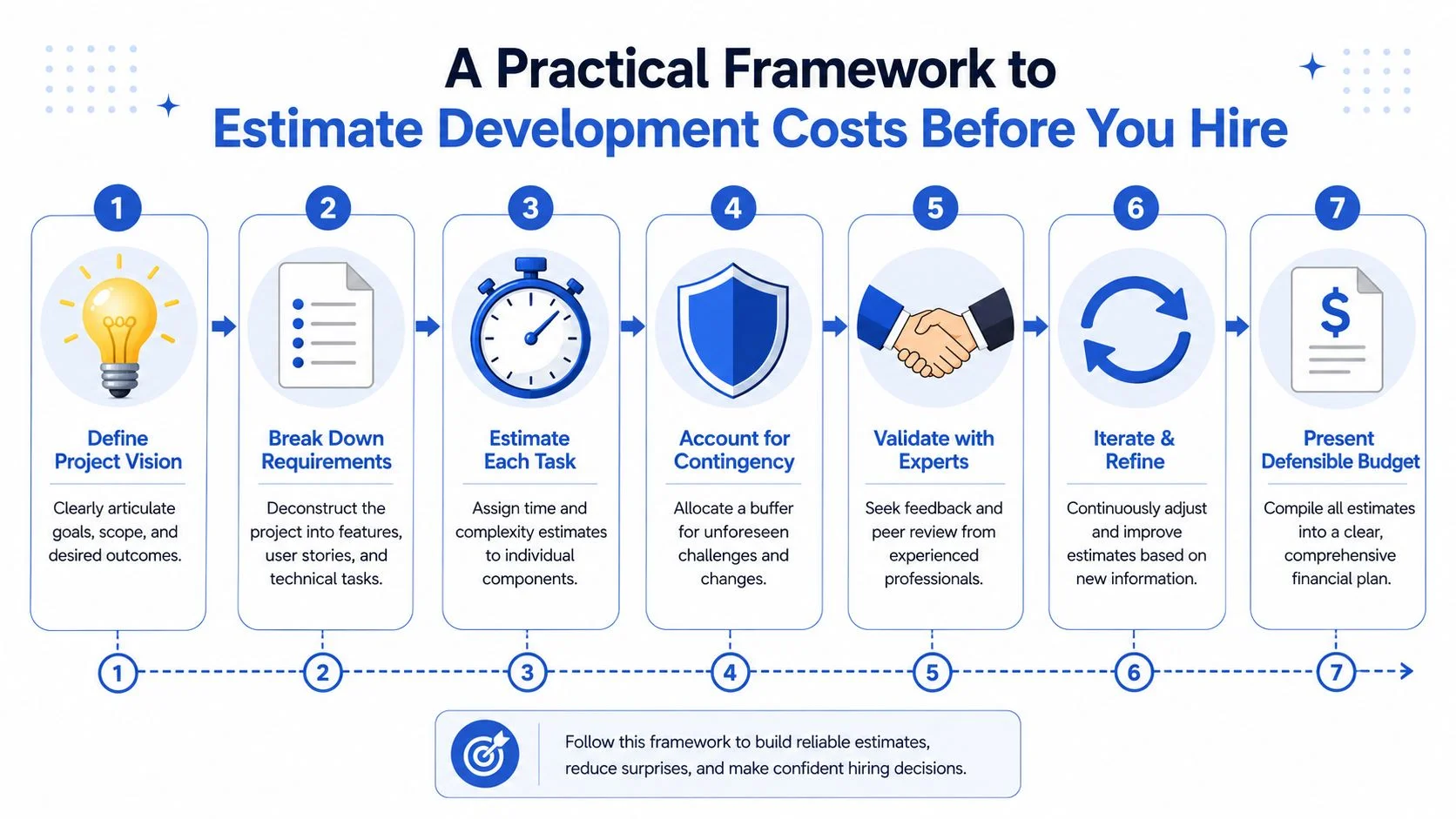
A Practical Framework to Estimate Development Costs Before You Hire
A founder usually gets into trouble before a single line of code is written. The pattern is familiar. A product idea gets priced from a few screens, one agency quotes six figures, another promises to do it for half, and nobody has tied that number to architecture, compliance, model usage, or contract risk.
A usable estimate starts with decomposition. Break the product into systems, estimate each system by phase, then check whether the team you plan to hire can deliver that scope within the budget you have.
Start with a work breakdown structure
The most defensible approach is to turn product scope into a work breakdown structure, estimate hours by phase, and calculate cost as estimated hours multiplied by hourly rate, with overhead and risk handled separately. One software estimation guide also recommends three-point estimation using optimistic, most-likely, and pessimistic scenarios instead of a single guess (practical software estimation workflow).
For an early-stage founder, that usually means pricing the product in layers:
Define the release boundary
Decide what is required for launch, what belongs in version two, and what is still a hypothesis.Break work into phases
Separate discovery, UX/UI, architecture, engineering, QA, deployment, and handoff.Split features into buildable tasks
“User management” is too vague. Login, roles, permissions, MFA, session handling, and audit logs should be estimated separately.Add technical work that founders often miss
API integration, admin tooling, observability, data migration, model evaluation, wallet logic, and compliance review all consume budget.Estimate uncertainty openly
Give every major workstream a best case, expected case, and high-risk case.
A lump-sum quote can still be useful, but only if the assumptions behind it are visible.
Estimate by system behavior, not by screen count
Screen count is one of the fastest ways to underbudget a complex product. Two apps can each have ten screens and have completely different cost profiles.
A fintech onboarding flow with KYC checks, transaction monitoring hooks, and role-based approvals costs more than a simple SaaS signup flow. An AI support assistant with retrieval, prompt controls, fallback logic, and evaluation loops costs more than a chatbot UI. A Web3 dashboard that triggers on-chain actions, signs transactions, and handles failed confirmations costs more than a standard analytics page.
This is the decision framework founders need. Ask where complexity lives. If complexity sits in regulated workflows, model reliability, or irreversible blockchain logic, the estimate has to reflect specialist engineering and more testing time.
Build a range before you build a team
Single-point estimates create false confidence. Teams discover edge cases during implementation, not during the first sales call.
A practical budget should include three views:
- Optimistic for clean execution and limited rework
- Most likely for the path you should plan around
- Pessimistic for architecture changes, integration friction, or added compliance and security work
That approach is common in cost estimation practice, and sprint-based budgeting is a useful way to apply it in delivery planning (sprint-based project budgeting). Founders should also keep a contingency reserve outside the base estimate rather than pretending uncertainty does not exist.
Here is what that looks like in real planning. A startup may estimate a SaaS MVP at 16 weeks with a small product team, then discover that SSO, billing edge cases, and reporting export requirements add another sprint or two. In AI and fintech, the gap is usually larger because external systems and reliability requirements create more unknowns. In Web3, audit feedback alone can reshape scope late in the cycle.
If you want a structured starting point before you talk to agencies or start hiring, a software development cost estimator can help translate broad scope into a budget range.
Turn scope into a staffing decision
Once the backlog is sized, compare delivery models against that workload instead of choosing based on day rate alone.
Use at least three scenarios:
- In-house team when the product is core IP and you expect continuous iteration
- Agency or dedicated external team when speed matters and you need design, engineering, and QA operating together from day one
- Hybrid model when you want internal product ownership but need outside capacity for build-out or specialist work
The trade-off is straightforward. In-house hiring gives tighter control, but recruiting takes time and early management overhead is real. External teams can compress time to market, but weak scope definition often turns “faster” into expensive rework.
Regional hiring can also change the math. If you’re comparing international staffing options, some founders evaluate models such as Hire LATAM talent to assess cost, timezone overlap, and communication load before committing to a hiring plan.
A good estimate does not give you one number. It gives you a budget range, the assumptions behind it, and a clear view of which parts of the product can break that budget first.
Beyond the Build Uncovering Hidden Costs in Your First Year
Founders love to ask what it costs to build the software. The more expensive question is what it costs to operate it for the first year.

Your launch budget is not your first year budget
One cost guide makes this point clearly. Development is typically only 60–70% of first-year cost. The same guide notes that cloud hosting can run $500–$10,000 per month, security audits can cost $5,000–$25,000 annually, and ongoing maintenance can run 15–20% of initial build cost per year. It also notes that full-time hiring adds roughly 20-25% of base salary in recruitment and onboarding expenses (first-year software cost breakdown).
That changes how you should budget. If you only reserve money for design and build, you may launch and immediately face a second budget problem. Hosting, monitoring, support, patching, and compliance don’t wait.
The hidden items usually include:
- Cloud and infrastructure for hosting, storage, environments, and scaling
- Security operations including audits, penetration testing, and remediation
- Maintenance and support for bug fixing, minor improvements, and dependency updates
- Post-launch product work such as analytics changes, onboarding fixes, and admin improvements
Hiring model changes total spend
The same product can have very different first-year economics depending on whether you hire employees, use contractors, or engage a delivery team. In-house teams create continuity, but they also create fixed overhead before velocity is proven. Outsourced delivery can compress startup time, though founders still need internal decision-makers who can approve scope and keep priorities stable.
For India-based hiring specifically, market guidance shows a wide spread depending on model and experience. One hiring comparison reports Asia-region annual compensation bands of $20,000–$60,000 for developers, while another guide cites an India-based app development professional at about $4,000 per year versus a U.S.-based mobile app developer at $89,000 per year. The same guide also notes full-time software-developer hiring costs of roughly $28,548–$35,685 before coding begins (developer hiring cost comparisons).
A short explainer on total cost of ownership helps many stakeholders align on this point:
If your financial model only covers the build, you haven’t budgeted for a software business. You’ve budgeted for a demo.
How Blocsys Ensures Predictable Budgets and Flawless Execution
Complex software budgets become manageable when the estimate is tied to scope, technical risk, and delivery structure instead of guesswork. That is especially true for teams building exchanges, tokenisation systems, AI-assisted compliance workflows, or SaaS products with financial logic.
In practice, a strong delivery partner should do three things well. First, translate product goals into a scoping document that engineering, QA, and business stakeholders all understand. Second, separate ordinary feature work from high-risk work such as security, compliance, contract logic, or infrastructure dependencies. Third, show how the budget changes under different staffing models.
For teams evaluating external execution, dedicated developers in 2026 and the cost-benefit of scaling faster is a useful lens because it frames cost around capacity, velocity, and operating model rather than rate cards alone.
Blocsys offers services relevant to that process, including a software development cost estimator and delivery support for blockchain, AI, and fintech systems. The practical value isn’t a generic quote. It’s turning a vague concept into a build plan with milestones, dependencies, and first-year budget visibility.
If you’re budgeting a product where mistakes are expensive, the right next step is not to ask for the cheapest quote. It’s to ask for the clearest estimate.
Frequently Asked Questions on Software Development Costing
How much does software development cost?
It depends on size and complexity. Budgeting research places small projects at $5,000–$50,000, medium projects at $50,000–$200,000, and large projects at $200,000+, with some complex systems starting at $100,000 and exceeding $1 million as noted earlier.
How can I estimate development costs before hiring developers?
Use a work breakdown structure, estimate effort by phase, apply rates, and build a range using optimistic, most-likely, and pessimistic scenarios. That gives you a decision-ready estimate instead of a guess.
What affects AI, SaaS, and blockchain budgets most?
SaaS budgets often move with workflow complexity and integrations. AI budgets usually move with data, reliability, and model operations. Blockchain budgets usually move with smart contract risk, audit readiness, and transaction security.
Should I budget only for the build?
No. First-year costs matter. Hosting, maintenance, support, audits, and hiring overhead can materially change what the project really costs after launch.
Can Blocsys help estimate software development costs?
Yes. Teams that need structured budgeting for blockchain, AI, or software products can use Blocsys Technologies to review scope, compare delivery models, and turn product requirements into a more defensible project budget before hiring developers.
