
Every hospital leader in India knows the feeling. The OPD is packed, billing is lagging behind the front desk, insurance pre-authorisations are still being chased in WhatsApp groups, and someone from administration is asking for NABH evidence that lives in three spreadsheets and two email threads. In radiology, requests pile up faster than films get tracked, while the nursing team keeps asking for one clean patient record instead of six versions of the same chart.
That’s why a Hospital Information Management System in India is no longer a software purchase. It’s the operational layer that decides whether a hospital can move patients, information, revenue, and compliance evidence without constant manual fire-fighting. For CIOs, administrators, and digital transformation leads, the key question in 2026 is not whether to digitise, but how to choose a system that survives Indian bandwidth, staffing, and regulatory realities.
Table of Contents
- The Reality Behind Indian Hospital Information Management Systems in 2026
- What a Hospital Information Management System Does
- Core Modules Every Indian Hospital Should Evaluate
- Cloud vs On-Premise HIMS for Indian Hospitals
- EMR EHR Integration and the ABDM Digital Health Stack
- Why HIMS Implementations Fail After Go-Live in India
- A Practical HIMS Implementation Roadmap for Indian Hospitals
- Why Blocsys Is the Right HIMS Partner for Indian Healthcare
The Reality Behind Indian Hospital Information Management Systems in 2026
A hospital administrator in Pune, Lucknow, or Coimbatore usually doesn’t start the day thinking about architecture diagrams. The day starts with queues, phone calls, missing beds, a delayed claim, and a consultant asking why yesterday’s notes aren’t visible in today’s ward round. By afternoon, someone wants a discharge summary, someone else wants an audit trail, and the front office is still reconciling cash, insurance, and package billing.
That daily chaos is the underlying search intent behind hospital information management software in India. Hospitals are looking for a system that can reduce friction across registration, clinical documentation, billing, ancillary services, and reporting, while still working in places where internet quality, device availability, and staff training are uneven. A brochure-style HIMS pitch doesn’t help there. A working blueprint does.
Practical rule: If a vendor can’t explain how their system behaves during poor connectivity, staff turnover, and insurance pressure, they’re not selling hospital software for India. They’re selling a demo.
The Indian context matters because public health information systems here were built in stages. NRHM moved most public facilities from paper-heavy reporting to electronic reporting through HMIS and patient-level tracking through MCTS by mid-2013, and the HMIS web rollout pushed access down to sub-centre level in most districts. By 31 December 2013, 87,138 health facilities were generating and using work plans from MCTS, about 49% of all public health facilities operated by NRHM; work-plan usage was highest in CHCs at 57% and sub-centres at 50% (source).
That history matters because it shows the pattern. India doesn’t just need software. It needs adoption, workflow fit, and sustained use after go-live. That’s where most hospital buyers are still underestimating the challenge. If you’re evaluating a modern platform, the buying decision should be shaped by integration depth, bandwidth tolerance, and whether the vendor can support real hospital operations instead of only a procurement checklist. For organisations building or replacing their stack, a partner with hospital-domain delivery experience, such as hospital management software development in India, is more useful than another generic IT reseller.
A strong HIMS decision in 2026 is a leadership decision, not a software catalog decision. It has to work for leadership teams, finance, clinicians, and the registration counter at the same time.
What a Hospital Information Management System Does
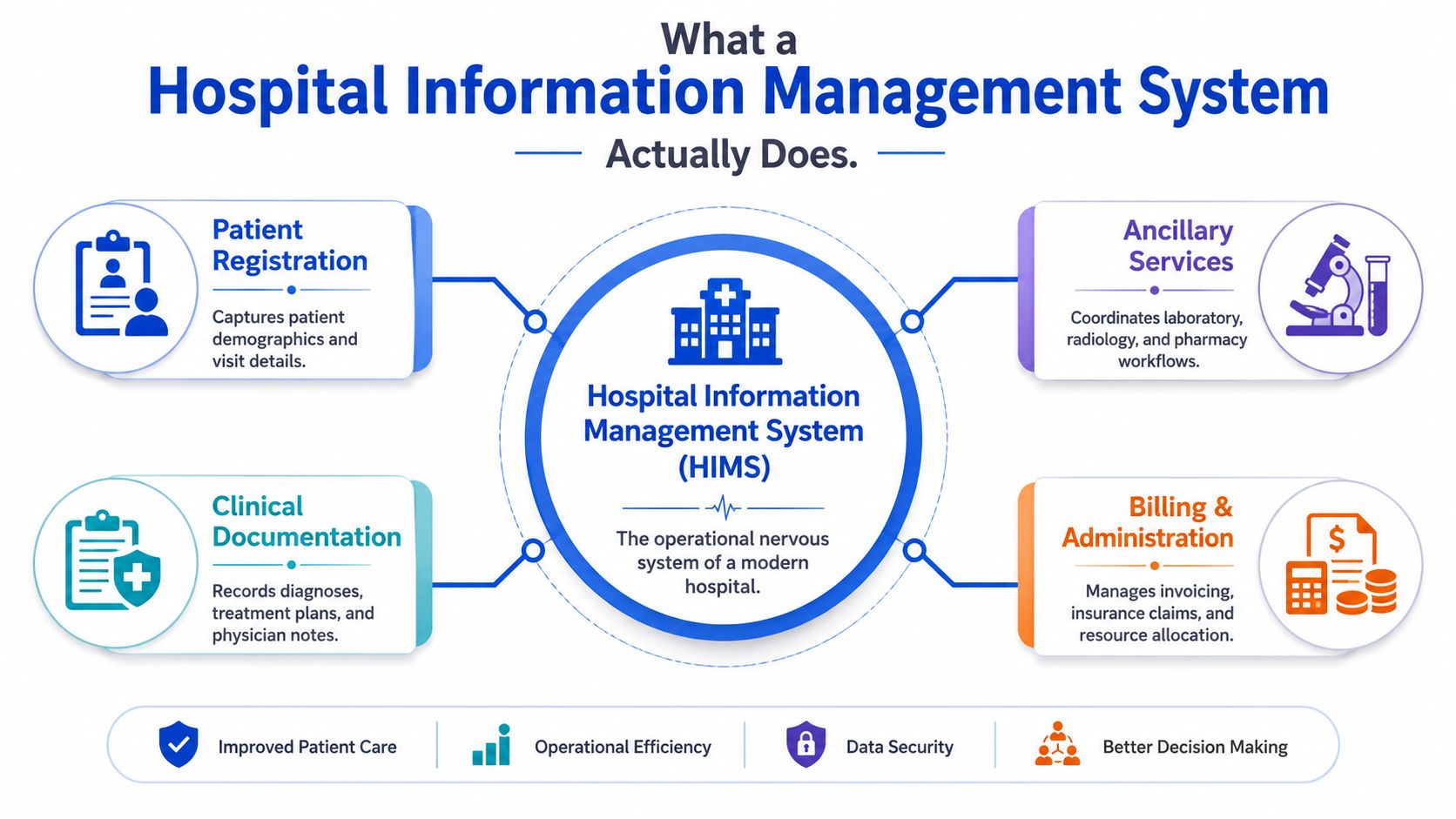
A Hospital Information Management System is the operational nervous system of the hospital. It connects patient registration, clinical documentation, ancillary services, billing, insurance, and reporting so that each department works from the same live workflow instead of separate silos. In practice, it functions as the hospital’s coordination layer, linking front desk activity, ward work, diagnostics, and finance into one running system.
HIMS, HMS, EMR, and EHR are not the same thing
Indian buyers often use HIMS, HMS, and hospital information system as if they mean exactly the same product. In practice, the labels overlap, but the scope differs. HIMS usually refers to the broader workflow platform. HMS is often used more casually for hospital operations software. EMR focuses on the patient’s clinical record inside the hospital, while EHR is designed for longitudinal health data that can move across systems and settings.
India’s public-sector architecture reflects this layered model. The national HMIS stack was specified as a web-enabled, open-source, standards-based system with HL7 Development Framework support, built to handle transaction-heavy workflows across departments in government hospitals (source). That tells you something important. HIMS in India is not just front-office software. It is a coordination layer.
Who needs it most
The strongest fit is usually multi-specialty hospitals, hospital chains, and clinics planning scale. Government health programmes also need it because reporting, referral flow, and patient identity tracking depend on structured data, not disconnected registers. For Indian hospitals, the buying decision should start with workflow mapping, not a feature checklist.
The practical test is whether the system can handle daily hospital movement without forcing staff back to paper or duplicate entry. In tier-1 hospitals, that means cleaner coordination between departments. In tier-3 settings, it often means choosing a setup that staff can keep using even when bandwidth, training time, and device availability are uneven. That gap between procurement and sustained use is where many rollouts stall.
For enterprise planning, HIMS sits alongside hospital ERP, analytics, and clinical systems. In hospitals that want finance, ops, and care delivery aligned, hospital ERP development becomes part of the same conversation, not a later add-on.
Core Modules Every Indian Hospital Should Evaluate
A serious hospital management information system works best when it is assessed as a chain of workflows. Each module captures a specific piece of data, and that record should move the next step forward without manual re-entry. In Indian hospitals, that is what reduces queue delays, claim friction, and gaps in documentation across departments. A setup built around screens alone usually creates more handoffs for staff to manage.
Patient flow starts before the doctor sees the case
Patient registration should capture identity cleanly, and ABHA-linked identity should be part of the design where the hospital is ready for it. Appointment scheduling and queue management need to show staff who is arriving, when, and for which speciality. In OPD, the system should carry encounter notes forward so clinicians are not rewriting the patient story at every visit.
IPD works differently. Admission, transfer, discharge, and bed management have to behave like a live command centre, because ward status changes through the day. A bed assigned in the morning cannot still appear free in the evening just because the update never reached the ward clerk.
Ancillary and finance modules must close the loop
A hospital workflow does not stop at clinical notes. Laboratory information, radiology and PACS integration, pharmacy, inventory, OT scheduling, billing, insurance, HR and payroll, finance, and hospital CRM all depend on clean handoffs. If the lab order does not land properly, the nurse re-enters it. If billing does not receive the correct package or insurer rule, the claim gets delayed. If inventory does not reflect consumption, the purchase team buys blind.
The India-wide data picture shows why this matters. By 1 April 2020, the national HMIS portal had 17,704,350 total reports. In 2019–2020, there were 169,125 available facilities, and 161,019 were actively reporting. Reporting was dominated by sub-centres at 79.54%, followed by PHCs at 14.33%, CHCs at 4.48%, sub-district hospitals at 1.10%, and district hospitals at 0.56%. About 60% of all reports came from just eight states, including Uttar Pradesh, Rajasthan, Karnataka, West Bengal, Maharashtra, Gujarat, Madhya Pradesh, and Bihar.
Operational insight: If your HIMS cannot keep one patient identity stable across registration, lab, billing, and discharge, every downstream module keeps creating reconciliation work.
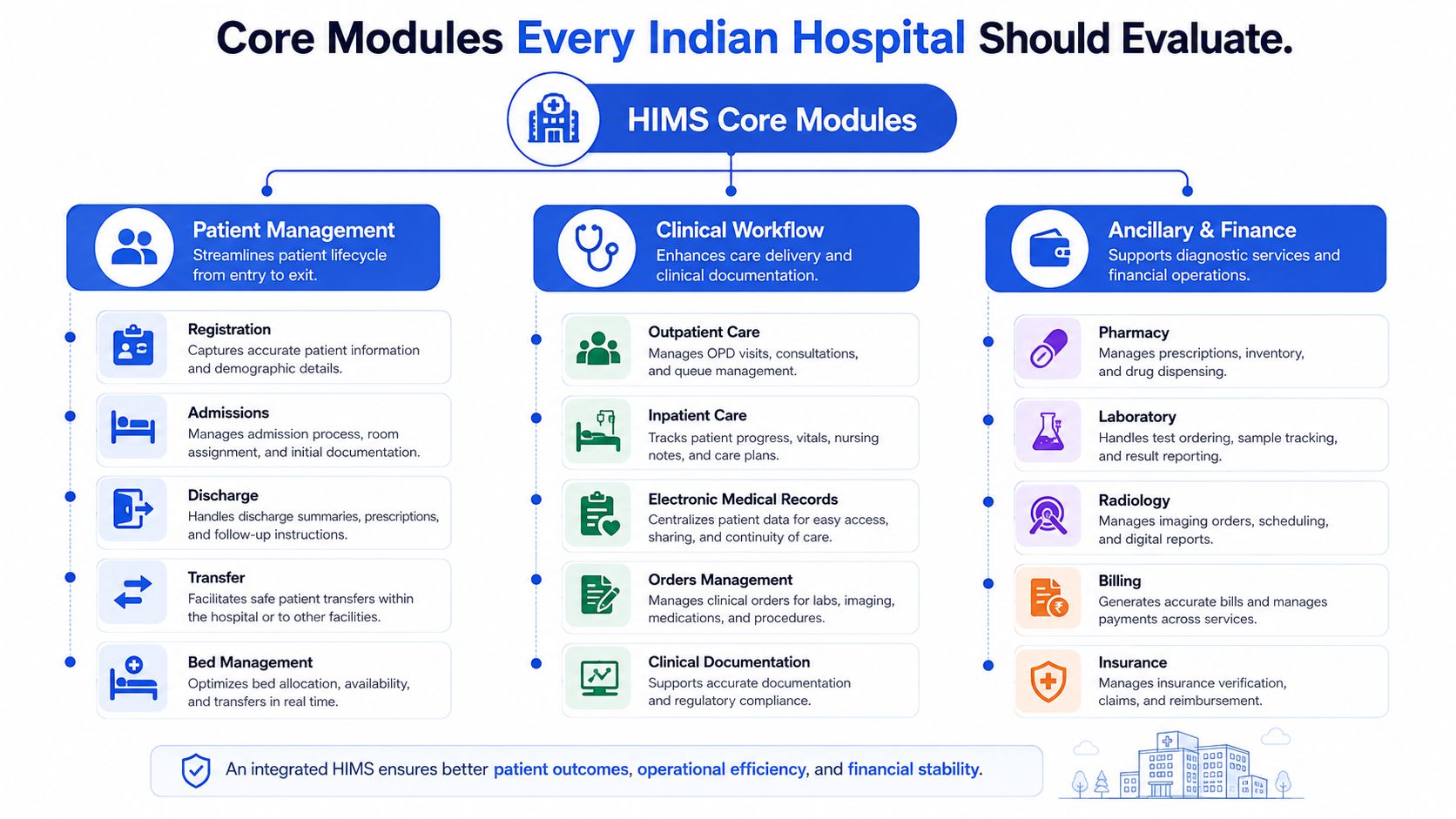
A mid-size hospital should evaluate module selection as dependency design. Registration feeds queueing. Queueing feeds consultation. Consultation feeds orders. Orders feed lab, radiology, and pharmacy. Those feed billing and discharge. When that chain breaks, digitisation just moves the paperwork into a different interface.
For hospitals that need a custom build instead of a template package, custom hospital management software in India is the right lens. The question is not whether the vendor has a module. The question is whether each module fits the workflow in your wards, lab, pharmacy, and accounts team.
Cloud vs On-Premise HIMS for Indian Hospitals
The cloud-versus-on-premise argument gets oversimplified fast. In India, the decision should be made on bandwidth, uptime, data governance, staffing, and how fast the hospital needs to scale. The official HIS implementation guidance for public-sector deployments explicitly prefers cloud-based servers, a centrally hosted web server in a well-equipped data centre, and minimum 512 kbps internet connectivity for data transmission, along with ICD-10 and SNOMED-aligned standards (source).
What the trade-off really looks like
Cloud usually reduces infrastructure burden. On-premise gives more local control, but it also pushes the hospital into hardware upkeep, patching, backups, and a bigger dependence on internal IT. That matters in tier-2 and tier-3 settings where IT teams are lean and clinical demand is high. For most chains, clinics, and multi-specialty hospitals under 300 beds, cloud-first is usually the cleaner operational choice. On-premise still makes sense when regulation, air-gapped environments, or connectivity constraints force it.
| Decision Factor | Cloud HIMS | On-Premise HIMS |
|---|---|---|
| Deployment style | Centrally hosted and accessible over the web | Installed and managed inside the hospital environment |
| Infrastructure burden | Lower internal hardware and maintenance burden | Higher local maintenance, patching, and backup responsibility |
| Connectivity sensitivity | Needs stable internet and offline design for weak sites | Less dependent on constant external connectivity |
| Scaling | Easier to expand across branches and units | Scaling usually needs more hardware and local planning |
| Control | Vendor and cloud governance are central | More direct local control over servers and access |
| Best fit | Chains, clinics, and growing multi-specialty hospitals | Air-gapped or highly constrained environments |
In practical terms, cloud also makes it easier to think about disaster recovery, upgrade cycles, and multi-site access. On-premise can still be the right answer where the hospital team insists on local hosting, but it’s a heavier operating model.
If a vendor starts talking only about infrastructure and never about workflow, that’s a warning sign. The best HIMS decision is about reliability in daily use, not just where the server sits. For some organisations, cloud computing consulting is a sensible step before procurement because it clarifies connectivity, hosting, and recovery assumptions.
A related note matters for broader digital infrastructure planning. Tokenization Platform Development is designed for secure and compliant platforms for real-world assets, securities, real estate, commodities, and digital assets using enterprise blockchain technology. That’s a different domain, but it shows the same principle, infrastructure must fit the regulatory and operational model, not the other way around.
EMR EHR Integration and the ABDM Digital Health Stack
A HIMS only becomes strategically useful when its records can move cleanly into India’s digital health stack. That means patient identity, encounter data, consent, and coding must align with ABHA, ABDM, HIE-CM, and public reporting pipelines. Without that, the hospital still has software, but it doesn’t have interoperable health records.
What integration should look like
Hospitals should insist on HL7/FHIR-based APIs, ICD-10 and SNOMED CT coding support, ABHA-linked identity handling, and consent management for digital record exchange. Those are not decorative features. They are the operational basics for interoperability. If a vendor can’t explain how identity resolution works when a patient arrives with partial details, the integration story isn’t ready.
NIC’s eHospital HMIS gives a useful reference point because it is used by more than 1,000 health facilities across the country, is hosted on NIC’s National Cloud MeghRaj, and is ABDM-compliant (source). That doesn’t mean every private hospital should copy the same stack. It does show what large-scale ABDM-aligned deployment looks like in practice.
A working ABDM integration is less about a checkbox and more about whether the vendor can preserve identity, consent, and auditability when patients move between facilities.
Before a signature, hospital buyers should verify three things. First, whether the system can exchange structured data rather than only PDFs. Second, whether consent and identity are auditable. Third, whether the implementation team understands the hospital’s coding discipline, not just the software UI.
For disposal and lifecycle planning around legacy IT assets, this Beyond Surplus IT equipment FAQ about HIPAA requirements is a useful reference point for understanding how healthcare organisations think about secure equipment retirement and privacy controls.
Why HIMS Implementations Fail After Go-Live in India
Most hospital software failures don’t happen on launch day. They happen six weeks later, when the super-users are tired, the training material is already outdated, and staff have returned to old shortcuts. The problem is rarely that the system can’t technically work. The problem is that the hospital hasn’t built the operating discipline to keep it working.
The usual failure modes are human and organisational
Indian field evidence repeatedly points to shortages of trained staff, inadequate infrastructure, weak post-implementation support, poor literacy, funding gaps, and system faults as the common blockers. Hospital management and health workers also underuse information for strategic decisions, while interoperability and usability keep showing up as major blockers. A recent India-focused review frames the primary bottleneck as change management, not just technology procurement (source).
The public HMIS story shows the same pattern in a different setting. The system has wide reach, but strategic use has often lagged behind reporting. That gap is the warning for every private hospital buying HIMS now. Reporting can be high while decision quality stays low if leadership doesn’t embed the system into daily work.
The answer is not more modules. It’s better adoption design. Hospitals should demand role-based training, named super-user programmes, escalation paths for go-live issues, and post-launch KPIs that the leadership team reviews. If the vendor disappears after installation, the hospital ends up with software ownership but no operational change.
Key takeaway: Go-live is not the finish line. It’s the point where governance, training, and support start mattering more than the demo.
Leadership teams should ask one hard question during procurement. Who owns adoption after the contract is signed? If the answer is vague, the implementation risk is already visible.
A Practical HIMS Implementation Roadmap for Indian Hospitals
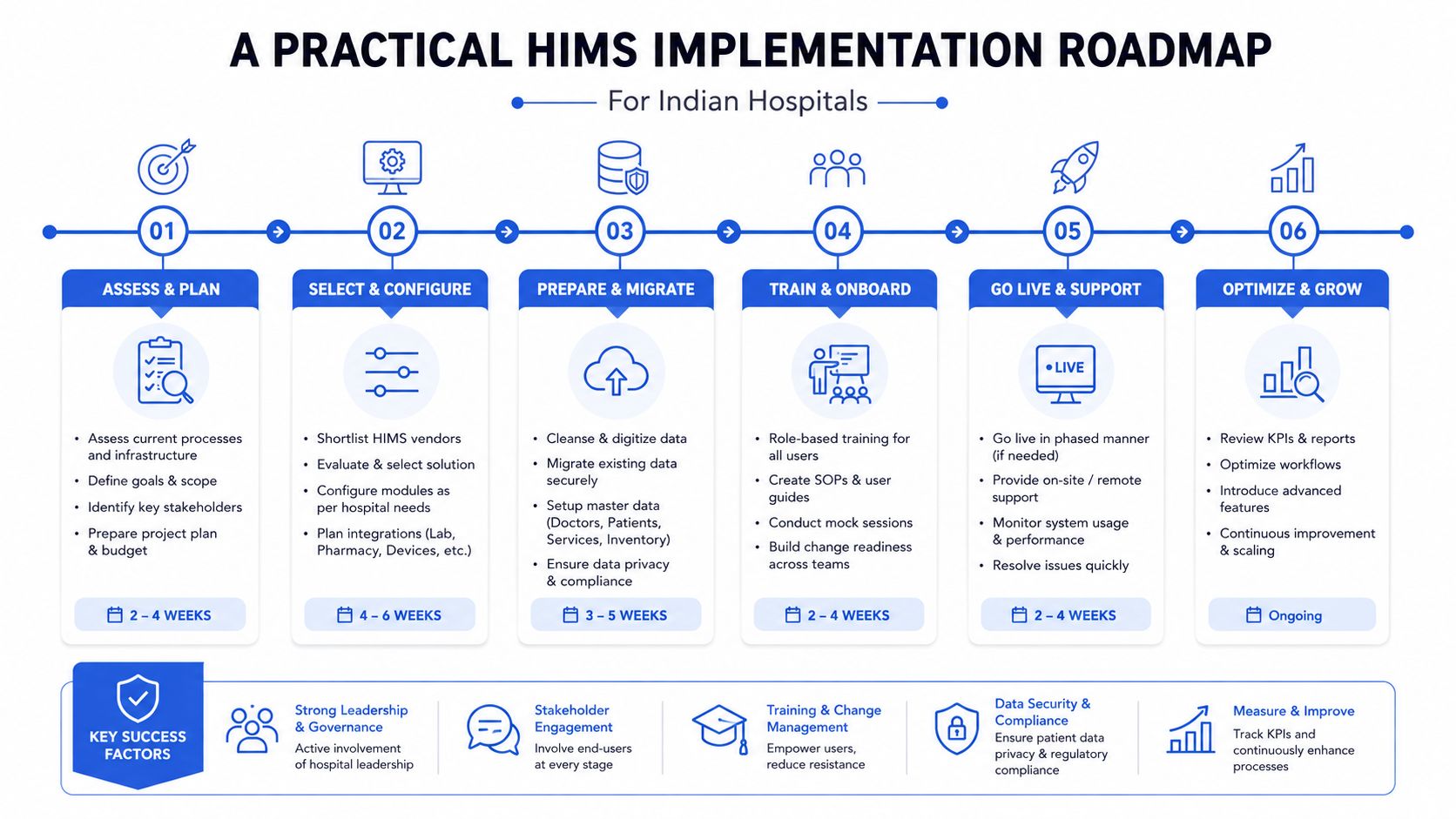
A hospital can’t fix every process on day one, and it shouldn’t try. The best rollout path is phased, measurable, and tied to operating reality. Start with the parts that create the most friction, then expand once the team trusts the system.
Phase 1 through phase 3 should prove value fast
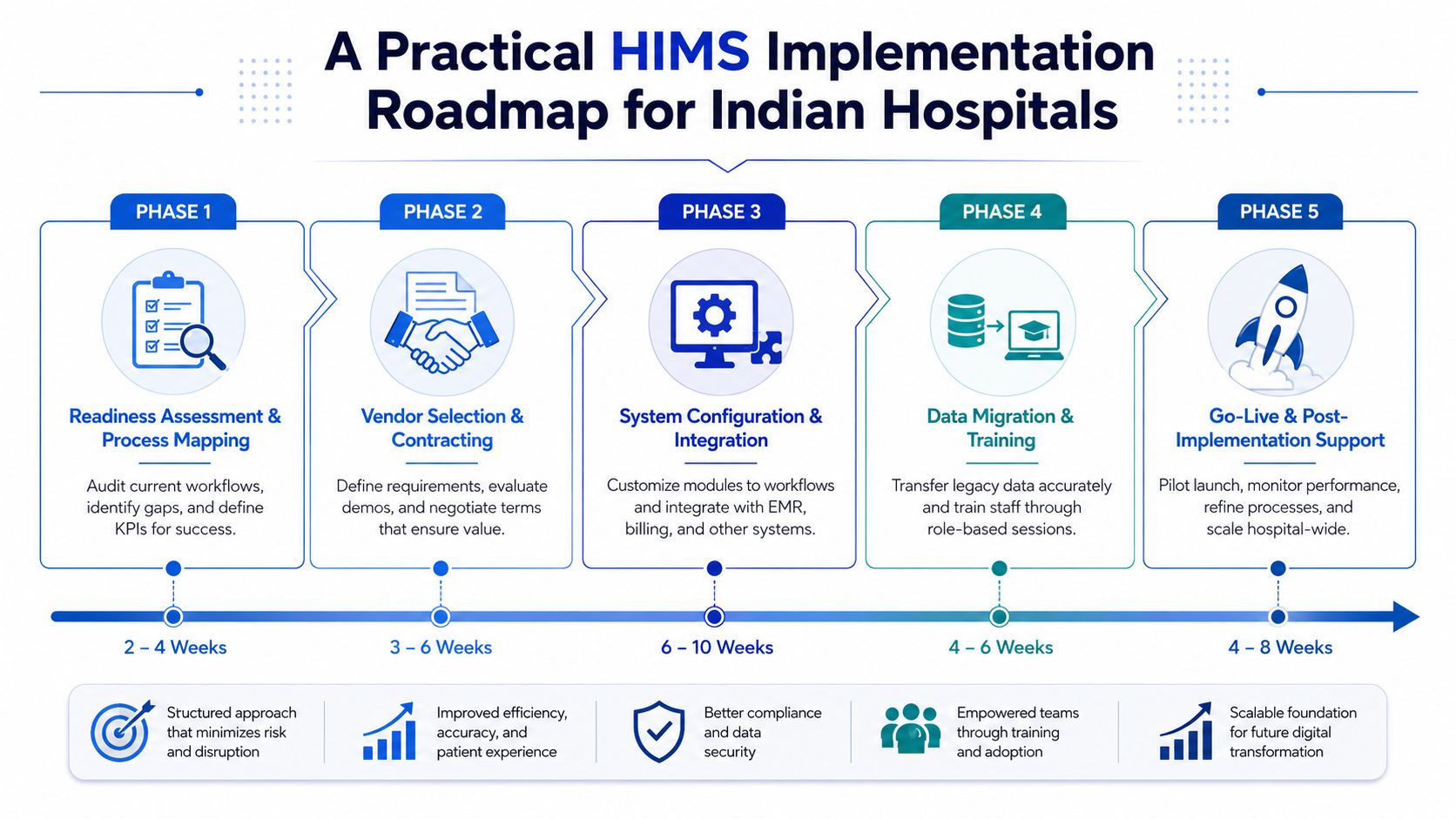
The first phase is readiness assessment and process mapping. The hospital should document current workflows, data ownership, and failure points. The second phase is vendor shortlisting and RFP, where the team evaluates integration depth, offline behaviour, role permissions, and support model. The third phase is pilot rollout, usually focused on registration, OPD, and billing because those areas produce visible results quickly.
After that, phased expansion should add IPD, lab, radiology, pharmacy, and finance in a controlled sequence. Final optimisation should focus on analytics, dashboards, and AI-assisted decision support only after core data quality is stable. That sequencing matters because poor data in early modules contaminates every later report.
What to measure after go-live
Hospitals should track the metrics that reveal whether the system is really adopted, not just installed. Registration turnaround, insurance claim cycle time, and clinical documentation completeness are good starting points. If those don’t improve, the problem is usually process fit, training, or support, not the database schema.
A good vendor conversation also includes total cost of ownership over five years, ABDM integration depth, and workflow localisation for regional languages. Those points matter more than feature lists because they tell you whether the platform can live in your actual hospital environment.
One more practical point. If the rollout depends on a single super-user or a single department, it’s fragile. The implementation should be designed so that the hospital can absorb staff turnover without losing adoption momentum.
Why Blocsys Is the Right HIMS Partner for Indian Healthcare
Indian hospitals now need four things at once, ABDM-ready architecture, custom workflow engineering, cloud-native scalability, and post-go-live adoption support. That combination is hard to get from an off-the-shelf product alone. It usually requires a development partner that understands hospital operations, integration, and long-term support.
Blocsys approaches this as a healthcare software build problem, not just a licensing problem. As a Healthcare Software Development Company, Blocsys can support custom Hospital Information Management System development, EMR and EHR integration, cloud healthcare platforms, and hospital ERP workflows for hospitals, multi-specialty groups, clinics, and healthcare enterprises. For organisations comparing vendors, the practical starting point is often the Blocsys hospital software capability page and then mapping that against their own workflow and compliance needs.
If your team is evaluating a new HIMS, you need a partner that can handle implementation realism, not only product positioning. Blocsys fits that brief when the requirement is a system that has to work in Indian conditions, across clinical, administrative, and integration layers.
If you’re planning a Hospital Information Management System in India rollout, Blocsys Technologies can help you design the architecture, map the workflows, and plan the integration path around ABDM, EMR, billing, and hospital operations. Visit Blocsys Technologies to discuss HIMS development, EMR/EHR integration, and a practical implementation roadmap for your hospital.
Frequently Asked Questions
What is a Hospital Information Management System (HIMS)?
A Hospital Information Management System (HIMS) is an integrated healthcare software platform that connects patient registration, clinical documentation, diagnostics, pharmacy, billing, insurance, inventory, reporting, and other hospital workflows in one system. It acts as an operational coordination layer that allows different departments to work from connected patient and administrative data instead of maintaining separate records and manual processes.
What is the difference between HIMS, HMS, EMR, and EHR?
HIMS generally refers to the broader hospital workflow and information platform, while HMS is often used as a general term for hospital management software. EMR focuses primarily on a patient’s clinical record within a healthcare organisation, whereas EHR is designed to support longitudinal health information that can be shared across different systems and care settings. A modern HIMS can integrate EMR and EHR capabilities with administrative, financial, and operational workflows.
What modules should an HIMS include for Indian hospitals?
A comprehensive HIMS for Indian hospitals should include patient registration, appointment and queue management, OPD and IPD workflows, bed management, clinical documentation, laboratory, radiology and PACS, pharmacy, inventory, operation theatre management, billing, insurance and TPA workflows, finance, HR, reporting, and administrative management. Hospitals may also require ABHA and ABDM integration, EMR/EHR connectivity, analytics, mobile access, and multi-branch management depending on their operational requirements.
How does HIMS support ABDM and ABHA integration?
HIMS can support ABDM and ABHA integration by connecting patient identity, consent, clinical records, and healthcare data with India’s digital health ecosystem through structured APIs and interoperability standards. A properly designed system should support standards such as HL7 and FHIR, maintain auditable consent and identity workflows, and allow authorised health information to move between participating systems rather than relying only on document-based exchanges.
Is cloud or on-premise HIMS better for Indian hospitals?
Cloud HIMS is generally suitable for hospitals that want easier scalability, centralised infrastructure, multi-site access, and lower internal hardware maintenance, while on-premise HIMS can be appropriate for organisations requiring greater local infrastructure control or operating under specific connectivity, regulatory, or security constraints. The right choice depends on bandwidth, uptime requirements, data governance, IT resources, disaster recovery, and the hospital’s operating environment.
How does HIMS improve hospital operations?
HIMS improves hospital operations by connecting workflows across registration, consultation, diagnostics, pharmacy, billing, insurance, inventory, and discharge. This reduces duplicate data entry, improves information availability between departments, helps staff track patient movement, and can reduce delays in billing, claims, documentation, and reporting when the system is properly implemented and adopted.
What integrations are important in a Hospital Information Management System?
Important HIMS integrations include ABHA and ABDM services, HL7/FHIR-based healthcare interfaces, laboratory information systems, PACS and radiology systems, pharmacy and inventory platforms, payment gateways, insurance and TPA systems, accounting software, HR and payroll systems, and hospital CRM tools. Integration allows information to move between departments and external systems without requiring staff to repeatedly enter the same patient or transaction data.
How can hospitals ensure HIMS works with poor internet connectivity?
Hospitals operating in areas with unreliable connectivity should evaluate HIMS platforms for offline or low-bandwidth workflows, local data handling, synchronisation mechanisms, lightweight interfaces, and reliable recovery procedures. A system designed for Indian healthcare environments should clearly define what staff can continue doing during connectivity interruptions and how pending transactions and records are synchronised when the connection returns.
Why do HIMS implementations fail after go-live?
HIMS implementations often fail after go-live because of inadequate staff training, weak change management, poor workflow alignment, insufficient post-launch support, infrastructure limitations, and dependence on a small number of super-users. Successful implementation requires role-based training, process mapping, adoption monitoring, escalation procedures, ongoing support, and leadership ownership rather than treating software installation as the end of the project.
How long does it take to implement a HIMS in India?
HIMS implementation in India can take several months depending on hospital size, number of departments, integrations, data migration, custom workflows, deployment model, training requirements, and the number of facilities involved. A phased implementation that starts with high-impact workflows such as registration, OPD, and billing can allow hospitals to demonstrate value earlier before expanding into IPD, laboratory, radiology, pharmacy, finance, analytics, and other modules.
How much does it cost to build a Hospital Information Management System in India?
The cost of building a Hospital Information Management System in India depends on the number of modules, hospital size, custom workflows, integrations, ABDM and ABHA requirements, deployment model, data migration, security, user roles, reporting, mobile applications, and ongoing support. A basic HIMS for a smaller healthcare facility can cost significantly less than a custom enterprise platform designed for a multi-specialty hospital chain with extensive integrations and multi-location operations.
