
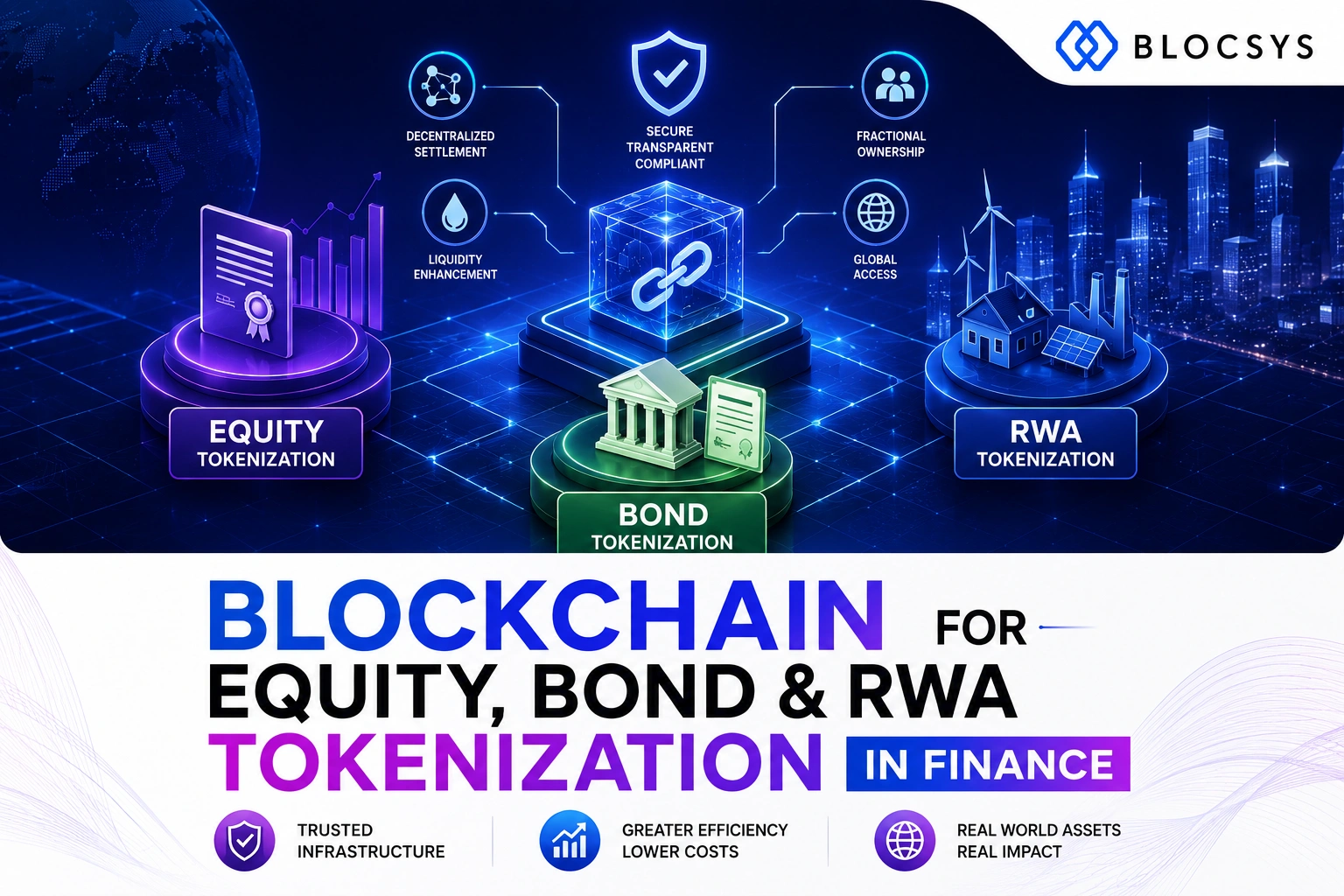
How Financial Institutions in the US, UK, and Europe Are Using Blockchain for Equity, Corporate Bond, and RWA Tokenization
Banks and asset managers aren’t experimenting anymore, they’re deploying. Across the US, UK, and Europe, blockchain has moved from pilot projects to production infrastructure for equity tokenization, corporate bond tokenisation, and real-world asset (RWA) tokenization. One question keeps surfacing in boardrooms: how does Robinhood Chain work, and what does its architecture mean for institutional tokenization strategy? This guide breaks down enterprise blockchain fundamentals, walks through Robinhood Chain Layer 2 explained in plain terms, and shows how firms are building on-chain financial ecosystems today. If you’re evaluating Blocsys as a partner for this shift, you’re in the right place.
Enterprise Blockchain Overview
Enterprise blockchain isn’t a buzzword anymore. It’s infrastructure. Banks use permissioned and public-adjacent networks to settle trades, issue securities, and track ownership records without relying on layers of intermediaries.
What’s different now versus five years ago? Regulatory clarity. The EU’s MiCA Regulation, the UK’s DLT Pilot Regime, and evolving FCA Digital Assets guidance have given institutions a rulebook to build against. Consequently, capital markets teams that once treated blockchain as R&D now treat it as a procurement decision.
Robinhood blockchain infrastructure is a useful case study here. It shows how a consumer-facing brokerage translates institutional-grade rails into a product retail investors can actually use.
How Does Robinhood Chain Work at a Foundational Level?
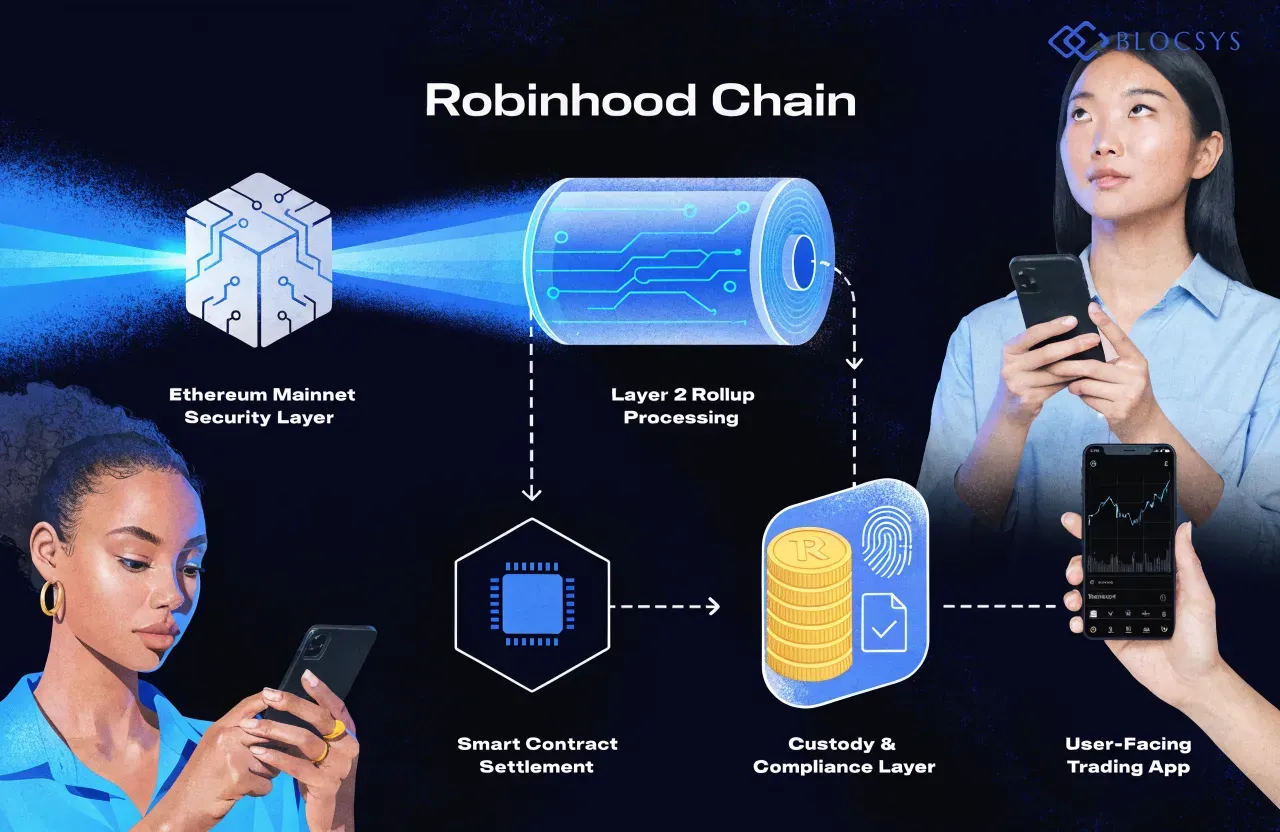
At its core, Robinhood Chain works by anchoring tokenized securities to a Layer 2 network built on Ethereum. Trades settle faster, costs drop, and ownership records live on-chain instead of in siloed ledgers. That’s the short answer. The longer answer involves smart contracts, custody arrangements, and interoperability bridges we’ll unpack throughout this piece.
Institutions don’t want another blockchain to manage, they want infrastructure that disappears into their existing workflows. That’s the real test for any Layer 2 built for finance.
Why Financial Institutions Are Adopting Blockchain
Three pressures are driving adoption: cost, speed, and access. Settlement cycles that used to take two days now settle in minutes. Reconciliation that required armies of back-office staff now runs through automated smart contracts.
Additionally, tokenization opens fractional ownership. A corporate bond that once required a six-figure minimum can now be split into tokens accessible to smaller investors. That’s not a marginal improvement, it’s a structural change to capital markets.
Here’s why this matters for your institution specifically. If competitors settle trades in minutes while you’re still waiting on custodial confirmations, you’re losing flow. Liquidity follows efficiency.
Robinhood Chain Architecture as a Blueprint
Robinhood Chain architecture demonstrates a pattern other institutions are now copying: build a dedicated Layer 2, keep security anchored to Ethereum mainnet, and layer compliance controls on top. This isn’t unique to Robinhood, but its scale makes it a reference implementation worth studying.
Equity Tokenization
Equity tokenization converts shares into digital tokens that represent fractional or full ownership. Each token settles on-chain, and transfer records update instantly instead of through days-long clearing processes.
US brokerages are piloting tokenized equity for private company shares, giving retail investors access to pre-IPO stakes that were previously locked behind accredited-investor walls. Meanwhile, European exchanges are testing tokenized listed equities under MiCA-compliant frameworks.
Smart contracts for tokenized stocks handle dividend distribution, voting rights, and transfer restrictions automatically. There’s no manual intervention needed once the contract logic is deployed correctly. That’s a meaningful reduction in operational risk.
How Does Robinhood Chain Work for Tokenized Stock Products?
For equity products specifically, Robinhood Chain works by wrapping the underlying share in a smart contract that mirrors price movement while handling custody through a regulated entity. The token trades on-chain; the actual share sits with a licensed custodian. This dual-layer model satisfies regulators while giving users near-instant settlement.
Is this the only approach? No. But it’s become a template institutions reference when scoping their own Robinhood-style blockchain development initiatives.
Corporate Bond Tokenisation
Corporate bond tokenisation is arguably further along than equity tokenization in the UK and Europe. The DLT Pilot Regime specifically carves out space for tokenized bond issuance and trading, giving institutions legal cover to experiment at scale.
Major European banks have issued tokenized bonds worth hundreds of millions of euros, settling through central bank digital currency pilots alongside traditional cash. Settlement that once took T+2 now happens same-day, sometimes instantly.
UK institutions face a similar dynamic. The FCA Digital Assets sandbox lets firms test bond tokenisation platforms without full regulatory exposure upfront. That reduces the cost of experimentation considerably.
Building this kind of platform from scratch is expensive and slow. That’s why firms increasingly turn to specialized corporate bond tokenization infrastructure rather than reinventing settlement logic in-house.
Comparison: Traditional vs Tokenized Bond Settlement
| Factor | Traditional Settlement | Tokenized Settlement |
|---|---|---|
| Settlement time | T+2 days | Minutes to same-day |
| Minimum investment | Often six figures | Fractional access |
| Reconciliation | Manual, multi-party | Automated via smart contract |
| Transparency | Siloed ledgers | Shared on-chain record |
RWA Tokenization Beyond Securities
RWA tokenization extends past stocks and bonds into real estate, commodities, and even carbon credits. The European tokenization market has grown fastest here because MiCA gives issuers a clear compliance path for asset-backed tokens.
Consider tokenized ETFs. These wrap a fund’s holdings into tradable tokens, letting investors gain exposure without navigating traditional brokerage onboarding. Tokenized investment funds follow a similar model, structuring fund shares as blockchain-native instruments with programmable redemption rules.
Firms exploring this space often start with a real world asset tokenization platform rather than building custody, compliance, and settlement logic separately. That’s the pragmatic path.
What Assets Are Being Tokenized Right Now?
- Corporate and government bonds
- Private and public equity shares
- Real estate and commercial property
- Investment fund units and tokenized ETFs
- Carbon credits and sustainability instruments
Digital Asset Infrastructure
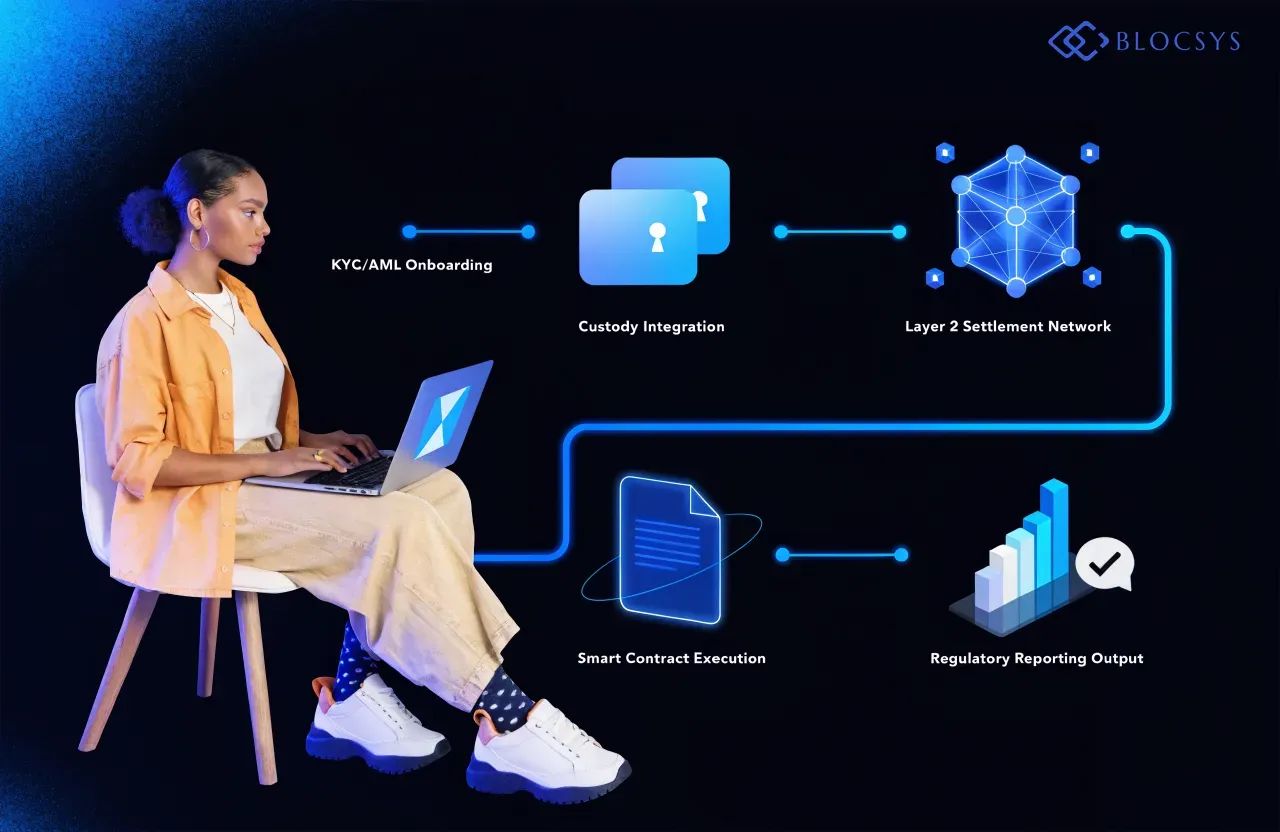
None of this works without solid infrastructure underneath. A digital securities platform needs custody integration, KYC/AML tooling, and settlement rails that talk to both traditional finance and blockchain networks simultaneously.
Ethereum Layer 2 for financial applications has become the default choice for institutions. Why? Lower gas costs, faster finality, and inherited security from Ethereum mainnet. That combination is hard to beat.
Robinhood Chain Layer 2 explained simply: it’s a rollup that batches transactions off-chain, then posts proofs back to Ethereum for security. Users get speed; the network keeps trust anchored to a battle-tested base layer.
Smart Contracts and Settlement Automation
Smart contracts remove manual steps from the settlement process. Once conditions are met, tokens transfer automatically. No wire confirmations, no manual matching between counterparties.
This matters most in corporate actions. Dividend payments, coupon distributions, and bond maturities can all trigger automatically through contract logic. Furthermore, audit trails become immutable, which simplifies regulatory reporting significantly.
How Does Robinhood Chain Work With Smart Contract Settlement Specifically?
Robinhood Chain works by routing every trade through a smart contract that verifies ownership, checks compliance rules, and finalizes settlement in a single automated flow. There’s no separate reconciliation step afterward. The contract is the record.
That single-step model is what institutions are trying to replicate when they ask how does Robinhood Chain work under the hood — they want the automation without rebuilding it from scratch.
Blockchain Interoperability
Blockchain interoperability solutions let tokenized assets move between networks without losing custody guarantees. This is critical because no institution wants to be locked into a single chain.
Cross-chain bridges, standardized token protocols, and shared compliance oracles all play a role here. Without interoperability, tokenized markets fragment into isolated pools of liquidity, which defeats the purpose of tokenization in the first place.
DeFi infrastructure development increasingly focuses on this exact problem, connecting permissioned institutional chains with public liquidity venues while maintaining compliance boundaries.
Security and Compliance
Security isn’t optional at institutional scale. Smart contract audits, multi-signature custody, and continuous monitoring are table stakes now, not add-ons.
Regulation shapes architecture directly. MiCA Regulation compliance affects how European issuers structure token contracts. The DLT Pilot Regime dictates trading venue requirements in the EU. FCA Digital Assets guidance shapes UK custody rules. Get these wrong, and you’re rebuilding from scratch later.
Document integrity matters too. Institutions handling tokenized securities often pair their platforms with a blockchain document verification system to keep issuance records tamper-proof.
Compliance isn’t a checkbox you add after launch, it’s the architecture decision you make on day one. Retrofitting compliance into a live token system is far more expensive than building it in from the start.
Enterprise Implementation Strategy
So how should your institution actually approach this? Start with a narrow use case. Don’t tokenize your entire balance sheet on day one.
Pick one asset class, corporate bonds are a common starting point given regulatory clarity, and build a controlled pilot. Test settlement, custody, and reporting before scaling.
Choosing the right blockchain matters too. Many institutions lean toward Ethereum-based infrastructure for its maturity. If that’s your direction, an Ethereum blockchain elite implementation architecture gives you a proven foundation rather than experimental tooling.
ROI Considerations
| Cost Area | Traditional Model | Tokenized Model |
|---|---|---|
| Back-office reconciliation | High, manual | Reduced via automation |
| Settlement risk | Multi-day exposure | Minimized, near-instant |
| Distribution reach | Limited to accredited channels | Broader, fractional access |
| Infrastructure cost | Legacy system maintenance | Upfront build, lower ongoing cost |
For institutions also active in secondary markets, pairing tokenization with crypto trading platform development or OTC trading platform development creates a complete on-chain financial ecosystem rather than a disconnected pilot.
Future of Institutional Finance
Where’s this heading? Toward full interoperability between tokenized securities, DeFi liquidity, and traditional custody rails. Blockchain capital markets won’t replace existing infrastructure overnight, but they’re absorbing more of it every quarter.
Tokenized investment funds, prediction markets, and hybrid trading models are converging. Institutions exploring newer formats often review prediction markets platform development or hybrid trading prediction market platform development as adjacent revenue streams alongside core tokenization work.
Consumer access is expanding too. Distribution through mobile-first channels, including Telegram Mini App development, is giving tokenized products reach that traditional brokerage apps never had.
Why Choose Blocsys
Blocsys is an enterprise blockchain development company built specifically for institutional tokenization work. We’ve built asset tokenization platforms, RWA infrastructure, and compliance-first digital securities systems for clients navigating MiCA, DLT Pilot Regime, and FCA requirements simultaneously.
Whether you’re scoping equity tokenization, corporate bond tokenisation, or a Robinhood-style Layer 2 build, our team handles architecture, smart contract development, and regulatory alignment end to end. If you’re planning a build, our software development cost estimator gives you a realistic starting budget before you commit.
Institutions asking how does Robinhood Chain work are usually really asking one thing: can we build something like this ourselves, faster and cheaper. We help you answer yes.
Frequently Asked Questions
Here are direct answers to the questions we hear most often about equity, corporate bond, and RWA tokenization.
How does Robinhood Chain work in simple terms?
Robinhood Chain works as a Layer 2 network built on Ethereum, batching trades off-chain for speed and posting security proofs back to the mainnet. Tokenized assets settle in minutes instead of days, with custody handled through regulated partners.
Is corporate bond tokenisation legal in the UK?
Yes. The DLT Pilot Regime and FCA Digital Assets framework give UK institutions a clear regulatory path to issue and trade tokenized bonds, provided they operate within sandbox or approved market infrastructure rules.
What’s the difference between equity tokenization and RWA tokenization?
Equity tokenization specifically converts company shares into blockchain tokens. RWA tokenization is broader, covering bonds, real estate, funds, commodities, and other physical or financial assets represented on-chain.
How much does it cost to build a tokenization platform?
Costs vary based on asset class, compliance scope, and blockchain choice, typically ranging from tens of thousands to several hundred thousand dollars for enterprise-grade builds. Use our cost estimator for a project-specific figure.
Why are institutions choosing Ethereum Layer 2 for tokenization?
Ethereum Layer 2 networks combine mainnet-level security with lower transaction costs and faster settlement. That balance makes them the preferred choice for financial applications handling regulated assets.
Does Blocsys build custom RWA and tokenization platforms?
Yes. Blocsys designs and builds custom equity tokenization, corporate bond tokenisation, and RWA tokenization platforms, including smart contracts, custody integration, and compliance tooling tailored to US, UK, and EU regulations.
Conclusion
Blockchain tokenization has moved past proof-of-concept. US, UK, and European institutions are settling bonds, issuing equity, and tokenizing real-world assets on live infrastructure today. Understanding how does Robinhood Chain work gives you a practical blueprint, but building your own requires the right development partner.
Blocsys builds enterprise-grade tokenization infrastructure, from smart contracts to Layer 2 architecture to regulatory-aligned custody. Ready to move from research to implementation? Talk to our team about Robinhood-style blockchain development and start scoping your tokenization roadmap today.
Ready to move beyond theory and build an intelligent platform that delivers real-world value? Blocsys Technologies specialises in engineering enterprise-grade AI and blockchain solutions for the fintech, Web3, and digital asset sectors. Connect with our experts today to discuss your vision and chart a clear path from concept to a secure, scalable reality.
