
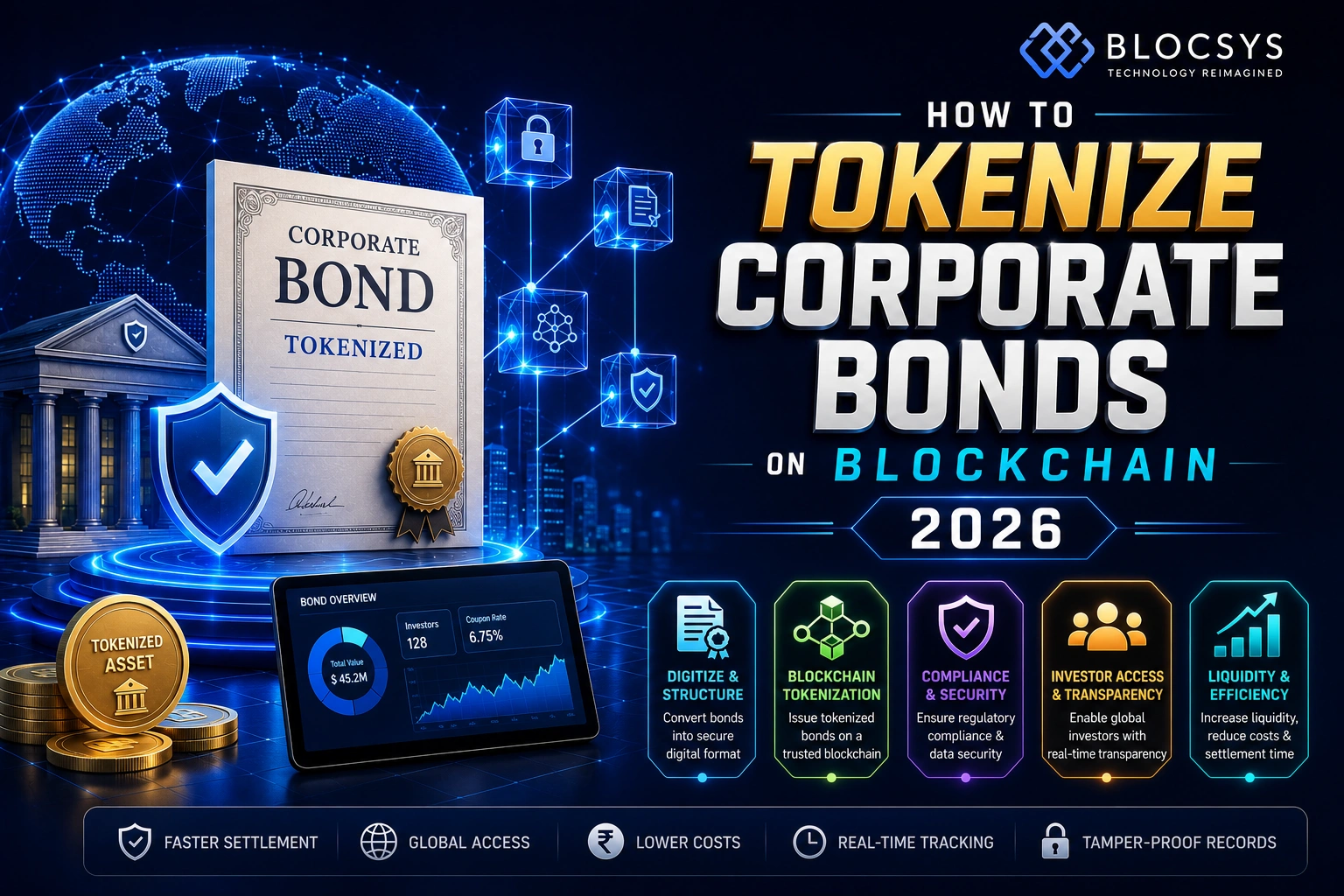
By mid-2025, the tokenized real-world asset market had grown to over $21 billion across more than 15 blockchain ecosystems according to this market analysis. That changes the conversation around corporate bond tokenization. This is no longer a lab exercise for innovation teams. It’s an infrastructure decision for issuers, dealers, custodians, and market operators.
For banks, bond issuers, asset managers, fintechs, and enterprise technology leaders, the question isn’t whether tokenized debt instruments are technically possible. It’s how to tokenize corporate bonds on blockchain in a way that survives compliance review, integrates with existing capital markets operations, and still works after issuance day. That’s where most guides fall short.
This guide is written for decision-makers who need a practical view of digital bond issuance, not just a conceptual one. It covers structuring, smart contracts, investor onboarding, settlement, custody, servicing, and the operational exceptions that usually appear once a live instrument meets real-world workflows. For readers evaluating implementation partners or internal build options, Blocsys also publishes practical resources on Canton Network and digital bond issuance in US capital markets and a useful software development cost estimator for early planning. It’s also worth watching adjacent capital formation activity, including these insights into Latin American tech investment, because tokenized capital markets adoption often follows broader regional fintech maturity.
Table of Contents
- The Inevitable Shift to On-Chain Capital Markets
- The Business Case for Tokenizing Corporate Bonds
- The Corporate Bond Tokenization Process Step-by-Step
- Building on an Enterprise-Grade Technical Foundation
- Navigating Global Regulatory and Compliance Frameworks
- Your Partner for Enterprise Bond Tokenization
- Frequently Asked Questions about Corporate Bond Tokenization
- What is corporate bond tokenization
- How does blockchain improve corporate bond issuance
- How do tokenized corporate bonds work
- What are the benefits of corporate bond tokenization
- Why use DAML for digital securities
- How does Canton Network support corporate bond tokenization
- What compliance requirements apply to tokenized corporate bonds
- How much does it cost to develop a corporate bond tokenization platform
- Can corporate bonds be traded on blockchain
- Why is GIFT City important for digital securities and corporate bond tokenization
- How can Blocsys help build a corporate bond tokenization platform
The Inevitable Shift to On-Chain Capital Markets
More than $21 billion in tokenized real-world assets was already in circulation by mid-2025, spread across over 15 blockchain ecosystems, as noted earlier. For executive teams, that is enough market activity to treat on-chain bonds as an operating model decision, not a lab exercise.
The primary shift is not issuance alone. It is the move to managing the full bond lifecycle on shared digital infrastructure, from bookbuilding and allocation through coupon payments, consent actions, transfers, reconciliations, and maturity. That is the part many market summaries skip, and it is the part that determines whether a programme reduces operating cost or merely adds a new interface on top of the same exceptions.
A tokenized corporate bond changes the control model. Eligibility checks can be enforced at transfer. Settlement status can be visible to the relevant parties in near real time. Investor positions, corporate actions, and servicing events can be synchronized across participants instead of being reconciled after the fact. The hard part is that exceptions do not disappear. Failed allocations, restricted investors, payment breaks, data corrections, and regulator-driven holds still happen. Institutions need workflows that handle those events cleanly.
That is why architecture choices matter early. Teams that start with public chain debates usually miss the operational design questions that determine programme success. Which party has authority to approve a transfer restriction override? How are beneficial ownership records updated after secondary trades? What happens if a paying agent file does not match the ledger state on coupon date? On enterprise platforms built with DAML and privacy-preserving networks such as Canton, those rules can be modeled directly into the transaction flow rather than handled through email and spreadsheet repair.
The pressure to move on-chain is coming from three directions:
- Operations: reduce reconciliations, manual servicing work, and break handling across issuance and post-trade events.
- Distribution: support smaller ticket sizes, digital channels, and broader investor access without rebuilding each process for every deal.
- Control: encode transfer rules, investor permissions, and auditability into the workflow itself.
This operating model matters most for institutions that expect repeat issuance and active lifecycle management:
- Issuers and arranger banks: They need a reusable framework for multiple bond programmes, amendments, and servicing events.
- Asset managers and distributors: They need onboarding, allocation, holdings visibility, and reporting to remain consistent across primary and secondary activity.
- CTOs and CIOs: They need systems that connect with KYC, custody, payments, treasury, registrar, and compliance infrastructure already in production.
- Digital asset and market infrastructure providers: They need support for regulated securities workflows, not only crypto-native transfers.
For teams assessing implementation paths, this overview of digital bond issuance in the US using Canton Network is a useful reference point because it focuses on market structure and enterprise integration, not only token creation.
Regional momentum also matters. Firms watching issuance and digital asset adoption in emerging markets can use these insights into Latin American tech investment as a signal that the supporting ecosystem is maturing alongside institutional demand.
The institutions that move first do not gain an advantage from putting one bond on-chain. They gain it from building a controlled issuance and servicing model they can run repeatedly, with fewer handoffs, clearer exception management, and better auditability.
The Business Case for Tokenizing Corporate Bonds
The commercial case for corporate bond tokenization is straightforward when you compare process design, not just technology labels. Traditional issuance is fragmented. Legal documents, registrar workflows, settlement messaging, custody records, and investor servicing often sit across disconnected systems and service providers. Tokenization creates a chance to redesign that stack around a shared source of truth.
Where the traditional model breaks down
The hidden cost in conventional bond operations usually isn’t one large fee. It’s the accumulation of checks, handoffs, reconciliations, and delay buffers across the lifecycle.
The Bank for International Settlements found that tokenised bonds had a mean bid-ask spread of about 19 basis points, compared with 30 basis points for conventional bonds from the same issuers, representing an 11 basis point improvement and a roughly 36% reduction in trading costs according to the BIS assessment. For executive teams, that’s not just a market structure detail. It’s evidence that tokenization can improve tradability and execution efficiency even before the market reaches full scale.
A useful background read for teams evaluating the broader asset side of this shift is Blocsys’ guide to how real-world asset tokenization works in blockchain.
Traditional Bonds vs. Tokenized Bonds
| Attribute | Traditional Corporate Bonds | Tokenized Corporate Bonds |
|---|---|---|
| Issuance workflow | Paper-heavy and document-fragmented | Digitally orchestrated with programmable asset logic |
| Investor eligibility | Often checked through onboarding and manual controls | Can be enforced at token transfer level |
| Settlement model | Multi-party coordination with operational lag | Programmable settlement within the platform design |
| Register management | Often split across agents and record systems | Shared digital record with controlled permissions |
| Secondary transfer controls | Broker, custodian, and market-rule dependent | Transfer restrictions can sit inside smart contract rules |
| Coupon servicing | Operationally scheduled and reconciled | Can be automated with controlled event triggers |
| Corporate actions | Manual interpretation and execution-heavy | Can be modelled with approval workflows and fallback handling |
| Auditability | Evidence spread across systems | Event history is easier to trace within a unified ledger design |
What actually improves for issuers and investors
For issuers, the key benefit is process compression. A tokenized bond can align issuance, allocation, settlement, and servicing inside a coordinated workflow instead of passing responsibility across multiple disconnected systems.
For investors, the advantage is cleaner access and better transfer mechanics. Lower minimum investment models have already appeared in market implementations, and that matters for distributors trying to widen participation without weakening controls.
Practical rule: Don’t build the business case around “blockchain efficiency” in the abstract. Build it around fewer manual approvals, cleaner transfer controls, faster servicing, and a more usable instrument for investors.
What doesn’t work is treating tokenization as a cosmetic wrapper. If documentation, compliance, settlement, and servicing still rely on parallel offline processes, the institution takes on new technology without removing old friction.
The Corporate Bond Tokenization Process Step-by-Step
Bond tokenization projects rarely fail at issuance. They fail later, when coupon servicing, transfer exceptions, and investor changes still depend on email, spreadsheets, and manual approvals outside the ledger.
A workable programme follows the full bond lifecycle, from structuring through maturity, with explicit controls for day-2 operations. That is the difference between a pilot and an operating model a treasury, trustee, paying agent, and compliance team can support in production.
Pre-issuance structuring
The design decisions made here determine whether the bond can be serviced predictably after launch.
Start with the legal and commercial terms. Define coupon structure, maturity, denomination, investor class, transfer restrictions, governing law, paying agent responsibilities, record-date logic, and corporate action scenarios. Then map those terms into system behaviour. If the bond includes redemption triggers, consent thresholds, approval chains, or investor eligibility gates, those rules need to be expressed as workflow logic before development starts.
One choice has outsized impact. Decide whether the token is the primary on-ledger record of the security or a controlled digital representation linked to an external registrar or custody record. That decision affects settlement design, beneficial ownership tracking, reconciliation effort, and how exceptions are handled when on-chain and off-chain records diverge.
Teams that want to pressure-test scope before build usually benefit from a structured pre-implementation review. This RWA tokenization checklist for asset tokenization projects is a useful starting point.
Issuance and token minting
Once the legal model is settled, the platform team can implement the bond instrument and the issuance workflow.
At minimum, the platform should support:
- Instrument definition: Bond terms are stored as machine-readable parameters with clear version control.
- Identity linkage: Approved wallets or digital identities are tied to permitted investors and account structures.
- Mint controls: Only authorised roles can create supply, with issuance approvals recorded in the ledger history.
- Transfer policy: Secondary transfers are checked against investor status, jurisdiction, holding limits, and any lock-up conditions.
- Event hooks: Coupon dates, notices, maturity, redemption windows, and servicing milestones trigger governed operational processes.
The token contract is only one component. Production issuance also requires approval orchestration, cash-leg integration, document distribution, reporting, and an audit trail that operations and internal audit can verify. Institutions often review infrastructure partners early at this stage, including top AWS cloud consultants, because deployment choices affect resilience, key management, monitoring, and integration cost.
A technical explainer is useful here before moving further:
Distribution and secondary trading
At this point, the instrument starts behaving like a security rather than a demo.
Investors are onboarded, screened, mapped to authorised identities or wallets, and allocated positions after subscription closes. In a controlled design, post-issuance transfers do not depend on repeated manual review of every transaction. Eligibility rules, holding constraints, and transfer permissions are enforced by the platform, with override paths reserved for approved exception handling.
Secondary trading can be supported through a permissioned venue, bilateral transfer workflows, or a hybrid model that reflects the institution’s target investor base. The right choice depends on market structure, local regulation, expected liquidity, and the role of existing intermediaries. What matters is consistency across ownership records, transfer approvals, settlement timing, and post-trade reporting.
Servicing redemption and day-2 operations
This is the part many tokenization guides under-specify, and it is where operating cost and operational risk become visible.
Coupon events, record dates, tax treatment, notices, investor status changes, early redemptions, and corrections need governed workflows. Some events can be automated end to end. Others require human approval, timed intervention, or temporary suspension while legal or compliance teams review the case. A platform that cannot handle both paths will push exceptions back into email and spreadsheets, which defeats the point of tokenization.
Common failure points include:
- Failed coupon servicing: Payment rails reject an instruction, account details change, or a cut-off is missed.
- Blocked transfers: A sanctions update, KYC expiry, pledge restriction, or investor classification change stops delivery.
- Voluntary events: Consent solicitations, partial redemptions, restructurings, and covenant-triggered actions require approvals and investor communications.
- Error correction: Misallocation, duplicate booking, or incorrect entitlement data requires pause rights, remediation logic, and a clear audit record.
If the legal instrument allows discretion, the operational model must allow controlled intervention. That usually means role-based approvals, explicit pause and resume rights, versioned business rules, and synchronized updates across ledger, cash systems, and investor reporting. In enterprise deployments, technologies such as DAML and Canton Network are pertinent. They support multi-party workflow control, privacy boundaries, and state consistency across participants without forcing every exception into a custom side process.
The institutions that get bond tokenization into production design for routine operations and for the moments when routine operations break. This forms the actual step-by-step process.
Building on an Enterprise-Grade Technical Foundation
Institutional bond tokenization fails when teams pick infrastructure that fits open crypto markets but not regulated debt workflows. Public chain design patterns can be useful for experimentation, but they usually create difficult questions around privacy, permissions, workflow control, and operational governance.
Why public-chain patterns often fail institutional debt workflows
A tokenized corporate bond isn’t just an asset contract. It’s a multi-party legal and operational process involving issuers, arrangers, paying agents, custodians, compliance teams, and investors.
That creates architecture requirements that are hard to compromise on:
- Privacy controls: Not every participant should see every data field or transaction detail.
- Rights and obligations modelling: The system needs to reflect actual legal relationships between named parties.
- Operational governance: Pause rights, approvals, and exception handling must be explicit.
- Interoperability: Institutions rarely run one monolithic application stack.
For cloud and infrastructure planning, teams often benchmark providers and integration partners before selecting their deployment model. A practical reference point for that side of the stack is this directory of top AWS cloud consultants, especially when tokenization platforms need enterprise hosting, monitoring, and security patterns.
Why DAML fits digital securities
DAML is well suited to digital securities because it models agreements, workflows, permissions, and state changes as first-class concepts. That matters in debt markets, where the instrument is only one part of the process. The surrounding approvals, participant roles, entitlements, and obligations are just as important.
In practice, DAML helps institutions express:
- Who can see what
- Who can initiate or approve an event
- What conditions must be met before a transfer or servicing action occurs
- How auditability is preserved without exposing unnecessary data
That’s why many enterprise architects prefer it over generic smart contract stacks when building regulated instruments. For teams exploring architecture patterns, this guide on building a tokenization platform with DAML and Canton Network is a useful technical reference.
Where Canton Network matters
Canton Network becomes relevant when multiple private applications need to transact without collapsing privacy into a shared public state.
That is the institutional interoperability problem in one sentence. Different market participants want shared certainty, but they don’t want universal visibility. Canton’s design supports synchronisation across applications while preserving permissioned data boundaries, which is closer to how regulated financial markets operate.
One market option in this category is Blocsys, which builds tokenization and digital asset systems for enterprise use cases including bond tokenization frameworks, DAML smart contract development, and Canton-based infrastructure. The value of that kind of approach is architectural alignment. The technology stack fits regulated workflows instead of forcing capital markets processes into crypto-native assumptions.
Navigating Global Regulatory and Compliance Frameworks
Compliance can’t sit at the edge of a tokenized bond platform. It has to sit inside the asset logic and the surrounding workflow model. Otherwise, the institution ends up checking rules at onboarding and hoping the asset behaves later. That isn’t enough for regulated debt instruments.
Compliance needs to sit inside the asset logic
The practical model is compliance-by-design. The platform encodes transfer restrictions, identity rules, investor eligibility, and approval conditions so they operate during issuance and throughout the bond’s life.
For India-specific corporate bond tokenization, smart contracts must implement ERC-3643 (T-REX) standards to encode transfer restrictions that enforce SEBI-accredited investor eligibility directly at the token level, ensuring only whitelisted on-chain identities can hold or transfer tokens, according to this explanation of tokenized bond mechanics. For executives, the lesson is broader than one jurisdiction. Transfer compliance should be enforced by asset behaviour, not only by front-end onboarding.
A broader operating lens for teams designing these controls is Blocsys’ framework for Web3 regulatory compliance.
The same principle applies across markets such as the UAE, Singapore, Europe, the UK, Switzerland, and the US. Local rules differ, but the design pattern is consistent. Identify the legal holder class, define who may transact, determine how identity is verified, and embed those rules into system behaviour so operations teams aren’t manually policing every transfer.
Compliance-by-design works best when legal, operations, and engineering define exceptions together. If one group designs in isolation, gaps appear immediately after go-live.
GIFT City and the India opportunity
GIFT City (IFSC) deserves attention because it gives India a focused environment for international financial activity, digital securities innovation, and modernised capital markets infrastructure.
For bond issuers and institutions operating in or through GIFT IFSC, the opportunity is practical. A permissioned digital securities stack can support issuance workflows, investor eligibility controls, auditable servicing, and cross-party coordination in a structure that looks familiar to regulated institutions. That’s where DAML and Canton Network become especially relevant. They allow firms to model rights, obligations, approvals, and privacy in a way that fits institutional finance better than generic token contracts.
The strongest implementation approach in GIFT City is usually hybrid. Keep legal certainty, compliance, and regulated participant controls at the centre. Then use tokenization to improve issuance, transfer governance, reporting, and servicing.
Your Partner for Enterprise Bond Tokenization
A serious corporate bond tokenization programme has to do four things well. It has to represent the bond correctly, enforce investor and transfer controls, connect with enterprise operations, and keep working when real servicing exceptions show up.
That combination is why many institutions struggle to move from pilot to production. Legal teams think in terms of rights and restrictions. Operations teams think in terms of exceptions and reconciliations. Engineering teams often start with contracts and APIs. A production platform has to unify all three views.
For financial institutions, bond issuers, asset managers, and fintech providers evaluating a build or implementation path, Blocsys aligns with that enterprise requirement set. The company works across corporate bond tokenization, RWA tokenization, DAML smart contract development, Canton Network development, enterprise blockchain solutions, and digital securities platform development. That makes it relevant for firms designing issuance infrastructure, investor onboarding flows, settlement orchestration, and lifecycle servicing for tokenized debt instruments.
The right next step isn’t another generic blockchain workshop. It’s a scoped architecture and operating model review that answers the hard questions early. What is the legal representation of the instrument, where does compliance live, how are lifecycle exceptions handled, and which systems remain off-chain by design.
How UK Businesses Can Tokenise Corporate Bonds
UK businesses and financial institutions can use blockchain infrastructure to tokenise corporate bonds, creating digital representations of bond ownership and enabling more efficient issuance, transfer, and settlement. Tokenising corporate bonds can improve transparency across ownership records, automate parts of the bond lifecycle through smart contracts, and reduce operational complexity. For organisations targeting the UK market, the ability to tokenise corporate bonds should also be considered alongside applicable securities regulations, investor requirements, and compliance controls.
Tokenizing Corporate Bonds on Blockchain in GIFT City
GIFT City provides a relevant context for businesses exploring blockchain-based corporate bond tokenization. The process can involve structuring the bond as a digital asset, defining the token, implementing the required blockchain infrastructure, and establishing workflows for issuance, ownership management, transfers, and settlement. For businesses considering corporate bond tokenization in GIFT City, following a structured development approach can help create a more efficient and organized digital bond platform.
Frequently Asked Questions about Corporate Bond Tokenization
What is corporate bond tokenization
Corporate bond tokenization is the legal and operational representation of a bond on distributed ledger infrastructure. In a production setup, the token is only one part of the model. The platform also has to enforce holding rules, record ownership changes, process coupon and redemption events, and handle exceptions such as failed settlements, investor offboarding, and transfer rejections.
How does blockchain improve corporate bond issuance
It improves issuance by reducing reconciliation work across issuance records, allocation workflows, approvals, and settlement instructions. A shared transaction model can shorten the path from order capture to final allocation and give issuers, arrangers, custodians, and investors a more consistent audit trail.
The gain is not automatic. Institutions still need to integrate treasury systems, investor onboarding, payment rails, and reporting processes if they want lower operating cost and faster execution.
How do tokenized corporate bonds work
The issuer defines the bond terms, investor eligibility rules, transfer restrictions, servicing events, and maturity logic. Those terms are implemented in application logic and legal documentation, then represented on the ledger through controlled token issuance.
After issuance, the hard work starts. The platform has to support position changes, coupon calculations, payment confirmations, corporate actions, ledger corrections where permitted, and off-chain system reconciliation. That post-issuance operating model is where many pilots fail.
What are the benefits of corporate bond tokenization
The main benefits are better control over distribution, stronger rule enforcement, clearer auditability, and less manual coordination across parties. For some institutions, tokenization also makes smaller denominations, new investor channels, and more structured secondary transfer workflows commercially realistic.
The return on investment usually comes from fewer breaks in operations, lower servicing overhead on eligible products, and better data quality across the bond lifecycle.
Why use DAML for digital securities
DAML is well suited to digital securities because it models rights, obligations, approvals, and visibility rules directly. That matters in bond workflows, where different parties need a shared state but should not see all data.
It also supports lifecycle logic more cleanly than many generic smart contract approaches. For corporate bonds, that includes subscription approvals, transfer consent, record-date handling, coupon events, maturity processing, and exception workflows that operations teams will face in production.
How does Canton Network support corporate bond tokenization
Canton Network supports synchronized workflows across institutions while keeping data private to the parties that need to see it. That is a better fit for regulated debt markets than public-by-default architectures.
In practice, this helps institutions coordinate issuance, settlement, servicing, and reporting across issuers, dealers, custodians, paying agents, and investors without forcing all participants into one shared database model.
What compliance requirements apply to tokenized corporate bonds
Requirements depend on jurisdiction, instrument structure, investor type, custody model, and whether secondary trading is allowed. Typical workstreams include securities law analysis, investor qualification, KYC and AML controls, disclosure obligations, transfer restrictions, books-and-records requirements, reporting, tax handling, and market infrastructure rules.
Compliance also has to continue after issuance. If an investor loses eligibility, a transfer is challenged, or a corporate action changes the instrument terms, the platform and operating model must support controlled intervention.
How much does it cost to develop a corporate bond tokenization platform
Cost depends on what is being built. A limited issuance portal is materially different from a production platform that includes onboarding, entitlement checks, settlement orchestration, custody connectivity, lifecycle servicing, reporting, and exception handling.
Budgeting should cover more than smart contract development. The largest cost drivers are usually integration with enterprise systems, security and environment setup, legal and compliance design, operating model definition, test cycles with counterparties, and post-launch support. A practical starting point is the Blocsys cost estimator at https://blocsys.com/software-development-cost-estimator/.
Can corporate bonds be traded on blockchain
Yes, if transfers are supported within the applicable legal and market structure. That can mean bilateral transfers between approved holders, transfers within a permissioned network, or trading through a regulated venue.
Blockchain does not remove transfer controls. The platform still needs to check investor eligibility, enforce holding restrictions, coordinate settlement status, and keep ownership records aligned with the governing legal model.
Why is GIFT City important for digital securities and corporate bond tokenization
GIFT City matters because it gives institutions a defined environment for building and testing digital capital markets infrastructure within a regulated international finance context. For firms assessing tokenized bonds, that can make structuring, participant access, and cross-border workflow design more practical.
Its relevance depends on the issuance strategy. It is more useful for institutions evaluating cross-border distribution and digital market infrastructure than for every domestic bond program.
How can Blocsys help build a corporate bond tokenization platform
Blocsys can support solution architecture, DAML contract design, Canton Network implementation, compliance-aware workflow design, and integration with enterprise systems involved in issuance and servicing. That includes the operating realities often missed in early planning, such as lifecycle event processing, exception queues, reconciliation design, and role-based data visibility across institutions.
For executive teams, the practical question is whether the platform can support real issuance volume and post-trade operations without adding a new layer of operational risk. That is the standard any enterprise bond tokenization program should use.
If you’re planning a corporate bond tokenization initiative and need a practical path from structuring to production, connect with Blocsys Technologies. Blocsys works with financial institutions, bond issuers, fintechs, and enterprise teams on corporate bond tokenization, RWA tokenization, DAML smart contract development, Canton Network development, enterprise blockchain solutions, and digital securities platform development.
