
You’re probably in one of two situations right now. Either your team has already agreed that tokenized corporate bonds are worth serious evaluation, but the architecture still feels vague. Or you’ve had three meetings in a row where legal, product, treasury, and engineering all used the same words while meaning different things.
That’s normal. Search results around corporate bond tokenization platform development mostly chase the same angle: broad tokenization benefits, generic blockchain stacks, and compliance talk anchored in US, UK, or EU frameworks. They rarely help the people who have to ship the platform. The gap is sharper if you’re dealing with India-linked operations, multi-jurisdiction issuance, or institutional workflows that need privacy, auditability, and deterministic servicing.
This guide is for CTOs, digital asset heads, capital markets teams, fintech founders, and enterprise decision-makers who need a buildable answer. It focuses on features, cost, technology choices, and the part competitors usually ignore: the difference between data science and big data decisions inside a bond tokenization platform. If you need a practical baseline on tokenized assets before diving deeper, start with how real-world asset tokenization works in blockchain.
Table of Contents
- Introduction
- Understanding Data Science and Big Data
- Comparing Goals Data Characteristics and Architecture
- Technology Stack and Cost Analysis
- Team Skills Workflows and Roadmap
- Use Cases and Decision Criteria
- Why Choose Blocsys and Next Steps
Introduction
A corporate bond tokenization platform is not just a ledger with a dashboard. It’s a regulated workflow system for issuance, allocation, settlement, custody coordination, transfer controls, coupon servicing, redemption, and reporting. If your design starts with token minting and ends with a wallet screen, you’re building a demo, not market infrastructure.
Financial institutions in the UAE, Dubai, Abu Dhabi, Europe, the UK, the USA, Singapore, Germany, Switzerland, the Netherlands, Canada, Australia, and India are all asking the same practical questions. Which stack handles privacy properly? Where should DAML fit? When does Canton Network make more sense than a generic chain? What should stay off-chain? What will this cost? And which parts of the data architecture deserve machine learning versus simple event streaming?
I’ve seen teams overcomplicate the chain layer and underfund the data layer. That’s backwards. Bond tokenization succeeds when the platform handles policy, audit, and integration cleanly. Everything else is secondary.
Understanding Data Science and Big Data
When planning a digital securities platform, data science and big data are often confused. They’re related, but they solve different problems. In corporate bond tokenization, that distinction affects architecture, compliance design, cost, and even your hiring plan.
Why this distinction matters in bond tokenization
Data science is about extracting insight from data. Big data is about handling large, fast, diverse streams of operational data reliably. In a bond platform, you usually need both, but not in equal proportion.
The regulatory gap matters here. Existing coverage still leans heavily toward SEC, FCA, and VARA-style discussions while leaving India underexplained, despite the need for more actionable guidance around the Indian regulatory environment, as noted by Blocsys on corporate bond tokenization platform development. That matters because Indian market design pushes stronger emphasis on auditable operations, policy enforcement, and domestic integration realities.
If your institution segments issuers, distributors, or investor cohorts before platform rollout, the same discipline used in segmenting B2B markets for outbound is surprisingly useful here. Good segmentation improves onboarding rules, investor eligibility logic, and workflow design before code gets written.
Where data science fits
Use data science when you want the platform to make better decisions, not merely record events.
That includes:
- Risk scoring for issuers or offerings based on historical defaults, covenant patterns, or servicing behaviour
- Compliance anomaly detection for suspicious transfer attempts or unusual investor movement
- Coupon and redemption forecasting for treasury planning and liquidity readiness
- Document intelligence that extracts structured terms from legal packs and issuance templates
This layer usually works best off-chain. Keep the model outputs, policy flags, and final decisions available to the workflow engine, but don’t try to force ML inference into the ledger itself. That adds complexity without helping legal certainty.
For teams designing ingestion and transformation flows, a solid data pipeline architecture matters more than any AI label. Without disciplined ingestion, your models won’t be trustworthy enough for issuance or compliance decisions.
Where big data fits
Big data is the operational backbone. It ingests and processes high-volume events from user onboarding, sanctions checks, document repositories, custody systems, approval workflows, token issuance, transfer events, coupon schedules, settlement messages, and admin logs.
That’s the right approach when you need to:
- Capture every critical state change across the platform
- Maintain a tamper-evident audit trail for compliance and operations
- Stream settlement and transfer events into downstream systems
- Support T+0 style orchestration without manual reconciliation queues
- Monitor operational health across services, APIs, validators, and integrations
Big data keeps the system accountable. Data science makes the system smarter.
In bond tokenization, most institutions should prioritise big data first. You can launch a production platform with event streaming, policy engines, and analytics dashboards. You can’t safely launch with half-built observability and hope machine learning will save you later.
Comparing Goals Data Characteristics and Architecture
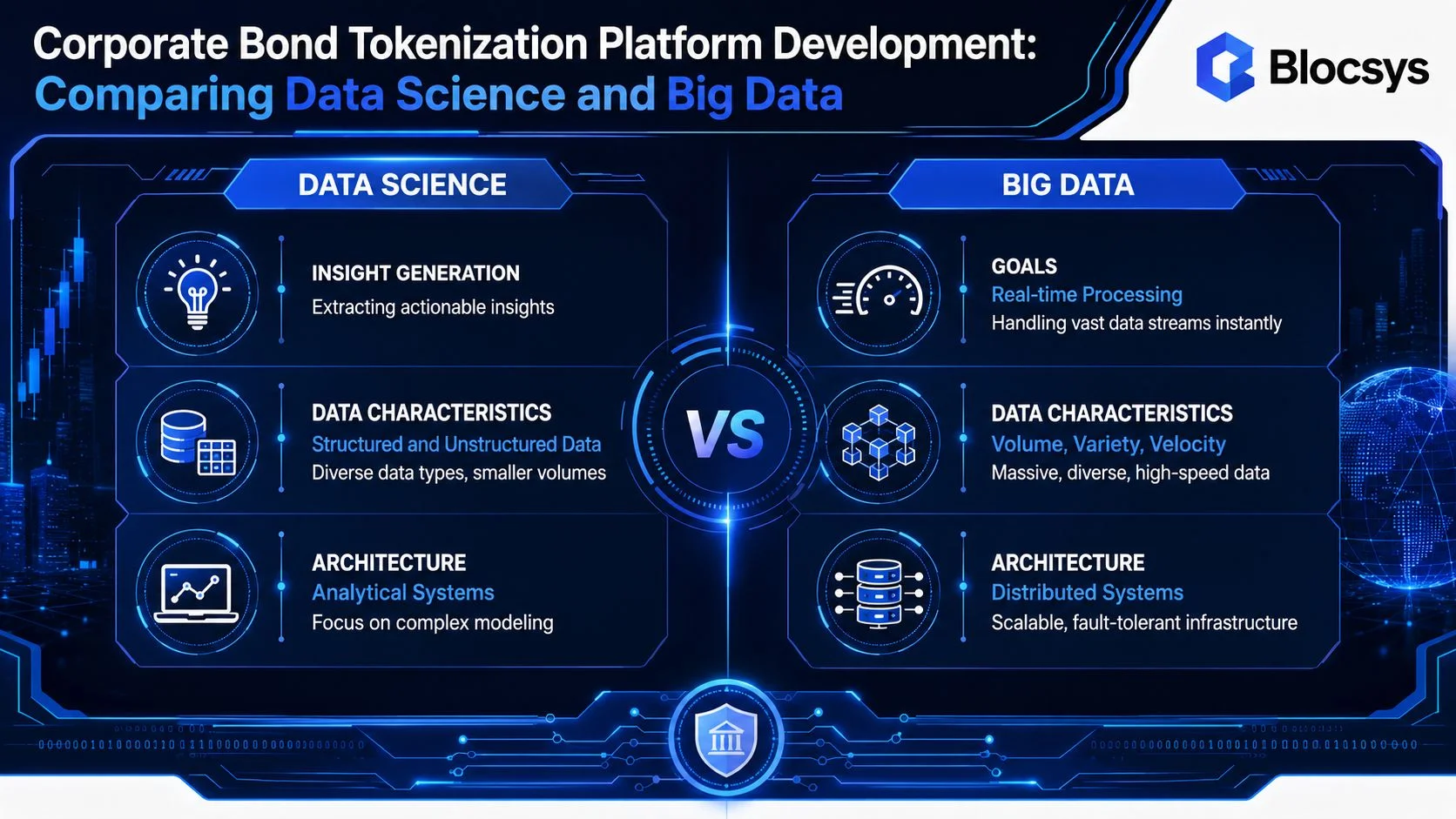
Some teams ask whether they should build a data science layer or a big data layer. That’s the wrong question. The right question is which one should dominate the architecture for your first production release.
A side by side view
| Dimension | Data Science | Big Data |
|---|---|---|
| Primary goal | Generate insight and prediction | Process and govern operational events |
| Typical bond data | Bond terms, issuer profiles, compliance outcomes, payment history | Transfer logs, KYC events, audit events, settlement messages, admin actions |
| Data shape | Structured and unstructured, often curated | High-volume, high-velocity, event-heavy |
| Best use in tokenization | Risk modelling, anomaly detection, servicing forecasts | Event streaming, auditability, workflow orchestration, reporting |
| Latency expectation | Often near-real-time or batch | Real-time or close to real-time |
| Core architecture | Model pipelines, feature stores, analytics services | Distributed event buses, data lakes, stream processors, monitoring stacks |
| Failure mode | Weak predictions or poor signal quality | Lost events, broken reconciliation, compliance blind spots |
The architecture trade off most teams miss
A bond tokenization platform has at least three data planes.
First, the transaction plane. This is the ledger state, token balances, contract state, and transfer approvals.
Second, the workflow plane. This includes approval systems, legal repositories, KYC providers, treasury systems, custodians, investor onboarding, and servicing jobs.
Third, the intelligence plane, comprising analytics, anomaly detection, dashboards, and predictive models.
Most failed designs collapse all three into one stack. That creates brittle systems.
Practical rule: Keep legal state and workflow state tightly controlled. Keep analytical experimentation outside that critical path.
The stronger pattern is a policy-centric, event-driven design. The chain or DLT handles asset state and permissioned coordination. Middleware handles orchestration and integrations. Stream processing captures every event. Analytics and ML consume the event history without directly owning the bond record.
How to choose the right operating model
Choose data science first only if your competitive edge depends on differentiated underwriting, issuer scoring, or compliance intelligence. That’s more common for asset managers and risk-heavy credit products than for standard issuance rails.
Choose big data first if your immediate goal is regulated issuance, servicing automation, cross-system auditability, and post-trade reliability. That’s the right call for most banks, exchanges, custodians, and enterprise issuers.
A practical choice framework looks like this:
- Go data science-heavy when your team needs predictive insight across portfolios, private credit risk, or complex eligibility scoring.
- Go big data-heavy when your team must prove every user action, approval, transfer, and servicing event to operations, auditors, and regulators.
- Use both when scaling into multi-issuer or multi-asset infrastructure with secondary liquidity, rich reporting, and institutional analytics.
If you’re choosing between elegance and auditability, choose auditability. Bond platforms don’t fail because the dashboard looked plain. They fail because someone can’t reconstruct a transfer decision six months later.
Technology Stack and Cost Analysis
A bank approves a bond tokenization pilot, then loses three months arguing over chain choice while the primary cost drivers sit elsewhere. The budget does not blow up because DAML was expensive or because Kafka needed one more broker. It blows up because no one priced data retention, reconciliations with treasury systems, Indian compliance workarounds, security reviews, and manual exception handling from day one.
Start with the stack that matches bond operations, not crypto fashion.
For the ledger layer, permissioned infrastructure fits institutional debt better than public-first architectures in most enterprise cases. DAML with a Canton-style setup is a strong option where transaction privacy, participant-level visibility, and controlled workflows matter. EVM stacks still fit narrower issuance models, but they shift more burden onto custom contract design, off-chain policy engines, and privacy controls. That trade-off raises engineering risk fast.
The contract model matters more in bonds than in simple token issuance. Coupon schedules, maturity events, transfer restrictions, role-based approvals, and servicing exceptions need explicit state transitions and audit trails. Teams comparing implementation options should review this DAML smart contract development guide for architecture and workflow choices.
At the application and data layer, the right stack usually looks like this:
- Workflow services for issuance orchestration, allocation logic, covenant checks, and lifecycle servicing
- Compliance services for KYC, AML, sanctions screening, investor eligibility, and jurisdiction rules
- Data pipelines for event capture, reconciliation, reporting, surveillance, and regulator-ready audit exports
- Portals and ops consoles for issuers, investors, trustees, compliance teams, and support staff
- Integration middleware for core banking, payment rails, custody systems, document stores, and notification systems
Here, data science and big data choices start to diverge in cost.
If your platform is big data-heavy, spend goes into streaming, storage, observability, lineage, and reporting. Expect higher infrastructure and data engineering cost, but lower operational pain later. If your platform is data science-heavy, spend moves toward feature engineering, model pipelines, analyst tooling, and governance around scoring and decision support. That can improve pricing, issuer screening, or risk surveillance, but it does not replace the need for an event-grade system of record.
For corporate bonds, I would fund big data plumbing first.
A practical enterprise stack often includes DAML or another permissioned ledger layer, Java or Kotlin backend services, PostgreSQL for transactional services, Kafka for event streaming, object storage for immutable records, a warehouse such as BigQuery or Snowflake for analytics, and Power BI or Superset for regulated reporting. Python belongs in the stack if you are building risk models, anomaly detection, or investor behavior analytics. It should not own lifecycle truth.
Cost comparison for tokenization platforms
Cost discussions in this category are often too shallow. Vendors quote token issuance screens and leave out audit evidence, data retention policy, exception queues, and operations support. Those are not side items. They decide whether the platform survives its first real issuance.
India-based builds can look cheaper on paper, but the discount narrows once you add legal structuring, regulated data handling, maker-checker workflows, and integrations with incumbent financial systems. Public guidance from enterprise tokenization cost studies consistently shows that simple MVPs are one budget, while institutional platforms with compliance controls, integrations, and security assurance move into a different range entirely. The gap is large because the hard part is not minting tokens. The hard part is running debt infrastructure that can stand up to audits and disputes.
A useful way to budget is by capability, not by vague labels such as MVP or enterprise:
| Cost Area | What You Are Paying For | Cost Pressure |
|---|---|---|
| Ledger and contract layer | Asset model, permissions, lifecycle logic, testing | Moderate at first, high if workflows are custom |
| Backend and integrations | Banking APIs, payment flows, custody, document systems, servicing | Usually the biggest build cost |
| Data and reporting | Streaming, warehousing, regulator reports, audit exports, monitoring | Often underestimated |
| Security and assurance | Contract review, infra review, access controls, logging, DR planning | Expensive, unavoidable |
| Legal and compliance setup | Issuance structure, investor eligibility, disclosures, recordkeeping | High variance by jurisdiction |
What actually drives the budget up
The expensive parts are boring, and that is exactly why teams miss them.
Security audits can cost tens of thousands of dollars, and legal structuring for SPVs or compliant issuance vehicles can cost materially more than early product teams expect, as outlined in Pedex’s hidden fee analysis for enterprise tokenization projects. Annual maintenance also stays high because regulated platforms need patching, monitoring, reporting updates, certificate renewals, vendor support, and periodic control reviews. Budget for that from the start.
India adds its own friction. The rulebook for tokenized corporate bonds is still fragmented across securities law, digital recordkeeping expectations, KYC obligations, and settlement realities. There is no single clean operating standard that product teams can implement once and forget. That gap forces firms to build extra policy layers off-chain, maintain stricter data segregation, and keep more evidence for internal audit and external review. Those controls increase cost even if the core tokenization logic looks simple.
This is the hidden bill competitors skip: reconciliation jobs, exception dashboards, document versioning, investor communication trails, and archive storage. None of it looks impressive in a demo. All of it matters in production.
There is still a strong business case. Finantrix’s analysis of institutional tokenization economics for bonds and equities points to lower issuance costs when digital infrastructure replaces manual issuance and servicing steps at scale. The savings appear only when the operating model is disciplined. For teams trying to control early infrastructure spend, it also helps to reduce runway with cloud credits during pilot and staging setup.
Team Skills Workflows and Roadmap
The wrong team composition can sink a bond tokenization initiative faster than a bad chain choice. You need people who understand fixed-income workflows, not just wallets and smart contracts.
Who you actually need on the team
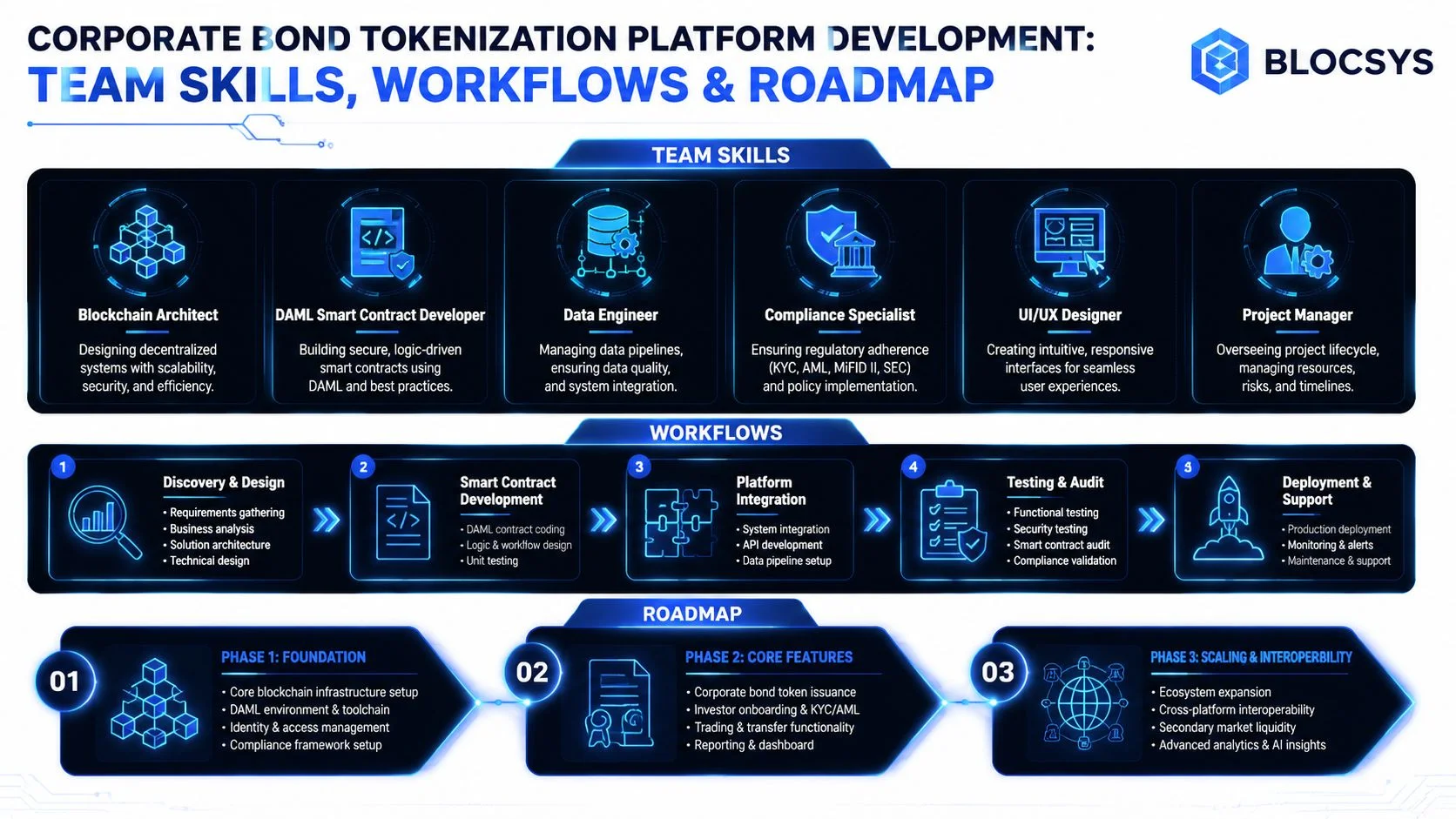
A production build usually needs six core roles.
- Blockchain architect to define the network model, privacy boundaries, contract topology, and integration patterns
- DAML smart contract developer if you’re modelling controlled workflows, rights, obligations, and selective visibility
- Data engineer to build event pipelines, reporting flows, observability, and downstream analytics
- Compliance specialist to map KYC, AML, sanctions, eligibility, and jurisdiction rules into product behaviour
- UI and UX designer for issuer, investor, and operations dashboards
- Project manager or delivery lead to align legal, business, and engineering dependencies
If you’re hiring internally, Recruiting resources for Blockchain talent can help define role scopes more clearly than generic Web3 job descriptions. Most enterprise projects fail because they hire Solidity-first talent for workflow-heavy infrastructure.
A sensible delivery workflow
Put the process in this order:
Requirements and legal mapping
Define the issuance structure, investor classes, custody model, transfer restrictions, servicing logic, and reporting obligations.Architecture design
Decide what lives on-chain, what stays off-chain, how policies are enforced, and where event capture happens.Smart contract and service development
Build DAML templates or equivalent workflow contracts alongside orchestration services and admin tooling.Integration testing
Connect KYC providers, legal repositories, treasury systems, settlement systems, and reporting pipelines.Security and control review
Run contract audits, access control validation, and operational resilience testing.
A short explainer can help align technical and business stakeholders:
A practical 12 to 24 month roadmap
A realistic roadmap has three phases.
Phase 1 is the foundation. Build the issuance engine, identity layer, transfer policy controls, and auditable event model.
Phase 2 is operational maturity. Add coupon automation, maturity redemption, exception handling, reporting, and custody coordination.
Phase 3 is scale and interoperability. Expand to multi-issuer workflows, secondary transfer models, broader analytics, and cross-network interoperability where justified.
Match your hiring plan to the architecture. A data-heavy platform without data engineers turns into expensive improvisation.
If your organisation is struggling to assemble a delivery team, Blocsys’s guide to blockchain startup talent challenges is useful because it addresses retention and team-shape issues that pure recruitment guides tend to skip.
Use Cases and Decision Criteria
A treasury team approves a tokenized bond pilot. Six months later, the contracts work, the dashboard looks polished, and the economics still fail because the platform was built for token issuance, not for data operations. That mistake is common in corporate bond tokenization. A core decision is not only public chain versus permissioned network. It is whether your operating model depends more on high-volume event infrastructure or on analytics-heavy decision systems.
Three realistic deployment scenarios
Investment bank issuing private credit instruments
Start with big data discipline. The bank needs immutable event capture across allocation, investor eligibility, approvals, settlement status, servicing actions, and exception handling. Data science belongs in the second layer for surveillance, anomaly detection, and desk-level portfolio analysis. It should not drive the first architecture decision.
This is the case where teams in India often overbuild AI and underbuild audit trails. That is backwards.
Fintech offering fractional access to bond products
Use a mixed architecture, but keep the split explicit. The operational core needs fast policy checks, onboarding controls, transaction logging, and reconciliation. The commercial layer can use analytics for investor segmentation, suitability logic, churn prediction, and product packaging. If you blur these layers, compliance changes become expensive because business analytics starts contaminating transaction workflows.
A lot of fintech teams discover this only after the first regulatory review.
Institutional or public-sector issuance tied to sustainable finance in GIFT City
Use a permissioned workflow model with tight data boundaries. Sustainable finance programs bring reporting obligations, document lineage requirements, and stakeholder scrutiny that generic token stacks do not handle well. In GIFT City, that matters even more because firms are operating in a partially defined regulatory environment for digital securities. You need controlled disclosure, clear role-based access, and reporting logic that can be adapted as policy direction changes.
How to decide without wasting budget
Use four filters, and apply them in this order.
Event volume and state complexity
Choose a big data-first architecture if the platform must process frequent lifecycle events across issuers, arrangers, custodians, paying agents, and investors. Bond platforms fail in production when teams treat event history as an afterthought.Analytics dependence
Invest earlier in data science only if pricing support, surveillance, allocation intelligence, or compliance scoring changes the business case. If those models are not revenue-critical or risk-critical, keep them downstream.Reconstruction and reporting pressure
If legal, treasury, compliance, and auditors need to recreate asset state changes with low manual effort, event-driven design is required. A token ledger alone does not satisfy this requirement. You also need usable off-chain data models, lineage, and retention rules.Jurisdiction fit
If India is part of the plan, reject imported assumptions from the US, Singapore, or the EU. Indian issuers still face gaps around treatment, enforceability, reporting expectations, and operational responsibility for tokenized bond structures. That uncertainty changes vendor choice, legal drafting, and reserve budget.
Cost discipline belongs in the same discussion. Five-year viability depends less on launch cost than on servicing overhead, exception handling, reconciliations, audit support, and regulatory change requests. Smaller AUM programs are hit hardest because fixed compliance and data engineering costs do not scale down gracefully. As noted earlier, hidden fees and operating drag can make a technically sound platform commercially weak.
If expected AUM is modest and compliance complexity is high, build a narrow issuance workflow first. Do not fund a full-marketplace vision on day one.
Why GIFT City deserves serious attention
GIFT City is one of the few Indian settings where tokenized bond infrastructure can be tested with institutional seriousness rather than retail-style experimentation. That makes it useful for issuers that need controlled workflows, stricter governance, and better alignment with treasury, custody, and reporting functions.
It is still not a shortcut around regulatory ambiguity. Treat it as a structured environment for disciplined pilots, not as proof that every bond tokenization model is production-ready in India.
If you are scoping a project there, use an implementation-first framework before you shortlist vendors or chains. This RWA tokenization checklist for asset tokenization projects is a practical starting point when legal structure, custody ownership, data responsibilities, and compliance controls are still unresolved.
Why Choose Blocsys and Next Steps
If you’re building a corporate bond tokenization platform, you need a partner that understands workflow-heavy infrastructure, not just token contracts. That means knowing where DAML fits, how Canton-style privacy changes system design, why event-driven auditability matters, and how compliance logic should sit inside the transaction path.
One option in this category is Blocsys, which builds blockchain, AI, and enterprise software systems for tokenization, digital securities, and institutional infrastructure. The practical fit is strongest when the mandate includes modular data pipelines, compliance-aware orchestration, DAML-oriented workflow modelling, and enterprise integrations across custody, treasury, onboarding, and reporting.
Use the software development cost estimator early. It forces scope discipline. That alone can save months of drift.
The next step is simple. Define one issuance class, one jurisdictional scope, one custody model, and one target operating flow. Then test whether your proposed stack can support issuance, transfer controls, servicing, and auditability without hand-built workarounds.
If you’re planning a corporate bond tokenization platform, tokenized RWA infrastructure, DAML smart contract implementation, Canton Network integration, or a broader digital securities build, connect with Blocsys Technologies. A focused discovery conversation can help you validate architecture, pressure-test compliance assumptions, and map realistic build cost before your team commits budget or delivery timelines.
Frequently Asked Questions
What is a corporate bond tokenization platform?
It is not just a ledger with a dashboard — it’s a regulated workflow system covering issuance, allocation, settlement, custody coordination, transfer controls, coupon servicing, redemption, and reporting. A design that starts with token minting and ends at a wallet screen is a demo, not market infrastructure.
Why does the distinction between data science and big data matter in bond tokenization?
Data science is about extracting insight from data, while big data is about handling large, fast, diverse streams of operational data reliably. In a bond platform you typically need both, but not in equal proportion, and this affects architecture, compliance design, cost, and hiring plans.
Where does data science fit in a bond tokenization platform?
Data science is used when the platform needs to make better decisions rather than just record events, such as risk scoring for issuers, compliance anomaly detection for suspicious transfers, coupon and redemption forecasting, and document intelligence for extracting terms from legal packs. This layer usually works best off-chain, keeping model outputs and policy flags available to the workflow engine without forcing ML inference into the ledger itself.
Where does big data fit in a bond tokenization platform?
Big data serves as the operational backbone, ingesting and processing high-volume events from onboarding, sanctions checks, document repositories, custody systems, approval workflows, token issuance, transfer events, coupon schedules, settlement messages, and admin logs. It’s the right approach for capturing every critical state change, maintaining a tamper-evident audit trail, and streaming settlement and transfer events into downstream systems.
Why is India-linked regulatory guidance often missing from existing coverage?
Existing coverage still leans heavily toward SEC, FCA, and VARA-style discussions, leaving India underexplored despite the need for more actionable guidance on the Indian regulatory environment. This gap matters because Indian market design pushes stronger emphasis on auditable operations, policy enforcement, and domestic integration realities.
What architecture trade-off do teams commonly get wrong?
Teams often overcomplicate the chain layer while underfunding the data layer, which is backwards. Bond tokenization succeeds when the platform handles policy, audit, and integration cleanly — everything else is secondary.
