
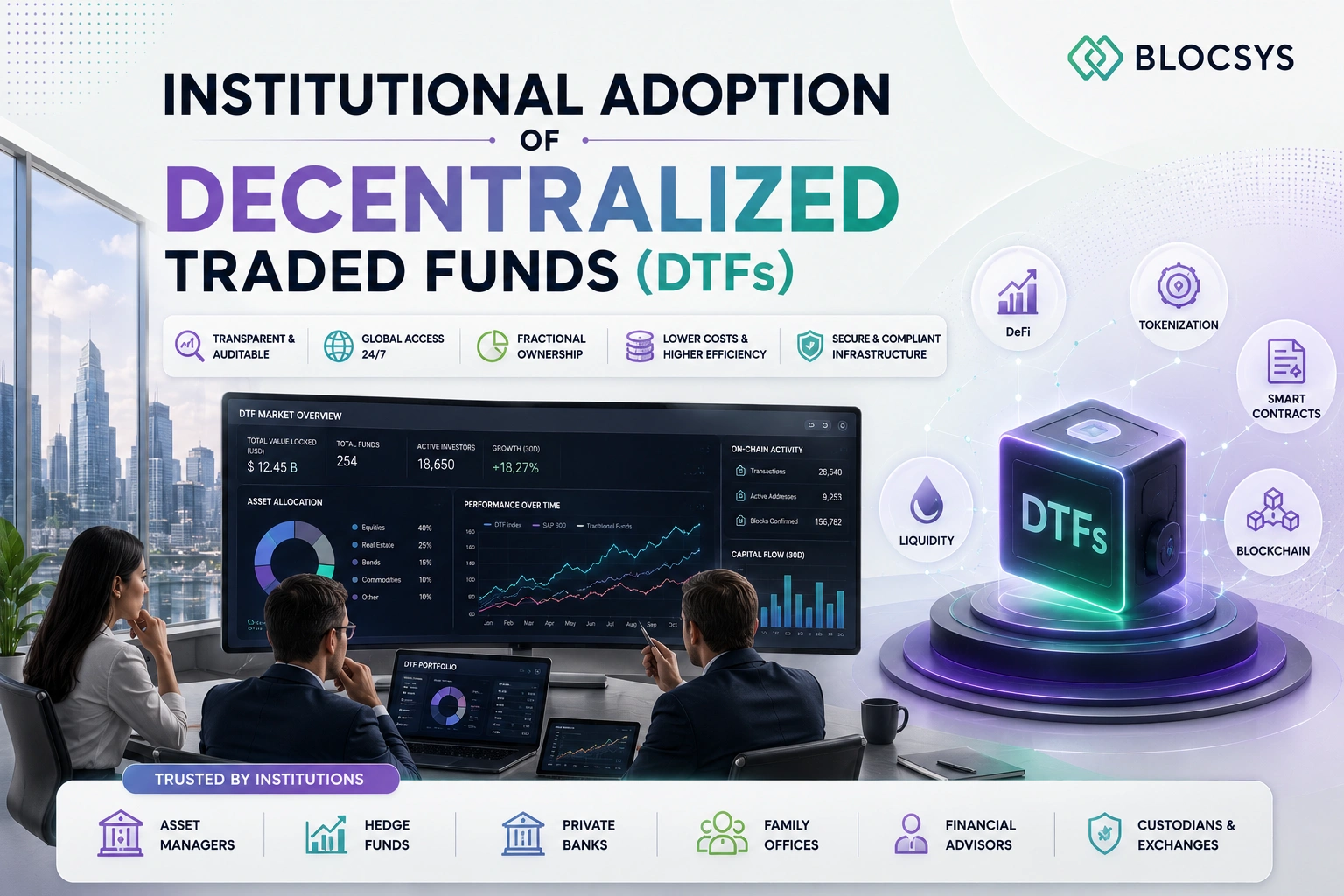
Institutional Adoption of Decentralized Traded Funds: Opportunities and Challenges
Walk into any serious investment committee meeting today and you’ll hear the same phrase whispered between coffee refills: decentralized traded funds. It’s no longer a fringe conversation reserved for crypto-native hedge funds. Institutional decentralized traded funds are moving into mainstream portfolio discussions at banks, asset managers, and sovereign wealth desks. If you’re evaluating this shift, the Decentralized Traded Funds (DTF) Platform — AI-Powered On-Chain Asset Management use case is a good place to see how the theory translates into working infrastructure. This piece breaks down why institutions care, what’s genuinely different about decentralized traded funds, and where the real obstacles sit. We’ll also touch on how Blocsys approaches enterprise-grade DTF platform development for organizations that can’t afford to get this wrong.
Institutional interest in decentralized traded funds isn’t hype-driven anymore. It’s driven by cost pressure, transparency demands, and a genuine appetite for programmable finance. However, adoption at scale requires more than enthusiasm — it requires infrastructure that regulators, auditors, and risk committees can actually trust.
What Are Institutional Decentralized Traded Funds?
A decentralized traded fund, commonly abbreviated as DTF, is an investment vehicle where fund composition, rebalancing, and settlement logic run through smart contracts rather than a centralized fund administrator. Think of it as an ETF’s cousin, except the rulebook lives on-chain and executes automatically.
Institutional decentralized traded funds add a layer most retail DeFi products skip entirely: compliance controls, permissioned custody, KYC-gated participation, and audit trails built for regulators. That’s the difference between a public DeFi index token and something a pension fund can actually hold.
Unlike traditional pooled vehicles, decentralized traded funds settle transparently on distributed ledgers. Every allocation change, every rebalance, every fee deduction is verifiable in real time. Consequently, institutional investors get something traditional funds rarely offer: continuous, auditable proof of what they actually own.
How Decentralized Traded Funds Differ From Traditional Fund Structures
Traditional mutual funds and ETFs rely on custodians, transfer agents, and end-of-day NAV calculations. Decentralized traded funds instead use smart contracts for near-instant settlement and continuous pricing. That’s a meaningful operational shift for anyone managing intraday risk.
Why Institutional Investors Are Exploring DTFs
Institutional investors don’t chase novelty for its own sake. They move when the math works. And right now, the math around decentralized traded funds is starting to work for three reasons: lower operational overhead, faster settlement cycles, and programmable compliance that scales across jurisdictions.
Consider a wealth management firm managing multi-asset portfolios across US, UK, and Singapore clients. Reconciling positions across custodians in each jurisdiction is expensive and slow. A properly built decentralized traded fund platform collapses that reconciliation into shared, cryptographically verified state. Everyone sees the same truth.
Institutions aren’t adopting decentralized traded funds because blockchain sounds impressive in a board deck. They’re adopting it because reconciling positions across five custodians and three time zones has become financially indefensible when a smart contract can do it in seconds.
Furthermore, institutional blockchain adoption tends to follow a predictable curve: pilot programs, tokenized pilot funds, then full production infrastructure. Firms exploring institutional DTF adoption today are essentially building the operational muscle memory they’ll need for broader digital asset management tomorrow.
Market Drivers Behind Institutional Adoption
Several forces are converging at once. Regulatory clarity has improved across Switzerland, Singapore, and the UAE, giving compliance teams a defensible framework. Meanwhile, institutional-grade custody providers have matured enough that CISOs no longer treat digital asset custody as an unacceptable risk.
Additionally, client demand is shifting. Family offices and high-net-worth clients increasingly ask their wealth managers about tokenized exposure. Asset managers who can’t offer it risk losing mandates to fintech-forward competitors.
- Falling settlement and custody costs compared to legacy fund administration
- Growing regulatory frameworks in Europe, Switzerland, UAE, and Singapore
- Client demand for tokenized, transparent investment products
- Maturing enterprise blockchain infrastructure and institutional custody solutions
- Competitive pressure from fintech-native asset platforms
![Decentralized traded funds — [Flow diagram showing institutional DTF adoption journey: Market Research → Regulatory Assessment → Pilot Fund Launch → Custody Integration → Full Production Deployment → Investor Onboarding]](https://s3.blocsys.com/blocsys/blog-images/1785110502340-b69e975fce588933.webp)
Enterprise Blockchain Infrastructure for Decentralized Traded Funds
Here’s what most people miss: the blockchain itself is the easy part. Building enterprise blockchain infrastructure that can support decentralized traded funds at institutional scale means solving for throughput, interoperability, node reliability, and disaster recovery — all before a single dollar gets allocated.
Enterprise blockchain development for DTFs typically involves permissioned layers sitting on top of public settlement rails, multi-chain interoperability bridges, and oracle networks feeding verified pricing data. Without reliable oracles, a decentralized traded fund is just a smart contract guessing at asset values.
Moreover, institutions need failover architecture. If a validator network stalls during a market event, the fund can’t simply freeze. Enterprise-grade decentralized traded fund platform development accounts for this from day one, not as an afterthought bolted on after a near-miss.
Interoperability Across Chains and Legacy Systems
Most institutions run core banking systems that predate blockchain by decades. A working DTF platform needs middleware that bridges legacy custodial ledgers with on-chain settlement, so back-office teams aren’t forced into a disruptive rip-and-replace project.
AI-Powered Portfolio Management in Institutional DTFs
AI-powered decentralized traded funds are where things get genuinely interesting. Rather than static, rules-based rebalancing, AI models can continuously assess market volatility, liquidity depth, and correlation shifts, then propose or execute rebalancing within pre-approved risk bands.
Picture an asset manager running a multi-strategy decentralized traded fund across equities-linked tokens, commodities, and stablecoin yield instruments. An AI allocation engine monitors thousands of signals overnight. By morning, it has already adjusted weightings within the smart contract’s permitted parameters, and every adjustment is logged immutably.
That said, AI doesn’t replace human oversight here. It augments it. Portfolio managers still set guardrails, risk limits, and override authority. Consequently, you get speed and consistency without surrendering fiduciary control.
Tokenized Assets and Digital Investment Strategies
Tokenized assets sit at the foundation of every decentralized traded fund. Real estate, private credit, commodities, and equities can all be represented as on-chain tokens, each carrying programmable rights around dividends, voting, and transferability.
This is where asset tokenization gets strategically interesting for institutions. A robust asset tokenization platform lets a fund manager fractionalize illiquid holdings, distribute them across a broader investor base, and still maintain compliance controls at the token level. For firms exploring physical asset exposure, real world asset tokenization extends this logic to real estate, commodities, and infrastructure debt.
Digital investment strategies built on tokenized assets also unlock something traditional funds struggle with: composability. A tokenized bond position inside a decentralized traded fund can plug directly into a lending protocol or collateral pool, generating additional yield without leaving the fund’s custody boundary.
![Decentralized traded funds — [Flow diagram showing asset tokenization process for institutional DTFs: Asset Selection → Legal Structuring → Valuation → Smart Contract Deployment → Token Issuance → Compliance Screening → Investor Distribution]](https://s3.blocsys.com/blocsys/blog-images/1785110502842-9d0488d1189353dc.webp)
Institutional Custody and Security
Custody remains the single biggest trust barrier for institutional decentralized traded funds. Boards want to know: who holds the keys, and what happens if something goes wrong? Multi-party computation, hardware security modules, and qualified custodian partnerships are now standard requirements, not nice-to-haves.
Security also extends beyond key management. Smart contract audits, formal verification, and continuous monitoring for anomalous transaction patterns need to be built into the platform architecture. A single unpatched vulnerability can undo years of trust-building with institutional clients.
Why Custody Architecture Determines DTF Adoption Speed
Firms that partner with experienced blockchain developers tend to move faster here, simply because custody architecture mistakes are expensive to unwind after launch. Getting it right the first time saves months of remediation later.
Compliance and Regulatory Challenges
Regulatory uncertainty is still the most cited blocker to institutional DTF adoption. Jurisdictions differ wildly. What’s compliant in Switzerland or Singapore may face a completely different classification in the US or Germany.
Consequently, compliance needs to be embedded at the protocol level, not layered on afterward. That means programmable KYC/AML checks, jurisdiction-aware transfer restrictions, and automated regulatory reporting built directly into the smart contract logic governing the decentralized traded fund.
Governance models matter here too. Who can propose a rebalance? Who approves emergency pauses? Clear on-chain governance, backed by legally enforceable off-chain agreements, gives regulators something concrete to evaluate rather than a black box.
Opportunities for Financial Institutions and Asset Managers
So what’s actually in it for asset managers willing to move first? Quite a lot, honestly. Early movers get to define product standards before competitors catch up, and they capture client mandates from investors already asking for tokenized exposure.
Additionally, decentralized traded funds open new revenue lines: programmable fee structures, automated yield strategies, and cross-border distribution without duplicating fund administration in every jurisdiction. Investment banks exploring institutional blockchain infrastructure can also extend existing OTC desks into tokenized settlement, similar to how an Institutional OTC Crypto Trading Platform Built on Blockchain handles large-block digital asset trades today.
There’s also a quieter opportunity: operational efficiency. Fewer intermediaries, faster reconciliation, and continuous auditability translate directly into lower cost ratios, which asset managers can either pass to clients or keep as margin improvement.
Risks and Adoption Challenges of Decentralized Traded Funds
Let’s be honest about the friction. Decentralized traded funds introduce new risk categories that traditional risk frameworks weren’t built to handle: smart contract risk, oracle manipulation risk, cross-chain bridge vulnerabilities, and liquidity fragmentation across venues.
The biggest adoption risk isn’t the technology failing — it’s institutions bolting blockchain onto legacy risk frameworks that were never designed to evaluate on-chain exposure in the first place.
Talent shortage is another real challenge. Enterprise blockchain development requires engineers who understand both distributed systems and institutional finance constraints, and that combination is genuinely scarce. Firms often end up building dedicated blockchain engineering teams rather than hiring piecemeal.
Liquidity is worth flagging too. A decentralized traded fund is only as good as the depth behind its underlying tokenized assets. Thin liquidity during stress events can cause slippage that undermines the fund’s entire value proposition.
![Decentralized traded funds — [Decision tree diagram for institutional DTF risk assessment: Identify Risk Category → Smart Contract Risk, Custody Risk, Liquidity Risk, Regulatory Risk → Mitigation Controls → Ongoing Monitoring → Board Reporting]](https://s3.blocsys.com/blocsys/blog-images/1785110502367-346521c255f13cfd.webp)
The Future of Institutional DTFs
Where does this go next? Expect institutional decentralized traded funds to converge with real-world asset tokenization at a much larger scale, pulling private credit, infrastructure debt, and commercial real estate on-chain alongside traditional securities.
We’ll also likely see deeper integration between DTF platforms and post-trade infrastructure. Firms already using permissioned ledger systems for reconciliation, similar to a Permissioned Blockchain Infrastructure for Capital Market Post-Trade Operations, are well positioned to extend that infrastructure into full fund tokenization.
Furthermore, expect AI’s role to expand from portfolio rebalancing into predictive compliance monitoring and automated regulatory filing. That’s not speculative — it’s already in active development across several enterprise blockchain teams globally.
Why Choose Blocsys for Enterprise DTF Platform Development
Blocsys builds decentralized traded fund platforms for institutions that need more than a proof of concept. We focus on custody-grade security, jurisdiction-aware compliance logic, and AI-driven portfolio automation designed to survive audit scrutiny, not just demo well.
Our team has hands-on experience across blockchain development company engagements spanning tokenized funds, OTC trading infrastructure, and enterprise post-trade systems. That breadth matters because a DTF platform touches custody, compliance, trading, and reporting all at once.
Whether you need full enterprise blockchain development, a standalone digital asset platform, or a complementary DeFi trading platform built on blockchain, we architect it around institutional risk tolerance from day one, not as a retrofit.
Frequently Asked Questions
Here are direct answers to the questions we hear most often about institutional decentralized traded funds.
What are Institutional Decentralized Traded Funds (DTFs)?
Institutional decentralized traded funds are investment vehicles where fund allocation, rebalancing, and settlement run through blockchain-based smart contracts instead of a traditional fund administrator. They add institutional-grade compliance, custody, and reporting controls on top of standard DeFi index logic.
Why are financial institutions adopting Decentralized Traded Funds?
Institutions are adopting decentralized traded funds to cut reconciliation costs, speed up settlement, and meet growing client demand for tokenized, transparent investment products. Regulatory clarity in markets like Switzerland and Singapore has also removed a major adoption barrier.
What opportunities do DTFs create for institutional investors?
DTFs create opportunities around faster settlement, programmable fee structures, cross-border distribution, and access to previously illiquid tokenized assets. They also let asset managers launch new products faster than traditional fund structures allow.
How do AI and blockchain improve institutional DTF platforms?
AI continuously analyzes market signals and proposes or executes rebalancing within risk limits set by portfolio managers, while blockchain ensures every action is recorded immutably. Together, they deliver faster, auditable, and more responsive fund management.
What challenges do financial institutions face when adopting DTFs?
The biggest challenges include regulatory fragmentation across jurisdictions, custody and key management risk, smart contract vulnerabilities, and a shortage of engineers who understand both blockchain and institutional finance requirements.
How do tokenized assets enhance decentralized traded funds?
Tokenized assets let funds fractionalize illiquid holdings like real estate or private credit, distribute them to a broader investor base, and plug them into other on-chain protocols for additional yield, all while maintaining compliance controls.
What security and compliance measures are required for enterprise DTF platforms?
Enterprise DTF platforms need multi-party computation or HSM-based key management, qualified custodian integration, formal smart contract audits, and programmable KYC/AML checks embedded directly into the fund’s on-chain logic.
How do institutional DTFs differ from traditional ETFs and mutual funds?
Unlike ETFs and mutual funds that rely on end-of-day NAV calculations and multiple intermediaries, decentralized traded funds settle continuously on-chain with real-time transparency into holdings, allocations, and fee deductions.
What is the future of institutional adoption of Decentralized Traded Funds?
Expect deeper convergence with real-world asset tokenization, tighter integration with post-trade infrastructure, and AI expanding beyond rebalancing into predictive compliance and automated regulatory reporting.
How can Blocsys build secure enterprise-grade Decentralized Traded Fund platforms?
Blocsys combines custody-grade security architecture, jurisdiction-aware compliance logic, and AI-powered portfolio automation, drawing on experience across tokenized funds, OTC trading, and enterprise post-trade systems to deliver audit-ready DTF platforms.
Conclusion: Building What Comes Next
Institutional adoption of decentralized traded funds isn’t a question of if anymore. It’s a question of who builds the infrastructure well enough to earn institutional trust first. The opportunities are real: lower costs, faster settlement, tokenized access to new asset classes, and AI-driven portfolio management that scales. However, the challenges around custody, compliance, and risk architecture are equally real, and they punish shortcuts.
If your organization is evaluating institutional decentralized traded funds, don’t start from scratch alone. Explore how the Decentralized Traded Funds (DTF) Platform — AI-Powered On-Chain Asset Management use case tackles custody, compliance, and AI-driven allocation together as one system.
Ready to build a secure, compliant, enterprise-grade DTF platform? Connect with Blocsys for decentralized traded fund platform development, AI-powered portfolio management, asset tokenization, smart contract development, and full enterprise blockchain consulting. Whether you’re an investment bank, wealth management firm, fintech company, or Web3 enterprise, our team is ready to help you build the next generation of institutional digital asset infrastructure. Visit Blocsys and let’s start the conversation.
Ready to move beyond theory and build an intelligent platform that delivers real-world value? Blocsys Technologies specialises in engineering enterprise-grade AI and blockchain solutions for the fintech, Web3, and digital asset sectors. Connect with our experts today to discuss your vision and chart a clear path from concept to a secure, scalable reality.
