
The popular advice is to put more assets on-chain and wait for liquidity to follow. That’s backwards. For banks, asset managers, custodians, and market infrastructures, financial institutions blockchain tokenization is first an operating-model decision, then a technology decision. The useful question is not whether an equity, bond, fund, or collateral position can be represented by a token. It’s whether the legal ownership, compliance controls, settlement asset, custody model, and legacy workflows are ready to support production use.
Institutional adoption has moved beyond isolated experimentation. A joint study by Ripple, CB Insights, and the UK Centre for Blockchain Technologies found that banks and traditional financial institutions invested more than $100 billion in blockchain infrastructure from 2020 to 2024, alongside 345 blockchain-company investments by banks during that period. Europe led the study’s regional count for crypto-banking services with 64 banks, compared with 30 in North America and 24 in Asia. The UK Centre for Blockchain Technologies summary shows why this matters: institutions are funding payments, custody, tokenization, and market infrastructure, not running innovation pilots.
This guide is for decision-makers evaluating institutional blockchain tokenization, digital securities, blockchain settlement, tokenized collateral, and RWA infrastructure in the US, UK, and Europe. It separates narrow production use cases from early-stage models, compares regional rulebooks, and identifies the technology and governance layers required before an institution launches tokenized assets.
Table of Contents
- Introduction Why Institutional Blockchain Has Moved Beyond Experiments
- Why Financial Institutions Are Tokenizing Traditional Assets
- How the US UK and Europe Differ on Blockchain Adoption and Regulation
- Equity Tokenization and Corporate Bond Tokenization in Practice
- RWA Tokenization Settlement Custody and Collateral Transformation
- Technology Infrastructure Financial Institutions Need to Launch Tokenized Assets
- What Financial Institutions Should Consider Next and How Blocsys Can Help
Introduction Why Institutional Blockchain Has Moved Beyond Experiments
The strongest institutional use cases aren’t retail crypto products. They sit inside the machinery of capital markets, where reconciliation, settlement timing, collateral movement, asset servicing, and compliance create persistent operating costs. Blockchain gives institutions a shared transaction record and programmable rules, but the business value appears only when that record connects to legally recognised ownership and existing controls.
That’s why the market is shifting from “should we experiment?” to “which process should we redesign first?” Payments, custody, tokenized funds, bonds, and collateral are more credible starting points than broad promises about blockchain replacing every market intermediary. The institutional blockchain adoption outlook for 2026 reflects this change, with attention moving toward governance, integration, and regulated deployment.
A useful distinction guides the rest of this article:
- Live or operationally focused: token custody, fund registers, settlement rails, collateral workflows, and controlled wholesale payment applications.
- Pilot-stage: DeFi interfaces for supervised institutions, cross-platform interoperability, and selected tokenized securities markets.
- Still experimental: open-ended tokenized equity liquidity, frictionless global secondary markets, and models that assume legal recognition will automatically follow technical issuance.
Regulated adoption is also becoming measurable. A 2026 survey reported that 86% of European financial institutions and 82% of UK institutions identified real-time payments and 24-hour fund settlement as core blockchain use cases. The same survey reported that 99% of European institutions and 100% of UK institutions expected regulatory policy to support digital-asset adoption. The survey reporting points to a practical conclusion: policy confidence and operational settlement are moving together.
Practical rule: Start with the market process that creates the most reconciliation or liquidity friction, not the asset class that produces the most attractive tokenization narrative.
Why Financial Institutions Are Tokenizing Traditional Assets
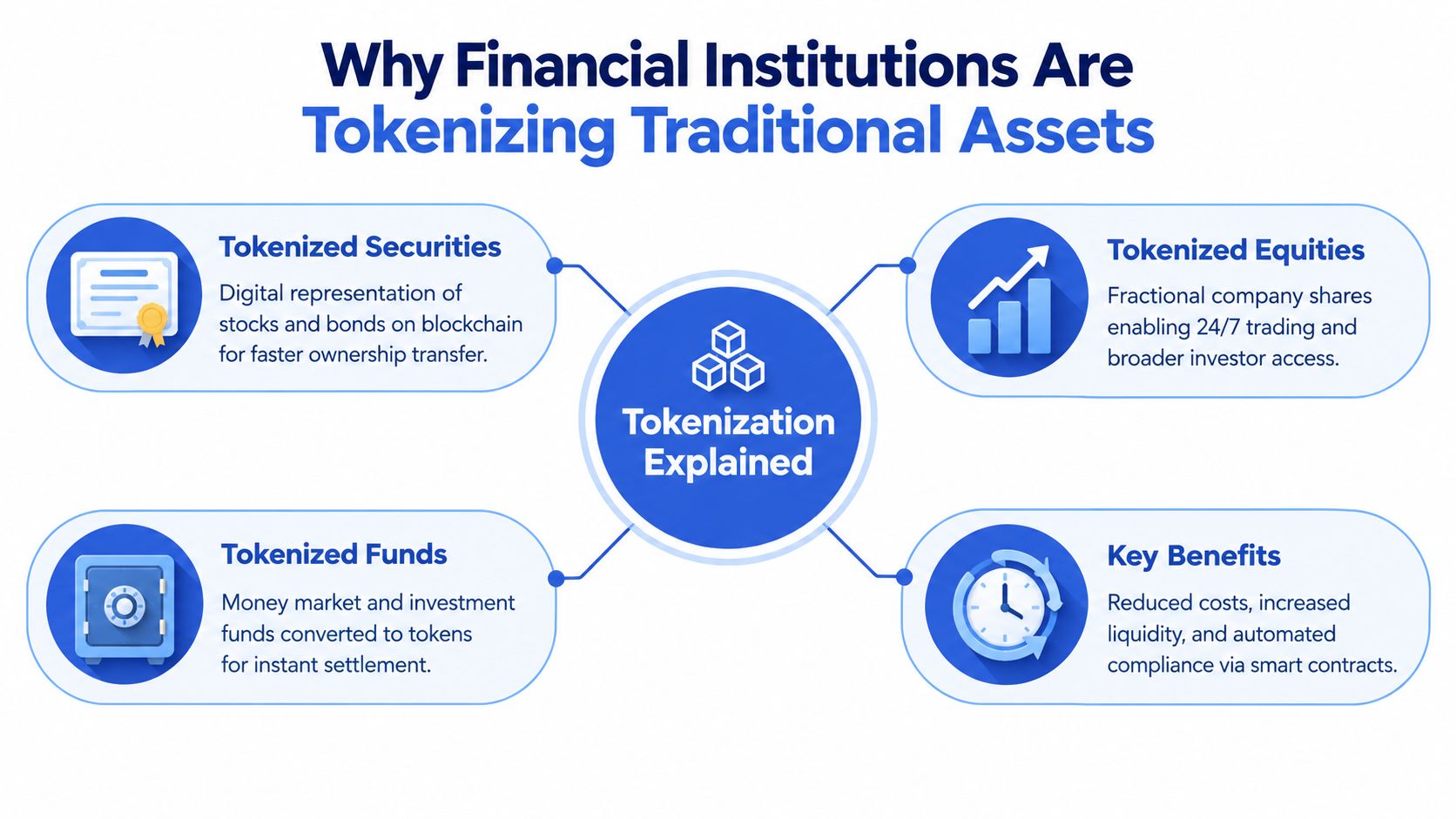
Tokenization is the creation of a digital representation of an asset, claim, or financial right on a distributed ledger. For an institution, that token isn’t automatically the asset itself. It may represent direct legal ownership, a beneficial interest, a claim against an issuer, or an exposure supported by an off-chain register. The legal wrapper determines what investors own.
A useful analogy is a securities register. Traditional markets maintain records of ownership, transfer restrictions, payment obligations, and corporate actions across multiple systems. A tokenized security places some of those rules into a programmable ledger. Smart contracts can enforce transfer permissions, calculate coupon or dividend events, and record ownership changes, while regulated entities still provide issuance, custody, identity, and legal administration.
What tokenization changes
The commercial case usually rests on several connected improvements:
- Settlement: A tokenized asset can support atomic delivery-versus-payment when the asset and settlement instrument operate within a compatible environment.
- Lifecycle automation: Smart contracts can encode coupon schedules, dividend instructions, transfer restrictions, redemptions, and reporting events.
- Transparency: Approved participants can work from a consistent transaction history instead of reconciling disconnected records.
- Collateral mobility: Tokenized instruments can move through controlled workflows when margin or liquidity needs change.
- Fractionalization: An issuer can structure smaller digital interests, subject to securities law, investor eligibility, and transfer rules.
- Operational efficiency: Fewer manual handoffs may reduce duplicated data entry and exception handling.
These benefits don’t come from uploading a PDF to a blockchain. Institutions need a token model, a legal opinion, investor onboarding, identity controls, custody arrangements, settlement logic, corporate-action procedures, and integration with accounting and reporting systems. The tokenization revolution in banking is therefore better understood as a redesign of financial plumbing.
A Tokenization Platform Development project can cover secure and compliant platforms for RWAs, securities, real estate, commodities, and digital assets using enterprise blockchain technology. The platform is only one part of the operating model. Its controls must match the asset’s legal status and the institution’s existing responsibilities.
How the US UK and Europe Differ on Blockchain Adoption and Regulation
The US, UK, and Europe share a preference for regulated digital assets, but they aren’t following one institutional playbook. Their market structures, supervisory approaches, settlement systems, and treatment of stablecoins create different paths for the same product.
Europe has the clearest region-wide compliance reference point through MiCAR, while banks remain selective about crypto-asset activity. The EBA reported that, as of the third quarter of 2024, most surveyed EU banks still didn’t issue or service crypto-assets. About 10% expected to engage in crypto activities within two years, mainly custody and administration, while historical EBA data showed related technologies used by fewer than 30% of the sample. The ECB reported that 1% of SSM-supervised credit institutions were already using DeFi applications and about 7% were exploring, planning, or testing them. The EBA joint report.pdf) supports a narrow interpretation of European adoption. Banks are targeting custody, administration, and infrastructure rather than broad retail deployment.
The UK is taking a market-infrastructure route. The FCA’s 2025 consultation on tokenized funds proposed rule changes that would allow authorised funds to use distributed ledger technology, building on the Investment Association’s Blueprint for Fund Tokenisation. The Bank of England has also identified tokenized collateral as a 2026 priority because it may reduce trade-lifecycle friction and improve liquidity management. The UK regulatory discussion on fund tokenization illustrates the UK’s emphasis on controlled wholesale-market experimentation.
The US has strong institutional interest in settlement rails, custody, tokenized money, and private platforms, but its regulatory pathway remains more fragmented across agencies and products. That fragmentation affects whether an institution can move from a controlled platform to a broadly distributed market.
| Dimension | United States | United Kingdom | Europe |
|---|---|---|---|
| Primary institutional focus | Settlement rails, custody, tokenized money, and private market infrastructure | Tokenized funds, wholesale-market infrastructure, collateral, and settlement | Custody, administration, tokenized debt, funds, collateral, and regulated digital-asset services |
| Stablecoin position | Market development depends on applicable federal and state frameworks | Systemic sterling stablecoins will be jointly regulated by the Bank of England and FCA once recognised by HM Treasury | MiCAR places emphasis on stablecoin reserves, redemption, and supervision |
| Settlement asset constraint | Institutions evaluate tokenized deposits, stablecoins, and platform-specific settlement models | Stablecoins can’t currently be used by Bank-regulated FMIs as settlement assets in core wholesale markets | Institutions are assessing regulated settlement assets alongside tokenized deposits and market infrastructure |
| Market infrastructure direction | Private and institutional platforms are prominent | FCA and Bank of England initiatives support controlled wholesale-market development | MiCAR and supervisory work support harmonised but cautious adoption |
| Strategic implication | Design for product-specific regulatory analysis | Design for UK market-infrastructure and fund-tokenization pathways | Design for cross-border compliance and supervisory consistency |
Europe’s policy confidence is high, but production scope remains selective. The UK offers a clear test environment for tokenized funds and collateral. The US presents significant institutional opportunity, yet firms must map each product and intermediary role to the relevant regulatory perimeter. A regional adoption analysis from Blocsys is useful context, but the strategic decision still belongs at the product and process level.
Equity Tokenization and Corporate Bond Tokenization in Practice
Equity tokenization and corporate bond tokenization look similar at issuance, but their operational profiles differ. A tokenized equity may represent a legally recognised share, a beneficial interest, or an exposure linked to an off-chain share register. Investors should never assume that a token delivers voting rights, dividend rights, or direct ownership without checking the legal structure.
Corporate bonds have a more defined lifecycle. The institution identifies the issuer and instrument, establishes the legal framework, verifies eligible investors, issues tokens under controlled transfer rules, and connects coupon, maturity, redemption, and reporting events to the servicing process. The token can support programmable administration, but it doesn’t remove the issuer’s obligations or the need for regulated intermediaries.
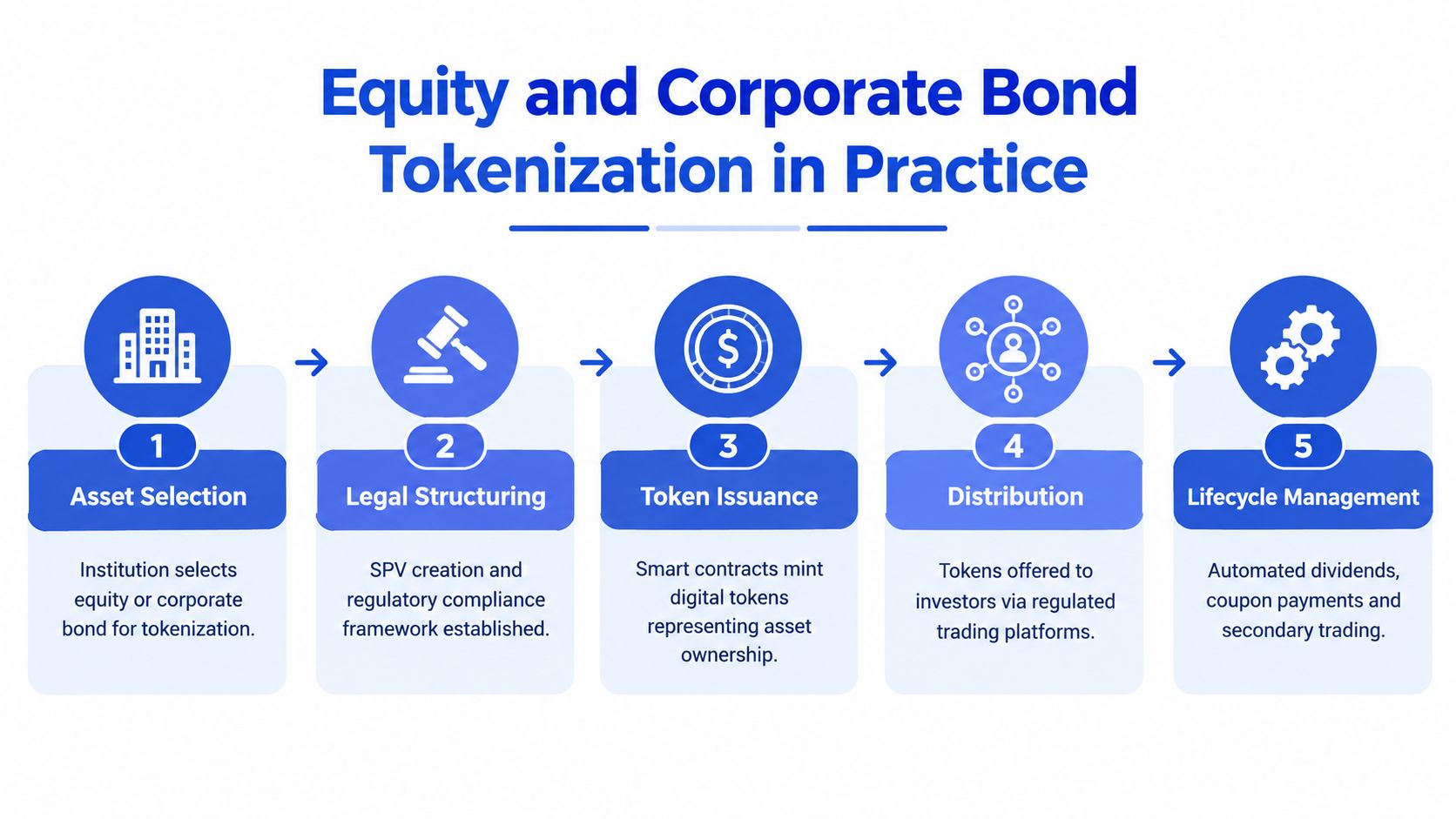
The institutional issuance sequence
- Asset selection: The institution chooses an equity, corporate bond, fund interest, or another instrument with a clear ownership and servicing model.
- Legal structuring: Counsel defines the relationship between the token, the issuer, the register, investor rights, transfer restrictions, and redemption.
- Token issuance: A smart contract creates units with identity, eligibility, supply, and lifecycle rules.
- Distribution: Regulated platforms or intermediaries handle investor onboarding, KYC, AML, suitability, and allocation.
- Lifecycle management: The operating model manages dividends, coupons, redemptions, transfers, reporting, and exceptions.
The main advantage of a tokenized corporate bond is not a speculative secondary-market premium. It is the possibility of connecting issuance, ownership, payment, and reporting in a more consistent workflow. A token may also support faster DVP settlement and more efficient collateral handling, provided the settlement asset and custody environment are compatible.
The enterprise guide to corporate bond tokenization provides a useful reference for the product architecture. In practice, institutions should test three questions before approving a launch:
- Ownership: Does the token confer a direct legal right, a beneficial interest, or synthetic exposure?
- Transfer: Who may hold it, which venues can process it, and how are blocked transfers handled?
- Servicing: Which system remains authoritative for payments, tax, corporate actions, and investor records?
Equity tokenization remains commercially attractive because it could broaden access and automate shareholder administration, but secondary-market liquidity and legal recognition are harder than issuance. Corporate bonds and fixed-income instruments often offer a more contained starting point because their cash flows and maturity events are easier to model.
RWA Tokenization Settlement Custody and Collateral Transformation
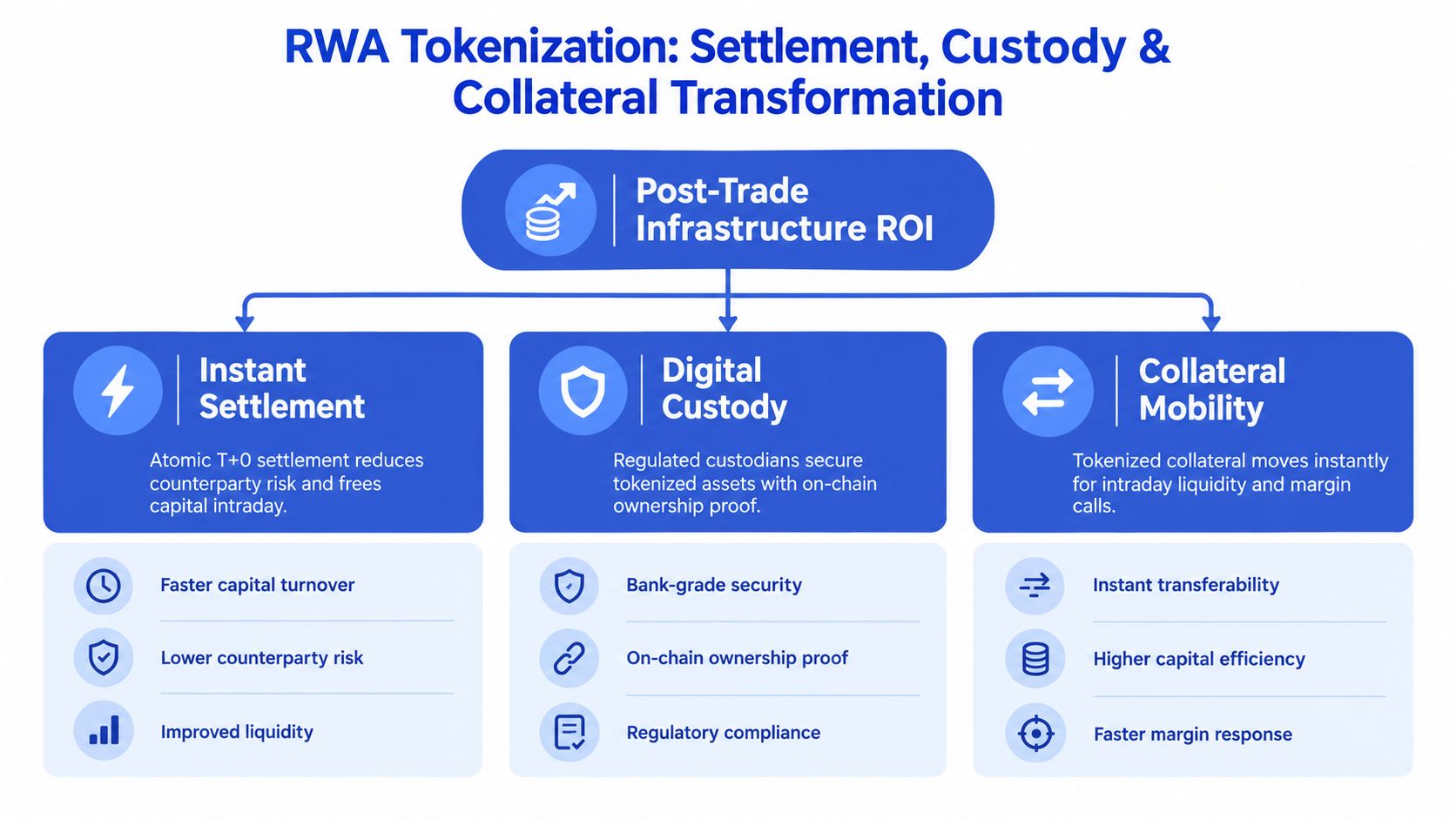
The most credible near-term value in RWA tokenization sits in post-trade infrastructure. Institutions can use tokenized money-market funds, deposits, regulated stablecoins, bonds, and collateral as coordinated components in an intraday liquidity workflow. The emphasis is less on creating a new speculative asset and more on moving value, collateral, and ownership with fewer breaks between systems.
A 2026 ECB report stated that one private US platform processed an average of USD 354 billion in tokenised repo transactions per day in March 2026, four times its average daily volume a year earlier. The ECB analysis of tokenised finance describes the technical implication clearly: tokenized markets can operate as liquidity and collateral orchestration layers, with atomic transfer, near-real-time netting, and continuous settlement capabilities.
Where operating change appears
Settlement improves only when both legs of the transaction can settle together. A tokenized bond on one ledger and a cash payment trapped in a separate batch system won’t automatically create DVP. Institutions need a compatible settlement asset, clear finality rules, and controls for failed or reversed transactions.
Custody becomes a digital control problem as much as a safekeeping problem. Custodians must manage wallets, signing authority, transaction policies, key recovery, asset segregation, identity permissions, and audit evidence. The token’s on-chain record must also align with legal ownership and the institution’s books.
Collateral is where the balance-sheet case can become tangible. Tokenized collateral can move through approved workflows for margin calls and intraday liquidity, reducing delays caused by manual instructions and disconnected records. The institutional collateral-management perspective shows why interoperability and permissions matter more than choosing a public chain.
Survey evidence reinforces the demand for settlement infrastructure. 86% of European respondents and 82% of UK respondents ranked real-time payments and 24-hour fund settlement among core blockchain use cases, according to regional industry reporting. But institutions should treat those figures as demand signals, not proof that every market is ready for 24-hour operation.
The UK’s own timetable demonstrates the gap between ambition and production readiness. The Bank of England’s operating-hours consultation proposes adding a weekend settlement day, most likely Sunday, and settlement on certain UK bank holidays. Those changes aren’t expected before 2029, and longer settlement windows aren’t expected before 2031, as reported in the UK settlement modernisation analysis.
Technology Infrastructure Financial Institutions Need to Launch Tokenized Assets
A financial institution tokenization platform is not just a minting interface. It is a controlled operating stack that connects legal rights, identity, asset servicing, custody, settlement, and reporting. Institutions should design the stack around the required control points rather than begin with a preferred blockchain network.

A practical enterprise stack
- Ledger layer: Choose a permissioned, public, or hybrid DLT model based on privacy, finality, participant permissions, and interoperability needs.
- Asset layer: Encode supply, ownership, transfer restrictions, investor eligibility, corporate actions, coupon schedules, and redemption logic.
- Identity layer: Connect KYC, AML, sanctions screening, accreditation or professional-investor status, and wallet permissions.
- Custody layer: Define key management, signing policies, segregation, recovery, transaction monitoring, and reconciliations.
- Settlement layer: Connect tokenized assets to deposits, stablecoins, central-bank money where available, or another approved settlement asset.
- Integration layer: Link the ledger to order management, portfolio accounting, treasury, risk, tax, reporting, CSD, exchange, and fund-administration systems.
- Control layer: Preserve audit trails, approvals, exception handling, operational resilience, and supervisory evidence.
Blockchain Development can include custom applications built on public, private, and hybrid blockchain networks for enterprises, startups, and governments. For a bank, the build decision should follow a proper gap analysis. A partner may accelerate the ledger and workflow components, while internal teams retain control of legal interpretation, risk appetite, data governance, and regulated operations.
The cross-border design problem deserves early attention. Europe’s MiCAR environment, the UK’s market-infrastructure initiatives, and US product-specific regulation don’t create one universal token standard. Legal finality, redemption mechanics, custody recognition, privacy, and transfer restrictions must be represented in the platform’s policy engine.
Budget planning should cover discovery, legal structuring, integration, security testing, custody operations, compliance workflows, production support, and migration. A Software Development Cost Estimator can help frame the technology discussion, but an institution shouldn’t treat an initial build estimate as the total cost of operating regulated digital-asset infrastructure.
What Financial Institutions Should Consider Next and How Blocsys Can Help
The next phase of institutional tokenization won’t be measured by how many assets receive a token. It will be measured by whether a bank or asset manager can eliminate a real manual process while preserving legal certainty, investor protection, custody control, and supervisory confidence.
A sound decision framework asks:
- Which process changes first? Choose settlement, custody, collateral, fund administration, or issuance based on a defined operational problem.
- What does the token legally represent? Document ownership, redemption, transfer, and servicing rights before writing smart-contract logic.
- Where is the regulatory perimeter? Map the US, UK, and European rules separately, especially for stablecoins, funds, custody, and settlement assets.
- What legacy work disappears? Track reconciliations, manual approvals, duplicated registers, and exception handling rather than relying on abstract efficiency claims.
- Can the model scale across borders? Design interoperability and compliance orchestration early, because fragmented rulebooks can block a single regional platform.
Over the next 12 to 24 months, the strongest institutional opportunities are likely to remain narrow and regulated: tokenized registers, fund dealing, bond issuance, collateral movement, custody, and wholesale settlement. The Bank of England’s stablecoin framework makes the boundary clear. Systemic stablecoins will be jointly regulated by the Bank and FCA once recognised by HM Treasury, and they currently can’t be used by Bank-regulated FMIs as settlement assets in core wholesale markets, as set out in the Bank of England’s proposed sterling stablecoin regime.
Blocsys Technologies works with fintechs, exchanges, and digital-asset businesses on production-ready blockchain and AI-powered platforms, including tokenization systems, trading infrastructure, and compliance workflows. For financial institutions, that aligns with the practical need to connect tokenized securities and RWA platforms to enterprise operations rather than treating blockchain as a standalone experiment.
If your organisation is evaluating equity tokenization, corporate bond tokenization, RWA infrastructure, custody, or blockchain settlement, visit Blocsys Technologies to discuss the legal, technical, and operational requirements. Start with a defined market process, and use that conversation to shape a compliant platform that can move from pilot to controlled production.
