
A mining company can have a credible deposit, experienced operators, and a clear development plan, yet still struggle to secure capital on terms that fit the project. Exploration risk, long timelines, infrastructure requirements, and commodity-price exposure make conventional funding difficult to structure. This guide is for mining companies, mineral-rights owners, project developers, investors, financial institutions, and technology teams evaluating blockchain-based capital raising for mining companies. It explains where tokenized structures can complement equity or project debt, what investors may receive, which controls are essential, and which risks blockchain cannot remove. For broader context, see this guide to real-world asset tokenization.
Table of Contents
- Introduction Why Mining Finance Needs a New Approach
- Why Traditional Mining Finance Falls Short for Modern Projects
- What Blockchain Based Capital Raising Means for Mining Companies
- What Mining Assets and Interests Can Be Represented Digitally
- How Tokenized Mining Capital Raising Works in Practice
- Risks Regulation and What Blockchain Does Not Solve
- How Blocsys Helps Mining Companies Build Compliant Tokenization Platforms
Introduction Why Mining Finance Needs a New Approach
A project developer may need capital in stages. Early funds support exploration and permitting. Later funding pays for feasibility work, roads, processing equipment, power connections, and mine development. Traditional finance often treats these needs as separate transactions, each with its own diligence process, documentation, investor group, and settlement cycle. That fragmentation can make a technically sound project expensive to finance and difficult for smaller investors to access.
Blockchain-based capital raising offers a different approach. It can provide the digital infrastructure for recording eligible investment interests, enforcing transfer rules, automating defined payments, and giving authorised investors a clearer view of ownership and project activity. It doesn’t turn an exploration licence into a guaranteed cash flow, and it doesn’t replace geological diligence. Its value lies in improving the way a legally enforceable financing structure is issued and managed.
India provides evidence that investors have already shown substantial appetite for blockchain-linked capital formation. Indian blockchain and crypto startups reached $587.16 million in risk funding by October 17, 2021, compared with $37 million in the previous year, according to Times Now’s report on Indian blockchain startup funding. That funding largely supported digital-asset businesses, not mines, but it demonstrates that blockchain-native platforms can attract serious capital when investors understand the business model and governance.
Practical rule: Treat tokenization as a financing and investor-management infrastructure decision, not as a substitute for a bankable mine plan.
The practical question is therefore not whether every mineral asset should become a token. It’s whether a particular royalty, project interest, inventory claim, bond, or structured financing instrument can benefit from digital issuance while preserving legal rights, compliance, reporting, custody, and investor protection.
Why Traditional Mining Finance Falls Short for Modern Projects
A mining project can need substantial capital long before it produces revenue. Its value may depend on geological confirmation, permits, infrastructure, processing performance, and future commodity prices. That timing creates a financing gap. Lenders look for dependable repayment, while an exploration company may have no operating cash flow. Equity investors can accept uncertainty, but they may seek substantial ownership for funding a project before it reaches a clearer milestone.
The capital mismatch
Resource projects repeatedly face the same financing constraints:
- High upfront capex: Exploration, studies, land access, roads, power, water, processing, and equipment may require extensive spending before production.
- Long development cycles: Investors may wait through several technical and regulatory milestones before distributions become possible.
- Exploration uncertainty: A licence, geological model, or drilling programme does not guarantee commercially recoverable reserves.
- Infrastructure dependence: A deposit can appear valuable yet remain uneconomic if transport, energy, processing, or export infrastructure is unavailable or costly.
- Commodity exposure: Revenue follows prices the company cannot control, while construction and operating costs can move in the opposite direction.
- Narrow investor access: Junior projects often rely on specialist resource funds, strategic investors, private placements, offtake arrangements, or founders’ networks.
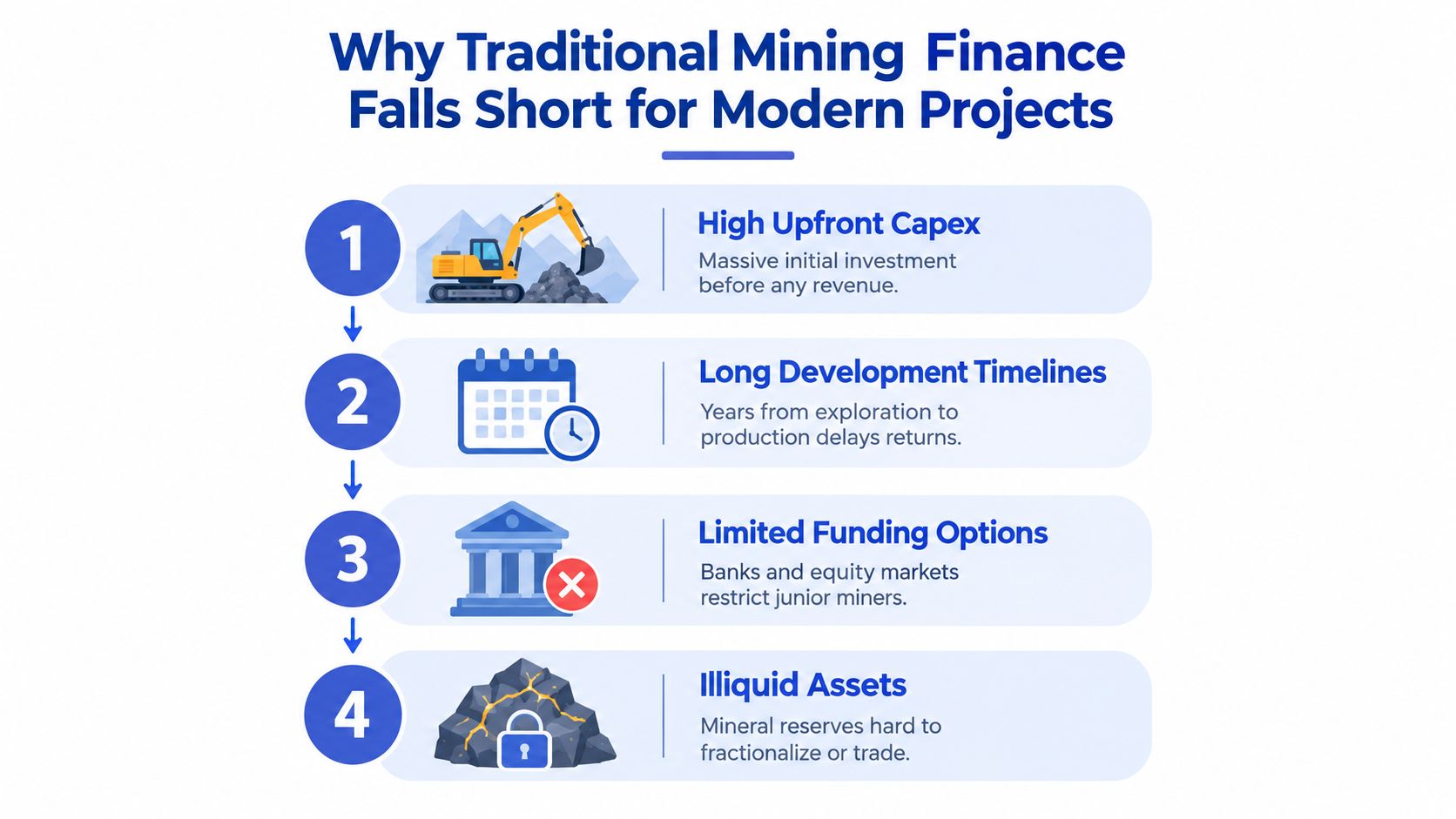
Bank debt may not fit a project that has yet to demonstrate reliable repayment capacity. Conventional equity can absorb uncertainty, but dilution may be significant. As the investor register grows, reporting, transfers, and administration also become harder to manage. Private placements can work efficiently for a known group, yet they do not by themselves create a transparent, programmable ownership record or a compliant process for later transfers.
Why structure matters
Blockchain does not remove these economic constraints. A tokenized bond remains debt. A tokenized royalty remains a contractual right to defined payments. A tokenized project interest can still sit inside an SPV and remain subject to securities laws, tax rules, custody requirements, and transfer restrictions.
Companies reviewing private placements should examine investor due diligence and recovery rights, as illustrated by resources such as Kons Law Hydro Phi Technologies. Digital presentation does not replace verification of promoters, title, use of proceeds, disclosures, or contractual remedies.
The relevant comparison is infrastructure, not fractional ownership alone. A tokenized structure can provide a clearer digital record, controlled transfer rules, and automated administration, but only when the legal rights and operating data are properly defined. The RWA tokenization approach for mining investments illustrates how those structures connect digital records with underlying commercial interests.
A corporate bond tokenization platform can support digital bond issuance, smart contract automation, settlement, and investor management for banks, financial institutions, and capital markets. For a mining issuer, those functions matter only after the debt terms, security package, covenants, repayment source, and investor eligibility have been established.
What Blockchain Based Capital Raising Means for Mining Companies
Blockchain-based capital raising is the use of blockchain infrastructure to issue, distribute, record, and manage a legally defined investment interest connected to a mining business or asset. The token is the digital representation. The enforceable right comes from the offering documents, corporate structure, asset records, contracts, and applicable law.
That distinction prevents a common misunderstanding. A mining company isn’t necessarily selling cryptocurrency. It may be issuing a tokenized security, such as a bond, equity interest, royalty entitlement, revenue-linked claim, or participation interest held through an SPV. Investors may receive contractual rights to repayment, distributions, voting, information, or proceeds, depending on the instrument.
The structure in simple terms
Consider a copper development held by a project company. The issuer might establish an SPV, place a defined royalty or debt claim inside that structure, and issue digital securities to eligible investors. A permissioned blockchain records who owns the securities. Smart contracts enforce approved transfers and calculate distributions based on inputs supplied by the issuer, trustee, administrator, custodian, or verified production data.
The arrangement has several layers:
- Underlying asset: This could be a mineral right, royalty, offtake-linked claim, inventory, or project cash flow.
- Legal issuer: A mining company or SPV issues the investment instrument.
- Digital representation: A token mirrors the rights described in the legal documents.
- Compliance layer: KYC, AML, investor eligibility, jurisdictional restrictions, and transfer controls govern participation.
- Operational layer: Reporting, distributions, voting, redemptions, and corporate actions are managed throughout the token’s lifecycle.
This model differs from generic crowdfunding. Crowdfunding may collect money from many participants, but it doesn’t provide a programmable ownership registry, automated compliance, or controlled secondary transfers. It also differs from a crypto fundraising campaign, where the token may represent access, utility, or speculative exposure rather than a claim on a clearly documented mining asset.
The Tokenization Platform Development model is relevant because it covers enterprise blockchain systems for real-world assets, securities, real estate, commodities, and digital assets. For mining, the platform must connect the token to legal documentation, asset verification, investor records, payment processes, and governance. The technology is only one component of the financing.
What Mining Assets and Interests Can Be Represented Digitally
Not every mining-related asset is equally suitable for tokenization. The strongest candidates usually have a clear legal owner, objective verification method, defined economic rights, and an administrator capable of producing reliable reports. Structure matters more than the token label.
A mineral reserve isn’t automatically an investable token. Geological data may support valuation, but investors need to know what right they acquire and who can enforce it. An exploration claim may be represented digitally for recordkeeping or financing, yet the token may not transfer the underlying licence unless the relevant law and documents permit that result.
A practical comparison
| Asset or Interest Type | Suitability for Tokenization | Key Requirement |
|---|---|---|
| Mineral rights or extraction interests | Potentially suitable where title and transfer rules are clear | Verified ownership, regulatory consent, and enforceable transfer documentation |
| Mining royalties | Often suitable for structured financing | Defined royalty formula, payment source, reporting, and collection controls |
| Project equity | Potentially suitable as a digital security | Corporate law compliance, investor rights, register recognition, and transfer restrictions |
| Project debt or bonds | Suitable where repayment terms are documented | Issuer, security package, covenants, trustee or administrator, and regulated distribution |
| Offtake-linked interests | Suitable in carefully defined structures | Valid offtake contract, counterparty diligence, pricing methodology, and payment waterfall |
| Mineral inventory | Possible when independently verifiable | Custody, title, valuation, inspection, insurance, and redemption or sale mechanics |
| Future exploration upside alone | Weak fit without contractual rights | Clear risk disclosure and a legally enforceable claim, not just a digital record |
A 2024 peer-reviewed review of blockchain in the minerals industry explained that mineral assets can be tokenised and linked to NFTs, supporting digital ownership records and easier tracking and transfer of mining rights. It also highlighted blockchain’s ability to preserve an auditable history of ownership changes, which can help investors examine title, origin, and collateral quality. The review is available through research on blockchain in the minerals industry.
India’s commodity-finance experience offers a useful adjacent example. A 2021 STPI and MeitY selection highlighted Origo Commodities and its TradeFi work, which used warehouse-held physical commodities to support securitised assets for capital markets. That doesn’t establish a universal model for mines, but it shows how objectively verified physical assets can support digital financing structures.
Treasury teams comparing commodity-linked digital instruments may also find this resource on stablecoin design for treasury teams useful. Mining companies should still distinguish a reserve-backed token, a commodity-linked payment instrument, and a tokenized security. They carry different rights, risks, custody arrangements, and regulatory questions. A focused analysis of fractional ownership of mining royalties using blockchain technology can help teams assess whether a royalty structure is more appropriate than direct ownership of a mineral asset.
How Tokenized Mining Capital Raising Works in Practice
A viable programme begins with legal and commercial design, not minting. The issuer first identifies the asset or cash-flow interest, confirms ownership, tests whether it can be pledged or transferred, and chooses the instrument. The structure may involve an operating company, SPV, trustee, administrator, custodian, broker, regulated marketplace, or other service providers.
The operating sequence
1. Define the investment instrument.
The issuer decides whether investors receive debt, equity, royalty, offtake, revenue, voting, redemption, or another contractual interest. The offering documents should explain payment priority, risks, reporting, default remedies, and restrictions.
2. Verify the underlying asset.
Title records, licences, technical studies, contracts, inventory, production data, and corporate approvals need independent review. A blockchain record can preserve evidence, but it can’t cure defective title or inaccurate data.
3. Onboard eligible investors.
The platform collects identity information, performs KYC and AML checks, assesses eligibility, records jurisdiction, and applies any suitability or accreditation rules required by the offering. Wallet permissions should reflect those decisions.
4. Issue and distribute the digital securities.
Once subscriptions and conditions are satisfied, the system mints or allocates tokens to approved wallets. The token registry should connect each holding to the investor record without exposing unnecessary personal information on-chain.
5. Manage the lifecycle.
The platform handles transfers, lock-ups, corporate actions, voting, distributions, redemptions, reporting, and status changes. Smart contracts can automate calculation and workflow, but a controlled data source must confirm production, sales, expenses, or other inputs.
A permissioned network may be appropriate where investors, custodians, administrators, and regulated intermediaries require access controls. Public-chain components may offer broader interoperability, but they introduce additional questions around wallet recovery, privacy, sanctions screening, gas payments, and cross-border transfer restrictions.
The most important design choice is the connection between the legal register and the blockchain register. If those records diverge, investors may have a token that doesn’t reliably establish the right they believe they bought.
Custody also requires careful treatment. Some investors may use institutional custodians, while others may use controlled wallets. The issuer needs policies for lost credentials, unauthorised transfers, estate events, corporate actions, and regulatory freezes. A smart contract framework for mining royalty platforms can support automation, but contract code should be audited and governed by documented operational procedures.
The secondary market deserves realistic wording. A token can be technically transferable without having a buyer, a licensed venue, sufficient disclosure, or legal permission to trade. In the US, Canada, Australia, UAE, Europe, Africa, Latin America, and other jurisdictions, the offer, custody, marketing, and resale analysis may differ. A global platform therefore needs jurisdiction-aware rules rather than a single unrestricted transfer function.
Risks Regulation and What Blockchain Does Not Solve
A token can improve ownership records and investor workflows while a mine still misses its production target. It cannot raise ore grade, secure a permit, stabilise copper prices, or finish construction on schedule. Investors remain exposed to geological, operating, environmental, political, counterparty, currency, tax, and commodity risks. The financing format must leave those fundamentals visible.
The India regulatory question
India provides a useful test case. Blockchain businesses have attracted substantial funding, while the legal treatment of tokenized real-world assets is still developing. Indian Web3 startups reportedly raised $564 million in 2024, up 109% from the prior year, according to The Hindu BusinessLine’s coverage of India’s Web3 funding environment. The same coverage noted that the sector had already attracted over $500 million in 2021, with exchanges and trading platforms accounting for $427.53 million of deal value.
Funding for blockchain companies does not establish that a tokenized mining security may be offered or traded freely in India. Public commentary says India lacks a dedicated asset-tokenisation law, and existing frameworks do not expressly recognise blockchain or decentralised registers. That leaves open questions about statutory registers, depository functions, taxation, cross-border compliance, and investor protection, as discussed in commentary on India’s asset-tokenisation framework.
A proposed Asset Tokenisation (Regulation) Bill, 2026 would define asset tokens as digital representations of rights or interests in an underlying asset. Issuance alone would not transfer ownership unless the arrangement expressly provides for it. The proposal would place SEBI as the principal authority for tokenized securities and RBI oversight over payment-linked or banking-related tokens, according to legal analysis of the proposed bill. It remains a proposal, so each transaction still requires legal analysis. Companies should also review this regulatory challenges and compliance roadmap for blockchain startups when designing their control framework.
Operating economics still decide the outcome
Crypto-mining guidance in India emphasises electricity costs, hardware choices, and taxation. The same discipline applies to mining-project tokenization. A financing structure can improve investor administration, but it cannot make an uneconomic operation viable. Coverage of Indian crypto-mining profitability considerations highlights why power prices, imported equipment, and VDA tax treatment should be tested before a company assumes that on-chain fundraising can support distributions.
The board should compare the tokenized structure with plain equity and project debt. The relevant questions concern compliance costs, custody, reporting, smart-contract development, investor servicing, and marketplace access. Those costs must be justified by the intended capital base and the operating benefit, not by fractional ownership alone.
How Blocsys Helps Mining Companies Build Compliant Tokenization Platforms
Mining companies exploring digital securities need more than a token contract. They need a connected system for asset records, investor onboarding, KYC and AML workflows, permissioned ownership, smart-contract controls, reporting, custody integrations, distributions, and lifecycle management. The design should also support audit trails and jurisdiction-specific transfer rules.
Over the next 12 to 24 months, institutional interest in tokenized mining finance may develop selectively rather than uniformly. The most credible opportunities are likely to involve clearly documented claims, professional administration, verifiable assets, defined payment mechanics, and compliance controls. India’s venture funding evidence, including CoinDCX’s $90 million round and an India-focused blockchain fund launched with a $50 million corpus and investment tickets ranging from $100,000 to $5 million, indicates that blockchain capital markets can attract different funding sizes, as reported by coverage of India’s blockchain investment activity. It doesn’t eliminate the need for disciplined project underwriting.
Blocsys Technologies works across blockchain, Web3, fintech, digital assets, RWA tokenization, smart contracts, and enterprise technology. For a mining use case, its role can be evaluated around platform architecture, token lifecycle management, investor workflows, compliance logic, and production-ready integrations. The appropriate build may be a permissioned investor registry, a tokenized royalty platform, a digital bond workflow, or a broader mining investment platform, depending on the legal instrument and operating model.
Teams can also assess smart contract development, dedicated blockchain engineering teams, and hiring blockchain developers as part of a delivery plan. The right first step is a feasibility assessment that maps the asset, investor rights, jurisdiction, compliance obligations, data sources, custody model, and expected funding process before technology is selected.
Frequently Asked Questions
1. What is blockchain-based capital raising for mining companies?
Blockchain-based capital raising uses blockchain infrastructure to issue, record, distribute, and manage investment interests connected to a mining project or asset. These interests can include tokenized bonds, equity, royalties, or other legally defined financial instruments.
2. Why are mining companies exploring blockchain for raising capital?
Mining projects often require significant funding before they generate revenue and can face challenges such as exploration risk, long development timelines, infrastructure costs, and commodity-price volatility. Blockchain can provide digital infrastructure for managing investment interests, ownership records, investor onboarding, and defined payment workflows.
3. What mining assets can be tokenized?
Potentially tokenizable mining-related interests include mineral rights, mining royalties, project equity, project debt, bonds, offtake-linked interests, and verified mineral inventory. The suitability of an asset depends on its legal ownership, transferability, verification process, and the rights attached to the investment.
4. How does mining asset tokenization work?
A mining company or an SPV first defines the underlying asset or financial interest and establishes the applicable legal structure. The corresponding rights are then represented digitally through tokens, while smart contracts and platform infrastructure can manage ownership, transfers, investor eligibility, distributions, and other lifecycle activities.
5. Can mining royalties be tokenized?
Yes. A mining royalty can potentially be represented through a tokenized structure when the royalty rights, payment mechanism, ownership, and legal enforceability are clearly defined. The platform can then help manage investor ownership and distributions associated with the royalty.
6. What are the benefits of tokenizing mining assets?
Tokenization can provide a digital ownership record, controlled investor access, automated transfer rules, streamlined investor management, improved transaction tracking, and programmable distribution workflows. However, it does not remove the underlying geological, operational, financial, or commodity-market risks of mining projects.
7. How can blockchain improve investor management for mining projects?
Blockchain-based platforms can maintain digital records of eligible investors and their holdings while applying predefined transfer and access rules. They can also support KYC and AML workflows, reporting, distributions, voting, redemptions, and other investor lifecycle activities.
8. Can blockchain make mining investments more accessible to investors?
A properly structured tokenization platform can potentially support broader access to eligible investors by digitally representing defined investment interests and simplifying certain administrative processes. However, access remains subject to securities regulations, investor eligibility requirements, jurisdictional restrictions, and the legal structure of the offering.
9. What are the main risks of blockchain-based mining finance?
Key risks include regulatory uncertainty, unclear asset ownership, inaccurate underlying data, smart contract vulnerabilities, cybersecurity threats, commodity-price volatility, geological uncertainty, operational risks, and limited secondary-market liquidity. Blockchain infrastructure cannot eliminate these underlying investment risks.
10. Is tokenized mining the same as cryptocurrency fundraising?
No. Tokenized mining finance can involve legally defined securities or contractual interests such as bonds, equity, royalties, or project participation rights. This differs from a cryptocurrency fundraising model where a token may primarily represent utility, access, or another type of digital-asset interest.
11. Can tokenized mining assets be traded on a secondary market?
Technically transferable tokens do not automatically create a compliant or liquid secondary market. Secondary trading depends on the legal structure, investor eligibility, applicable securities regulations, approved trading venues, disclosures, custody arrangements, and availability of buyers and sellers.
12. How can a blockchain development company help mining companies with tokenization?
A blockchain development company can help build mining tokenization platforms, smart contracts, investor-management systems, KYC and compliance workflows, tokenized royalty infrastructure, digital bond platforms, custody integrations, and reporting systems. The technology should be designed around the mining project’s legal structure, asset verification, investor requirements, and regulatory framework.
Blocsys Technologies helps organisations design and build blockchain, fintech, digital-asset, RWA tokenization, smart-contract, and enterprise platforms for structured capital formation. Visit Blocsys Technologies to discuss a mining tokenization use case, review the required compliance and investor-management architecture, and define practical next steps for implementation.
