
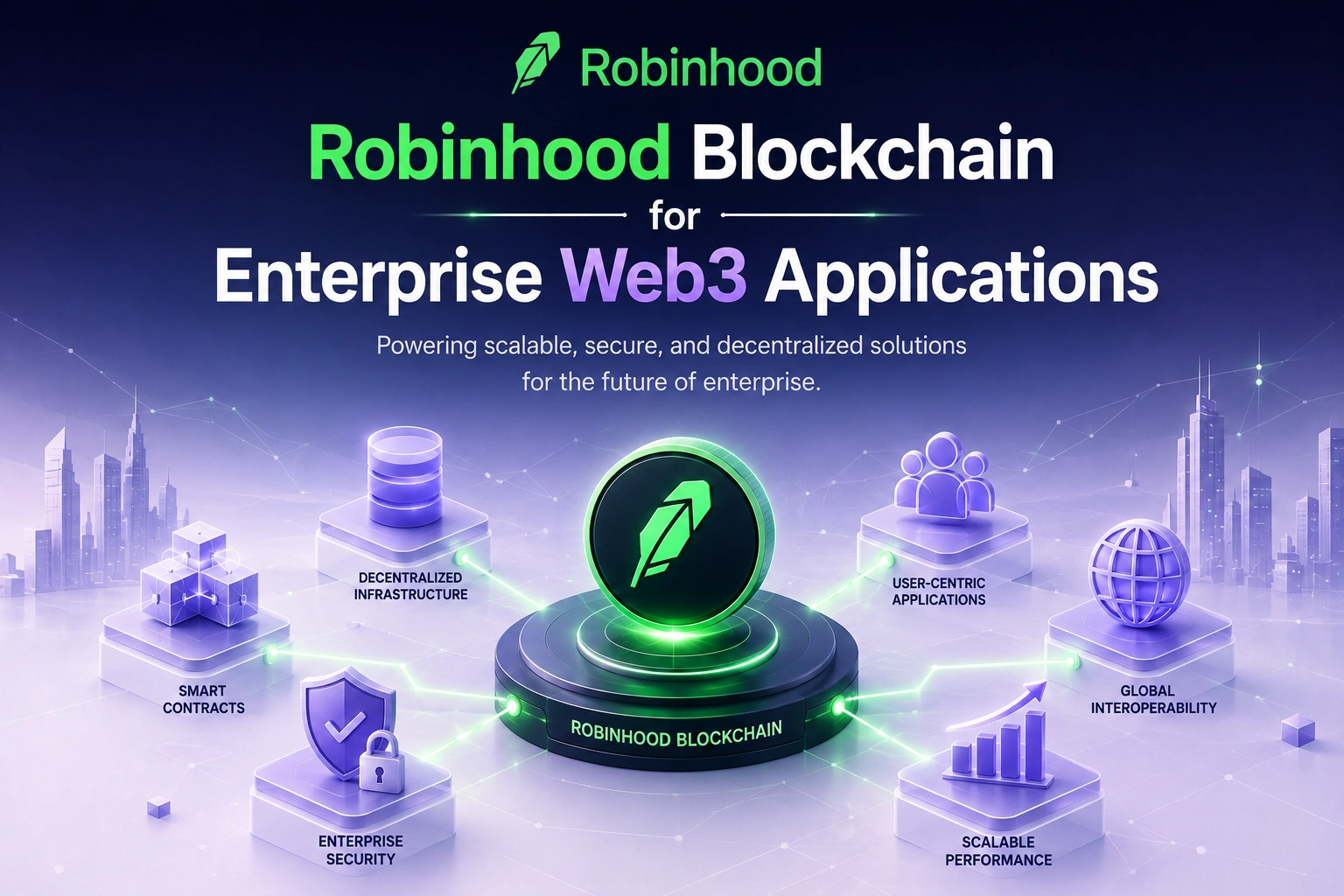
Robinhood Blockchain as the Foundation for Enterprise Web3 Applications
Robinhood Blockchain has quickly become one of the most talked-about developments in fintech and enterprise technology circles. What started as a brokerage app for retail investors has turned into a serious blockchain infrastructure play, and enterprises are paying attention. If you’re a CTO, product leader, or founder exploring Enterprise Web3 Applications, you’ve probably wondered whether Robinhood’s approach offers a blueprint worth studying. It does, and in this article, we’ll break down why. Along the way, we’ll show how a partner like Blocsys helps organizations turn these ideas into production-ready systems through its Blockchain Development services, and why teams increasingly choose to hire Web3 developers rather than build everything from scratch.
Enterprise Web3 Applications are no longer a niche experiment. Banks, exchanges, healthcare networks, and manufacturing giants are all testing blockchain infrastructure for real operational needs. Robinhood’s move into this space, with its own Layer-2 network, tokenized assets, and wallet infrastructure, gives us a concrete case study for what enterprise-grade blockchain adoption actually looks like in 2026.
What Is Robinhood Blockchain, Exactly?
Robinhood Blockchain refers to the company’s expanding blockchain ecosystem, built to support tokenized stocks, crypto trading, staking, and digital asset custody at scale. It’s not just a feature bolted onto an existing app. Instead, it’s infrastructure designed from the ground up to handle high transaction volume, regulatory scrutiny, and global user demand.
Here’s why that matters for enterprises: Robinhood didn’t build a toy blockchain. It built something meant to survive real financial workloads. That’s exactly the standard enterprise buyers care about when they evaluate Blockchain Infrastructure providers for mission-critical systems.
The Robinhood blockchain platform combines a custom Layer-2 network, a proprietary wallet system, smart contract capability, and API-driven integrations. Together, these pieces form a model enterprises can study, and in many cases, adapt for their own Web3 initiatives.
“Robinhood’s blockchain strategy proves something we’ve argued for years: enterprise blockchain succeeds when it’s invisible to the end user but rock-solid underneath. Consumers don’t care about consensus mechanisms. They care about speed, trust, and uptime.” — Blocsys Blockchain Architecture Team
Understanding Robinhood’s Blockchain Infrastructure
Robinhood blockchain infrastructure rests on a few key pillars: a Layer-2 scaling solution, tokenization tools for real-world assets, custodial and non-custodial wallet options, and a compliance layer built for regulated markets. This isn’t experimental architecture. It’s designed for production traffic and audited financial reporting.
Enterprises exploring similar builds should note the emphasis on modularity. Robinhood didn’t lock itself into a single chain forever. Instead, it built infrastructure flexible enough to support multiple asset classes and jurisdictions, which is a lesson every enterprise blockchain platform team should take seriously.
Why Robinhood Blockchain Is Becoming a Template for Enterprises
Robinhood Blockchain works because it solves three problems at once: scalability, user experience, and regulatory alignment. Most consumer crypto products get one or two of these right. Robinhood, however, built its stack to satisfy all three simultaneously, and that’s rare.
Enterprises evaluating Enterprise Web3 Applications often struggle with the same tradeoffs. Do you optimize for speed and sacrifice compliance? Do you prioritize decentralization and lose performance? Robinhood’s answer, a permissioned Layer-2 approach layered with compliance automation, gives enterprise architects a proven pattern to reference.
Market Trends Driving Enterprise Web3 Adoption
Enterprise blockchain adoption has accelerated sharply. According to recent industry surveys, over 60% of Fortune 500 companies are now piloting or actively running blockchain-based systems for payments, identity, or supply chain tracking. Meanwhile, tokenized real-world assets are projected to exceed several trillion dollars in value by the end of the decade.
Consequently, enterprise blockchain platform vendors are racing to build infrastructure that can handle this volume without sacrificing compliance. Robinhood’s blockchain wallet and settlement layer additions reflect exactly this shift, moving from speculative crypto trading toward regulated, asset-backed digital finance.
| Trend | 2023 Status | 2026 Status |
|---|---|---|
| Tokenized Assets | Early pilots | Mainstream institutional adoption |
| Layer-2 Adoption | Niche, dev-focused | Standard for enterprise scale |
| AI + Blockchain Integration | Rare | Common in fraud detection, compliance |
| Enterprise Wallet Infrastructure | Fragmented | Consolidated, API-driven |
Major Drivers Behind Enterprise Web3 Infrastructure
What’s actually pushing enterprises toward Web3 development? Several forces are converging at once.
First, cost pressure. Traditional settlement systems are slow and expensive compared to blockchain-based rails. Second, customer expectation. Younger users expect instant, transparent digital asset ownership. Third, regulatory clarity is finally improving across the US, UK, EU, UAE, and Singapore, giving enterprises confidence to build.
Furthermore, AI-powered blockchain solutions are making compliance and fraud monitoring dramatically easier, removing one of the biggest historical blockers to enterprise adoption.
Benefits of Robinhood-Inspired Blockchain Architecture for Enterprises
Robinhood blockchain infrastructure offers a few clear lessons enterprises can borrow directly.
- Layer-2 scalability reduces transaction costs while keeping settlement fast.
- Built-in wallet infrastructure improves user onboarding and custody security.
- Modular smart contracts allow rapid feature rollout without rebuilding the base chain.
- Compliance automation reduces manual regulatory overhead.
- API-first design lets enterprise systems integrate without deep blockchain expertise on staff.
These aren’t abstract ideas. They’re the exact components our teams at Blocsys implement when we help enterprises design Blockchain Infrastructure from the ground up.
Enterprise Web3 Applications vs Traditional Enterprise Software
Traditional enterprise software relies on centralized databases, siloed permissions, and manual reconciliation between systems. Enterprise Web3 Applications flip that model. Data lives on shared, verifiable ledgers, smart contracts automate business logic, and multiple parties can trust the same source of truth without a middleman.
That said, Web3 isn’t a wholesale replacement for everything. Rather, it’s best applied where trust, transparency, and multi-party coordination create real friction today, think trade settlement, supply chain provenance, or digital identity.
Blockchain Infrastructure Powering Enterprise Web3 Applications
Enterprise blockchain infrastructure needs a few non-negotiable components: high-throughput consensus, secure key management, interoperability across chains, and developer-friendly tooling. Robinhood Web3 initiatives check each of these boxes, and enterprises building similar stacks should demand the same.
Additionally, enterprises should think about long-term maintainability. Blockchain infrastructure isn’t a one-time build. It requires ongoing security audits, upgrades, and monitoring, which is why many organizations work with a dedicated Blockchain Consulting partner rather than going it alone.
Layer-2 Architecture and Enterprise Scalability
Robinhood Layer 2 blockchain technology solves a problem every enterprise eventually hits: base-layer congestion. Layer-2 networks batch transactions off the main chain, then settle them in bulk, cutting costs and boosting speed dramatically.
For enterprises processing thousands of daily transactions, whether payments, tokenized securities, or supply chain events, Layer-2 isn’t optional anymore. It’s foundational. This is precisely where Dedicated Blockchain Engineering Teams earn their keep, designing Layer-2 rollouts tailored to specific throughput and compliance needs.
Blockchain Wallets and Enterprise Identity
A Robinhood blockchain wallet isn’t just a place to store crypto. It’s an identity layer, a security boundary, and a user experience touchpoint all at once. Enterprises building Web3 products need to think about wallets the same way.
Enterprise identity management built on blockchain wallets allows organizations to verify users, manage permissions, and secure assets without relying entirely on centralized credential systems. This matters enormously for banks, exchanges, and healthcare networks handling sensitive data across borders.
Smart Contracts and Enterprise Automation
Smart contracts automate agreements without needing a middleman to enforce them. For enterprises, that means faster settlement, fewer disputes, and dramatically reduced administrative overhead.
Robinhood’s tokenization efforts rely heavily on smart contract logic to manage issuance, transfers, and compliance checks automatically. Enterprises pursuing similar goals typically start with a scoped pilot through Smart Contract Development before scaling to production systems.
Blockchain APIs and Enterprise Integration
No enterprise wants to rip out its existing systems to adopt blockchain. That’s where APIs come in. Well-designed blockchain APIs let enterprises plug Web3 functionality into existing CRM, ERP, and payment systems without a full rebuild.
Robinhood’s API-driven approach to blockchain features shows how this can work smoothly for millions of users. Enterprises should demand the same level of integration flexibility from any Enterprise Blockchain Platform they adopt.
AI Integration With Enterprise Web3 Applications
AI and blockchain are becoming inseparable in enterprise contexts. AI models can monitor transactions for fraud in real time, automate compliance reporting, and even optimize smart contract execution paths.
Robinhood blockchain infrastructure already uses AI-driven risk models to flag suspicious activity before it becomes a problem. Enterprises building their own Web3 platforms should plan for this integration from day one, not bolt it on later. Consequently, teams that combine AI-powered blockchain solutions with strong data governance see far fewer compliance headaches down the road.
Compliance and Governance in Enterprise Blockchain
Regulation is often the deciding factor in whether an enterprise blockchain project succeeds or stalls. Robinhood enterprise blockchain efforts have had to satisfy SEC guidelines, international financial regulators, and strict KYC/AML requirements simultaneously.
That’s a heavy lift, but it’s manageable with the right architecture. Building compliance rules directly into smart contracts, rather than handling them manually after the fact, is one of the biggest efficiency gains enterprises can realize.
Enterprise Implementation Roadmap
So, how should an enterprise actually get started? Here’s a practical roadmap based on patterns we’ve seen work across finance, healthcare, and retail clients.
- Assess business use cases where blockchain solves real friction, not just hype-driven pilots.
- Choose Layer-2 or Layer-1 architecture based on transaction volume and cost tolerance.
- Design wallet and identity infrastructure early, since retrofitting it later is expensive.
- Build compliance rules into smart contracts from the start.
- Integrate via APIs rather than replacing legacy systems outright.
- Partner with an experienced Enterprise blockchain development team to avoid common security pitfalls.
This is exactly the roadmap our team at Blocsys walks clients through during early-stage Blockchain Consulting engagements.
Real-World Enterprise Use Cases
Financial Services
Banks and exchanges use blockchain infrastructure for instant settlement, tokenized securities, and OTC trading. Solutions like an Institutional OTC Crypto Trading Platform or a dedicated OTC Trading Platform show how enterprises move large trades securely without slippage or delay.
Capital Markets and Post-Trade Operations
Post-trade reconciliation has traditionally been slow and error-prone. A Permissioned Blockchain Infrastructure for Capital Market Post-Trade Operations cuts settlement times from days to minutes.
Healthcare and Document Verification
Hospitals and credentialing bodies use blockchain to prevent fraud. A Tamper-Proof Document Verification Platform ensures records can’t be altered without detection.
Supply Chain and Retail
Food safety and provenance tracking benefit enormously from blockchain. A Blockchain-Powered Organic Certification & Food Traceability Platform gives consumers verifiable proof of sourcing claims.
Digital Commerce and Gaming
Transparent, provably fair digital experiences are gaining traction. A Blockchain-Powered Lottery & Raffles Platform or a Raffle Platform Development project shows how transparency builds consumer trust.
DeFi and Trading Infrastructure
Enterprises entering decentralized finance often start with a DeFi Trading Platform Built on Blockchain, a Crypto Trading Platform Development engagement, or even a Cryptocurrency Exchange Development build. Prediction markets are also gaining enterprise interest through platforms like those built by a Prediction Markets Platform Development Company.
Robinhood’s Blockchain Strategy and the Future of Enterprise Web3
Robinhood’s blockchain strategy points toward a future where consumer fintech and enterprise infrastructure converge. As tokenization expands beyond crypto into stocks, bonds, and real estate, the line between “consumer app” and “enterprise infrastructure provider” gets blurry.
Enterprises watching this space closely should expect more competition, more regulatory clarity, and more pressure to modernize legacy financial rails. Robinhood blockchain developments over the next few years will likely keep setting benchmarks that enterprise architects reference when justifying their own Web3 budgets.
“The enterprises that win in Web3 won’t be the ones who move fastest. They’ll be the ones who build infrastructure that’s boring, reliable, and compliant, then innovate on top of it. That’s the real Robinhood Blockchain lesson.” — Blocsys Enterprise Solutions Lead
Challenges and Future Opportunities
Nothing about enterprise blockchain adoption is entirely frictionless. Interoperability between chains remains a headache. Regulatory frameworks still vary wildly between the US, UK, EU, and UAE. Talent shortages in blockchain architecture continue to slow projects down.
However, these challenges are shrinking every year. AI-assisted development, standardized Layer-2 protocols, and maturing compliance tools are making enterprise blockchain platforms far easier to build than they were even two years ago. Organizations that move now will have a real head start over competitors still stuck evaluating options.
Why Blocsys Is the Ideal Enterprise Blockchain Consulting and Development Partner
Building infrastructure inspired by Robinhood Blockchain isn’t something most internal teams can do alone. It requires deep experience across Layer-2 architecture, wallet security, smart contract auditing, and regulatory design, all at once.
That’s where Blocsys comes in. We’ve helped fintech companies, exchanges, and enterprise organizations design and launch secure, scalable blockchain systems across financial services, healthcare, and digital commerce. Whether you need to hire blockchain developers for a specific build or want a full Enterprise blockchain development team embedded with your product organization, we structure engagements around your actual business goals, not generic templates.
If you’re planning a Web3 initiative in 2026, it’s worth reviewing our Founder Checklist 2026: Blockchain Startup Guide before you start scoping vendors. And when you’re ready to build, our team is prepared to hire Web3 developers onto your project quickly, with proven experience across Layer-2 systems, wallets, and enterprise-grade smart contracts.
Frequently Asked Questions
Here are direct answers to the questions we hear most often about Robinhood Blockchain and Enterprise Web3 Applications.
What is Robinhood Blockchain and how does it work?
Robinhood Blockchain is the company’s blockchain ecosystem built to support tokenized assets, crypto trading, staking, and digital wallets at scale. It combines a Layer-2 network for fast, low-cost transactions with a compliance layer designed for regulated financial markets.
It works by processing transactions off the main chain through Layer-2 rollups, then settling them in batches, which keeps costs low while maintaining security. This structure lets Robinhood support millions of users without sacrificing speed or regulatory compliance, a model enterprises frequently study when designing their own blockchain infrastructure.
How does Robinhood Blockchain support Enterprise Web3 Applications?
Robinhood Blockchain demonstrates how enterprise-grade Web3 Applications can be built with real compliance guardrails, not just experimental crypto features. Its wallet infrastructure, smart contract logic, and API integrations give enterprises a working reference architecture.
Enterprises can study its Layer-2 scalability approach, wallet-based identity model, and automated compliance checks, then adapt similar patterns for their own Enterprise Web3 Applications in banking, healthcare, or supply chain.
Why is Robinhood investing in blockchain infrastructure?
Robinhood is investing in blockchain infrastructure because tokenized assets and decentralized finance are reshaping how people trade, invest, and hold digital assets. Building proprietary infrastructure gives Robinhood more control over cost, speed, and user experience.
It also positions Robinhood competitively against both traditional brokerages and pure-crypto exchanges, capturing users who want stocks, crypto, and tokenized assets in one platform with enterprise-level reliability.
What technologies power Robinhood Blockchain?
Robinhood Blockchain relies on a custom Layer-2 scaling solution, smart contract infrastructure for tokenization, secure wallet systems, and API layers for integration. AI-powered monitoring tools support fraud detection and compliance automation across the platform.
Together, these technologies form a full-stack blockchain infrastructure platform, not just a single blockchain feature bolted onto an existing app.
What are the benefits of Enterprise Web3 Applications for businesses?
Enterprise Web3 Applications reduce settlement times, cut reconciliation costs, and create transparent, auditable records across multiple parties. They also enable new business models like tokenized assets and programmable smart contracts.
Additionally, businesses gain stronger security through cryptographic verification and reduced reliance on centralized intermediaries, which lowers operational risk over time.
How can enterprises build Robinhood-inspired blockchain platforms?
Enterprises should start by identifying real business problems blockchain can solve, such as slow settlement or fragmented identity systems. From there, they need to choose appropriate Layer-2 architecture, design wallet infrastructure, and build compliance directly into smart contracts.
Partnering with an experienced Enterprise blockchain development team, like Blocsys, helps avoid common security and architecture mistakes during this process.
How does Layer-2 blockchain improve enterprise performance?
Layer-2 blockchain technology processes transactions off the main chain and settles them in batches, dramatically reducing costs and increasing throughput. This matters for enterprises handling thousands or millions of daily transactions.
Without Layer-2, enterprises would face high fees and slow confirmation times, making large-scale Enterprise Web3 Applications impractical.
What industries can benefit from Enterprise Web3 Applications?
Financial services, healthcare, supply chain, manufacturing, retail, and digital commerce all benefit from Enterprise Web3 Applications. Use cases range from tokenized securities and OTC trading to document verification and food traceability.
Essentially, any industry dealing with multi-party trust issues, verification needs, or slow settlement processes stands to gain from blockchain infrastructure.
How much does it cost to build an Enterprise Web3 platform?
Costs vary widely based on scope, ranging from tens of thousands of dollars for a focused pilot to several hundred thousand for a full enterprise-grade platform with wallets, smart contracts, and compliance automation.
Working with an experienced Blockchain Consulting partner helps enterprises scope projects accurately and avoid costly rework later in development.
Why should enterprises choose Blocsys for Enterprise Blockchain Development?
Blocsys brings hands-on experience building Layer-2 systems, wallets, smart contracts, and compliance frameworks across finance, healthcare, and digital commerce. We don’t offer generic templates, we design infrastructure around each client’s actual regulatory and business requirements.
From initial consulting through production deployment, our Enterprise blockchain development team supports organizations at every stage, whether that means a scoped smart contract audit or a full Enterprise Web3 platform build.
Robinhood Blockchain has shown that enterprise-grade Web3 infrastructure is achievable, scalable, and compliant when built correctly. Enterprises across the US, UK, Europe, UAE, and Singapore are already following similar blueprints to modernize their digital asset strategies. If your organization is ready to move from research to real implementation, Blocsys is ready to help you design, build, and launch secure Enterprise Web3 Applications, starting with a conversation about your specific goals.
Ready to move beyond theory and build an intelligent platform that delivers real-world value? Blocsys Technologies specialises in engineering enterprise-grade AI and blockchain solutions for the fintech, Web3, and digital asset sectors. Connect with our experts today to discuss your vision and chart a clear path from concept to a secure, scalable reality.
