
India’s live pilot shows what integration looks like in practice: Demat 2.0 has supported three tokenized corporate bond issuances totaling ₹1,025 crore, including an L&T ₹500 crore bond. Corporate bond tokenization integration connects token issuance and lifecycle logic with core banking, investor onboarding, custody, accounting, settlement, and reporting systems through governed APIs and event-driven data flows.
A treasury team can approve a digital bond workflow in the morning and still discover that the general ledger, custody records, investor eligibility service, payment rail, and regulatory reports speak different data languages. A tokenized corporate bond cannot operate as an isolated blockchain asset. The bank must connect it to the operating model that already manages customer records, permissions, cash, valuation, reconciliations, corporate actions, and exceptions.
This guide is for banks, custodians, asset managers, investment firms, fintechs, issuers, and financial technology teams evaluating bond tokenization integration across the USA, UK, UAE, Germany, Singapore, Canada, Australia, India, and other markets. It focuses on the practical sequence, not a standalone blockchain deployment: map the estate, establish interfaces, control identity and custody, reconcile every state change, test failure paths, and release one governed workflow before expanding.
The regulatory position still belongs to the institution and its advisers. Technology integration doesn’t automatically create compliance, licensing, investor eligibility, or reporting compliance. India’s SEBI FAQ confirms that a tokenized corporate bond remains a security under the Securities Contracts (Regulation) Act, 1956 and continues under the existing SEBI framework, which illustrates why legal classification must remain connected to architecture decisions (SEBI’s official FAQ).
A useful seven-part roadmap starts with core banking APIs, then covers blockchain infrastructure, onboarding, custody, accounting, settlement, and interoperability. The same framework helps an enterprise bank protect legacy controls, a fintech launch a focused service, an asset manager preserve portfolio records, an issuer coordinate lifecycle events, and a custodian maintain ownership evidence. Teams planning broader modernization can also review this legacy system modernization guide for relevant integration principles.
Table of Contents
- 1. How should core banking systems connect to tokenized bonds?
- 2. What blockchain and smart contract infrastructure must banks integrate?
- 3. How should investor onboarding connect with KYC and AML systems?
- 4. What custody and wallet model fits a financial institution?
- 5. How should accounting and reconciliation systems handle tokenized bonds?
- 6. How can settlement and payment systems support tokenized bonds?
- 7. How should institutions synchronize tokenized and legacy bond data?
- 7-Point Corporate Bond Tokenization Integration Matrix
- Turn integration requirements into a controlled rollout
1. How should core banking systems connect to tokenized bonds?
Core banking integration should connect the tokenization platform to customer, account, ledger, treasury, settlement, and reporting services through controlled APIs and asynchronous messages. The bridge should translate token events into familiar banking objects, while preserving the transaction identifier, bond identifier, investor identity, authorization evidence, and exception status needed for audit.
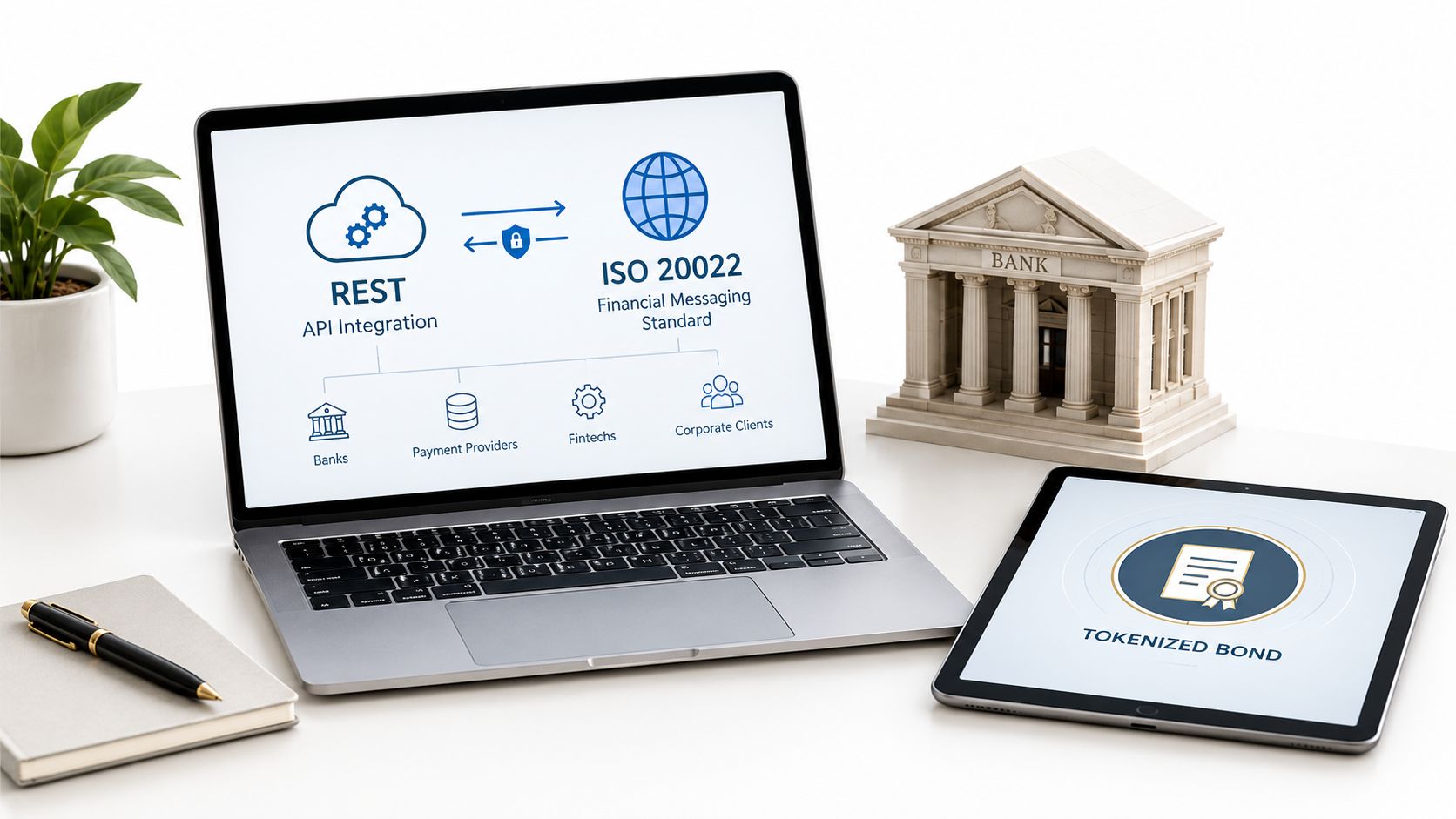
Start with an inventory, not a blockchain vendor. Document existing REST endpoints, ISO 20022 message capabilities, batch interfaces, mainframe dependencies, account models, data owners, and downstream consumers. A bank may have separate services for customer records, securities processing, cash management, general ledger, risk, CRM, and regulatory reporting. The tokenized bond workflow must identify which system is authoritative for each field.
Build a translation layer, not a direct dependency
A stateless integration service can isolate the tokenization platform from changes in core banking. It should transform issuance instructions, holdings, settlement instructions, coupon events, and redemption events into the formats used by internal systems. REST APIs may support synchronous validation, while message queues such as RabbitMQ or Kafka can absorb timing differences and retries.
The design should include:
- Canonical identifiers: Map the bond’s legal and operational identifiers to internal security, customer, account, and portfolio records.
- Idempotent processing: Ensure a retried event doesn’t create a duplicate account entry, payment instruction, or position update.
- Boundary observability: Log authentication, payload validation, correlation IDs, response codes, latency, and failure reasons.
- Ownership and service levels: Assign responsibility for schema changes, outages, reconciliation, and incident response to the bank, vendor, or both.
Practical rule: Treat the API boundary as a controlled financial system, not as plumbing that can be changed informally.
Run a parallel period before production. Compare tokenized bond transactions with expected banking outputs, test rejected and duplicated messages, and reconcile missing events on a defined schedule. A corporate bond tokenization platform can sit within this architecture, but the bank still needs to define its own system ownership, controls, and integration contracts.
2. What blockchain and smart contract infrastructure must banks integrate?
The blockchain layer should represent the bond’s permitted ownership and lifecycle states, while surrounding systems retain legal, customer, financial-control, and operational responsibilities. The institution must select a public, permissioned, or hybrid network based on privacy, participant governance, transaction visibility, finality, operational resilience, and jurisdictional requirements.
Permissioned networks can simplify participant access and data governance. Public networks may offer broader composability but introduce different questions around privacy, key management, transaction fees, network dependencies, and operational control. A hybrid model may keep sensitive records and permissioning within an institutional environment while exposing carefully controlled proofs or interfaces elsewhere.
Encode terms with explicit governance
Smart contracts should represent approved bond terms, transfer restrictions, coupon schedules, maturity, redemption, investor permissions, and corporate-action states. They shouldn’t silently replace legal documentation. Legal and operations teams need a readable mapping between the offering documents, operating procedures, and contract states.
Use modular contracts with narrowly defined roles. Upgrade authority requires a formal process, separation of duties, approval evidence, and a tested recovery path. Oracle data, such as reference rates or approved event inputs, should be validated and supported by fallback procedures. If an external data source becomes unavailable, the workflow must specify whether processing pauses, uses an approved prior value, or moves to manual intervention.
Independent code review is essential before deployment. Test authorization boundaries, replay attempts, malformed inputs, paused states, recovery, and lifecycle transitions. Document every permission, state change, and administrative action so compliance, audit, operations, and technology teams can understand what the code does.

Teams evaluating implementation patterns can use this smart contract architecture guide as a technical reference. Network monitoring should cover node health, transaction submission, confirmation, finality, rejected calls, contract events, and administrative changes. Blockchain infrastructure is successful only when these signals reach the same incident and control processes used for the bank’s other critical systems.
3. How should investor onboarding connect with KYC and AML systems?
Investor onboarding should make eligibility a controlled, reusable service rather than a one-time form submission. The tokenization platform should receive verified identity and risk outcomes from approved systems, apply offering rules, and record the evidence behind each access decision without exposing unnecessary personal data on-chain.
The workflow typically connects an investor portal to identity verification, sanctions screening, beneficial-ownership checks, accreditation or professional-investor classification where relevant, tax documentation, consent records, and ongoing monitoring. The exact controls depend on the institution, product, investor type, and jurisdiction. A technology provider can orchestrate these services, but it doesn’t decide the institution’s legal obligations.
Separate eligibility from transaction execution
An investor may be approved for one offering and restricted from another. Store eligibility as a versioned decision with its source, timestamp, reviewer or rule, expiry condition, and applicable product scope. A screening update should trigger a controlled review rather than changing ownership or blocking a transaction without an explanation.
Useful design controls include:
- Asynchronous processing: Let document collection, screening, and review proceed through separate states instead of blocking the whole workflow on one slow provider.
- Risk-based routing: Send unusual ownership structures, high-risk jurisdictions, possible PEP matches, and name variations to a defined review queue.
- Webhook updates: Refresh status when a screening provider changes an outcome, with retry and replay controls.
- Consent evidence: Capture acceptance of risks, token mechanics, transfer restrictions, disclosures, and electronic communications.
- Case management: Preserve the reason for approval, rejection, escalation, or expiry.
A fast onboarding screen isn’t a control. The control is the traceable decision behind the investor’s ability to subscribe, hold, transfer, and receive payments.
Connect the orchestration layer to existing compliance systems rather than creating a parallel customer file. This blockchain verification and customer onboarding resource is relevant when designing identity and verification workflows. Periodic reviews should detect incomplete records, expired checks, inconsistent beneficial-owner data, and eligibility decisions that no longer match the offering rules.
4. What custody and wallet model fits a financial institution?
Custody integration defines who controls keys, approves transfers, records ownership, and acts during an outage. Treat it as an operating-model decision, not a wallet configuration. The choice must align with investor servicing, legal segregation, recovery responsibilities, staffing, and the bank’s existing control framework.
Self-custody maximizes direct control but increases demands for key governance, hardware security, approvals, monitoring, recovery, and trained staff. Third-party custody reduces internal operating work while creating provider dependency, service-level exposure, integration risk, and concentration concerns. Hybrid custody can assign transaction, client, long-term holding, and recovery functions across internal and external wallets. The institution should document which party controls each function and how authority returns to the bank if a provider is unavailable.
Assign wallets to operating roles
A production design may use issuer wallets, settlement wallets, investor or omnibus wallets, operational wallets, and recovery holdings. Each wallet needs an owner, permitted actions, approval path, and reconciliation source. The address is only a technical identifier. It must connect to the approved account, entitlement, authorization history, and position record so operations and auditors can trace ownership.
Key controls include:
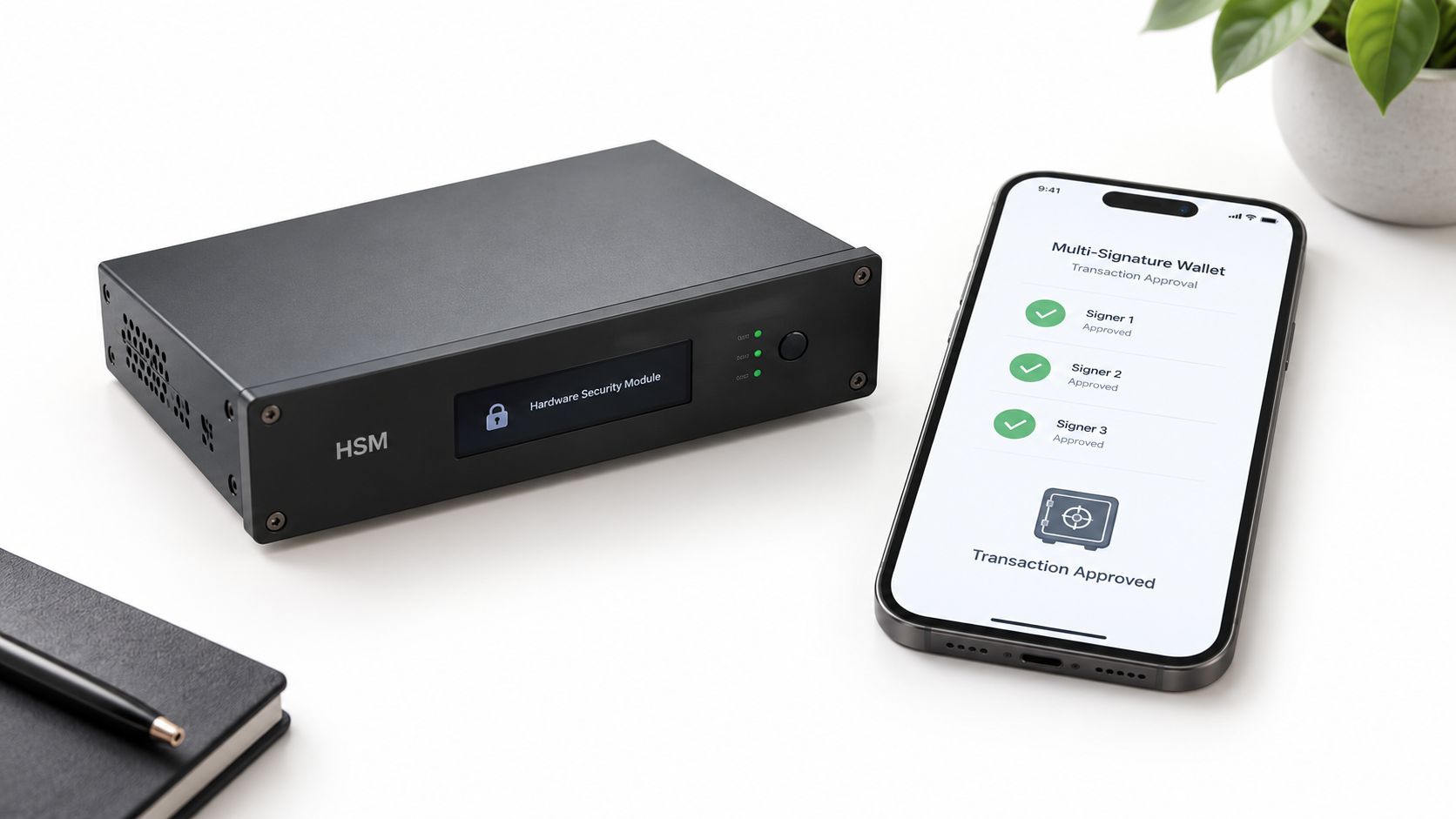
- HSM-backed key management: Protect signing keys and restrict administration through role separation.
- Multi-party authorization: Require independent approval for issuance, transfers, administrative changes, and recovery.
- Continuous reconciliation: Compare wallet balances, token events, custody records, and accounting positions.
- Incident procedures: Define freezing, investigation, communications, evidence preservation, and controlled resumption.
- Provider governance: Record availability expectations, escalation routes, audit access, and incident notification duties.
Test the model against a failed recovery attempt, an unavailable approver, a compromised credential, a rejected transfer, and a node outage. For example, a recovery exercise should verify that authorized staff can restore signing capability without bypassing segregation controls, while operations can preserve pending orders and client records. The runbook should state who declares the incident, which wallet is used, how evidence is retained, and when normal processing resumes.
The underlying network may be public, private, or hybrid, but custody controls must remain explicit. Guidance on digital asset custody and compliance can help structure that assessment.
5. How should accounting and reconciliation systems handle tokenized bonds?
A bank’s accounting model must treat tokenized bonds as financial instruments with coordinated on-chain and off-chain records. Each issuance, purchase, transfer, coupon accrual, valuation, impairment, redemption, fee, or reversal requires an accounting treatment, an accountable owner, a source event, and an exception procedure.
The token event should pass through an accounting service before it reaches the general ledger. That service validates the event, applies product and account rules, calculates the posting, and sends an idempotent instruction to the GL or fund-accounting platform. The retained record should include the bond identifier, investor or portfolio, transaction reference, valuation basis, effective date, and approval evidence. This design also gives operations a controlled fallback when an event arrives late, fails validation, or conflicts with a legacy record.
Reconciliation should run as an operational control across the hybrid architecture. Compare blockchain events with custody records, sub-ledgers, GL positions, portfolio systems, and investor statements. Flag missing events, duplicate messages, timing differences, quantity mismatches, unauthorized movements, stale valuations, and coupon discrepancies. Assign every exception a case number, severity, owner, due date, and resolution evidence.
The data model needs clear ownership:
- Position data: What the investor or portfolio holds.
- Transaction data: How the position changed.
- Valuation data: Which approved price or valuation method was used.
- Income data: How coupons, fees, and accrued amounts were recognized.
- Reporting data: How the instrument appears in internal, client, tax, and regulatory outputs.
Posting frequency is an architecture decision. Batch posting can protect an older GL from event bursts. Near-real-time posting may fit a modern sub-ledger. The choice should reflect materiality, reporting cutoffs, valuation frequency, and operational capacity, rather than forcing blockchain timing onto systems that cannot support it.
Coupon processing requires separate testing for contract dates, entitlement snapshots, payment instructions, failed payments, withholding, returned funds, and investor statements. After each material lifecycle event, accounting, custody, and payment records should reconcile. Manual adjustments require approval and a complete audit trail.
6. How can settlement and payment systems support tokenized bonds?
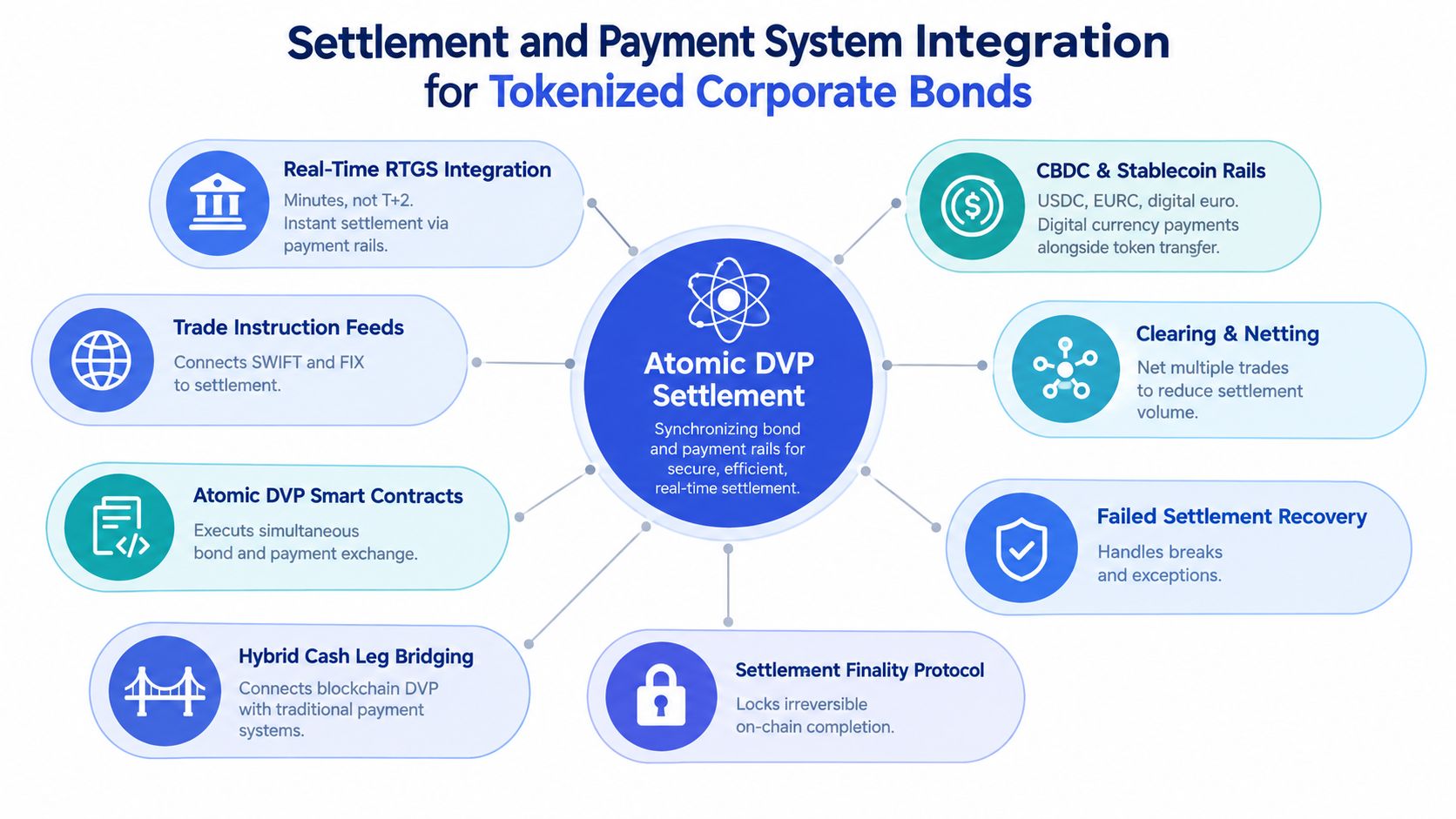
Settlement integration must coordinate the token transfer, payment rail, and delivery-versus-payment controls as one operating process. The chosen settlement asset may be RTGS funds, ACH, commercial-bank money, CBDC infrastructure, stablecoins, or another approved option. Each choice affects legal finality, liquidity, participant access, reconciliation, and outage procedures.
A practical workflow can start on a trading or issuance platform, confirm investor eligibility, reserve the bond, create a payment instruction, receive an authoritative payment result, and then finalize ownership. The order and control points matter. Releasing the bond before confirmed cash creates a different exposure from coordinating both legs through atomic logic.
Payment systems also need clear ownership across the hybrid architecture. APIs should carry a correlation ID for the cash and asset legs, while the ledger, payment provider, custody platform, and operations team retain defined responsibilities. Idempotency keys prevent retries from creating duplicate instructions. Status polling and event callbacks should distinguish a timeout, rejection, settlement confirmation, and reversal.
Design the exception path before production
Settlement failures should produce a controlled operational case rather than an informal manual fix. Define the permitted action, approval level, evidence, and system of record for each condition:
- Unmatched instructions: Hold, repair, or cancel under approved rules.
- Insufficient funds: Block asset release and route the case to operations.
- Late confirmation: Poll status and prevent duplicate submissions.
- Price or term disputes: Escalate to authorized personnel without changing contract state informally.
- Network outage: Use an approved contingency process with reconciliation requirements.
- Reversal requests: Separate an operational correction from a legally completed transfer.
During a staged rollout, conventional settlement may serve as a fallback. It must not create two competing sources of truth. Record the temporary state, assign fallback approval, and reconcile the banking and blockchain records when normal processing resumes. This stablecoin settlement infrastructure resource provides context for payment-rail design.
A short technical explainer can help non-engineering stakeholders understand why the payment leg matters:
7. How should institutions synchronize tokenized and legacy bond data?
A bank can complete a token transfer while its custody, accounting, or reporting systems still show the previous state. Synchronization therefore requires an operating model for shared data, ownership, and exceptions, not just a blockchain connection. In a hybrid environment, tokenized and conventional bonds may follow different workflows while representing related positions, transactions, and lifecycle events.
Define the canonical model before connecting production systems. Begin with the fields needed to operate and control the asset: bond identifier, holder, quantity, status, settlement state, and lifecycle date. Assign an authoritative system to each field. The token ledger can evidence a transfer, the custody platform can own the client relationship, and the general ledger can own the accounting entry. That ownership must be documented, tested, and visible to operations and audit teams.
Synchronization also depends on durable event handling. A message bus should support retries, deduplication, required ordering, dead-letter handling, and replay. Schema versioning prevents a change to a coupon event or holding message from disrupting risk, reporting, or client applications. Encryption in transit and at rest, together with role-based access, limits exposure of sensitive information.
Use control points that make failures diagnosable:
- Canonical registry: Maintain approved definitions for bond terms, identifiers, permissions, and lifecycle states.
- Schema governance: Review changes, publish versions, and test backward compatibility.
- Event correlation: Carry a shared transaction and business-process identifier across connected systems.
- Exception diagnostics: Display the failed field, source record, expected value, retry history, and assigned owner.
- Runbooks: Record repair, replay, manual approval, fallback, and final reconciliation procedures.
Operational teams should be able to answer two questions quickly: which record governs this fact, and how can they prove that each dependent system received it? Monitoring should surface stale positions, mismatched quantities, missing events, and unresolved ownership before they affect client statements or regulatory reports.
Cross-chain activity adds controls for identity, message authenticity, finality, asset uniqueness, privacy, and recovery. Institutions assessing those dependencies can consult this blockchain interoperability reference.
7-Point Corporate Bond Tokenization Integration Matrix
| Item | Implementation complexity 🔄 | Resource requirements 💡 | Expected outcomes ⭐📊 | Ideal use cases ⚡ | Key advantages ⭐ |
|---|---|---|---|---|---|
| Core Banking System Integration via Standardized APIs | 🔄 Moderate–High: adapter work, legacy API reverse‑engineering, extensive testing | 💡 Medium: API gateway, middleware, integration engineers, message queues | ⭐⭐⭐ 📊 Seamless GL sync, regulatory audit trails, faster time‑to‑market | ⚡ Banks with mature IT governance needing hybrid token/traditional workflows | ⭐ Maintains existing workflows, lowers training, enables phased rollout |
| Blockchain Network and Smart Contract Infrastructure Integration | 🔄 Very High: chain choice, smart contract design, governance and upgrade complexity | 💡 High: blockchain engineers, security auditors, validator/infra resources | ⭐⭐⭐⭐ 📊 Atomic settlement, automation of bond terms, immutable audit trail | ⚡ Institutions aiming for full on‑chain settlement, 24/7 trading and automation | ⭐ Eliminates intermediaries, reduces post‑trade costs, transparent records |
| Investor Onboarding and KYC/AML System Integration | 🔄 Moderate: API integrations and jurisdictional rule variations | 💡 Medium: identity providers, screening services, compliance staff | ⭐⭐⭐ 📊 Faster onboarding, reduced compliance risk, clear audit logs | ⚡ Platforms targeting retail/international investors with rapid KYC needs | ⭐ Automated screening, lower manual review, improved conversion |
| Custody and Wallet Infrastructure Integration | 🔄 High: HSMs, multi‑sig workflows, custody provider integrations and recovery planning | 💡 High: HSM hardware, security ops, insured custodians, skilled operators | ⭐⭐⭐ 📊 Strong key security, reduced custody loss risk, reconciled balances | ⚡ Institutions holding large tokenized bond positions or offering custody | ⭐ Multi‑sig/HSM security, insurance options, clear custody controls |
| Accounting, Reconciliation, and Financial Reporting Integration | 🔄 High: complex accounting rules, idempotent GL posting, reconciliation logic | 💡 Medium–High: accounting specialists, reconciliation engines, market data feeds | ⭐⭐⭐ 📊 Timely, auditable financial reports; near‑real‑time NAV and exception alerts | ⚡ Asset managers/funds needing accurate NAV, regulatory reporting | ⭐ Automates journal entries, improves auditability, scales finance ops |
| Settlement and Payment System Integration | 🔄 Very High: DVP smart contracts, payment‑rail integrations, legal/regulatory alignment | 💡 High: RTGS/CBDC/stablecoin access, settlement engineers, formal verification | ⭐⭐⭐⭐ 📊 Atomic DVP, reduced settlement failures, improved liquidity use | ⚡ Institutions seeking real‑time settlement and lower counterparty risk | ⭐ Eliminates settlement risk, lowers working capital, enables instant settlement |
| Data Synchronization, Interoperability, and Legacy System Bridging | 🔄 High: schema governance, identifier mapping, event sourcing and idempotency | 💡 Medium–High: message bus, schema registry, integration engineers | ⭐⭐⭐ 📊 Consistent cross‑system state, fewer reconciliation exceptions, better traceability | ⚡ Hybrid deployments that must keep on‑chain and legacy systems aligned | ⭐ Enables gradual adoption, centralizes metadata, automates propagation and alerts |
Turn integration requirements into a controlled rollout
A sound corporate bond tokenization integration program starts with the operating model, not the chain. Map issuance, subscription, allocation, transfer, custody, coupon, redemption, reporting, exception, and fallback procedures. For every step, identify the responsible team, authoritative system, data exchanged, approval required, evidence retained, and recovery action.
Then choose architecture against actual institutional requirements. A global bank may need multiple core systems, strict segregation, established custody providers, and jurisdiction-specific reporting. A fintech may begin with one issuance workflow and a smaller number of controlled integrations. An asset manager may prioritize portfolio, NAV, valuation, and investor reporting. A custodian may prioritize account structures, wallet controls, entitlement records, and operational resilience. There isn’t one correct architecture for all of them.
Use a staged release plan:
- Map systems and ownership: Document APIs, message formats, data domains, legal records, and manual workarounds.
- Select the network model: Assess permissioning, privacy, governance, finality, node operations, and participant responsibilities.
- Design the integration contract: Define APIs, event schemas, idempotency, retries, authentication, versioning, and service ownership.
- Establish control services: Connect identity, KYC and AML screening, custody, key management, accounting, valuation, reconciliation, and reporting.
- Test the full lifecycle: Include issuance, allocation, transfer, coupon, redemption, rejected transactions, failed settlement, duplicate messages, key recovery, and outages.
- Run one controlled workflow: Release a narrow bond process with parallel records, defined monitoring, and accountable operations.
- Expand deliberately: Add investors, products, networks, or settlement assets only after exception rates, control evidence, and support procedures are understood.
Partner selection should be equally concrete. Look for architecture capability, smart-contract expertise, API engineering, financial-system integration, documentation, test automation, monitoring, access control, governance, incident response, and change management. Ask candidates to show how they handle a duplicate event, a payment timeout, a lost key, a rejected investor, a schema migration, and a reconciliation mismatch. A polished demonstration isn’t evidence of production readiness.
Blocsys Technologies Pvt Ltd can support relevant blockchain development, tokenization, smart-contract, API, and financial-system integration work. Its broader corporate bond tokenization solution is relevant when an institution is defining digital issuance and lifecycle infrastructure, while blockchain infrastructure development can support network and application architecture. These capabilities don’t constitute regulatory approval or make an institution automatically compliant. They should sit within the bank’s legal, risk, compliance, security, and governance framework.
For general company information, visit the Blocsys Technologies homepage. Institutions comparing integration approaches can also browse CEFCore integrations as an additional reference point when assessing how external services connect to enterprise environments.
Frequently asked questions
What is corporate bond tokenization integration?
Corporate bond tokenization integration connects a digital bond issuance and lifecycle platform with the institution’s core banking, investor, custody, accounting, payment, settlement, risk, and reporting systems. It combines APIs, event-driven messaging, identity controls, smart contracts, reconciliation, and operational procedures so tokenized bonds can operate within established financial workflows rather than as isolated blockchain assets.
How do tokenized bonds integrate with banking systems?
Tokenized bonds integrate with banking systems through API adapters, message queues, data transformation services, and controlled event processing. Issuance, holdings, transfers, coupon events, settlement instructions, and redemption events are mapped to customer records, accounts, securities records, general-ledger entries, payment instructions, and reporting outputs, with retries and reconciliation for failures.
What APIs are needed for bond tokenization integration?
A typical integration may require APIs for investor and account data, eligibility, KYC and AML screening, securities issuance, order and allocation processing, custody, wallet authorization, payment initiation, settlement status, valuation, accounting, reporting, and notifications. REST or ISO 20022 interfaces may be appropriate, but the final set depends on the institution’s existing architecture and operating model.
How does a bank connect a blockchain network to existing infrastructure?
A bank usually connects blockchain infrastructure through managed nodes or approved network endpoints, an integration gateway, smart-contract services, event listeners, identity and authorization controls, and message-driven adapters. The gateway should validate transactions, correlate blockchain events with internal records, protect sensitive data, monitor finality and availability, and route exceptions to accountable operations teams.
What should smart contracts do in a tokenized bond system?
Smart contracts can encode approved bond terms, transfer restrictions, investor permissions, coupon and redemption states, and controlled administrative actions. They shouldn’t replace legal documentation, compliance judgment, or operational governance. Contract logic needs independent review, explicit upgrade controls, documented permissions, lifecycle testing, and recovery procedures before production use.
How should investor onboarding work for tokenized corporate bonds?
Investor onboarding should combine a portal with identity verification, beneficial-ownership checks, sanctions screening, investor classification, disclosures, consent, and ongoing monitoring. The tokenization platform should receive a governed eligibility decision, preserve the evidence and expiry conditions, and apply offering-specific restrictions before subscription, transfer, or payment activity is authorized.
Which custody model is best for tokenized bonds?
The best custody model depends on control requirements, investor structure, staffing, recovery capability, service-provider risk, and the institution’s legal and operational responsibilities. Self-custody offers direct control but requires mature key management, third-party custody introduces provider dependency, and a hybrid model can separate transaction, client, and recovery functions when governance supports it.
How should KYC and AML systems connect to tokenized bond platforms?
KYC and AML systems should connect through authenticated APIs, webhooks, case-management workflows, and versioned eligibility records. Screening results should be refreshed when relevant data changes, while high-risk or ambiguous cases move to human review. Integration software can automate orchestration and evidence capture, but it doesn’t independently establish the institution’s regulatory compliance.
How are accounting and reconciliation handled for tokenized bonds?
Accounting services translate validated lifecycle events into idempotent GL or sub-ledger entries for issuance, positions, valuation, income, fees, impairment, and redemption. A reconciliation engine compares blockchain events with custody, portfolio, payment, investor-statement, and GL records, then assigns discrepancies to owners with documented repair and approval procedures.
How should a bank handle tokenized bond settlement failures?
The bank should use queued, idempotent payment instructions, authoritative status responses, explicit timeout handling, and controlled exception procedures. Failed, delayed, unmatched, or reversed payments must not create inconsistent asset and cash records. A pre-approved fallback can maintain operations during an outage, provided the institution defines the temporary source of truth and reconciles it after recovery.
What security controls matter most in tokenized bond integration?
Key controls include strong identity and access management, HSM-backed key protection, multi-party approvals, network and API authentication, encryption, smart-contract review, segregation of duties, transaction monitoring, immutable audit evidence, recovery testing, and incident runbooks. Security must cover the whole workflow, including vendors, message buses, custody, core banking adapters, and manual operations.
How should an institution select a tokenization integration partner?
Select a partner that can explain the complete operating model, not only the blockchain component. Assess its smart-contract practice, API and legacy integration experience, custody and settlement understanding, data governance, testing discipline, monitoring, documentation, incident response, change management, and ability to work with internal legal, risk, compliance, security, and operations teams.
Blocsys Technologies can help banks, financial institutions, fintechs, issuers, asset managers, and custodians design tokenization platforms, smart contracts, blockchain infrastructure, APIs, and financial-system integrations around their existing operating models. Discuss your custody, onboarding, accounting, settlement, and interoperability requirements with the team, then visit Blocsys Technologies to explore the next step.
