
You can build a polished gold token on paper in a week. The harder part is making that token survive contact with a bank’s compliance team, a vault operator’s records, and a regulator who wants to know exactly what backs each unit. That’s where most projects stall, because gold tokenization infrastructure is not a minting exercise, it’s an operating model.
Banks and fintechs usually start with the same question: how do we launch a gold-backed product without turning the back office into a reconciliation fire drill? For teams working in the US, UK, Europe, UAE, Singapore, and other major financial centres, the answer depends less on the chain you choose and more on how you connect issuance, custody, settlement, and reporting into one auditable system. For wider asset tokenization work, the same logic carries over, but gold is unforgiving because it has a physical custody layer that digital assets usually don’t.
Table of Contents
- What Is Gold Tokenization Infrastructure
- Core Components of Gold Tokenization Systems
- Token Issuance, Custody, and Proof of Reserves
- Smart Contracts and Automated Settlement
- Compliance, Security, and Regulatory Navigation
- Development Process and Implementation Roadmap
- Partnering with Blocsys for Gold Tokenization Solutions
- FAQs
- What is gold tokenization infrastructure?
- Why do banks and fintechs need specialised infrastructure for tokenized gold?
- How does token issuance work for gold-backed assets?
- What role does custody play in a gold tokenization system?
- How is proof of reserves implemented for tokenized gold?
- Why is reconciliation so important in gold tokenization?
- How do smart contracts help automate gold token settlement?
- Can wallets and transfers be restricted in gold tokenization platforms?
- What are the main security requirements for gold tokenization infrastructure?
- How should a bank or fintech start a gold tokenization infrastructure project?
What Is Gold Tokenization Infrastructure
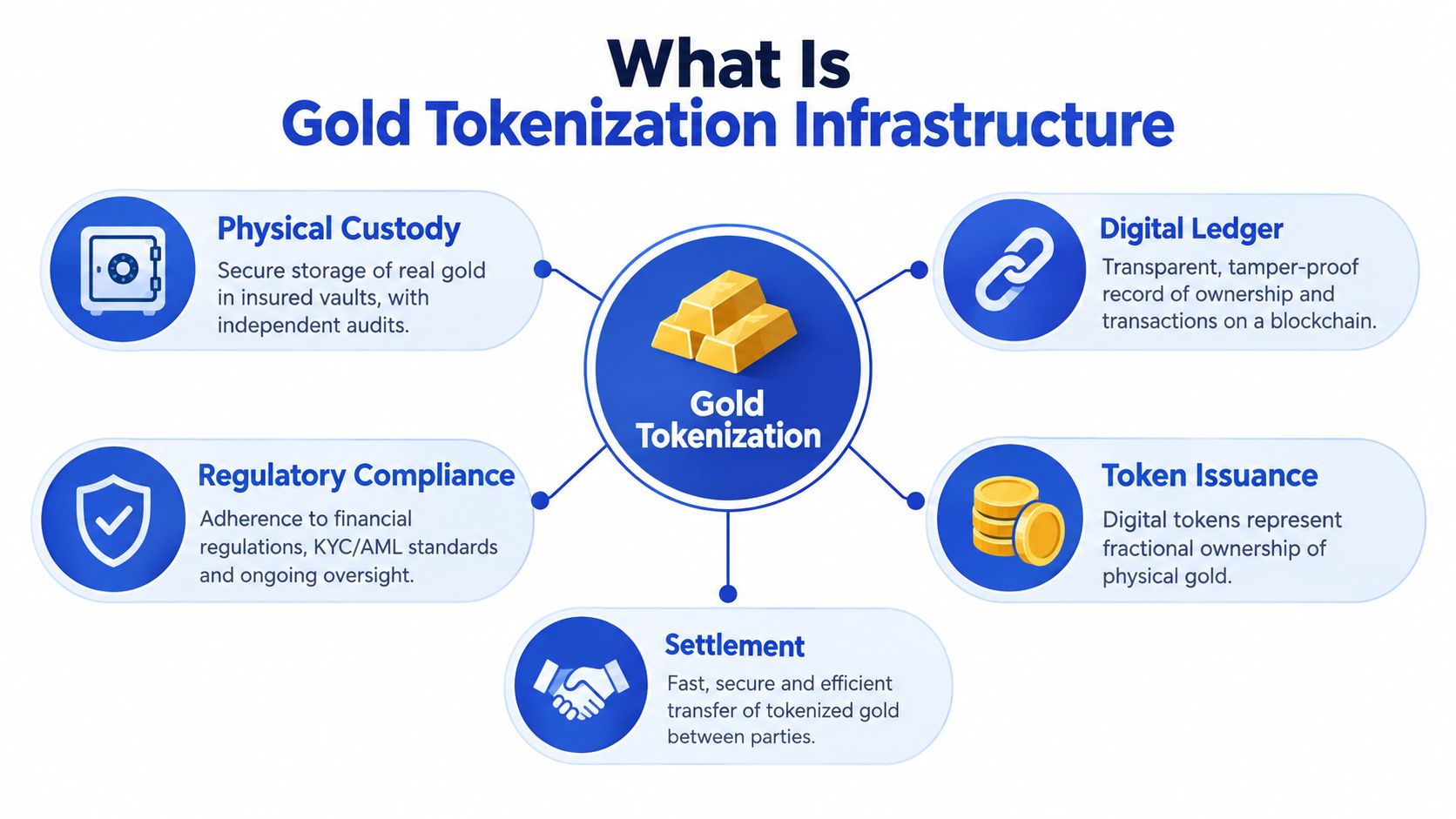
A treasury team can approve the concept in one meeting, then the operations lead asks the first hard question, where is the gold, who controls it, and how do we prove the token still maps to it after transfer? That question exposes the shape of gold tokenization infrastructure. It is the bridge between a digital claim and physical bullion, and it has to keep those two sides in lockstep.
The system is bigger than token creation
The token itself is only the visible layer. Underneath it sit the ledger, issuer controls, vault connectivity, settlement logic, compliance checks, and reporting workflows that keep the product defensible in practice. If any one of those layers is weak, the token may still move on-chain, but the business can’t confidently answer who owns what, where the bullion sits, or whether redemption can happen cleanly.
That is why banks and fintechs need to think in terms of tokenized gold infrastructure, not just a gold token. The infrastructure has to support the whole lifecycle, from issuance and transfers to redemption and reconciliation. It also has to separate responsibilities cleanly, because the entity creating the token is not necessarily the same entity holding the metal or running the trading venue.
Practical rule: if the vault record and the ledger can drift apart, the product is still a prototype, no matter how polished the wallet app looks.
Who actually does what
The issuer controls the supply of tokens and the rules that govern them. The custodian or vault operator controls the bullion and the physical audit trail. The technology provider connects the two, automates the checks, and makes the operational state legible to finance, risk, and compliance teams.
For teams comparing operating models, the main mistake is to treat these roles as interchangeable. They aren’t. A platform can automate token issuance, but it can’t magically create legal ownership in the underlying metal, and it can’t substitute for custody controls. That distinction matters in regulated markets, especially where the legal status of digital gold is still unsettled or fragmented.
A useful internal reference point is Gold Tokenization DeFi Lending Digital Wealth, because the same underlying architecture has to support multiple product shapes, not just one retail wrapper. Once the operational model is clear, the rest of the stack becomes easier to evaluate.
Core Components of Gold Tokenization Systems
A gold tokenization project can pass a demo and still fail in production. The failure usually sits between the ledger, the vault, and the institution’s control environment. A bank-grade design separates those responsibilities from the start and defines how data, authority, and exceptions move across the stack.
Blockchain, smart contracts, custody, and financial integration
The blockchain records ownership state, transfer history, and permissions. Banks often choose permissioned or hybrid blockchain networks because identity, governance, and operational access require tighter control. Public chains can support some products, but the architecture should follow the institution’s control requirements rather than a preference for one network model.
Smart contracts turn product rules into enforceable transaction logic. Restrictions on verified wallets, transfer eligibility, redemption workflows, and administrative actions belong in tested code, supported by controlled procedures. The design also needs defined responses for paused operations, failed settlement, key compromise, and issuer recovery. A contract that handles only the successful path is incomplete.
The custody and vault layer introduces a separate operating problem. Vault systems track bar identifiers, purity, location, allocation, and physical movements. They rarely expose that information in a format a blockchain can consume directly. Integration services must reconcile vault events with digital state and preserve an audit trail. Token issuance can be automated without proving that the issuer controls the underlying metal. Those are separate capabilities, and confusing them creates a compliance gap.
Regulatory treatment can widen that gap. In markets such as India, the status of digital gold, tokenized claims, custody arrangements, and redemption rights may not fit neatly into one established framework. The product team therefore needs legal analysis, documented asset ownership, approved custodial responsibilities, and clear customer disclosures before choosing the token model. Technical completion does not resolve a regulatory grey zone.
Financial integration connects the token system to KYC, AML, transaction monitoring, settlement, risk reporting, treasury, and core banking systems. Teams assessing enterprise blockchain engineering for public, private, and hybrid networks should evaluate how those connections operate under load, during outages, and during reconciliation rather than focusing only on chain selection.
What working teams optimize for
Hiring should cover more than smart contract development. The delivery team needs people who understand vault operations, financial controls, security monitoring, incident response, and production support. The role mix described by GENTY recruitment fintech provides a useful reference for defining specialized fintech responsibilities.
The right architecture lets finance, risk, compliance, custody, and engineering work from the same controlled record.
Lifecycle management continues after launch. A platform for automating token lifecycle management and digital asset operations can support state changes, exceptions, approvals, and audit evidence across the product’s operating life. That operational layer determines whether tokenization remains manageable after issuance, integrations, and customer demand grow.
Token Issuance, Custody, and Proof of Reserves
The difference between a speculative token and a legitimate gold-backed instrument starts before the first token is minted. Legal ownership, custody instructions, and reserve backing have to exist in the operating model first, otherwise the on-chain supply is just a representation without a solid claim behind it. That sequence matters more than the branding.
Issuance has to follow ownership, not the other way around
A bank-grade issuance flow begins with controlled deposit or allocation of bullion into approved custody. Only then should the smart contract create the corresponding token supply. If supply can be created before the metal is confirmed, the product invites a gap between the ledger and the vault, and that gap is exactly what risk teams will challenge.
The token supply also needs to stay bounded by the underlying inventory. That sounds obvious, but in practice it requires APIs, issuance guards, and reconciliation logic that prevent accidental over-minting. A tokenised gold system is only as credible as its ability to prove that each digital unit maps to a specific quantity of physical bullion.
Proof of reserves is an operating process, not a marketing line
Proof of reserves only works if it is tied to a repeatable control framework. That means periodic and ideally near-real-time checks across the vault record, the blockchain record, and the issuer’s internal control environment. It also means clear segregation between the issuer, the custodian, and the venue, so one party isn’t left marking its own homework.
For regulated entities, the value of proof of reserves is not the headline, it’s the audit trail. If an auditor, regulator, or internal risk committee asks how a token was backed on a specific date, the answer needs to come from reconciled records, not from a general statement on a landing page. The same goes for redemption, because a token that can’t be converted back into bullion or a cash equivalent under defined conditions is a much weaker financial product.
Digital Asset Custody Compliance Building Regulatory Ready Blockchain Platforms is a useful reference point here because custody compliance is where many tokenisation projects either harden their controls or become difficult to defend later. That’s especially true when the legal owner, the vault operator, and the product issuer are not the same entity.
Reconciliation is where trust is earned
A strong reconciliation workflow compares token supply, vault inventory, and redemption requests as part of normal operations. If there’s a mismatch, the system should flag it immediately and stop new issuance until the discrepancy is resolved. That is not overkill, it is the minimum standard for a product that claims direct backing.
The operational takeaway is simple. Gold tokenization is not trustworthy because it uses blockchain. It’s trustworthy only when the chain, the vault, and the control layer all agree, continuously and provably.
Smart Contracts and Automated Settlement
A lot of teams say they want automation, but what they usually mean is faster minting. In gold tokenization, real automation is about removing manual settlement gaps, enforcing compliance at transfer time, and making sure the token only moves when the underlying conditions are satisfied. That is a much stricter design problem.
API-first and blockchain-native patterns do different jobs
An API-first model is easier when you need to connect legacy banking systems, treasury tools, or vault software that already exists. It lets you keep the product logic in familiar enterprise systems while the chain acts as a settlement and ownership layer. The trade-off is that you still need very disciplined integration design, because the off-chain and on-chain states must stay aligned.
A blockchain-native model puts more of the operational logic inside the smart contracts. That gives stronger on-chain enforcement, especially for transfer restrictions and redemption triggers, but it also raises the bar for testing, upgrade governance, and exception handling. For banks, that often means hybrid designs win, because they balance control with operational realism.
Settlement should be atomic wherever possible
The strongest architecture is the one that makes transfer of the token and payment settlement happen together. The RBI-linked discussion of the Unified Markets Interface describes an approach where financial assets can be tokenised and settled through wholesale CBDC, so the asset transfer and payment can occur simultaneously. For gold tokenisation, that pattern reduces principal settlement risk because the token should only move when the settlement leg finalises. The source discussing that model is this legal and market analysis of the Unified Markets Interface.
Practical rule: if the payment leg and token transfer can fail independently, you still have counterparty risk.
A helpful implementation pattern is ERC3643 Token Standard Explained RWA Tokenization, because compliance-aware token logic is often the difference between a transferable instrument and a product that only works inside a narrow operational perimeter. The point is not that one standard solves everything, it’s that the contract layer has to reflect who may hold the token, who may receive it, and under what conditions it may be burned or redeemed.
Compliance, Security, and Regulatory Navigation
A gold token can be technically transferable while the underlying metal remains difficult to verify, move, or redeem. The compliance design therefore has two separate layers: the legal status of the token and the operating controls that connect issuance to physical custody. A compliant contract does not prove that a vault holds the gold represented by the supply.
India shows why infrastructure must stay adaptable
India illustrates the problem clearly. The regulatory position is fragmented and continues to change. SEBI has stated that digital gold falls outside its regulatory ambit. Its November 2025 public caution distinguishes SEBI-regulated products, including commodity derivative contracts, Gold ETFs, and Electronic Gold Receipts, from unregulated digital gold. That distinction affects distribution, disclosures, eligible users, and the controls required around transfers.
A separate legal analysis notes that India has no unified framework for real-world asset tokenisation. The token therefore follows the legal treatment of the underlying asset rather than entering a single, predictable token regime. A bank cannot treat token issuance as a standalone software decision. It must establish which entity owns the gold, which entity issues the token, what redemption promise exists, and which regulator can supervise each activity.
India’s gold market also explains why institutional products require conservative controls. SBI Research has described strong domestic demand and significant central-bank purchases. The figures indicate that gold has material importance in India’s financial system, but they do not establish that a proposed token is licensed or acceptable for distribution. Product approval still depends on classification, custody, marketing, and the structure of the issuer.
The custody layer needs separate evidence. The World Gold Council has reported that a substantial share of the RBI’s gold reserves was held domestically by end-September 2024, with domestic holdings increasing from March. That information supports a practical requirement: a tokenisation platform needs identifiable vault arrangements, reconciled inventory records, independent verification, and procedures for exceptions. Token issuance alone is not physical custody, and proof of reserves is only useful when the reserve data can be matched to specific bars, locations, ownership records, and outstanding token balances.
Security has to be built into the workflow
Key management is the first control. Weak issuer-key protection can allow unauthorised minting, transfers, or redemptions even when the smart contract has passed an audit. Use separated signing authority, documented approval thresholds, secure key storage, and tested recovery procedures.
Transaction monitoring is the next layer. Gold tokens can move through wallets and venues that create AML, sanctions, fraud, or market-abuse concerns. Monitoring should connect wallet activity with customer identity, transfer purpose, redemption requests, and case-management processes.
Wallet gating may also be required. Certain products should restrict holding and receipt to verified wallets, approved jurisdictions, or eligible customer categories. The restriction must be enforced in the token lifecycle, not maintained only in an operating manual.
Compliance belongs in issuance, transfer, pause, burn, redemption, and reporting workflows. Retrofitting controls after customers hold the token creates remediation work and can leave the institution unable to explain whether the digital claim and the physical reserve still match.
Development Process and Implementation Roadmap
A bank can deploy a token contract and still lack a workable gold product. The implementation fails when legal classification, physical custody, and operating procedures are left for later review. A phased roadmap keeps those decisions connected and gives risk, compliance, operations, and engineering clear approval points.
Start with the operating model
Discovery should define the product class, redemption promise, jurisdictions, customer eligibility, and accountable custody parties. India deserves explicit legal review because the boundary between a digital claim, a regulated financial product, and an interest in physical gold can remain unclear. The same token design may require different controls across markets.
Document whether the token is redeemable, transferable, or limited to approved wallets. Then map the physical process, including bar allocation, vault instructions, ownership records, redemption settlement, and exception handling. Issuing a token does not place gold in custody. The operating model must identify the vault, the custodian, and the evidence connecting each outstanding claim to inventory.
Architecture follows those decisions. Specify permissioning, identity integration, vault and settlement interfaces, reconciliation jobs, reporting ownership, and the controls available to pause or reject a transaction. Approval should require legal sign-off on the product model and operations sign-off on the custody and reconciliation procedures.
Build for tests that reflect production
Testing must cover failed and delayed paths alongside successful minting. Exercise mint, transfer, pause, burn, redemption, vault mismatch, stale inventory data, rejected wallets, and reconciliation exceptions. Contract audits are useful, but they do not test the handoffs between the ledger, custody provider, settlement system, and case-management workflow.
The token is rarely the failure point. The production risk sits in the handoffs.
Begin with a limited pilot covering one product class, a defined customer group, and an agreed custody route. Set exception thresholds before launch, assign an owner for every breach, and require evidence that unresolved mismatches are blocked from scale. Blockchain Development and Asset Tokenization Platform capabilities can support this delivery work, while approval gates keep technical progress aligned with legal and operational readiness. Tokenization Platform Development can then support expansion after the pilot, reconciliation results, and control evidence pass review.
Partnering with Blocsys for Gold Tokenization Solutions

Gold tokenisation needs more than a contract deployment. It needs enterprise blockchain architecture, control-aware workflows, secure integrations, and a product structure that can survive legal and operational review. That is the gap Blocsys Technologies works in, alongside broader tokenisation and blockchain delivery programmes.
For organisations planning institutional gold tokenization infrastructure, the right partner is the one that understands custody, smart contracts, settlement, and compliance as one system. Blocsys Technologies builds production-oriented blockchain and tokenisation platforms for teams that need execution support, not just concept decks. See how our team approaches blockchain delivery at How Blocsys Builds Dedicated Blockchain Development Teams for Enterprise Projects.
If you’re building a bank-grade or fintech-grade gold tokenisation product, Blocsys Technologies can help you design the infrastructure, smart contracts, and operational workflows around it. Visit Blocsys Technologies to discuss your gold tokenization roadmap and the next steps for a regulated launch.
FAQs
What is gold tokenization infrastructure?
Gold tokenization infrastructure is the set of systems that connect a digital token to physical gold, including blockchain rails, custody integration, issuance controls, compliance checks, settlement logic, and reconciliation workflows. It matters because the token only has value if the digital record stays aligned with the bullion it represents.
Why do banks and fintechs need specialised infrastructure for tokenized gold?
Banks and fintechs need specialised infrastructure because gold tokenisation isn’t just a software feature, it’s an operating model that spans legal ownership, vault custody, financial controls, and transfer rules. A consumer crypto stack usually won’t provide the auditability, role separation, and settlement discipline required for regulated financial products.
How does token issuance work for gold-backed assets?
Token issuance should happen only after the underlying gold is confirmed in approved custody and mapped to the product’s legal ownership structure. The smart contract then mints tokens within the defined supply limits, so every digital unit corresponds to verified physical backing.
What role does custody play in a gold tokenization system?
Custody is the physical control layer that holds the bullion, tracks movements, and provides the inventory records the token must match. Without reliable custody integration, the token may move on-chain while the physical backing becomes unclear, which undermines trust and auditability.
How is proof of reserves implemented for tokenized gold?
Proof of reserves is implemented by reconciling on-chain token supply with off-chain vault records, usually with audit trails, issuer controls, and custody reports. In a serious deployment, it’s not a one-time statement, it’s a recurring operational process that verifies the backing continuously or at defined intervals.
Why is reconciliation so important in gold tokenization?
Reconciliation is important because it ensures the token supply and the physical gold inventory stay in sync. If there’s a mismatch, the system needs to detect it quickly, stop further issuance if necessary, and give finance and risk teams a clear record of what happened.
How do smart contracts help automate gold token settlement?
Smart contracts automate rules around transfer, compliance, redemption, and settlement so the product doesn’t rely on manual processing for every event. In stronger architectures, the token transfer and the payment leg can settle together, which reduces counterparty risk.
Can wallets and transfers be restricted in gold tokenization platforms?
Yes, wallets and transfers can be restricted through compliance-aware token logic that checks whether the receiving address is eligible. That’s especially useful for institutional products where KYC, jurisdiction, or investor classification affects who may hold the token.
What are the main security requirements for gold tokenization infrastructure?
The main security requirements include strong key management, access control, transaction monitoring, secure contract design, and careful segregation of duties between issuer, custodian, and platform operator. Security needs to cover both the blockchain layer and the off-chain systems that support custody and settlement.
How should a bank or fintech start a gold tokenization infrastructure project?
Start by defining the legal model, custody arrangement, target markets, and redemption promise before choosing the chain or writing contracts. Then design the architecture around those rules, test the failure paths, and only scale once reconciliation, compliance, and custody integration are stable.
