
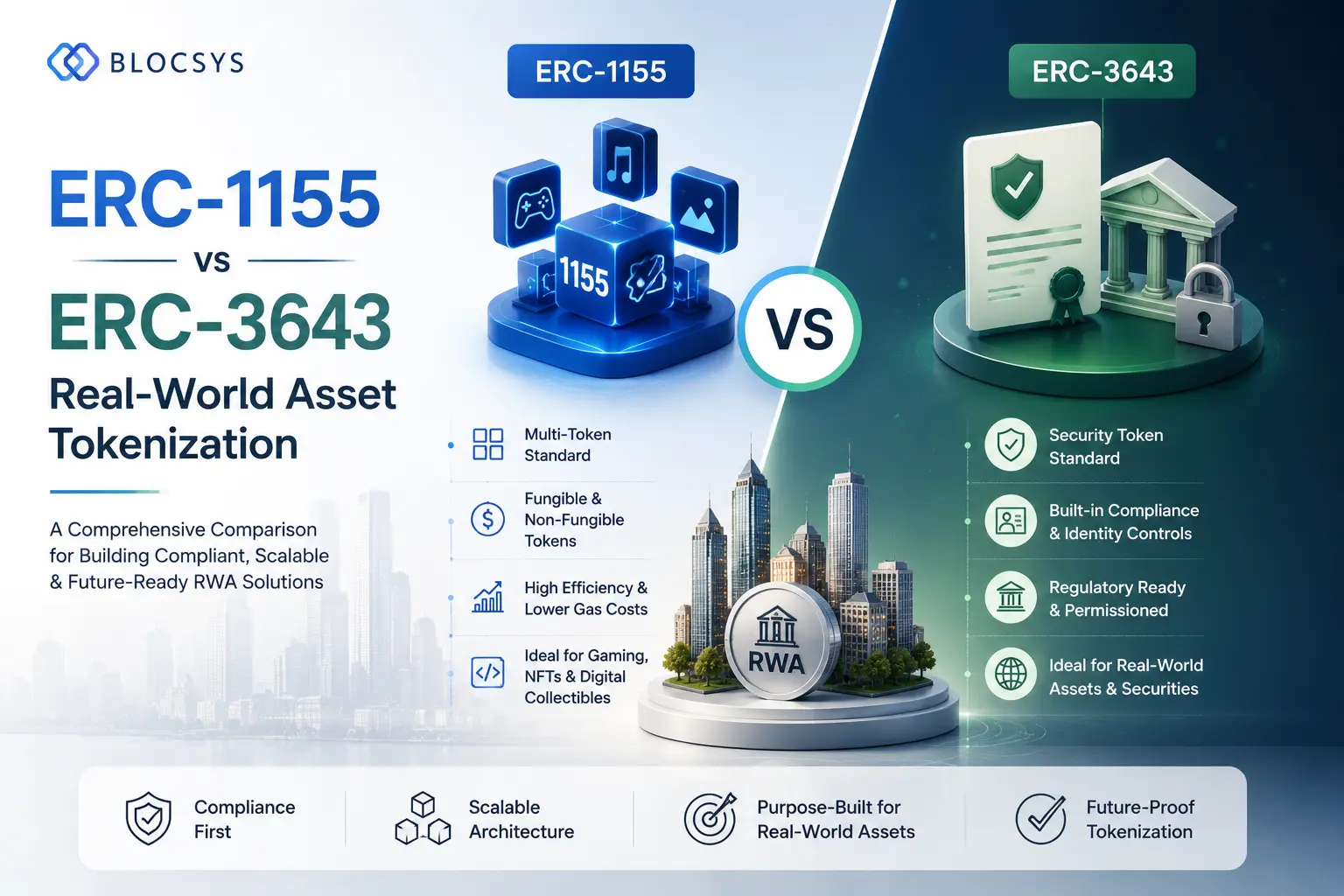
ERC-1155 vs ERC-3643 for Real-World Asset Tokenization
If you’re evaluating token standards for a tokenization platform, you’ve probably run into two names again and again: ERC-1155 and ERC-3643. Both show up constantly in conversations about Real World Asset Tokenization, yet they solve fairly different problems. This article breaks down how ERC-1155 and ERC-3643 actually work, where each one fits, and why the “better” standard depends entirely on your asset, your investors, and your regulatory environment.
What Is Real-World Asset Tokenization?
RWA tokenization is the process of representing rights or interests in a physical or financial asset as a digital token on a blockchain. The token itself does not create legal ownership — it reflects rights that are defined by an off-chain legal structure, contract, or agreement. Real estate, bonds, private credit, commodities, and equity are common examples of assets that get tokenized this way.
Here’s the direct answer many readers are searching for: ERC-1155 is generally a flexible multi-token standard, while ERC-3643 is purpose-built for permissioned, compliance-oriented tokenization. Neither is universally superior — the right choice depends on your asset structure, investor base, and legal requirements.
Why Token Standards Matter for RWA Tokenization Platforms
Token standards define how ownership, transfers, and metadata behave at the smart contract level. Choose the wrong architecture, and you’ll end up bolting on compliance logic after launch, which is expensive and risky. Choose the right one, and identity, eligibility, and transfer rules fit naturally into your platform from day one.
Consequently, enterprises building a Asset Tokenization Platform need to think about token architecture before writing a single line of Solidity. Getting this decision right shapes how secondary transfers, custody, and investor onboarding work for years afterward.
What Is ERC-1155?
ERC-1155 is a multi-token standard on Ethereum that lets a single smart contract manage multiple token types at once. According to the official ERC-1155 specification, one contract can hold fungible tokens, non-fungible tokens, and semi-fungible configurations simultaneously, each identified by a unique token ID.
That’s a meaningful departure from ERC-20 or ERC-721, where each contract typically handles one token type. With ERC-1155, you get one contract instead of dozens.
Key Capabilities of the ERC-1155 Multi-Token Standard
The ERC-1155 specification defines several core capabilities that matter for tokenized assets:
- Configurable token IDs that can represent fungible, non-fungible, or semi-fungible assets within one contract
- Safe transfer functions that check whether the receiving contract can handle the token before completing the transfer
- Batch transfer functionality, allowing multiple token types to move in a single transaction
- Flexible metadata handling through a URI function tied to each token ID
These features make ERC-1155 well suited for use cases involving multiple asset classes or fractionalized units. However, the standard does not natively include identity verification, KYC checks, or transfer restrictions. If a regulated RWA project needs those controls, developers typically add custom smart-contract logic or supporting compliance infrastructure on top of the base standard.
What Is ERC-3643?
ERC-3643, formerly known as the T-REX protocol, is a permissioned token standard designed specifically for regulated digital securities and tokenized assets. Unlike a general-purpose token standard, ERC-3643 builds identity and compliance directly into its architecture.
Do not think of ERC-3643 as simply another flavor of ERC-1155 or ERC-20. It’s a fundamentally different design, built around the assumption that every transfer must be validated against eligibility rules before it can settle.
Permissioned Architecture Behind ERC-3643
According to official ERC-3643 documentation, the standard uses onchain identity contracts (often referred to as ONCHAINID) linked to investor wallets. Every transfer runs through a compliance module that checks eligibility conditions such as jurisdiction restrictions, investor accreditation, and holding limits before execution.
Therefore, a transfer that violates a predefined rule simply fails at the smart contract level. This permissioned transfer mechanism is the defining feature separating ERC-3643 from more general token standards.
![ERC-1155 — [Flow diagram showing ERC-3643 permissioned transfer flow: Investor Wallet → Identity Verification (ONCHAINID) → Compliance Module Check → Eligibility Rules Validation → Transfer Approved or Rejected]](https://s3.blocsys.com/blocsys/blog-images/1786752154578-22c157d99115e04a.webp)
ERC-1155 vs ERC-3643 at a Glance
What’s the core difference between ERC-1155 and ERC-3643? ERC-1155 focuses on flexible, efficient multi-token management, while ERC-3643 focuses on permissioned, identity-driven compliance for regulated assets. Both can technically represent tokenized assets, but they were built with different priorities in mind.
Token standard selection isn’t a checkbox exercise. We’ve seen teams pick ERC-1155 for a security offering because batch transfers looked efficient, then spend months retrofitting identity checks that ERC-3643 would have given them natively. The standard has to match the legal structure of the asset, not the other way around.
Key Architectural Differences Between ERC-1155 and ERC-3643
Beyond the surface-level summary, the two standards diverge across identity, transfer logic, and smart contract design. Let’s look at where these differences actually matter for enterprise RWA platforms.
Identity and Compliance Comparison
ERC-1155 does not include a built-in identity layer. Any KYC, AML, or investor eligibility logic must be added through custom smart contracts, an identity registry, or a third-party compliance system layered on top.
ERC-3643, on the other hand, ties identity directly to the token contract through onchain identity claims. Compliance rules live inside the protocol itself, not bolted on afterward. That said, using ERC-3643 doesn’t automatically make a project compliant in every jurisdiction — legal and regulatory review is still required regardless of which standard you choose.
Transfer Restrictions and Ownership Models
Under ERC-1155, transfers execute freely unless developers add custom restriction logic. This works well for open marketplaces, gaming assets, and collectibles where permissionless transfer is actually desirable.
ERC-3643 enforces transfer restrictions natively. Every transfer checks against compliance rules automatically, which supports securities-like ownership models where eligibility must be verified continuously, not just at issuance.
Metadata and Batch Transfer Capabilities of ERC-1155
One of ERC-1155’s standout features is batch transfer support — moving several token types in a single transaction rather than submitting separate calls for each one. This reduces transaction overhead considerably for platforms managing large, diverse token portfolios.
Metadata under ERC-1155 is handled through a URI function associated with each token ID, allowing rich, flexible asset descriptions. ERC-3643 also supports metadata, but its architecture prioritizes identity and compliance data alongside standard asset information.
ERC-1155 vs ERC-3643 Comparison Table
| Feature | ERC-1155 | ERC-3643 |
|---|---|---|
| Token Model | Multi-token, single contract | Permissioned security token |
| Fungibility | Fungible, non-fungible, semi-fungible | Primarily fungible, permissioned |
| Identity Layer | Not built-in | Onchain identity (ONCHAINID) |
| KYC/AML | Requires custom integration | Native compliance module |
| Transfer Restrictions | Optional, custom logic | Enforced automatically |
| Batch Transfers | Native support | Not a core feature |
| Investor Eligibility | Not defined by standard | Checked at every transfer |
| Regulatory Suitability | Case-dependent | Designed for regulated securities |
| Development Complexity | Lower for basic use cases | Higher, compliance-driven |
| Typical RWA Fit | Collectibles, fractional bundles, mixed portfolios | Bonds, equity, funds, private credit |
![ERC-1155 — [Comparison flow chart: RWA Asset Intake → Legal Structure Review → Investor Eligibility Requirements → Decision Branch splitting into ERC-1155 Path (flexible, permissionless) versus ERC-3643 Path (permissioned, compliance-enforced)]](https://s3.blocsys.com/blocsys/blog-images/1786752155434-55222b6e82d1cccd.webp)
RWA Use Cases: Where ERC-1155 Fits and Where ERC-3643 Fits
Real deployments look different across asset classes, investor types, and jurisdictions. Below are illustrative scenarios meant to show architectural fit, not confirmed real-world implementations.
When ERC-1155 May Be Appropriate for Real World Asset Tokenization
Picture a platform tokenizing a mixed portfolio of collectible-grade commodities, equipment leases, and fractional carbon credits. Semi-fungible units, batch issuance, and flexible metadata make ERC-1155 a reasonable technical fit here, especially where transfer restrictions are lighter or investor eligibility is less complex. A Carbon Tokenization Platform managing many credit batches with varying vintages and project types is one scenario where ERC-1155’s multi-token architecture reduces contract sprawl.
Even so, if that same platform later needs to sell credits as regulated financial instruments to accredited investors only, additional compliance infrastructure would need to sit on top of the base ERC-1155 contracts.
When ERC-3643 May Be More Suitable
Now consider a tokenized corporate bond offered to institutional investors across multiple jurisdictions. Eligibility must be checked continuously — not just at purchase, but on every secondary transfer too. This is exactly the scenario ERC-3643 was designed for. A Corporate Bond Tokenization Platform Development initiative built around permissioned transfers can enforce jurisdictional and accreditation rules automatically at the protocol level.
Similarly, an Equity Tokenization Platform Development project representing private company shares would likely lean toward ERC-3643, given that share transfers often carry legal restrictions tied to investor status and cap table accuracy.
Legal Ownership and Token Representation
Here’s something worth repeating: a token, regardless of standard, does not itself establish legal ownership. What actually determines ownership is the underlying legal agreement, custody arrangement, and jurisdictional framework behind the asset. ERC-1155 and ERC-3643 both represent rights — they don’t create them.
Additionally, regulatory treatment varies by asset type, token structure, issuer, investor category, and jurisdiction. Frameworks like MiCA in the EU, the EU DLT Pilot Regime, UK financial-market rules, US securities regulation, and regulatory sandboxes in the UAE and Singapore each apply differently depending on these factors. No single regulation governs all RWA tokenization activity globally.
Compliance-enforcing smart contracts are a technical control, not a legal opinion. ERC-3643 can stop an ineligible wallet from receiving tokens. It can’t tell you whether your offering structure actually qualifies for an exemption in a given country. That still requires a lawyer, every time.
Decision Framework for Choosing a Token Standard
So how should your team actually decide? Ask these questions before writing any smart contract code:
- Does the underlying asset qualify as a security in your target jurisdictions?
- Do investors need continuous eligibility checks on secondary transfers?
- Is your asset better represented as fungible, non-fungible, or semi-fungible units?
- Will you need batch issuance across many token types?
- How much custom compliance logic can your team realistically build and maintain?
If your answers point toward regulated securities with strict investor controls, ERC-3643’s permissioned architecture likely fits better. If you’re managing diverse, less-restricted digital assets, ERC-1155 offers more flexibility with lower development overhead. Working with an experienced Hire Real World Asset Tokenization Developers team early helps you avoid costly architecture mistakes later.
![ERC-1155 — [Decision tree diagram: Start at Asset Classification → branch to Regulated Security (leads to ERC-3643 permissioned path with identity and compliance modules) → branch to Non-Security Digital Asset (leads to ERC-1155 multi-token path with batch transfers and flexible metadata)]](https://s3.blocsys.com/blocsys/blog-images/1786752155046-9b6439c2b8f01d92.webp)
Security, Scalability, and Interoperability Considerations
Both standards run on EVM-compatible chains, so general smart contract security practices apply to each — audits, access controls, and upgrade governance all matter regardless of which one you pick. ERC-1155’s batch functions reduce the number of transactions needed, which can lower gas costs for high-volume operations. ERC-3643’s compliance checks add processing overhead per transfer, a reasonable tradeoff for regulated eligibility enforcement.
Interoperability differs too. ERC-1155 is broadly supported across NFT marketplaces, wallets, and gaming ecosystems, since it’s been a widely adopted standard for years. ERC-3643 interoperates primarily within permissioned financial ecosystems, custodians, and compliance-aware infrastructure built for security tokens rather than open consumer marketplaces.
Enterprise Implementation Considerations
Building either standard into production requires more than deploying a contract. You’ll need custody arrangements, secondary market infrastructure, ongoing compliance monitoring, and integration with existing financial systems. Development complexity for ERC-3643 tends to run higher, given the identity and compliance layers involved, while ERC-1155 implementations can be lighter when compliance requirements are minimal.
Cost varies significantly based on asset complexity, jurisdictions involved, and integration scope, so generic figures aren’t particularly useful here. Blocsys offers a Cost Estimator Tool that gives project-specific estimates based on your actual requirements, which is a far more reliable starting point than industry averages.
Why Blocsys Is a Trusted RWA Tokenization and Enterprise Blockchain Development Company
Blocsys works with asset owners, financial institutions, and fintech companies building tokenization infrastructure across both permissionless and permissioned models. Whether your project calls for ERC-1155’s multi-token flexibility, ERC-3643’s compliance-oriented architecture, or a hybrid approach, our team brings enterprise blockchain development experience covering smart contracts, identity systems, custody integration, and secondary market infrastructure.
From an Asset Tokenization Platform supporting diverse portfolios to permissioned security token deployments, Blocsys approaches each engagement as a technical and regulatory puzzle that needs solving together, not a one-size-fits-all product.
Frequently Asked Questions
Here are direct answers to the questions we hear most often about ERC-1155 vs ERC-3643 for RWA tokenization.
What is the difference between ERC-1155 and ERC-3643?
ERC-1155 is a multi-token standard that lets one smart contract manage fungible, non-fungible, and semi-fungible tokens with batch transfer support. ERC-3643 is a permissioned token standard built around onchain identity and compliance, enforcing investor eligibility on every transfer. The core difference lies in design intent: ERC-1155 prioritizes flexibility and efficiency, while ERC-3643 prioritizes regulatory compliance and permissioned control for tokenized securities.
Which is better for RWA tokenization, ERC-1155 or ERC-3643?
Neither is universally better. The right choice depends on your asset type, investor eligibility requirements, transfer restrictions, and jurisdiction. ERC-1155 suits diverse or less-regulated digital assets needing flexible multi-token management. ERC-3643 suits regulated securities like tokenized bonds or equity where continuous compliance enforcement matters. Evaluate your legal structure first, then match the token architecture to it.
Can ERC-1155 be used for Real World Asset Tokenization?
Yes, ERC-1155 can represent real-world assets, particularly fractionalized or mixed-portfolio assets like commodities, collectibles, or equipment interests. However, it does not include built-in identity, KYC, or transfer restriction mechanisms. Regulated RWA use cases requiring investor eligibility checks typically need additional smart-contract logic or compliance infrastructure layered on top of the base ERC-1155 contract.
Why is ERC-3643 used for RWA tokenization?
ERC-3643 is used because it embeds identity verification and compliance enforcement directly into the token’s transfer logic. Every transfer checks eligibility conditions like jurisdiction and accreditation status before executing. This makes it well suited for tokenized securities such as bonds, equity, and funds where regulators expect continuous, enforceable ownership restrictions rather than one-time verification at purchase.
Does ERC-3643 support KYC and AML requirements?
ERC-3643 supports technical enforcement of KYC and AML-related eligibility rules through its identity registry and compliance module, using onchain identity claims linked to investor wallets. That said, ERC-3643 doesn’t replace legal KYC/AML processes performed by regulated entities. It enforces predefined rules at the smart contract level, but jurisdiction-specific legal and compliance review remains necessary alongside it.
What types of real-world assets can be tokenized with ERC-1155?
ERC-1155 works well for assets with fungible, non-fungible, or semi-fungible characteristics, such as fractional commodities, equipment interests, collectibles, carbon credits, and mixed-asset portfolios. Its batch transfer capability suits platforms managing many token types simultaneously. For assets requiring strict regulatory transfer controls, additional compliance layers usually need to be added beyond the base ERC-1155 standard.
What are the benefits of ERC-3643 for tokenized assets?
ERC-3643 offers native identity verification, permissioned transfers, and automated compliance enforcement built directly into the token contract. This reduces reliance on external compliance systems for regulated tokenized assets like bonds and equity. However, these benefits address technical enforcement only — they don’t guarantee regulatory approval, liquidity, or legal compliance across every jurisdiction without proper legal review.
What should businesses consider when choosing between ERC-1155 and ERC-3643?
Businesses should assess asset classification, investor eligibility rules, transfer restriction needs, target jurisdictions, and development resources. Regulated securities generally favor ERC-3643’s permissioned architecture, while flexible or less-restricted digital assets often fit ERC-1155 better. Consulting legal counsel alongside experienced blockchain developers helps ensure the chosen standard aligns with both technical and regulatory requirements.
Can ERC-1155 support permissioned RWA tokenization?
ERC-1155 can support permissioned tokenization, but only through custom smart-contract additions since permissioning isn’t native to the standard. Developers typically integrate identity registries, whitelist logic, or third-party compliance systems alongside the base ERC-1155 contract. This approach works but requires more custom engineering than a standard purpose-built for permissioned transfers, like ERC-3643, from the outset.
How much does it cost to build an RWA tokenization platform?
Cost depends on asset complexity, chosen token standard, compliance requirements, custody integration, and target jurisdictions, so generic figures rarely reflect actual project costs. Platforms built on ERC-3643 typically involve more development work due to identity and compliance layers compared to simpler ERC-1155 implementations. Using the Blocsys Cost Estimator Tool gives a more accurate, project-specific estimate based on your requirements.
Conclusion
ERC-1155 and ERC-3643 solve different problems within the same broader goal: representing real-world value onchain. ERC-1155 gives you flexible, efficient multi-token management, well suited to diverse or less-restricted digital assets. ERC-3643 gives you permissioned, compliance-driven architecture built for regulated securities. Your asset structure, investor base, and jurisdiction should drive that decision, not trends.
If your organization is exploring Real World Asset Tokenization, Blocsys can help you evaluate token architecture, compliance requirements, and platform design before you commit to a build. Reach out to discuss your project and get a clearer picture of what fits your specific asset, investors, and regulatory landscape.
Ready to move beyond theory and build an intelligent platform that delivers real-world value? Blocsys Technologies specialises in engineering enterprise-grade AI and blockchain solutions for the fintech, Web3, and digital asset sectors. Connect with our experts today to discuss your vision and chart a clear path from concept to a secure, scalable reality.
