
If you hire blockchain developers in Germany, look for teams that combine Solidity or Rust smart contract skills, Web3 infrastructure experience, and strict security and testing practices for regulated environments. Germany’s blockchain ecosystem already included more than 22,000 jobs and about 275 companies in an earlier assessment by the German Federal Ministry for Economic Affairs, but production-ready talent still requires careful evaluation.
A German fintech may have a clear product requirement, such as tokenised securities, a digital-asset trading platform, or blockchain settlement connected to existing banking systems. The difficult part isn’t finding someone who can deploy a contract to a test network. It’s finding developers who can design the full system, document decisions, protect keys, test failure paths, and integrate on-chain logic with enterprise software.
This guide is for German startups, fintechs, Web3 companies, digital-asset businesses, and technology leaders deciding between local recruitment, remote specialists, and an outsourced blockchain development partner. It focuses on the services developers deliver, the skills that matter in production, and the hiring trade-offs that shape security, delivery speed, and long-term maintainability.
Table of Contents
- Why German Businesses Hire Blockchain Developers Now
- Blockchain Development Services Available in Germany
- Technical Skills to Look for in Blockchain Developers
- Hiring Models for Blockchain Development Teams
- Germany-Specific Considerations When Hiring Blockchain Developers
- How Blocsys Can Help German Businesses Build Blockchain Products
Why German Businesses Hire Blockchain Developers Now
A Frankfurt fintech launching a digital-asset product usually starts with a business requirement, not a blockchain preference. It may need issuance workflows, investor records, wallet connectivity, transaction monitoring, or a trading engine that works with existing identity and finance systems. The blockchain layer is only one part of the product, and the engineering team must make every surrounding component reliable.
That is why hiring a blockchain developer in Germany is different from hiring a general application developer and adding Solidity later. The role can involve protocol selection, custody flows, signing infrastructure, event indexing, API design, smart contract upgrades, and operational controls. A developer who understands only the contract layer may leave the most important business risks untouched.
Germany has a substantial local ecosystem. The Federal Ministry source described more than 22,000 blockchain-sector jobs and approximately 275 companies, with 41% of those firms employing more than ten people, in its earlier study. It also identified Berlin as a major centre for international talent, while financial and technology activity creates demand in other hubs.
From proof of concept to core infrastructure
Blockchain work has also moved beyond isolated demonstrations. Tokenisation, trading infrastructure, digital-asset platforms, and compliance workflows all require software that connects decentralised networks with conventional enterprise systems. A prototype can demonstrate a transaction. A production system must handle permissions, failed calls, chain reorganisations, monitoring, data retention, and controlled releases.
The European skills picture reinforces the hiring challenge. The CHAISE blockchain skills forecast projected 29,383 additional blockchain-skilled people across the EU between 2021 and 2026, with Germany contributing 3,879 new blockchain-related jobs during that period. The same forecast estimated about 361,767 blockchain-related workers in the EU-26 in 2021, showing how specialised the field remains.
Practical rule: Treat blockchain hiring as systems engineering hiring. The contract is a component, not the whole product.
German businesses benefit most from this approach when they need a secure digital-asset platform, tokenisation infrastructure, enterprise blockchain integration, or a Web3 product that must survive formal testing and operational scrutiny. The Blocsys perspective on institutional blockchain adoption in Europe is useful context for teams assessing where blockchain fits into larger financial and enterprise workflows.
Blockchain Development Services Available in Germany
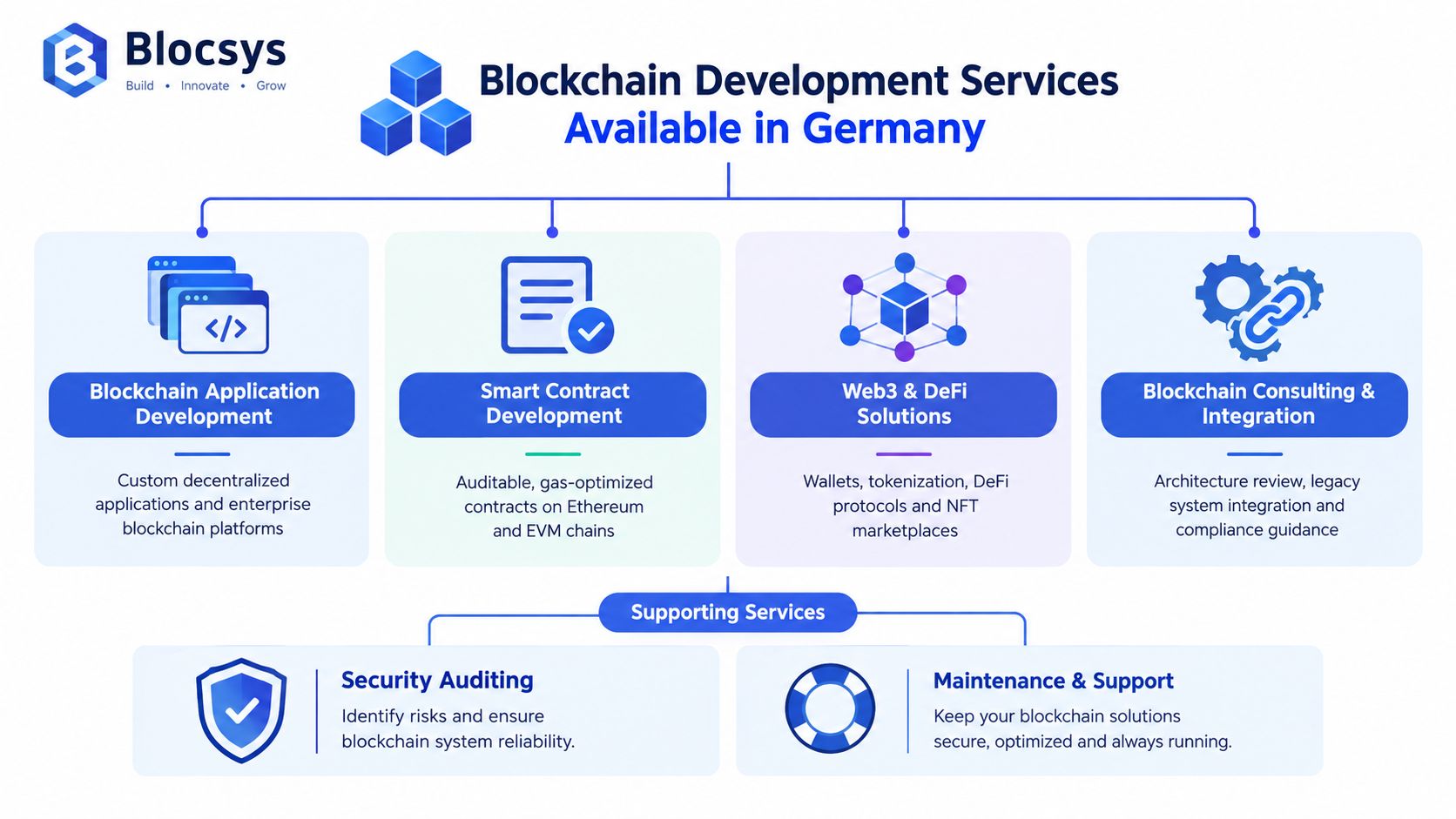
Blockchain development services in Germany usually span the application layer, smart contracts, infrastructure, integrations, and ongoing security work. A serious provider should map each service to a business workflow rather than present blockchain as a single package.
Application and smart contract engineering
Blockchain application development covers decentralised applications, enterprise portals, transaction dashboards, administration consoles, and services that read and write blockchain data. Developers may build the user interface, backend services, indexers, and operational tooling around the chain.
Smart contract development covers contract logic for issuance, transfers, permissions, escrow, staking, settlement, and other on-chain workflows. Solidity developers working with Ethereum-compatible networks should understand upgrade patterns, event design, access control, gas behaviour, and failure handling. Rust may be relevant when the selected network or protocol stack requires it.
The difference between a demo and a production implementation is visible in the surrounding work. Production teams write tests, define deployment controls, document contract assumptions, and establish monitoring before users rely on the system.
Web3, tokenisation, and digital assets
Web3 development often combines wallet connections, signing flows, account abstraction decisions, front-end applications, APIs, and blockchain data services. A marketplace, DeFi interface, or digital-asset portal needs clear handling for rejected signatures, stale balances, chain switching, transaction confirmation, and support workflows.
Tokenisation projects require more than creating a token contract. Teams need to model ownership, issuance, transfer restrictions, investor or user permissions, reporting, and the relationship between off-chain records and on-chain state. Businesses exploring Tokenization Platform Development may need infrastructure for real-world assets, securities, real estate, commodities, and digital assets using enterprise blockchain technology.
Platforms, wallets, and enterprise integrations
Digital-asset platform work can include exchange components, trading infrastructure, wallet integrations, custody connections, portfolio views, settlement services, and administrative controls. The engineering scope depends on whether the business owns custody, connects to an external provider, or supports multiple wallet and network types.
Enterprise blockchain development adds another layer. Developers may integrate blockchain events with banking software, customer systems, accounting tools, risk platforms, data warehouses, and compliance processes. A blockchain development company in Germany should be able to explain these interfaces, not just show contract screenshots.
A practical service brief should specify:
- Business workflow: What asset, transaction, or record will the system manage?
- Network boundary: Which chain or chains are required, and why?
- Integration surface: Which APIs, databases, wallets, custody systems, and identity services must connect?
- Operational ownership: Who monitors deployments, keys, incidents, upgrades, and support?
- Assurance work: What testing, review, audit preparation, and documentation are expected?
Technical Skills to Look for in Blockchain Developers
The strongest blockchain developers demonstrate how their technical decisions protect the product. Ask them to explain a complete transaction path, from a user action through the frontend, API, signing process, contract call, event indexer, database, and notification layer. This reveals more than a list of frameworks.
Start with architecture, not language names
A developer should understand the boundary between on-chain and off-chain logic. Putting every piece of business logic on-chain can increase cost, expose sensitive information, and make upgrades difficult. Keeping too much off-chain can weaken auditability or create a central point that the product never explained to users.
Look for experience with:
- Blockchain architecture: Network selection, transaction lifecycle, finality assumptions, event indexing, node access, and failure recovery.
- Smart contract languages: Solidity for Ethereum and EVM networks, or Rust and other languages where the chosen protocol requires them.
- Backend engineering: TypeScript, Python, Go, or Java services that handle APIs, queues, signatures, permissions, and data persistence.
- Wallet and key flows: Secure signing, role separation, custody integration, nonce handling, and recovery procedures.
- Testing and delivery: Unit tests, integration tests, fork-based testing, CI pipelines, deployment scripts, and release controls.
A candidate who can write Solidity but can’t explain reentrancy, access control, oracle assumptions, upgrade risks, or gas optimisation isn’t ready to own a high-value contract.
Test security as a working habit
Security should appear in the developer’s process, not only in a final audit request. Ask for a threat model, test strategy, and explanation of what happens when an external call fails. Review how the candidate handles paused functions, privileged roles, replay protection, input validation, and unexpected token behaviour.
The DAML versus Solidity comparison can help enterprise teams frame language selection around privacy, permissions, execution models, and operational requirements rather than popularity.
For a realistic technical assessment, request a small repository or live exercise that includes:
- A contract with explicit roles and guarded state changes.
- Tests for successful, rejected, repeated, and partial-failure paths.
- A backend service that indexes events without trusting the frontend.
- A short threat model identifying assumptions and attack surfaces.
- Deployment and rollback notes written for another engineer.
This is also where Blockchain Development should be understood broadly, including custom applications on public, private, and hybrid networks, rather than as contract coding alone.
Hiring Models for Blockchain Development Teams
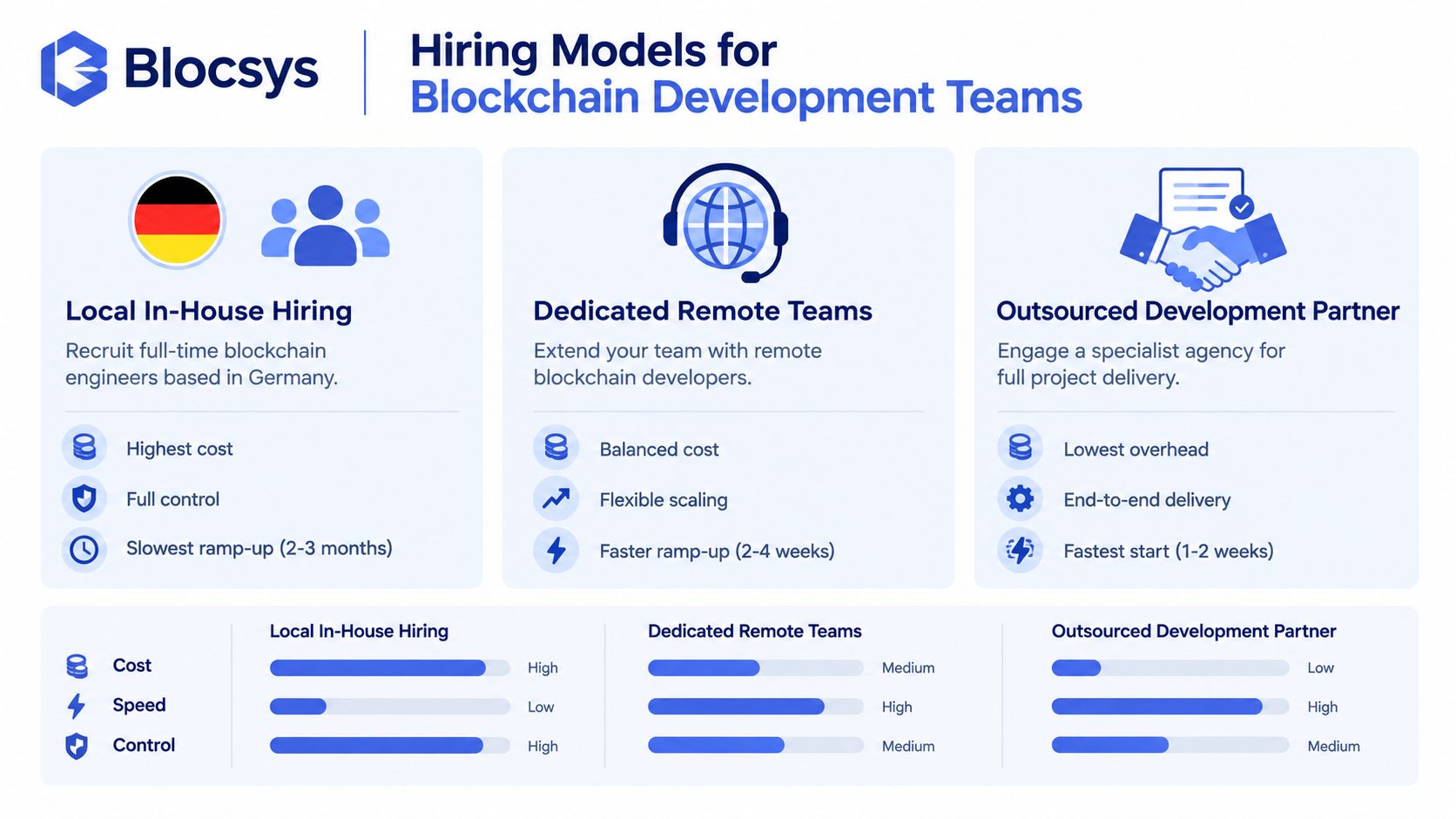
German companies generally choose among three approaches: local in-house hiring, a dedicated remote team, or an outsourced development partner. No model wins in every situation. The right choice depends on how much product ownership, specialist depth, delivery management, and local coordination the business already has.
Local in-house hiring
Local hiring gives a German business direct control over product context, team rituals, and internal knowledge. It can work well when blockchain is a long-term strategic capability and the company already has experienced engineering leadership.
The trade-off is a narrow hiring pool and a slower path to a complete team. The CHAISE forecast noted that only about a dozen German institutions offered blockchain-related courses in a linked education paper, which points to a limited formal training pipeline. A local team may still need external security specialists, protocol engineers, or delivery support.
Dedicated remote teams
A dedicated remote team extends an internal group without requiring every specialist to become a permanent local hire. Germany-based product and compliance owners can retain decision authority while remote engineers handle smart contracts, backend services, testing, and integrations.
India is particularly relevant to cross-border sourcing. Recent coverage described India as the second-largest developer market globally and the largest source of new blockchain developers, with 17% of 39,148 newcomers in the 2024 cohort. India’s share of global Web3 developers also rose from 5% to 12% over the last decade, according to reported India Web3 market data.
That scale doesn’t remove the need for screening. One source reports that roughly 80% of Indian blockchain developers are aged between 18 and 27, while other data describes 4.76 million open-source developers and contribution activity across code, bug fixes, and documentation. GitHub history, testing depth, security reasoning, and communication should therefore matter more than job titles.
For practical staffing guidance, these tips from nexus IT group are relevant when structuring specialist recruitment and team extension.
Outsourced development partners
An outsourced partner makes sense when the company needs a complete delivery function, including architecture, development, testing, documentation, and project coordination. It can reduce internal management overhead, but the buyer must establish ownership of repositories, infrastructure, deployment credentials, technical decisions, and post-launch support.
The safest cross-border arrangement usually combines German ownership of product, data, risk, and acceptance criteria with a remote team responsible for clearly defined engineering outcomes. A dedicated developer model for 2026 can be evaluated on that basis, without assuming that location alone determines quality.
Germany-Specific Considerations When Hiring Blockchain Developers
Germany’s hiring challenge isn’t limited to finding people who know Solidity. The 2026 Digital Decade snapshot cited in the available market data reports that 59.55% of people aged 16 to 74 have at least basic digital skills, Germany ranks 15th in the EU on that measure, and ICT specialists represent 5.5% of total employment. These figures describe the wider digital environment, not blockchain talent alone, but they help explain why specialised recruitment can take careful planning.
Build for regulated workflows
Technical capability and legal compliance aren’t the same thing. Developers can implement permissions, audit trails, transaction controls, identity integrations, reporting interfaces, and security mechanisms, but legal and regulatory interpretation belongs with qualified advisers and the business’s own governance function.
German projects often need stronger documentation than a short-lived Web3 experiment. Require architecture decisions, data-flow diagrams, access matrices, key-management procedures, incident plans, contract specifications, and clear records of who approved production changes.
Security review isn’t a ceremony at the end. It should influence the architecture before implementation begins.
Assess enterprise behaviour
A developer may be technically strong yet unsuitable for a German enterprise if they can’t work with change control, procurement processes, information-security reviews, or detailed acceptance criteria. Ask how they communicate risk, document assumptions, handle ambiguous requirements, and respond when a business stakeholder rejects a technically elegant solution.
Cross-border recruitment also requires practical planning around employment structure, time zones, intellectual property, confidentiality, and travel. Teams considering relocation or international hiring can review visa sponsorship information for Germany separately from the technical assessment, because immigration support doesn’t replace engineering evaluation.
Use a blended delivery structure
A useful structure places a German product owner or technical lead close to the business and gives remote engineers ownership of defined workstreams. The arrangement works only when the remote team has access to decision-makers, documented requirements, code review, and a shared definition of production readiness.
How Blocsys Can Help German Businesses Build Blockchain Products
German businesses hiring blockchain developers need more than isolated coding capacity. They need architecture that connects smart contracts, Web3 interfaces, tokenisation workflows, digital-asset infrastructure, APIs, security controls, and enterprise systems into one maintainable product.
Blocsys Technologies Pvt Ltd supports global businesses with blockchain development for fintech, exchanges, digital-asset companies, Web3 products, and enterprise use cases. Its relevant capabilities include smart contract development, Web3 application engineering, tokenisation systems, trading infrastructure, and integrations with existing technology environments.
The practical starting point is a technical discovery that defines the asset or workflow, target networks, custody and wallet model, contract responsibilities, integration requirements, testing approach, and ongoing ownership. Teams can then choose local collaboration, dedicated remote specialists, or broader project delivery according to their internal capacity. The Blocsys approach to dedicated enterprise blockchain teams provides one way to structure that engagement.
If you’re comparing providers, ask each one to show how it will manage threat modelling, contract testing, API integration, deployment controls, documentation, and post-launch support. Those answers will tell you more than a portfolio full of disconnected demos.
Frequently Asked Questions
What should I look for when hiring blockchain developers in Germany?
When hiring blockchain developers in Germany, look for experience in blockchain architecture, smart contract development, Web3 infrastructure, backend engineering, wallet integration, testing, security, and enterprise integrations. Developers should also understand how to build scalable and production-ready blockchain solutions.
What skills should a blockchain developer in Germany have?
A blockchain developer should have skills in blockchain architecture, Solidity or Rust, smart contract development, backend programming, API integration, wallet integration, testing, security, and blockchain deployment. For enterprise projects, experience with system integration, cloud infrastructure, and secure development practices is also valuable.
What blockchain development services can businesses in Germany hire developers for?
Businesses can hire blockchain developers for smart contract development, decentralized applications, Web3 platforms, tokenization solutions, digital asset platforms, wallet development, blockchain integrations, blockchain APIs, and enterprise blockchain solutions. Developers can also provide testing, security audits, maintenance, and ongoing technical support.
Should German companies hire local blockchain developers or remote developers?
The choice depends on the project’s requirements, budget, technical complexity, and preferred working model. Local developers can provide closer collaboration, while remote blockchain developers can give businesses access to specialized technical talent and flexible development teams without requiring permanent local hiring.
How much does it cost to hire blockchain developers in Germany?
The cost depends on the developer’s experience, technical specialization, project complexity, blockchain network, required features, development duration, and engagement model. Companies should consider the overall technical expertise and delivery capability of the developer or development team rather than comparing rates alone.
Can I hire dedicated blockchain developers for a project in Germany?
Yes, businesses in Germany can hire dedicated blockchain developers or development teams for specific projects. A dedicated team can handle areas such as smart contracts, backend development, Web3 applications, blockchain integrations, testing, and infrastructure while allowing the business to maintain control over product requirements and development priorities.
Why is security experience important when hiring blockchain developers?
Security is critical because blockchain applications can involve smart contracts, private keys, financial transactions, digital assets, and sensitive business information. Developers should understand secure smart contract development, access control, vulnerability testing, key management, threat modeling, and secure deployment practices.
Can blockchain developers in Germany build tokenization platforms?
Yes, blockchain developers can build tokenization platforms for securities, real-world assets, commodities, funds, and other digital assets. A complete tokenization platform may require token issuance, ownership management, transfer restrictions, permissions, compliance workflows, custody integrations, and connections between blockchain networks and existing business systems.
How do I evaluate a blockchain development company in Germany?
Evaluate a blockchain development company based on its blockchain expertise, smart contract capabilities, security practices, development methodology, enterprise experience, integration capabilities, testing processes, scalability approach, and post-development support. Reviewing previous projects and understanding the company’s technical approach can help determine whether it is suitable for your requirements.
Can I hire blockchain developers from India for a German blockchain project?
Yes, German companies can hire blockchain developers or dedicated development teams from India for blockchain projects. When selecting a remote team, businesses should evaluate technical expertise, blockchain experience, communication, security practices, development processes, documentation, and the team’s ability to understand the project’s business and regulatory requirements.
Blocsys Technologies offers blockchain development support for German businesses building smart contracts, Web3 applications, tokenisation platforms, digital-asset infrastructure, and enterprise integrations. Visit Blocsys Technologies to discuss your requirements, assess the right delivery model, and plan the next technical step.
