
A mid-sized digital-asset team can start Monday with wallet reconciliations, failed smart-contract calls, sanctions alerts, investor eligibility checks, and reporting requests competing for the same people. The technology may be on-chain, but the operating model often remains a patchwork of spreadsheets, dashboards, tickets, and manual approvals.
This guide is for fintech companies, banks, exchanges, digital-asset providers, Web3 startups, and enterprise technology leaders evaluating AI-powered SaaS platforms for Web3. It explains where AI agents can safely automate blockchain workflows, where humans must remain accountable, and how to design a production platform that connects wallets, smart contracts, compliance systems, and enterprise software. For teams assessing an implementation partner, Blocsys works across AI-enabled financial platforms, blockchain infrastructure, smart contracts, tokenization, and enterprise workflow automation.
Table of Contents
- The Operations Problem Every Web3 Team Is Trying to Solve
- What AI-Powered SaaS Platforms for Web3 Actually Are
- Inside the Architecture of an Enterprise Web3 SaaS Platform
- How AI Agents Change Day to Day Blockchain Workflows
- Enterprise Use Cases Where AI Web3 SaaS Delivers Real Value
- Security, Compliance, and Scale Considerations for Production
- The 12 to 24 Month Outlook and Building With Blocsys
- Frequently Asked Questions
- What is an AI-powered SaaS platform for Web3?
- How do AI agents automate blockchain workflows?
- How can AI SaaS platforms integrate with blockchain networks?
- What role do smart contracts play in Web3 SaaS?
- What features should an enterprise Web3 SaaS platform include?
- What are the main use cases of AI-powered Web3 SaaS?
- How secure are AI-powered blockchain SaaS platforms?
- How can Web3 SaaS platforms scale for enterprise users?
- How much does it cost to build an AI-powered Web3 SaaS platform?
- How long does development take?
- Is an AI-powered SaaS platform suitable for my business?
- Why choose Blocsys for AI, SaaS, and blockchain development?
The Operations Problem Every Web3 Team Is Trying to Solve
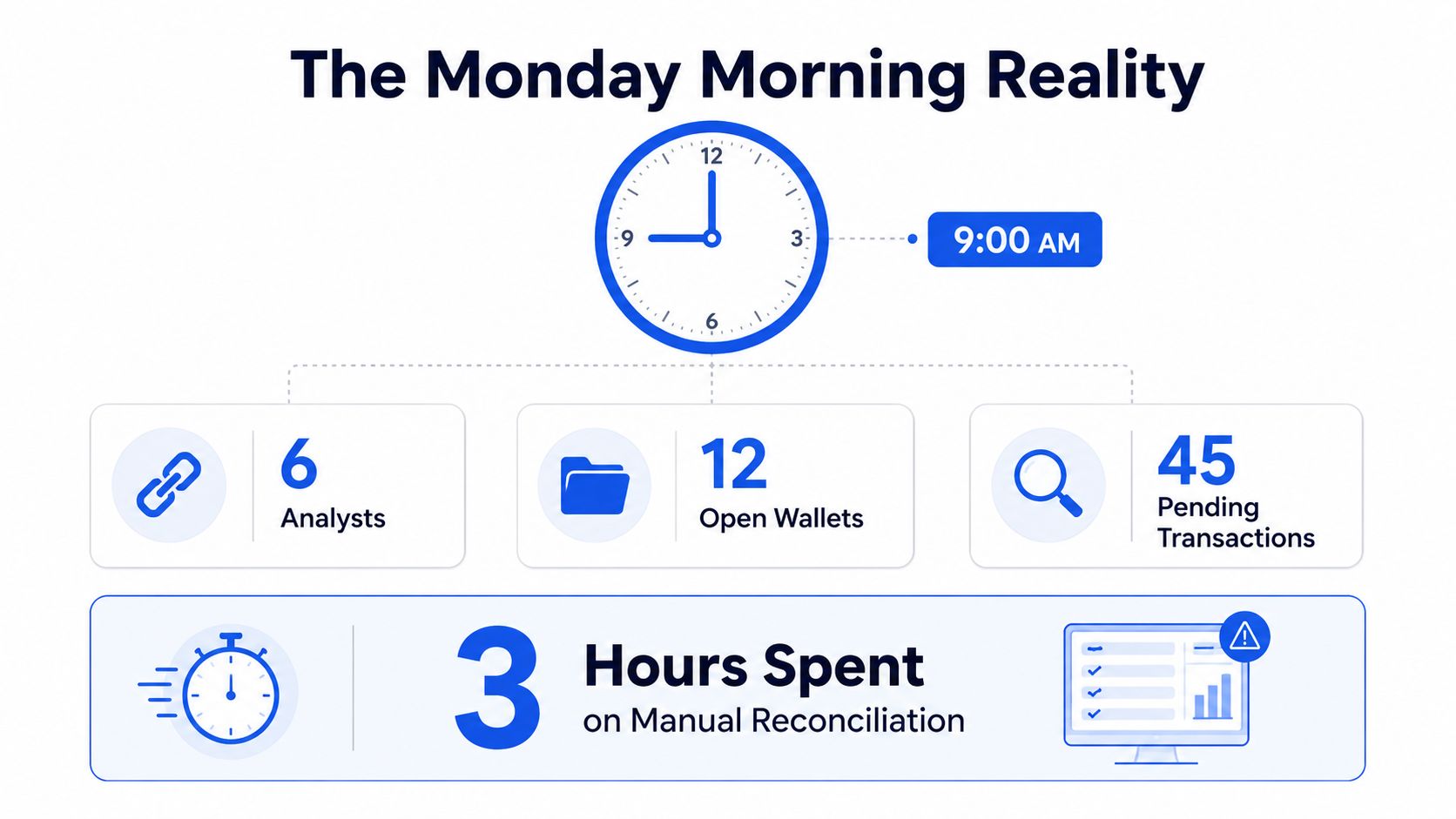
At 9:00 on Monday morning, a digital-asset treasury team opens its operations queue. Tokenized treasury positions need reconciliation, exchange wallets contain deposits and withdrawals awaiting review, staking balances must be compared with the internal ledger, and several smart-contract calls have failed without a clear operational explanation.
The team doesn’t have one problem. It has a coordination problem. Analysts move between custody systems, blockchain explorers, transaction-monitoring tools, internal finance software, ticketing systems, and compliance records. Each tool may work well alone, but none owns the complete workflow from event detection to evidence, approval, execution, and verification.
A conventional dashboard shows activity. It doesn’t necessarily explain which event matters, retrieve the relevant customer or counterparty context, compare the event with policy, prepare the evidence pack, and route the case to the right person. That missing orchestration layer creates swivel-chair work across custody operations, smart-contract monitoring, treasury, risk, and regulatory reporting.
An AI-driven Web3 SaaS platform changes the sequence. It consumes events from wallets, indexers, contracts, and enterprise systems, classifies them, checks deterministic policies, gathers supporting evidence, and routes only unresolved or high-risk cases to an analyst. It can reconcile expected and observed balances, identify a failed transaction pattern, draft a review summary, and preserve the data used to reach that recommendation.
The point isn’t to remove people from financial control. The point is to stop asking skilled operators to perform repetitive joins between systems. Enterprise teams evaluating blockchain use in financial institutions should assess the workflow layer as carefully as the chain, wallet, or smart-contract layer.
Practical rule: Automate the preparation and routing of a decision before automating the decision itself.
What AI-Powered SaaS Platforms for Web3 Actually Are
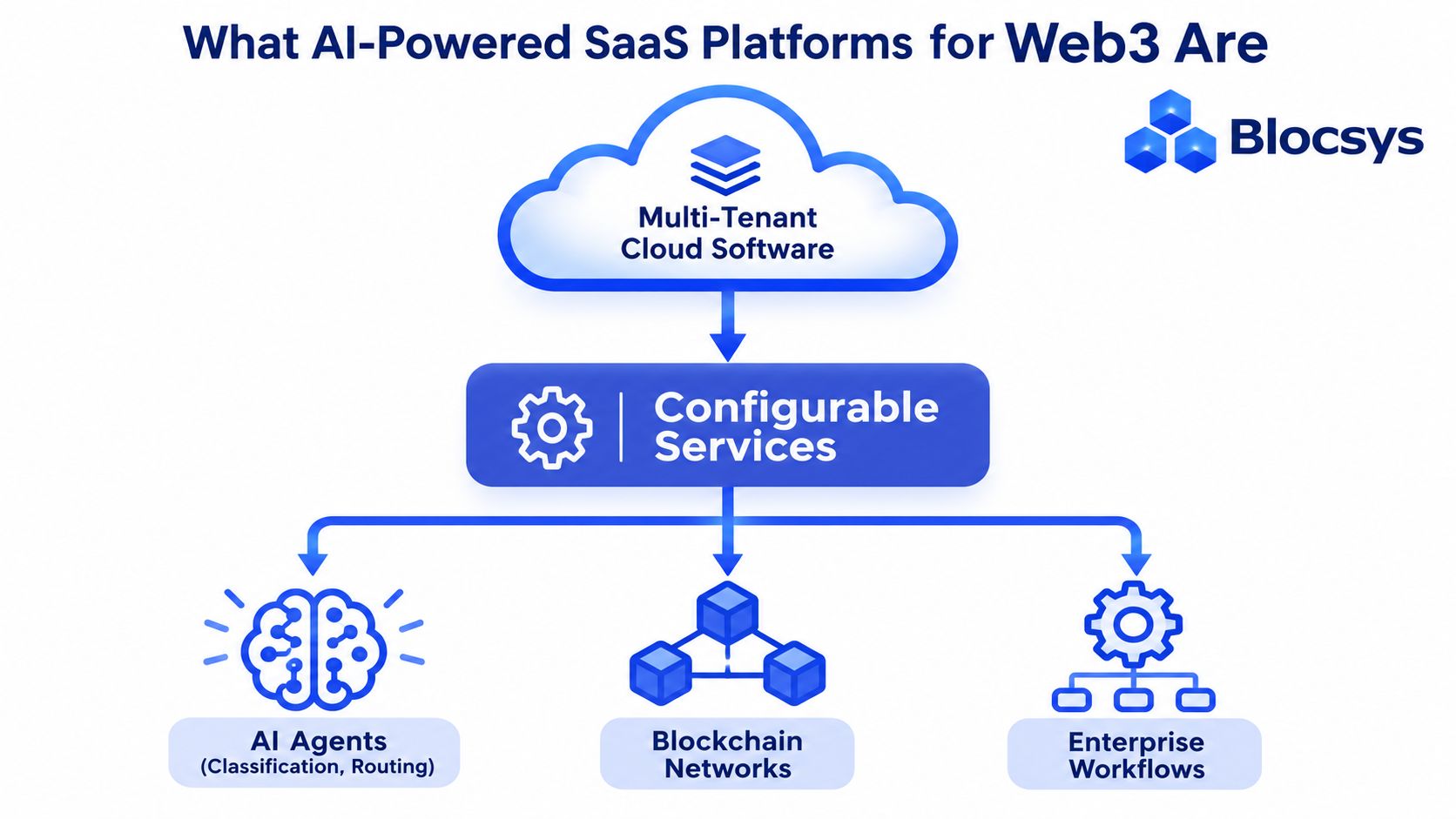
An AI-powered SaaS platform for Web3 is multi-tenant cloud software that turns blockchain operations into configurable enterprise services. It connects blockchain networks and wallets with business systems, while AI agents classify events, route work, draft outputs, and handle bounded exceptions under explicit policies.
That definition has three connected layers.
The SaaS control plane
The SaaS layer provides the operating environment. It normally includes tenant isolation, role-based access control, workflow configuration, dashboards, API access, audit logs, usage controls, and integrations with custody, finance, identity, compliance, and support systems.
For a bank or regulated digital-asset provider, this layer must answer basic operational questions clearly. Which organisation owns this case? Which user approved the action? Which policy was active at the time? Which data source supplied the decision context? Can the organisation export a complete record for internal audit or regulatory review?
The AI agent layer
The agent layer interprets events and coordinates work. An agent may recognise that a transaction is a deposit mismatch, retrieve the related customer and wallet records, compare the activity with policy, and prepare a case for review. Another may read a failed contract event, classify the failure, call a simulation service, and route the result to engineering or treasury operations.
An agent isn’t a free-form chatbot connected directly to a blockchain RPC endpoint. A safe implementation gives it typed tools, limited permissions, structured inputs, deterministic validation, and explicit approval states. The model can recommend the next action, but a policy service should decide whether that action is permitted.
Teams also need to manage the broader operational burden around models, retrieval, integrations, testing, and monitoring. Material on solving AI Day 2 Ops challenges is useful context because a production agent is an operating service, not merely a successful prototype.
The blockchain execution layer
The blockchain layer connects nodes, indexers, wallet services, smart contracts, bridges, token standards, and transaction simulators. It supplies immutable events and executes approved actions, but it doesn’t replace enterprise identity, segregation of duties, case management, or reporting.
The practical value appears when these layers share a state model. A token issuance request can move from an enterprise approval system to an eligibility check, a smart-contract simulation, a controlled signing process, an on-chain confirmation, and an audit record without an operator copying information between separate applications. That is the foundation of AI for blockchain operations, and it also supports Tokenization Platform Development for real-world assets, securities, real estate, commodities, and digital assets.
Inside the Architecture of an Enterprise Web3 SaaS Platform
The architecture should be designed around control boundaries, not around the novelty of a model. A multi-tenant Web3 SaaS platform may share compute and observability infrastructure, but tenant data, policies, credentials, workflows, quotas, and signing authority must remain logically separated.
The main platform components
| Component | Enterprise responsibility | Design priority |
|---|---|---|
| Tenant control plane | Organisations, environments, policies, users, quotas | Strong isolation and configuration boundaries |
| API gateway | Wallet, compliance, reporting, and workflow access | Authentication, authorisation, rate limits, versioning |
| Event and indexer layer | Chain events, transaction states, contract activity | Reorg handling, provenance, replay safety |
| Workflow engine | State transitions, approvals, retries, escalations | Idempotency and deterministic execution |
| AI agent runtime | Classification, planning, retrieval, tool calls | Least privilege, evaluation, traceability |
| Operations dashboard | Risk, compliance, treasury, and support queues | Explainable status and audit-grade exports |
The API gateway should expose business capabilities rather than raw chain mechanics wherever possible. A create-review-case or simulate-transfer operation is easier to govern than allowing every agent to construct arbitrary calldata. Webhooks should carry signed, replay-resistant events, while queues absorb bursts and preserve work when a downstream service is unavailable.
Smart-contract listeners and indexers feed the workflow engine. The engine then applies deterministic state changes, such as moving a transaction from detected to awaiting-review, before invoking an AI agent for interpretation. This separation prevents a model from becoming the system of record.
Architecture principle: The agent may recommend a transition, but the workflow engine should own the transition.
Identity and access management need the same discipline. Use role-based permissions for operators, reviewers, administrators, developers, and auditors. Integrate secrets management and key-management systems rather than placing signing material in application logic. For high-value actions, connect the workflow to custody controls, HSM or MPC-backed signing, approval policies, and transaction simulation.
A data pipeline should also preserve lineage across off-chain records and blockchain events. The data pipeline architecture needs to capture source timestamps, chain identifiers, transaction hashes, block context, transformation steps, model versions, and reviewer decisions. That record supports reconciliation and later investigation.
For an institution developing secure and compliant tokenization platforms for real-world assets, securities, real estate, commodities, and digital assets, the same architecture must connect issuance records, investor data, cap-table state, transfer restrictions, and on-chain contract events. The platform isn’t complete when it mints a token. It must also explain who was eligible, who approved the action, and whether the final chain state matches the enterprise record.
How AI Agents Change Day to Day Blockchain Workflows
AI agents are most useful when they reduce interpretation and coordination work while deterministic services retain control over execution. Legacy automation typically waits for a rule and performs a fixed action. An agent can interpret a multi-source event, plan a sequence, call approved tools, and present a recommendation, but it still needs boundaries.
Where agents add leverage
During onboarding, an agent can extract beneficial-owner information from corporate documents, compare it with identity records, screen counterparties, identify missing evidence, and prepare a case. A human reviewer should approve material findings, exceptions, and the final relationship decision.
During monitoring, the agent can correlate wallet behaviour, contract events, ledger entries, and risk signals. Instead of presenting a large queue of disconnected alerts, it can group related activity, explain the relevant context, and prioritise cases. The analyst still validates the material conclusion.
Compliance work is especially suited to evidence orchestration. An agent can assemble Travel Rule data, sanctions-screening context, transaction-monitoring results, case notes, suspicious-activity narrative drafts, and reporting inputs. The system should preserve the underlying evidence and make clear which text was generated, which data was retrieved, and which conclusion a human accepted.
| Workflow | Legacy pattern | AI-assisted pattern | Human ownership |
|---|---|---|---|
| Onboarding | Manual document review and repeated data entry | Extraction, completeness checks, case preparation | Approval and exceptions |
| Monitoring | Analysts inspect disconnected alerts | Correlation, prioritisation, and summaries | Material risk assessment |
| Reconciliation | Spreadsheet comparisons across systems | Automated matching and mismatch routing | Resolution of ambiguous cases |
| Treasury | Periodic dashboard review | Continuous signals, simulations, and proposals | Fund movement and policy changes |
| Reporting | Manual evidence collection | Draft evidence packs and reporting outputs | Validation and submission |
For treasury or DeFi operations, an agent can monitor liquidity, collateral health, utilisation, and slippage, then propose a rebalance. It may simulate the transaction and check exposure limits, but a defined approval threshold should govern whether funds move. The agent shouldn’t have unrestricted access to a treasury wallet merely because it can describe a plausible strategy.
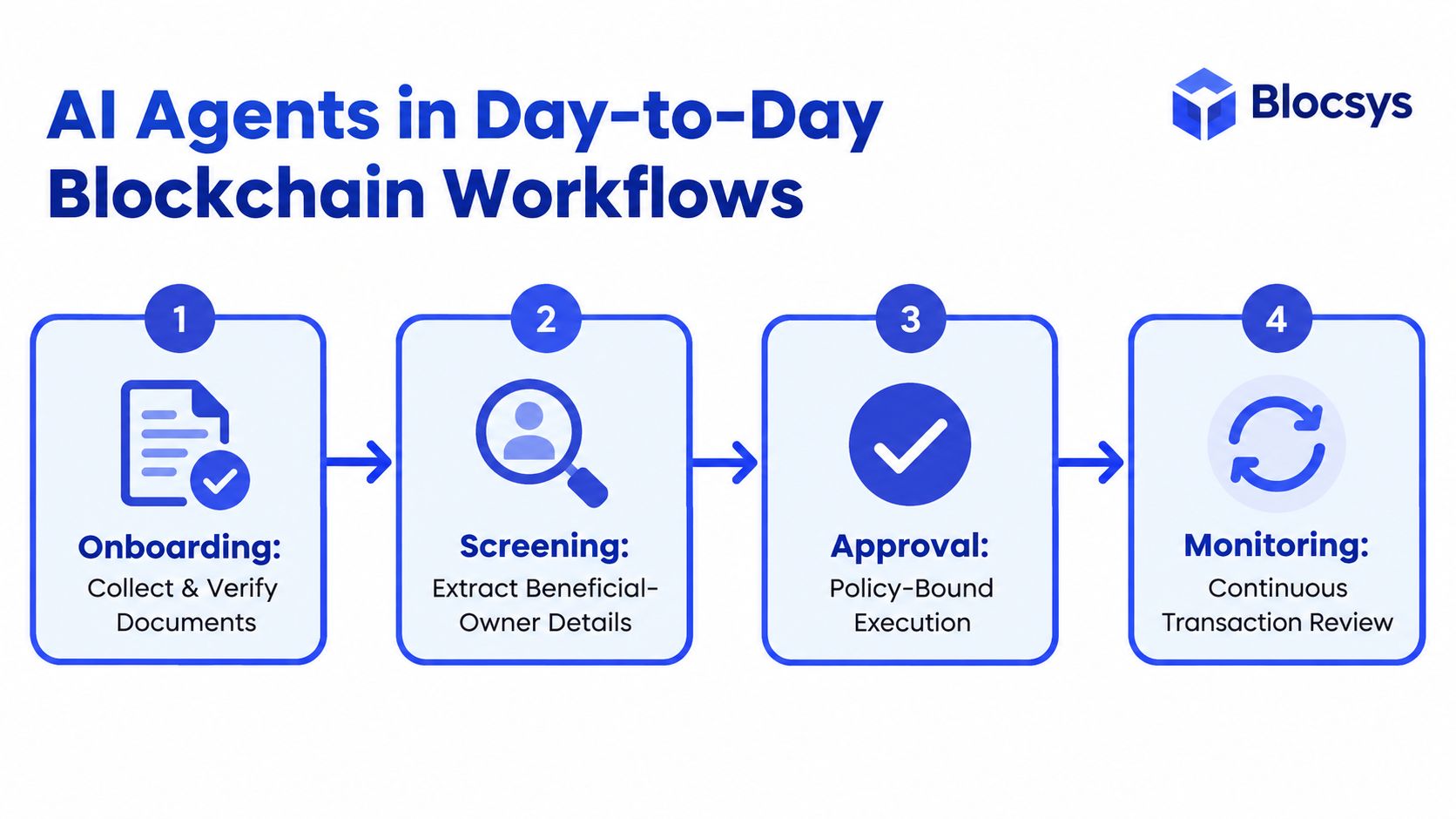
The strongest implementation pattern is propose, simulate, route, execute, verify. Startups may accept more automation to move quickly. Enterprises should favour constrained models, evaluation suites, least-privilege tools, and interfaces that expose each automated action. Further AI orchestration insights can help teams distinguish agent planning from production-grade control.
A practical AI agent architecture for intelligent automation records prompts, retrieved data, tool calls, policy evaluations, approvals, transaction hashes, and outcomes. That trace is more valuable than a polished conversation because it lets an operator reproduce what happened.
Enterprise Use Cases Where AI Web3 SaaS Delivers Real Value
The best enterprise use cases share three characteristics: transactions or records arrive continuously, the control process repeats, and the evidence can be represented in structured form. That makes compliance, reconciliation, and operational routing stronger starting points than open-ended autonomous trading.
Tokenization is a good example. An agent can reconcile an issuance request with investor eligibility, legal-entity data, cap-table records, and contract events. It can flag a mismatch or prepare the minting package, while legal teams retain responsibility for approvals and authorised signers retain minting authority.
Custody providers can use agents to classify unusual wallet or user behaviour, collect supporting records, and coordinate review queues. Segregation of duties shouldn’t disappear. The agent should help the first-line team understand a case, not combine initiation, approval, signing, and release in one opaque action.
Exchanges face a different set of operational problems. Agents can triage deposit mismatches, bridge delays, failed withdrawals, duplicated tickets, and cross-chain identity context. A workflow engine can route the issue to operations, risk, or compliance based on policy and preserve the chain evidence used by the receiving team.
| Use Case | What the AI Agent Does | What Humans Retain |
|---|---|---|
| Token issuance | Matches requests with eligibility records and on-chain events | Legal approval, minting authority, exceptions |
| Digital-asset custody | Correlates wallet activity and prepares review cases | Segregation of duties and release decisions |
| Exchange operations | Classifies mismatches, delays, and withdrawal cases | High-risk review and customer-impact decisions |
| DeFi operations | Monitors positions and proposes rebalancing | Fund movement, limits, and strategy approval |
| Compliance | Drafts case summaries and evidence packs | Material findings and regulatory submissions |
| Smart-contract releases | Compares changes and generates test scenarios | Independent review, security testing, release approval |
Payment and settlement teams can reconcile invoices with on-chain transfers, identify failed transactions, and prepare support responses. Smart-contract release teams can ask an agent to compare proposed changes, map dependencies, extract invariants, and generate test cases. That agent must not certify code or bypass independent security review.
The common thread is orchestration plus evidence. AI earns its place by connecting systems and reducing repetitive analysis. It doesn’t earn trust by claiming autonomous control over assets.
Security, Compliance, and Scale Considerations for Production
Production blockchain automation has to remain safe when models hallucinate, data sources are wrong, integrations fail, and attackers manipulate prompts or transaction payloads. A threat model should cover compromised administrators, prompt injection, data poisoning, malicious calldata, private-key theft, replay, bridge failures, tool abuse, and cascading workflow errors.
India illustrates why evidence-generating controls matter. As of March 9, 2026, 54 virtual digital asset service providers had registered with FIU-IND as reporting entities, while FIU-IND had directed the takedown of 53 unregistered exchanges, according to this India digital-assets regulatory roundup. The same regulatory environment requires live demonstrations of KYC systems, cybersecurity audits, sanctions screening, transaction monitoring, blockchain analysis, and Travel Rule compliance.
India’s AI governance direction also matters for product design. The 2025 guidance applies to developers, deployers, and end-users across finance and digital services, and recommends lifecycle controls, compliance demonstration, provenance, labelling, watermarking, and grievance mechanisms, as described in the consultation coverage on India’s AI governance guidelines. These expectations reinforce a broader principle for teams operating in the US, Europe, the UK, UAE, Singapore, Germany, Switzerland, Canada, or Australia. An automated output needs provenance and accountability, not just a confidence score.
| Risk Area | Primary Threat | Production Control |
|---|---|---|
| Model behaviour | Hallucinated or unsupported recommendation | Retrieval constraints, validation, evaluation suites |
| Tool access | Unauthorised transaction or data access | Typed APIs, least privilege, allowlists |
| Signing | Key theft or excessive authority | HSM or MPC controls, dual approval, limits |
| Workflow failure | Duplicate or cascading execution | Idempotency, queues, stop conditions |
| Data integrity | Poisoned or stale source records | Provenance, source validation, reconciliation |
| Compliance | Missing evidence or unexplained decision | Immutable logs, retention, review workflows |
| Availability | Node, bridge, or integration outage | Backpressure, retries, failover, observability |
For covered Indian virtual-asset services, tax-reporting rules also cover crypto-assets, CBDC, and electronic-money products under the financial account reporting framework effective January 1, 2026, increasing the need for structured compliance outputs. The exact controls will vary by business model and jurisdiction, but the architecture should keep deterministic policy enforcement outside the model.
Scale comes from event-driven services, queue backpressure, rate limits, idempotent handlers, regional observability, and tested recovery paths. Start read-only, then allow reversible actions, then introduce tightly capped execution with explicit rollback and revocation procedures. Teams building digital-asset custody and compliance platforms should treat auditability as a core product capability rather than a reporting add-on.
The 12 to 24 Month Outlook and Building With Blocsys
Over the next 12 to 24 months, the practical direction for AI-powered Web3 SaaS won’t be unrestricted autonomy. It will be constrained agents operating across better-integrated evidence, policy, and execution systems.
The first likely vector is autonomous compliance preparation. Agents will assemble regulator-ready evidence packs from KYC records, wallet activity, sanctions results, Travel Rule fields, and case histories. The integration requirement is a governed evidence store with provenance, retention rules, reviewer workflows, and submission controls. The outcome is faster preparation without transferring accountability for material decisions to a model.
The second vector is agentic treasury operations. Agents will monitor yield positions, collateral health, liquidity, exposure, and transaction costs, then propose rebalancing actions within policy. To make that safe, the platform needs simulation, allowlists, exposure ceilings, approval thresholds, signing controls, and post-execution verification. The agent can watch continuously, but it shouldn’t become an unbounded portfolio manager.
The third vector is low-code smart-contract lifecycle tooling. Agents will compare proposed contract changes, identify affected workflows, generate test cases, and organise evidence for review. This may shorten coordination around audits, but it won’t remove the need for independent security assessment, formal release ownership, or human approval.
Enterprise teams evaluating enterprise AI agent management should ask whether the platform can govern agents after deployment. A production programme needs model and prompt versioning, tool inventories, evaluation results, incident records, access reviews, and a clear owner for every workflow.
A practical adoption checklist
- Start with evidence-heavy work: Choose reconciliation, alert triage, case preparation, or reporting drafts before autonomous fund movement.
- Define the decision boundary: Document what the agent may read, propose, execute, reverse, or escalate.
- Measure operational value: Track queue age, exception quality, reconciliation completeness, review effort, and evidence coverage rather than relying only on model accuracy.
- Introduce authority gradually: Move from read-only assistance to recommendations, then to reversible actions, and finally to capped execution where governance permits.
- Test failure modes: Simulate stale data, chain reorganisations, rejected transactions, prompt injection, unavailable APIs, and incorrect model outputs.
- Keep a human owner: Every automated workflow needs a responsible team, escalation path, stop condition, and review cadence.
Blocsys Technologies designs and builds AI-powered SaaS platforms, AI agents, blockchain integrations, smart contracts, tokenization systems, and enterprise financial technology workflows. Its work can include the multi-tenant SaaS shell, event and data pipelines, policy-aware agent orchestration, custody and wallet integrations, audit trails, dashboards, and production deployment required by fintechs, exchanges, banks, and digital-asset businesses.
Cost depends on the number of integrations, supported networks, custody model, compliance depth, tenant controls, agent complexity, and operational requirements. Teams defining a scope can use the Blocsys Cost Estimator Tool as an early planning aid, then validate the estimate against a technical discovery and delivery plan.
Frequently Asked Questions
What is an AI-powered SaaS platform for Web3?
An AI-powered SaaS platform for Web3 is cloud software that connects enterprise workflows with blockchain networks, wallets, smart contracts, and off-chain systems. AI agents classify events, retrieve context, prepare cases, route work, and propose actions, while deterministic policies and human approvals control sensitive execution.
How do AI agents automate blockchain workflows?
AI agents consume events and business data, interpret the situation, call approved tools, and move work through a defined workflow. They can reconcile records, prioritise alerts, prepare compliance evidence, simulate transactions, and route exceptions. They should not receive unrestricted authority over signing keys or high-risk transfers.
How can AI SaaS platforms integrate with blockchain networks?
Integration normally uses node providers, indexers, wallet and custody APIs, event listeners, webhooks, smart-contract interfaces, transaction simulators, and enterprise APIs. The platform should normalise chain events into a common workflow model and preserve transaction hashes, source data, policy decisions, approvals, and execution outcomes.
What role do smart contracts play in Web3 SaaS?
Smart contracts enforce defined on-chain rules for activities such as issuance, transfers, settlement, permissions, and asset management. A Web3 SaaS platform coordinates the surrounding workflow, including eligibility, approvals, simulations, signing, monitoring, reconciliation, and reporting. Smart contracts don’t replace those off-chain controls.
What features should an enterprise Web3 SaaS platform include?
Core features include tenant isolation, role-based access, policy management, workflow orchestration, blockchain APIs, event indexing, wallet and custody integrations, dashboards, immutable audit logs, secrets management, observability, transaction simulation, approval routing, and exportable compliance evidence. AI agents should operate through controlled tools.
What are the main use cases of AI-powered Web3 SaaS?
Common use cases include wallet reconciliation, transaction monitoring, onboarding, sanctions and counterparty screening, Travel Rule evidence preparation, tokenization operations, custody review, exchange support, DeFi position monitoring, payment settlement, and smart-contract release coordination. Human ownership remains important for material risk and asset-control decisions.
How secure are AI-powered blockchain SaaS platforms?
Security depends on architecture and operating controls rather than the presence of AI. Production platforms should use least-privilege access, typed APIs, allowlists, transaction simulation, segregated duties, dual approval, HSM or MPC-backed signing, short-lived credentials, immutable logs, independent validation, and tested revocation and recovery procedures.
How can Web3 SaaS platforms scale for enterprise users?
They scale through multi-tenant isolation, event-driven services, queues, backpressure, idempotent processing, rate limits, horizontal service design, regional observability, and resilient integrations. Blockchain-specific concerns, including node availability, indexing delays, chain reorganisations, transaction replacement, and contract failures, must be represented in workflow state.
How much does it cost to build an AI-powered Web3 SaaS platform?
There isn’t a reliable single price because scope varies substantially. The main cost drivers are AI agent complexity, number of chains, custody and wallet integrations, compliance requirements, tenant architecture, smart-contract development, security testing, dashboards, data pipelines, and ongoing monitoring. A discovery phase and a detailed technical scope provide a more useful estimate.
How long does development take?
Development time depends on whether the project is a focused workflow, a new multi-tenant platform, or a regulated financial system with extensive integrations. A read-only proof of concept is materially different from production deployment with custody controls, audit evidence, resilience testing, security review, and operational support. Teams should plan delivery in governed increments rather than treating a prototype as a finished platform.
Is an AI-powered SaaS platform suitable for my business?
It is a strong candidate when your organisation handles repetitive, multi-system, evidence-heavy workflows and already has defined policies or review procedures. Start with reconciliation, monitoring triage, onboarding preparation, or reporting drafts. Avoid beginning with unrestricted trading, irreversible transfers, or decisions that lack a reliable source of truth.
Why choose Blocsys for AI, SaaS, and blockchain development?
Blocsys Technologies works on AI-enabled financial platforms, AI agent development, blockchain platform engineering, smart contracts, tokenization, and enterprise workflow automation. A suitable engagement can cover architecture, integrations, compliance-oriented evidence trails, multi-tenant SaaS design, and production implementation for fintech, banking, exchange, and digital-asset use cases.
AI-powered SaaS for Web3 works best when it treats blockchain as an execution and evidence layer, AI as a constrained orchestration layer, and SaaS as the governed operating environment. Start with repetitive workflows, preserve human ownership of material decisions, and make every automated action explainable and reversible where possible.
Blocsys Technologies offers AI-powered SaaS development, AI agent development, blockchain platform engineering, smart-contract development, digital-asset and tokenization systems, and compliance-focused workflow automation for enterprise Web3 operations. Visit Blocsys Technologies to discuss your architecture, implementation roadmap, or next production blockchain and AI initiative.
