
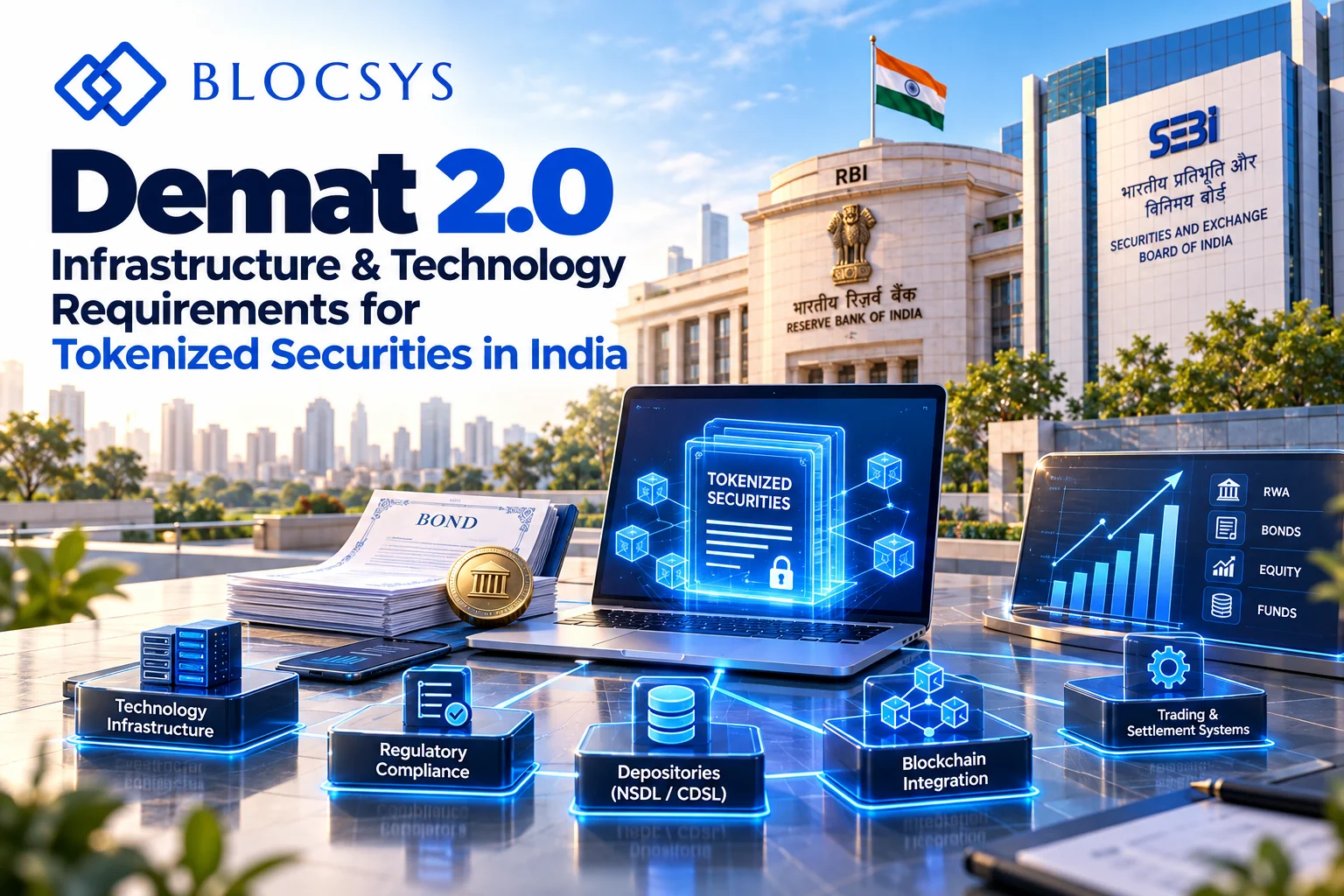
Demat 2.0 Infrastructure: Technology Requirements for Tokenized Securities in India
India’s capital markets are inching toward a new settlement model, and the technology stack behind it matters more than the headlines suggest. Demat 2.0 infrastructure isn’t just a faster version of the existing depository system — it’s a fundamentally different architecture built on distributed ledgers, smart contracts, and programmable ownership records. If you’re a CTO, compliance lead, or technology decision-maker at a bank, brokerage, or depository, understanding what this infrastructure actually requires is far more useful than reading another explainer on what tokenized bonds are. Let’s get into the technical layer, because that’s where the real decisions get made. You can also explore how Demat 2.0, Tokenization & CBDC Integration is being approached as a connected ecosystem rather than a standalone upgrade.
What Is Demat 2.0 in the Context of Tokenized Securities
Demat 2.0 refers to a proposed evolution of India’s dematerialized securities framework, where ownership records move from centralized depository databases toward blockchain-based or distributed ledger-backed registries. Today, NSDL and CDSL maintain electronic records of securities ownership. Demat 2.0, as discussed across industry and fintech circles, envisions tokenized representations of these securities — issued, transferred, and settled using distributed ledger technology.
It’s important to be precise here: SEBI has not announced a formal “Demat 2.0” regulatory framework as of this writing. What exists are pilot programs, discussion papers, and industry proposals around tokenized corporate bonds and asset tokenization. Treat Demat 2.0 as an emerging conceptual model, not an enacted regulation.
How Tokenized Securities Infrastructure Could Work in India
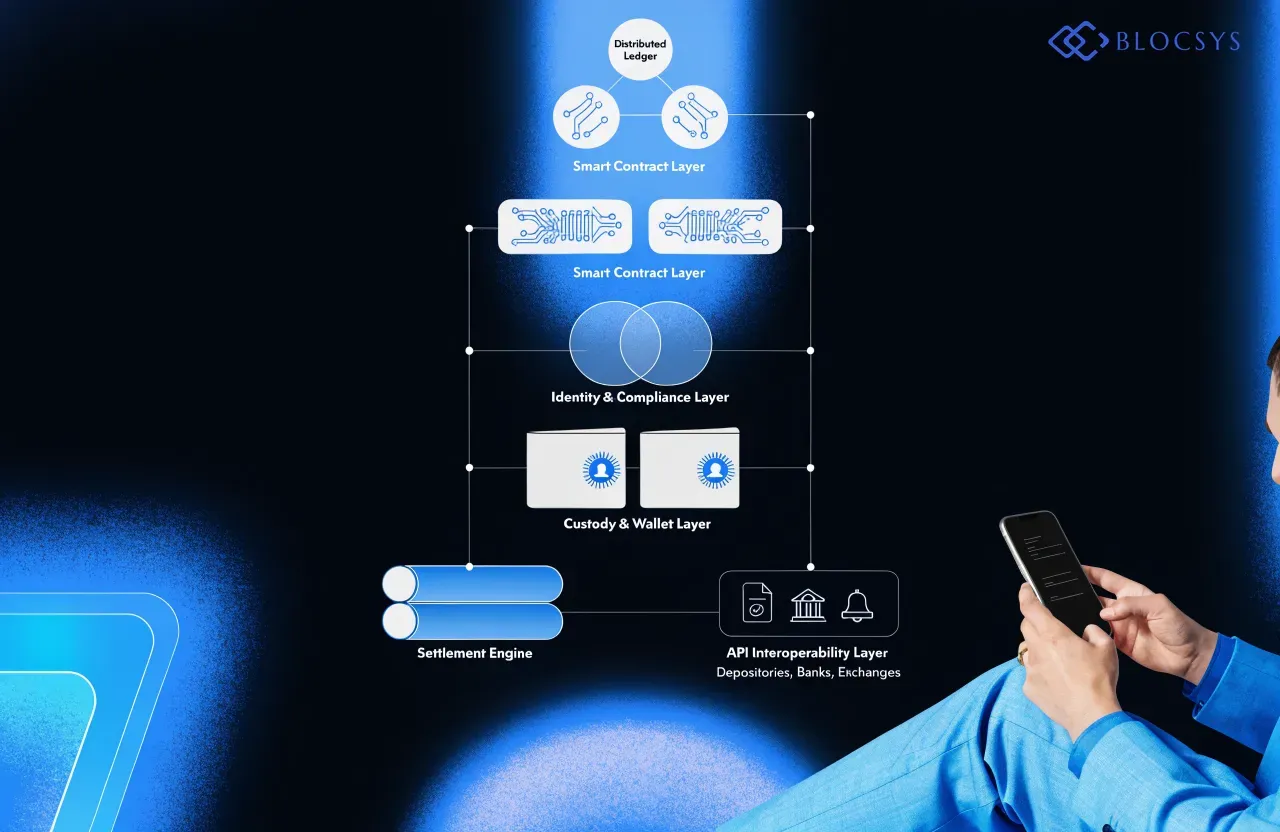
Picture a layered system. At the base sits a distributed ledger that records token issuance and transfers. Above that sits a compliance layer enforcing SEBI rules, KYC norms, and investor eligibility checks. On top of both sits the user-facing layer — brokers, custodians, and exchanges interacting through APIs.
For tokenized securities in India to function at scale, this layered approach has to interoperate with existing systems rather than replace them outright. Depositories, clearing corporations, and settlement banks won’t disappear overnight. Instead, tokenized securities infrastructure likely sits alongside them, bridging traditional rails with programmable asset registries.
Core Technology Components of Demat 2.0 Infrastructure
Building Demat 2.0 infrastructure means assembling several distinct technology layers that work together. Here’s a quick breakdown of what each layer typically handles:
| Layer | Primary Function |
|---|---|
| Distributed Ledger | Records token issuance, ownership, and transfer history |
| Smart Contracts | Automate issuance rules, transfer restrictions, corporate actions |
| Identity & Access Management | KYC verification, investor eligibility, permissioned access |
| Custody & Wallets | Secure storage and management of tokenized holdings |
| Settlement Engine | Matches trades and finalizes transfer of tokens and funds |
| APIs & Interoperability | Connects depositories, banks, exchanges, and custodians |
Each layer introduces its own compliance and security considerations. Skipping any one of them creates a weak link that undermines the entire system. Let’s break down each component.
Blockchain and Distributed Ledger Infrastructure
At the heart of any Demat 2.0 infrastructure sits a distributed ledger. This could be a permissioned blockchain — meaning only vetted institutions like depositories, banks, and brokers can validate transactions — or a hybrid model combining permissioned and public elements.
Permissioned ledgers make sense for regulated securities because they let regulators retain oversight while still gaining the auditability benefits of blockchain. Platforms like DAML, Hyperledger Fabric, and Corda have been used globally for similar capital-market use cases. India’s tokenized securities infrastructure would likely lean toward permissioned architectures given RBI and SEBI’s emphasis on regulatory control. Firms exploring this path often look at DAML development expertise specifically because DAML was designed for regulated financial workflows.
The mistake institutions make is assuming blockchain infrastructure is a drop-in replacement for a database. It’s not. You’re building a system where regulatory logic, not just transaction logic, has to be enforced at the protocol level.
Token Issuance and Digital Ownership Records
Token issuance is where a security — a bond, an equity share, a fund unit — gets represented as a digital token on the ledger. This isn’t simply minting a cryptocurrency-style token. Each token needs embedded metadata: issuer details, face value, coupon terms, maturity dates, and transfer restrictions.
Digital ownership records then track who holds which tokens, replacing (or mirroring) the role NSDL and CDSL currently play. Consequently, the architecture has to decide whether tokens are the authoritative record or whether they simply represent an existing demat holding. That distinction carries huge legal and operational weight, and it’s one of the open questions in India’s tokenized securities in India debate.
Smart Contract Infrastructure
Smart contracts automate what used to require manual processing. Coupon payments, dividend distributions, maturity redemptions, and transfer restrictions can all be coded directly into contract logic.
For example, a tokenized corporate bond could have a smart contract that automatically distributes interest payments to token holders on a set schedule. Firms working on Corporate Bond Tokenization Platform Development build exactly this kind of automated lifecycle management into their platforms.
However, smart contracts handling regulated securities need audit trails, upgrade mechanisms, and kill switches for regulatory intervention. Unlike typical DeFi contracts, these can’t be fully autonomous — regulators and depositories need override capability built in from day one.
Digital Identity and Access Management
Every investor interacting with tokenized securities needs verified digital identity. This connects naturally with India’s existing digital identity rails — Aadhaar-based KYC, PAN verification, and CKYC records maintained by CERSAI.
Demat 2.0 technology would need to layer blockchain-based identity credentials on top of these existing systems rather than building parallel KYC infrastructure from scratch. Access management also needs to enforce investor eligibility rules — for instance, restricting certain tokenized instruments to qualified institutional buyers. Role-based permissions become critical, because not every participant on the network should see every transaction.
Custody and Wallet Infrastructure
Who holds the keys to tokenized securities? That question defines your custody model.
Institutional custody typically requires multi-signature wallets, hardware security modules (HSMs), and cold-storage key management. Retail investors, meanwhile, would likely interact through custodial wallets managed by brokers or depositories rather than holding private keys themselves — similar to how demat accounts work today.
Custody infrastructure also needs disaster recovery protocols. If a key gets lost or compromised, there has to be a recovery path that doesn’t rely on a single point of failure. This is where enterprise blockchain solutions differ meaningfully from consumer crypto wallets.
Contact Us
Exploring blockchain infrastructure for tokenized securities? Connect with Blocsys to discuss your financial-market technology requirements.
Settlement and Transaction Processing
Settlement is where tokenized securities infrastructure could genuinely outperform the current T+1 cycle. Because tokens and payment can settle atomically on a shared ledger, delivery-versus-payment (DvP) becomes near-instantaneous in theory.
That said, this depends heavily on whether payment settlement happens on-chain too — which brings the Digital Rupee into the picture. RBI’s CBDC pilots, including the wholesale Digital Rupee (e₹-W) trials, explore exactly this kind of programmable settlement. If tokenized securities settle against a tokenized form of central bank money, you get true atomic settlement. Without it, you’re still bridging blockchain assets to traditional banking rails, which reintroduces latency and reconciliation risk.
Integration With Depositories, Banks, and Capital-Market Systems
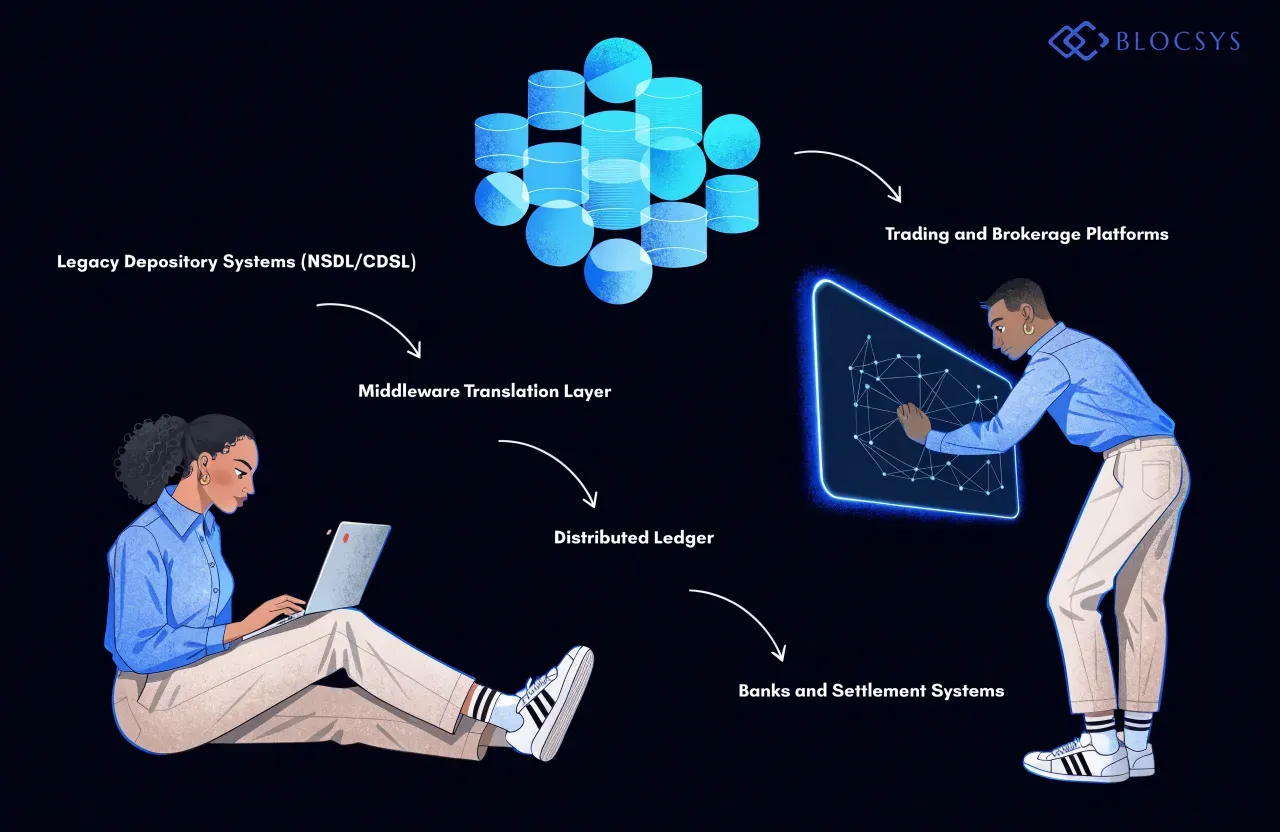
No Demat 2.0 infrastructure survives in isolation. It has to integrate with NSDL, CDSL, clearing corporations, banks, and existing trading systems. This typically happens through middleware layers that translate blockchain events into formats these legacy systems already understand.
Think of it as a translation layer sitting between two worlds. Traditional systems speak in batch files and end-of-day reconciliation. Blockchain systems speak in real-time events and cryptographic proofs. Bridging these two worlds well is probably the single hardest engineering problem in this entire space. Institutions building this kind of bridge often start with permissioned blockchain infrastructure for post-trade operations before extending into full tokenization.
APIs and Interoperability
APIs form the connective tissue of any tokenized securities infrastructure. Issuers need APIs to mint tokens. Brokers need APIs to execute trades. Custodians need APIs to report holdings. Regulators need APIs to pull audit data.
Interoperability goes further than APIs, though. If multiple institutions run separate permissioned ledgers, there needs to be a standard for cross-chain communication — otherwise you end up with isolated silos that can’t talk to each other. Standards like ISO 20022 for financial messaging already provide a template; tokenized securities infrastructure would need similar standardization to avoid fragmentation across India’s capital-market institutions.
Reconciliation and Record Synchronization
Here’s a question worth asking directly: if tokens exist on a blockchain and traditional records still exist elsewhere, how do you keep them in sync?
Reconciliation infrastructure needs to continuously compare on-chain token balances against off-chain depository records, flagging discrepancies in near real-time rather than at end-of-day batch cycles. This is a meaningfully different reconciliation model than what exists today, and it requires dedicated monitoring tools built specifically for distributed ledger environments.
Compliance and Regulatory Technology
Compliance technology, or RegTech, has to be embedded into Demat 2.0 infrastructure rather than bolted on afterward. This means automated transaction monitoring, suspicious activity flagging, and reporting pipelines that feed directly into SEBI’s surveillance systems.
Smart contracts can enforce compliance rules automatically — for instance, blocking a transfer that would violate foreign ownership limits. Additionally, audit trails need to be immutable and exportable in formats regulators can actually use. Compliance isn’t a feature here; it’s the foundation everything else gets built on.
Security and Cybersecurity Requirements
Security for tokenized securities infrastructure spans several distinct attack surfaces: smart contract vulnerabilities, private key compromise, consensus-layer attacks, and API-level breaches.
Smart contract audits aren’t optional — a single flawed line of code can freeze or misdirect billions in tokenized assets. Key management requires HSMs and multi-party computation (MPC) for institutional custody. Furthermore, the network itself needs continuous monitoring for anomalous transaction patterns, since fraud detection in a 24/7 settlement environment looks very different from fraud detection in a batch-processed one.
Scalability and Performance Considerations
India’s capital markets process massive daily volumes. Any Demat 2.0 infrastructure has to handle peak trading loads without latency spikes.
Permissioned blockchains generally handle this better than public chains because validator sets are smaller and known. Still, architecture choices around consensus mechanisms, block size, and transaction throughput all directly affect whether the system can handle exchange-level volumes. Testing under realistic load conditions matters more here than theoretical benchmarks.
Challenges in Building Tokenized Securities Infrastructure
Let’s be honest about the obstacles. Legal recognition of tokenized ownership remains unsettled in India. Legacy system integration is genuinely hard, not just a buzzword-level challenge. Cross-institutional governance — deciding who runs validator nodes and who sets network rules — raises as many political questions as technical ones.
Moreover, talent remains scarce. Few engineering teams inside Indian banks and depositories have deep DAML, Corda, or Hyperledger experience. That’s precisely why many institutions turn to specialized partners for dedicated blockchain engineering teams rather than building capability from zero internally.
How Financial Institutions Can Prepare for Demat 2.0
You don’t need to wait for final regulation to start preparing. Begin by auditing your existing systems for API readiness — can your core platforms expose and consume real-time data feeds?
Next, pilot smart contract logic on sandboxed environments using real instrument data. Consider working through blockchain consulting engagements to map out where tokenization fits your specific product lines, whether that’s equities, bonds, or fund units. Also invest in staff training around digital identity, custody models, and compliance automation — these skills will matter regardless of which specific Demat 2.0 standard eventually emerges.
Conclusion
Demat 2.0 infrastructure represents a genuine shift in how securities ownership could be recorded and settled in India. It’s not a single technology — it’s an orchestration of distributed ledgers, smart contracts, identity systems, custody solutions, and compliance tooling working in concert. We’ve walked through each layer here, and the common thread is clear: integration with existing systems matters as much as the blockchain layer itself.
For institutions serious about tokenized securities infrastructure, the groundwork starts now, well before final regulatory frameworks land. Reviewing resources like Demat 2.0, Tokenization & CBDC Integration is a practical next step for understanding how these pieces connect to India’s broader Digital Rupee ecosystem.
Contact Us
Ready to build infrastructure for tokenized financial assets? Talk to Blocsys about developing scalable blockchain solutions.
Frequently Asked Questions
Here are direct answers to the questions we hear most often about Demat 2.0 infrastructure and tokenized securities in India.
What is Demat 2.0 infrastructure?
Demat 2.0 infrastructure refers to the proposed technology stack — distributed ledgers, smart contracts, digital identity, and custody systems — that would support tokenized representations of securities in India, building on the existing dematerialized holding model.
How could Demat 2.0 support tokenized securities in India?
Demat 2.0 could support tokenized securities by recording ownership on a distributed ledger instead of solely in centralized depository databases, while still integrating with NSDL, CDSL, and existing regulatory frameworks.
What technology is required for tokenized securities infrastructure?
Core requirements include a permissioned distributed ledger, smart contract engines, digital identity and KYC integration, custody and wallet systems, settlement infrastructure, and APIs connecting depositories, banks, and exchanges.
What role does blockchain play in Demat 2.0?
Blockchain provides the shared, tamper-resistant ledger where token issuance and ownership transfers get recorded, giving multiple institutions a synchronized view of the same data without relying on one central database.
How can smart contracts support tokenized securities?
Smart contracts automate issuance rules, coupon or dividend payments, transfer restrictions, and maturity redemptions, reducing manual processing while enforcing compliance conditions directly in code.
How could tokenized securities integrate with Indian depositories and financial institutions?
Integration typically happens through middleware layers and APIs that translate blockchain-based token events into formats existing depository, banking, and clearing systems can process and reconcile.
What role do custody and digital wallets play in tokenized securities?
Custody infrastructure secures the private keys controlling tokenized holdings, using HSMs, multi-signature wallets, or custodial models so institutions and retail investors can safely hold digital securities.
How can tokenized securities infrastructure handle settlement and reconciliation?
Settlement can occur near-instantly through atomic delivery-versus-payment on a shared ledger, while reconciliation tools continuously compare on-chain balances against off-chain records to catch discrepancies early.
What compliance and security requirements apply to tokenized securities in India?
Compliance requirements include KYC/AML enforcement, SEBI-aligned transaction monitoring, and immutable audit trails, while security requirements cover smart contract audits, key management, and continuous network monitoring.
How can financial institutions prepare their technology infrastructure for Demat 2.0?
Institutions can prepare by auditing API readiness, piloting smart contracts in sandboxed environments, training staff on digital identity and custody models, and engaging blockchain consulting partners early.
How can businesses build blockchain infrastructure for tokenized securities?
Businesses typically build this infrastructure by partnering with experienced blockchain development teams for ledger architecture, smart contract development, and custody integration, rather than building every layer in-house from scratch.
Ready to move beyond theory and build an intelligent platform that delivers real-world value? Blocsys Technologies specialises in engineering enterprise-grade AI and blockchain solutions for the fintech, Web3, and digital asset sectors. Connect with our experts today to discuss your vision and chart a clear path from concept to a secure, scalable reality.
