
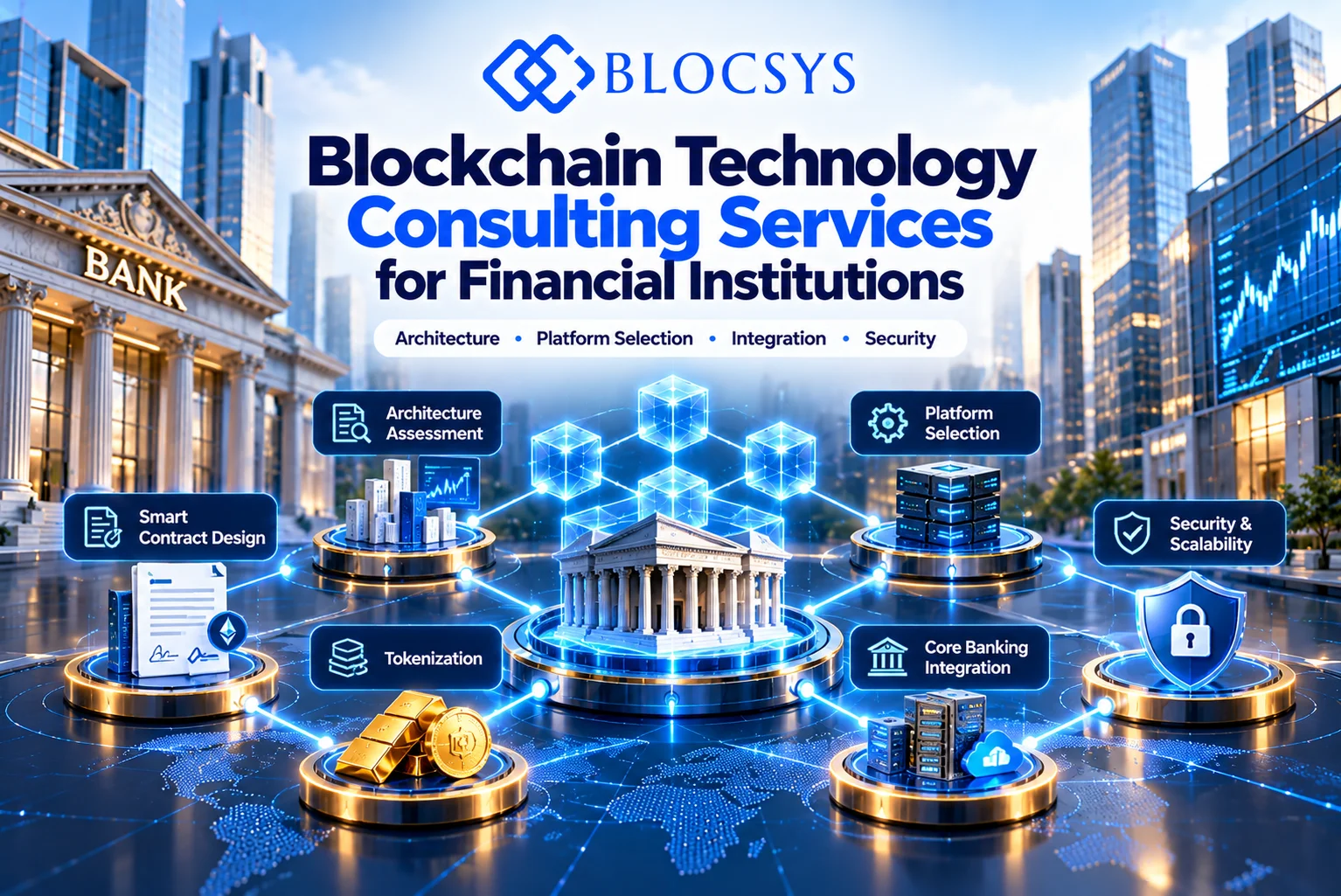
A bank’s innovation team has a clear mandate to explore blockchain, but the vendor proposals quickly become difficult to compare. One supplier recommends a permissioned network, another proposes a public chain, and a third leads with tokenization without explaining how the design will connect to core banking, custody, settlement, or compliance systems.
That uncertainty is familiar to banks, payment providers, asset managers, fintech companies, investment firms, and technology leaders across the USA, UK, UAE, Europe, Singapore, Canada, and Australia. This guide focuses on the technical decision layer, including architecture assessment, platform selection, smart contract controls, integration patterns, security, scalability, and implementation readiness. It also separates blockchain technology consulting from business strategy advice and pure software development, so you can assess proposals on engineering substance rather than presentation quality. For adjacent context on building fintech products with AI, it’s useful to consider how blockchain infrastructure fits into the wider financial technology stack.
Financial institutions evaluating regional adoption can also review how financial institutions in the US, UK and Europe are using blockchain, particularly when comparing market-specific operating models.
Table of Contents
- Why Financial Institutions Are Rethinking Their Blockchain Approach
- What Blockchain Technology Consulting Means for Financial Institutions
- Why Banks Need Specialized Technical Consulting
- Blockchain Architecture Assessment and Platform Selection
- Smart Contract Architecture and Tokenization of Digital Assets
- Banking System Integration APIs Security and Scalability
- Technical Roadmaps Implementation Planning and Choosing Your Consulting Partner
- Frequently Asked Questions About Blockchain Technology Consulting
- What does blockchain technology consulting include for financial institutions?
- How does blockchain technology consulting differ from blockchain business consulting?
- What does blockchain consulting for banks cost in scope terms?
- How should a financial institution evaluate blockchain platforms?
- Are permissioned or public networks better for banking?
- What does a smart contract architecture review involve?
- How are tokenization projects technically governed?
- How does blockchain integrate with core banking systems?
- Which security and scalability considerations matter most?
- How should an institution choose a blockchain technology consulting partner?
Why Financial Institutions Are Rethinking Their Blockchain Approach
Blockchain is no longer a conversation limited to innovation labs. In India, State Bank of India established a financial blockchain consortium with 10 commercial banks in 2017, an early example of adoption built around shared infrastructure and interoperability rather than an isolated application. The same documented account identifies ICICI Bank, Yes Bank, Kotak Mahindra Bank, and Axis Bank as institutions exploring use cases such as vendor financing and international trade finance, while the Ministry of Electronics and Information Technology’s National Strategy for Blockchain Framework records exploration and pilot activity involving RBI, SBI, Yes Bank, Axis Bank, and ICICI Bank. The underlying account of India’s consortium-led banking activity is a useful reminder that enterprise blockchain is an operating-model and integration decision.
The question has therefore changed. Financial institutions aren’t asking only whether blockchain is interesting. They’re asking which network should hold which state, who governs membership, how identity is managed, how a smart contract can be paused, and how a transaction interacts with existing ledgers and payment rails.
Practical rule: A blockchain proposal is incomplete until it explains failure handling, ownership of operational controls, integration boundaries, and the path from pilot to production.
The right blockchain technology consulting partner turns those questions into an architecture and implementation plan. That means testing the proposed use case against settlement requirements, privacy rules, data residency expectations, custody arrangements, regulatory responsibilities, and the institution’s ability to operate the platform after launch.
What Blockchain Technology Consulting Means for Financial Institutions
Blockchain technology consulting is specialised advisory work that helps banks and financial institutions evaluate, design, integrate, and implement blockchain-based systems. It connects enterprise architecture, distributed ledger design, smart contracts, digital assets, security, compliance workflows, and delivery planning so a proposed network can operate within real banking infrastructure.
Business strategy consulting answers questions such as which use case deserves investment, what business problem should be prioritised, and how value might be measured. Blockchain technology consulting answers the next set of questions: which ledger model fits the participants, what data belongs on-chain, how finality is established, how keys are controlled, and how the system integrates with core banking and payment platforms.
Pure development services are narrower still. A development team can build a contract, application, or wallet, but it shouldn’t be expected to make unresolved decisions about governance, settlement design, privacy, or regulatory operating models without architectural direction.
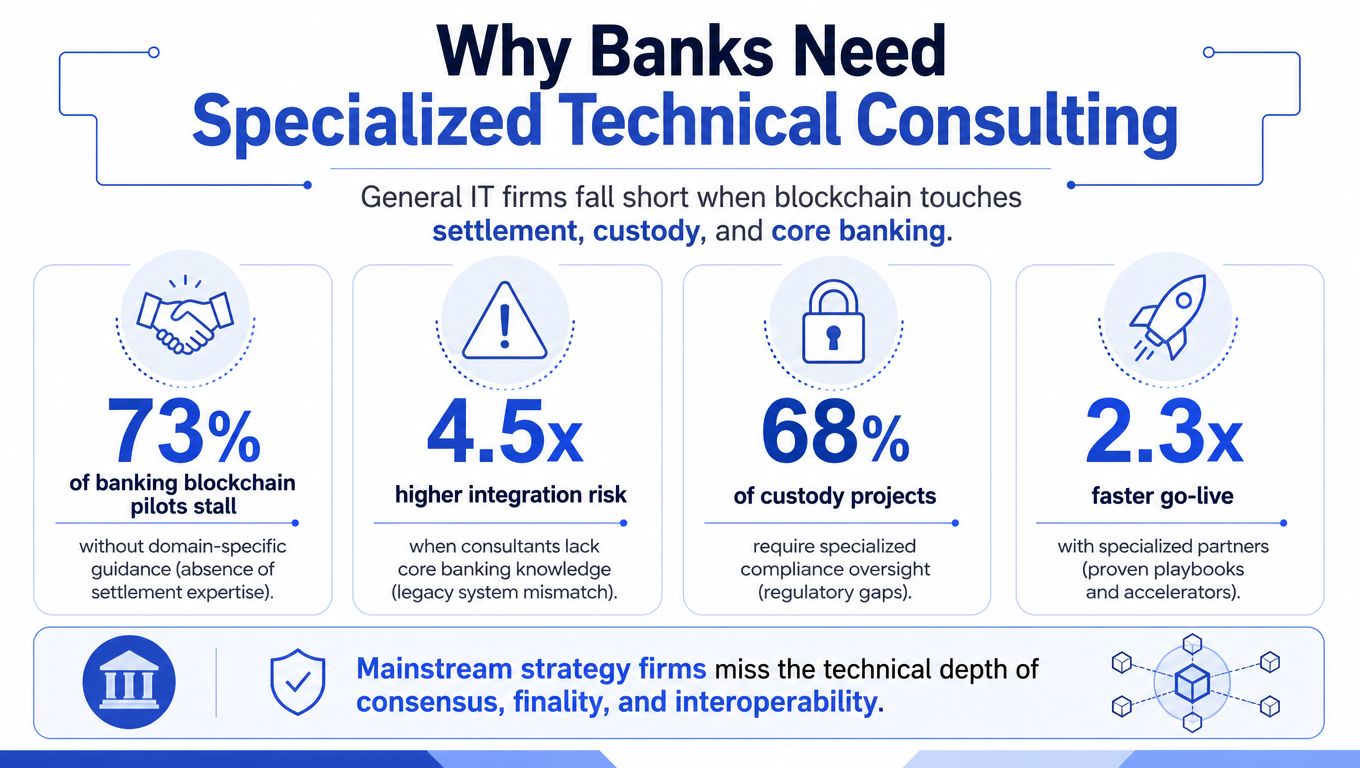
A financial blockchain consulting engagement commonly includes:
- Architecture assessment: Mapping systems, data flows, trust boundaries, identities, and operational dependencies.
- Network selection: Comparing permissioned, public, and hybrid models against governance, privacy, performance, and interoperability requirements.
- Smart contract architecture: Defining contract states, permissions, upgrade paths, testing, audit evidence, and emergency controls.
- Tokenization design: Establishing token schemas, ownership rules, lifecycle events, custody responsibilities, and settlement interactions.
- Integration planning: Connecting ledgers to core banking, payments, treasury, custody, reporting, and risk systems through controlled interfaces.
- Production planning: Defining milestones, operating responsibilities, vendor due diligence, resilience tests, and rollout gates.
For institutions that already have a defined architecture, Blockchain Development can address custom applications across public, private, and hybrid blockchain networks. That work is different from deciding whether the underlying architecture is appropriate.
The distinction becomes especially important during digital transformation programmes. A useful enterprise blockchain consulting approach should leave the institution with decisions it can defend to engineering, operations, risk, compliance, procurement, and executive stakeholders.
Why Banks Need Specialized Technical Consulting
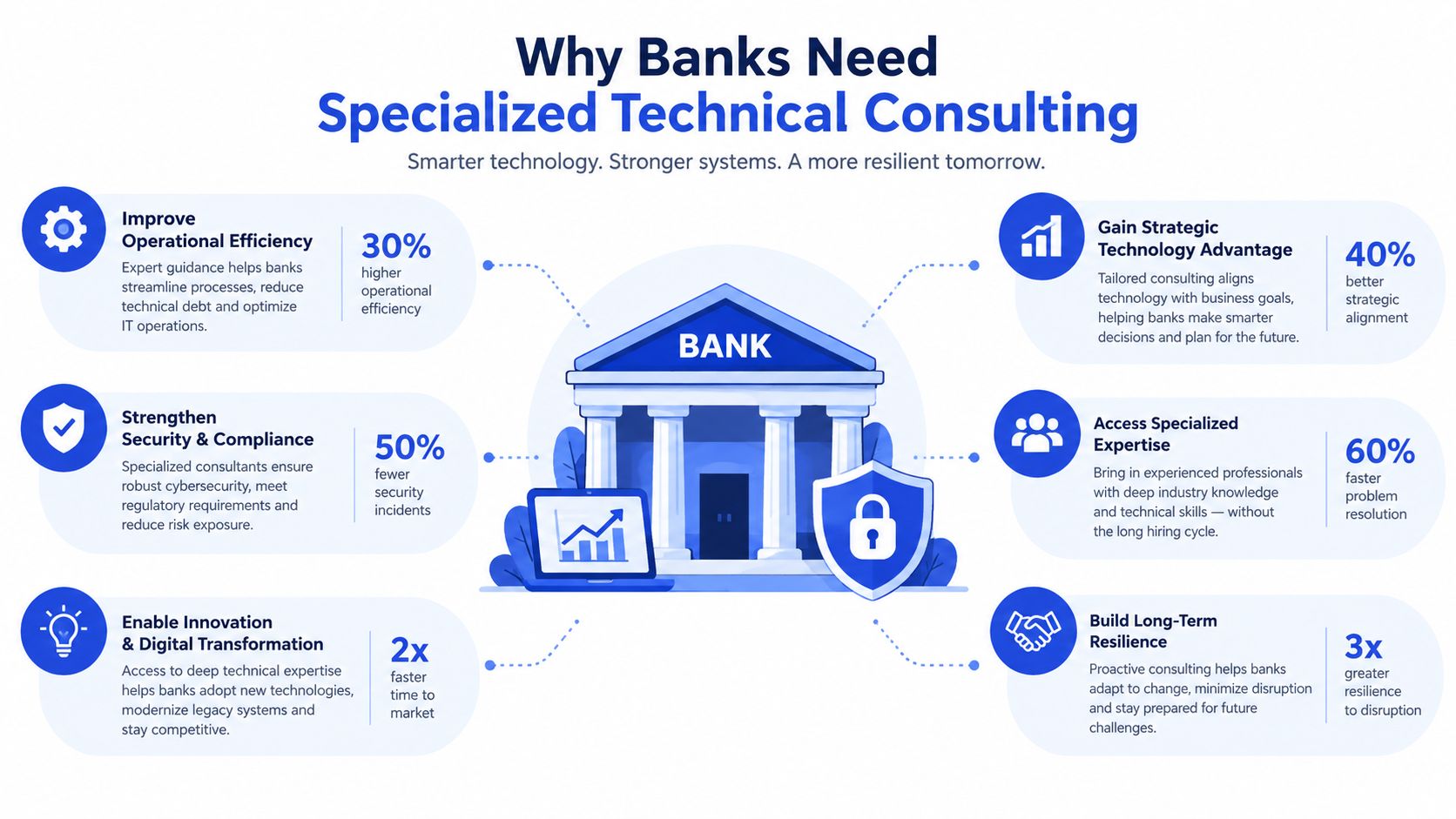
A general IT consultancy may understand integration, cloud infrastructure, or programme management. A strategy firm may understand market structure and operating models. Neither capability automatically provides the expertise required when a distributed ledger touches settlement finality, custody, key management, participant admission, or legally significant records.
Financial institutions need technical advice that accounts for the consequences of a bad design. A public network may provide broad reach but introduce privacy, governance, fee, or transaction finality considerations that don’t fit a regulated workflow. A permissioned network may offer stronger participant control, but it still requires sound identity architecture, operational resilience, and a credible governance model.
The adoption evidence from India shows why this work has become more practical. A 2023 Deloitte study cited in an independent analysis found that nearly 70% of BFSI institutions in India were actively exploring or implementing blockchain solutions. The same source describes survey findings in which 45% of Indian financial institutions had integrated blockchain into specific services, while 80% of respondents associated it with improved security and transparency and 70% associated it with improved operational efficiency. These figures are reported in the analysis of blockchain adoption in Indian financial services.
The market is moving beyond awareness campaigns. Institutions need architecture reviews, compliance-sensitive workflows, implementation support, and operating models that survive contact with production constraints.
The strongest consulting engagement challenges the proposed design before the bank commits to it.
A specialist should be able to explain not only what a platform can do, but also what it cannot safely do, which controls sit on-chain or off-chain, how recovery works after a key compromise, and which legal questions require specialist counsel rather than technical opinion.
Blockchain Architecture Assessment and Platform Selection
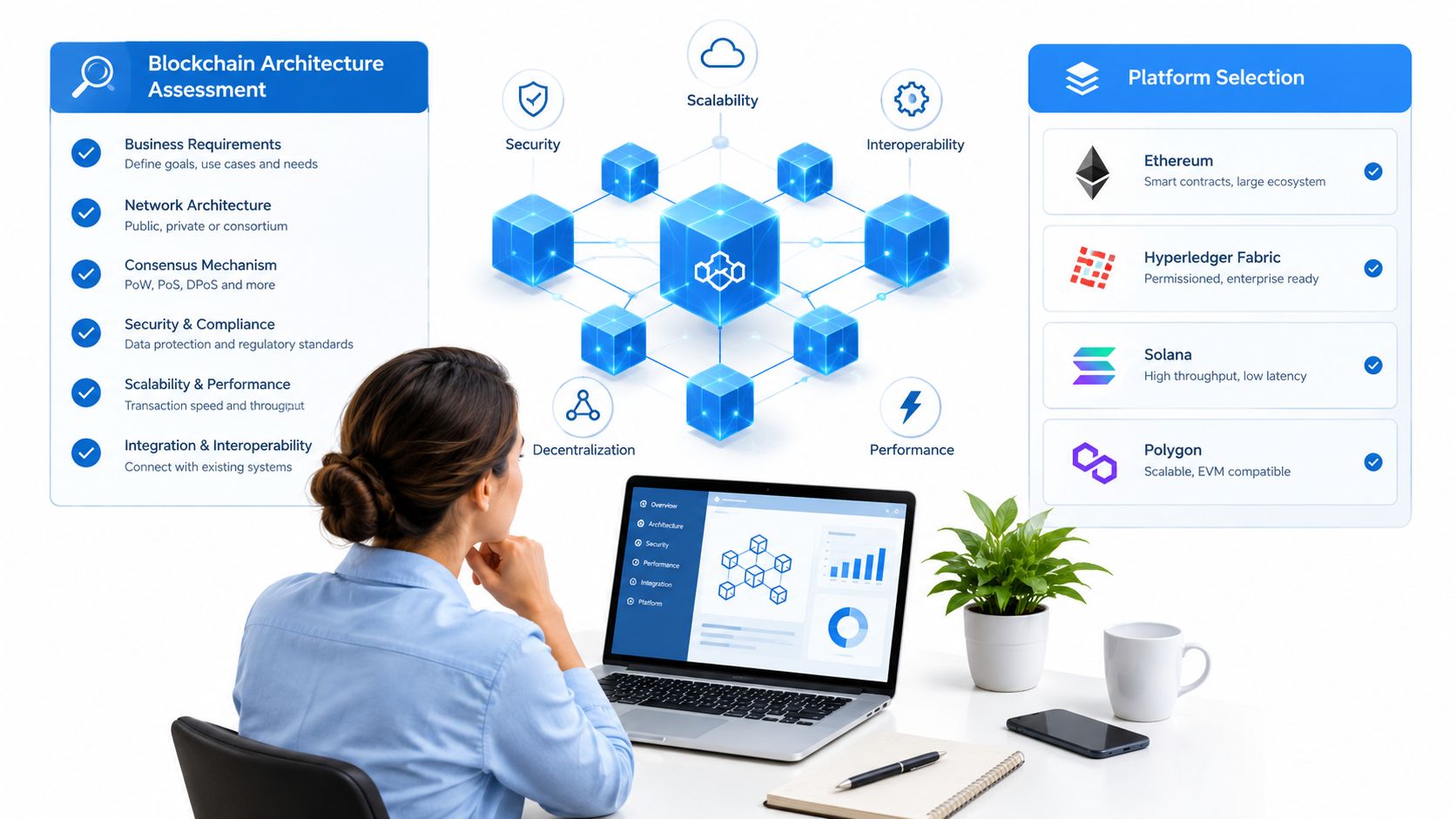
An architecture assessment starts with the institution’s existing environment, not with a preferred blockchain platform. The consulting team should inventory core banking systems, payment engines, custody platforms, identity services, data stores, reporting tools, and external counterparties. It should then map where transaction state is created, validated, reconciled, amended, and reported.
The assessment should answer practical questions:
- Which participants need to write to the ledger, and which only need read access?
- Does the process require shared state, or would an API and central database solve the problem more easily?
- What level of transaction finality does the business process require?
- Which data must remain private, and can sensitive information stay off-chain?
- Who can approve membership, upgrades, emergency pauses, and dispute handling?
- How will the ledger connect to existing books of record?
Comparing permissioned and public networks
The permissioned versus public decision isn’t a matter of ideology. It depends on the institution’s trust model, participants, data sensitivity, settlement requirements, and tolerance for external dependency.
| Evaluation Criterion | Permissioned Network | Public Network |
|---|---|---|
| Control | Known organisations can govern admission, permissions, upgrades, and operating policies. | Control is distributed across the network and may not align with one institution’s governance model. |
| Privacy | Access controls and private data patterns can support regulated workflows, although privacy still requires careful design. | Transaction visibility and network-level data exposure require additional privacy techniques and policy review. |
| Participant governance | A consortium or appointed operator can define membership and responsibilities. | Participation is generally open or governed by public protocol rules. |
| Finality and performance | The network can be configured around known participants and institutional workflow requirements. | Performance and finality depend on the selected public network and its external operating conditions. |
| Interoperability | Controlled interfaces can connect institutions and internal systems, but a closed design can create silos. | Public reach can support broader connectivity, but integration, identity, and compliance controls remain necessary. |
| Operational responsibility | The institution and its consortium partners must operate nodes, keys, monitoring, upgrades, and recovery. | The institution still owns application, wallet, compliance, and integration responsibilities, even when it doesn’t operate the base network. |
For tokenized assets, architecture should be interoperability-first. PwC’s guidance says regulated tokenised assets should be distinguished from speculative virtual assets and that deposit-token or asset-token initiatives should be designed for interoperability across institutions. Its analysis of tokenised assets in India supports a practical design priority: shared identity, standardised token schemas, and settlement-layer connectivity should be considered from the beginning, not added after separate pilots have created incompatible rails.
A consulting partner should provide a decision record, target architecture, platform shortlist, integration map, risk register, and proof-of-concept acceptance criteria. The modular blockchain architecture guidance is relevant when an institution wants to separate consensus, settlement, identity, compliance, and application services rather than bind every function to one monolithic stack.
Smart Contract Architecture and Tokenization of Digital Assets
Smart contracts should be treated as controlled transaction software, not as simple automation scripts. A production review should examine contract states, role permissions, validation rules, oracle dependencies, upgrade mechanisms, event logging, testing evidence, and the separation between on-chain instructions and off-chain business processes.
A bank also needs an operational answer for abnormal conditions. That includes pause authority, transaction limits, circuit-breaker logic, key rotation, incident response, rollback or recovery procedures, and the treatment of partially completed workflows. A contract that executes correctly in a demonstration can still be unsuitable for production if nobody can explain who may stop it, how a compromised key is contained, or how records are reconciled after an outage.
RBI executive P. Vasudevan said the central bank had tested tokenization through its Unified Markets Interface, with about 248 certificate-of-deposit transactions worth roughly ₹17,000 crore processed so far. He also identified legal uncertainty, data privacy, liquidity, interoperability, and concentration risk as important challenges. Those details are reported in coverage of RBI’s tokenization pilot and risk observations.
Designing tokenized instruments
Tokenization is more than representing an asset on a ledger. The token model must express ownership or entitlement, transfer restrictions, eligibility, settlement conditions, corporate actions, redemption, cancellation, and the relationship between the digital record and the underlying asset or liability.
For deposits, securities, certificates of deposit, funds, or real-world assets, consultants should define:
- The token schema: What fields, status values, permissions, and identifiers does the instrument require?
- The lifecycle: How are issuance, transfer, pledge, freeze, redemption, and cancellation represented?
- The control model: Which institution, custodian, administrator, or regulator can perform sensitive actions?
- The identity layer: How are participants, wallets, credentials, and beneficial owners connected?
- The settlement model: Which cash leg, payment rail, or deposit-token mechanism completes the transaction?
- The evidence model: Which events must be retained for audit, reporting, reconciliation, and dispute resolution?
Technical capability doesn’t determine legal ownership, settlement enforceability, or regulatory classification. The consulting team should document those dependencies and leave legal conclusions to qualified counsel. It should, however, design the system so that the required controls can be implemented and tested.
A practical smart contract architecture guide can help teams compare contract structures and workflow choices before development begins.
Banking System Integration APIs Security and Scalability
A ledger becomes useful to a bank only when it works with the systems that already manage customer accounts, payments, liquidity, risk, custody, and reporting. Integration design should identify the system of record for each data element and define whether the blockchain is authoritative, contributory, or just an auditable coordination layer.
APIs commonly connect the ledger to core banking and payment services, but an API alone doesn’t resolve reconciliation. The design must define idempotency, message ordering, duplicate handling, timeouts, retries, exception queues, transaction correlation, and the point at which an off-chain action becomes an on-chain state change.
Integration and interoperability controls
A sound integration plan usually includes:
- Identity mapping: Connect institutional identities, customer credentials, wallet addresses, and permission roles without exposing unnecessary personal data.
- Key management: Use controlled generation, storage, rotation, recovery, and approval processes for signing keys.
- Privacy boundaries: Keep sensitive information off-chain where appropriate, while preserving verifiable references and audit evidence.
- Network connectivity: Define how participants exchange messages, verify status, and handle incompatible protocols or token schemas.
- Operational monitoring: Track contract events, node health, failed messages, settlement exceptions, suspicious activity, and reconciliation breaks.
- Resilience testing: Test node failure, network partition, delayed response, unavailable counterparties, key compromise, and recovery procedures.
India illustrates why architecture must remain adaptable across regulatory contexts. There is no single dedicated blockchain law governing all distributed ledger use in the country. Guidance is spread across the RBI, SEBI, the Income Tax Act, the Prevention of Money Laundering Act, and CERT-In directions, as described in the India fintech legal and regulatory guide.
For institutions working across asset classes, analysis also identifies different regulatory tracks involving RBI, SEBI, and IFSCA, with unresolved questions around ownership, custody, and smart contracts. The discussion of tokenisation and securities regulation in India shows why a platform designed for one sandbox or settlement rail may create future lock-in.
CBDC and digital payment infrastructure should therefore be treated as integration domains, not isolated blockchain products. A technical roadmap should allow the institution to connect emerging settlement mechanisms with existing payment services while keeping identity, monitoring, reporting, and recovery controls under institutional governance.
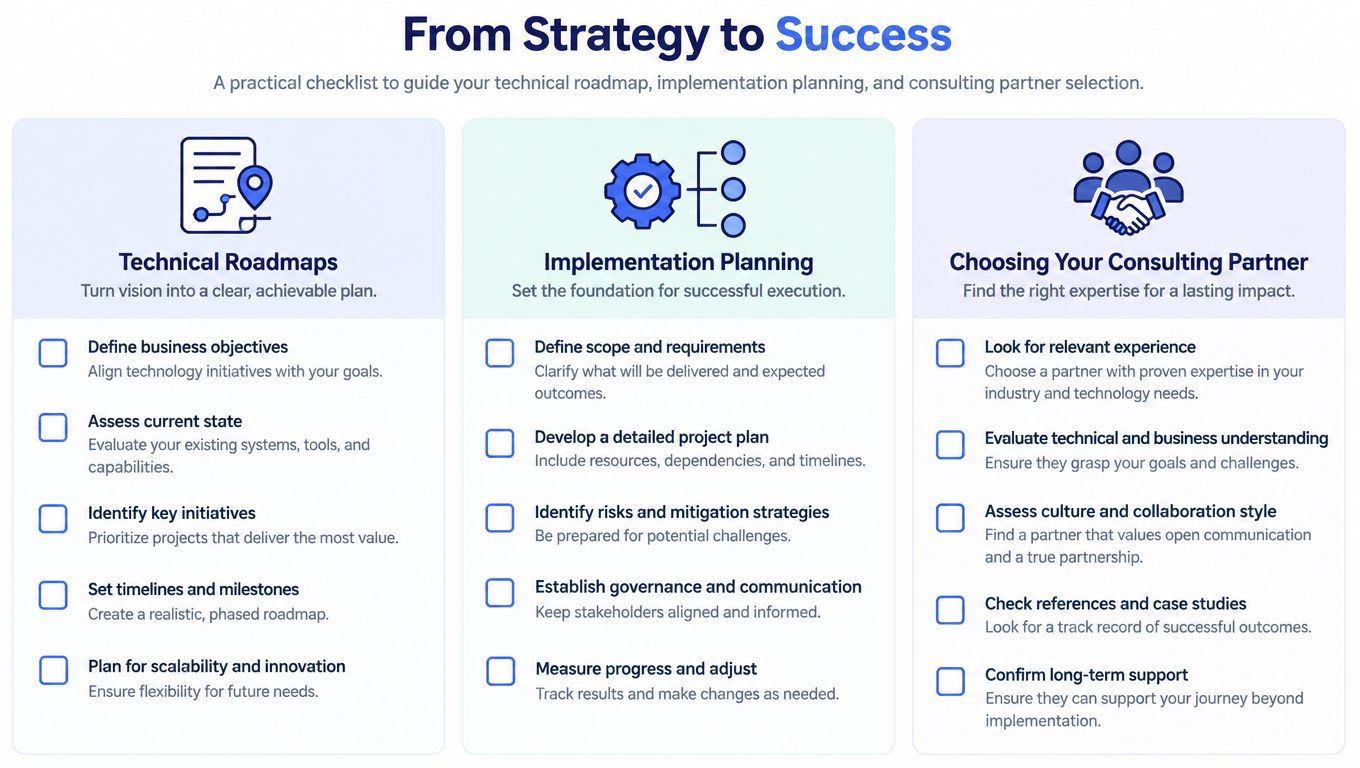
Technical Roadmaps Implementation Planning and Choosing Your Consulting Partner
A technical roadmap should convert architecture decisions into controlled delivery. It should define the target operating model, pilot boundary, integration dependencies, security evidence, testing environments, data migration approach, support responsibilities, and production rollout gates.
The governance gap is often largest between a successful proof of concept and a live regulated service. IFSCA’s 2025 consultation addresses issuance, trading, custody, clearing, settlement, AML/KYC, governance, technology, and cyber-risk controls, but it doesn’t provide a complete day-to-day playbook for vendor due diligence, internal controls, or production rollout criteria. The IFSCA consultation paper on tokenization makes that implementation gap important for institutions moving beyond pilots.
What to require from a consulting partner
Evaluate a blockchain technology consulting company against evidence of:
- Enterprise architecture depth: It can map ledgers to core banking, payments, custody, identity, and reporting systems.
- Smart contract discipline: It documents testing, permissions, upgrades, audits, emergency controls, and recovery.
- Tokenization competence: It understands schemas, lifecycle management, custody, settlement, and interoperability.
- Security ownership: It can explain key management, privacy, monitoring, incident response, and resilience testing.
- Delivery readiness: It produces acceptance criteria, operating procedures, rollout gates, and handover documentation.
- Regulatory awareness: It distinguishes technical controls from legal advice and designs for changing requirements.
Blocsys Technologies Pvt Ltd offers blockchain consulting, development, smart contract work, tokenization, digital asset platforms, and financial technology integrations. Its relevant services include real-world asset tokenization and enterprise blockchain engineering, which can be evaluated alongside the architecture and governance requirements defined for the institution.
For a wider partner evaluation framework, this guide to choosing a blockchain consulting partner can sit alongside your procurement scorecard. The right partner will not just recommend a platform. It will show how the design operates under normal conditions, stress, regulatory review, integration failure, and eventual change.
Frequently Asked Questions About Blockchain Technology Consulting
What does blockchain technology consulting include for financial institutions?
Blockchain technology consulting includes architecture assessment, network selection, smart contract design, tokenization, identity and privacy planning, core-system integration, security, scalability, interoperability, and implementation planning. The work connects technical decisions to banking operations so the institution can evaluate whether a proposed distributed ledger is suitable for a controlled production environment.
How does blockchain technology consulting differ from blockchain business consulting?
Blockchain business consulting focuses on use-case selection, commercial rationale, operating models, and investment decisions. Blockchain technology consulting focuses on how the chosen use case will work, including ledger architecture, consensus, data placement, permissions, APIs, smart contract controls, key management, testing, and rollout readiness. The two disciplines can work together, but they answer different questions.
What does blockchain consulting for banks cost in scope terms?
Cost depends on the scope of work rather than the label “blockchain consulting”. A short architecture review is different from a platform selection programme, smart contract audit, tokenization design, integration build, or production implementation. A credible proposal should describe deliverables, assumptions, dependencies, environments, testing responsibilities, and operational handover instead of offering a vague fixed package.
How should a financial institution evaluate blockchain platforms?
Evaluate each platform against the actual operating requirements. Review participant governance, privacy, identity, finality, performance, node operation, smart contract support, interoperability, resilience, data location, monitoring, upgrade procedures, and integration interfaces. The institution should also ask who controls the platform, how changes are approved, and what happens if a participant, node, key, or external dependency fails.
Are permissioned or public networks better for banking?
Neither model is universally better. Permissioned networks often suit workflows requiring known participants, controlled access, and institutional governance, while public networks may offer broader reach and external connectivity. The decision should consider privacy, settlement requirements, participant trust, compliance controls, operating responsibility, interoperability, and whether the institution can accept dependencies outside its direct governance.
What does a smart contract architecture review involve?
A smart contract architecture review examines contract states, permissions, validation logic, dependencies, upgradeability, event records, testing, audit evidence, and emergency procedures. It should also assess who can pause or upgrade the contract, how keys are protected, how limits are enforced, how failed transactions are reconciled, and how the institution recovers from compromise or operational interruption.
How are tokenization projects technically governed?
Tokenization projects need governance for issuance, identity, transfer eligibility, custody, redemption, settlement, contract upgrades, freezes, disputes, and incident response. The technical design should assign each action to an authorised role, maintain evidence of changes, define the relationship between on-chain records and underlying assets, and support interoperability rather than creating a closed token silo.
How does blockchain integrate with core banking systems?
Integration usually combines APIs, event messaging, identity services, data stores, payment systems, custody platforms, and reconciliation processes. The design must define which system is authoritative, how transactions are correlated, how duplicates and timeouts are handled, how sensitive data is protected, and how ledger events trigger or confirm off-chain banking actions.
Which security and scalability considerations matter most?
The most important considerations include key management, identity assurance, role separation, privacy, contract testing, node resilience, monitoring, recovery, throughput, latency, finality, message handling, and operational capacity. Scalability isn’t only a transaction-count question. It also includes the ability to onboard participants, process exceptions, support reporting, manage upgrades, and maintain controls as the network grows.
How should an institution choose a blockchain technology consulting partner?
Choose a partner that can demonstrate enterprise architecture capability, financial-services integration knowledge, smart contract discipline, tokenization experience, security depth, and implementation planning. Ask for sample deliverables, decision records, test strategies, operating models, and rollout gates. The partner should challenge weak assumptions and explain trade-offs clearly rather than presenting blockchain as a universal replacement for existing systems.
Blocsys Technologies provides blockchain consulting, smart contract development, tokenization, digital asset platform work, and financial technology integration for institutions assessing production-ready distributed ledger systems. Visit Blocsys Technologies to discuss your architecture assessment, platform selection, tokenization, integration, or implementation planning requirements.
