Custom Blockchain Development vs Ready-Made Solutions: Which Is Right for Your Business?
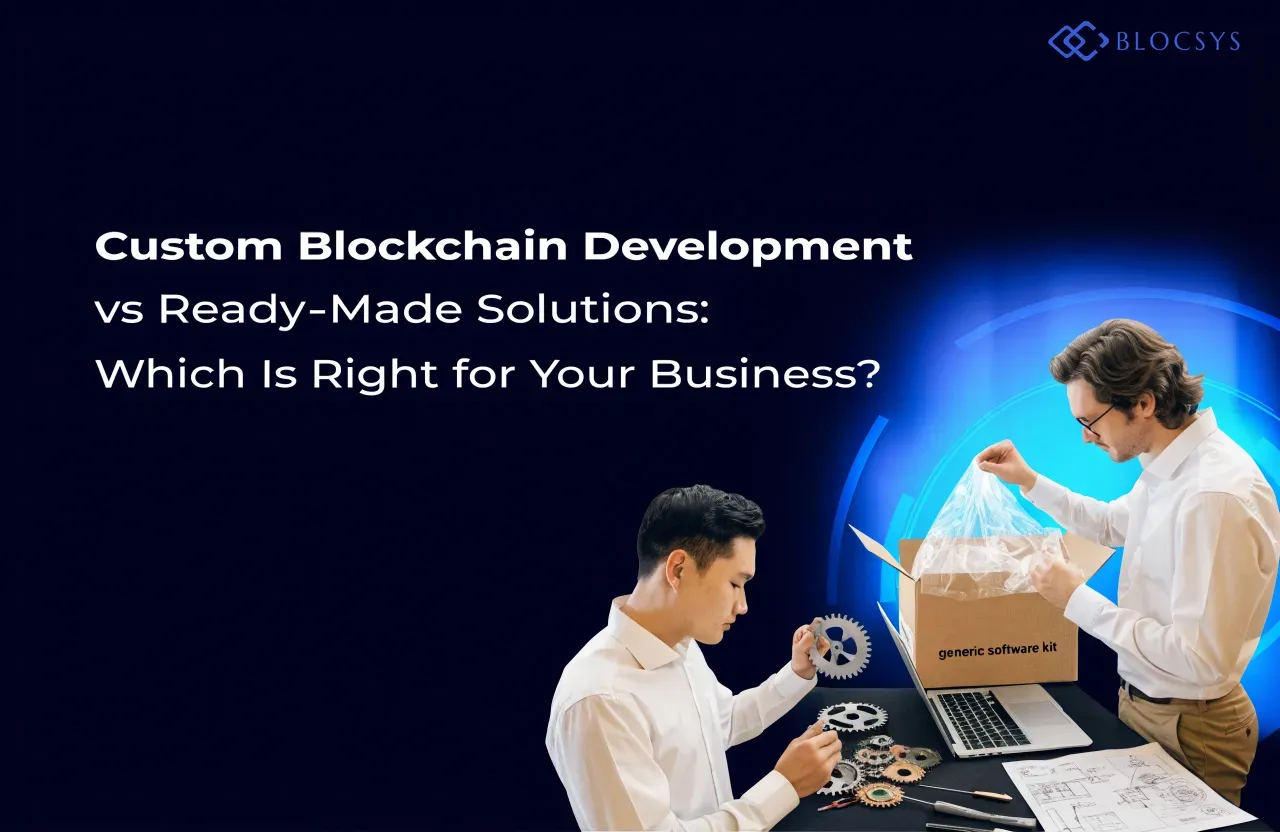
Every technology leader evaluating blockchain eventually hits the same fork in the road: build something tailored, or adopt something already built. The honest answer to custom blockchain development vs ready-made solutions is that neither option wins by default. It depends on your workflows, your integrations, your compliance obligations, and how much control you actually need over the system. Businesses that skip this analysis often end up paying for flexibility they’ll never use, or locked into a platform that can’t handle the one requirement that actually matters to their operation.
This article walks through what each approach really means, where each one falls short, and how to decide which path fits your organization. We’ll also look at when combining the two makes more sense than picking a side. If you’re currently comparing vendors or weighing a build with an experienced blockchain development partner, this framework should make the decision a lot less abstract.
What Is Custom Blockchain Development?
Custom blockchain development means building application logic, smart contracts, access controls, and integrations around your specific business processes. It does not necessarily mean writing a new blockchain network from scratch. Most custom projects use an established protocol, such as Ethereum, Hyperledger Fabric, or a similar framework, and then build tailored functionality on top of it.
That distinction matters. A custom solution might reuse proven consensus mechanisms and network infrastructure while customizing the parts that touch your business: permission models, data flows, smart contract logic, reporting, and how the system connects to your existing software. Custom blockchain application development services typically cover architecture design, smart contract development, API integrations, and ongoing support once the system goes live.
In short: you own the design decisions. You also own the responsibility for getting them right.
What Are Ready-Made Blockchain Solutions?
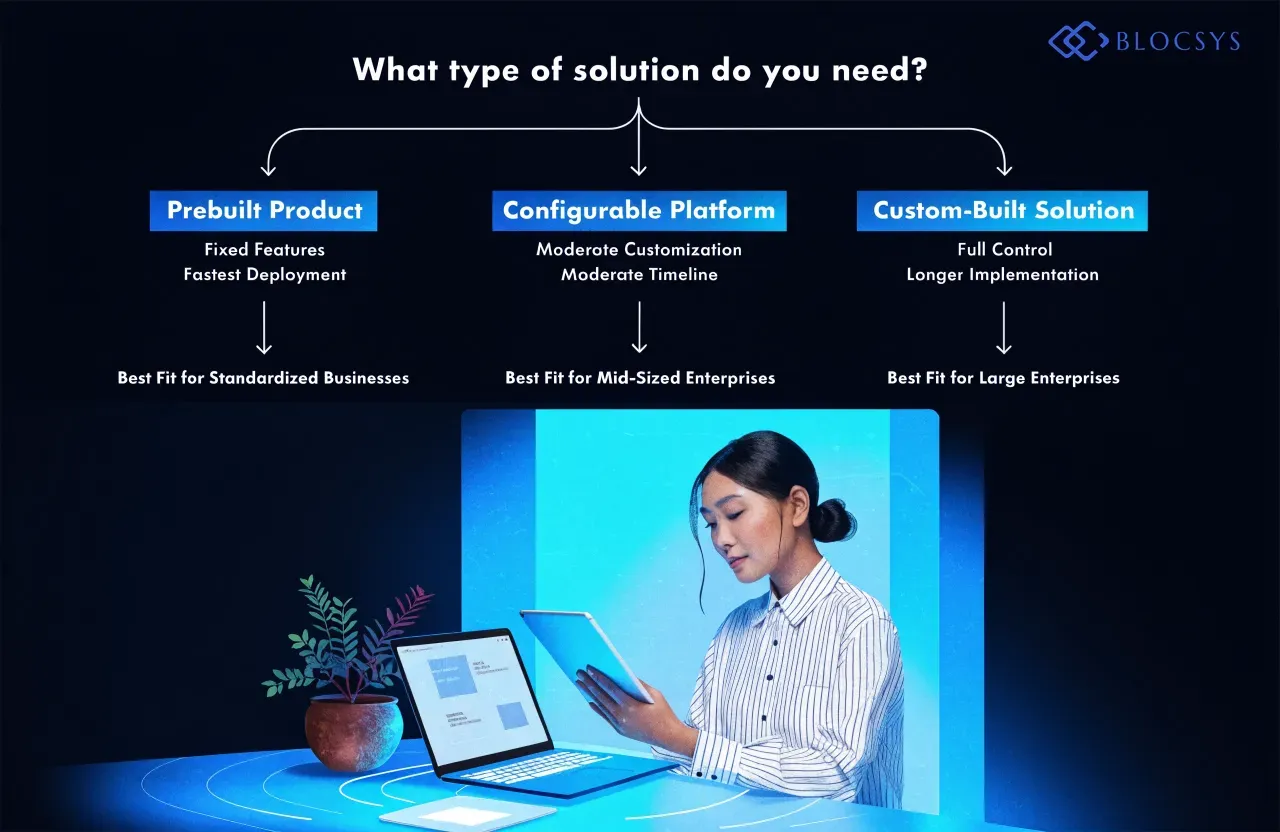
Ready-made blockchain solutions range from fully packaged products to configurable platforms built on existing frameworks. A prebuilt product gives you fixed functionality with limited adjustment options. A configurable platform gives you more room to adapt workflows, user roles, and integrations without touching the underlying code.
There’s also a middle category worth naming: using established blockchain infrastructure, such as a public network or an open-source framework, as the foundation for a solution that’s still substantially custom-built on top. That’s different from simply subscribing to a ready-made product. One gives you a vendor’s roadmap; the other gives you someone else’s proven groundwork plus your own application layer.
Ready-made blockchain solutions suit businesses with standard requirements: common workflows, predictable transaction types, and integration needs the vendor has already solved for other customers.
Custom Blockchain Development vs Ready-Made Solutions: Key Differences
Here’s where the custom blockchain development vs ready-made solutions comparison gets concrete. The table below covers the factors that actually drive this decision. Treat it as a starting point, not a verdict, since real capabilities vary by vendor, architecture, and implementation quality.
| Factor | Custom Blockchain Development | Ready-Made Blockchain Solutions |
|---|---|---|
| Customization and business fit | Built around your exact workflows and rules | Fits standard use cases; configuration has limits |
| Initial implementation time | Longer, depending on scope and integrations | Generally faster, though setup and migration still take time |
| Integration with existing systems | Designed specifically for your tech stack | Depends on the vendor’s available connectors and APIs |
| Security responsibilities | Full control, but full accountability too | Shared with vendor; review their practices carefully |
| Scalability and flexibility | Can be architected for your growth plans | Bound by the vendor’s platform roadmap |
| Maintenance and expertise needed | Requires in-house or partner engineering support | Often handled or simplified by the vendor |
| Vendor dependency | Lower, especially with open frameworks | Higher; switching providers can be costly |
| Long-term adaptability | Easier to extend as needs change | Limited to what the product supports or plans to add |
Notice that almost every row says “depends.” That’s intentional. A well-architected ready-made platform can outperform a poorly planned custom build, and vice versa. The real differentiator isn’t the label on the solution; it’s how well it was designed and implemented.
Most businesses don’t actually need a blockchain built from zero. They need someone who understands which parts of the stack are worth customizing and which parts aren’t worth reinventing. That judgment call matters more than the build-versus-buy label itself.
When Should a Business Choose Custom Blockchain Development Over Ready-Made Solutions?
Custom development earns its cost when your requirements genuinely don’t match what existing products offer. Think about a capital markets firm that needs a permissioned post-trade reconciliation system with specific regulatory reporting rules. A generic product likely won’t model those settlement rules correctly. Blocsys has built exactly this kind of system — a permissioned blockchain infrastructure for capital market post-trade operations — because the governance and data-access requirements were too specific for an off-the-shelf fit.
Another common trigger: specialized permission models. A food traceability network that needs farm-to-shelf data custody rules, like the blockchain-powered organic certification and food traceability platform Blocsys built, requires access controls tuned to specific certifying bodies and supply chain roles. Similarly, a tamper-proof credential system, such as a tamper-proof document verification platform, needs cryptographic workflows matched to a specific issuing authority’s process. Rebuilding those rules inside someone else’s product usually means fighting the platform instead of using it.
These examples are illustrative of the category, not case-study guarantees. The trade-off is real: custom development costs more upfront and takes longer to launch. However, it gives you a system that actually matches how your business runs, instead of one you have to run around.
Custom vs Off-the-Shelf Blockchain Solutions: What Justifies the Investment
Before committing to a custom build, ask what specifically a ready-made product can’t do. Is it the permission model? The settlement logic? A regulatory reporting format no vendor supports? If you can’t name the exact gap, custom development may be solving a problem that doesn’t exist yet.
When Are Ready-Made Blockchain Solutions the Better Choice?
Ready-made blockchain solutions make sense when your use case is common and your internal engineering capacity is limited. A startup testing a loyalty rewards concept, for instance, doesn’t need a bespoke ledger architecture to validate demand. A configurable platform gets the idea in front of users faster, and that speed often matters more than architectural purity at the validation stage.
Established functionality also helps when standard workflows cover most of what you need. If your organization needs a straightforward asset-tracking ledger with typical roles and typical reporting, a mature product has likely already solved those problems across many other customers. Reinventing that logic yourself adds cost without adding value.
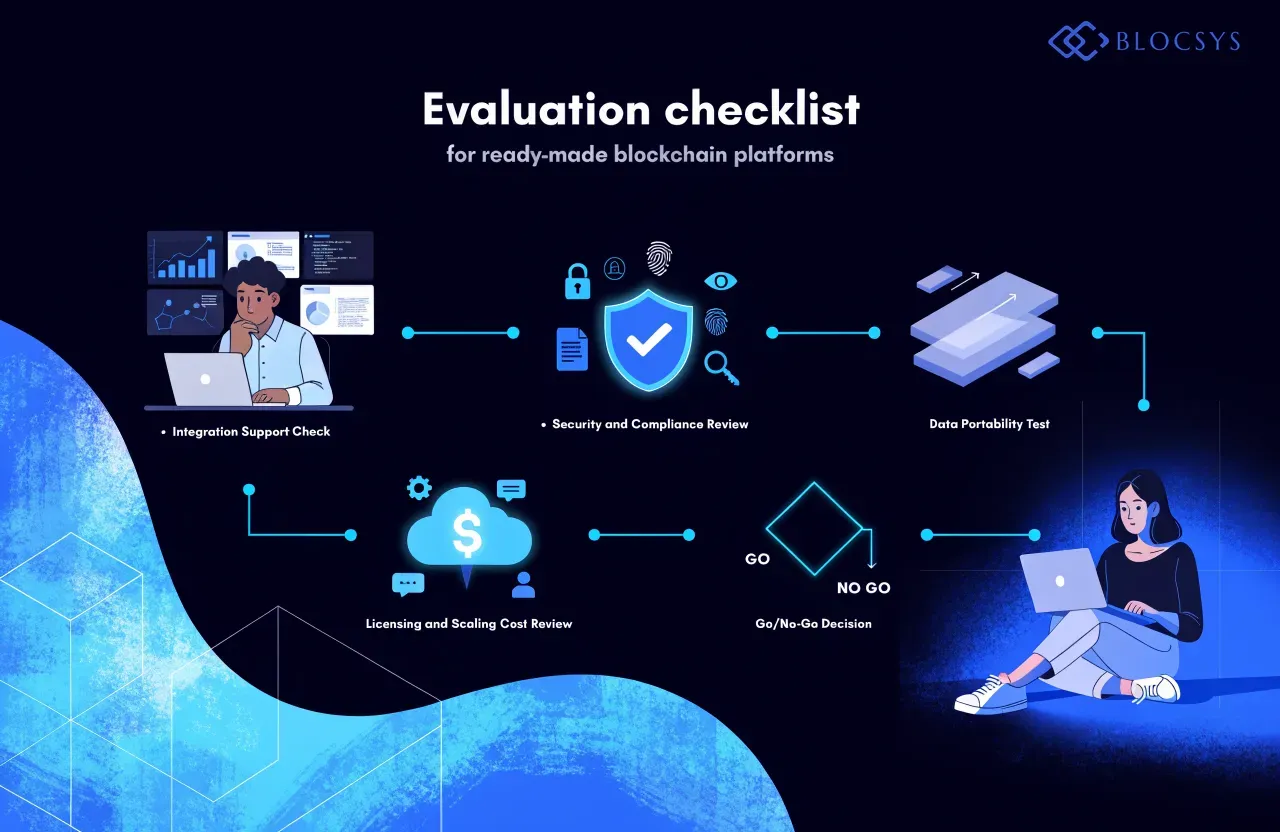
That said, don’t adopt a ready-made product without checking a few things first. Review its integration support against your actual systems, not just its marketing page. Ask about data portability — can you export your data if you switch providers later? Review its security practices and certifications. Finally, understand the licensing model, since per-transaction or per-user fees can scale unpredictably as your usage grows.
Blockchain vendor lock-in is the risk most commonly underestimated here. A platform that’s cheap today can become expensive to leave in three years once your operations depend on it.
Can Businesses Combine Ready-Made Platforms with Custom Development?
Yes, and this hybrid approach is more common than the build-versus-buy framing suggests. A business might adopt an existing blockchain framework or network for its core infrastructure, then custom-build the application logic, smart contracts, and integrations that make the system fit its specific operations.
Consider an institutional trading environment. An institutional OTC crypto trading platform built on blockchain might rely on established settlement infrastructure while custom-building the order matching logic, counterparty risk controls, and compliance workflows specific to that institution. The same logic applies to a DeFi trading platform built on blockchain, where the underlying protocol is well-established but the trading mechanics and governance rules are custom.
This approach balances practicality with flexibility. You’re not reinventing network-level infrastructure that’s already proven, but you’re also not stuck inside a vendor’s product limitations. The trade-off is that hybrid builds still require real architecture decisions about where the “ready-made” layer ends and the “custom” layer begins.
How to Choose the Right Blockchain Development Approach
Before picking a path, work through a short set of practical questions. They’ll tell you more than any vendor comparison chart.
- Which business requirements can’t be met by existing solutions?
- What integrations are mandatory, and does a vendor already support them?
- Who controls access, upgrades, and ongoing maintenance once the system is live?
- Can your data and application components migrate if the provider changes direction, raises prices, or shuts down?
- Which security and governance responsibilities stay with your business regardless of which option you pick?
- Does your team have the expertise to operate and maintain the solution long-term?
Answering these honestly often reveals the decision for you. If your answers point to several mandatory, non-standard requirements, custom development or a hybrid build is probably worth the investment. If most answers point to standard needs and limited internal capacity, a ready-made platform is a reasonable starting point.
Scalability deserves a closer look too. Blockchain platform scalability isn’t just about transaction throughput; it’s about whether the architecture can absorb new business lines, new regulatory requirements, and new integration partners without a rebuild. Ask any vendor or blockchain consulting services partner to walk through what a five-year growth scenario looks like on their architecture, not just today’s feature list.
Internal capability matters just as much as the technology choice. If your team lacks blockchain-specific engineering depth, a dedicated blockchain engineering team can fill that gap for either a custom build or an implementation of a ready-made platform. Either way, don’t underestimate ongoing blockchain maintenance and support — smart contract upgrades, security patching, and monitoring don’t stop after launch.
The businesses that regret their blockchain decision usually didn’t pick the wrong technology. They skipped the maintenance and governance conversation until after launch, when it’s expensive to fix.
Conclusion: Make the Decision Based on Business Requirements
There’s no universal winner in custom blockchain development vs ready-made solutions. A bank with strict regulatory reporting needs and a startup validating a simple idea will reasonably land on opposite answers, and both can be right for their situation. What matters is matching the approach to your actual requirements: your integrations, your security obligations, your growth plans, and your internal capacity to operate what you build or buy.
Work through the requirements honestly, test them against what ready-made products actually offer, and don’t assume custom is automatically better just because it’s more flexible on paper. If you’re mapping out that decision and want an outside perspective on architecture, integration, or implementation planning, Blocsys works with businesses on exactly this kind of evaluation before a single line of code gets written.
Frequently Asked Questions
Here are direct answers to the questions we hear most often about custom blockchain development vs ready-made solutions.
What is the difference between custom blockchain development and ready-made solutions?
Custom development builds application logic, smart contracts, and integrations around your specific workflows. Ready-made solutions offer prebuilt or configurable products with fixed or limited customization. The core difference is control: custom gives you design ownership; ready-made gives you a vendor’s existing framework.
Is custom blockchain development better than a ready-made solution?
Neither is universally better. Custom development suits complex, non-standard requirements; ready-made solutions suit standard workflows with limited internal engineering capacity. The right choice depends on your specific business needs, not a general rule about which approach wins.
When should a business choose custom blockchain development?
Choose custom development when existing products can’t support your permission model, integrations, governance rules, or regulatory requirements. It’s also worth it when you need long-term architectural control and plan to scale the system well beyond what current vendors offer.
Are ready-made blockchain solutions suitable for enterprises?
Yes, for enterprises with standard workflows and predictable requirements. Ready-made solutions can work well when the vendor already supports your required integrations and compliance needs. Complex enterprise requirements, however, often exceed what a configurable product can handle alone.
Can ready-made blockchain solutions be customized?
Many configurable platforms allow adjustments to workflows, roles, and integrations without full custom development. The extent of customization depends entirely on the specific product and vendor. Always review documented configuration limits before assuming a platform can meet a unique requirement.
Which option is easier to integrate with existing business systems?
It depends on the vendor and your tech stack. Ready-made platforms integrate easily if the vendor already supports your systems. Custom development is built specifically for your integrations, which can mean more upfront work but fewer compatibility surprises later.
How should businesses compare the security of custom and ready-made solutions?
Review who’s responsible for what: custom builds put security fully in your hands, while ready-made products share responsibility with the vendor. Check certifications, patching practices, and incident history for either path before deciding which model fits your risk tolerance.
Can businesses combine ready-made blockchain platforms with custom development?
Yes. A hybrid approach uses established blockchain infrastructure or frameworks for the core network while custom-building the application logic, smart contracts, and integrations your business actually needs. This balances proven infrastructure with tailored functionality.
What should a business evaluate before selecting a blockchain solution?
Evaluate mandatory integrations, security and compliance responsibilities, data portability, scalability needs, and your team’s ability to maintain the system long-term. Also clarify which requirements existing products genuinely can’t meet before assuming you need a custom build.
How can a business choose the right blockchain development partner?
Look for a partner with documented experience in your specific use case, clear communication about security and maintenance responsibilities, and transparency about trade-offs rather than a one-size-fits-all pitch. Ask for architecture reasoning, not just a feature list.
Sources referenced for technical and security context: Hyperledger Fabric documentation (hyperledger-fabric.readthedocs.io), Ethereum developer documentation (ethereum.org/developers), and NIST’s blockchain security guidance (nist.gov) informed general statements about architecture, consensus frameworks, and security responsibility models used in this article.
Internal link report: Home (https://blocsys.com/) — used twice, anchors “an experienced blockchain development partner” and “Blocsys”; Blockchain Development (https://blocsys.com/blockchain-development/) — anchor “blockchain application development”; Blockchain Consulting (https://blocsys.com/blockchain-consulting/) — anchor “blockchain consulting services”; Dedicated Blockchain Engineering Teams (https://blocsys.com/dedicated-blockchain-engineering-teams/) — anchor “dedicated blockchain engineering team”; Tamper-Proof Document Verification Platform, Organic Certification Platform, Post-Trade Reconciliation Platform, OTC Crypto Trading Platform, and DeFi Trading Platform — used as illustrative examples of custom and hybrid builds.
Content-overlap assessment: This article stays focused on the build-versus-buy decision and does not overlap with existing 2027 content on tokenization trends, blockchain trends, top development companies, tokenized bonds, or tokenization platform evaluation. No tokenization-specific comparisons or company rankings were included.
Research limitation disclosure: I could not browse Blocsys’s live existing blog archive or service pages directly in this session to confirm exact wording or check for overlap beyond the titles and URLs provided; this assessment relies on the topic list and link list supplied rather than direct page review.
Ready to move beyond theory and build an intelligent platform that delivers real-world value? Blocsys Technologies specialises in engineering enterprise-grade AI and blockchain solutions for the fintech, Web3, and digital asset sectors. Connect with our experts today to discuss your vision and chart a clear path from concept to a secure, scalable reality.