Payment Gateway Integration for Digital Gold Apps: Features and Requirements
Buying gold online should feel as easy as ordering groceries. Yet behind that simple “Buy Now” button sits a complex chain of checks, confirmations, and bank communications. Payment gateway integration for digital gold apps is what makes this chain work smoothly, turning a customer’s tap into a confirmed gold purchase within seconds. Without reliable payment infrastructure, even the best digital gold app will frustrate users and lose trust fast.
Think about a customer in Pune who wants to buy ₹500 worth of gold during a lunch break. She expects instant confirmation, not a spinning loader and a prayer. Payment gateway integration for digital gold apps directly affects whether that purchase completes, whether her holdings update correctly, and whether she trusts the platform enough to come back. For jewellery businesses, bullion dealers, and fintech founders, this is not a side feature. It’s core to the product.
This article walks through how payment gateway integration actually works inside a digital gold application, what features matter, and what businesses should check before picking a provider. If you’re planning a build, our digital gold and silver app development page outlines how these pieces fit together in practice.
What Is a Payment Gateway and How Does It Work?
A payment gateway is software that securely passes payment information between a customer, a merchant’s application, and the banking network. It doesn’t move money itself. Instead, it encrypts card or bank details, sends them to the right financial institution, and relays back an approval or decline.
Here’s where confusion often creeps in: a payment gateway is not the same as a payment processor. The gateway handles the technical transmission of data. The processor, working alongside acquiring and issuing banks, actually settles the funds between accounts. Many providers in India bundle both roles into one service, which is why the terms get used interchangeably. Still, understanding the distinction helps when you’re troubleshooting a failed transaction or negotiating settlement terms.
A bank, on the other hand, holds the actual money. The gateway and processor are intermediaries that let your gold app talk to that bank without ever touching sensitive card data directly. This separation is also why PCI DSS compliance matters so much, something we’ll cover later.
How Payment Gateway Integration Works in a Digital Gold Application
Payment gateway integration in a digital gold application connects the app’s checkout screen to a payment gateway API, enabling customers to pay for gold through UPI, cards, or net banking while the backend verifies and records each transaction. Let’s trace the full journey with a practical example.
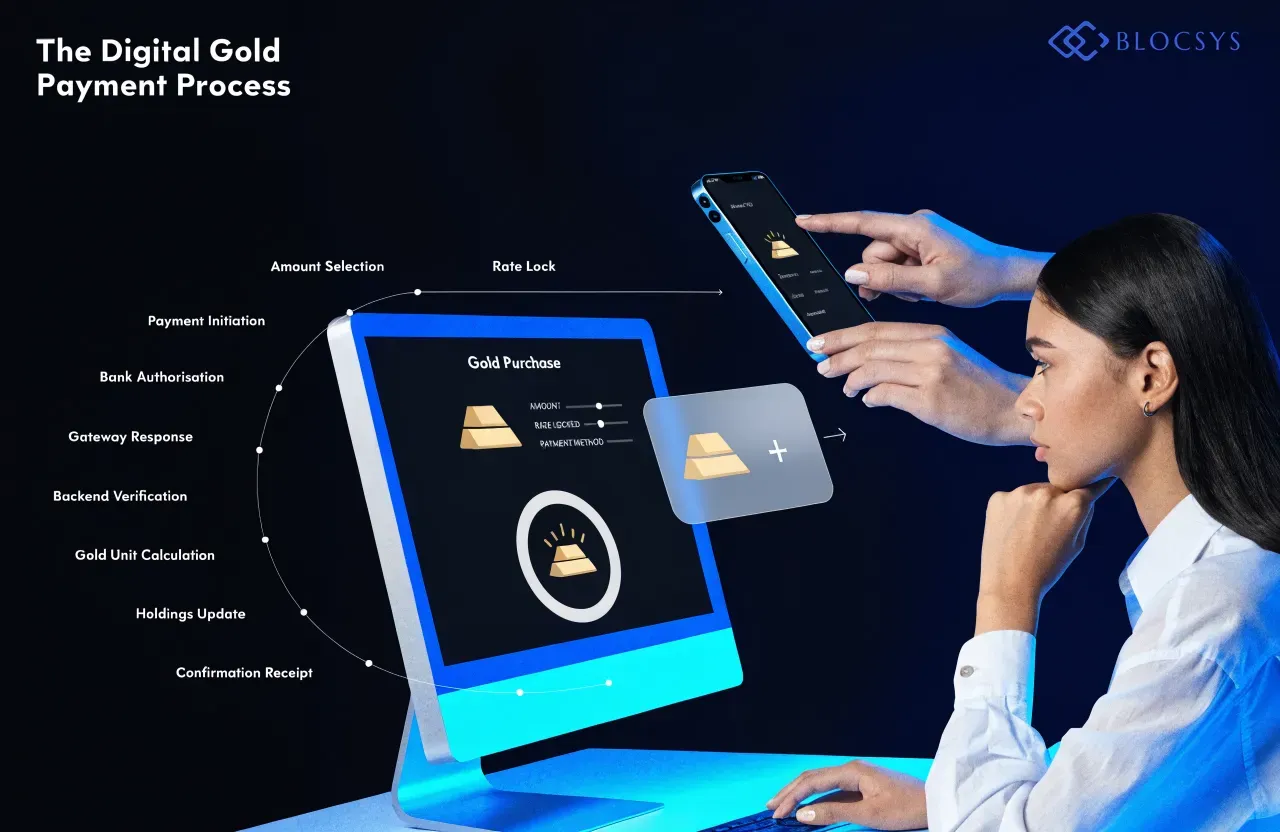
Say a customer selects ₹2,000 worth of digital gold. The app locks the current gold rate for a short window, say 30 to 60 seconds, and sends a payment request to the gateway. The customer chooses UPI, enters their PIN, and the request moves to their bank for authorisation.
Authorisation is the bank confirming the customer has sufficient funds and approving the hold on that amount. Capture happens next, when the merchant actually claims those funds. In most UPI and card flows today, authorisation and capture happen almost simultaneously, but they remain distinct steps technically.
Once the gateway sends a success response, the digital gold app’s backend verifies this independently, not just the frontend’s version of events. Only after backend verification does the system calculate gold units at the locked rate and update the customer’s holdings. This separation between “payment success” and “gold allocation” matters more than people realise.
Why This Workflow Needs Extra Checks for Gold Apps
Digital gold transactions differ from typical e-commerce purchases because gold prices fluctuate by the minute. A generic online store doesn’t need to lock a price for 30 seconds while payment completes. A gold app does. Additionally, some payment providers apply closer scrutiny to merchant categories involving precious metals, investment products, or bullion. Therefore, businesses should never assume a gateway automatically supports digital gold transactions just because it supports general retail payments.
Essential Payment Methods to Support in a Digital Gold App
Indian customers expect flexibility, so digital gold apps typically need to support UPI, debit cards, credit cards, and net banking at a minimum. UPI payment integration has become the default choice for most buyers because of its speed and near-zero friction, particularly for smaller, frequent gold purchases.
Debit card payment integration and credit card payment integration remain relevant too, especially for larger one-time purchases where customers prefer card-linked rewards or EMI options. Net banking integration still serves older demographics and corporate buyers who prefer direct bank transfers over card rails.
However, not every payment method will be available to every merchant. Availability depends on what the chosen gateway supports, how the business is categorised, and the gateway’s internal risk policies. Before finalising your payment stack, confirm directly with the provider which methods they’ll enable for a digital gold or bullion merchant account. Don’t assume blanket availability.
The biggest mistake founders make isn’t picking the wrong gateway, it’s picking one before confirming merchant category approval for gold transactions. That conversation should happen before a single line of integration code gets written.
Key Features Required for Payment Gateway Integration
A solid payment gateway integration for digital gold apps needs more than just a checkout button. Here are the features that actually matter day to day:
- Secure checkout with encrypted data transmission
- Support for multiple payment methods based on provider eligibility
- Real-time transaction status tracking
- Automated payment confirmation and digital receipts
- Refund initiation and tracking tools
- Customer-facing payment history
- Admin dashboard visibility into every transaction
Transaction status tracking deserves special attention. Customers want to know immediately whether their payment succeeded, failed, or is pending. Leaving them guessing creates support tickets and erodes trust quickly. Similarly, an admin-side view that flags stuck or pending transactions saves support teams from manually digging through logs every time a customer complains.
Payment Gateway Integration Architecture for Digital Gold Apps
Behind the scenes, several systems talk to each other during every transaction. The customer’s mobile or web app sends a request to your backend server. The backend then calls the payment gateway API, usually authenticated with API keys or tokens issued by the provider.
The gateway forwards the request to the payment processor and relevant bank. Once a decision comes back, two things typically happen. First, the gateway sends a response to your backend’s API call. Second, and more importantly, it fires a webhook, an automated server-to-server notification confirming the final payment status.
Why does the webhook matter so much? Because frontend confirmation alone isn’t reliable. A customer’s network could drop right after payment but before the app receives a response, even though the payment succeeded on the bank’s side. Relying only on what the frontend sees, you’d wrongly mark that transaction as failed. Webhook verification on the backend closes this gap, giving your system the actual source of truth.
This is also why payment gateway API integration should always route critical decisions through the backend. The frontend displays results to the customer, but it should never be the final word on whether gold gets allocated.
How Are Digital Gold Purchases Processed After Payment Confirmation?
Once the backend confirms payment through webhook verification, the application cross-checks the transaction amount against the locked gold rate and calculates the exact gold units purchased. This calculation needs to happen using the rate that was active at the time of purchase, not the current rate, since gold prices move constantly.
After calculating units, the system creates a permanent transaction record, linking the payment reference, gold weight, purchase price, and customer account. Only then does it update the customer’s digital gold holdings and generate a receipt.
Coordinating payment confirmation with gold allocation matters because a mismatch here creates real financial exposure. If gold gets allocated before payment is fully verified, and the payment later fails or reverses, the business absorbs the loss. Getting this sequence right isn’t optional, it’s foundational to the product’s integrity.
How to Handle Failed, Pending and Duplicate Payment Transactions
Failed and pending payments are handled by checking transaction status through the gateway’s API or webhook before updating records, and by using idempotency keys to prevent the same payment from being processed twice. Payments fail for plenty of reasons: insufficient funds, bank server timeouts, expired UPI sessions, or customers simply closing the app mid-transaction.
Pending transactions are trickier. The payment might still be processing on the bank’s end even though your app hasn’t received a final status yet. In these cases, your backend should poll the gateway’s status API periodically rather than guessing. Never mark a pending transaction as failed just because a response took longer than expected.
Duplicate transactions often happen when a customer, frustrated by a slow response, taps “pay” again. Idempotency, assigning a unique key to each payment attempt, prevents the gateway from processing that second tap as a separate charge. Reconciliation jobs that run periodically can also catch mismatches between your transaction database and the gateway’s records, flagging anything unusual for manual review.
Refunds, Payment Reconciliation and Merchant Settlements
A refund request from the business triggers a process through the gateway, but the actual credit reaching the customer’s account depends on their bank’s processing timeline, which the gateway doesn’t fully control. This distinction matters when customers ask why their refund “hasn’t arrived” even though your dashboard shows it as processed.
Payment reconciliation involves regularly matching your application’s internal transaction records against the gateway’s settlement reports. This catches discrepancies early, before they turn into accounting headaches or customer disputes.
Merchant settlement refers to when the gateway actually transfers collected funds into your business bank account. Settlement timelines, along with any transaction fees, vary by provider and by agreement terms. Some settle within a day, others take longer. Treat these as provider-specific details to confirm directly, not universal standards you can assume.
Security Requirements for Payment Gateway Integration
Secure payment integration requires encrypted API communication, webhook signature verification, strict access control, and compliance with applicable PCI DSS requirements whenever card data is involved. The PCI Security Standards Council publishes detailed guidelines on handling cardholder data responsibly, and these apply regardless of your app’s niche.
Webhook signature verification confirms that a payment confirmation genuinely came from the gateway and wasn’t spoofed by someone else. Skipping this step opens the door to fraudulent transaction confirmations, a risk no gold app can afford.
Wherever possible, use provider-hosted checkout pages or tokenised payment flows instead of handling raw card numbers yourself. This reduces your PCI compliance burden significantly while keeping customer data safer. Additionally, store only what’s necessary, transaction references and status, never full card details, in your own database.
How to Choose the Right Payment Gateway for a Digital Gold App
Start by confirming merchant category eligibility directly with the provider. This single step prevents months of wasted integration work. Beyond that, evaluate supported payment methods, transaction charges, documentation quality, settlement speed, and refund handling.
Also look closely at how well-documented their payment gateway API is. Clear documentation speeds up development and reduces integration bugs down the line. Ask about their customer support responsiveness too, because when a transaction gets stuck at 11 PM, you’ll want a provider that answers quickly, not a support ticket that sits for days.
Security practices matter just as much as pricing. A slightly cheaper gateway with weak fraud detection or poor webhook reliability can cost you more in disputes and manual reconciliation than you’d save on transaction fees.
Payment Gateway Integration Services Offered by Blocsys
Blocsys works with businesses building digital gold and silver platforms, handling backend development, custom API integration, and admin dashboard development alongside mobile and web application builds. These capabilities support payment workflows depending on each project’s specific requirements.
Our team builds the backend logic that verifies payments, handles webhook processing, manages transaction records, and connects gold allocation to confirmed payments, the kind of architecture we’ve described throughout this article. We don’t claim partnerships with specific payment gateway providers. Instead, we integrate with whichever gateway a business selects, based on their eligibility and commercial agreements with that provider.
If you’re exploring what this looks like for your own platform, our digital gold and silver app development services page covers the broader scope of what goes into building these applications.
How Much Does Payment Gateway Integration Cost in a Digital Gold App?
Integration cost depends on several factors: the number of payment methods supported, backend complexity, webhook handling, reconciliation logic, security testing, and how much custom logic the gold allocation workflow requires. A simple single-gateway integration naturally costs less than one supporting multiple methods with robust failure handling.
It’s worth separating two distinct cost categories here. Software development costs cover the engineering work, the backend, API connections, and testing. Payment gateway charges, meanwhile, include setup fees, per-transaction fees, and any monthly charges the provider sets independently. These vary by provider and should be confirmed directly with them rather than assumed from generic e-commerce pricing you might find online.
We can’t quote exact Blocsys pricing here since every project’s scope differs. However, discussing your specific requirements lets us scope the development work accurately alongside whatever provider fees apply to your chosen gateway.
Why Choose Blocsys for Digital Gold and Silver App Development?
Blocsys builds custom applications for businesses entering the digital gold and silver space, covering Android and iOS development, web platforms, backend systems, and admin dashboards. Our work also extends into blockchain integration where a business’s model calls for it.
Rather than offering a fixed template, we build around each business’s specific payment and transaction requirements, whether that means a particular gateway, a specific set of supported payment methods, or custom reconciliation workflows. This approach lets jewellery businesses, bullion dealers, and fintech startups shape an application that fits their actual operations instead of adapting their operations to generic software.
Conclusion: Build a Digital Gold App with Reliable Payment Integration
Payment gateway integration for digital gold apps touches nearly every part of the customer experience, from the first tap on “Buy Gold” to the final confirmation receipt. Getting it right means choosing an eligible provider, building backend-verified payment workflows, and handling refunds and settlements without guesswork.
Consequently, businesses that treat payment integration as a core architectural decision, not an afterthought, end up with platforms customers trust and return to. Planning to launch a digital gold application with a secure and convenient payment experience? Connect with Blocsys to discuss your business requirements and explore a customised digital gold and silver app development approach.
Frequently Asked Questions
Here are direct answers to the questions we hear most often about payment gateway integration for digital gold apps.
What is payment gateway integration in a digital gold app?
It’s the technical connection between a digital gold app’s checkout and a payment gateway’s API, allowing customers to pay through UPI, cards, or net banking while the backend verifies and records each transaction before updating gold holdings.
Which payment methods can digital gold apps support?
Most apps support UPI, debit cards, credit cards, and net banking. Actual availability depends on what the chosen gateway permits for a digital gold merchant category.
How does UPI integration work in a digital gold application?
The customer approves the payment through their UPI app or PIN, the request routes through their bank, and the gateway sends back an authorisation response that the backend verifies before allocating gold.
How are digital gold purchases processed after payment confirmation?
The backend verifies the payment through webhook confirmation, calculates gold units at the locked purchase rate, creates a transaction record, and then updates the customer’s holdings.
Can every payment gateway support digital gold transactions?
No. Eligibility depends on the provider’s merchant category policies. Businesses should confirm directly with the gateway that digital gold transactions are permitted before integrating.
How are failed and pending payments handled in digital gold apps?
The backend checks transaction status through the gateway’s API, uses idempotency keys to avoid duplicate charges, and avoids marking pending transactions as failed until a final status arrives.
How do digital gold applications process payment refunds?
The business initiates a refund through the gateway, but the actual credit timeline depends on the customer’s bank. Reconciliation ensures refund records match across both systems.
What security requirements apply to payment gateway integration?
Encrypted API communication, webhook signature verification, access control, and PCI DSS compliance for card data handling, often achieved through tokenised or provider-hosted checkout flows.
How much does payment gateway integration cost in a digital gold app?
Costs depend on backend complexity, number of payment methods, and security testing required. Development costs are separate from the gateway’s own transaction and setup fees.
Can Blocsys develop a digital gold app with custom payment gateway integration?
Yes. Blocsys builds custom backend systems, API integrations, and admin dashboards for digital gold apps, tailored to whichever payment gateway a business selects based on their eligibility.
Ready to move beyond theory and build an intelligent platform that delivers real-world value? Blocsys Technologies specialises in engineering enterprise-grade AI and blockchain solutions for the fintech, Web3, and digital asset sectors. Connect with our experts today to discuss your vision and chart a clear path from concept to a secure, scalable reality.