How to Build a Bullion Trading App Like AIB, dP GOLD and RSBL SPOT: Features, Technology and Development Process
Bullion dealers across India no longer rely on phone calls and WhatsApp broadcasts to share gold and silver rates. Many have moved to dedicated applications that push live prices, manage customers and support order booking. If you’re exploring Bullion Trading App Development for your own business, you’re part of a genuine shift in how precious metal trading happens across Indian cities. This article walks you through what that shift looks like in practice.
Apps like AIB, dP GOLD and RSBL SPOT are often cited as reference points in this space. We’ll use them to explain what a nationwide bullion platform needs, without claiming to replicate their design or proprietary logic. If you’re planning a custom build, digital gold and silver app development is the service category you’ll eventually need to discuss with a technology partner.
Here’s the short version: building an All-India bullion trading application means combining a live pricing engine, city-wise rate logic, customer and dealer modules, and a central admin system. Everything else in this guide expands on that foundation.
Introduction – The Growing Role of Digital Applications in India’s Bullion Market
Gold and silver prices move fast, often several times a day. Dealers who used to rely on phone trees now push rates instantly through an app. Customers check prices before visiting a store. Wholesale buyers place orders without a physical visit. This is exactly where Bullion Trading App Development becomes relevant for a growing number of businesses.
A custom application also gives a bullion business something a shared or third-party tool can’t: full control over branding, pricing logic and customer data. That’s the real driver behind most All India Bullion App Development projects we see discussed in the industry today.
What Are AIB, dP GOLD and RSBL SPOT Apps?
AIB, dP GOLD and RSBL SPOT are existing applications used in India’s bullion and precious metals space. Each is published independently, and their exact feature sets differ. Before you model a new build on any of them, it helps to treat them as reference points rather than templates.
Based on publicly available app store listings, all three position themselves around gold and silver rate communication for the trade. Beyond that general positioning, specific features such as order booking, dealer-to-dealer trading or multi-city coverage vary by app and aren’t something we can confirm uniformly across all three without checking each listing directly at the time of your research.
| Application | Publicly Stated Purpose | Verified Core Focus | Features Requiring Independent Verification |
|---|---|---|---|
| AIB Bullion App | Gold and silver rate communication for bullion trade users | Rate display | Order booking, multi-city depth, dealer network size |
| dP GOLD App | Precious metal rate and market information app | Rate display | Trading workflow, wholesale features |
| RSBL SPOT App | Spot rate and bullion trading-related app linked to an established refiner | Rate display, trading-related functionality | Exact transaction flow, settlement process |
Treat this table as a starting point. Download and review each app directly before finalising your own feature list.
In twelve years of watching bullion dealers go digital, the ones who win aren’t copying a competitor’s screen — they’re rebuilding the competitor’s workflow around their own pricing discipline and their own customer base.
Rate App vs Trading App vs Digital Gold Platform
These three categories get mixed up often, so let’s separate them clearly.
- A bullion rate application mainly displays live gold and silver prices, often by city or purity.
- A bullion trading application adds customer accounts, order booking, transaction history and dealer management on top of rate display.
- A digital gold investment platform is different again — it involves customer holdings, purchase, custody and redemption of actual metal or digital gold units, which brings in separate regulatory and operational considerations.
This guide focuses on the second category: a full Bullion Trading App Development project, not a simple rate ticker and not an investment platform.
Why Build Your Own Bullion Trading App Like AIB, dP GOLD and RSBL SPOT?
Relying on someone else’s app means you’re bound by their rules, their branding and their roadmap. A Custom Bullion Trading App Development project removes that dependency entirely.
You own the customer relationship. You decide which cities get coverage first. You set your own purity categories, your own buy-sell spread logic and your own dealer hierarchy. Consequently, your app grows exactly the way your business grows, not the way a third-party platform allows.
If you operate across multiple branches or states, a custom Bullion Trading Platform Development approach also lets you centralise rate updates while still giving each branch some local pricing flexibility. That balance is hard to get from a generic, shared application.
Essential Features of an All-India Bullion Trading Application
What should a nationwide bullion app actually include? Here’s the core list most businesses need.
Customer-Facing Features
- Live gold and silver rates, updated through a connected pricing feed.
- City-wise bullion rate display for branches in different regions.
- Purity-based categories, including 995 and 999 gold rates alongside silver grades.
- Separate buy and sell rate display.
- Historical price charts for trend reference.
- Rate alerts and push notifications when prices cross a threshold.
- Customer registration, login and secure order booking.
- Transaction and order history inside the customer account.
Business-Facing Features
- Dealer and wholesale customer management with role-based pricing.
- Inventory tracking for gold and silver stock.
- Admin dashboard with reporting across branches.
- Rate sharing tools for broadcasting prices to customer groups.
Not every feature here is mandatory on day one. Order booking and dealer management, for instance, are often phase-two additions once the core rate app is stable. That’s a normal sequencing decision in any Bullion Trading Software Development project.
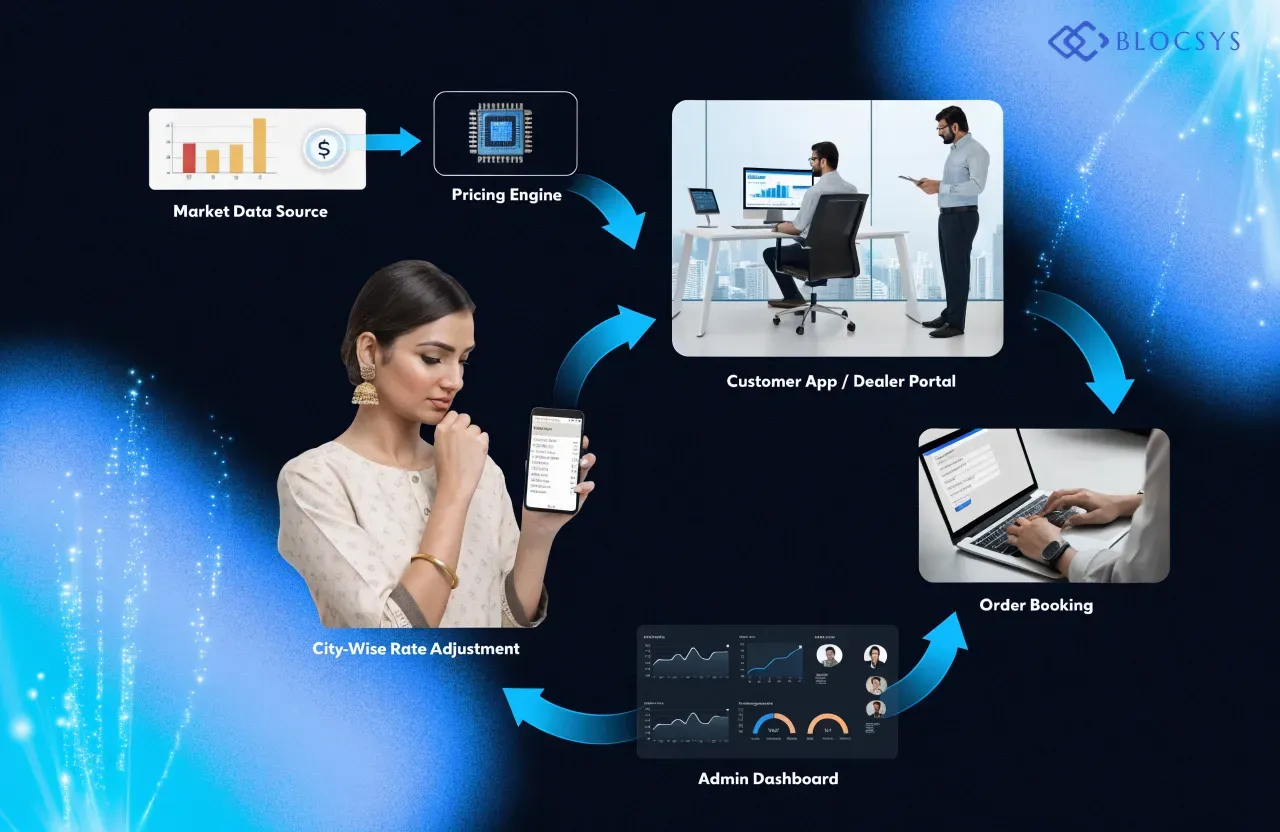
Live Gold and Silver Price API Integration
How do apps actually get live rates? Through a market data feed connected via API, refreshed on a schedule or in near real time.
A Live Gold and Silver Rate App typically pulls from a market data provider, applies dealer-defined margins, and then displays a final customer-facing rate. This is an important distinction: the international benchmark price, the domestic market reference, and your own displayed rate are three different numbers.
Good API integration also needs fallback handling. If the feed goes down, the app should fall back to the last known rate with a timestamp, or allow manual override by an admin. Data validation checks matter too — a sudden, implausible price jump should trigger a review before it reaches customers. Not every data provider offers the same licensing terms or update frequency, so this is a point worth confirming early with your chosen vendor.
City-Wise and All-India Bullion Rate Management
Can one app really manage All India Bullion Rates for dozens of cities? Yes, through a centralised admin layer with branch-level overrides.
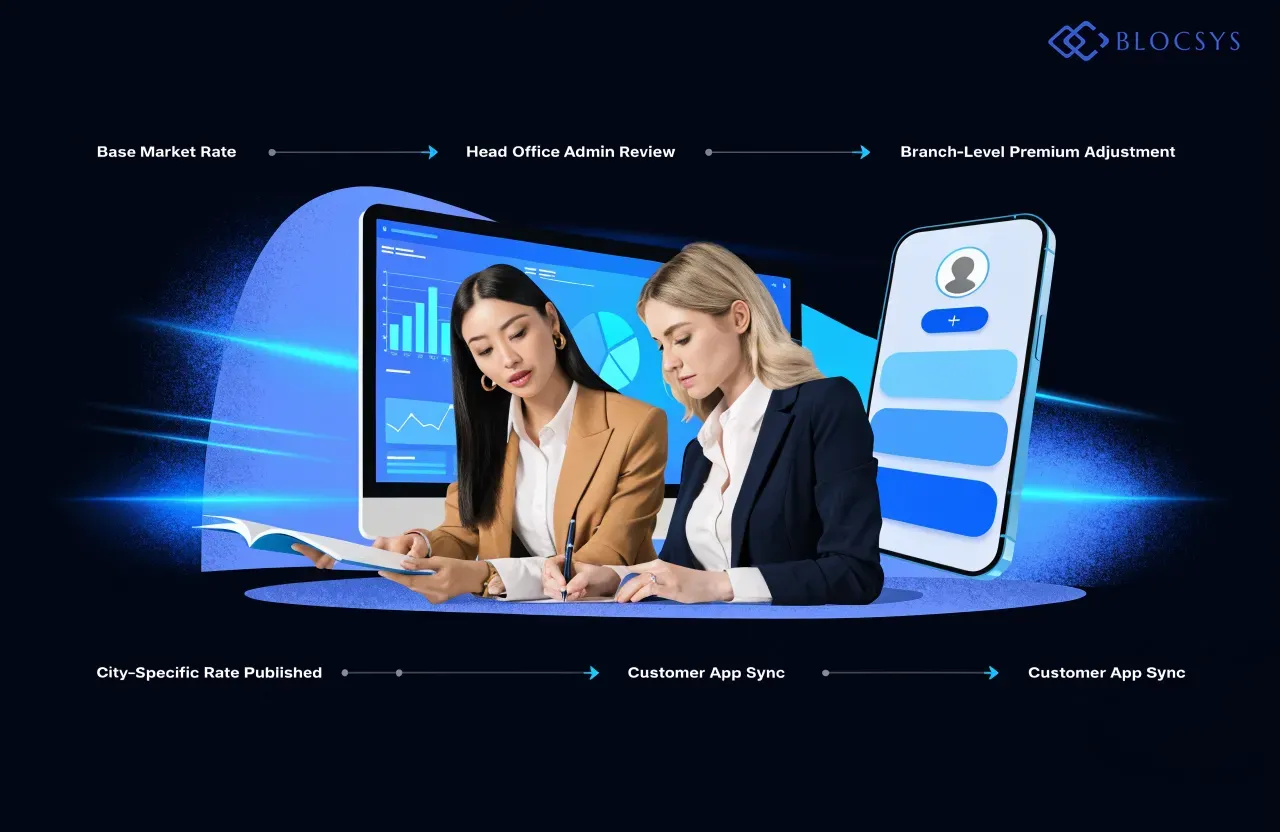
Here’s how it typically works: a head office sets a base rate from the market feed, then each branch or city node applies its own adjustment for local premiums, applicable taxes or regional demand. The admin panel controls who can edit what, and every change should sync across the customer app instantly.
We won’t invent actual city-level figures here — real rates depend on your market references, currency conversion and dealer margins. What matters for development is that the architecture supports this layered pricing model from the start, rather than being retrofitted later.
Customer, Dealer and Order Management Modules
A nationwide bullion application usually serves more than one type of user. Retail customers, wholesale dealers and internal staff all need different access levels.
Typically, this means role-based access control: customers see rates and place orders, dealers get wholesale-specific pricing and bulk order tools, and staff manage approvals through the admin side. Order booking flows from request to confirmation to transaction record, though the exact steps vary by business. Some dealers require manual approval on every order; others automate smaller transactions.
This is also where Bullion Customer Management and Bullion Dealer Management System functionality overlap — the underlying database structure is similar, but permissions and pricing visibility differ sharply between the two user types.
Technology Stack and Architecture for a Bullion Trading App Development Project
What’s actually under the hood? A typical Bullion Trading Application Development build involves several connected layers.
- Android and iOS frontend applications for customers and dealers.
- A web application and a separate dealer portal.
- Backend services handling business logic, pricing rules and order workflows.
- A database layer for customers, transactions, rates and inventory.
- Pricing and market data API integration.
- Authentication and role-based access control.
- An admin dashboard with reporting tools.
- Cloud hosting with monitoring for uptime and scalability.
There’s no single mandatory stack here. The right choice depends on your integrations, expected user volume and how fast you need to launch. A team working on Bullion App Development usually finalises the stack after requirement analysis, not before.
Security and Scalability Requirements
Security in a bullion app covers secure authentication, encrypted data storage, API-level protection and regular audit trails. Role-based permissions matter here too — a branch admin shouldn’t be able to edit another branch’s rates.
Scalability means planning for growth from the start: more cities, more concurrent users during price swings, and more transaction volume as dealers come on board. However, application security is separate from the physical custody, verification and regulatory responsibilities your business already handles offline — the app supports your operations, it doesn’t replace your compliance processes.
Step-by-Step Bullion Trading App Development Process
How long does a build like this actually take, start to finish? It moves through a fairly standard sequence.
- Business requirement analysis — understanding your pricing model, branches and user types.
- Competitor and feature research — reviewing apps like AIB, dP GOLD and RSBL SPOT for relevant ideas.
- Scope definition and user-role mapping.
- UI/UX design and prototyping.
- Frontend and backend development.
- API and third-party integrations, including the live price feed.
- Testing and security validation.
- Deployment and launch across app stores and web.
- Ongoing maintenance, monitoring and future upgrades.
Each stage produces a concrete deliverable — a requirement document, a clickable prototype, a tested build — so you’re never guessing where the project stands.
How Much Does It Cost to Build a Bullion Trading App in India?
Cost depends on scope. A basic rate-display app costs less than a full trading platform with dealer management, order booking and multi-branch admin controls.
Key cost drivers include the number of platforms (Android, iOS, web), the complexity of city-wise pricing logic, dealer and customer role systems, order management workflows, and third-party integrations like your pricing API. Separately, you’ll also budget for ongoing API subscription fees, cloud hosting and ongoing maintenance — these are operational costs, distinct from the one-time development cost.
Because every business has a different feature list, it’s best to get a tailored estimate rather than a generic number. Tools like the Software Development Cost Estimator can give you a useful starting range before a detailed scoping call.
Bullion App Development Services Offered by Blocsys
Blocsys works with businesses that need custom mobile and web applications, backend systems and admin dashboards built around their specific operating model. For bullion businesses specifically, this includes digital gold and silver app development covering live pricing integration, customer and dealer modules, and multi-location rate management.
Beyond bullion-specific work, the team has also built platform architecture for related domains like crypto trading development and OTC trading platform development — experience that translates well into the API integration, order-matching logic and dashboard reporting a bullion app also needs.
Before any code gets written, the focus is on understanding your actual pricing, customer and dealer workflows. That groundwork shapes everything that follows.
Why Choose Blocsys for Custom Bullion App Development?
Blocsys isn’t claiming to be behind AIB, dP GOLD or RSBL SPOT, and it won’t tell you it’s the only option in India. What it offers instead is a structured approach to Bullion Trading App Development built around your specific requirements.
That means custom mobile and web platforms, backend systems designed for your pricing logic, API integrations for live rates, and admin dashboards your team can actually use day to day. Scalable architecture matters too — a platform built for five cities today should handle fifty without a rebuild.
Most importantly, the team takes time to map your pricing, customer and dealer workflows before development starts. That upfront clarity is usually what separates a smooth build from a messy one.
Conclusion – Build Your Own All-India Bullion Trading Application
A custom bullion application brings live rates, city-wise pricing, customer access, dealer workflows and central administration into one connected system. The exact scope — how many features, which user roles, how many cities at launch — depends entirely on your business model.
Good Bullion Trading App Development isn’t about copying AIB, dP GOLD or RSBL SPOT feature for feature. It’s about identifying what actually matters to your dealers and customers, then building around that.
Planning to launch your own All-India bullion trading application? Connect with Blocsys to discuss your requirements for live gold and silver rates, city-wise pricing, customer management and a customised mobile or web platform through their digital gold and silver app development service.
Frequently Asked Questions
Here are direct answers to the questions we hear most often about Bullion Trading App Development.
What is an All-India bullion trading application?
It’s a centralised platform that displays live gold and silver rates across multiple Indian cities while supporting customer accounts, order booking and dealer management under one system.
What are the main features of apps like AIB, dP GOLD and RSBL SPOT?
Publicly, all three focus on gold and silver rate communication for the bullion trade. Specific features beyond that, such as order booking depth, vary by app and should be checked directly on their current listings.
How much does it cost to build a bullion trading app in India?
Cost depends on platforms, features and integrations. A basic rate app costs less than a full trading platform with dealer and order management, so get a scoped estimate rather than a flat number.
Can a custom bullion app display live gold and silver rates?
Yes. A connected market data API feeds prices into the app, where dealer-defined margins are applied before the rate reaches customers.
How can an application manage city-wise bullion prices?
Through a layered pricing model — a base rate from the market feed, adjusted by branch-level premiums, taxes and local factors, then published to each city.
Can a bullion trading app support both retail and wholesale customers?
Yes, through role-based access that gives wholesale dealers different pricing visibility and bulk order tools compared to retail customers.
Which APIs are required for live gold and silver price integration?
You’ll need a market data provider API for benchmark and domestic reference prices, plus internal logic to apply your own margins and overrides.
How long does it take to develop a custom bullion trading application?
Timelines vary by scope, but a full build typically moves through requirement analysis, design, development, integration and testing across several weeks to a few months.
Can a bullion application be developed for Android, iOS and web?
Yes. Most businesses launch across all three, often alongside a separate dealer portal and an admin dashboard.
Can Blocsys develop a custom All-India bullion trading application?
Yes. Blocsys builds custom mobile and web applications, including bullion-focused platforms, through its digital gold and silver app development service, based on your specific pricing and operational requirements.
Ready to move beyond theory and build an intelligent platform that delivers real-world value? Blocsys Technologies specialises in engineering enterprise-grade AI and blockchain solutions for the fintech, Web3, and digital asset sectors. Connect with our experts today to discuss your vision and chart a clear path from concept to a secure, scalable reality.