How Equity Tokenization Can Transform Pre-IPO Investment Opportunities in India
Indian investors have never been more curious about companies before they list. Founders, family offices and angel investors all want a closer look at growth stories before an IPO. That curiosity is why Pre-IPO Equity Tokenization is now a serious topic in boardrooms. Public markets are open to almost everyone, while private companies stay largely out of reach. Technology partners like Equity Tokenization Platform Development teams are exploring how blockchain could narrow that gap, within the law.
Going public isn’t quick. A company needs audited financials, clean records, governance upgrades and detailed disclosures under SEBI’s ICDR Regulations. Meanwhile, it still has payrolls to meet and products to build. Capital needs don’t pause for IPO preparation.
Why Do Pre-IPO and Unlisted Companies Face Investment and Liquidity Challenges?
Many strong businesses stay unlisted for years. Some aren’t ready for public-market scrutiny. Others simply don’t need to list yet. However, they still need money for expansion, hiring and product development.
Let’s look at it from three angles. Each group wants something different.
The company’s view
Picture a Pune-based logistics software company with a strong customer base. Its founders mostly know the same circle of investors. Consequently, raising another ₹50 crore means convincing the same few people again. Reaching new, eligible investors takes time and relationships.
The existing shareholder’s view
Early investors and employees with vested ESOPs often hold shares for years. Finding an eligible buyer is hard. Moreover, price negotiations are private, and paperwork can drag on. Exit options before an IPO stay thin.
The investor’s view
An investor who wants private-market exposure faces a different maze. Deal flow is relationship-driven. Valuations are hard to verify, information is patchy, and sellers are hard to find. Fragmented processes make the whole ecosystem slower than it needs to be.
Understanding the Difference Between Listed, Pre-IPO and Unlisted Shares
A listed company’s shares trade on recognised stock exchanges like NSE and BSE. Settlement runs through depositories, and disclosure rules are strict. Price discovery happens openly, every trading day.
Unlisted shares work differently. An unlisted public company or a private limited company has no exchange market for its stock. Transfers happen bilaterally, under the Companies Act, 2013 and the company’s articles. Price discovery is negotiated, and disclosure is lighter.
“Pre-IPO” isn’t a legal category. It describes a stage: a company that’s preparing for, or considering, a listing. That label doesn’t give the public a right to buy its shares. Access still depends on the issuance structure and investor eligibility.
What Is Equity Tokenization and How Does It Work?
Equity tokenization is the process of representing eligible equity interests as digital tokens on a blockchain. The token records who holds what and under which rules. It doesn’t replace the underlying security.
That distinction matters. The legally recognised ownership is still the share, recorded in statutory registers or with a depository. A token is a digital representation linked to that interest, through a legal structure designed for the purpose. Without that structure, a token is just a data entry.
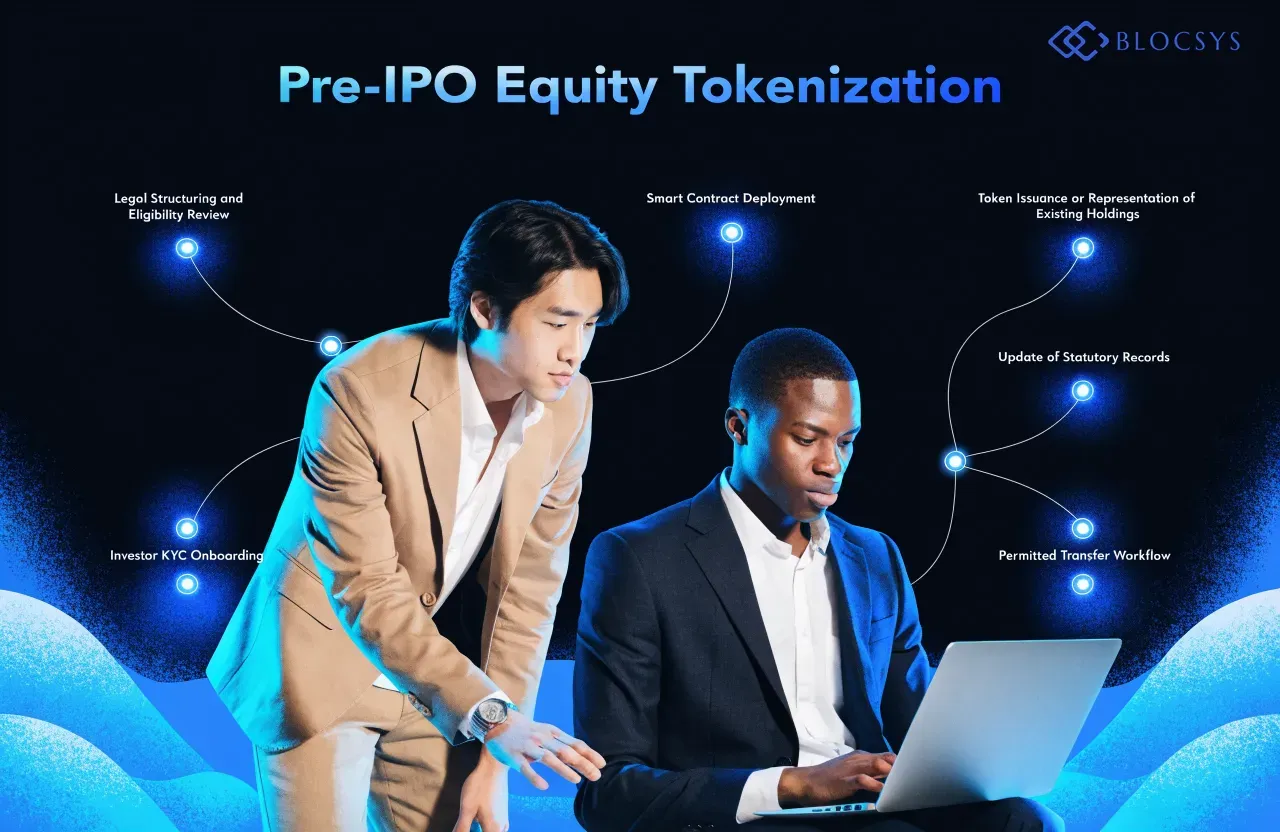
A suitable platform combines several parts. Smart contracts enforce rules, such as who can hold or receive a token. Investor onboarding checks identity and eligibility. Digital ownership records update as permitted transfers happen. Together, they support issuance administration and shareholder management.
Here’s a simple example. A growing Bengaluru fintech wants cleaner shareholder administration. It explores a platform that mirrors eligible holdings as tokens, while its statutory registers stay in place. Every authorised transfer is checked against preset rules. Its legal team keeps the official records aligned.
Tokenizing existing shares versus issuing new tokenized equity
These are two different routes. Tokenizing existing shares creates digital representations of holdings that already exist. The capital structure doesn’t change, and no new money comes in.
Issuing new tokenized equity interests means the company creates new securities to raise capital. That changes the cap table, dilutes existing holders and triggers issuance rules. Founders should never treat them as the same thing.
How Pre-IPO Equity Tokenization Could Transform Investment Opportunities in India
Here’s the core idea. Tokenization doesn’t create demand or change securities law. It could make private-market operations more structured, transparent and easier to administer. Every benefit below ties to a real problem.
Better ownership administration
Many unlisted companies still manage shareholder data across spreadsheets, PDFs and email chains. A blockchain-based ledger can offer one consistent record of holdings, transfers and restrictions. Therefore, founders and CFOs get cleaner cap-table visibility, and auditors get a clearer trail.
Structured investor onboarding
Onboarding today often repeats the same document checks for every deal. A digital platform can run KYC once, record eligibility status and apply it to future permitted transactions. As a result, investor participation could become more organised, though only for those who qualify under the issuance structure.
Wider access, within limits
Tokenization could help a company reach more eligible investors through a controlled digital channel. It can’t turn a private offer into a public one. A private placement stays a private placement, with the same eligibility rules.
Fractional representation
Platforms can divide a representation into smaller units, which may lower ticket sizes. However, a smaller token doesn’t automatically create legally recognised fractional share ownership. Indian company law deals in whole shares, so any fractional model needs a carefully built legal structure.
Smart contracts for rules and workflows
Smart contracts can encode predefined conditions. For example, they can block transfers to unverified wallets or enforce a lock-in period. Consequently, routine compliance checks become automatic rather than manual. They support administration. They don’t replace legal judgement.
A practical scenario
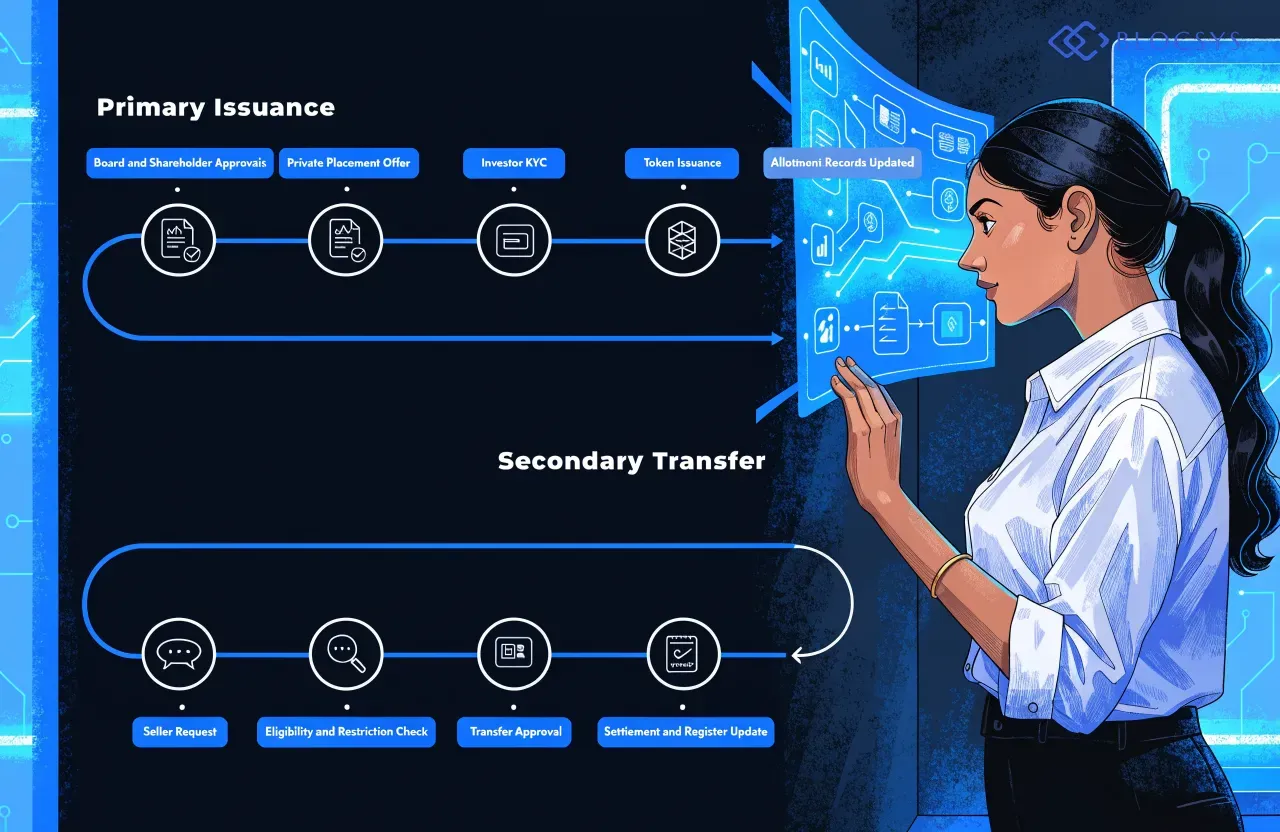
Say a Chennai consumer brand has an early investor holding 2% and wants to sell part of it. A prospective eligible investor wants in. On a digital equity platform, both are verified. The proposed transfer is checked against the articles, any right of first refusal and lock-in terms. Approved, it settles and the records update. The token never grants rights beyond the underlying share.
Tokenization fixes the paperwork problem before it fixes the market problem. Companies that get their records, rights and transfer rules in order first are the ones that can use digital infrastructure well.
How Can Equity Tokenization Address Liquidity Challenges in Unlisted Companies?
Tokenization can improve how transfers are administered, but it can’t guarantee liquidity. Liquidity needs willing buyers and sellers. Without them, a perfect digital record still sits idle.
Today’s unlisted market has familiar friction. Buyers and sellers struggle to find each other. Valuation views differ widely. Information is uneven, and execution is slow. Blockchain-based equity infrastructure can help with some of this, including transparent transaction histories, faster ownership updates and organised investor matching.
Still, technical transferability isn’t market liquidity. A token that can move between wallets isn’t the same as a token someone will buy at a fair price. Real liquidity depends on eligible participants, pricing, transfer restrictions and authorised trading infrastructure. Any platform promising active trading by default deserves scepticism.
How Pre-IPO Equity Tokenization Could Support Capital Raising
Growing companies often need funding well before an IPO. Digital infrastructure can help manage those rounds. It can support issuance administration, investor onboarding, ownership records and investor reporting for an eligible private raise.
Two activities need clear separation. Primary issuance happens when the company issues new securities and receives capital. Secondary transactions happen when existing shareholders transfer holdings to someone else, and the company receives nothing. They serve different needs. Primary funds growth, while secondary offers shareholder exit opportunities.
Equally important, digital infrastructure doesn’t create an unrestricted public fundraising route. Under Section 42 of the Companies Act, 2013, a private placement has defined limits, including offers to no more than 200 persons in a financial year (excluding qualified institutional buyers and employees under ESOPs). Public offers fall under separate rules. Legal structuring comes first.
Traditional Pre-IPO Investment vs Tokenized Equity: Understanding the Differences
Both models have strengths. Let’s compare them fairly.
- Ownership records: Traditional setups use registers, demat accounts and spreadsheets. Tokenized models add a shared digital ledger, but statutory records remain.
- Onboarding: Traditional onboarding is manual and repeated. Digital onboarding can be reusable and rule-based.
- Transfers: Traditional transfers rely on paperwork and intermediaries. Tokenized workflows can automate checks, though legal transfer steps still apply.
- Transparency: Tokenized systems keep time-stamped transaction histories. Traditional records are often siloed.
- Settlement: Blockchain-based settlement can be faster operationally, but must align with regulated payment and securities infrastructure.
Traditional securities infrastructure still matters. Depositories, registrars and regulated intermediaries carry legal weight that a blockchain alone doesn’t. Tokenized equity isn’t automatically more liquid, safer or more profitable. It’s a different operating model, with its own risks.
Regulatory and Compliance Considerations for Equity Tokenization in India
This is where you need care. We’re not offering legal advice, and the rules change. Always confirm the current position with qualified counsel and official sources.
Several regulators and laws matter. The Ministry of Corporate Affairs administers the Companies Act, 2013, including Section 42 on private placements, Section 56 on transfers and the Companies (Prospectus and Allotment of Securities) Rules. Those rules also cover dematerialisation requirements, which MCA has extended to many unlisted companies. SEBI regulates securities markets, including the ICDR Regulations that govern IPOs. The Depositories Act, 1996 governs depositories like NSDL and CDSL. Recognised stock exchanges run the listed market.
Each activity sits in a different bucket. A private placement, a public issue and a secondary transfer follow different rules. A tokenized digital representation is a fourth thing, and we’re not aware of a dedicated Indian framework that treats tokenized private-company equity as a regulated, tradable product. Don’t assume models from other countries apply here.
Practically, any platform must respect investor eligibility, identity verification, transfer restrictions, disclosures and statutory registers. Tokens can’t replace those registers or recognised depositories. Choosing a blockchain doesn’t create compliance. Legal structure does.
Technology Infrastructure Required for an Equity Tokenization Platform
What does a platform need underneath? It depends on the goal. An issuance tool, a shareholder management system and a broader digital securities ecosystem need different architectures.
Core components usually include a blockchain layer, smart contracts, token issuance and management modules, and investor onboarding with identity verification. Role-based permissions control who can see or do what. Digital ownership records, transaction monitoring, reporting and admin dashboards complete the operational picture. Custody and banking integrations connect the platform to existing financial infrastructure.
Non-functional needs matter just as much. Security, privacy, auditability and scalability decide whether institutions will trust a platform. Furthermore, integrations with registrars, KYC providers and payment rails often take more effort than the smart contracts themselves.
Challenges and Risks of Equity Tokenization in the Indian Market
Let’s be honest about the hurdles. Regulatory clarity is still developing. Legal structuring for token-to-share linkage is complex. Transfer restrictions, secondary-market permissions and investor eligibility all limit what’s possible.
Operational risks are real too. Cybersecurity, custody arrangements and technology integration need serious attention. Shareholders must also accept the model, and the market needs enough participants to matter.
Above all, tokenization doesn’t remove company risk. A weak business is still weak on-chain. Valuation risk and the possibility of loss remain. Before building, evaluate the legal, financial, operational and technology requirements together.
The Future of Pre-IPO Investment and Digital Equity Markets in India
India already has strong digital public infrastructure and a deep depository system. Some projects explore related ideas, such as Demat 2.0, Tokenization & CBDC Integration. Today’s technology can already support digital ownership representation, onboarding and records. Future market structures may go further.
Banks, depositories, intermediaries, technology providers and regulators will all shape what happens. Nothing here is guaranteed. Approvals, adoption and returns are uncertain, so plan for several outcomes.
The winners won’t be the loudest tokenization platforms. They’ll be the ones built around regulated workflows, clear legal rights and boring, reliable operations.
Equity Tokenization Platform Development Services Offered by Blocsys
Blocsys is a technology development company working on blockchain and digital asset platforms. For businesses exploring digital equity infrastructure, that includes custom blockchain development, smart contract development, token issuance infrastructure, investor-facing applications, backend systems, admin dashboards and API integrations.
Architecture follows the business model, intended users, security needs and regulatory framework. Blocsys builds technology. It isn’t a broker, legal adviser, depository or exchange, and it doesn’t hold regulatory approval to issue or trade tokenized equity. Related work, like its asset tokenization platform offering, shows the underlying technology range. Debt instruments have their own needs, as covered in corporate bond tokenization.
Why Choose Blocsys for Equity Tokenization Platform Development?
Equity is a different product from bonds, commodities or crypto, so the platform should reflect that. Blocsys brings blockchain development, digital asset platform experience, smart contracts, backend systems and web applications together. A customised approach means your workflows, not a template, drive the design.
Security and scalability come first, because shareholder data and capital flows demand it. Equally, Blocsys keeps the focus on business outcomes: cleaner records, structured onboarding and workflows your legal team can stand behind.
Conclusion: Can Pre-IPO Equity Tokenization Transform Investment Opportunities in India?
Pre-IPO companies need capital. Existing shareholders need exits. Investors need access, information and fair pricing. Pre-IPO Equity Tokenization could improve digital ownership representation, onboarding, transaction administration and secondary-market infrastructure. It won’t bypass the IPO process or securities law.
Success depends on solid legal structuring, regulatory compliance, eligible participants and dependable technology. Digital equity infrastructure may become a meaningful step in the evolution of India’s private capital markets.
Exploring equity tokenization for your business? Connect with Blocsys to discuss your digital equity platform requirements, blockchain architecture, smart contract infrastructure and technology development approach.
Frequently Asked Questions
Here are direct answers to the questions we hear most often about equity tokenization and pre-IPO investments in India.
What is equity tokenization in India?
It’s the digital representation of eligible equity interests as blockchain tokens. The legally recognised security still follows Indian company and securities law.
How does equity tokenization work for pre-IPO companies?
The company links tokens to eligible holdings or new issuances. Smart contracts enforce transfer rules, and the platform handles onboarding and records alongside statutory registers.
Can unlisted company shares be tokenized in India?
Technically, they can be represented digitally. Legally, it depends on structure, company law, dematerialisation requirements and SEBI rules. Take qualified legal advice first.
How can equity tokenization improve liquidity for unlisted shares?
It can speed up transfer administration and record updates. Actual liquidity still needs eligible buyers, fair pricing and authorised trading infrastructure.
Can investors buy tokenized pre-IPO shares?
Only where a lawful structure permits it and the investor is eligible. We don’t see a general public market for tokenized private-company equity in India.
Does equity tokenization allow companies to raise funds without an IPO?
Companies already raise funds privately, for example through Section 42 private placements. Tokenization may help administer such rounds. It doesn’t create an unrestricted fundraising shortcut.
What is the difference between traditional pre-IPO shares and tokenized equity?
Traditional shares use registers and demat records. Tokenized equity adds a digital representation and automated rules, while the underlying share remains the legal asset.
Is equity tokenization legal in India?
There’s no blanket answer. Issuing and transferring securities is regulated, and a tokenized model must fit existing law. Confirm the latest position with counsel.
Can existing shareholders tokenize their equity holdings?
Possibly, subject to the articles, transfer restrictions, board and shareholder consents, and applicable regulations. It requires company involvement and legal structuring.
How can a company develop an equity tokenization platform?
Start with legal structuring and business requirements. Then plan architecture, smart contracts, onboarding, integrations and security with an experienced technology partner like Blocsys.
Ready to move beyond theory and build an intelligent platform that delivers real-world value? Blocsys Technologies specialises in engineering enterprise-grade AI and blockchain solutions for the fintech, Web3, and digital asset sectors. Connect with our experts today to discuss your vision and chart a clear path from concept to a secure, scalable reality.