Gold Saving App Development: Features, Cost, and Business Opportunities
Walk into many jewellery showrooms and you’ll still see the same routine. A customer pays a monthly instalment, and a staff member writes it in a register or a card. Gold saving app development changes that routine. Your customers can pay, track and review their savings from a phone, and your team gets clean records instead of paper trails. If you’re planning to modernise your scheme, digital gold and silver app development is a practical place to start.
This guide is for jewellers, gold retailers, merchants and fintech founders. It isn’t investment advice. We’ll focus on the business side: how these apps work, which features matter, what drives cost, and how to choose a partner.
What Is a Gold Saving App and How Does It Work?
A gold saving app is a digital platform where customers enrol in a savings plan, make recurring contributions and track their account. The business manages plans, payments, balances and maturity through an admin dashboard. The exact workflow depends on your scheme rules.
Here’s a typical customer journey:
- The customer registers and completes verification where needed.
- They choose a plan, such as an 11-month scheme with a fixed monthly amount.
- They pay each month through UPI, cards or net banking.
- The app records the payment and updates the account.
- They view their balance and history in a dashboard.
- At maturity, they redeem according to your terms.
However, “updates the account” means different things in different models. Some schemes record rupee contributions and add a bonus at the end. Others convert each payment into gold weight at the day’s rate. Your software has to follow your model, not the other way around.
Why Should Jewellery Businesses Develop Their Own Gold Saving App?
A branded app gives you direct control over customer savings operations. You own the interface, the data and the customer relationship. Moreover, you’re not asking customers to learn a third-party platform that carries someone else’s name.
Think about what manual schemes cost you. Staff reconcile payments by hand. Customers phone the store to ask about balances. Missed instalments go unnoticed until the month ends. A digital system tackles each of these problems.
Potential operational benefits include:
- Organised payment records that are searchable in seconds.
- Customers can check balances without visiting or calling.
- Automated reminders reduce manual follow-ups.
- Reports give management a clear view of active accounts.
- Multi-branch chains can run one consistent scheme.
We won’t promise that an app guarantees retention or revenue growth. It doesn’t. What it does is remove friction and give you better data to work with. Whether that turns into business value depends on how well you run the scheme.
Gold Saving Scheme vs Digital Gold Investment App: What Is the Difference?
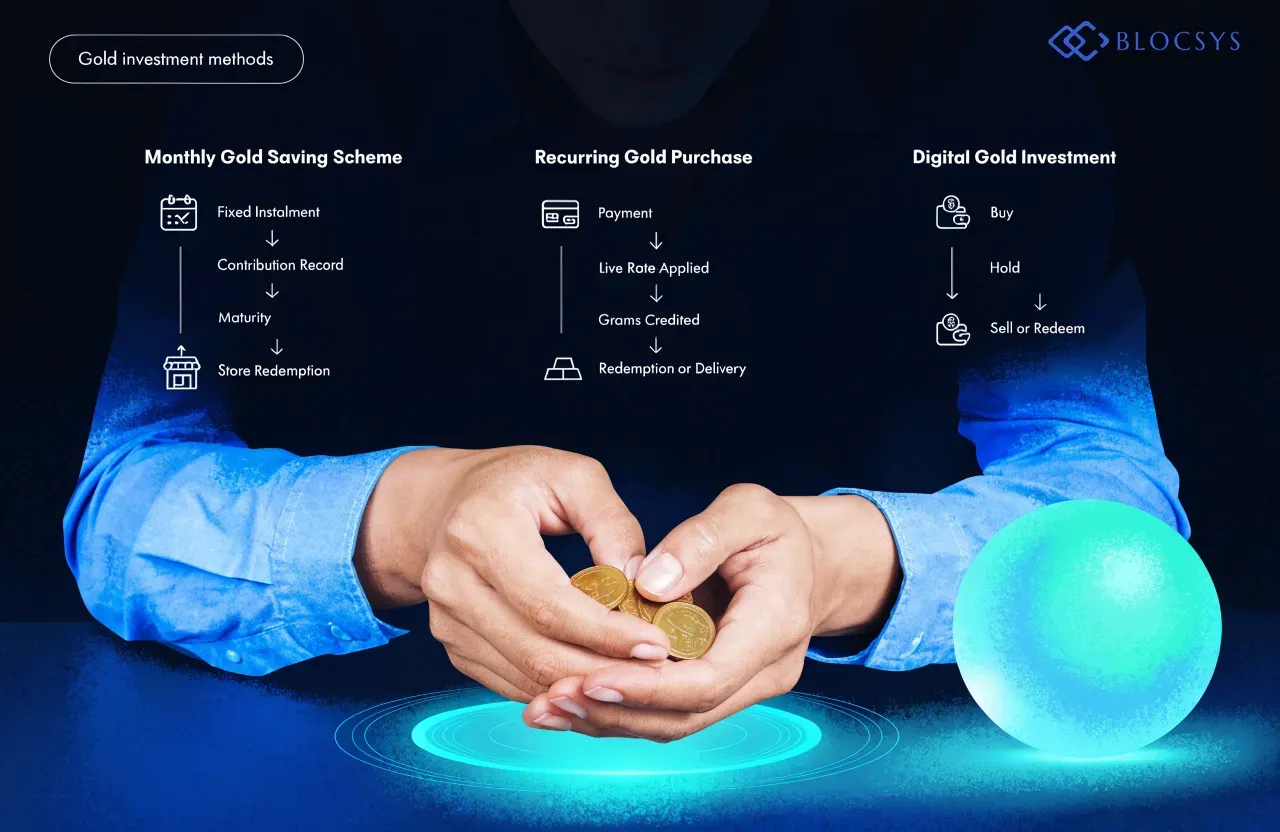
These three models look similar on a phone screen, but they work very differently. Don’t treat them as interchangeable. Your contracts, accounting and software logic all depend on which one you run.
Monthly Gold Saving Scheme
A customer commits to fixed instalments over a set term, often with a maturity date. At the end, they typically redeem the accumulated value, and some jewellers add a bonus or discount. Whether contributions convert to gold weight along the way depends on the scheme’s terms. Redemption is usually tied to purchases in the store.
Recurring Gold Purchase
Here, each payment buys gold at the prevailing rate, and the customer’s balance is held in grams. The app needs live pricing at the moment of purchase. It also needs clear rules for supply, storage and delivery. A recurring payment isn’t automatically a gold purchase, so define that logic explicitly.
Digital Gold Investment App
This is usually a broader platform where customers buy and sell gold on demand. It involves buy and sell pricing, a wider set of transactions and often a partner who holds the physical metal. If you’re exploring that route, our work on bullion rate app development covers the pricing side.
Legal treatment varies as well. Not every monthly savings plan is a chit fund, and not every one is free of regulation. Before you build, get advice from a qualified lawyer on how your scheme is structured.
Essential Features of a Gold Saving App
Your feature list should mirror your scheme rules. Some features below apply to every model, while others depend on how you handle gold allocation. Let’s walk through them.
Customer Registration and Profile Management
Customers sign up with a mobile number and OTP, then add basic details. Profiles hold contact information, nominee details and linked accounts. Good profile management also saves your staff from re-entering data.
KYC and Customer Verification
Customer registration and KYC may be required depending on your model, ticket size and legal advice. The app can collect identity documents and track verification status. Don’t assume it’s needed or unnecessary. Check with your compliance advisers.
Savings Plan Creation and Management
Admins define plans: amount, tenure, bonus rules and eligibility. Flexible configuration matters because jewellers change schemes seasonally. Hard-coded plans mean developer calls every time you launch an offer.
Monthly Contribution Scheduling
The app tracks due dates, grace periods and the status of each instalment. It shows customers what’s due and when. Additionally, it flags missed payments for your team.
Recurring Payment and Payment Gateway Integration
Payment gateway integration lets customers pay by UPI, card or net banking. Recurring payment integration can set up mandates so customers don’t pay manually each month. However, availability depends on the payment provider and the payment method. Confirm options with your provider early.
Gold Price Integration
If your scheme uses daily rates, live gold rate integration pulls prices from a trusted source. You’ll need rules for which rate applies, when it’s locked and how often it refreshes. Schemes with fixed rupee contributions may not need it at all.
Gold Accumulation and Balance Calculation
For models that credit grams, the system divides the payment by the applicable rate and updates the balance. Taxes, charges and rounding rules must be defined first. Calculation errors destroy customer trust, so test this logic thoroughly.
Customer Savings Dashboard
A gold savings dashboard shows plan details, paid and pending instalments, balance and maturity date. Keep it simple. Customers should understand their position at a glance.
Payment History and Transaction Records
Every payment, failure, refund and adjustment should appear in a customer transaction history. Customers can download receipts, and your team can resolve disputes quickly.
Maturity and Redemption Management
Gold maturity management handles notifications, eligibility checks and redemption requests. Depending on your terms, customers may redeem against jewellery purchases, receive coins or claim another benefit. The workflow should capture approvals and store-level fulfilment.
Notifications and Payment Reminders
Push, SMS and email reminders cut missed payments. Gold savings notifications also confirm receipts and announce maturity.
Admin Dashboard and Reporting
The admin dashboard for a gold saving app lets staff manage schemes, customers and payments. Reports cover collections, overdue accounts, maturities and branch performance.
Customer Support and Query Management
In-app queries, ticketing and FAQs keep support organised. Staff can see a customer’s full history before responding.
Role-Based Access and Administrative Controls
Branch managers, accountants and support agents shouldn’t see identical screens. Role-based permissions protect sensitive data and create accountability.
The best scheme apps we’ve seen start with the rulebook, not the screens. If your terms are fuzzy on paper, the software will only make the confusion faster.
How Does Monthly Gold Saving App Development Work?
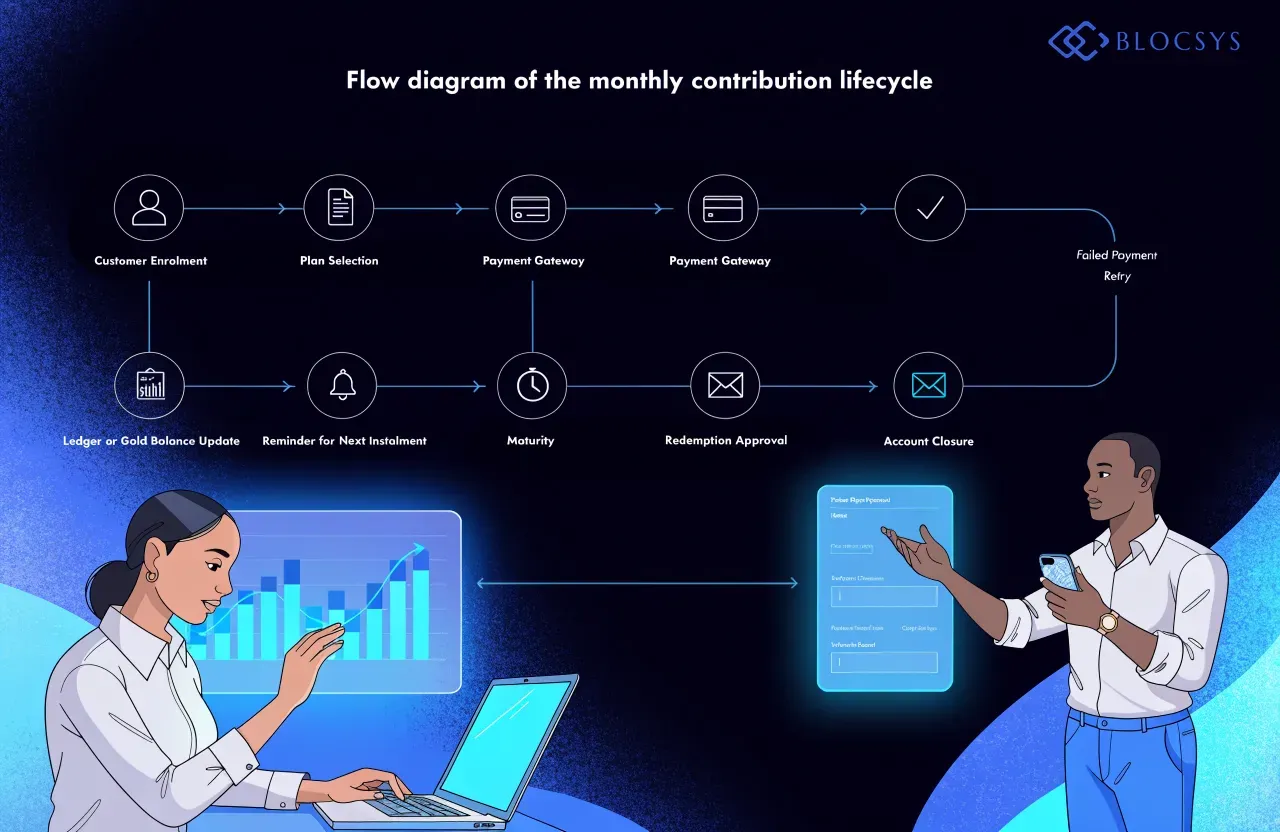
Monthly gold saving app development starts by translating your scheme terms into system rules. The platform then automates enrolment, payment tracking, balance updates and maturity handling. Everything flows from those rules.
The Business Side
You define plans, contribution amounts, payment schedules, eligibility and terms. The app stores them as configurable settings. Therefore, launching a new plan becomes a dashboard task rather than a development project.
The Customer Side
After enrolling, customers pay each instalment. The gateway confirms success, and the app records it against the right account. Depending on your model, it either adds the amount to a rupee ledger or converts it to gold at the applicable rate. Not every scheme converts each payment immediately, and the system shouldn’t assume it does.
Handling Exceptions
Real schemes get messy. Payments fail. Customers miss months. Refunds happen. Therefore, your app needs rules for each case:
- Failed payments should retry or prompt the customer, without double-crediting.
- Missed contributions follow your grace-period or forfeiture terms.
- Refunds need approval and an audit entry.
- Maturity dates trigger alerts and unlock redemption.
Finally, redemption requests move through approval and fulfilment, and the account closes with a full record.
Gold Saving App Development Services Offered by Blocsys
Blocsys is a technology development company that builds customised digital gold and silver applications. We don’t operate schemes, hold gold or provide financial services. We build the software your business runs on.
Our relevant services include:
- Custom digital gold application development around your savings model.
- Android and iOS app development for customers.
- Web application development for customers and branches.
- Backend development for accounts, schemes and balance logic.
- Admin dashboard development for operations and reporting.
- Payment gateway and API integration.
- Blockchain development, where a use case genuinely needs it.
Your scheme is unique, so a generic template rarely fits. We design around your plan structure, customer management needs, payment flows and balance records. You can read more about our approach on the digital gold and silver app development page.
Which Platforms Can Your Gold Saving App Be Built For?
You can build for Android, iOS, web and an administrative portal, all sharing one backend. Most businesses launch with mobile and an admin dashboard, then add other channels later.
Customers typically use an Android gold saving app or iOS gold saving app to register, pay and monitor savings. A gold saving web application helps customers who prefer browsers or who visit the store and need help. Meanwhile, your staff use the web dashboard to manage schemes, customers, payments and reports.
A shared backend keeps everything consistent. When a customer pays on their phone, the admin sees it instantly. If a branch updates a plan, every platform reflects it. That’s why architecture matters more than screens.
Technology and Integrations Required for a Gold Saving App
A gold savings platform needs a secure backend, a database, payment integrations, pricing sources and notification services. Each piece connects through APIs. Here’s how they fit:
- Backend: handles accounts, plan rules, balance calculations and workflows.
- Database: stores customers, transactions and audit logs reliably.
- Payment gateway: processes collections and confirms status through callbacks.
- Gold price API: supplies rates where your model needs them.
- Authentication: OTP login, device checks and session controls.
- Notification services: SMS, email and push messaging.
- Business system integrations: accounting, billing, CRM and gold inventory integration.
Inventory integration is worth mentioning. If your store sells jewellery against matured balances, linking the app to your billing system avoids duplicate entry.
Where Blockchain Fits
Blockchain isn’t a requirement. It can add value for traceable digital records or specific asset-record workflows. However, it doesn’t prove physical gold backing, custody, ownership, price accuracy or regulatory compliance. Use it only when it solves a clear business problem.
Security and Compliance Considerations for Gold Saving Applications
Security protects customer data and money, while compliance depends on how your scheme is structured. Developers build the controls. Your business, advisers and partners handle the legal obligations.
On the technical side, expect secure authentication, encrypted data, role-based access, payment security, complete transaction records and audit trails. Administrative actions, such as editing a balance, should always leave a trace. Indeed, audit logs often settle disputes faster than anything else.
On the legal side, requirements vary with your model, services, customer locations and payment arrangements. In India, an ordinary recurring purchase arrangement differs from a legally structured chit scheme, and some deposit-style schemes may attract other rules. We can’t give blanket answers. Consult a lawyer and check current guidance from relevant authorities before launch.
Responsibilities also split across parties. The app developer builds the software. The business operates the scheme and sets the terms. A gold supplier or custodian, if involved, handles the metal. Payment providers process funds. No developer can grant regulatory approval.
Compliance isn’t a feature you add at the end. Decide your legal structure first, then build the software to match it.
How Much Does Gold Saving App Development Cost?
Gold saving app development cost depends on scope, not a fixed price list. We won’t quote numbers without understanding your model. Anyone who does is guessing.
The main cost factors include:
- Application complexity and the number of platforms.
- Customer and administrator feature depth.
- Savings-plan workflows and rule flexibility.
- Recurring payment integrations.
- Gold pricing integrations and third-party APIs.
- Backend infrastructure and scalability needs.
- Security requirements.
- Testing effort and ongoing maintenance.
Scope makes a big difference. A basic app with registration, plans and payment tracking is a smaller build. An advanced platform with automated recurring payments, gold balance calculations, maturity workflows, several admin roles and external integrations is much larger. Likewise, adding gold-saving functionality to an existing digital gold app usually costs less than building a platform from scratch, since you can reuse existing components.
Want a rough starting point? Try our software development cost estimator, then share your requirements for a proper quote based on approved features.
How to Develop a Gold Saving App for Your Business
You don’t need technical expertise to run this process. You need clarity about your scheme. Here’s how a typical project runs.
- Understand the business model. Is it a monthly scheme, recurring purchase or something else?
- Define rules and journeys. Document plans, payments, bonuses, maturity and redemption.
- Prepare feature requirements. Separate must-haves from later additions.
- Select platforms. Choose Android, iOS, web or a mix.
- Design the interface. Keep screens simple for first-time users.
- Build the backend and apps. Develop the logic, mobile and web layers.
- Integrate payments and pricing. Connect gateways and rate sources.
- Implement security controls. Add authentication, permissions and logging.
- Test everything. Run the full customer and admin workflows.
- Launch. Many businesses start with a pilot group.
Before launch, validate the money-related workflows. Run test contributions, failed payments, a missed month, a maturity and a redemption. Then compare balances against manual calculations. If they don’t match, fix the logic before real customers arrive.
How to Choose the Right Gold Saving App Development Company
Choose a partner who understands your savings model, not just app development in general. Price matters, but a cheap build that miscalculates balances will cost far more later.
When you evaluate a gold saving app development company, ask about:
- Experience with digital gold or financial-style applications.
- Android, iOS and web capabilities.
- Backend and admin dashboard skills.
- Payment and API integration experience.
- Data security practices.
- Scalability, testing and maintenance support.
- Communication and project management.
Also test their curiosity. A good team asks how your scheme handles missed payments and early exits. A weak one jumps straight to screens. Request references and demonstrations of similar work, and verify them yourself.
Why Choose Blocsys for Gold Saving App Development?
Blocsys works as a technology partner for jewellery businesses, gold retailers, bullion businesses and fintech companies planning customised digital gold applications. We focus on building software around your operating model.
Our relevant capabilities include digital gold and silver app development, mobile and web development, backend and admin dashboard development, payment and third-party integrations, and blockchain development where it’s required. We help you plan functionality around your requirements, from scheme rules to reporting needs.
To be clear, we’re a development company. We don’t hold gold, run schemes, give investment advice or guarantee regulatory compliance. You stay in control of your business, and we build the technology to support it.
Conclusion: Build a Custom Gold Saving App with Blocsys
Gold saving app development gives jewellery businesses a way to digitise customer savings, manage recurring contributions and offer a more accessible experience. Success depends on the basics: the right business model, sensible features, reliable payment workflows, accurate balance calculations, strong security and a partner who listens.
Planning to launch your own gold-saving application? Connect with Blocsys to discuss your business model, application features and technology requirements for a customised digital gold platform.
Frequently Asked Questions
Here are direct answers to the questions we hear most often about gold saving app development.
What is gold saving app development?
It’s the process of building software that lets a business run customer gold-saving programmes digitally. The software covers enrolment, contributions, payment records, balances and redemption.
How does a monthly gold-saving application work?
Customers join a plan and pay instalments on a schedule. The app records each payment and updates the account according to your scheme rules. At maturity, the customer redeems as per your terms.
What features should a gold-saving app include?
Core features are registration, plan management, payment integration, transaction history, a customer dashboard, notifications and an admin dashboard. Gold price integration and KYC depend on your model.
Can jewellery businesses launch their own gold-saving applications?
Yes, from a technology standpoint. Legal requirements depend on your scheme structure and location, so take professional advice before launching.
Can an existing digital gold app include monthly savings functionality?
Often, yes. Developers can add plan management, contribution scheduling and maturity workflows to an existing platform. The effort depends on how the current system is built.
Can a gold-saving app manage recurring customer payments?
It can integrate with payment providers that support recurring payments or mandates. Availability varies by provider and payment method, so confirm options early.
How does a gold-saving application calculate customer gold balances?
It depends on your model. Some apps divide each payment by the applicable gold rate to credit grams. Others hold a rupee balance and apply value at maturity. Rounding and charges should be defined upfront.
Can a gold-saving app support Android, iOS and web platforms?
Yes. A shared backend can serve Android, iOS and web apps, along with the admin portal. This keeps data consistent across every channel.
How much does it cost to develop a gold-saving application?
Cost depends on features, platforms, integrations, security and maintenance. A basic app costs less than an advanced platform with automated payments and multiple admin roles. You’ll get an accurate figure only after scoping requirements.
Can Blocsys develop a customised gold-saving application for a jewellery business?
Yes. Blocsys builds customised digital gold applications around your scheme, payment flows and customer management needs. We provide the technology, not gold custody or financial services.
Ready to move beyond theory and build an intelligent platform that delivers real-world value? Blocsys Technologies specialises in engineering enterprise-grade AI and blockchain solutions for the fintech, Web3, and digital asset sectors. Connect with our experts today to discuss your vision and chart a clear path from concept to a secure, scalable reality.