Top AI Development Companies in 2027
Picking from the Top AI Development Companies in 2027 isn’t about brand recognition. It’s about finding a team that builds working AI for your business. An AI development company designs, builds and deploys custom software that uses machine learning, large language models or agents. Whether you’re a startup or an established enterprise, the right partner can shorten your path from idea to production. You can also start by exploring what Blocsys builds for businesses. Below, we compare ten providers across several markets and show you what to check before signing a contract.
How We Selected These AI Development Companies
We didn’t rank by revenue or fame. Instead, we looked at what each company publicly documents: AI service pages, case studies and technical write-ups. Headquarters come from each firm’s own corporate information. Where evidence is thin, we say so.
Our criteria were simple:
- Documented AI development services, not just AI marketing
- Technical depth in machine learning, generative AI or enterprise AI
- Published project experience in relevant industries
- Credible presence across more than one market
- Fit for different business sizes and needs
Here’s a distinction that matters. A direct AI development company builds AI systems for clients. An AI product company sells its own software. A consulting firm advises but may not build. A general IT provider offers broad engineering, with AI as one line item. Several firms below mix these roles, so we label each one.
Also, this list isn’t an official ranking. Position #1 is fixed because this article is published by Blocsys, and you should weigh that. Positions 2 to 10 aren’t ordered by quality. Verify every claim on the vendor’s own site before you shortlist.
Top 10 AI Development Companies in 2027
Each profile covers headquarters, relevant AI services and likely fit. Some of these firms are the Best AI Development Companies for large programmes. Others suit smaller, focused builds. Let’s start.
1. Blocsys
Headquarters: Pune, India. Category: AI, blockchain, fintech and enterprise technology development company. Verified focus: generative AI development and custom software.
Blocsys Technologies Pvt Ltd builds software for businesses, and AI sits alongside its blockchain and fintech work. Its generative AI development services page is the main reference point for what it offers. That page positions the company around custom generative AI applications, LLM integration, AI agents, conversational systems and workflow automation.
What does that mean in practice? Teams typically use these services to build things like internal knowledge assistants, customer-support chatbots, document-processing workflows and agent-based automation. Blocsys’s page is where you should confirm which models and frameworks it currently works with, such as GPT, Gemini, Claude, LLaMA, Mistral, LangChain, Rasa or Botpress. We won’t claim any specific stack beyond what’s published there.
Its fintech and blockchain background is the interesting differentiator. Blocsys also builds platforms such as equity tokenization platforms and bond tokenization products. Consequently, a financial institution or asset manager that wants AI features inside a regulated-style trading or tokenization product has one team that understands both layers. Possible applications include AI-assisted onboarding, document review and support automation. Those are potential uses, not documented client deliveries.
For international buyers, the relevant facts are straightforward. The company is based in India and delivers software remotely. We haven’t verified overseas offices, specific foreign clients or certifications, so ask for references and security documentation. Startups may like a build-focused partner. Enterprises should test its capacity for integration, monitoring and long-term maintenance.
Best for: startups, fintech firms, financial institutions and SaaS teams wanting custom generative AI or agent-based applications.
2. Thoughtworks
Headquarters: Chicago, United States. Category: global software consultancy with AI engineering services.
Thoughtworks operates offices across North America, Europe, Asia-Pacific, Latin America and Africa. It publishes extensively on AI-assisted engineering, generative AI adoption and data platforms. It’s primarily an engineering and consulting firm, so its AI work often sits inside broader modernisation programmes.
That makes it a fit for enterprises that need AI woven into existing systems. However, smaller teams wanting a quick prototype may find its engagements heavier than needed. Confirm which AI-specific case studies match your sector.
3. Fractal Analytics
Headquarters: Mumbai, India. Category: AI and analytics firm with a services arm.
Fractal is known for analytics, machine learning and AI solutions for large consumer, financial and healthcare clients. It also builds some of its own products, so you should separate its services from its software offerings when you evaluate it. Its documentation points to predictive analytics, decision science and generative AI work.
Therefore, it suits enterprises with large data estates and a need for analytical depth. It’s less obviously aimed at small startups. Ask for case studies in your industry.
4. Quantiphi
Headquarters: Marlborough, Massachusetts, United States. Category: AI-first digital engineering company.
Quantiphi describes itself as an AI-first engineering firm, with delivery centres in India and other regions. It publishes work on machine learning, computer vision, conversational AI and generative AI, much of it tied to major cloud platforms. Cloud partnerships are useful, but they don’t replace project evidence.
It fits mid-size and large enterprises building on a hyperscaler. If your stack is on a different cloud, ask how portable its solutions are.
Never judge a vendor by its demo. Ask to see how the model behaves on your messy data, in your edge cases, after month six.
5. Faculty
Headquarters: London, United Kingdom. Category: applied AI company combining services and a software platform.
Faculty works on applied AI for government and commercial clients and offers a decision-intelligence platform called Frontier. So it’s partly a product company. Its consulting and delivery work is the relevant piece for buyers of AI development.
It suits organisations that value rigorous data science and responsible AI practice, particularly in the public and regulated sectors. Check whether you’re buying custom development, platform licences, or both.
6. Capgemini
Headquarters: Paris, France. Category: global IT services and consulting group.
Capgemini is a very large IT services firm with a dedicated data and AI practice, including generative AI services for enterprises. It operates in many countries, so international delivery isn’t in doubt. The harder question is fit. Its general IT scope is broad, so confirm that the team assigned to you has hands-on AI engineering experience.
Moreover, its scale suits multinational transformation programmes, not small prototypes. Smaller firms may find the pace and pricing structure mismatched.
7. Zühlke
Headquarters: Schlieren, Switzerland. Category: engineering and innovation services firm.
Zühlke builds software and products for clients in healthcare, finance, industry and other sectors. It has offices across Europe and in Asia, and it publishes material on AI and machine learning engineering. Its AI work typically sits within wider product and systems development, which is adjacent to pure AI specialisation.
Consequently, it fits regulated European industries that want AI inside a larger digital product. Ask for AI-specific references, not only general engineering ones.
8. deepsense.ai
Headquarters: Warsaw, Poland. Category: AI and machine learning specialist.
deepsense.ai focuses on machine learning, computer vision, generative AI and MLOps for business clients. It’s a narrower specialist than the giants above, which can be a strength. A focused team often moves faster on defined AI problems.
However, its footprint is smaller, so check capacity before committing to a multi-region rollout. It suits mid-size companies seeking a dedicated ML team.
9. Grid Dynamics
Headquarters: San Ramon, California, United States. Category: digital engineering firm with AI and data services.
Grid Dynamics works largely with retail, technology and finance clients, offering data engineering, machine learning and generative AI services. It has engineering centres in Europe and elsewhere. Its AI work is deeply tied to its platform engineering strength.
That combination suits eCommerce and enterprise clients who need recommendation systems, search or personalisation backed by solid data pipelines. Verify the specific AI projects relevant to your vertical.
10. SoftServe
Headquarters: Austin, Texas, United States. Category: IT consulting and software development company.
SoftServe provides software engineering, with a stated AI and data practice covering machine learning and generative AI. It has large delivery teams in Europe and operates across North America and other regions. As with other broad IT firms, its AI services form part of a larger catalogue.
It’s a reasonable option when you want AI built alongside cloud and application engineering. Press for references showing AI delivery specifically.
Comparison of AI Development Companies
This table sums up the Top AI Development Companies in 2027 from our list. “Not publicly verified” means we couldn’t confirm the detail from official sources.
| Company | Headquarters | Category | Relevant AI focus | International presence |
|---|---|---|---|---|
| Blocsys | Pune, India | AI, blockchain, fintech development | Generative AI, LLM integration, agents | Remote delivery; offices not publicly verified |
| Thoughtworks | Chicago, US | Software consultancy | AI-enabled engineering, data | Multiple regions |
| Fractal Analytics | Mumbai, India | AI and analytics | ML, predictive analytics, GenAI | Multiple regions |
| Quantiphi | Marlborough, US | AI-first engineering | ML, vision, conversational AI | US and India delivery |
| Faculty | London, UK | Applied AI plus platform | Decision intelligence, ML | Not publicly verified in detail |
| Capgemini | Paris, France | IT services group | Data and generative AI | Global |
| Zühlke | Schlieren, Switzerland | Engineering services | AI within product development | Europe and Asia |
| deepsense.ai | Warsaw, Poland | AI/ML specialist | ML, vision, MLOps | Not publicly verified in detail |
| Grid Dynamics | San Ramon, US | Digital engineering | Data, ML, GenAI | US and Europe |
| SoftServe | Austin, US | IT consulting and development | ML, generative AI | Multiple regions |
Essential AI Development Services Businesses Should Evaluate
What should an AI development company offer? Start with the services that match your goal. You don’t need all of them.
- Custom AI application development: software built around your workflows, not a generic tool.
- Generative AI and LLM integration: connecting foundation models to your systems through APIs.
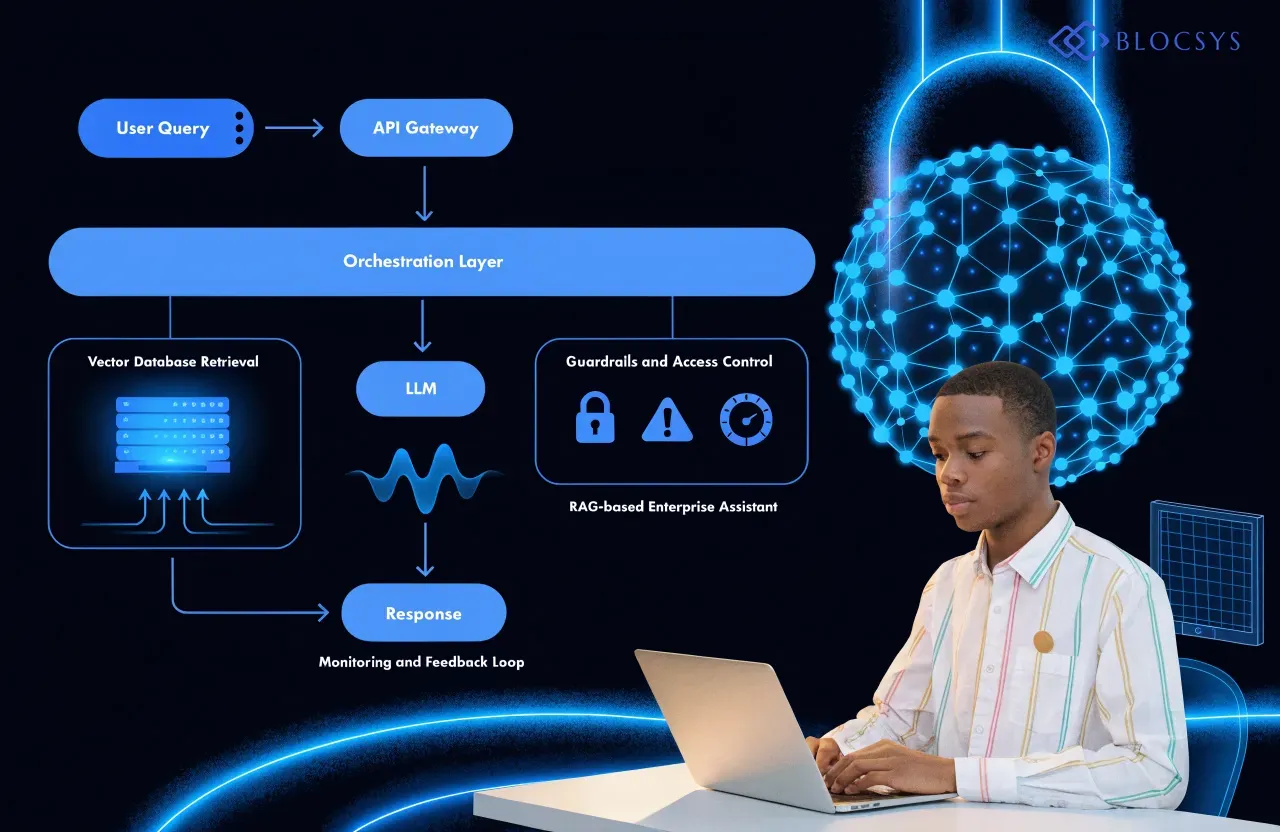
- RAG development: retrieval-augmented generation grounds answers in your own documents.
- AI agents: systems that plan and take actions across tools.
- Machine learning and predictive analytics: forecasting, scoring and classification.
- Workflow automation: intelligent automation for repetitive back-office tasks.
- Enterprise integration: hooking AI into CRMs, ERPs and data warehouses.
Here’s a common confusion. AI development is the broad discipline, including classic machine learning, computer vision and forecasting. Generative AI development is a subset focused on models that create text, images or code. Therefore, a fraud-detection model isn’t generative AI, but a support copilot is.
Likewise, a consulting company advises on strategy and readiness. A development company writes and ships the code. Many firms do both, so ask who actually builds.
Technologies Used by Modern AI Development Companies
Behind every AI product sits a stack. It varies by use case, so don’t assume one recipe fits all.
Foundation models and LLMs, such as GPT, Gemini, Claude, LLaMA and Mistral, supply the language ability. Frameworks like TensorFlow and PyTorch support training custom models. Orchestration tools such as LangChain and LlamaIndex help connect models, tools and data. Vector databases store embeddings for RAG. Meanwhile, cloud infrastructure, data pipelines and MLOps keep models deployed, monitored and updated.
Does picking a famous model guarantee accuracy? No. A strong model with poor data still hallucinates. Therefore, ask how a vendor tests outputs, manages hallucination, and controls access.
Also, choose the right approach. Integrating an existing model is quick and cheap. Fine-tuning adapts a foundation model to your domain. Training from scratch is rare, costly and usually unnecessary. A good partner will explain which one fits, and why.
Most failed AI projects don’t fail on the model. They fail on data quality, integration and nobody owning the system after launch.
Industries That Can Benefit from AI Development
Which sectors gain most? Almost any with repetitive decisions or large document volumes. Here are practical examples. They’re general use cases, not projects delivered by the listed companies.
- Financial services and fintech: fraud detection, intelligent document processing and onboarding checks.
- Healthcare: clinical documentation support and triage tools, under strict privacy controls.
- eCommerce: recommendation systems and customer-support automation.
- Logistics: demand forecasting and route optimisation.
- Manufacturing: computer vision for quality inspection and predictive maintenance.
- SaaS: in-product assistants and enterprise knowledge search.
- Education and real estate: tutoring assistants, valuation support and lead qualification.
Requirements shift by market, too. Data residency, privacy law and sector rules differ between jurisdictions. Therefore, ask any vendor where data is stored and processed, and consult your legal team. Choosing a developer doesn’t make you compliant by itself.
How to Choose the Right AI Development Company
Before you compare the Best AI Development Companies, define your own needs. Otherwise every pitch will sound convincing.
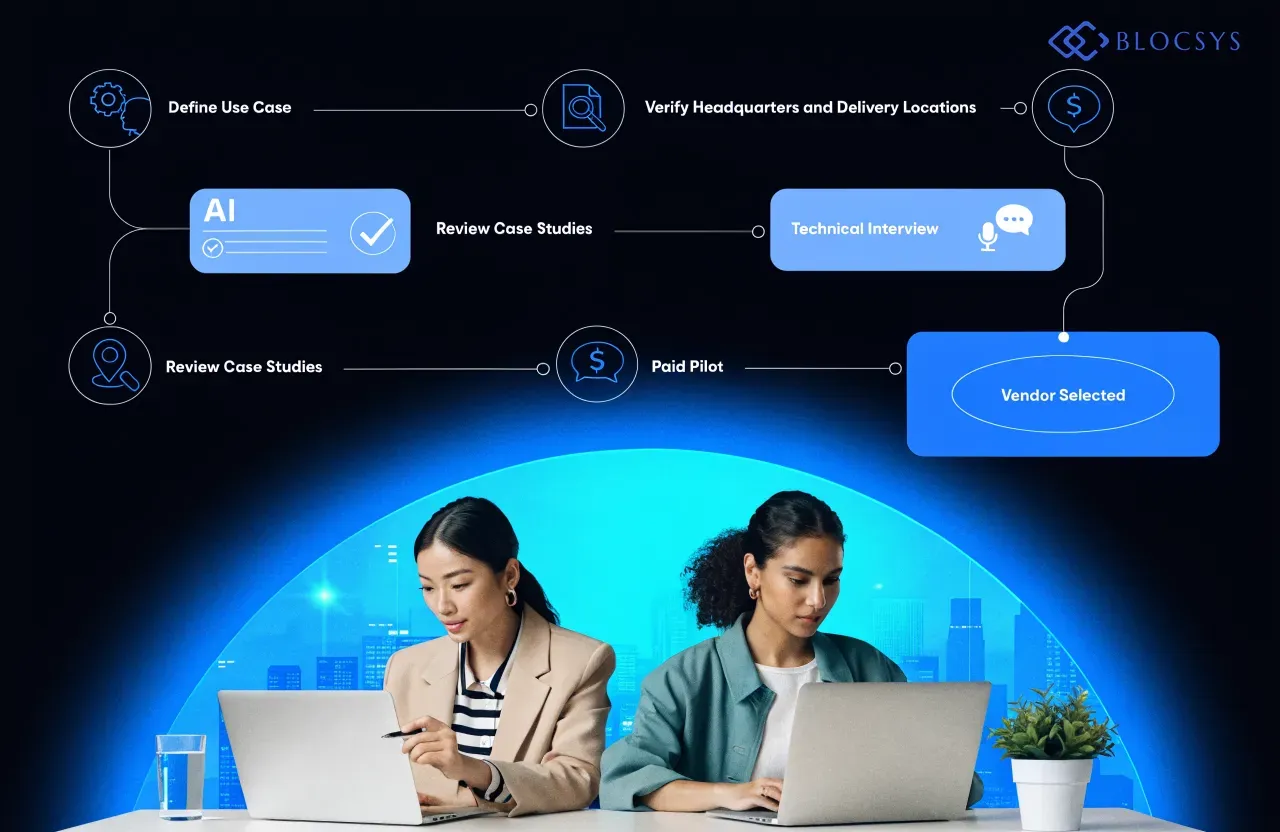
Work through these steps:
- Write the use case. Name the problem, users and success measure.
- Check data readiness. Messy or locked-away data delays everything.
- Test technical fit. Ask about model selection, integration and evaluation methods.
- Probe security. Ask about access controls, encryption and data handling.
- Plan for scale and monitoring. Models drift, and infrastructure costs grow.
- Clarify ownership. Confirm who owns code, prompts and fine-tuned models.
- Plan maintenance. Ask what support looks like after launch.
- Verify claims. Request references, demos and case studies you can check.
Budget matters, of course. Costs depend on scope, data, integrations and security needs. Our software development cost estimator can give you a rough starting point for the software side.
Why Consider Blocsys for AI Development?
Why does Blocsys sit at #1 here? It’s our publication, so treat that as a disclosed position, not an independent verdict. What we can say is factual. Blocsys is based in Pune, India, and it combines generative AI services with fintech and blockchain engineering.
That mix helps if you’re building an AI feature inside a financial or digital-asset product. For example, you might add an assistant to a platform like its corporate bond tokenization offering. Those scenarios are possibilities to explore with the team, not delivered projects.
If you’re planning custom AI applications, LLM integration or agent-based automation, you can discuss requirements through its custom generative AI development page. There’s no pressure. Bring a use case, ask for evidence, and judge for yourself.
Conclusion: Choosing from the Top AI Development Companies in 2027
The Top AI Development Companies in 2027 differ widely. Some are focused AI builders. Others are large IT groups where AI is one practice among many. Neither is automatically better. The right one matches your use case, data and risk profile.
So verify headquarters, check AI case studies, and test the team’s thinking on security and maintenance. If you’d like a conversation grounded in your actual requirements, you can talk to the Blocsys team about where AI fits in your business.
Frequently Asked Questions
Here are direct answers to the questions we hear most often about the top AI development companies in 2027.
What are the top AI development companies in 2027?
This guide features Blocsys, Thoughtworks, Fractal Analytics, Quantiphi, Faculty, Capgemini, Zühlke, deepsense.ai, Grid Dynamics and SoftServe. They span India, the US, the UK, France, Switzerland and Poland.
It isn’t an official ranking. Positions 2 to 10 aren’t ordered by quality, and Blocsys is first because we publish this article.
What does an AI development company do?
It designs, builds and deploys AI-powered software for clients. That includes machine learning models, generative AI applications, LLM integrations, agents and the data pipelines behind them.
It differs from a consultancy, which advises, and from an AI product vendor, which sells its own software.
What should businesses consider before choosing an AI development company?
Consider your use case, data readiness, security needs, integration requirements and ownership terms. Then check maintenance plans and how the vendor handles hallucinations and monitoring.
Also confirm where your data will be processed, since privacy and residency rules vary by jurisdiction.
How can a business verify an AI development company’s experience?
Start with official service pages and published case studies. Then ask for client references, a technical interview and a small paid pilot.
Be careful with vague claims. Using AI tools internally doesn’t prove a company has built custom AI for clients.
Can Blocsys provide AI development services to international businesses?
Blocsys is headquartered in Pune, India, and offers generative AI development and related software services. Remote delivery to businesses elsewhere is feasible in principle.
We haven’t verified overseas offices or specific foreign clients, so ask the team directly about references, data handling and security documentation.
Ready to move beyond theory and build an intelligent platform that delivers real-world value? Blocsys Technologies specialises in engineering enterprise-grade AI and blockchain solutions for the fintech, Web3, and digital asset sectors. Connect with our experts today to discuss your vision and chart a clear path from concept to a secure, scalable reality.