How Equity Tokenization Could Transform Investment in Unlisted Companies
Many of India’s fastest-growing businesses will never appear on a stock exchange ticker. They’re private limited companies and unlisted public companies, and they still hire, build and expand. Consequently, they still need capital. Equity Tokenization for Unlisted Companies is one idea that could change how that capital, and the ownership behind it, gets managed. You can read more about the build side in our guide to Equity Tokenization Platform Development.
However, we need to be honest about the starting point. Unlisted shares don’t trade on a continuous exchange. Founders struggle to reach investors beyond their networks. Shareholders struggle to find buyers. Investors struggle to find reliable information.
So where does technology fit in? Blockchain-based records could make ownership administration more structured. Yet tokenization doesn’t bypass securities law, and it doesn’t guarantee liquidity. Let’s explore what it can and can’t do.
What Are Unlisted Companies and How Does Unlisted Share Investment Work?
An unlisted company is one whose shares aren’t listed on a recognised stock exchange such as NSE or BSE. Its shares exist, and shareholders legally own them. However, there’s no screen-based market where anyone can buy or sell them at a quoted price.
Two structures dominate. A private limited company restricts share transfers through its articles of association and limits its membership. An unlisted public company can have more shareholders and freer transferability, but it’s still not listed. Both fall under the Companies Act, 2013.
Investors usually acquire unlisted shares in two ways. They subscribe to new shares issued by the company, or they buy existing shares from a current shareholder. Each route involves company approvals, valuation, documentation and registers.
Dematerialisation matters here too. Under the Companies (Prospectus and Allotment of Securities) Rules, unlisted public companies and, more recently, most private companies must issue securities in dematerialised form. Rules change, so confirm the current position with your company secretary.
Here’s the key point. Unlisted shares aren’t open for unrestricted public trading. Compared with listed shares, they involve more negotiation, more paperwork and far less price visibility.
Why Do Unlisted Companies Face Liquidity and Investment Challenges?
Short answer: there are few buyers, few sellers and no common marketplace. Liquidity in unlisted shares depends on finding a counterparty who’s eligible, willing and agrees on price. That’s hard.
The company’s view
Why do so many businesses stay unlisted? Some aren’t ready for listing requirements. Others prefer private ownership. Some simply don’t meet the criteria yet.
Still, they need money for expansion, product development and working capital. Capital raising for unlisted companies often relies on the promoter’s circle, a few angel investors or institutional rounds. Reaching a wider pool of eligible investors takes time and intermediaries.
The existing shareholder’s view
Think about an early employee holding shares in a Bengaluru software company. She’d like to sell part of her stake. However, she doesn’t know who’s eligible to buy, whether the articles allow it, or what price is fair.
Shareholder exit opportunities in unlisted companies are often tied to a funding round, a buyback or an acquisition. Meanwhile, her holding sits idle. That’s the heart of shareholder liquidity pain.
The investor’s view
Investors face their own hurdles. How do you find suitable companies? Where’s reliable financial information? Is a valuation of ₹400 crore justified, or just negotiated? Who’s actually selling?
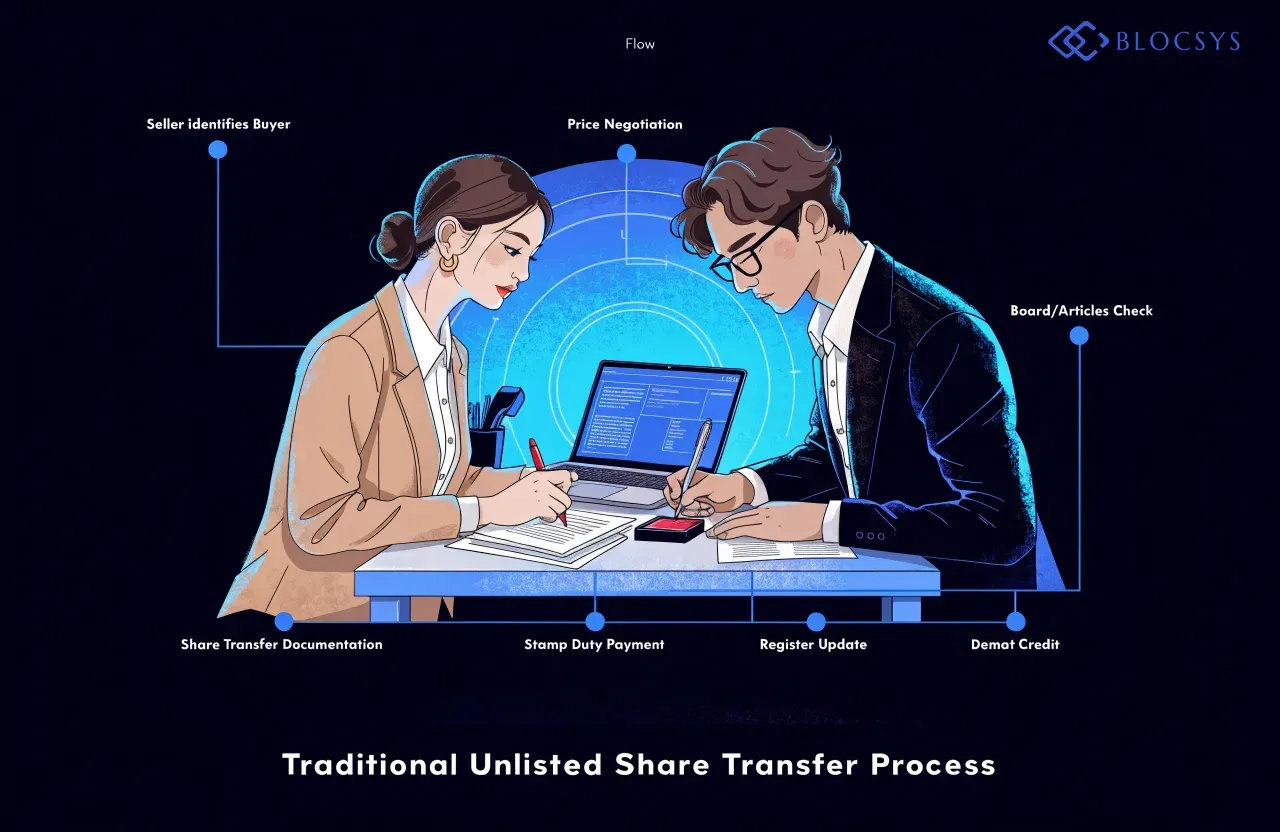
Private company valuation is rarely transparent. Furthermore, closing a transfer involves share transfer forms, stamp duty, board approvals and demat credit. Each step adds delay.
These problems point to a need for more structured private-market infrastructure. That’s where tokenization enters the conversation.
What Is Equity Tokenization and How Does It Work for Unlisted Companies?
Equity tokenization represents eligible equity interests or ownership rights as blockchain-based digital tokens. The token is a digital record and management layer. It isn’t, by itself, the legal share.
That distinction is critical. The underlying security still depends on company law, the articles of association and securities regulation. The token must be linked to that legal interest through a clear structure. Otherwise it’s just a digital entry with no enforceable meaning.
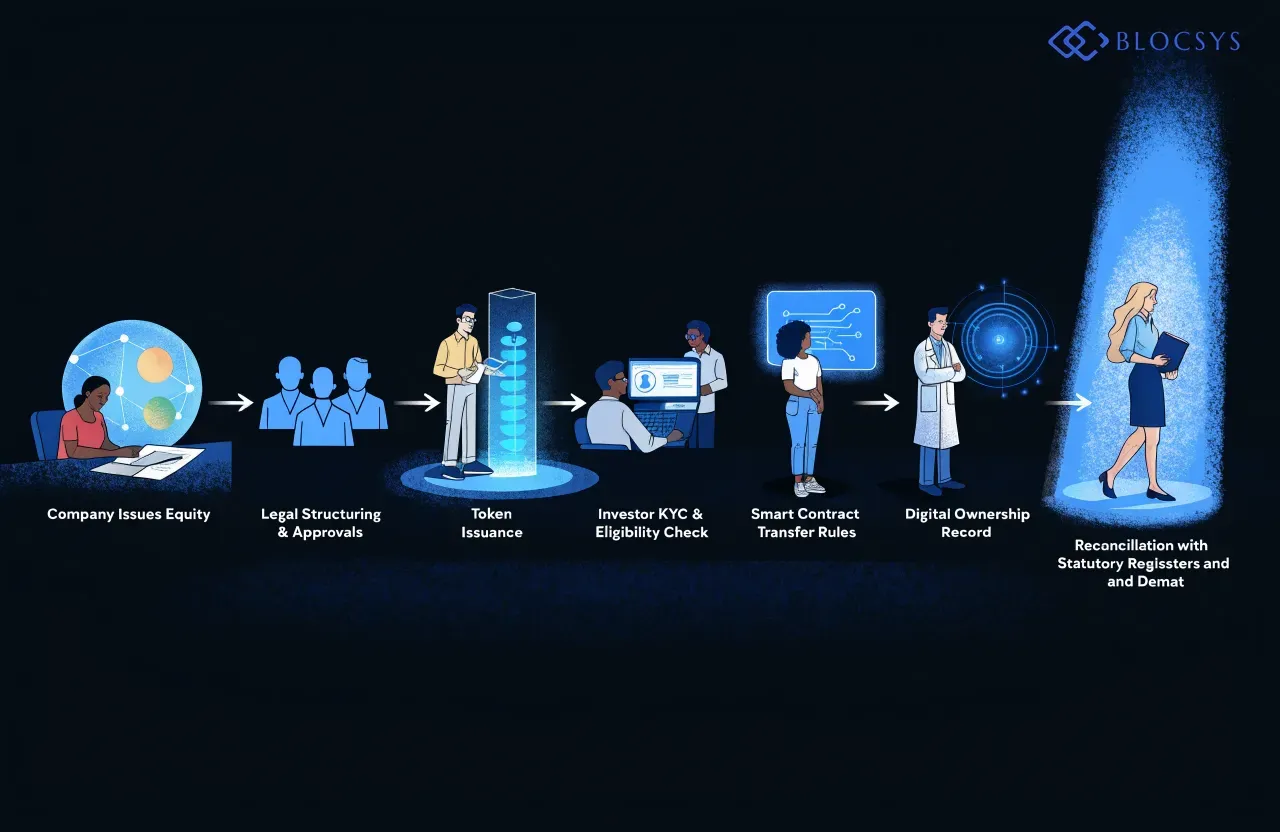
A workable platform typically combines four things. Token issuance records the equity. Smart contracts enforce predefined rules, such as who can hold or receive tokens. Investor onboarding handles identity and eligibility checks. Finally, a digital ownership record tracks holdings over time.
Consider a hypothetical example. A Pune-based manufacturing company wants to bring in ten eligible investors through a private placement. Its platform verifies each investor, records the allotment digitally and restricts transfers to approved wallets. The statutory registers and demat requirements still apply alongside it.
A token is a ledger entry, not a legal shortcut. The strongest tokenization projects start with the legal structure and work backwards to the technology.
How Equity Tokenization for Unlisted Companies Could Transform Investment
This is where the real potential sits. Equity Tokenization for Unlisted Companies could introduce more structured digital participation into a market that’s currently run on paperwork, emails and personal introductions.
Tokenizing existing shares versus issuing new tokenized equity
Two approaches exist, and they affect people differently. Tokenizing existing shares creates digital representations of equity that shareholders already hold. The capital structure doesn’t change, and no new money enters the company.
Issuing new tokenized equity interests works differently. The company raises fresh capital, and new holders may dilute existing shareholders. Rights, pricing and approvals must be defined upfront.
Therefore, founders should decide which problem they’re solving first. Is it cleaner records for existing holders, or new fundraising? The platform design follows from that answer.
Better administration and transparency
Digital ownership of unlisted shares can bring all holdings, transfers and approvals into one auditable record. Promoters see who owns what. Investors see their entitlements. Auditors see the transaction trail.
Moreover, smart contract-based equity management can encode transfer conditions. For example, a lock-in period, a right of first refusal or an investor eligibility check can run automatically before a transfer is processed. That cuts manual follow-ups.
Investor access and onboarding
Investor access to unlisted shares could improve when onboarding and KYC sit inside one platform. Eligible investors could review company information and complete documentation digitally. The scope depends on the issuance structure and applicable eligibility rules.
Importantly, this doesn’t open unlisted shares to everyone. It makes a restricted, permitted process easier to run.
Fractional representation
Fractional equity representation is often cited as a benefit. Suppose a token represents a tenth of a share’s economic interest. That sounds like fractional ownership.
However, dividing a token doesn’t automatically create legally recognised fractional share ownership. Indian company law doesn’t generally recognise fractions of a share that way. Any such structure needs careful legal design, possibly through a trust or pooled vehicle, with professional advice.
What each party could gain
Companies could gain cleaner cap-table management and organised investor communication. Existing shareholders could gain clearer transfer workflows and visibility. Investors could gain structured onboarding and a consolidated record of their holdings.
Notice that none of these gains guarantees returns. They improve process, not business performance.
How Can Equity Tokenization Improve Liquidity in Unlisted Shares?
It can improve the administration of transfers, but it can’t create buyers. Technical transferability and market liquidity aren’t the same thing. Confusing them is the most common mistake we see.
Real liquidity depends on five factors. You need eligible buyers and eligible sellers. You need active market participation. You need a price both sides accept. You need transfer restrictions to allow the deal. And you need authorised trading infrastructure.
A blockchain platform can help with some of this. It can support investor discovery among registered participants, organise transfer requests and keep a transparent transaction record. Additionally, blockchain-based transaction settlement can shorten reconciliation steps once the legal framework permits it.
Still, a token that can move between wallets in seconds is worthless if nobody wants to buy it. Likewise, a shareholder bound by a lock-in can’t sell, regardless of technology.
So treat tokenization as one of several private market liquidity solutions. It’s an enabler of organised secondary-market infrastructure, not a promise of an active secondary market for unlisted shares.
How Can Unlisted Companies Use Equity Tokenization to Access Investors?
Start by separating two activities. Primary issuance is where the company raises new capital by issuing securities. Secondary transactions are where existing shareholders transfer holdings to someone else, and the company receives no new funds.
They serve different needs. A founder funding a new factory cares about primary issuance. An early investor seeking an exit cares about secondary transfers. Platforms should handle both, but with different workflows.
For primary issuance, Section 42 of the Companies Act, 2013 and the related Prospectus and Allotment of Securities Rules govern private placements. Offers generally go to identified persons, with limits on the number of offerees per financial year and specific documentation and payment-channel requirements. A public offer, by contrast, follows a different route, including SEBI’s ICDR Regulations.
Where can digital infrastructure help? It can organise investor information, track offer letters, record allotments and manage ownership data. Private company fundraising becomes easier to administer.
However, it doesn’t turn a private placement into a public fundraising route. Tokenization can’t widen the eligible investor pool beyond what the law allows.
Traditional Unlisted Share Investment vs Tokenized Equity
Here’s a fair comparison. Each model has strengths, and neither is automatically better.
- Ownership record: Traditional shares use statutory registers and demat accounts. Tokenized equity adds a digital ledger that must reconcile with those registers.
- Onboarding: Traditional onboarding is manual and varies by company. Platforms can standardise KYC and eligibility checks.
- Transfers: Traditional transfers involve physical or demat paperwork and approvals. Smart contracts can pre-check conditions, though legal approvals remain.
- Transparency: Traditional records sit with the company and depositories. A shared ledger can give permissioned participants a consistent view.
- Fractions and settlement: Traditional shares are whole units. Tokens can be divided technically, but legal recognition isn’t automatic.
Blockchain offers operational advantages in recordkeeping and workflow automation. Conversely, traditional infrastructure remains necessary for legal title, depository functions and regulatory reporting. Tokenized equity isn’t inherently more liquid, safer or more profitable.
The question isn’t whether blockchain replaces the existing securities stack. It’s whether it can sit alongside that stack and remove friction without removing accountability.
Regulatory and Compliance Considerations for Equity Tokenization in India
Can unlisted shares be tokenized in India? I can’t point you to a dedicated, fully regulated public framework for tokenized private-company equity. Therefore, treat any model as subject to existing law and confirm the latest position with qualified counsel before building.
Several existing provisions matter. The Companies Act, 2013 governs share issuance, private placements under Section 42, transfer rules and statutory registers. The Ministry of Corporate Affairs (MCA) administers the Act and its rules, including dematerialisation requirements for unlisted companies.
SEBI regulates securities markets, including the ICDR Regulations for public issues. The Depositories Act, 1996 governs depositories like NSDL and CDSL, which hold securities in electronic form. Recognised stock exchanges like NSE and BSE operate regulated trading venues for listed securities.
Why can’t any blockchain platform simply issue and trade tokenized securities? Because tokens linked to securities don’t escape securities law. Issuance, transfer restrictions, investor eligibility and disclosures still apply. Blockchain tokens don’t independently replace statutory registers, depositories or legally required ownership records.
Practically, a compliant design needs identity verification, eligibility screening, enforceable transfer restrictions and reconciliation with statutory records. Also, distinguish private placements, public issues, secondary transfers and token representation. Each has different rules.
Finally, this isn’t legal advice. Consult your legal team and, where relevant, engage regulators early.
Technology Infrastructure Required for an Unlisted Equity Tokenization Platform
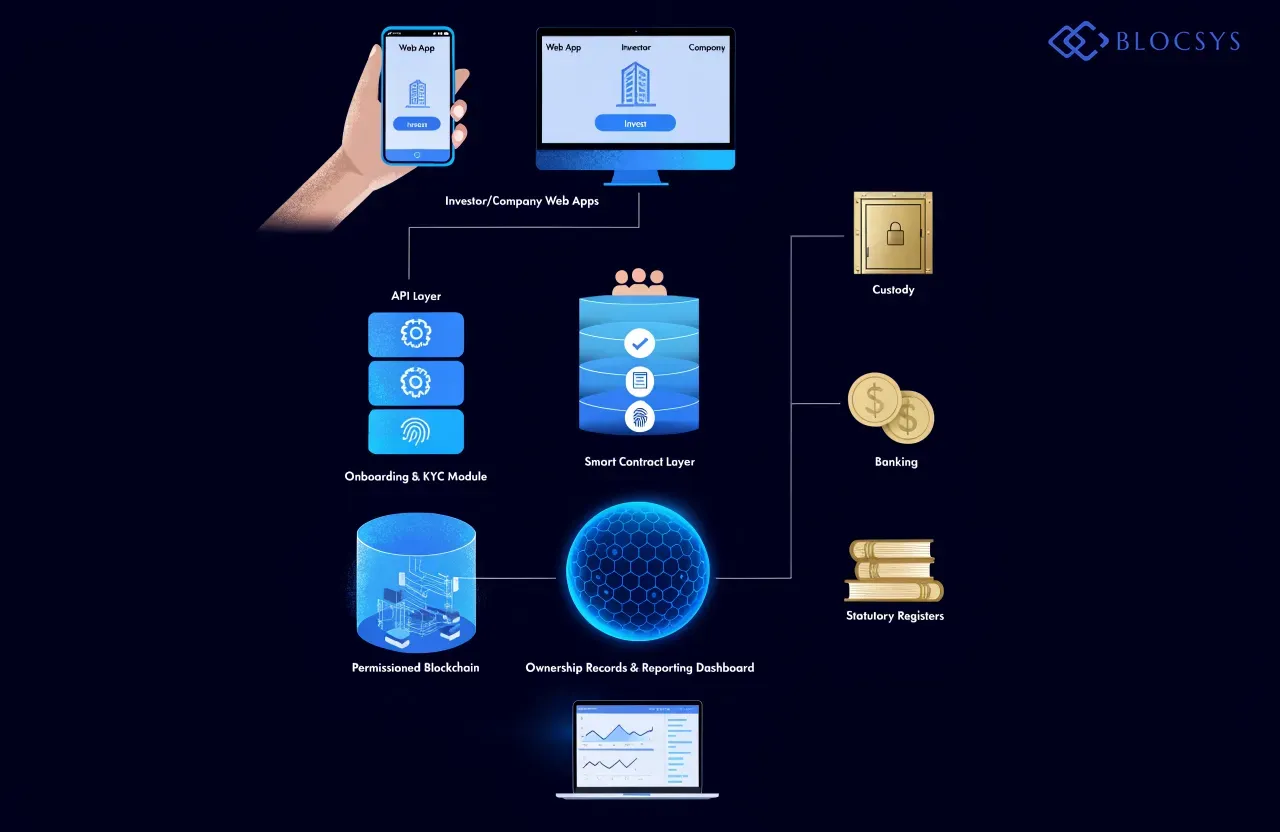
Which components does a serious platform need? Start with blockchain architecture. Permissioned networks are often considered for regulated equity because they control who participates. However, choosing a network doesn’t establish compliance.
Smart contracts then encode token rules, such as transfer restrictions and role-based permissions. Token issuance and management modules handle allotments, cap-table updates and corporate actions.
The onboarding layer covers investor identity verification, KYC and eligibility records. Meanwhile, transaction monitoring, reporting tools and administrative dashboards give companies and compliance teams oversight. Custody integrations and banking or payment connections tie the platform to the wider financial system.
Security, privacy and auditability aren’t optional. Shareholder data is sensitive, so access controls and encryption matter. Scalability matters too, especially for platforms serving multiple issuers.
Architecture also varies by goal. An equity issuance platform focuses on onboarding and allotment. A shareholder management system prioritises records and transfer workflows. A broader digital securities ecosystem adds multiple issuers, secondary-transfer modules and institutional integrations. Likewise, India’s work on digital securities infrastructure, such as Demat 2.0, Tokenization & CBDC Integration, shows how connected these layers can become.
Challenges and Risks of Equity Tokenization for Unlisted Companies
Let’s be realistic. Regulatory clarity is the first hurdle. Secondary-market permissions, transfer restrictions and legal structuring all need resolution before launch.
Second, private-company information stays limited. A digital record doesn’t make a business transparent. Valuation uncertainty remains, even when infrastructure improves.
Third, practical risks pile up. Cybersecurity, custody arrangements and technology integration with registrars and banks take effort. Shareholders must also accept new processes, and market adoption isn’t guaranteed.
Above all, tokenization can’t remove investment risk. Companies can underperform. Investors can lose money. Exits can fail. Businesses should evaluate legal, financial, operational and technology requirements together before committing to Equity Tokenization for Unlisted Companies.
The Future of Unlisted Equity Investment and Digital Securities in India
Where might this go? Nobody can promise approvals or adoption. Still, interest in digital securities infrastructure is growing globally, and Indian institutions are watching closely.
Several players will shape outcomes. Regulators set the boundaries. Depositories and exchanges decide how digital records connect to existing systems. Financial institutions and intermediaries bring investors. Technology providers build the rails.
Meanwhile, today’s capabilities are already useful. Digital onboarding, ownership records and workflow automation work now. Broader secondary-market models remain potential future developments, dependent on regulation and participation.
Equity Tokenization Platform Development Services Offered by Blocsys
Blocsys is a technology development company working in blockchain development, digital asset platform development, tokenization solutions, smart contract development and custom software development. We build the technology layer. We don’t provide legal advice, brokerage, investment banking, depository or stock exchange services.
For equity projects, that means designing blockchain architecture, writing smart contracts and building token issuance infrastructure. It also covers investor-facing applications, backend systems, administrative dashboards, API development and third-party integrations.
Architecture follows your model. A promoter-led private company needs something different from a fintech platform serving several issuers. We plan around your users, security needs and the regulatory framework your legal advisers identify. Related capabilities include asset tokenization platform work and corporate bond tokenization, which is a separate product category from equity.
Why Choose Blocsys for Equity Tokenization Platform Development?
You want a partner who understands that technology serves a business problem. Blocsys approaches platform builds as custom engineering rather than template installs. Your ownership workflows, approval chains and reporting needs shape the design.
Specifically, our team brings experience across blockchain development, smart contracts, backend systems and web applications. Consequently, one team can deliver the ledger, the interface and the integrations.
Scalability and security guide each decision. We don’t claim regulatory approvals, and we don’t promise liquidity, returns or fixed timelines. We focus on building secure, scalable infrastructure that your legal and compliance advisers can work with.
Conclusion: How Equity Tokenization for Unlisted Companies Could Shape the Future
Unlisted companies need capital. Their shareholders want exit options. Investors want access and clarity. Today’s processes serve these needs slowly and unevenly.
Equity Tokenization for Unlisted Companies could improve digital ownership representation, investor onboarding and transaction administration. It might also support more organised secondary-market infrastructure. However, success depends on legal structuring, regulatory compliance, eligible market participation and reliable technology.
Digital equity infrastructure may become one part of India’s evolving private equity market. Exploring equity tokenization for your unlisted company? Connect with Blocsys to discuss your digital equity platform requirements, blockchain architecture, smart contract infrastructure and technology development approach. You can also review our equity tokenization platform development page as a next step.
Frequently Asked Questions
Here are direct answers to the questions we hear most often about equity tokenization and unlisted companies.
What is equity tokenization for unlisted companies?
It’s the representation of eligible equity interests in a private or unlisted company as blockchain-based tokens. The token supports digital records and workflows, while the legal security remains governed by Indian law.
How does equity tokenization work for private companies?
The company structures the offering legally, then issues tokens linked to the equity. Investors complete KYC, smart contracts apply transfer rules, and a digital ledger records ownership alongside statutory registers.
Can unlisted company shares be tokenized in India?
There’s no dedicated framework I can confirm for tokenized private-company equity. Any model must comply with the Companies Act, 2013, SEBI rules and depository requirements. Take legal advice before proceeding.
How can tokenization improve liquidity in unlisted shares?
It can make transfer administration, investor discovery and record-keeping more organised. However, liquidity still depends on eligible buyers, pricing, transfer restrictions and authorised trading infrastructure. It isn’t guaranteed.
Can investors buy tokenized shares of private companies?
Only where the structure is legally permitted and the investor meets eligibility rules. Tokenization doesn’t open private shares to the general public.
Can unlisted companies raise capital through equity tokenization?
Possibly, through compliant private placements, where a platform helps administer investor onboarding and allotment records. It doesn’t create an unrestricted public fundraising route.
What is the difference between unlisted shares and tokenized equity?
Unlisted shares are the legal securities of a company not listed on an exchange. Tokenized equity is a digital representation or management layer linked to such securities. The token doesn’t replace the underlying legal interest.
Is equity tokenization legal in India?
Legality depends on structure. Existing securities and company law applies, and no blanket permission exists simply because blockchain is used. Verify the current position with qualified legal counsel and, where needed, regulators.
Can existing shareholders tokenize their unlisted shareholdings?
That depends on the articles of association, company consent, transfer restrictions and applicable law. Shareholders shouldn’t act unilaterally. The company and its advisers must design the structure first.
How can a company develop an equity tokenization platform?
Begin with legal structuring and a clear business model. Then work with a technology partner like Blocsys to design architecture, smart contracts, onboarding flows, dashboards and integrations around your requirements.
Ready to move beyond theory and build an intelligent platform that delivers real-world value? Blocsys Technologies specialises in engineering enterprise-grade AI and blockchain solutions for the fintech, Web3, and digital asset sectors. Connect with our experts today to discuss your vision and chart a clear path from concept to a secure, scalable reality.