
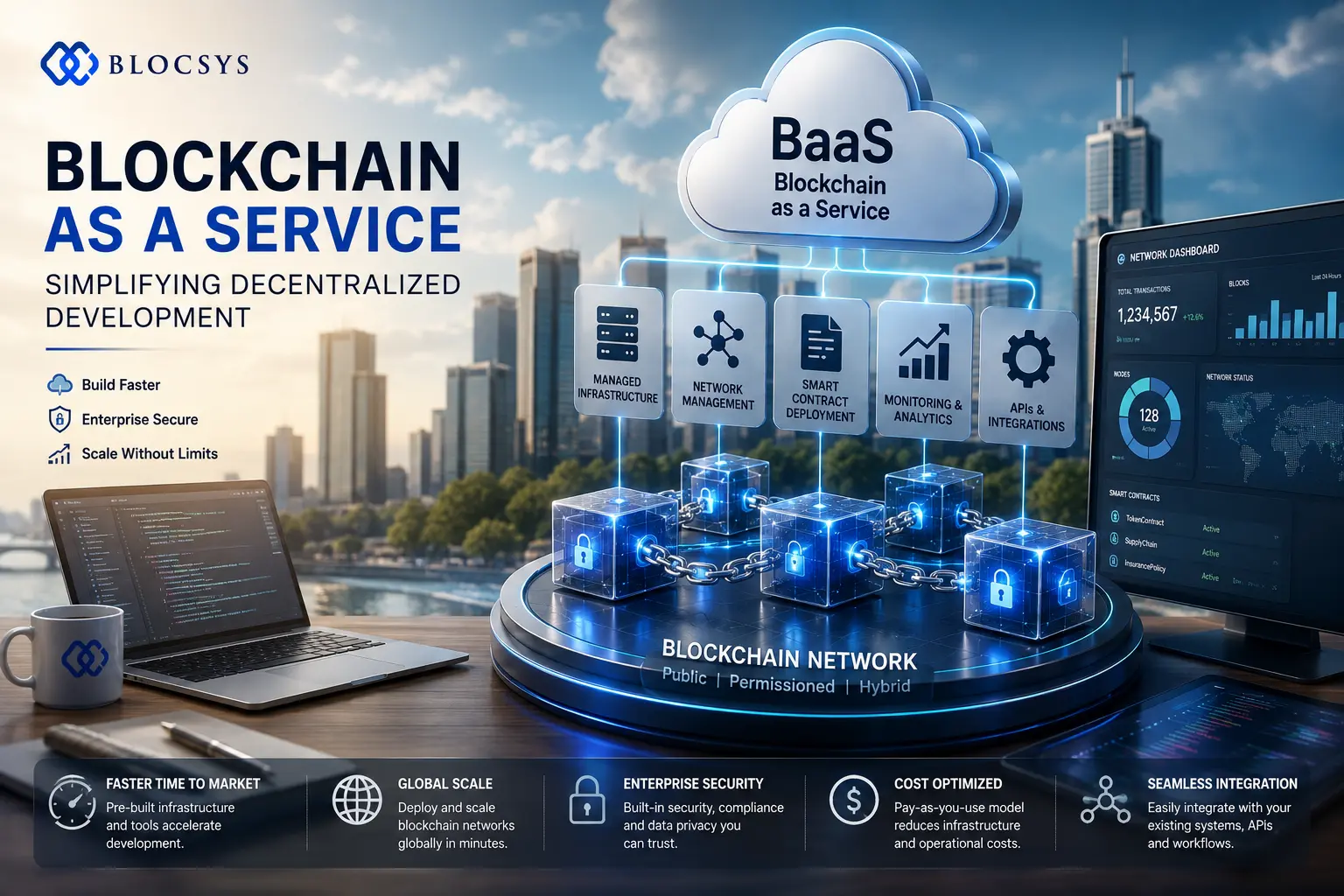
Building a blockchain network from scratch still scares off most enterprises, and honestly, it should. Running nodes, patching consensus bugs, and managing key infrastructure is a full-time job on its own. That’s exactly the gap Blockchain as a Service fills. It hands you managed nodes, ready-made APIs, and deployment tooling, so your team can focus on the application layer instead of the plumbing underneath it. If you’re weighing blockchain development options for 2026, understanding how BaaS actually works will save you months of infrastructure guesswork.
What Is Blockchain as a Service?
Blockchain as a Service is a cloud-based delivery model. A provider hosts, operates, and maintains the blockchain infrastructure, and you build on top of it through APIs, SDKs, and dashboards. Think of it the way you’d think about managed databases: you don’t rack servers, you just query the endpoint.
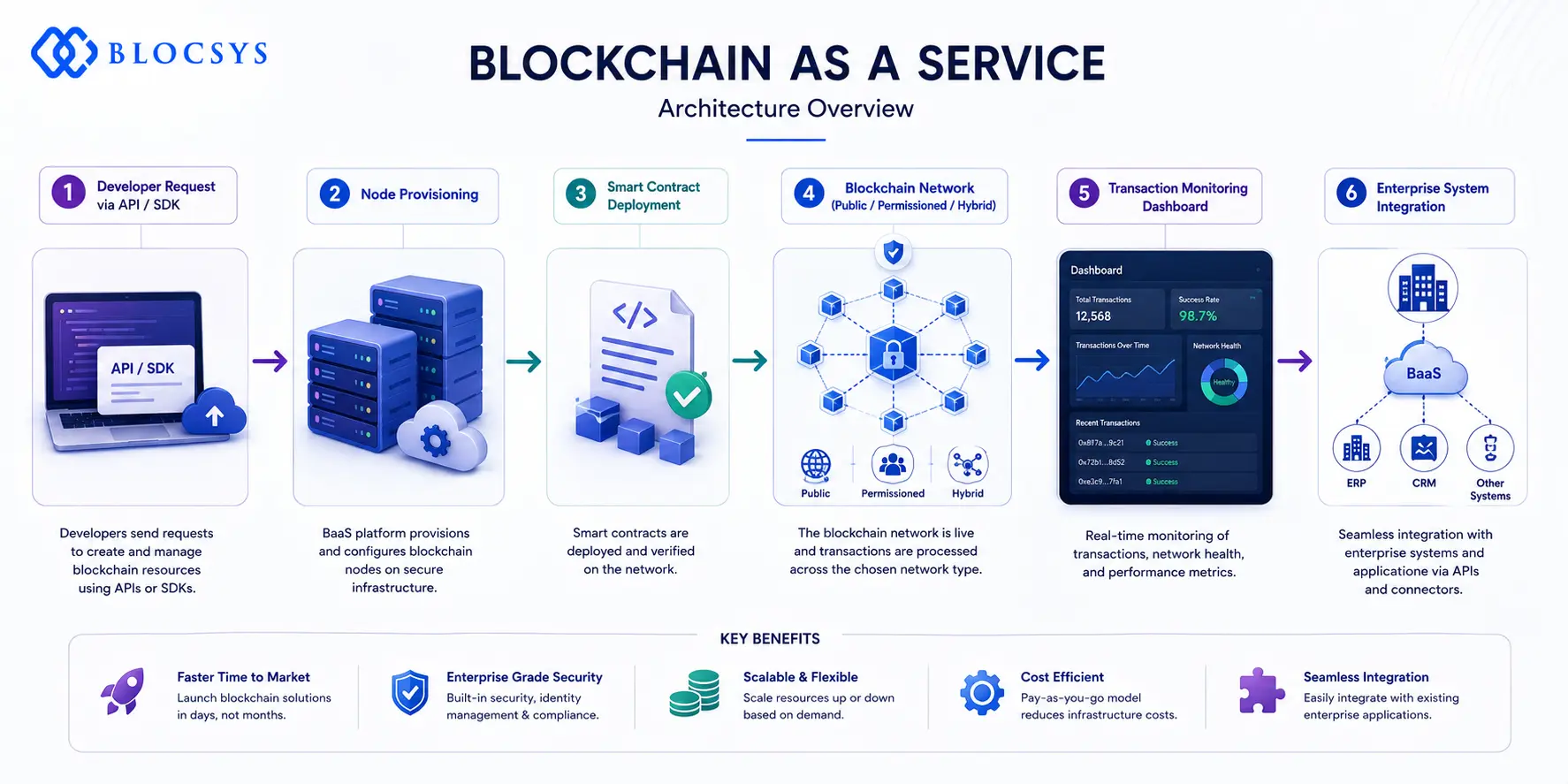
Under the hood, a Blockchain as a Service platform provisions nodes, handles consensus configuration, exposes RPC endpoints, and gives developers tools to deploy smart contracts without touching the underlying network layer. You still own your application logic and your data model. The provider owns uptime, patching, and node availability.
How Blockchain as a Service Works
Here’s the basic flow. You pick a network type, public, permissioned, or hybrid, and the BaaS platform spins up the nodes you need. From there, you interact through REST or gRPC APIs, an SDK in your language of choice, or a CLI that wraps the same endpoints.
Nodes, APIs, and RPC Endpoints
Every Blockchain as a Service provider runs full nodes or validator nodes on your behalf, then exposes RPC endpoints so your application can read chain state or submit transactions. Wallet integration, key management modules, and transaction monitoring dashboards typically ship alongside these endpoints. Smart contract deployment usually happens through a console or a pipeline hook, so your CI/CD process can push contract updates the same way it pushes application code.
Most enterprises don’t fail at blockchain because the technology is hard. They fail because they underestimate what running the infrastructure actually costs in engineering time. BaaS doesn’t remove that cost, it just moves it to someone whose entire job is running nodes reliably.
Blockchain as a Service vs Traditional Blockchain Infrastructure
Traditional blockchain infrastructure means your team provisions servers, configures consensus, sets up validator nodes, and handles every upgrade manually. It gives you full control but demands dedicated DevOps and blockchain engineering capacity around the clock.
A managed blockchain services model flips that. The provider handles node uptime, network monitoring, and version upgrades, while you consume the network through defined interfaces. This isn’t the same as generic SaaS, though. SaaS gives you a finished application; BaaS gives you infrastructure and tooling you still build applications on top of. Custom blockchain development sits at the other extreme, purpose-built architecture, tuned consensus, and full control over every layer, at a much higher upfront engineering cost.
Key Components of a Blockchain as a Service Platform
Most platforms in this space bundle a similar stack, even though implementation details vary between providers.
- Managed blockchain nodes across public, permissioned, or consortium networks
- APIs and SDKs for transactions, queries, and event subscriptions
- Smart contract deployment and versioning tools
- Wallet and key management modules
- Transaction monitoring and alerting dashboards
- Identity and access control layers
- Interoperability bridges or cross-chain messaging support
Together, these pieces form what most people mean when they say Blockchain as a Service platform, a managed layer between raw protocol code and your application.
Benefits of Blockchain as a Service
Speed is the obvious win. You can spin up a permissioned network in days rather than months, since node provisioning and network configuration happen through the provider’s tooling. Consequently, your developers spend their time writing application logic instead of maintaining infrastructure.
Operational complexity drops too. You’re not staffing a team purely to keep nodes online. Additionally, scaling becomes simpler, since most Blockchain as a Service providers let you add nodes or adjust throughput through configuration rather than physical provisioning. Easier integration with existing systems is another practical advantage, since most platforms ship connectors or well-documented APIs your engineering team can wire into ERP, CRM, or internal databases without reinventing the wheel.
Limitations and Challenges of BaaS
None of this comes free of trade-offs. Provider dependency is real. If your BaaS provider changes pricing, deprecates a feature, or shuts down a service line, you’re exposed. Vendor lock-in follows the same pattern, migrating a live network between providers is rarely trivial.
Customization is limited too. You’re working within whatever the provider’s platform allows, so highly specialized consensus rules or unusual network topologies may not fit. Compliance requirements can also get tricky. A provider hosting your nodes doesn’t automatically satisfy your regulatory obligations, you still own data residency, audit trails, and reporting. Pricing models vary widely between transaction-based, node-based, and flat subscription tiers, so cost forecasting takes real analysis before you commit.
Public, Permissioned, and Hybrid Blockchain Support in BaaS
A capable Blockchain as a Service provider should support more than one network architecture, since business requirements differ enormously.
Public blockchain support suits Web3 applications, tokenization projects, and anything needing open verifiability. Permissioned blockchain support suits supply chain consortiums, healthcare data sharing, and financial institutions that need known, vetted participants. Hybrid architectures blend both, keeping sensitive records on a permissioned layer while anchoring proofs or settlement data to a public chain for transparency. Choosing the right architecture upfront matters more than choosing the provider itself.
Blockchain as a Service Use Cases Across Industries
Supply chain traceability remains one of the strongest fits, since permissioned networks let manufacturers, distributors, and retailers share verified data without a central authority. Our Blockchain-Powered Organic Certification & Food Traceability Platform illustrates this pattern well, tracking certification status from farm to shelf on a managed network.
Financial services use BaaS for settlement and reconciliation workflows where permissioned nodes and controlled participant access matter more than public visibility. Our work on a Permissioned Blockchain Infrastructure for Capital Market Post-Trade Operations shows how a managed network handles trade matching without exposing sensitive counterparty data publicly.
Tokenization of real-world assets, digital identity verification, healthcare record sharing, payments infrastructure, and asset management platforms round out the common enterprise patterns. Document verification is another strong use case, our Tamper-Proof Document Verification Platform Built on Blockchain shows how a managed blockchain layer confirms document authenticity without a central registry owning the truth. Web3 applications, meanwhile, lean on public chain BaaS offerings for wallet connections, NFT minting, and decentralized application hosting.
Blockchain as a Service for Enterprise Blockchain Development
Enterprise teams rarely start from zero anymore. Instead, they pick a Blockchain as a Service platform, configure the network type, then bring in specialized engineering talent to build the application layer correctly.
That’s where working with experienced blockchain developers pays off. Platform tooling handles infrastructure, but architecture decisions, contract design, and integration logic still require real expertise. Many enterprises choose to hire blockchain developers specifically for this layer, since misconfigured smart contracts or poor API integration patterns can undo whatever time the managed infrastructure saved you.
Blockchain Security and Compliance in a BaaS Model
Here’s something that trips up a lot of teams: using a Blockchain as a Service provider does not automatically make your application secure or compliant. The provider typically secures node infrastructure, network uptime, and physical security. You still own private key management practices, smart contract auditing, API access control, and application-layer data handling.
Responsibility splits roughly like this: the provider handles node security, patching, and infrastructure monitoring. You handle key custody policy, smart contract review, access control configuration, backup strategy, and regulatory reporting. Disaster recovery planning matters on both sides, ask your provider what their failover guarantees actually cover before you assume anything.
The biggest security mistake we see isn’t a bad smart contract. It’s a company assuming their BaaS provider’s SOC 2 report covers their own compliance obligations. It doesn’t. Read the shared responsibility model line by line before you go live.
APIs, SDKs, and Enterprise Integrations
Good Blockchain as a Service platforms treat integration as a first-class concern. REST APIs and language-specific SDKs let your engineering team connect blockchain events to existing ERP, CRM, and database systems without custom middleware for every connection.
Smart contract deployment pipelines matter here too, since your application logic usually lives in contracts rather than the node layer itself. If your use case involves programmable business logic, escrow conditions, or automated settlement, proper smart contract development practices matter more than which cloud region hosts your nodes.
How to Choose a Blockchain as a Service Provider
Evaluate providers against a consistent framework rather than marketing claims. Here’s what actually matters:
- Supported networks, public, permissioned, and hybrid options
- Scalability under real transaction load, not just marketing benchmarks
- Security certifications, key management approach, and audit history
- API and SDK maturity, documentation quality, and language support
- Interoperability with other chains and enterprise systems
- Pricing structure and predictability at scale
- Compliance coverage across the regions you operate in
- Geographic availability and data residency options
- Support responsiveness and SLA terms
- Customization limits and exit or migration paths
Vendor lock-in deserves special attention. Ask directly how data and smart contracts migrate if you ever leave. If the answer is vague, treat that as a warning sign, not a technical footnote.
Blockchain as a Service vs Custom Blockchain Development
BaaS makes sense when speed matters, your architecture is fairly standard, and you don’t need unusual consensus mechanics. Custom blockchain development makes more sense when you need specialized throughput, a novel consensus model, or full control over every network parameter.
Many enterprises actually land somewhere in between, starting on a managed platform, then migrating specific components to custom blockchain development once their requirements outgrow what a shared platform can flex to support. That’s not a failure of BaaS, it’s a natural maturity curve for serious blockchain products.
How to Build a Blockchain Application Using BaaS
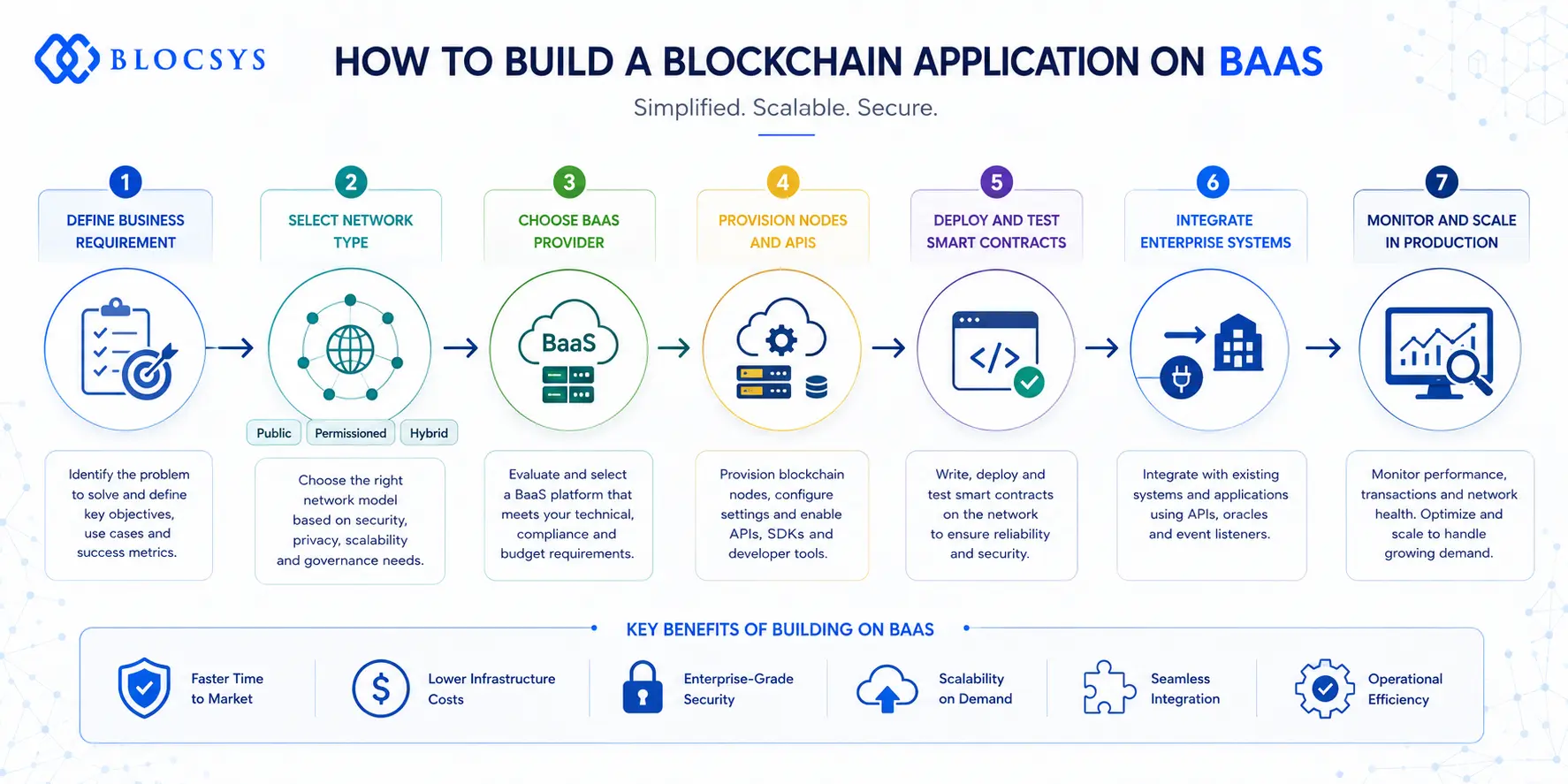
Start by defining your actual business requirement, not the technology. Then choose your network type: public, permissioned, or hybrid. Next, select a provider using the evaluation framework above, and provision your nodes and API access.
From there, deploy and test smart contracts in a staging environment before touching production data. Integrate wallet and key management into your application flow, then connect the network to your existing ERP, CRM, or internal systems. Finally, set up transaction monitoring and alerting before go-live, not after. Ongoing infrastructure management is real work, which is why many enterprises bring in a dedicated blockchain engineering team to own scaling and maintenance long-term.
The Future of Blockchain as a Service in 2026
The provider landscape has shifted noticeably from a few years ago. Microsoft retired Azure Blockchain Service back in 2021, and AWS has been winding down Amazon Managed Blockchain, steering customers toward specialized infrastructure providers instead. IBM has shifted its blockchain business toward consulting and Hyperledger-based enterprise engagements rather than a single packaged BaaS product.
In their place, specialized node and RPC infrastructure providers, along with enterprise consortium networks built on Hyperledger Fabric and Corda, have become the practical default for serious deployments. Interoperability standards are maturing too, so cross-chain messaging and multi-network deployments are becoming realistic options rather than experimental side projects. Expect more industry-specific managed networks, tighter compliance tooling, and better developer experience across the board through 2026.
Frequently Asked Questions
Here are direct answers to the questions we hear most often about Blockchain as a Service.
What is Blockchain as a Service in simple terms?
Blockchain as a Service is a managed model where a provider runs the nodes, network infrastructure, and maintenance, while you build applications on top through APIs and SDKs. It works similarly to a managed database, you don’t manage servers, you just connect and build. This lets development teams launch blockchain applications faster without hiring a full infrastructure team.
How does Blockchain as a Service differ from managed blockchain services?
The terms overlap heavily in practice. Managed blockchain services usually refers to the operational side, node uptime, patching, and monitoring, while Blockchain as a Service often includes broader tooling like SDKs, smart contract deployment pipelines, and wallet integration. Most current platforms bundle both under one offering, so the distinction matters more in vendor comparisons than in daily use.
Is Blockchain as a Service secure by default?
No, and this is a common misunderstanding. A BaaS provider typically secures node infrastructure and network uptime, but you still own private key management, smart contract auditing, access control, and application-layer security. Treat provider security certifications as a baseline, not a complete guarantee, and build your own security review process around it.
Can Blockchain as a Service support both public and permissioned networks?
Yes, most established providers support public, permissioned, and hybrid architectures. Your choice depends on the business requirement, public chains suit open, verifiable Web3 applications, while permissioned networks suit consortiums like supply chain or financial settlement groups where participants need to be known and vetted in advance.
What is the biggest risk of using a Blockchain as a Service provider?
Vendor lock-in tops the list. If migrating your network, contracts, or data away from a provider is difficult, you lose negotiating leverage and flexibility over time. Always confirm migration paths, data portability, and exit terms before committing, and avoid providers who can’t give you a clear answer on this point.
When should a business choose custom blockchain development instead of BaaS?
Choose custom development when you need specialized consensus mechanics, unusual throughput requirements, or complete control over every network parameter. BaaS fits standard architectures where speed to market matters more than deep customization. Many enterprises start on a managed platform, then migrate specific high-demand components to custom infrastructure as requirements grow.
How much does Blockchain as a Service typically cost?
Pricing varies by provider and usually falls into transaction-based, node-based, or flat subscription models. Costs depend on network type, node count, transaction volume, and support tier. Since public pricing pages rarely reflect real production costs, request a detailed quote based on your actual expected usage before comparing providers.
Do smart contracts still need auditing on a BaaS platform?
Absolutely, yes. A BaaS provider deploys and hosts your smart contract, but it doesn’t review your contract’s logic for vulnerabilities. Reentrancy bugs, access control flaws, and logic errors are your responsibility to catch through independent auditing, regardless of which platform hosts the deployed contract.
What industries benefit most from Blockchain as a Service today?
Supply chain traceability, financial services settlement, healthcare data sharing, digital identity, asset tokenization, and document verification consistently show the strongest results. These use cases benefit from permissioned or hybrid networks where verified participants share trusted data without needing a fully public chain or building infrastructure from scratch.
Do I still need blockchain developers if I use a BaaS platform?
Yes, infrastructure is only part of the equation. Smart contract design, integration architecture, API security, and business logic still require skilled engineers. A BaaS platform removes the burden of running nodes, but building a correct, secure application on top of it still demands real blockchain development expertise.
Getting Started with Blockchain as a Service
Blockchain as a Service won’t magically solve every infrastructure problem, but it removes a genuine barrier for teams that don’t want to run nodes themselves. Used well, it lets you ship faster, scale more predictably, and integrate blockchain into systems you already run. Used carelessly, it just relocates your infrastructure risk to a vendor contract you haven’t read closely enough.
If you’re weighing BaaS against custom infrastructure, or you need help architecting the application layer correctly, our blockchain development team can walk through your specific requirements. And if budget planning is part of your next step, the Blocsys Software Development Cost Estimator gives you a realistic starting point before you commit to a platform or a build.
Ready to move beyond theory and build an intelligent platform that delivers real-world value? Blocsys Technologies specialises in engineering enterprise-grade AI and blockchain solutions for the fintech, Web3, and digital asset sectors. Connect with our experts today to discuss your vision and chart a clear path from concept to a secure, scalable reality.
