

Most business problems don’t need blockchain. India’s blockchain market was valued at USD 1,088.0 million in 2025, while its fintech-blockchain segment was valued at USD 0.35 billion in 2024 and projected to reach USD 1.87 billion by 2030, which shows why implementation demand is growing, not why every workflow needs a distributed ledger. IMARC’s India blockchain market estimate supports the opportunity, but a consultant’s first job is still to test whether blockchain creates more value than a conventional database.
That distinction matters to CIOs, CTOs, product leaders, founders, and transformation teams across the USA, UK, UAE, Germany, Singapore, Canada, Australia, and India. Blockchain business consulting starts with an operational problem, maps the people and systems involved, compares alternative technologies, and produces a defensible path from business requirement to use case, proof of concept, and implementation.
Table of Contents
- Why Most Blockchain Projects Start With the Wrong Question
- How Consultants Identify Business Problems Worth Solving
- Blockchain Versus Traditional Database Assessment
- Evaluating Technical and Business Feasibility
- Real-World Blockchain Use Cases Across Industries
- Moving From Use Case to Proof of Concept
- When to Engage a Blockchain Consulting Partner
Why Most Blockchain Projects Start With the Wrong Question
The popular question is, “What can blockchain do for us?” It sounds appealing, but it often produces a catalogue of fashionable ideas rather than a useful investment decision. Teams select tokenisation, supply chain tracking, or digital identity before they’ve established whether the underlying process has a trust, reconciliation, or audit problem that a distributed ledger can address.
The better question is narrower: Which business problem requires shared, tamper-evident records across parties that don’t fully control one another? If one organisation owns the process, controls the database, and can enforce data quality internally, blockchain may add cost and governance overhead without improving the outcome.
Practical rule: Start with the failure in the workflow, not with the features of the protocol.
From technology curiosity to operational evidence
A useful discovery process examines where employees re-enter information, where organisations reconcile conflicting records, where approvals depend on unverifiable documents, and where participants lack a shared version of an event. Those symptoms may point to a blockchain use case, but they may also indicate poor integration, weak master data, unclear ownership, or an outdated process.
Experienced consultants separate those causes before recommending architecture. A shared ledger can preserve a common history, but it can’t verify whether a supplier entered false information at the source, repair an ineffective approval policy, or replace legal agreements between participants.
The shift from pilots to commercial systems is visible in India’s expanding market. The gap between USD 350 million in 2024 and a projected USD 1.87 billion in 2030 implies more than a fivefold expansion over six years, according to IMARC’s India blockchain market forecast. That opportunity is strongest where engineering must connect blockchain with identity, compliance, registries, payments, and enterprise applications.
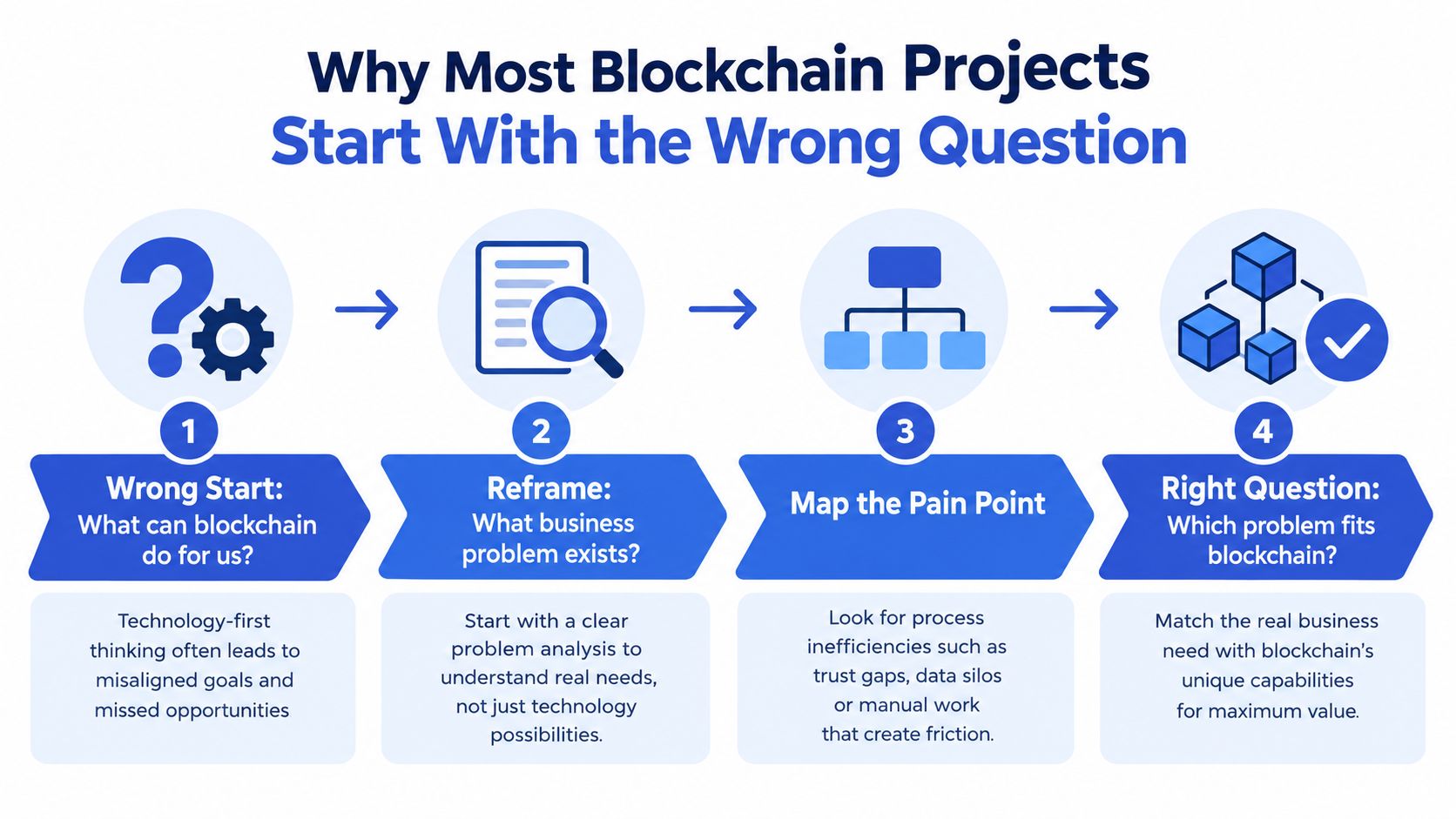
The result is a more disciplined form of blockchain use case consulting. Instead of promising transformation, the consultant identifies the process constraint, measures its business significance, tests alternative solutions, and recommends blockchain only when its distinctive properties justify the additional complexity.
How Consultants Identify Business Problems Worth Solving
Blockchain use case assessment begins with process discovery. A consultant interviews the people who perform, approve, audit, and receive the output of a workflow. That group often includes operations teams, finance, legal, compliance, technology, external partners, and customers, because the visible problem in one department may originate in another organisation’s system.
Start with the workflow, not the ledger
The first deliverable is usually a current-state map. It should show:
- Participants: Who creates, changes, approves, consumes, and disputes each record?
- System boundaries: Which ERP, CRM, banking, custody, identity, or document systems hold relevant data?
- Control points: Where do approvals, signatures, sanctions checks, reconciliations, and exception reviews occur?
- Failure points: Where do delays, duplicate records, disputes, manual re-entry, and missing evidence appear?
- Economic impact: Which costs can the organisation measure, such as staff time, delayed settlement, investigation effort, or exposure to fraud?
The key distinction is between an internal efficiency problem and an inter-organisational trust problem. A slow approval queue may need workflow automation. Conflicting records between a manufacturer, logistics provider, insurer, and buyer may justify a shared record, provided each participant agrees on data standards and governance.
Consultants then trace the data lifecycle. They ask what must remain private, what can be shared, who can write to the system, whether historical records need correction, and how the organisation will handle keys, permissions, retention, and recovery. Blockchain stores selected evidence and state transitions, not every document or database field.
Test the reason for shared control
A candidate deserves deeper analysis when several independent parties need a common history but don’t want one participant to control it unilaterally. The case becomes stronger when reconciliation is frequent, disputes are expensive, and an auditable sequence of events matters.
A practical engagement should leave decision-makers with a ranked shortlist, not a generic list of blockchain use cases. Each candidate should state the problem, affected parties, required data, proposed control model, alternative solution, risks, and evidence needed for a proof of concept.
Where the assessment supports a build, Blockchain Development can involve public, private, or hybrid networks, depending on the required access model, performance, privacy, and governance. Development should follow the validated process design, not substitute for it.
Blockchain Versus Traditional Database Assessment
Blockchain is a shared ledger with governance and validation rules distributed across participating parties. A traditional database is usually controlled by one organisation or a clearly designated operator. The choice depends less on novelty than on who needs to trust which record, and why.
A central database is often the better option when one business owns the workflow, can enforce access, and needs fast changes or complex queries. Blockchain becomes more relevant when multiple parties write to a shared history, each party needs assurance that others can’t rewrite it without detection, and a neutral or jointly governed record reduces reconciliation.
A practical comparison
| Evaluation Criteria | Blockchain Suitable | Traditional Database Suitable |
|---|---|---|
| Participants | Several organisations need to write or verify shared records | One organisation owns the process and data |
| Trust model | Participants have limited mutual trust and need common validation | A trusted operator can enforce the rules |
| Auditability | The sequence of approvals, transfers, or events must be tamper-evident | Standard logs and access controls provide enough evidence |
| Reconciliation | Teams repeatedly compare separate records across organisational boundaries | A single source of truth already exists |
| Data control | Shared facts can be exposed selectively through permissions | Data must remain within one controlled environment |
| Change requirements | Business rules and state transitions are stable enough to encode | Records change frequently or require unrestricted correction |
| Operating model | Governance can be agreed across participants | A central owner can make decisions quickly |
The assessment should also consider latency, privacy, transaction costs, integration effort, recovery procedures, and the consequences of an incorrect input. A blockchain won’t make bad source data trustworthy. It can preserve the submitted record and its history, which is useful only when the participants have credible capture and verification controls.
For a plain-language explanation of the underlying ledger model, how blockchain works for yield seekers provides useful background. Business leaders should then translate that technical model into governance questions, including who operates nodes, who approves protocol changes, and who handles disputes.
The central decision isn’t “blockchain or no blockchain” in the abstract. It’s whether distributed control solves a specific coordination problem better than a central system. A structured blockchain versus traditional systems review keeps that comparison explicit before budget moves to architecture.
Evaluating Technical and Business Feasibility
A strong business case can still fail in implementation. The review must establish whether the organisation can operate the network, connect it to existing systems, meet legal obligations, and change the process without creating another bottleneck.

Four dimensions of a serious feasibility review
Technical feasibility examines transaction volume, privacy, identity, key management, interoperability, smart contract logic, data storage, resilience, and observability. It also determines whether a public, permissioned, or hybrid network fits the participants and workflow. Public infrastructure can support wider composability. Permissioned infrastructure may provide better control over membership and confidential business activity.
Integration feasibility often determines the project’s practicality. The solution may need connections to ERP records, payment rails, custody platforms, APIs, IoT devices, document repositories, identity providers, tax systems, or government registries. Consultants specify which events belong on-chain, which information remains off-chain, how identifiers stay synchronised, and how the process operates when an upstream system is unavailable.
Regulatory feasibility depends on the use case and jurisdiction. In India, the Finance Act 2022 introduced a 30% flat tax on income from virtual digital asset transfers and a 1% TDS regime on qualifying transactions, effective from April 1, 2022 and July 1, 2022 respectively, as documented in this parliamentary and regulatory discussion. On March 7, 2023, VDA service providers came under the Prevention of Money Laundering Act, adding reporting and oversight responsibilities.
For VDA businesses in India, compliance architecture must support more than written policies. Providers must register with FIU-IND, retain transaction records for at least five years, monitor activity, and report suspicious transactions, according to India’s fintech legal and regulatory overview. Systems therefore need audit trails, risk scoring, evidence capture, access controls, and review workflows.
Business readiness determines the outcome
Governance and adoption affect feasibility as much as engineering. Participants must agree to provide the required data, legal teams must define what a digital record represents, and operations staff should not maintain parallel manual processes indefinitely. Set decision rights, onboarding responsibilities, dispute procedures, support ownership, and measurable success criteria before choosing a chain.
The implementation plan should also identify dependencies outside the project team’s control, such as regulatory approvals, partner participation, and changes to legacy systems. A structured enterprise blockchain solutions, architecture, and implementation guide can help connect these technical, regulatory, and operational decisions. The final recommendation should state what is feasible now, what requires approval, and what should remain outside the blockchain.
Real-World Blockchain Use Cases Across Industries
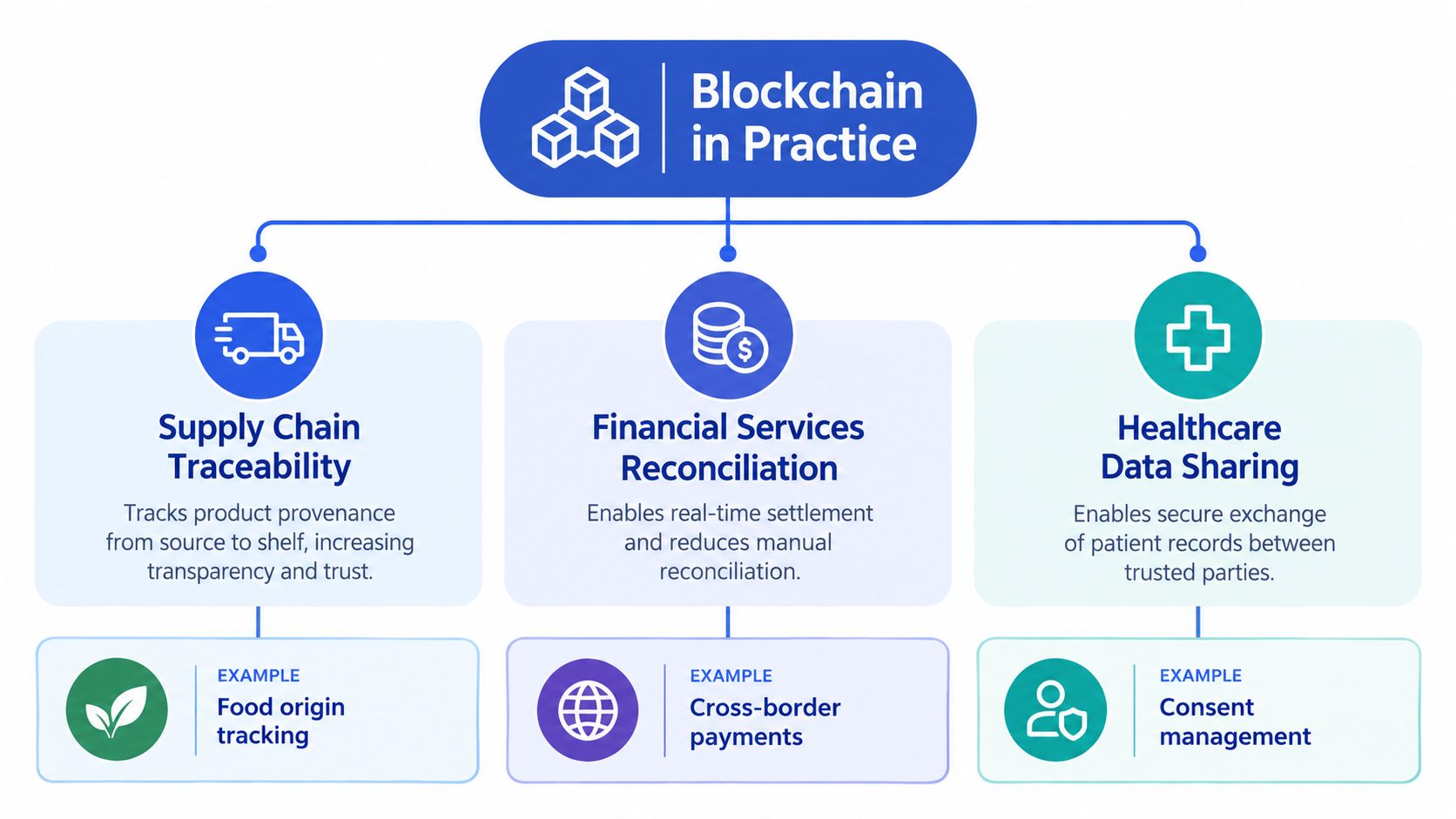
Blockchain should enter the discussion only after a business inefficiency is clear. The strongest candidates involve several independent parties, repeated reconciliation or verification, and agreed rules for who may create, update, or inspect each record. If one organisation controls the workflow and a conventional database already provides adequate auditability, blockchain may add cost without solving the underlying problem.
Supply chain and provenance
A manufacturer may need to prove a component’s origin, the organisations that handled it, and whether required checks occurred. A blockchain record can connect approved events from suppliers, logistics providers, inspectors, and buyers. Source documents and sensitive information can remain in controlled systems.
The benefit comes from a shared event history that reduces disputes and supports evidence-based compliance. It does not come from placing every supply chain record on-chain. Sensors, scanning procedures, supplier attestations, and audit controls still determine whether the recorded events deserve trust.
Financial services and digital assets
Financial institutions often reconcile positions, ownership, transfers, and settlement instructions across separate systems. A shared ledger can reduce duplicate representations of the same asset or obligation, provided participants agree on identity, permissions, finality, exception handling, and legal enforceability.
Digital asset platforms require the same discipline at a broader operational level. Custody, wallet permissions, transaction monitoring, sanctions screening, tax reporting, and recovery procedures must be designed alongside smart contracts. A product that processes transactions while keeping compliance evidence outside the operating workflow is incomplete.
India’s regulatory milestones show why infrastructure and compliance must be planned together. By FY 2024–25, parliamentary data reported ₹511.8 crore in TDS collection from crypto trades, implying transaction volume of about ₹51,180 crore under the 1% mechanism. The figures indicate a market where transaction systems and regulatory operations increasingly depend on one another.
Identity, documents, and tokenisation
Universities, employers, courts, banks, and public bodies may need to verify that an authorised institution issued a document and that it has not been altered. Blockchain can anchor a verification event or credential status, while personal information stays protected off-chain.
Tokenisation applies the same record-sharing principle but introduces legal and financial questions. India’s policy direction highlights land, MSME invoices, certificates, and municipal bonds as potential tokenisation areas requiring registry integration and legal identity binding, according to PwC’s analysis of tokenised assets in India. A token has practical value only when the underlying right, transfer rules, investor eligibility, and redemption process are defined.
Tokenization Platform Development describes platforms for real-world assets, securities, real estate, commodities, and digital assets using enterprise blockchain technology. Teams can also review blockchain use cases for 2026 as a reference, then test each option against a documented business problem, participant model, and feasibility assessment.
The following video offers a visual introduction to practical blockchain applications:
Moving From Use Case to Proof of Concept
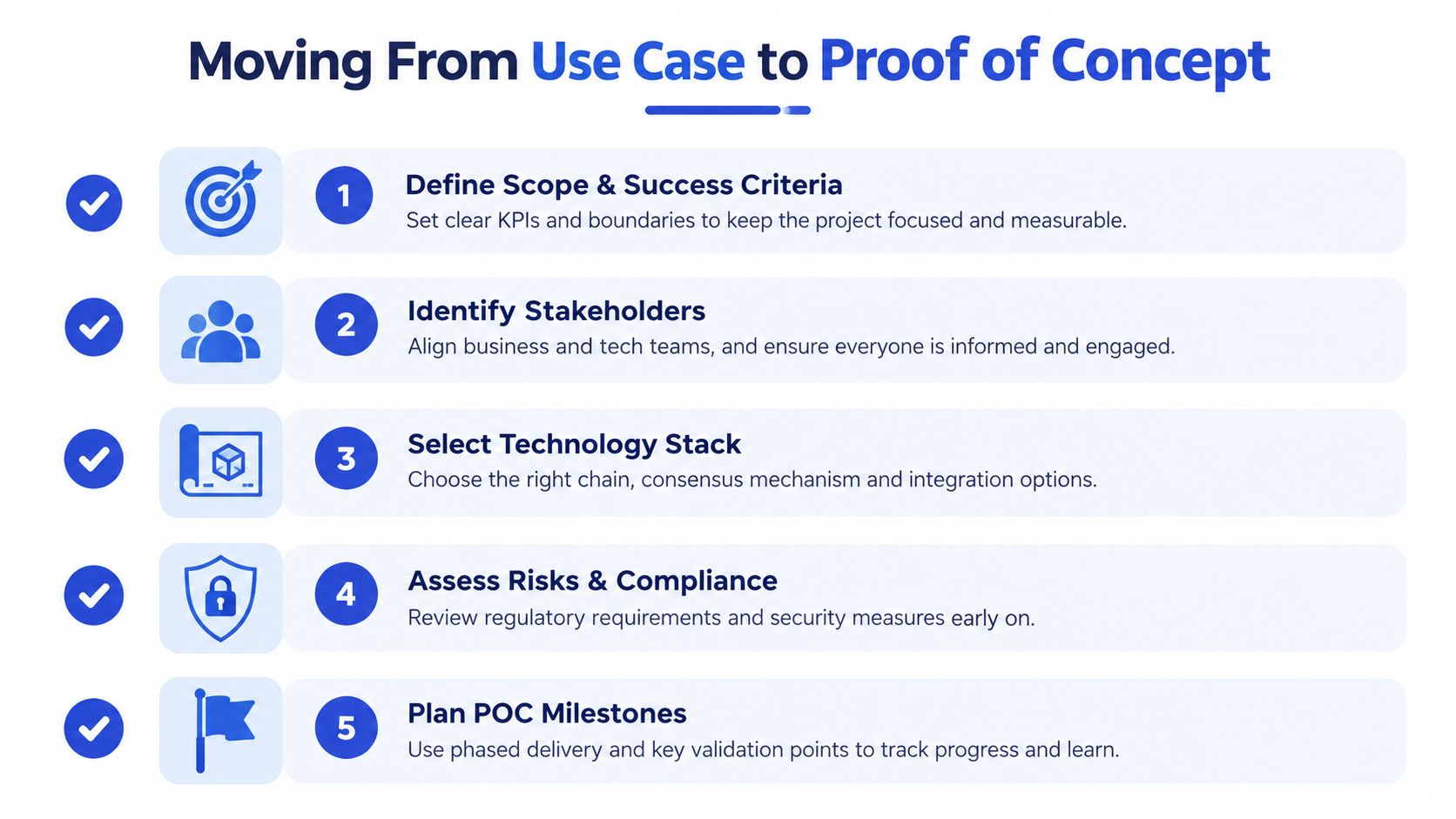
A proof of concept should answer a business question, not merely demonstrate that a transaction can be written to a chain. Its scope must be small enough to learn quickly and realistic enough to expose integration, governance, security, and user-adoption problems.
Define the test before building
Start with one workflow, a bounded participant group, representative data, and explicit success criteria. The team should know what it is testing, such as shared approval history, document verification, settlement logic, identity binding, or exception handling.
A useful PoC plan includes:
- Scope the transaction flow: Define the states, actors, permissions, events, and failure paths.
- Select representative participants: Include the parties whose adoption or data quality determines whether the model works.
- Choose the minimum architecture: Test the required chain, identity model, smart contracts, APIs, storage, and user interfaces without building the entire product.
- Model risk and compliance: Review privacy, key custody, access rights, fraud scenarios, audit evidence, and jurisdiction-specific obligations.
- Set a decision gate: Continue, revise, or stop based on evidence against the original problem statement.
The success measure should combine operational and technical evidence. Ask whether users complete the process, whether the system produces the required audit record, whether integrations behave reliably, and whether the proposed model is preferable to the centralised alternative.
Avoid the traps that invalidate PoCs
Scope creep turns a learning exercise into an underfunded production project. Weak data modelling creates a convincing demo that cannot represent real ownership, identity, or exception states. Excluding legal, compliance, operations, or external participants produces false confidence because the hardest constraints remain untested.
A PoC also shouldn’t hide operational costs. Include node or service administration, monitoring, incident response, key recovery, onboarding, support, and governance. If the team can’t explain who operates the system after launch, the concept hasn’t reached implementation readiness.
The transition to production requires a roadmap covering architecture hardening, security testing, data migration, integration, user training, legal documentation, participant onboarding, and staged rollout. A consultant should state which findings are proven, which remain assumptions, and what the next investment is intended to learn.
When to Engage a Blockchain Consulting Partner
A blockchain consultant should enter the conversation before anyone commissions smart contracts or selects a network. The right trigger is a business problem involving several organisations, regulated digital assets, tokenised rights, complex integration, or uncertainty about how control should be shared. Specialist input at this stage can challenge assumptions, expose dependencies, and give executives a defensible reason to proceed, redesign the proposal, or stop.
India’s blockchain market has grown from roughly USD 0.35 billion in 2024 toward a projected USD 1.87 billion by 2030, as noted earlier in this guide. That growth creates commercial interest, but implementation still depends on tax, AML, identity, data, privacy, and governance decisions. Market momentum does not remove those obligations.
What to expect from the engagement
A credible consulting engagement should produce working documents and decision evidence, not a technology presentation:
- Problem definition: A documented business pain point, its owner, affected participants, current workflow, and measurable consequence.
- Use-case ranking: Candidate solutions assessed against trust, reconciliation, audit, data-sharing, integration, and adoption requirements.
- Architecture options: A comparison of public, private, hybrid, and conventional database designs, including the reasons for rejecting each alternative.
- Feasibility findings: Technical, commercial, regulatory, security, privacy, and operating-model constraints.
- PoC plan: Scope, representative data, participants, milestones, success criteria, and decision gates.
- Implementation roadmap: Integration, governance, compliance, security, support, training, participant onboarding, and rollout requirements.
The consultant should also state what the proposed system will not solve. Blockchain cannot repair inaccurate source data, replace clear governance, or create adoption among participants who have no reason to join. A shared ledger may preserve an agreed record, but it does not prove that an uploaded document, identity, or physical shipment was truthful at the point of entry.
Blocsys Technologies Pvt Ltd can be considered when an organisation needs support across blockchain consulting, blockchain development, smart contract development, enterprise blockchain solutions, digital asset platforms, or tokenisation. Its fit should be judged against the requirements discovered during assessment, rather than an assumption that every multi-party workflow needs distributed ledger technology.
Compare providers on delivery method, documentation quality, security practices, integration experience, governance design, and operational support. A consultant should be willing to recommend a conventional system when it offers lower cost, simpler control, or better performance. Guidance on choosing a blockchain consulting partner can help structure that comparison.
A sensible 12 to 24-month outlook is a planning period for validated use cases to move from controlled pilots into governed production. The strongest candidates may arise in compliance-heavy financial services, identity, document verification, supply chain evidence, and tokenisation, but adoption is not automatic. Organisations with the clearest process metrics and the smallest viable scope are better positioned to learn whether blockchain creates enough value to justify its operating model.
Frequently asked questions
What is blockchain business consulting?
Blockchain business consulting analyses business problems, workflows, participants, data, controls, and technology alternatives to determine whether blockchain is appropriate. The consultant defines a suitable use case, tests technical and commercial feasibility, selects an architecture, and creates a path from proof of concept to implementation.
How do businesses identify blockchain use cases?
Businesses identify potential use cases by mapping workflows and locating shared records, repeated reconciliation, disputed histories, weak document verification, or trust gaps between independent participants. Strong candidates involve several organisations that need a common, auditable record and cannot comfortably depend on one party’s database.
How can a company evaluate whether blockchain is suitable?
A company should compare blockchain with a traditional database using participant independence, governance, privacy, data quality, audit requirements, integration complexity, performance, operating cost, and legal constraints. Blockchain is appropriate only when shared validation and a tamper-evident history provide a material advantage over centralised control.
Is blockchain better than a traditional database?
A conventional database is usually preferable for a single organisation with central control, frequent record changes, and straightforward access management. Blockchain becomes more relevant when several parties need to validate and retain a durable history without giving one participant unilateral control.
What does a blockchain feasibility assessment include?
It covers the business problem, stakeholders, workflow states, data requirements, privacy, identity, network model, integrations, smart contract logic, security, regulatory obligations, governance, operating costs, and organisational readiness. The assessment should compare the proposed design with simpler technical alternatives and identify assumptions that still require testing.
How does blockchain create business value?
Blockchain may reduce reconciliation, improve shared auditability, support verifiable documents, coordinate multi-party workflows, or represent rights and assets programmatically. The value depends on the process, participants, controls, and adoption model. Consultants should define measurable operational outcomes instead of promising a guaranteed return on investment.
How should a business select blockchain technology?
Select the technology after defining requirements for privacy, governance, performance, interoperability, identity, smart contracts, data handling, and compliance. A public, private, or hybrid network may fit, but the network should follow the operating model. It should not dictate the business design.
What should a blockchain proof of concept prove?
A proof of concept should test a defined business hypothesis with realistic data, representative participants, and a bounded workflow. It should demonstrate transaction logic, integration behaviour, permissions, audit evidence, user steps, security controls, and the criteria for deciding whether production investment is justified.
What belongs in a blockchain implementation plan?
The plan should cover architecture, integrations, smart contracts, identity, data migration, privacy, security testing, governance, legal review, compliance operations, participant onboarding, monitoring, support, training, rollout stages, and post-launch ownership. It should separate confirmed requirements from assumptions that need evidence.
When should a business hire a blockchain consultant?
Hire a consultant when the business faces a multi-party coordination problem, regulated digital asset workflow, tokenisation requirement, complex integration decision, or uncertainty about whether blockchain is justified. Specialist input has the greatest value before development, when it can prevent an unsuitable architecture or a pilot with no credible route to production.
Blocsys Technologies helps organisations assess blockchain business requirements, identify suitable use cases, evaluate feasibility, design enterprise blockchain solutions, and move validated concepts toward implementation. Visit Blocsys Technologies to discuss workflow, integration, compliance, or digital asset requirements with a blockchain consulting and technology partner.
