
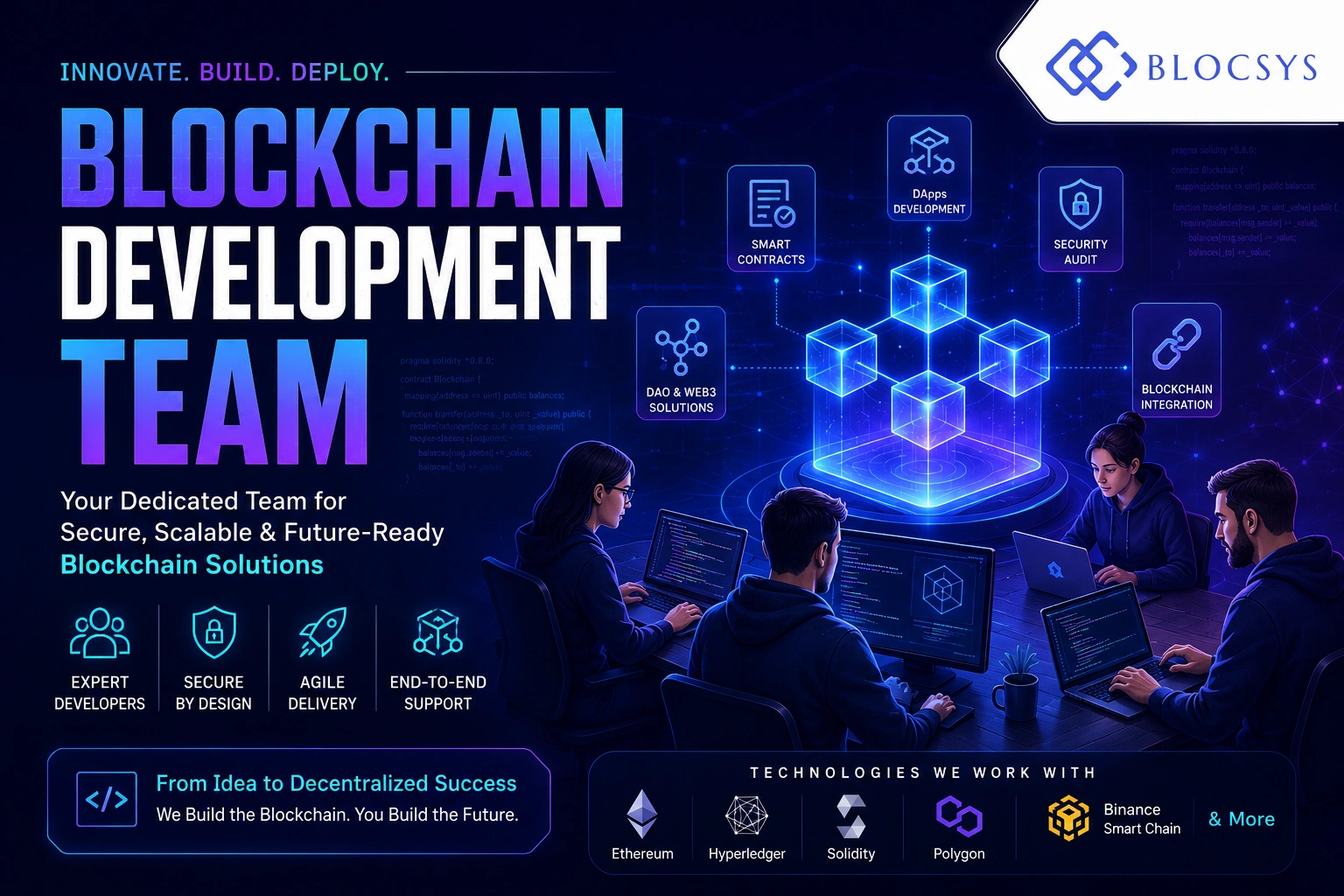
Blockchain Development Team: Build Your Web3 Product With a Dedicated Engineering Team
Building a Web3 product isn’t a side project you hand to one freelancer and hope for the best. It takes architecture decisions, smart contract engineering, security testing, and ongoing maintenance long after launch. That’s why more startups, fintech companies, and enterprises are turning to a dedicated Web3 development team instead of piecing together talent one hire at a time. In this guide, we’ll break down what a blockchain development team actually does, how it differs from hiring individual developers or freelancers, and what you need to know before you bring one on board.
If you’re already comparing options, you can explore Hire Blockchain Developers to see how flexible engagement models work in practice. Let’s get into the details.
What Is a Blockchain Development Team?
A blockchain development team is a group of specialized engineers, architects, and product professionals who work together to design, build, secure, and maintain blockchain-based products. Unlike a solo developer, a team brings multiple disciplines under one roof: architecture, smart contracts, backend infrastructure, frontend interfaces, DevOps, QA, and security.
Here’s the key distinction. A single developer can write code. A team can own outcomes. When you’re building something as complex as a tokenization platform or a DeFi protocol, you need people who understand consensus mechanisms, people who understand regulatory-grade security, and people who understand how to ship a product users actually trust. That’s rarely one person’s job.
A dedicated blockchain engineering team works as an extension of your own company. They join your workflows, understand your product roadmap, and stay engaged across the full lifecycle rather than disappearing after a single deliverable. This is fundamentally different from a freelancer who completes a task and moves on, or an outsourced vendor who treats your project as one ticket in a queue.
The biggest mistake we see founders make is treating blockchain development like generic web development. Smart contracts don’t get a second deployment after a bug — the team structure you choose determines whether that bug happens in testing or in production.
Why Businesses Need a Dedicated Blockchain Engineering Team
Web3 products carry risks that traditional software doesn’t. Smart contracts are often immutable once deployed. Digital asset platforms handle real money and real ownership records. Consequently, the margin for error is smaller, and the need for continuous, coordinated engineering is much higher.
A Web3 development team becomes necessary the moment your project crosses from “idea” into “product with real users and real assets.” If you’re building a wallet, an exchange, or a tokenization platform, you need architecture that scales, security that holds up under audit, and infrastructure that stays online. One developer, however talented, can’t cover all of that alone.
Signs Your Business Needs a Web3 Development Team
Consider a dedicated team when:
- Your product involves handling digital assets, tokens, or on-chain financial logic
- You need smart contracts audited and tested before mainnet deployment
- Your roadmap includes multiple releases, not a single MVP
- You’re integrating blockchain with existing enterprise systems
- Regulatory or compliance requirements demand documented, secure development practices
- You need to scale infrastructure as user adoption grows
Startups often underestimate this until they hit a wall — usually around security or scalability. Enterprises, on the other hand, usually recognize the need early because they already understand what it costs to run production systems at scale.
Dedicated Team vs Individual Developer vs Freelancer vs Project Outsourcing
This is where a lot of founders get confused, so let’s clear it up directly. These four models look similar on paper but behave very differently in practice.
| Model | Best For | Control | Continuity | Security Coverage |
|---|---|---|---|---|
| Individual Developer | Small, narrow tasks | Limited | Low | Depends on one person’s skill |
| Freelancer | One-off features | Low | Very low | Inconsistent |
| Project-Based Outsourcing | Fixed-scope builds | Moderate | Ends at delivery | Varies by vendor |
| Dedicated Blockchain Team | Ongoing product development | High | Continuous | Built-in, multi-role |
An individual blockchain developer is great when you have a narrow, well-defined task. Freelancers work similarly but usually with even less accountability and no long-term commitment to your codebase. Project-based outsourcing fits fixed-scope work — build it, deliver it, done — but it rarely supports a product that needs to evolve.
A Dedicated Blockchain Team for Startups or a Dedicated Blockchain Team for Enterprises works differently. The team stays engaged through discovery, development, testing, launch, and beyond. That continuity matters enormously when you’re maintaining smart contracts, responding to security findings, or scaling infrastructure under real traffic. If your product isn’t going to sit still after launch, your team shouldn’t either.
![Web3 Development Team — [Flow diagram comparing four engagement paths: Individual Developer, Freelancer, Project-Based Outsourcing, and Dedicated Team, each branching into control level, continuity, and security coverage outcomes]](https://s3.blocsys.com/blocsys/blog-images/1788247443849-bae66dcd55c7d968.webp)
Services a Blockchain Development Team Can Provide
A Blockchain Development Team for Web3 Projects typically covers a wide range of services, though not every team offers every capability. What matters is choosing a partner whose services match your product’s actual requirements.
Core Development Services
Most dedicated teams support blockchain architecture design, smart contract development, backend and API development, frontend interface development, and blockchain integrations with existing systems. These form the foundation of nearly every Web3 build, whether you’re launching a wallet or a full blockchain development platform.
Specialized Web3 Services
Beyond core development, many teams also support DeFi protocol development, tokenization and RWA platform builds, digital asset infrastructure, and exchange or trading system development. If your roadmap includes Real World Asset Tokenization, you’ll want a team with direct experience in asset-backed token structures, not just generic smart contract work.
Security, Testing, and Operations
Security audits, penetration testing, QA, DevOps, deployment, and post-launch monitoring round out what a mature Blockchain Product Development Team should offer. This is often the difference between a product that survives its first audit and one that doesn’t. Security isn’t a phase you add at the end — it needs to run through the entire build.
Typical Blockchain Development Team Structure and Roles
Team composition depends entirely on project scope. There’s no single “correct” team size — a token launch needs far less than an enterprise-grade exchange. That said, most teams draw from the same pool of roles, scaled up or down.
Core Roles You’ll Typically See
- Blockchain Architect — designs the system architecture, chooses the right chain and consensus model, and plans for scale
- Smart Contract Developer — writes and tests contract logic, usually in Solidity, Rust, or similar languages
- Backend Developer — builds APIs, off-chain logic, and system integrations
- Frontend Developer — builds the user-facing product and wallet connections
- DevOps Engineer — manages infrastructure, deployment pipelines, and node operations
- QA Engineer — tests functionality, edge cases, and contract behavior
- Security Specialist — audits contracts and infrastructure for vulnerabilities
- UI/UX Specialist — designs usable interfaces for often-complex Web3 interactions
- Project Manager / Business Analyst — keeps scope, timeline, and communication on track
Team Size by Project Stage
A lean MVP team might include just an architect, one or two developers, and a project manager — enough to validate an idea quickly. A standard product-development team adds QA, DevOps, and a security specialist as the product moves toward real users. An enterprise blockchain engineering team scales further still, often running parallel workstreams for compliance, integrations, and multi-chain support. None of these structures is “more correct” than another — they simply match different stages of product maturity.
Blockchain Technologies and Development Expertise
A capable Blockchain Engineering Team for Web3 Projects should be comfortable across multiple chains and frameworks, not locked into one ecosystem. Ethereum and EVM-compatible chains remain the most common foundation for smart contracts, DeFi, and tokenization work. However, many enterprise projects also require Layer 2 networks, permissioned chains, or multi-chain interoperability.
Expect a strong team to work with Solidity and Rust for contract development, Node.js or Go for backend systems, and standard Web3 libraries like ethers.js or web3.js for frontend integration. DevOps expertise should include containerized deployment, node infrastructure, and monitoring tools built for uptime-sensitive blockchain applications.
Technology alone doesn’t guarantee success, though. What separates a strong team from an average one is judgment — knowing when to use a permissioned chain instead of a public one, or when tokenization requires custom compliance logic rather than an off-the-shelf template. That judgment comes from experience across real projects, not just technical fluency.
Types of Web3 Products a Dedicated Team Can Build
Dedicated blockchain teams support a wide range of product categories, each with distinct technical demands.
Financial and Asset Platforms
This includes DeFi platforms, digital asset exchanges, tokenization platforms, and blockchain-based financial applications. Projects like Equity Tokenization Platform development or Corporate Bond Tokenization require deep understanding of both blockchain mechanics and financial compliance — a combination that individual developers rarely cover alone.
Enterprise and Infrastructure Systems
Enterprises frequently need custom blockchain infrastructure, permissioned networks, and integrations with legacy systems. Post-trade reconciliation platforms, document verification systems, and supply chain traceability tools all fall into this category — think along the lines of a Permissioned Blockchain Infrastructure for Capital Market Post-Trade Operations or a Blockchain-Powered Organic Certification & Food Traceability Platform.
Consumer and Gaming Products
Wallets, Web3 marketplaces, and gaming platforms round out the picture. These products often need heavier frontend investment and smoother onboarding, since end users may not be blockchain-native. Getting the UX right here matters just as much as getting the contracts right.
Development Workflow: From Discovery to Deployment
A structured workflow is what separates a professional Outsourced Blockchain Development Team from an ad-hoc group of contractors. While specifics vary by project, most engagements follow a similar arc.
It starts with discovery — understanding your business goals, target users, and technical constraints. From there, the team moves into architecture planning, where chain selection, data models, and security requirements get defined. Development follows in iterative sprints, with smart contracts, backend systems, and frontend interfaces built in parallel where possible.
Testing runs continuously, not just at the end. Unit tests, integration tests, and contract-specific testing (including testnet deployment) happen throughout development. Once the product passes security review, deployment moves to mainnet, followed by monitoring, maintenance, and iterative upgrades based on real usage data.
![Web3 Development Team — [Flow diagram showing blockchain development workflow: Discovery → Architecture Planning → Iterative Development → Continuous Testing → Security Audit → Mainnet Deployment → Monitoring and Maintenance]](https://s3.blocsys.com/blocsys/blog-images/1788247439522-27297e74df816787.webp)
Security and Testing: Non-Negotiable for Web3 Products
Security failures in blockchain products are expensive and often irreversible. Chainalysis has reported hundreds of millions of dollars lost to crypto hacks and exploits annually in recent years, with smart contract vulnerabilities among the leading causes. That statistic alone explains why security can’t be an afterthought.
A dedicated team builds security into the process rather than bolting it on at the end. This means code reviews at every stage, automated testing pipelines, formal verification for critical contract logic, and third-party audits before mainnet launch. QA engineers test not just for expected behavior but for edge cases — what happens under network congestion, what happens with malicious inputs, what happens when a dependency contract behaves unexpectedly.
Post-launch, monitoring tools track on-chain activity and flag anomalies in real time. This ongoing vigilance is one of the clearest advantages a dedicated team holds over a freelancer or a one-time outsourced vendor — nobody’s watching your contracts after a freelancer cashes their final invoice.
Post-Launch Maintenance and Scaling Support
Launch isn’t the finish line — it’s closer to the starting gun. Blockchain products need ongoing maintenance: contract upgrades, infrastructure scaling, dependency updates, and continuous monitoring as usage grows.
A dedicated Web3 development team stays engaged after launch, which matters more than most founders expect going in. Traffic spikes, new regulatory requirements, or a competitor’s feature can all demand rapid iteration. Without a team already familiar with your codebase, every change becomes slower and riskier.
Scaling considerations include node infrastructure capacity, database performance under higher transaction volume, and multi-chain expansion if your product grows beyond its original network. Enterprises especially benefit from a team that already understands their compliance posture, since scaling a regulated financial product involves more than just adding servers.
Engagement Models: Choosing How You Work Together
How you engage a blockchain development team shapes cost, control, and flexibility just as much as the team’s skill set does.
Dedicated Team Model
This is the primary model for ongoing product development. You get a consistent group of engineers who work exclusively on your product, integrate with your internal processes, and scale with your roadmap. It offers the highest continuity and the deepest product knowledge over time — which is exactly what most Web3 products need given their long development and maintenance cycles.
Project-Based Development
Best suited for fixed-scope work with a defined endpoint, like a smart contract audit or a single feature build. You know the cost upfront, but flexibility is limited once the scope is locked.
Staff Augmentation
Here, you add specific specialists — say, a smart contract developer or a DevOps engineer — into your existing in-house team. This works well when you already have core engineering but need niche blockchain expertise.
Hybrid Models
Many enterprises combine models: a dedicated core team for ongoing product work, supplemented by project-based engagements for specific audits or feature sprints. This flexibility is often what makes a Dedicated Blockchain Engineering Teams partnership practical for complex, evolving roadmaps.
Blockchain Development Team Costs and Pricing Factors
Cost varies widely based on team size, project complexity, geographic talent sourcing, and engagement length. A lean MVP team costs meaningfully less than an enterprise engineering team running multiple parallel workstreams. Factors that influence pricing include the number of chains supported, the depth of security auditing required, integration complexity, and whether you need ongoing maintenance versus a single build.
Rather than quoting generic numbers that don’t reflect your actual scope, it’s more useful to estimate based on your specific requirements. The Software Development Cost Estimator gives you a practical starting point for budgeting your project before you even start conversations with a development partner.
Generally, dedicated teams offer better cost efficiency over the long run compared to freelancers or repeated project-based engagements, simply because you avoid onboarding costs every time you need new work done. Continuity has a real dollar value, even if it doesn’t show up on the first invoice.
How to Choose the Right Blockchain Development Partner
Choosing a Blockchain Development Team Partner is a decision that affects your product for years, not weeks. A few questions should guide your evaluation.
Questions to Ask Before Hiring
- What services are included, and what falls outside scope?
- How is the team structured for a project like mine?
- How quickly can the team start, and how do onboarding and handoffs work?
- What blockchain technologies and chains does the team support?
- How are costs calculated, and what factors could change pricing mid-project?
- How is security handled — internal review, third-party audit, or both?
- Who owns the intellectual property and code once the project is delivered?
- What support is available after launch?
Look for a partner with demonstrated experience across the specific product type you’re building — a team strong in gaming platforms isn’t automatically strong in regulated tokenization work. Ask for real examples, not just a list of technologies. Furthermore, pay attention to how clearly they communicate technical tradeoffs. If they can’t explain their architecture choices in plain language, that’s worth noting.
Why Businesses Choose Blocsys
Blocsys works as a trusted blockchain, Web3, fintech, and enterprise technology partner, providing dedicated blockchain engineering teams built around each client’s actual product needs. From smart contract development to tokenization platforms and enterprise blockchain infrastructure, our teams cover the full lifecycle — discovery, architecture, development, security, and long-term maintenance.
What sets a dedicated engagement apart is continuity. Our teams stay embedded in your product, not cycling through one-off tickets. Whether you’re a startup validating an MVP or an enterprise scaling a regulated digital asset platform, you get engineers who understand your codebase, your compliance requirements, and your roadmap. You can review the Team or explore Dedicated Blockchain Engineering Teams to see how this works in practice.
Frequently Asked Questions
Here are direct answers to the questions we hear most often about building a Web3 product with a dedicated engineering team.
What is a blockchain development team?
A blockchain development team is a group of specialized engineers — architects, smart contract developers, backend and frontend developers, QA, DevOps, and security specialists — who work together to design, build, secure, and maintain a blockchain-based product across its full lifecycle, rather than completing isolated tasks.
When should a business hire a blockchain development team?
You should hire a blockchain development team once your project involves real digital assets, requires smart contract security, or spans multiple release cycles. If your roadmap goes beyond a single feature and includes ongoing maintenance, scaling, or compliance needs, a dedicated Web3 development team becomes far more practical than piecing together individual hires.
What does a dedicated blockchain development team do?
A dedicated team handles product discovery, architecture design, smart contract development, backend and frontend engineering, blockchain integrations, security testing, deployment, and post-launch maintenance. Capabilities depend on team structure and project scope, but the goal is continuous ownership of your product, not one-off delivery.
How much does it cost to hire a blockchain development team?
Costs depend on team size, project complexity, chain support, and engagement length, so there’s no fixed number that fits every project. Using a tool like the Software Development Cost Estimator gives you a realistic starting budget based on your specific product requirements before entering detailed conversations with a partner.
What roles are included in a blockchain development team?
Common roles include a blockchain architect, smart contract developers, backend and frontend developers, DevOps engineers, QA engineers, security specialists, UI/UX designers, and a project manager. Not every project needs every role — team composition scales with project complexity and stage.
What blockchain products can a dedicated team build?
Dedicated teams build DeFi platforms, tokenization and RWA platforms, digital asset exchanges, wallets, enterprise blockchain infrastructure, Web3 marketplaces, gaming platforms, and custom blockchain-based financial applications, each requiring a slightly different mix of technical expertise.
What is the difference between a blockchain developer and a blockchain development team?
A blockchain developer writes code for a specific task, while a blockchain development team combines multiple disciplines — architecture, security, QA, DevOps — to own an entire product’s development and maintenance. Complex Web3 products almost always need the broader coverage a team provides, especially around security and long-term scaling.
How long does it take to build a blockchain product with a dedicated team?
Timelines vary by complexity: a lean MVP might take 8 to 12 weeks, while a full-featured DeFi platform or tokenization system can take several months, factoring in architecture, development, security audits, and testnet validation before mainnet launch.
Should startups hire an in-house blockchain team or a dedicated external team?
Most startups benefit from a dedicated external team early on, since building in-house blockchain expertise from scratch is slow and expensive. A Dedicated Blockchain Team for Startups gives immediate access to specialized skills without the overhead of full-time hiring, while still supporting long-term product growth.
How do I choose the right blockchain development team?
Evaluate a team’s experience with your specific product type, ask how security and testing are handled, clarify IP ownership, and confirm post-launch support. A strong Blockchain Development Team Partner should communicate technical tradeoffs clearly and show real examples relevant to your project.
Building Your Web3 Product Starts With the Right Team
Choosing between a freelancer, an individual developer, or a dedicated Web3 development team shapes everything that follows — your product’s security, your timeline, and how well it scales once real users show up. For most serious blockchain products, especially those touching digital assets or financial logic, a dedicated team simply covers more ground than any single hire can.
If you’re planning a DeFi platform, a tokenization system, or enterprise blockchain infrastructure, it’s worth talking through your specific requirements with a team that’s built these before. Reach out to discuss your project with Blocsys, or start by exploring Hire Blockchain Developers to see how a dedicated engineering team could fit your roadmap.
Ready to move beyond theory and build an intelligent platform that delivers real-world value? Blocsys Technologies specialises in engineering enterprise-grade AI and blockchain solutions for the fintech, Web3, and digital asset sectors. Connect with our experts today to discuss your vision and chart a clear path from concept to a secure, scalable reality.
