
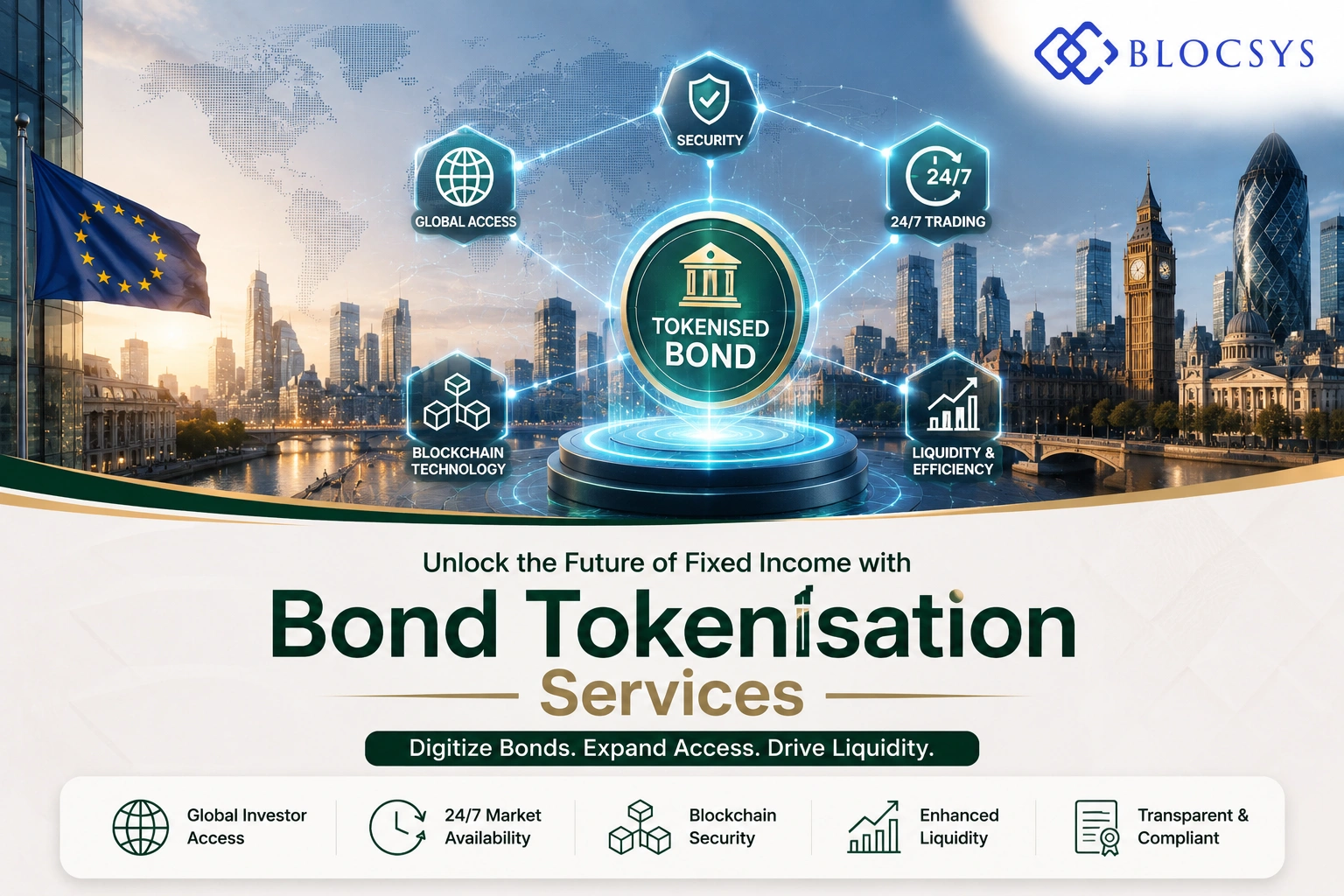
Tokenised bonds are no longer a theoretical corner of market plumbing. The sharpest benchmark is Hong Kong, where the HKMA reported US$3.9 billion in global tokenised bond issuance in 2023, and later data showed roughly HK$6 billion equivalent across four currencies in major tokenised bond programmes, while IOSCO put the decade-long global total at about US$10 billion versus roughly US$140 trillion in outstanding bonds globally, as captured in the HKMA and IOSCO references in the brief. That gap is the point, tokenisation is still small, but it’s now large enough to matter for treasury funding, distribution strategy, and post-trade design.
For banks, issuers, asset managers, and market infrastructure providers, Bond Tokenisation Services are best understood as a regulated capital-markets upgrade, not a crypto product. The question isn’t whether the technology works in isolation, it’s whether it can survive issuer onboarding, compliance checks, custody rules, settlement obligations, and secondary-market fragmentation across jurisdictions. That’s the commercial problem firms need to solve, and it’s the lens used throughout this guide, including practical implementation considerations with Blocsys Technologies and enterprise tokenisation architectures.
Table of Contents
- The Market Reality of Digital Bond Issuance
- How Bond Tokenisation Platforms Work
- Architecture Decisions and Infrastructure Trade-offs
- Global Regulatory Frameworks and Compliance Requirements
- The Distribution and Liquidity Challenge
- Enterprise Implementation Roadmap and Cost Factors
- Building Production-Ready Bond Tokenisation Infrastructure
The Market Reality of Digital Bond Issuance
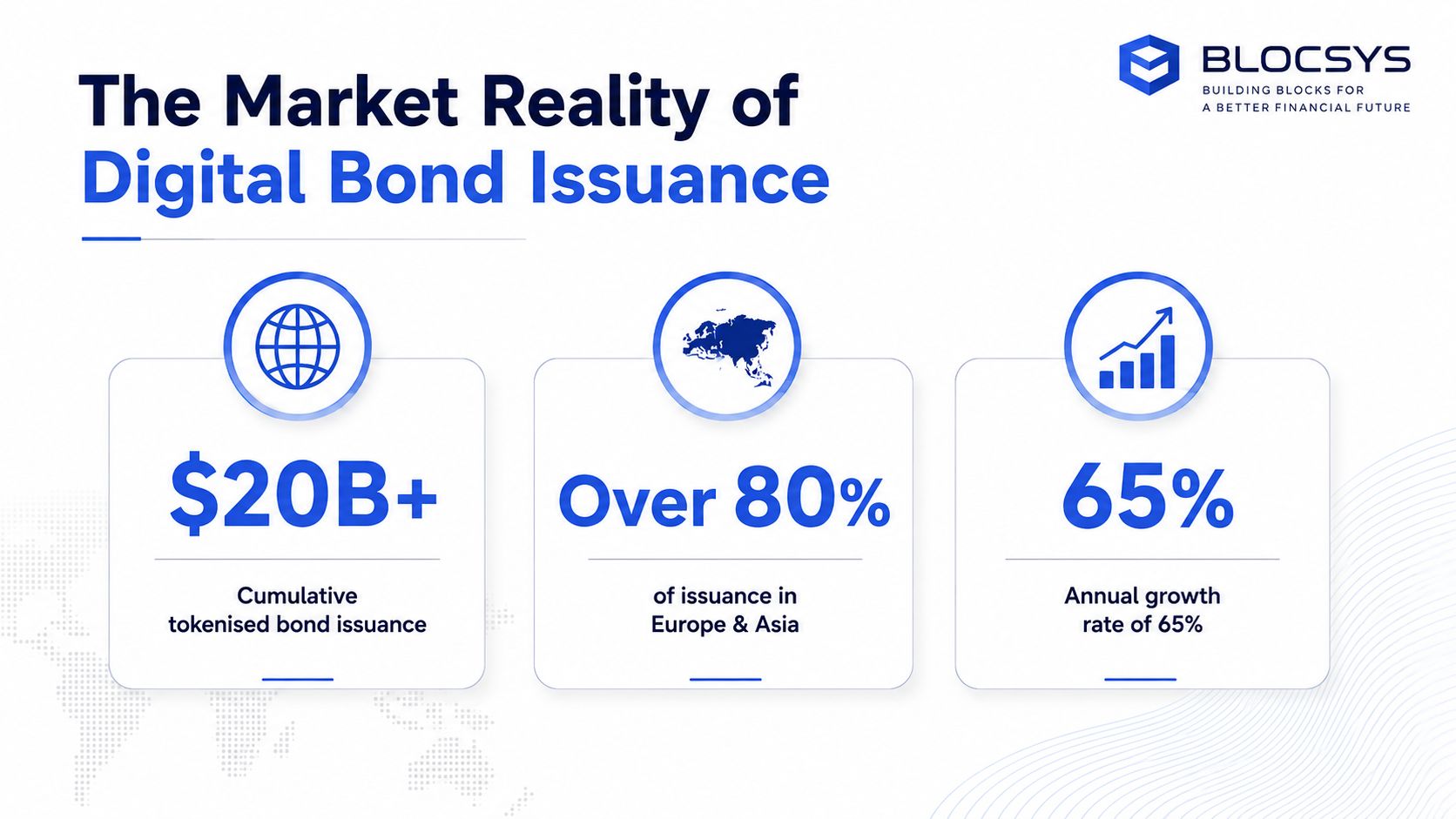
The market has moved past isolated experiments, but it hasn’t yet reached broad secondary-market maturity. The cleanest evidence comes from Asia and Europe, where regulated issuance has shown that tokenisation can support live capital-market activity, while still representing a tiny share of the global fixed-income universe. That’s why the right framing is market-structure change, not novelty.
What the issuance data actually says
Hong Kong remains the most useful regional benchmark for India and other institutional markets because it shows tokenised bonds can be issued under a regulated framework, not just demoed in a lab. The HKMA said the first government tokenised green bond was issued in February 2023 for HK$800 million, and that it was the first tokenised green bond issued by a government globally. The same ecosystem has since been used to benchmark multi-currency issuance and institutional structuring in the region (HKMA press release).
That matters because it changes the commercial conversation. Once issuers see live issuance in regulated markets, the discussion moves from “can we tokenise?” to “which workflow, which platform, and which investor segment should be tokenised first?” The evidence in the brief also shows that tokenised bonds remain a small but measurable segment of fixed income, which is exactly why infrastructure choices are now more important than marketing language.
Practical rule: if a tokenised bond programme cannot survive compliance review, custody review, and transfer-restriction review, it’s not production infrastructure. It’s a pilot with a wallet interface.
Why institutions are paying attention
The ECB’s 2026 analysis says 88% of tokenised bond issuances occurred in the last three years, which signals that adoption is still early but accelerating quickly. The same analysis says tokenised bonds have delivered measurable but moderate efficiency and liquidity gains at experimental scale so far, which is a useful caution for buyers who expect instant transformation. Those gains are real, but they’re not automatic. They depend on integration, liquidity, and regulatory adaptation, not just on-chain issuance.
For institutional stakeholders, the takeaway is simple. Tokenisation is now credible enough to fund, but not mature enough to outsource blindly. That makes vendor evaluation, market access design, and cross-border compliance more important than the label on the platform.
Where the market is still thin
The biggest gap is not issuance, it’s secondary trading depth. New tokenised bonds can settle cleanly at issuance and still fail to deliver the liquidity benefit that treasury desks, asset managers, and distributors need later. The issue is structural, fragmented rails don’t create a cohesive trading venue by themselves.
That’s why a serious analysis of tokenised bonds has to separate primary-market efficiency from secondary-market usability. Issuance can be engineered quickly. Distribution and tradability take broader market participation, standardisation, and interoperability, which is where many projects slow down.
Blocsys’s UK-focused analysis of Canton-based securities infrastructure is useful reading for teams comparing regulated issuance models with network design choices in Europe and beyond.
How Bond Tokenisation Platforms Work
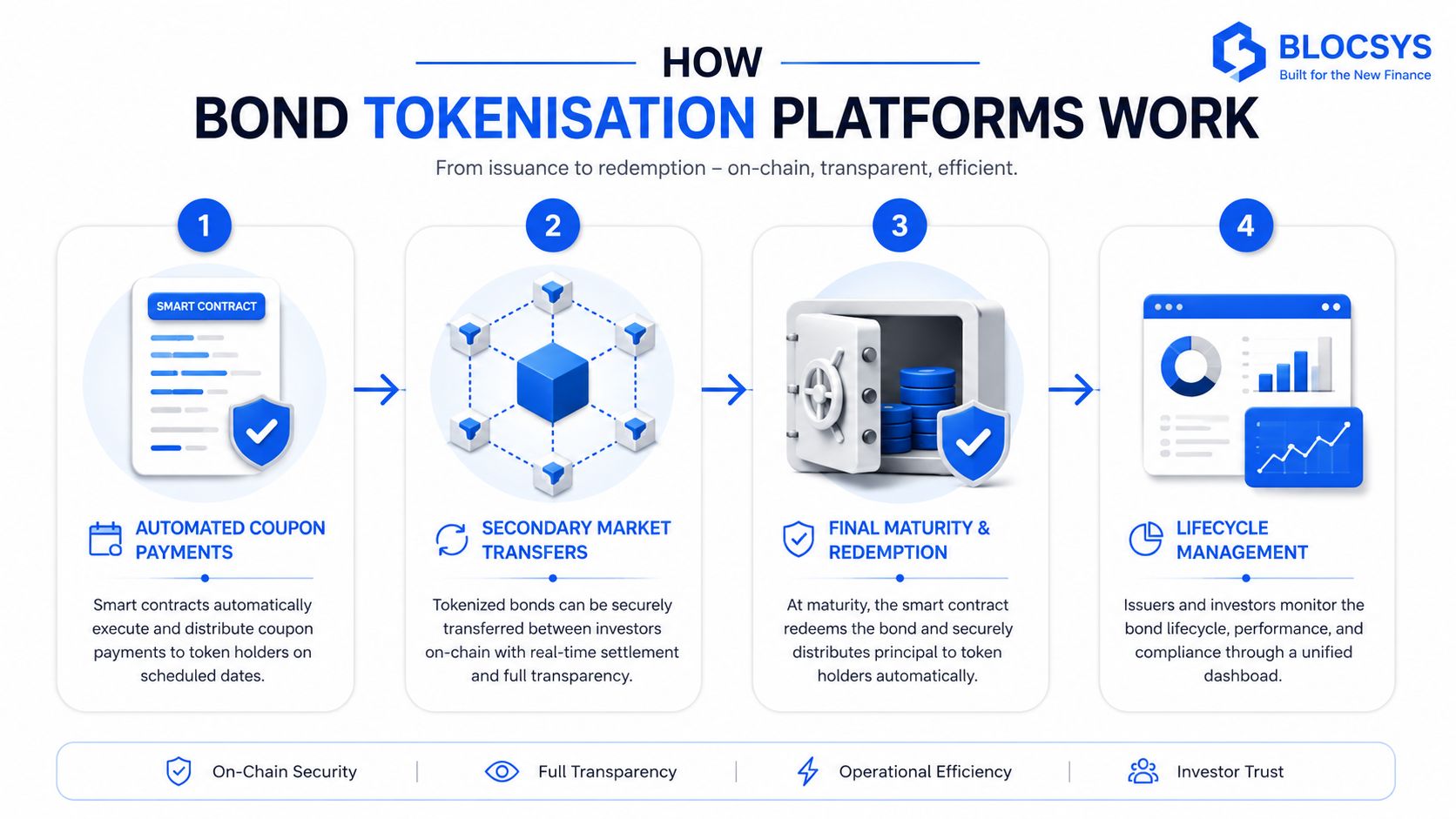
Bond tokenisation platforms handle issuance as an end-to-end operating process. They have to manage investor eligibility, transfer restrictions, coupon logic, reconciliation, reporting, and redemption while staying inside existing securities controls. Production systems therefore combine on-chain rules with off-chain market infrastructure, because the token itself has to sit inside a legal and operational framework that market participants can trust.
The lifecycle from issuance to redemption
A production-grade platform usually begins with instrument definition, then moves through minting, distribution, servicing, and maturity handling. The HKMA’s operational definition is useful here, it describes bond tokenisation as recording beneficial interests in a bond as tokens on a digital platform rather than in traditional book entries, with issuers and investors converting bonds and fiat into tokens on the platform (HKMA research memorandum). That definition matters because it puts the focus on ownership records and rights enforcement, not just token creation.
The issuer side normally includes:
- Instrument structuring, maturity, coupon, and transfer logic.
- Investor onboarding, including KYC, suitability, and whitelist checks.
- Token issuance, where digital units reflect the legal terms of the bond.
- Servicing, including coupon payments, events, and reporting.
- Redemption, which must extinguish the token and settle the liability cleanly.
Tokenised bonds can look efficient at issuance and still fail later if distribution channels are fragmented. That gap is visible across the market because secondary trading depth depends on more than a working minting process. The harder task is to connect primary issuance to resale, custody, and compliance checks across multiple venues without breaking transfer restrictions.
Bond tokenisation works when the token mirrors legal rights, not when it merely represents a database record on a chain.
Why smart contracts matter
Smart contracts reduce manual friction around routine bond operations. Coupon dates, transfer permissions, investor eligibility, and redemption conditions can be embedded into the instrument logic so the system enforces policy at the ledger layer. That is materially different from relying only on back-office controls, because the operating rules travel with the instrument rather than sitting in a separate process.
The corporate bond tokenization platform page sets out the functional stack in practical terms, and the related corporate bond tokenization platform development features and tech stack overview is useful for teams evaluating what has to be built versus what can be integrated. Blocsys Technologies develops secure and compliant corporate bond tokenisation platforms that support digital bond issuance, smart contract automation, faster settlements, and efficient investor management for banks, financial institutions, and capital markets users. That is not a full business case by itself, but it does describe the operating components institutional teams need to assemble.
The architecture only works if it interops with depositories, custodians, cash legs, and reporting systems. The Moneycontrol explainer in the brief notes that SEBI is reportedly exploring a pilot for tokenised corporate bonds using DLT, a permissioned Unified Markets Interface, and a parallel securities ledger. The broader point is that production platforms have to behave like institutional market infrastructure, not isolated token engines (Moneycontrol explainer).
Architecture Decisions and Infrastructure Trade-offs
For most capital-markets teams, the architecture choice starts with regulatory perimeter, custody model, and operating control, then works outward to ledger design. A permissioned or public network can both support tokenised bonds, but they produce very different outcomes for identity, transfer controls, and post-trade governance. The wrong combination usually adds friction rather than removing it.
Tokenization Platform Development is relevant here because bond tokenisation sits inside a wider real-world asset stack, where issuance, compliance, settlement, and asset servicing have to be designed together rather than bolted on later.
Permissioned or public infrastructure
Permissioned networks are usually the better fit for regulated bonds because issuers, custodians, and market operators need tighter control over identity, access, and transfer permissions. Public chains can offer broader composability, but they also raise governance and control questions that institutions often have to address with extra policy layers and middleware.
The choice becomes practical very quickly. If a bond must enforce jurisdictional transfer limits, investor whitelists, and auditability, the platform has to privilege control over maximal openness. Interoperability still matters, but it has to be built deliberately rather than assumed.
Custody architecture comparison
| Architecture Model | Security Profile | Regulatory Fit | Operational Complexity |
|---|---|---|---|
| HSM-based custody | Strong key protection with centralised control | Good for regulated institutions | Moderate |
| Air-gapped signing | High isolation, slower execution | Strong where offline control is required | High |
| MPC custody | Distributed signing, reduced single-point exposure | Good when policy and governance are mature | High |
| Multisig controls | Shared approval logic, flexible governance | Useful in consortium settings | Moderate |
| Custodial wallet model | Familiar operational handling, third-party dependence | Often easiest for institutional onboarding | Moderate to high |
A platform that sits inside existing depository and settlement processes usually needs a custody model that supports audit trails, revocation logic, and recovery procedures. The central question is which model a regulator, custodian, and issuer can all accept in practice.
Blocsys’s comparison of corporate bond tokenisation infrastructure choices is useful for teams shortlisting stack options across regulated deployments.
Why integration beats elegance
A bond tokenisation stack that cannot reconcile with trading, settlement, and corporate-action systems is a dead end. The strongest ledger design can still fail if the issuer’s servicing agent, custodian, or transfer agent cannot operate inside it. A useful commercial conclusion follows from that. Integration work should be treated as core architecture, because secondary-market distribution and cross-border compliance depend on it as much as issuance does.
Global Regulatory Frameworks and Compliance Requirements
Bond tokenisation is regulated securities work before it is software work. That means the platform design must follow the legal treatment of the instrument in each market, then map those rules into identity, transfer, settlement, and reporting controls. The jurisdictional spread matters because a structure that works in one market can fail in another.
The Web3 regulatory compliance framework is a sensible internal reference point for teams designing policy controls around tokenised securities.
Major jurisdictions and their practical implications
In the US, tokenised bonds still sit inside the SEC securities framework. That means transfer restrictions, broker-dealer considerations, offering compliance, and post-trade recordkeeping all need to be designed as securities controls, not as optional add-ons. In the UK, firms need to work through the FCA perimeter and the applicable securities regime, with tokenisation terminology used more often in market design and legal structuring.
In Germany, BaFin and eWpG are central, because the legal framework for electronic securities matters directly to how ownership is recorded and transferred. In the EU, firms have to distinguish MiCA from securities law, since MiCA is not a blanket answer for tokenised bonds, and the DLT Pilot Regime creates a specific environment for experimenting with market infrastructure under capped conditions.
The regulatory bodies that shape architecture
The UAE market is split by business model and venue, so teams may need to evaluate VARA, ADGM/FSRA, or DFSA depending on where the activity is housed. In Singapore, the MAS framework is a key reference point for digital-asset market discipline and institutional onboarding. Switzerland remains important for tokenisation because of its established digital-securities posture. Canada, Australia, and India are all relevant for commercial structuring, but each market still demands local legal review before launch.
Rule of thumb: if the instrument crosses borders, the compliance stack has to be jurisdiction-aware from day one, not patched into the platform after launch.
Distribution strategy is regulated too
The commercial implication is easy to miss. Distribution logic has to reflect where the investor sits, how the issuer may market the bond, and which transfer limits apply after issuance. That is why issuer guide materials, including Kons Law’s Rule 504 funding overview, can be useful as background for teams assessing how securities offerings and fundraising limits affect tokenised structures.
The regulatory frame also shapes servicing. KYC, AML, transfer restriction enforcement, custody permissions, and audit records need to be interoperable with the legal wrapper, otherwise the tokenised bond can’t be defended in front of regulators or investors.
The Distribution and Liquidity Challenge
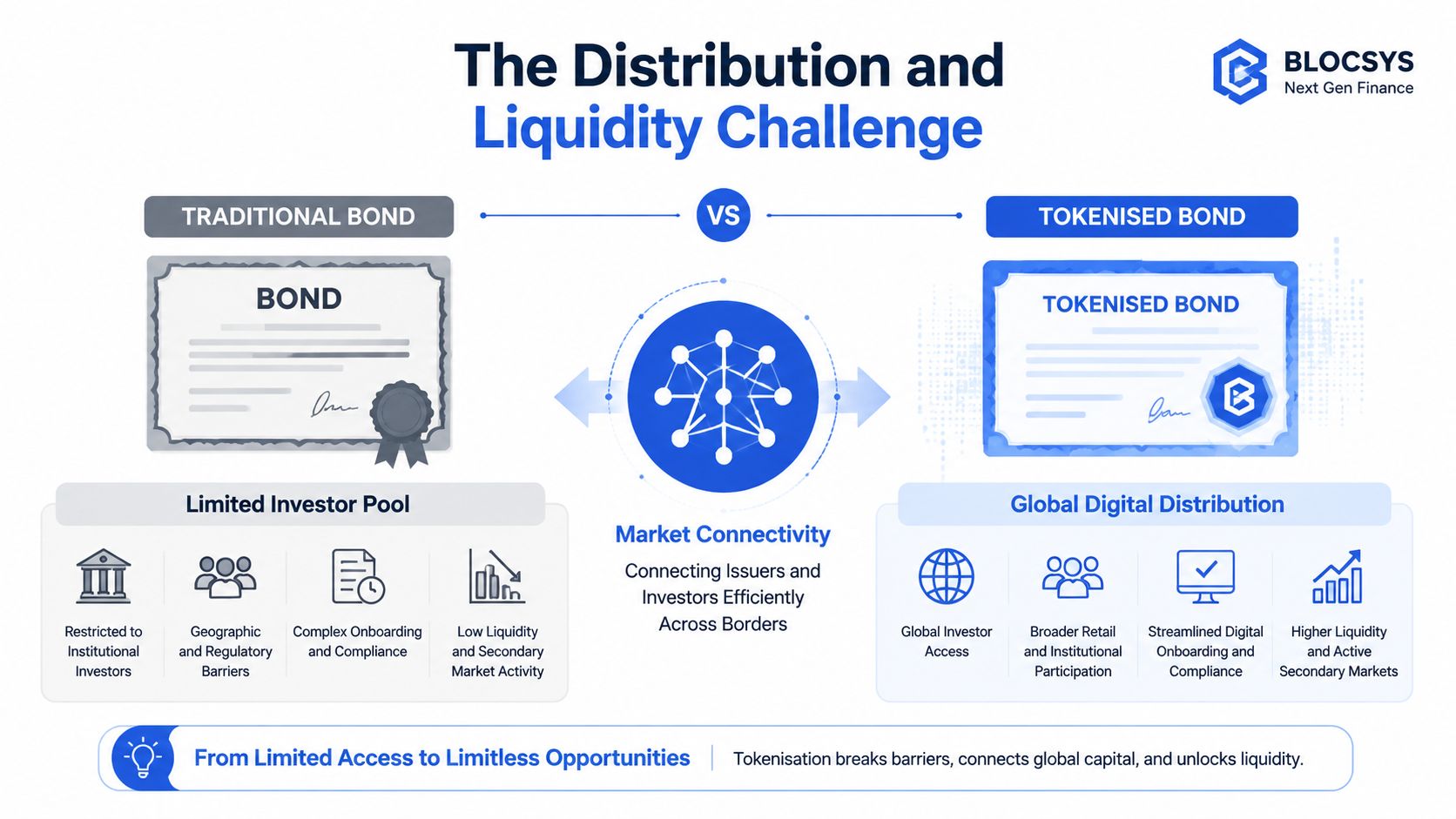
Most tokenisation decks talk about faster settlement and fractional ownership. The harder question is whether the product can find buyers, trade cleanly, and clear secondary-market compliance without creating more fragmentation than the old system. That’s the commercial bottleneck.
Distribution is the first value test
For many issuers, tokenisation is most compelling when it widens access to smaller-ticket investors or opens a cleaner route to diaspora-linked sovereign and quasi-sovereign demand. That is a distribution problem, not just a settlement problem. If the instrument cannot be placed efficiently, post-trade efficiency won’t save it.
The BIS bulletin in the brief points to a market where tokenised bonds have been issued in meaningful numbers, but the key adoption barriers still include interoperability, market maturity, and regulatory clarity. That aligns with the practical reality institutions see, the front end may be easier than the market design behind it.
Liquidity needs real market plumbing
The BIS also found average bid-ask spreads of about 19 basis points for tokenised bonds versus 30 basis points for conventional bonds by the same issuers, which is a measurable pricing difference tied to tokenisation mechanics (BIS Bulletin 107). The HKMA’s research in the brief also found tokenised bonds reduced borrowing costs by an average of 0.78 percentage points versus similar conventional bonds, which is relevant for sovereign and quasi-sovereign issuers evaluating funding economics.
Those numbers don’t mean liquidity is solved. They mean the market can already measure something, but only in a narrow slice of the ecosystem. Wider liquidity still depends on market-makers, interoperable venues, harmonised standards, and investor confidence.
Why fragmented pools are dangerous
If each tokenised bond launches on a different ledger, with different wallets, different transfer rules, and different settlement assumptions, the market gets more complex, not less. That risk is especially acute in cross-border distribution, where legal wrappers and platform rules can diverge fast. The OECD and IOSCO concerns referenced in the brief make the same basic point, token identification and interoperability standards are not optional decoration.
A useful commercial conclusion follows from that. Tokenisation is likely to create value first where distribution is currently constrained, not where institutional bond desks already have efficient access. That makes the early use case narrower than the marketing claims, but stronger where it matters.
Enterprise Implementation Roadmap and Cost Factors
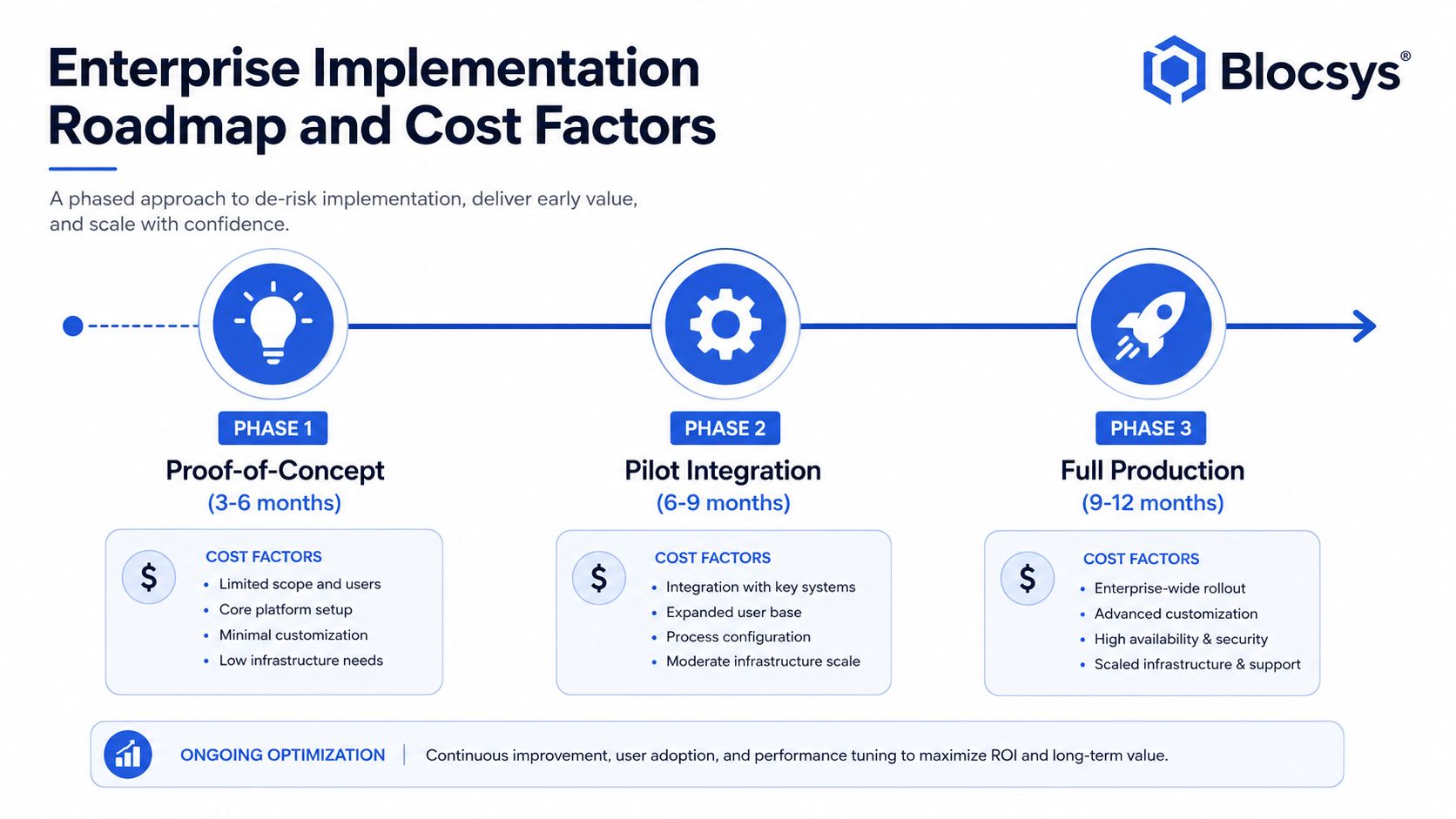
Institutional implementation works best when teams treat bond tokenisation as a phased operating model. The decision is how far the issuer wants to go, from a proof of concept, to a pilot embedded in existing workflows, to a full production stack with governance, controls, and support.
Three phases that buyers can actually manage
- Proof of concept tests instrument logic, token structure, and basic compliance rules.
- Pilot integration connects the token layer to onboarding, custody, and settlement systems.
- Full production adds governance, reporting, recovery, and support for live issuance.
Each phase brings different cost drivers. Early work is mostly architecture, legal mapping, and prototype development. Later work shifts into integration, security reviews, operational readiness, and user support. That progression matters because the expensive parts usually appear after the first prototype succeeds, when the token has to function inside existing securities processes rather than beside them.
What drives budget and delivery risk
Budget pressure usually comes from integration depth, compliance complexity, and custody design. A simple issuance demo can be built quickly. A production deployment that survives regulator scrutiny and operations review takes much more work because it has to handle exceptions, audits, and post-trade servicing without breaking.
The distribution problem also affects cost. If the issuer wants tokens to move across venues, custodians, and jurisdictions, the platform needs transfer logic, identity controls, and reporting that hold up outside a single controlled environment. That is where secondary-market interoperability and cross-border compliance start to dominate delivery risk, even if issuance itself appears straightforward.
Budget for integration first. The token itself is rarely the expensive part. The costly part is making the token behave like a securities instrument inside real institutional controls.
How to judge a provider
The right vendor should be able to explain legal wrappers, ledger architecture, custody design, and operational controls in the same conversation. If the team focuses only on chain choice, the buyer is being sold a component, not a service. For institutions, that creates execution risk.
A development partner with securities experience should also show how the platform handles KYC/AML, transfer restrictions, coupon processing, corporate actions, and settlement reconciliation. A phased enterprise implementation roadmap by Blocsys, illustrating project stages from proof-of-concept to full production deployment. Implementation planning becomes a commercial test of whether the provider can support issuance, distribution, and post-trade operations as one chain of responsibility.
Blocsys Technologies helps banks, financial institutions, and enterprises design and build tokenisation infrastructure that fits real securities workflows, not just technical demos. If you are evaluating Bond Tokenisation Services, corporate bond tokenisation, or digital securities platform development, visit Blocsys Technologies to discuss architecture, compliance, and implementation options with a team that works on production-grade blockchain systems.
Building Production-Ready Bond Tokenisation Infrastructure
Production-ready tokenisation is measured by live issuance, enforceable investor rights, custody approval, and the ability to keep operating when transfer rules, servicing exceptions, or jurisdictional boundaries change in practice. A polished interface does not prove that capability. Institutional deployment does.
The distribution problem is usually harder than the issuance problem. A platform may mint a token correctly, yet still fail if secondary-market transfer rules are hard to reconcile across venues, if investor onboarding differs by jurisdiction, or if post-trade reconciliation cannot be maintained once trading begins. That gap is where many tokenisation projects lose institutional relevance.
The strongest development partners combine capital-markets fluency with security engineering and regulatory discipline. They design the operational chain around the instrument, from onboarding and compliance to redemption, audit support, and transfer control. If the platform cannot survive custody review and post-trade scrutiny, it is not ready for institutional capital.
Implementation choices matter as much as the legal wrapper. Teams that need a clearer view of platform design can review how to build a tokenisation platform on DAML and Canton network, then test whether the architecture can support transfer permissions, segregation of duties, and operating controls across multiple counterparties. The test is whether the system can remain functional when distribution, settlement, and servicing responsibilities sit across different entities.
Blocsys Technologies helps banks, financial institutions, and enterprises design and build tokenisation infrastructure that fits real securities workflows, not just technical demos. If you are evaluating Bond Tokenisation Services, corporate bond tokenisation, or digital securities platform development, visit Blocsys Technologies to discuss architecture, compliance, and implementation options with a team that works on production-grade blockchain systems.
Frequently Asked Questions
- What are bond tokenization services, and how do they work?
Bond tokenisation services help financial institutions convert beneficial interests or rights associated with a bond into digital tokens recorded on a blockchain or digital ledger. A tokenisation platform manages the full lifecycle, including investor onboarding, KYC and eligibility checks, token issuance, transfer restrictions, coupon servicing, reporting, and redemption. The goal is to combine programmable infrastructure with existing securities, custody, and compliance processes.
- How does a tokenised bond differ from a traditional digital bond?
A traditional digital bond may still rely on conventional centralised book-entry systems. A tokenised bond records beneficial interests or bond-related rights as tokens on a digital platform. The important difference is that ownership rules, transfer permissions, and servicing logic can be integrated into the tokenisation infrastructure. However, the token still needs to operate within an appropriate legal and operational framework.
- What are the main benefits of tokenising corporate bonds?
Corporate bond tokenisation can improve operational efficiency by automating parts of issuance, investor management, transfer controls, coupon processing, and redemption. It can also support faster settlement and potentially expand distribution to new investor segments. However, the actual benefits depend on regulatory integration, interoperability, custody, and access to secondary-market liquidity.
- How does blockchain improve bond issuance and settlement?
Blockchain can provide a shared digital infrastructure where bond ownership, transfer rules, and lifecycle events are recorded and managed through programmable systems. Smart contracts can automate routine operations such as coupon schedules, investor eligibility, transfer permissions, and redemption conditions. For institutional deployments, blockchain infrastructure must also integrate with custody, settlement, reporting, and existing securities processes.
- What features should a bond tokenization platform include?
A production-ready bond tokenization platform should include instrument structuring, investor onboarding, KYC/AML controls, investor whitelisting, token issuance, transfer restrictions, custody integration, smart contract automation, coupon processing, reporting, settlement reconciliation, and redemption management. The platform should also support audit trails and integration with existing financial infrastructure.
- Can smart contracts automate coupon payments and bond redemption?
Yes. Smart contracts can automate predefined bond operations such as coupon schedules, investor eligibility checks, transfer permissions, and redemption conditions. This can reduce manual processing and help enforce operating rules at the infrastructure level. However, production systems still need governance, exception handling, custody controls, and integration with off-chain financial systems.
- Are tokenised bonds regulated as securities?
In many jurisdictions, tokenized bonds are treated as securities or must operate within existing securities regulations. This means issuers may need to address investor eligibility, transfer restrictions, offering requirements, custody, reporting, and jurisdiction-specific compliance. The exact legal treatment depends on the market and structure, so regulatory requirements should be considered during platform design rather than added after development.
- Which blockchain is best for building a bond tokenization platform?
There is no single blockchain that is best for every bond tokenisation project. The choice depends on regulatory requirements, identity controls, custody architecture, transfer restrictions, interoperability, and governance. Permissioned networks may offer stronger control for regulated institutional environments, while public infrastructure can provide broader composability but may require additional policy and compliance layers.
- How do KYC, AML, and investor transfer restrictions work in bond tokenization?
A bond tokenisation platform can integrate investor onboarding and eligibility checks before tokens are issued or transferred. Whitelisting and transfer rules can help restrict transactions to approved investors or jurisdictions. In a production environment, these controls need to work alongside the legal structure, custody model, audit records, and broader compliance requirements.
- What are the biggest challenges in creating liquidity for tokenized bonds?
The biggest challenge is that issuing a tokenized bond does not automatically create an active secondary market. Liquidity depends on investor participation, market makers, interoperable trading venues, compatible custody systems, and harmonized transfer rules. Fragmented platforms and isolated liquidity pools can create additional complexity rather than improving tradability.
- How much does it cost to develop a bond tokenization platform?
The cost of developing a bond tokenization platform depends primarily on integration depth, regulatory and compliance complexity, custody architecture, security requirements, and the number of systems that must connect to the platform. A proof of concept is generally less complex than a full production deployment with reporting, governance, recovery procedures, settlement integration, and post-trade servicing.
- How long does it take to build and launch a production-ready bond tokenization platform?
Development timelines depend on the project scope and implementation stage. A project may begin with a proof of concept, followed by pilot integration with onboarding, custody, and settlement systems, before moving to a full production deployment. The timeline increases when the platform requires complex integrations, security reviews, regulatory mapping, operational controls, and cross-border functionality.
- How should banks and financial institutions choose a bond tokenization service provider?
Banks and financial institutions should evaluate whether a provider understands both blockchain technology and securities operations. A suitable provider should be able to address legal and compliance considerations, ledger architecture, custody, KYC/AML, transfer restrictions, coupon processing, corporate actions, settlement reconciliation, security, and post-launch support. The focus should be on building infrastructure that can operate within real institutional workflows, not just creating a token issuance interface.
